Don Bacon (00:17):
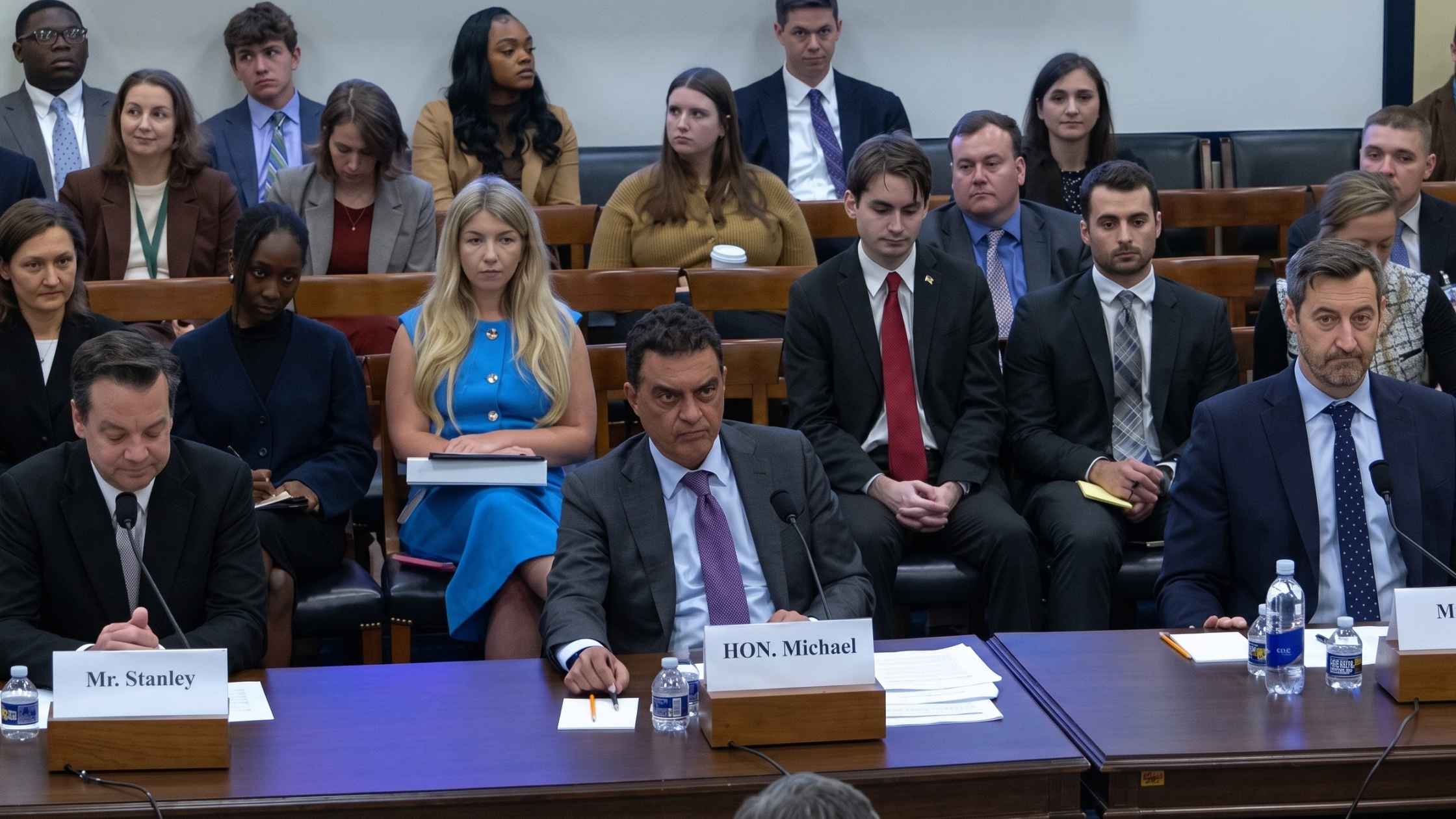
Welcome, everyone. We thank you all for being here. The subcommittee will come to order. I ask unanimous consent that the chair be authorized to declare a recess at any time, and without objection, so ordered. I also ask anonymous consent that non-committee subcommittee members be allowed to participate in today's hearing after all subcommittee members have had an opportunity to ask questions. Is there an objection? Without objection, non-subcommittee members will be recognized at the appropriate time for five minutes.
(00:45)
Okay. Good afternoon, and welcome to today's Cyber Information Technologies and Innovation Subcommittee hearing on science, technology, and innovation posture of the Department of Defense. Thank you to our witnesses for being here today. We're looking forward to hearing from you and getting smarter. We live in an era of unprecedented innovation in critical areas like quantum computing, artificial intelligence, autonomy, cyber and biotechnology. Given this progress, our nation's adversaries are working tirelessly to undermine American leadership and upset the world's security and stability.
(01:18)
Put simply, the battlefield is changing on a fundamental level, and our opponents are dead set on using this paradigm shift, and technology has an opportunity to degrade America's dominance.
(01:28)
One of the US's greatest competitive advantages is our ability to outthink and out-innovate our adversaries. At the Pentagon alone, there's an immense science and technology enterprise dedicated to advancing new ideas and technologies to arm our war fighters with necessary tools to win.
(01:44)
Equally as important as our in-house minds is our ability to coordinate and collaborate with the other brilliant professionals at our national or our nation's academic institutions, defense industrial base, and other US departments and agencies to ensure we are exploring every innovative path forward. Earlier this year, the department rolled out a massive reorganization into its research and engineering enterprise, focusing on streamlining decisions, concentrating technology investment areas, and providing clear demand signals to our industry.
(02:12)
Four months in, I look forward to hearing about how this transition is going and the main lines of effort moving forward. And we're joined today by three DOD leaders who are critical to the advancement of American Defense Innovation... Excuse me: the Honorable Emil Michael, the Under Secretary of Defense for Research and Engineering; Mr. Owen West, Director of the Defense Innovation Unit; and Mr. Cameron Stanley, Chief Data and Artificial Intelligence Officer.
(02:38)
Gentlemen, thank you for being here, and I look forward to your testimony. And with that, I yield to my friend and ranking member, Mr. Ro Khanna.
Ro Khanna (02:46):
Thank you, Mr. Chairman. Thank you for your leadership. I too want to welcome each of you here for your first public hearing before this committee.
(02:54)
I echo the chairman's comments about the rapid advance of innovation. Even having these conversations once a year seems inadequate to keeping up with the pace and breadth of technological change, and that's why your jobs are so important.
(03:09)
To that end, like the chairman, I'm interested to hear how the newly reconfigured research and engineering ecosystem is performing. Mr. Michael, you've also used the wide-ranging authorities granted as the department's chief technology officer at a greater skill than they've been leveraged before, and I hope to understand how that is going.
(03:27)
Mr. Stanley, under Mr. Michael's leadership, CDAO is responsible both for maturing existing enterprise programs and the numerous tasks by the DOD's AOI strategy. I look forward to hearing your approach to prioritizing and balancing these efforts.
(03:42)
And Mr. West, I know one of your focus areas is lowering barriers for commercial entry. That's a subject of great interest to many of us.
(03:50)
In the interest of time, I'll stop there. I look forward to our discussion this morning. Thank you, Mr. Chairman.
Don Bacon (03:55):
So, gentlemen, I yield to you for the order you want to go, and we'll yield each five minutes. Thank you.
Emil Michael (04:03):
Thank you, Chairman Bacon. And thank you Ranking Member Khanna and the distinguished members of the subcommittee. Thank you for the opportunity to testify today.
(04:12)
I'm honored to be here today alongside my esteemed colleagues, Owen West and Cameron Stanley. The three of us are here today representing a fundamental shift in how the war department approaches innovation.
(04:25)
We're moving from a fragmented, siloed innovation ecosystem to a single, unified model designed to transition technology from the lab to the war fighter. At Secretary Hegseth's direction, earlier this year, we officially realigned the innovation efforts, bringing DIU, CDAO, and the Strategic Capabilities Office under my purview as the department's chief technology officer.
(04:51)
My mandate as the department CTO is to ensure delivery of tangible, decisive, and battlefield-ready technology to our military, and to do it at a velocity and scale that our adversaries cannot hope to match. The urgency stems from the hard truth that if we don't maintain technological overmatch, American service members will pay the price in combat.
(05:12)
The reality is heightened by the strategic environment we face today. Our adversaries are investing heavily and moving with purpose to surpass us in key technology areas that will define the course of future conflicts. However, the United States possesses a strategic national asset that our adversaries can never replicate: a dynamic innovation ecosystem comprised of unmatched talent and unlimited creativity. This advantage is key to our deterrents, and it makes the outcome inevitable.
(05:43)
My office remains focused on harnessing the full potential of our innovation ecosystem to serve the American war fighter. After being confirmed last May, my first order of business was to restore strategic focus on the technologies that we need to maintain dominance on the battlefield.
(05:59)
I inherited a list of 14 CTAs, or Critical Technology Areas, which really didn't prioritize anything. There were a laundry list, they diluted our resources and slowed progress. Through rigorous, data-driven analysis, and in consultation with the military services and our experts in the intelligence community and made the decision to pair that list down to six.
(06:21)
The new list of six CTAs provides clarity to industry and to our innovators in our labs and across the war department, focusing their efforts and their funding vehicles. The war department's new critical technology areas are: applied artificial intelligence, biomanufacturing, contested logistics technologies, quantum and battlefield information dominance, scaled directed energy and scaled hypersonics.
(06:48)
The department is focused on its investments, its talent, and its leadership around these areas, while the private sector crowds its capital around to supercharge progress in these areas. And let me be clear: Other technology areas such as space and microelectronics remain important. R&E will continue to carry out our statutory mandate to provide rigorous oversight of all departmental R&D, but these six areas are the ones that will benefit most from attention, advocacy, and resources at my level.
(07:20)
For each of the CTAs, another thing we've changed is we've made tangible, focused sprints that we can measure our progress against them to accelerate the technology development cycles and we don't get stuck doing nothing. Each sprint has an accountable leader, and they're mandated to deliver with strict timelines and accountability.
(07:41)
An example of this is the rollout of genAI.mil, which is the war department's official, secure generative AI platform. We've unleashed Frontier AI to three million uniform personnel, contractors, and civilians. In just five months, the platform has attracted 1.4 million of the three million people we have in the department. They've generated over 69 million prompts; they've built 100,000 agents. Prior to that, we'd only had 80,000 users using AI in the whole department. But we're not limiting deployment to our unclassified systems alone.
(08:15)
In the last few weeks, we signed agreements with virtually all leading American frontier AI companies and AI infrastructure companies to deploy their capabilities onto our classified systems. We will continue to operate at a speed and scale that ensures AI is readily available to our war fighters.
(08:34)
Our efforts have not been limited to the CTAs and just AI. We've also bringing innovation to the production and acquisition of conventional weapons, enabling the return of mass effects through employment of large numbers of less exquisite weapon systems.
(08:50)
As you've seen yesterday, we announced the signing of five contracts with new entrants to build low-cost munitions for the first time in the department's history. These represent a new era where we can have mass-attributable, affordable weapons, and we're not doing it on a cost-plus basis; we're doing it on a fixed-price basis, with delivery dates that begin in 2027.
(09:16)
Lastly, on the structure, as both the chairman and ranking member have mentioned, it allows us to lay out a clear and rapid pathway for new and innovative ideas to make its way to work from working prototype to scaling the capability for the joint force. This is directly going after the infamous valley of death. You could start at the beginning with the reauthorization of SIBR SITRE, which, by the way, Andrew Castilian started at SITRE-SIBR program, so it's a good note that that program has produced results. Then we get to DIU for prototypes, app fit for scaling, and the Office of Strategic Capital to go big.
Don Bacon (09:55):
If you help wrap it up, I'm worried about votes coming up in a little bit, so what-
Emil Michael (09:57):
Okay. With that, I will pass it off to my partners.
Don Bacon (10:03):
Thank you very much.
Cameron Stanley (10:06):
Good afternoon, Chairman Bacon, Ranking Member Khanna, and distinguished members of the subcommittee. Thank you for the opportunity to discuss how the chief digital and AI office at the Department of War is arming our nation's most operationally demanding war fighting organizations, from tactical special operations formations to global combatant commands, with AI-enabled capabilities that redefine the modern battlefield and secure US military dominance for years to come. Since February, CDAO's flagship capability teams, Maven Smart System and War Data Platform have reimagined or have remained on call around the clock in support of Operation Epic Fury, enabling US forces to strike more than 13,000 targets in 38 days. What once took days now takes seconds. What enabled this shift? Historically, the department's approached to technology development siloed war fighters from technology delivery teams, producing a capability cycle where solutions were over budget, late to need, and not fit for purpose.
(11:02)
At the height of operations in Iraq and Afghanistan, a typical intelligence analyst was required to spend 16-hour days reviewing UAV footage for tiny anomalies that might signal major threats. The scale of unstructured data, combined with human exhaustion, made UAV image analysis one of the clearest operational pain points and a top priority for a solution that brought humans back into the loop in a framework that no longer was manageable with humans alone.
(11:29)
In response, in 2017, the Algorithmic Warfare Cross-Functional Team, also known as Project Maven, was established to apply data and machine learning to the problem. In theory, utilizing world-class computer vision models to detect objects of interest seemed straightforward. In practice, teams encountered fragmented frameworks, static slides, and an operating environment where the most effective linkage between systems was a person in a swivel chair.
(11:57)
These were not simply data and scale... Or scale problems. They were human, process, and information problems that even the most advanced AI systems could not solve. The Project Maven team realized that real progress requires more than better technology; it required better processes and better teams, achieved by embedding engineers with war fighters to build tools that enhance operational decision making and human judgment.
(12:21)
Over the past nine years, that approach has culminated into Operation Epic Fury's AI-enabled data-centric war fighting system in a real world conflict. But Operation Epic Fury is one operation. What does it look like to scale the Maven model across combatant commands and mission areas? The department's answer is its AI acceleration strategy released on January 12th. The strategy codifies seven years of operational experience and lessons into a clear, executable plan.
(12:48)
Today, I will focus on a few of those critical lessons. The first lesson, the department must leverage, not compete with, commercial innovation. In 2025 alone, Frontier AI Labs raised over $120 billion, and the industry capital expenditure on AI infrastructure exceeded 400 billion.
(13:05)
The department should not outspend our commercial partners. We should harness their technological and economic dynamism for national defense. This approach reshapes how the DOW contracts and recruits. For example, CDAO has reduced timelines for awarding contracts from years to as little as six days, bringing top engineering talent into mission workflows at speed and scale.
(13:26)
Critically... Sorry. Second lesson, the United States military is best equipped and trained fighting force in the world, not just because of what it builds, but because of its ability to field and sustain capability at the tactical edge under the most austere conditions. To meet their needs, CDAO embeds with war fighters to enable, iterate, and deliver operationally relevant capabilities. We work on their terms and their timelines so they can fight, win, and come home.
(13:55)
Next lesson, speed matters, especially in AI. Traditional development programs take years to produce results. Instead, CDAO is executing pacesetting projects, rapid, strategically scoped initiatives that address urgent adoption challenges using the Maven model of engineer war fighter teams. So far, CDAO has launched seven pace setting projects that are driving advances in human machine teaming, real-time operational learning and data integration in support of real-world mission.
(14:24)
Fourth lesson, today's battlefield requires modernizing the underlying software architecture. To that end, CDAO is transforming Advana into the War Data Platform and elevating it, along with the Maven Smart System, into department-wide programs. War Data Platform serves as a single source of truth for operational formations while the Maven Smart System will centralize its role within the department's CJADC2 initiative and accelerate AI-enabled applications across the force. In every formation, in every geography, on every mission, the American war fighter operates on CDAO technology. The last lesson, the department must win the AI infrastructure arms race. China has invested upwards of $300 billion in energy and compute infrastructure to develop sovereign AI. Moreover, in the early days of Operation Epic Fury, the world witnessed deliberate strikes from Iranian drones and missiles targeting commercial data centers in the UAE and Bahrain. They will not win this arms race.
(15:21)
As we speak, the department is aligning with its partners in the Department of Energy, intelligence community and interagency to build the AI arsenal. A modular ecosystem with a three-tiered strategy to ensure compute power outmasters our joint capacity needs. It will always be-
Don Bacon (15:36):
[inaudible 00:15:38].
Cameron Stanley (15:38):
Yes, Mr. Chairman. Mr. Chairman, members of the subcommittee, the modern battlefield is evolving at a pace unmatched in recent history. In an era of heightened geopolitical competition, our ability to achieve decision advantage is essential to maintaining the world's preeminent military. CDAO is preserving that advantage by harnessing the best technology available and delivering it to our war fighters. Thank you.
Don Bacon (15:58):
Thank you.
Owen West (16:01):
Chairman Bacon, Ranking Member Khanna and members of the subcommittee, I appreciate the opportunity to speak with you about how DIU is accelerating the conversion of commercially-derived technology into combat power.
(16:13)
For 30 years, the Pentagon has favored expensive quality over quantity. The battlefield evidence is clear: While we are winning every engagement, we are losing on the cost exchange too often.
(16:25)
Our adversaries have scaled production and reduced costs, forcing us to diversify our portfolio. We require both pricey high technology and low-cost lethal mass. President Trump, Secretary Hegseth, and Congress have directed an urgent rearmament, and Secretary Hegseth has tasked the Defense Innovation Unit with harnessing commercial companies to deliver accelerated combat power.
(16:50)
Our determination is to dramatically lower our cost per kill while reducing risk to force. The good news is that America's unrivaled entrepreneurs and private capital markets have foreseen this rebalance. In recent years, over $200 billion of private capital has flowed into non-traditional and commercial technology companies.
(17:11)
As the principal liaison to these commercial and non-traditional companies, DIU is bridging the gap from rapid prototyping to scaled, successful transitions that solve operational problems identified by the joint force.
(17:24)
We will be the fastest contracting and fielding agent in the department. We pioneered the competitive commercial solutions opening and other transaction authority to bring high-tech from solicitation to initial fielding in months, not years.
(17:39)
As part of an innovation ecosystem, coordinated by the chief technology officer to my right, we are tightening our linkages with the military services to deliver lethality they can scale. We're further knocking down transition barriers. These include classified infrastructure, authority to operate, testing and evaluation that delay technology delivery.
(18:02)
Our basic investment philosophy is to focus at the intersection of speed, scale and lethality to ensure the best return for the department and the American taxpayer. We thank you for your leadership from enacting long-needed acquisition reforms in the fiscal year 2026 NDAA to the reconciliation funding in the One Big Beautiful Bill.
(18:24)
With your support, DIU will leverage the full power of America's markets and entrepreneurs to deliver combat power. Thank you.
Don Bacon (18:34):
Thanks to all three of you. You have a very important mission area. We appreciate your leadership. Listening to Mr. Stanley's statement triggered a question to me, so I'd like to ask all three of you. If you could look at what you're doing at your accomplishments, please tell us, but also all the folks listening, what is an area or two that you've had a direct impact on the combat capabilities of our war fighters?
(18:57)
And Mr. Stanley, you touched on this a little bit, so we'll start off with you to give you guys a chance to think about it.
Cameron Stanley (19:02):
Thank you, Mr. Chairman.
Don Bacon (19:00):
... chance to think about it.
Cameron Stanley (19:02):
Thank you, Mr. Chairman. The best example of that in CDIO is the deployment of Maven Smart System at scale across the entire global enterprise. So at every single combatant command in most services as well as down to some tactical formations, we're actually using an AI enabled command and control capability called Maven Smart System. It's a software as a service deliverable, but this capability allows for the integration of multiple different AI tools to accelerate workflows for operational decision making to greatly reduce the amount of time it takes for operators to make better decisions faster on the battlefield. This tool has been widely used by just about every single formation that's been engaged in operations across the globe and is continuing to develop and build and get better over time. It's the first time in my career where an actual system of record has been used not only in current operations, but it's also evolving in real time with the expertise of our war fighters being inserted into that capability.
Don Bacon (20:06):
Thank you. Mr. Michael.
Emil Michael (20:08):
Thank you, Mr. Chairman. I'd say that the two things I'm most proud of were really for the first time we created a pathway for new companies to deliver munitions and we did that by having our cross-functional team evaluate the management team, the technology and their manufacturing capabilities. And we did that with all the military services and the other components and we were able to pull them through the process in months, not years. And that means we get combat power in one year, not five years. The second thing I think I'm most proud of is the innovation ecosystem, which was fractured.
(20:44)
Putting it together allows us to reduce duplication because this man on my right and this other man on my right, we could look at each other every day and make sure that we're not spending the taxpayers' money in double or triple format. And that's also allowed the office of strategic capital and some of the other parts of the innovation ecosystem to do things fast, like critical minerals deals, rebuilding the defense industrial base. It's because we have a full view as to all the technology investments that we can make in the department.
Don Bacon (21:10):
Thank you. Mr. West.
Owen West (21:12):
Chairman, I'd first like to acknowledge my predecessors. For decades, the department treated two exquisite pockets of American exceptionalism, the American war fighter and the American entrepreneur as distinct and separate. So DIU exists to bridge that gap and by and large when I took the seat seven weeks ago, my predecessors had done that. Now in terms of what to be proud of, the unit has many of these young companies, Emil mentioned a couple of them. I won't mention them by name. They touched DIU first in many cases. So some of the things you're seeing fielded these new entrants first touched DIU. Finally, to be specific what Secretary Hegseth has ordered, it is a pivot to unmanned systems and DIU along with TRMC and other elements of the office of the Secretary of War are running a program called Drone Dominance with a new template. It's an advanced purchase commitment which brings commerciality to the department that the secretary outlined during his acquisition strategy. Thank you.
Don Bacon (22:19):
Thank you. It's ultimately about combat capability and what you're delivering, so I appreciate that feedback. Mr. Michael, I understand there was a reorganization. You were talking about it by direction of the Secretary of Defense or Secretary of War. We understand there's a significant cut to your programs and the FY '27 budget. Can you talk about that and maybe impacts to your portfolio?
Emil Michael (22:41):
I believe we asked for significant increase, Mr. Chairman, across almost all items, particularly what you'll see in next year's budget as new big items is something we call AI arsenal, which is building the infrastructure required to do many, many, more tasks by AI. We've also asked for increases for the mission engineering integration activity, which is changing the requirements process. We're not gold plating requirements. We're giving vendors a common operational problem that we're trying to solve and the S&T lines have been largely flat and consistent with sort of the department's budgets.
Don Bacon (23:18):
I think to be more specific, the military service science and technology programs, can you talk about the impacts there?
Emil Michael (23:27):
I just got directive authority in '26 NDAA to begin looking at the military services budgets so I haven't been able to impact those for the '27 submission, but we are right now going through, I hate to call it an audit, but a review of all the technology spending by the services to make sure that we're spending enough in the right places and not duplicating where we don't have to.
Don Bacon (23:50):
I appreciate your feedback when you get a chance to analyze the cuts and what the impacts are. And with that, I... [inaudible 00:23:58].
Ro Khanna (23:58):
Thank you, Mr. Chairman. Mr. Michael, I'm assuming you must be aware of reporting last month at The Guardian highlighting certain aspects of your disclosure to the Office of Government Ethics. The article highlights that your initial disclosure in March of last year of a significant amount of stock in Elon Musk's xAI, the company behind Grok, your subsequent sales of those holdings earlier this year yielded you about what percent gain?
Emil Michael (24:29):
About 5X.
Ro Khanna (24:30):
So about 400% to 4,800%?
Emil Michael (24:35):
500%.
Ro Khanna (24:35):
500%. In between, you were serving as the Senate confirmed Under Secretary for Research and Engineering and Chief Technology Officer. Under your purview was a $200 million contract with xAI to embed their Grok models on the department's AI systems. I just want you to be transparent. Did you have any decision making role in that xAI contract?
Emil Michael (25:04):
No, that contract was signed by the previous CDAO and that was done before that office was affiliated with R&E.
Ro Khanna (25:12):
So you recused your matters for-
Emil Michael (25:16):
I didn't have to recuse. It was in a totally different office.
Ro Khanna (25:18):
Did you recuse yourself from any matters related to xAI?
Emil Michael (25:22):
Once the CDAO office, which does the contracts with AI companies, came under my purview in the fall after those contracts were signed in the summer, I recused.
Ro Khanna (25:33):
Is there any decision making or input you've had on xAI while you've been in the role of undersecretary?
Emil Michael (25:40):
Not until I sold my holdings.
Ro Khanna (25:44):
So while you had your holdings, you had absolutely no role on any decision making with xAI?
Emil Michael (25:49):
I did not.
Ro Khanna (25:51):
And do you believe then that you addressed any conflicts of interest and were avoided?
Emil Michael (25:57):
I do.
Ro Khanna (25:59):
So just to get fully your testimony, you never had any conversation with xAI, you never had any input on any decision making with xAI and you had zero interaction with them while you were undersecretary before you sold your stock?
Emil Michael (26:21):
Yeah. I recused myself completely from all matters regarding xAI while I held that stock.
Ro Khanna (26:26):
While you held that stock?
Emil Michael (26:27):
Yeah. While I held that stock, I recused myself from all matters regarding xAI.
Ro Khanna (26:32):
Why not just make the recusal public then?
Emil Michael (26:36):
I'm not sure I understand, sir.
Ro Khanna (26:37):
Have you made it public that you had recused yourself?
Emil Michael (26:41):
Well, because my initial ethics submission when I took the role didn't have the chief digital AI office as part of the office, it wasn't my original recusal, but I contacted our government ethics office inside the department as soon as I got the office and recused myself.
Ro Khanna (27:03):
But the bottom line is when you had the stock before you sold it, you had zero contact on any policy matter with xAI?
Emil Michael (27:13):
Correct.
Ro Khanna (27:14):
Okay. I'm satisfied.
Don Bacon (27:18):
Appreciate the direct answers. With that, Mr. Finstad.
Brad Finstad (27:23):
I'm going to take a different route here. So thank you, Chairman Bacon and Ranking Member Khanna for having this hearing today and thank you for the witnesses for being here. I want to talk a little bit about the DIU's on ramp hubs and we are honored in Minnesota to have one of the newest hubs and I had the opportunity to attend the ribbon cutting for that back in December and I've already seen some positive impacts and heard some great things about what that is doing to help the Minnesota defense ecosystem. So with that being said, Mr. West, I frequently hear from small businesses with innovative ideas that are eager to partner with the Department of War across Minnesota. However, I often hear of concerns about the so-called valley of death. I think Mr. Michaels, you addressed that a little bit earlier. Sounds scary. I don't know exactly what it is, but I think we all should just instinctively avoid the valley of death whenever possible.
(28:20)
So when these small businesses are struggling to bring their concepts out of the R&D phase and into the hands of our war fighters, that's what I'm hearing. So how is DIU planning to utilize the OnRamp hubs to bridge this valley of death by ensuring that these capabilities can be deployed across the department rather than stalling under initial demonstration phases?
Owen West (28:41):
Thank you, Congressman. One of our statutory obligations is connectivity and we frankly have to do a better job downstream of connecting with the military services to ensure that our prototypes and the young companies that you mentioned have a home and some budget behind them. And so in many ways we're a service organization responding to that demand signal, but we have to be upstream as well and so well beyond Silicon Valley, the OnRamp hubs, we have to look across the nation at all the great entrepreneurs, many of them veterans in these small communities that do have the ideas, the engineering skill, the entrepreneurship to be harnessed and converted into combat power. Your specific hub, I mean, I think, was opened in December. We've already seen 16 additional responses to our commercial solution openings, which are competitions that we run periodically. We've run about 20 so far this year.
(29:42)
And candidly, to leave this off, DIU has the obligation to run these competitions as objectively as possible with clarity and then sometimes to get to know early if something doesn't fit a military service, but we're certainly doing a disservice to these companies if we don't communicate well and create what you described as the valley of death.
Brad Finstad (30:09):
Thank you for that. And I would invite you to Minnesota to come see the hub and to see these young startup companies, in some case, seasoned mom and pop shops. I represent a district that has an amazing amount of welders, tinkerers, inventors, thinkers, companies that are starting to really tap into this ecosystem and I think it'd be great to have you get your feet on the ground there, eyes on the ground. Mr. Stanley, a question for you. We in this subcommittee had a hearing not so long ago about really the inventory and logistics and some of the archaic legacy software systems that are being used. And it just struck me when I hear the Department of War using Excel spreadsheets and other tools to track inventory. How are we really putting our war fighter in a top priority space? When we have commercial technology, big retailers, they know where every toothbrush in their system is at every given moment, but we're asking our men and women to go to an Excel spreadsheet to figure out where inventory is.
(31:20)
So can you give me a little idea of how are we coming on that front and what is your office doing to help really look at the commercial side and how do we bring that in?
Cameron Stanley (31:29):
Yes, Congressman. So we're actually working quite closely with many aspects of this problem. Underlying all of the technology questions, it's really a fundamental data problem. How is the data stored? How is it collected? How is it managed? How is it curated, and how is it structured so that you can bring some of those best of breed commercial tools into the department? The CDO actually reports to me as the CDAO of the department, our chief data officer, it's our duty, it's our responsibility to actually enforce these standards. We have several data decrees that we have issued within the department to get our data story right. Once you have the data story right, then you can start bringing in the tools. We are also working very closely with members of the defense industrial base to try and improve the data structure and the data story visualization, especially for exquisite munitions to try and accelerate not only their development and their deployment, increase the capacity of our ability to actually produce those munitions but also be able to track those more effectively, especially for a protracted conflict.
Brad Finstad (32:32):
Thank you. Thank you, Mr. Chair.
Don Bacon (32:33):
Mr. Ryan, you're recognized.
Pat Ryan (32:36):
Thank you, Mr. Chair. Thank you all for being here. Director West, appreciate your comments specifically about the legacy of DIU and the leaders before you. I think it's one of the things that is one of the greatest success stories bipartisan, everybody working together and I appreciate you saying that and the rapid progress you've made already in your time in the office. No knock on my friend from Minnesota, but in my great state of New York we also have a great, I think underappreciated actually, defense technology thriving ecosystem. I know many of you have spent time there recently and in the past between capital, startups, a lot of veterans and military folks, the fact that we don't yet have at least a permanent defense tech presence or DIU presence in New York, I think, is an opportunity and appreciate the conversations we've had and the work already in that direction.
(33:37)
I also want to highlight my alma mater of West Point in our great state that has made a huge investment at the academy in building out an innovation ecosystem that draws on both the cadets there but also the exceptional faculty, the labs and research space that they have. And they're actually standing up an off campus, commercial, public, private innovation works going forward that brings together partnerships with Detachment 201, JIATF-401, Army Futures, the PAEs, 200 plus industry partnerships, gift space. I just wanted to ask your thoughts on that. I know you're drinking from the fire hose as you come on, Director West, but any thoughts there and any way we can partner to support that, I think, would be for the greater good of the nation.
Owen West (34:25):
Thanks, Congressman. I worked for 20 years in New York City and was part of the founding group of veterans on Wall Street. There's always been an entrepreneurial spirit. I'd say the thing that has changed is capital allocation as you pointed out. Defense tech is white-hot now, but we don't have to go back only a decade ago, you had kind of people protesting affiliation with the Department of Defense and capital allocators were uninterested. So New York, we have the requirement to establish criteria to judge where the next OnRamp hub will occur. New York, I think, objectively meets many of these criteria. You mentioned West Point. I don't know what configuration this may take once we run it through our evaluation system. I do know that West Point is also beyond... The West Point works you mentioned, I believe they're starting a drone range. So that the Hudson speaks for itself as does the city.
Pat Ryan (35:30):
I appreciate that and if you want to say on the record that it'll be the next hub, we'd be excited to hear that here today, all joking aside, I know it has-
Owen West (35:39):
A little hard of hearing after [inaudible 00:35:41].
Pat Ryan (35:43):
Again, appreciate the partnership and go Army, beat Navy on the record. Shifting to another topic, commend you Undersecretary Michael, your comments, specifically seeing the launch of the low cost munition initiatives yesterday, I believe, or today, whenever that was exactly the right direction and it builds on the Drone Dominance program that I know several of you have worked on and just getting that high low mix correct. Anything that we can be continuing to do on that front as a subcommittee and the whole of the committee, I know that's a shared bipartisan priority. I would love to talk more in depth about that, but I want to ask a specific sort of subcomponent to that. Building on what we've seen in Ukraine and other combat zones across the world, specifically looking at comms networks and the opportunity for commercial cellular networks being used for beyond line of sight C2 around drone swarms.
(36:48)
I know DIU is moving towards gauntlet two and three. Director Stanley, you guys are looking at Swarm Forge. Are you looking at integrating commercial and private 5G options within that given kind of the complexities and challenges in the modern battlefield?
Cameron Stanley (37:06):
Yes, Congressman, thank you for the question. I'm very much an egalitarian when it comes to comms, yes, as much as we possibly can. Commercial comms in 5G line of sight, laser comms, smoke signals, I don't care. We're going to need the bandwidth on the battlefield regardless. And if there's a technology out there that enhances our ability to actually operate, especially in an EM contested environment, we're going to leverage that.
Pat Ryan (37:32):
Anything you want to add with the... I guess we're out of time. All right. Thank you, gentlemen. Yield back, Mr. Chair.
Don Bacon (37:44):
Thank you. Based on who is here, we...
Jeff Crank (37:44):
Thank you, Mr. Chairman. Director West, in the FY '25 NDAA, Congress established the shared commercial classified infrastructure pilot program and we're now seeing amazing and extraordinary demand for shared commercial SCIFs across the country, including in Colorado.
Jeff Crank (38:00):
SCIFs across the country, including in Colorado where qualified companies and research institutions are ready to support national security, but they lack access to accredited facilities and classified networks.
(38:15)
Under your leadership, I think this program appears to be gaining real momentum with potential sites being actively evaluated, prioritized and resourced, including in my district of Colorado Springs.
(38:28)
Can you walk us through how the Department is identifying and selecting these locations, what steps you're taking to establish centralized DoD sponsorship, accelerate classified network provisioning and cut through the traditional accreditation and reciprocity bottlenecks to deliver these capabilities at speed and at scale?
Owen West (38:52):
Yes, Congressman. I mean, we've identified that producing a prototype is insufficient to hand that over to a military service, which has its own bureaucracy.
(39:04)
And so as you point out, what you're going to see with DIU, and again, this started before me, but it is being accelerated and drastically accelerated, you're going to see a bundled service that includes SCIF access, authority to operate, essentially, can you bring software onto DoD networks, and probably some access to boutique ranges or other places where we can test. In other words, we're trying to speed up the whole system in terms of the valuation of where these SCIFs or secure compartmentalized facilities should be.
(39:41)
The first thing we ask is this in a SCIF desert? In other words, is there a nearby or proximate SCIF? Then we look at capitalization, the number of companies, the number of dual-use companies. Essentially, usage or demand, and we see a lot of demand.
(39:57)
And so the list keeps growing, but I think you're going to see this happen fairly quickly. As you said, there's wide department interest for many things like this under Secretary Hegseth who has directed us to just cut through a lot of the bureaucracy, organize quickly. So this includes DIA, DCSA, ANS. There is large cooperation and I think the underpinning is speed.
Jeff Crank (40:23):
Yeah. This is such a barrier, particularly to smaller companies to even entry into the market. So anything we could do. And I appreciate your leadership on that.
(40:34)
Secretary Michael, last year, DARPA terminated the DRACO program, our primary effort to field nuclear thermal propulsion. NTP would be a game changing technology to give the United States a leg up in the rapidly changing battlefield of on-orbit warfare.
(40:53)
At the same time, the Space Force and Space Command continue to tell Congress that they need more tools to support dynamic space operations, including in-space mobility. And General Saltzman's demand signals are pretty clear, the Joint Force needs the ability to maneuver satellites without the massive fuel penalties inherent to a chemical propulsion.
(41:15)
At the same time, the CCP is aggressively pursuing its plan to field an NTP spacecraft in the next decade. We can't effectively contest the cislunar domain if our assets remain sitting ducks in fixed orbits.
(41:31)
Understanding all of this, how does OSW R&E plan to continue supporting research into NTP and other technologies that support high delta-V maneuverability?
Emil Michael (41:44):
It's a good technical question for me, but the DARPA program, DRACO, served its purpose in terms of delivering learnings. It's a very hard technical problem. The president's issued an executive order compelling the whole government to figure out nuclear propulsion in space, and the lead for that is NASA. So we're transferring the learnings from DARPA to NASA and then going to be working with NASA at the Department of War for nuclear propulsion in space, given the importance in the cislunar atmosphere.
Jeff Crank (42:20):
Okay. I have several other questions, but I would go over my time if I did that. So I'm going to go ahead and yield back, Mr. Chairman. Thank you.
Mr. Chairman (42:29):
Thank you there, Mr. Crank. Based on the order of arrival, Mr. Vindman, you're now recognized.
Mr. Vindman (42:34):
Thank you, Chairman. So since we're all pitching on-ramp hubs, let me just pitch Northern Virginia, which has got hubs of military installations, including Quantico, Dahlgren, big R&D bases, great educational institutions. So certainly give Northern Virginia a look.
(42:54)
Now, during my 25-year career in the Army, I've had sort of a through line. I was a Land Warrior platoon leader, the first in the 82nd back in the late '90s. And then worked on the National Security Council as the legal advisor to emerging technologies. And then one of my last jobs was at DEVCOM Army Research and Development, basically 75% of army's R&D. So I think that cutting edge technology and systems for service members, the warfighters are absolutely critical.
(43:28)
So let me start by thanking you for your service to the nation, Director West, your leadership in uniform, and particularly your tours in Iraq.
(43:37)
I'm glad to hear that we're aligned on the goals to ensure our armed forces have drones that they need to win the next fight, or better yet, deter it.
(43:45)
Last month, General Petraeus published an article in Foreign Affairs titled The Autonomous Battlefield. Not sure if you had an opportunity to review it, but ask unanimous consent to enter that article into the record.
Mr. Chairman (44:00):
Without objection.
Mr. Vindman (44:00):
Thank you.
(44:02)
So I'll read a quote. "No Joint doctrine for autonomous formations yet exists. No major command has been tasked to develop one. No new unmanned systems force has been established. In essence, the US military is buying more drones without adequately considering how coordinated autonomous forces should be structured, coordinated, commanded and controlled." I'd include unmanned systems in general.
(44:26)
General Petraeus goes on to advocate for urgent development of Joint doctrine to ensure we are prepared to both train and use the systems.
(44:34)
Do you agree with General Petraeus on the need for Joint doctrine?
Owen West (44:39):
Congressman, I do. And I believe this is underway.
Mr. Vindman (44:44):
Can you comment a little bit more about that?
Owen West (44:48):
Congressman, I did read General Petraeus' article. And many of his basic points, the Department of War is enacting and really have been for several months now, but in terms of the new budget requests where 54-odd billion dollars has been requested for autonomous systems, baked into those lines are doctrinal and schoolhouse monies to do exactly what you're indicating.
Mr. Vindman (45:17):
I look forward to seeing the doctrine on that because obviously, I think, in the United States, autonomous systems, unmanned systems are very nascent. And a lot of that development has been going on in Ukraine for several years and they're much further advanced.
(45:35)
So modern battlefields, especially in conflicts such as Ukraine, have demonstrated the vulnerability of traditional radio frequency control drones, to jamming and electronic warfare. From BIU's perspective, how significant is this challenge for US forces?
Owen West (45:51):
Congressman, when we launched Drone Dominance, the first thing we did was ask for military experts. As suits, we're trying to tamp down the bureaucracy and move as fast as we can with a commercial buying program.
(46:03)
And what those military experts said is, "I think where you're going. And I know you're very deep on this subject."
(46:10)
But the three basic conclusions that they've drawn from the Ukrainians specifically, it's first, the fusion of the commercial world with the battlefield and the frontline units. Second is the drastic reduction of cost per kill. And third is speed.
(46:29)
And the fact that this is an iterative when I talk about speed, these iterations determine who the victor is month to month and sometimes week to week.
(46:38)
And so what you're implying is that there's an offensive and a defensive component that are intertwined and EW is an inherent component on both sides.
Mr. Vindman (46:48):
So one solution is the use of fiber optic-guided drones, which you're well aware, is resistant to electronic warfare and capable of operating GPS and RF-denied environments.
(46:58)
How do you assess the operational and tactical value of such systems for US forces?
Owen West (47:04):
I think a diversity of systems is required, but as you say ... Well, let me give a very specific example. We recently held our first gauntlet, which is a competition over 300 sorties, five Ukrainian drone companies participated. And the Victor used fiber optics. American companies are now on the move and we know of several that are going to integrate this in the next gauntlet.
Mr. Vindman (47:30):
Great. Well, I hope that DIU can play a significant role in prototype, in validating and accelerating these technologies. And thank you.
(47:38)
With that, I yield back.
Mr. Chairman (47:40):
Mr. McGuire, you're recognized for five minutes.
Mr. McGuire (47:42):
Thank you, Mr. Chairman. Thank you to our witnesses for being here today. I've got to respond to my colleague and say, "Go Navy, beat Army," but I love them all, of course.
(47:50)
What you guys do is very important. There are many ways to serve. I served in the SEAL teams. And it's amazing how much technology that the new SEALs are getting every day as we constantly update.
(48:01)
Software seems to have been something that was probably at the bottom of the top 20 priorities and now software is closer to the top because things change, as you can see in Ukraine on a day-to-day, sometimes hourly basis, trying to keep up.
(48:15)
And Mr. West, I agree with your comment. The fiber optic is a great idea, but also you need to look at all the options.
(48:23)
So Secretary Michael, your office has consolidated the list of critical technologies from 14 to six. How will this streamline development and capabilities in these new technology areas? And how will this affect your work on technology areas that aren't on the list anymore?
Emil Michael (48:41):
Yes, Congressman, basically, the idea or the thesis around how we thought about critical technology areas, which are a mandate from Congress, you ask us to tell you what we think the critical technology areas are, are those things that are not being focused enough on by the Department.
(48:59)
Where there is focus, even though it's still critical, it's not on the list. For example, space. Space is of critical domain for us, but we have a Space Force, a Space Command, it's a well funded set of ... in our budget request, so it remains critical, but not on the list.
(49:16)
The things that we aren't investing enough in are the things I added to the list. So it doesn't mean that those things that fell off are not important, it just means that we have momentum in the Department for those items.
Mr. McGuire (49:28):
Thank you.
(49:28)
Director West, in last year's Work and Families Tax Cut Act, we provided over a billion dollars to supercharge the small UAS industrial base. How often do you get to talk to the actual operators on the front lines who will use these technologies?
Owen West (49:44):
Congressman, we've integrated some of the best operators in the military services into the competition. So the operators are designing these competitions. And then they judge them by flying them off, often with just two hours of preparation for a new system, to determine if that system can be scaled for average drivers like myself.
Mr. McGuire (50:06):
And I know we're working hard on the Drone Dominance program. Working with these operators on the ground is probably helping you get fast feedback to make better, quicker decisions.
(50:16)
Mr. Stanley and Mr. Michael, yes or no, is there one large language model that does everything every user needs?
Cameron Stanley (50:24):
No.
Mr. McGuire (50:26):
Okay. Yes or no, is it important to be able to use large language models across all classification levels?
Cameron Stanley (50:33):
Emphatically, yes.
Mr. McGuire (50:34):
Yes. And what is the Department working on to allow access to multiple large language models across classification levels from one interface?
Cameron Stanley (50:44):
I'll go ahead and take that.
(50:46)
So when it comes to large language models, the integration of those models into a number of different domains, all classification domains, that work's ongoing.
(50:54)
We have GenAI.mil that began in the CUI classification that really was our first foray into the deployment of a large language model for the entire enterprise.
(51:06)
We are trying to replicate that success on our secret and top-secret domains. That work requires more bespoke engineering as you would expect for the deployment of those very specific models and capabilities at those different classification levels. That work is ongoing.
(51:22)
We are leveraging all of our lessons learned from our CUI deployment for both secret and top secret. We're looking for similar capabilities that we have in CUI on secret and top secret, but most importantly, we're trying to leverage a wide variety of models across all of those domains so that we can have the best technology for answering the best questions for the right purposes in realtime.
Mr. McGuire (51:49):
I was in the Pentagon last week and I saw posters with the Secretary of War encouraging the Department of War to use AI. Do you think there's a hesitancy for folks in your career field to use AI?
Cameron Stanley (52:01):
In my career field, no, sir. There's no hesitancy. In fact, in my office, I stated if we're going to profess that we are an AI-first department, which we are, everything in CDAO is going to be identified and use AI at speed and at scale. We are going to do or practice what we preach every single day.
Mr. McGuire (52:19):
How can we in Congress help you to cut the bureaucracy and the red tape so that we can speed things up because things move so fast with software upgrades and everything else? What can we do further?
Cameron Stanley (52:33):
Congressman, I think that's probably better taken in a different setting. I don't think I can answer that question in five seconds.
Mr. McGuire (52:40):
We really appreciate your service, guys. Thank you so much.
(52:43)
I yield back.
Mr. Chairman (52:46):
Thank you. We're all catching on here.
(52:48)
Ms. Houlahan.
Ms. Houlahan (52:49):
Thank you, Mr. Chair. Thank you for the chance to have questions for you all.
(52:54)
I'll start by my plug, which is for education, full stop. I would love it if I could ask of you all ... Some of the ways that we can accelerate and talk about only AI and figure out what technologies a SEAL needs is to educate people and to give them a fine, quality education.
(53:11)
And it seems as though you all, I believe, come from Harvard and from Stanford and from the academies. And the fact that we are in an environment right now where those are being maligned and abused, I think is atrocious. So I would ask of you all that you defend the power of our education system. I come from Philly. We have a lot of universities and a lot of research there and that will be my ask of you for now.
(53:37)
Also, my questions have to do with biotechnology. I spent a lot of time in that space. I worked a lot of time on the NDAA, the last NDAA, putting in some of the Commission's recommendations therein. And Mr. Michael, my questions will be to you about that. And I'm not sure to the degree that you've been able to come up to speed on that.
(53:57)
But in the NDAA, we established the Biotechnology Management Office, which is hopefully going to organize and advance and elevate biotech across the agency, across your agency. Was wondering if you might be able to provide an update on that.
Emil Michael (54:11):
Yeah. We're very excited that you put that in legislation. We've appointed a leader, a gentleman named Gary Vora.
(54:19)
We've actually written a charter and we've submitted to the congressional staff to get feedback from Congress as to, is it hitting the right notes relative to legislation?
(54:29)
And it's sitting at the Deputy Secretary's office, so it's got the right level of importance and elevation in the Department.
(54:36)
And it's synchronizing with my biotechnology, critical technology area. So it's really going to bolster our efforts.
(54:43)
And thank you for doing that.
Ms. Houlahan (54:44):
That's awesome. I'm really glad to hear that. And look forward to possible opportunity to meet with him.
(54:51)
How do you think the Department then will be able to ensure, as the law did intend, that the Biotechnology Management Office will be fully funded and staffed and empowered?
(54:59)
Is there anything else that you think that you might need to make sure that we are keeping pace at a minimum and maybe even better than that with China?
Emil Michael (55:09):
I think what I'd like to do, what I generally like to do is give the leaders a little bit of 30 days to get in the seat and then take the charter feedback from Congress, combine that with the leadership mandate and then come back to you with some questions or suggestions if we need to bolster it in any specific way.
Ms. Houlahan (55:29):
Terrific. Thank you.
(55:31)
Also related to the NDAA and biotech, Section 247 asked the Secretary of Defense or War to create guidelines on the ethical and responsible development and deployment of biotechnology within DoD or DoW to better support critical innovations while letting the United States do what it does best, which is leading by example through strength and norms.
(55:52)
Do you know what the status of these guidelines are or that ... And who is leading that effort? Is it the same Gary Vana?
Emil Michael (55:59):
Gary Vora. I'm not sure. I'll have to get back to you on that, but I think one of the reasons we call it Biomanufacturing, part of the critical technology areas and why I think it's going to synchronize well with the office that you created, is that we're going to be able to really move faster relative to China. They've invested a lot in this space and we have to do it in a way that's consistent with our values and principles. And I think that's going to have to come out of this joint effort at the Department. And we'll get back to you on that.
Ms. Houlahan (56:30):
Terrific.
(56:31)
And kind of related to the conversation on biotech and biomanufacturing and also my plea to you about academia, how are you guys, at this point, engaging with academia and with industry and with local communities, frankly, as well, to make sure that we're incorporating their perspectives as well into the NDAA guidelines that are required?
Emil Michael (56:54):
I mean, we know R&E has probably the most extensive university partnerships of any component of Department of War. I meet with the university presidents almost-
Emil Michael (57:00):
... where I meet with the university presidents almost every couple of weeks. We have strong partnerships with John Hopkins, with Stanford, with a lot of DOW research dollars go into these programs.
(57:16)
Also something that maybe Director West can address is we are really in need of cyber talent coming out of these universities. So we're very focused on growing next generation of talent that wants to be technologists both for the government and outside the government. We're a big part of the tech force if you've heard of that, which is recruiting university students to work in all different parts of the government to bring their tech skills to us and then they go back to the private sector.
Ms. Houlahan (57:46):
I'd love to have a longer conversation. I've run out of time on that and on cyber education and cyber academies and cyber everything. And I yield back. I appreciate that.
Don Bacon (57:57):
Just had to reshuffle the order here real fast. Mr. McCormick, you are now recognized.
Mr. McCormick (58:02):
Thank you, Mr. Chair. Great to have you all here on such a great occasion and especially with such an important topic. I think I spend about 80% of my time on this topic, I think between cyber and the future of what's going to make us hum versus what's going to get in the way of progress. This is one of the more important topics. Especially from where I come from, Georgia Tech is one of the leading universities in America and technologies. Mr. Mitchell or sorry, Mr. Michael. Sorry. I'm excited about this year's budget request, but I hope that we keep in mind the award-winning technology of the future comes from basic research done at place like Georgia Tech, which I just mentioned, which has enjoyed decades long research relationship with the department across all levels. How will the department ensure the basic research programs remain a priority so that we aren't caught with inferior technology in the future conflict?
Emil Michael (59:02):
You'll see from the Office of Secretary of War side, consistent promotion of the continued growth of basic research dollars going to universities. We're expanding our partnerships very consistently across the landscape, not just at the Ivy Leagues, but at state universities and technical universities. I think with the new authority that Congress was kind enough to grant me to direct some of the other military departments to ensure that their budgets are appropriately financed at that level as well, that we'll be able to do that in the coming years even better.
Mr. McCormick (59:39):
I like that premise. However, I was curious, what is the reasoning behind decisions like eliminating the Navy's University Research Initiative?
Emil Michael (59:47):
I'm not familiar with that, sir. It was a Navy program?
Mr. McCormick (59:50):
Yes. I'll get back to you on that. Obviously we have University of North Georgia just won a competition on cybersecurity. That's another good university in my area. I tell you what, I'll switch over to Mr. West. How has the realignment of your organization under research and engineering impacted your authority's people, mission, and ability to collaborate across the service and defense innovation enterprise?
Owen West (01:00:13):
Thanks, Congressman. I think the summary word is alignment. Emil as the CTO is the architect who sets the innovation strategy, including for the military services. Now as a field activity, I feel that this DIU has more durable authorities and we still have operational independence. So Emil sets the framework. We have strategy meetings as do the military services once a quarter. And within this framework, we haven't lost any speed.
Mr. McCormick (01:00:48):
Okay. Mr. Stanley, I'm going to pose the same question to you as far as the organization of the research and engineering impacted your authorities, people, mission, and ability to collaborate across service and defense innovation enterprise. In other words, is it getting the way or is it enhancing?
Cameron Stanley (01:01:04):
It's definitely enhancing, Representative. So when I look at where we were before CDAO was aligned underneath research and engineering, that was before my time as the CDAO, but I have experience inside of this architecture, this ecosystem from my previous roles in the department.
(01:01:22)
What I can say emphatically is I've never seen CDAO more empowered or enabled or connected to sister organizations across the entire enterprise. I am one phone call away from Director West or from Director Winchell over in DARPA. There are many examples I can talk to where AI is such a foundational capability and foundational technology area. We need to coordinate much better. Being underneath a single chief technology officer has greatly enhanced that.
Mr. McCormick (01:01:52):
Okay. And this one will be thrown to the general public. What can we do better? Where can we streamline the process? Usually it's the government getting in the way of progress. How can we do better?
Emil Michael (01:02:04):
Well, we have to continue to make it easier for newer companies to succeed while having existing companies be held to account. And you see that a lot in the deputy secretary's actions of working with the defense contractors to change their business model and ours so that we are not goal plating requirements, but we're holding them accountable on time and cost. And really got to welcome the new entrants in.
(01:02:31)
And a lot of that's our own bureaucracy, getting them through the process so they don't get stuck at qualification and testing, getting the times on ranges, giving them clear demand signals, quick yeses, quick noes is what I call it. And a lot of that's on us, but some of that we could certainly use your help.
Mr. McCormick (01:02:46):
Yeah, that's always been the crux of the defense problem is that contracting issue. I appreciate you guys being here and being part of the solution rather than the problem.
Don Bacon (01:02:54):
We had votes call, but we got time to get our remaining two folks, so we'll do that. Well, Mr. Whitesides, you're recognized.
Mr. Whitesides (01:03:01):
Thank you, Mr. Chairman. Good to see you all. Thanks for ... We had a nice meeting yesterday and appreciate the time.
(01:03:09)
I wanted to start by saying that I believe that the areas in your purview are the heart of DOD innovation and thus the heart of our national security. And I appreciate all of your stepping back into government service to do what is a crucial, crucial thing, which is to pull this massive enterprise that you're in charge of now into the speed and scale that is required to meet the challenges of the moment. So first I wanted to say thank you.
(01:03:42)
Mr. West, my first question is to you. I appreciated you coming to my office a few weeks ago to discuss how DIU is accelerating deployment of innovative technologies. Can you describe how your organization was able to use advanced purchasing commitments to fast track the drone dominance project? And of course, Emil, if you'd like to add, I'd love your thoughts as well.
Owen West (01:04:03):
Certainly, Congressman. A year ago, it sounds astonishing, but we didn't have a weaponized drone program in the department. So as Secretary Hegseth gave the order and Congress was good enough to devote monies to autonomous systems, when we designed the program, the advanced purchase commitment stood out as we examined past mistakes on having a steady demand signal so that young companies, and to give you an example, of the 25 finalists who competed, 23 of them were new entrants or startups.
(01:04:43)
But what's lacked in the past is this steady demand signal. And so with a billion, $1.1 billion sitting out there, by using a competitive process, these companies could build product roadmaps. And then as we've gone through these gauntlets, the other thing that's been illuminated are supply chain constraints. And then our brethren and office of strategic capital and other areas of the department can now lend money against our supply chain so that I'm convinced that a year from today we'll have a healthy American supply chain and we'll have drones that can compete on any battlefield in the world. And that starts in our judgment with advanced purchase so there's no ambiguity about the money that's on the backside.
Emil Michael (01:05:28):
Yeah. I will add that one of the advantages that a company applying to DOU has is that they're theoretically supposed to have a dual use. They have another avenue for revenue. There's a whole nother category of companies that are only building for the defense enterprise and that there's a huge venture capital push right now toward those companies.
(01:05:47)
If we can't get them through the department, which means giving them an advanced purchase commitment, which says if they build something that works, that we can't commit to them over multiple years so that they can continue getting investment dollars, it's going to be tough to sustain the defense tech industry that's very excited right now about the new pathways we're creating for them.
Mr. Whitesides (01:06:09):
Thank you. I think I speak for the entire committee, or at least I hope I do. And when I say that we want to be good partners to you, sir, as we navigate this big challenge ahead. And so if there are additional authorities or other ways that we can support the crucial work of innovation, we want to do that. And I know the chairman and I have talked a lot about that.
(01:06:32)
The last thing I'll say is just my pet issue that I always raise in every area. As you know, California and the American West is in a wildfire crisis and that threatens our military installations. It threatens our readiness, Vandenberg Space Force Base almost burned down a few years ago. I would appreciate your partnership as we work to make sure that our bases are protected and that we protect our troops and our people. And I think in doing so, we'll also make big investments in the American West, both in terms of autonomy and in sensing. I don't know if there's anything that you want to add to that subject.
Emil Michael (01:07:13):
Yeah. I believe that DARPA is collaborating with the state of Texas on how we can use autonomous aircraft to treat wildfires. And I believe DIU is looking at some commercial capabilities in this area too. It's not a state problem. It's a national problem. We think about that way because the impacts have ripple effects through the economies. So we take it seriously at the DARPA side. I don't know if Owen wants to address it at the U side.
Owen West (01:07:43):
In the past, we've worked with the California Army National Guard. You're on point for this issue, Congressman. And I think it's a combination of commercial dual use, as Emil has said. And then AI in terms of recognizing and responding, but you do have our commitment to cooperate with you. This is a pretty obvious one.
Mr. Whitesides (01:08:04):
Thank you for your service. I yield back.
Don Bacon (01:08:07):
Ms. Jacobs, you're recognized.
Ms. Jacobs (01:08:09):
Thank you, Mr. Chairman, for letting me wave onto your subcommittee today. Thanks to our witnesses for being here. I want to talk about DOD Directive 300.09. It remains the department's core policy on autonomy and weapon systems and requires that autonomous and semi-autonomous weapon systems be designed to allow appropriate levels of human judgment in the use of force and that they undergo rigorous testing, validation, and evaluation.
(01:08:34)
But the directive's additional senior review requirements for autonomous weapons systems without human supervision does not cover operational decision making beyond the scope of an individual weapon system. So platforms like Maven Smart System that you, Mr. Stanley, mentioned earlier, they sit earlier in the chain of decision making, helping to identify, classify and surface objects or potential targets at scale and that can materially shape the lethal outcomes even though a human being makes the final decision. Mr. Stanley, what department policy ensures human responsibility over the decisions to use force since directive 3000.09 only covers specific weapon systems?
Cameron Stanley (01:09:15):
There's a variety of policies, Madam Congresswoman, that actually dictate how lethal force is going to be used throughout the department. These policies very much predate any AI integration into the department. And they are standard practice for all of our war fighters and the operational commanders who ultimately have the responsibility to leverage military capability in any operation. Those are the ones that dictate what decisions are made, why they are made, and how they are made. They're very robust, especially when it comes to, again, any type of operational decision making with the use of lethal force.
Ms. Jacobs (01:09:55):
Okay. So why isn't there a 3000.09 or equivalent for the use of artificial intelligence and operational decisions?
Cameron Stanley (01:10:05):
The operational decision making process is quite robust when it comes to not only the people, but also how the data arrives, what data is actually leveraged in order to make those decisions. And it's also quite varied depending on the operation, depending on the geography, depending on what we're trying to do as far as accomplishing our objectives.
(01:10:26)
So when you look at the overarching policies, again, I would yield to my OSW policy colleagues as far as the questions about individual policies, but when it comes to the integration of AI, we view that as any other technology. How are we improving, how are we becoming more effective, how are we becoming more efficient in the application and delivery of those capabilities in real time.
(01:10:48)
That's one of the reasons why we are focused so much on how we are deploying AI, especially directly to those war fighters. They're the experts in how to use any type of military decision making and by partnering with them we get the perfect combination of human decision making with top shelf military or AI-enabled technology in order to integrate them into a complex application of that human machine team.
Ms. Jacobs (01:11:15):
Yeah. Yeah. I just want to make sure we have robust protections in place for human judgment. Under Secretary Michael, is the department considering any changes to directive 3000.09, especially any changes that would weaken oversight over decisions surrounding the development and fielding of autonomous weapons without human supervision?
Emil Michael (01:11:35):
I think it's a policy directive, so it's not in our group, but I would expect that all kinds of policies are changing as we learn from what's happening in Ukraine and Russia and we learn about the capabilities of AI and we learn about what it can and can't do. I think those policies are ever evolving. So I wouldn't want to commit that they're never going to change, but I'm not involved in any change right now.
Ms. Jacobs (01:11:56):
Okay. Thank you. And for either of you, as DOD integrates AI tools into the targeting process, how is the department incorporating civilian harm mitigation into this design testing, validation, and fielding of those systems?
Cameron Stanley (01:12:11):
When it comes to civilian harm, again, that's not the responsibility of R&E. We are working very closely with our counterparts there to make sure that they understand the implications from a technical perspective as well as integrating all of these technologies into the right robust framework for the operational commanders to know what their limits are. But when it comes to the civilian harm mitigation, that again, I defer to my colleagues in policy and P&R.
Ms. Jacobs (01:12:36):
So as you all are evaluating these tools and deciding what to bring in, are you at all looking at the civilian harm risks?
Cameron Stanley (01:12:49):
Every day, Congresswoman. The objective of our technical integration approach is not to limit what we do on the battlefield. It's to improve the decision making process. And what we found is that AI by itself makes mistakes, humans by themselves make mistakes. What we endeavor to do is take the human cognition, the human discreet... The ability or decision making processes and augment them as best possible with artificial intelligence, not only to make decisions faster, but also better decisions faster to minimize as much as possible collateral damage on the battlefield.
Ms. Jacobs (01:13:26):
All right. Thank you. Thank you, Mr. Chairman.
Don Bacon (01:13:29):
Thank you. I appreciate the testimony of all three of you. I think you could tell you have bipartisan support here. That's my sense. Folks have trust in you, you're credible, you're experienced. Also appreciate the direct, concise answers. We don't always see that. I may point out, so we're grateful to you. And with that, we'll close the committee and we'll go vote.
Speaker 1 (01:13:50):
Thank you.
Don Bacon (01:13:54):
I'll go shake their hands. Have you been aware of this?