


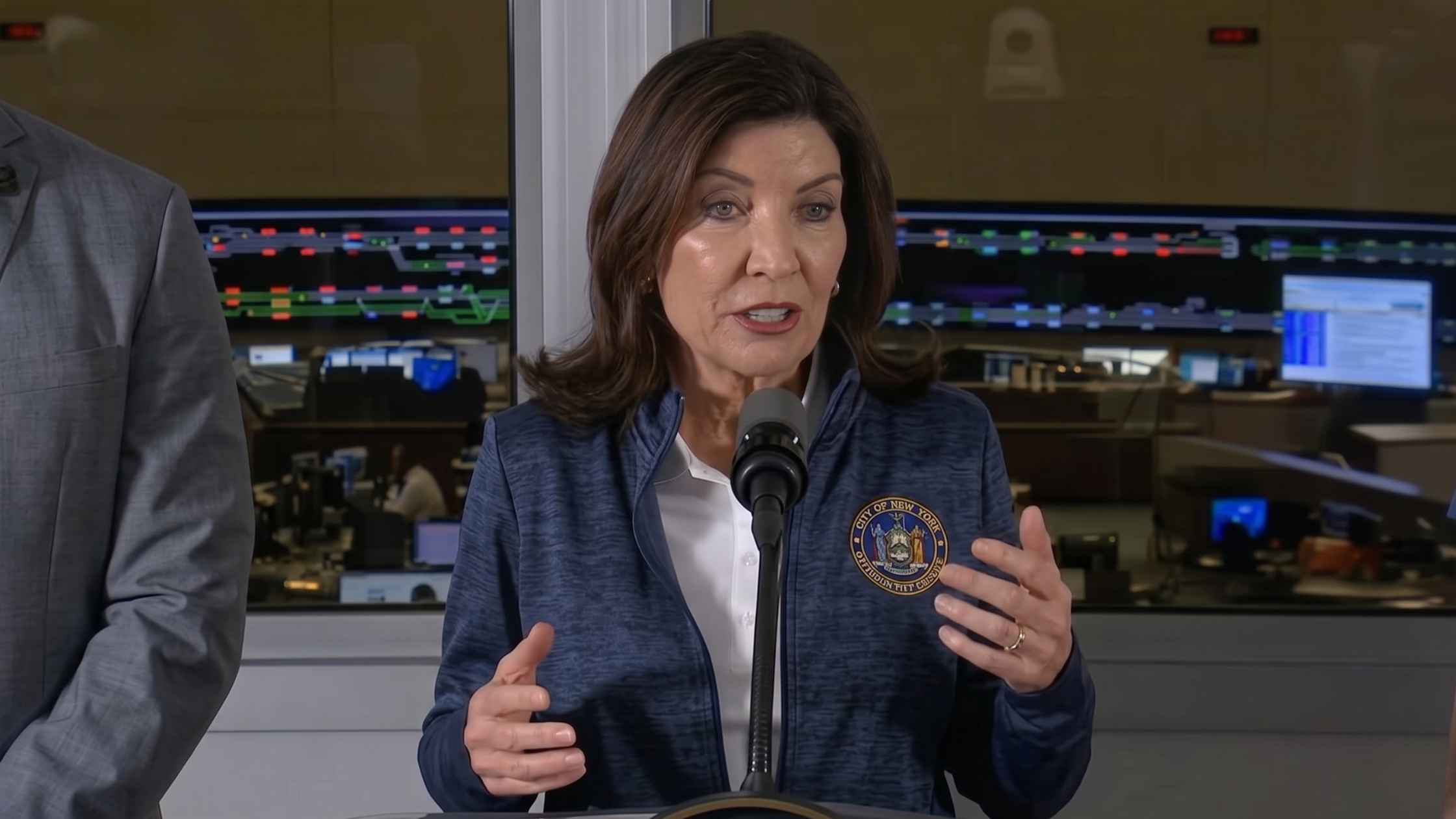
Kathy Hochul (07:20):
I wanted to give Long Island Rail Road riders the latest updates on the strike. Let me be clear. I did not want a strike. The MTA did not want a strike. The MTA has put fair offers on the table, in fact many of them. Despite that, for the first time in 30 years, the hundreds of thousands of people who rely on the LIRR are without service because of a strike. We all know that the railroad is the lifeblood of Long Island. Without it, life as we know it is simply not possible. The bottom line is no one wins in a strike. Everyone is hurt. The hundreds of thousands of people who rely on the railroad and the thousands of unionized workers who are losing out on wages.
(08:15)
I want to speak directly to the men and women of labor at the LIRR. The work you do is absolutely vital, absolutely. I value your labor and I believe that you deserve fair wages and benefits. But this strike has put all that at risk. Just three days of a strike would erase every dollar of additional salary that workers would receive under a new contract. We don't need to be here. Workers deserve better, but also, New Yorkers deserve better. That's why today, I'm urging all parties once again to bargain at the table and to get a deal done.
(08:59)
I also want to give an update to the Long Island Rail Road riders who are wondering about work tomorrow. Now, I've been in close communication. I've been touring the sites. I'm here at the operations control center to talk to the individuals overseeing the lines that we anticipate the highest volume on tomorrow. You'll hear more about that from our MTA leadership team. And we have a plan to ensure that essential workers can get into the city during the workday commute.
(09:26)
Now, starting at 4:00 a.m. tomorrow, the MTA will deploy shuttle buses to bring essential workers from across Long Island to subway stations in Queens, and those shuttle buses will be standing by to bring those essential workers back home to Long Island at the end of the day, to Long Island and Queens. For those in Nassau County who absolutely cannot work from home, there continues to be the option of taking a Nassau Inter-County Express bus directly to the subway connections in Queens. They will run extra bus service weekdays during the strike, and we've encouraged the county to add additional capacity. Another option is Citi Field. With the Mets hitting the road tomorrow, you can park there and transfer to the 7 Train.
(10:09)
So right here, as I said in the nerve center of the subway, every day, four million New Yorkers rely on this system to get around. This subway system is absolutely vital, even more so tomorrow. And the MTA, they've listened and asked questions. They're ready to meet the challenge. Extra trains are on standby and the MTA stands ready to run additional New York City subway service to meet the demand. And for the residents of Eastern Queens who typically rely on the speed and convenience of the LIRR, the E and A trains are there for you as a great option to get to and from the city at this time.
(10:48)
But let's face the facts. It's impossible to fully replace LIRR service, so effective Monday, I'm asking that regular commuters who can work from home should. Please do so. And employers should make every accommodations necessary to allow for remote work. Now, I've already directed all state agencies affected to implement telecommuting plans for the state employees who typically commute in from Long Island. But also, we have to maintain essential government services.
(11:23)
Now, everyone knows these alternatives are not business as usual, but unfortunately they're the direct result of this strike. Let me be clear. This strike would not have been possible if the Trump administration had not taken the highly unusual step last fall of releasing labor unions from mediation. Unfortunately for our commuters, the direct consequence of this action is the strike we have today. Now, New York, everyone knows, is a pro-labor state. We believe in working men and women receiving a fair wage and benefits. But the MTA cannot agree to a contract that would raise fairs as much as 8% and risk hiking taxes for Long Islanders. I have worked too long and hard to reduce costs for our residents, and I will not allow that to be undone.
(12:15)
As governor, my priority is to fight for affordability for all New Yorkers, and this strike puts that affordability at risk. Long Islanders deserve a break, as do all the residents who commute on their lines from Queens and elsewhere. They face tariff prices, price hikes on everything from food to school supplies, and skyrocketing gas prices after Trump's war in Iran. I will not let this dispute lead to higher prices and less money in the pockets of our residents. So we're looking at ways to defray the costs caused by this strike, costs that fly in the face of affordability, and I'll have more to say about that in the coming days if necessary.
(12:58)
Now, remember this. Not long ago when I became governor, the MTA was barreling off a fiscal cliff. Rider post pandemic was down, and there were calls to reduce service and slash costs. I took a different approach. I said, "Let's invest more. Let's create more reliability. Let's have a higher level of service," and those results have borne out. We've invested billions of dollars, and I need those investments to hold and not be diminished. And as a result, ridership has surged back, nearly all the way back to the pre-pandemic levels, which is an extraordinary result, and I want to thank all the workers across the lines, and at the MTA, who've been responsible for that success.
(13:43)
Like I said, I put the MTA on stable financial grounds. I worked hard to do that, and I don't want that undone. I will not let that be undone. But I believe, I know a deal can be reached to end this strike and end it soon. But to reach the deal, as I've said before, the MTA needs a partner. The MTA's made multiple generous officers with real wage increases. I urge both sides to come together as soon as possible and resolve this to avoid a prolonged strike that'll disrupt the lives of hardworking New Yorkers and affect the pocketbooks of the union members that their leaders are representing.
(14:22)
So getting everyone back to the table is the surest way to resolve this strike, of also achieving all of our goals, and getting the trains running once again. Thank you. I'll turn it over to the CEO of the MTA, Janno Lieber.
Janno Lieber (14:41):
Thank you, Governor. Thank you for your extraordinary support and leadership during this most recent challenge, but for years and years, you have been the MTA's and the riders' biggest proponent. You have been the transit governor, and we're seeing it again in this crisis moment. And thank you for sticking up for the Long Island Rail Road riders who would have to pay the cost of a labor settlement that blew up the MTA's budget. You've been very clear that we're not going to do that. The riders are who we're talking about today. We are here, as the governor said, in the subway control center, because we are totally focused on making sure that those Long Islanders who do have to travel to the city tomorrow during the work week are able to have subway services that'll really bring them into the city promptly. And Demetrius Crichlow, who's the president of transit, as well as Rob Free, the president of the Long Island Rail Road, will have more details on those efforts in a moment.
(15:46)
But first, I want to remind everyone about the status of the negotiations. We have always been willing to continue negotiations. We said, right up to the deadline that the unions had imposed, "Let's talk. Let's keep talking." And we sat there in the hallway so they couldn't even avoid seeing us, that we were available to talk to them right up to and through the deadline. It was they who elected to walk out. And we're more than willing to meet them halfway on wages. In fact, they wanted much more than halfway, settle for much more than halfway, which is why we put new ideas on the table again and again and again, and they were rejected every time. And apparently, they then criticized us for putting new ideas on the table. We need ideas about how to bridge the gap, and we need the unions to respond to our ideas and to come up with ideas and work with us. That's really important for us to get to the end.
(16:46)
And as the governor said, we are available to negotiate. We really need a partner. We need a partner who's willing to respond to ideas and come up with ideas and find a settlement. That's what we're looking for, and we're 24/7 available as the governor said. With that, let me turn it over to the president of the Long Island Rail Road, Rob Free.
Rob Free (17:04):
Thank you, Janno. Good morning. And thank you, Governor, for caring about the Long Island Rail Road riders and supporting the MTA as we work through this difficult situation. I'm Rob Free, President of the Long Island Rail Road, as they said. I'm here to provide some specifics on the bus service, but I would also like to start by thanking New York City Transit and MTA Bus, led by Demetrius, Bill Amoroso, and Frank Farrell, for their teams' efforts in putting this bus plan together, working with us to keep the region moving. Because that's what we want to do. That's why the MTA exists. We want to provide the safe, reliable service that we always do to keep the economy going, move millions of people every single day. That's what we want to do. We want to do what we do best, move this region.
(17:48)
So just as a reminder, the shuttle bus service is for absolutely essential workers. We want to make sure that we get the necessary people into the city so they can perform their functions. The buses will begin to operate tomorrow morning at about 4:30 a.m., and on the evening from about 3:00 p.m. to 7:00 p.m., from about six locations, from six locations on Long Island to Queens, spread out between Nassau and Suffolk County. There's no charge for these buses. There will also be reverse peak service during the a.m. and p.m. peak periods to Suffolk County only. On Nassau County, there's much more options. Suffolk County is further out. We wanted to provide that extra layer of service for them. There will only be peak service, as I said, for the Nassau locations.
(18:30)
For customer safety and customer service, there'll be MTA police at all busing locations and customer ambassadors to assist customers in their travels, including people with accessibility needs. Citi Field is also providing parking for about $6, so customers can choose to go there with convenient access to the 7 Line, one of the best subway lines that we have. And riders, please view the MTA website for the most up-to-date information-
Speaker X (18:57):
Mta.info.
Rob Free (18:59):
Mta.info. And with that, I'll turn it over to Demetrius. Thank you.
Demetrius Crichlow (19:08):
Good morning. I'm Demetrius Crichlow, President of New York City Transit. We are always committed to delivering fast, reliable, and safe service. Today is no different. Monday is no different, and every day thereafter. I'd like to remind New Yorkers that we have plenty of room, plenty of capacity in our system. The subway can take any influx of customers that are here. We may see higher ridership in places where we scheduled shuttle service or places throughout the five boroughs that are natural places for customers that would get normal drop-offs, like Jamaica and Flushing. Those are locations that we know or expect that customers will like to go to because there is availability there. We have plenty of subway lines. The reality is, any of the lines like the 7, the A, the E, the F, the J, the Z, each of them have plenty of capacity to take on additional ridership.
(20:08)
Now, this may be new or nontraditional for some customers. It is not their normal travel pattern. But I can reassure you that we have the capacity and we have a lot of service. If you talk about just the 7 itself, the train operates anywhere from a two-to-three-minute headway, two to three minutes in and out. For the A line, you have service that is around three-to-four-minute headway during the peak service. So there's plenty of capacity. And out of an abundance of preparation, we'll have additional trains ready to put into service as the need comes. And that means gap trains where we see ridership is starting to get a little heavy or where the stations are starting to get a little bit at capacity. We have gap trains that we could put in at various location.
(20:57)
Bottom line, we are here and we are ready. Our 24/7 operation is ready to provide service for New Yorkers. Thank you, and with that, I will turn it over to Governor Hochul.
Kathy Hochul (21:11):
Thank you, Demetrius, for explaining all the options that people will have. It's not, as you said, their customary travel, but it's something that this organization has worked really hard to find all the options, and adding more capacity and more trains ready to be added is really important to that. So I want to thank you and I want to thank the president of the Long Island Rail Road, Rob Free, and of course Janno Lieber, for all the work you've been doing. I want to make sure that we have everything we have here to answer questions and to be happy to take any. Cara.
Cara (21:46):
[inaudible 00:21:47] On-topic question?
Speaker 7 (21:48):
Yep, go ahead.
John Dias (21:50):
Yes, John Dias at CBS. Would you consider suspending congestion pricing during the LIRR strike?
Kathy Hochul (21:53):
You know, there's actually no legal mechanism to do that. Anyone who tells you they can doesn't understand federal law. And I want to stress, what we're encouraging people to do is stay home, not to divert this into a campaign event. This is serious business, and I want to make sure that people know that we hope to have a very shortened strike. That's our hope, but we're prepared for anything that happens.
Speaker 7 (22:24):
Great. [inaudible 00:22:25]
Speaker 9 (22:25):
[inaudible 00:22:25] three days worth of the strike will eat up any benefit that they would've gotten in the negotiations. What are the [inaudible 00:22:34] doing with that in mind, that you're going to use up the money that they're asking for in the first three days of the strike? What does that change about the way you negotiate?
Kathy Hochul (22:44):
No, I think what we're talking about in three days, if they had received what they asked for in negotiations. Because the workers are not paid, they're losing the money that they would've had in negotiations. So it's the workers who are losing on the three days of wages. Is that correct, Janno?
Janno Lieber (23:01):
Correct, absolutely.
Kathy Hochul (23:02):
Yeah, it's the workers who are losing three days. And that's who I... I feel bad for the workers. I mean, these are hardworking people who show up every single day in all kinds of conditions, and maybe they can be a voice here as well, because I don't want them to lose pay. I don't want them to lose their pay, but they are. That's how it is. They're on strike, they don't get paid.
Speaker 7 (23:21):
All right, Emma, go ahead.
Emma Barnett (23:22):
Emma Barnett with New York 1. Why was there no bargaining session yesterday?
Kathy Hochul (23:30):
Well, I think Janno told you what happened at 12:01 a.m. on Saturday morning. I was at the offices where the negotiations continued.
Janno Lieber (23:38):
Yeah.
Kathy Hochul (23:39):
We were the ones there.
Janno Lieber (23:41):
I'll just add if I may that we made it clear, we are available if they want to come back and negotiate. They walked out and they went on strike. So yesterday, we were at 2 Broadway. We were in the building where the negotiations take place. The governor was in the building. We have been available, and we've made that very clear, directly and through the National Mediation Board, that we are available if they're ready to come back and talk seriously.
Rob Free (24:10):
Janno, can I just add too?
Kathy Hochul (24:10):
Sure.
Rob Free (24:10):
[inaudible 00:24:10] Forgive me. I think you should ask the unions that. Where were they on Saturday? They-
Emma Barnett (24:12):
[inaudible 00:24:13] contacted them.
Rob Free (24:13):
But they went on strike. They walked away from the table. We were there that night, and we were there again yesterday. You should ask that question to the unions.
Emma Barnett (24:23):
I did, and they said you didn't invite them. [inaudible 00:24:24]
Kathy Hochul (24:26):
Okay. Here, you hear it here. Unions, you're invited back in.
Janno Lieber (24:29):
Yeah.
Kathy Hochul (24:30):
Okay? Here's my official invitation. We didn't want you to leave. You left. You are welcome to come back. I'll provide refreshments, whatever you like. Just come on back. This is important, to show that we have partners who are willing to get to a resolution to this, because it's hurting their members as well as our commuters.
Emma Barnett (24:52):
And does the strike impact the amount you are willing to negotiate an offer to the unions?
Kathy Hochul (24:54):
We will not be discussing our strike strategy, our negotiation strategy at this time.
Speaker 7 (24:57):
Great. Peter, Newsday.
Peter (25:02):
Peter at Newsday. In the past, there was the warning about probationary workers. If they don't show up to work, they could be fired. Did that happen? Have any probationary workers been fired?
Kathy Hochul (25:09):
You want to answer?
Rob Free (25:13):
No action has been taken. What we do is what we want every single day, employees to come to work and work. That's their responsibility.
Speaker 7 (25:23):
Jose.
Jose (25:23):
Hi. Is there any concern [inaudible 00:25:26] at New York City Transit, on Metro North, in terms of [inaudible 00:25:30] taken on, where they go on their own [inaudible 00:25:33] out of sympathy for the railroad workers?
Janno Lieber (25:35):
I'll-
Kathy Hochul (25:35):
Yeah, go ahead. Go ahead. Go ahead.
Janno Lieber (25:39):
I'm not concerned. The unions at Metro North and elsewhere have been very clear. They understand their obligations to show up for work and they haven't suggested otherwise. And in fairness, they understand that the guys who went out on strike are asking for a better deal than they got, and folks understand that this strike is because a few of these unions say, "We deserve better than the rest of MTA workers," and that's made an impression on a lot of our workforce.
Speaker 7 (26:13):
Michelle.
Michelle Cassidy (26:14):
Hi, Michelle Cassidy from Bloomberg News. Janno, how much is the strike costing the MTA every day? I mean, I know [inaudible 00:26:22] the cost of the buses, the shuttle buses.
Janno Lieber (26:23):
Yeah.
Michelle Cassidy (26:23):
But you're going to have, now, increased subway service. What's-
Janno Lieber (26:27):
I mean, listen, now is not the time to be talking about that. We will look at those numbers as they unfold. We save some money because when we're not running and people aren't working. It costs us some money to do some other things like buses and so on. We'll weigh all that. The key is for Long Islanders to be able to get their service back. That's our focus right now.
Speaker 7 (26:50):
Okay. [inaudible 00:26:51] Go ahead.
Speaker 14 (26:50):
Yeah, two quick questions. You mentioned the 8% potential raise. Have you calculated what that would mean for a fare raise if you were to go that direction? And then for the subway system, are we expecting delays tomorrow? That's potentially another 100,000 people that [inaudible 00:27:05]
Kathy Hochul (27:05):
No, I think that's what you're hearing here today, is that this highly sophisticated, professional organization has been planning for this, and you've heard from Demetrius and others that we're ready for this. We're ready for the capacity. And if it's more than anticipated, and again, we're encouraging people to stay home for the duration of the strike. If people have to come into work, cannot work from home, we'll be monitoring closely in this very room, and determining where extra trains need to go. The extra trains are ready to add. Is there anything else to add on that?
Demetrius Crichlow (27:36):
Sorry.
Kathy Hochul (27:36):
Oh, go ahead. [inaudible 00:27:41]
Demetrius Crichlow (27:41):
I would just say we took the time to plan out all of the locations that we anticipate customers would be going to, both drop-offs for the shuttles, but also locations where people in Queens may drive. If you want to drive to Queens, locations where there's parking. We took all of that into consideration in saying, "What is our capacity there, and what do we have existing service, and what additional service can we add to supplement it?"
Speaker 7 (28:04):
All right, do we have time for one more?
Speaker X (28:04):
[inaudible 00:28:07]
Speaker 7 (28:07):
All right. Thank you, guys. Really appreciate it.
Demetrius Crichlow (28:08):
Thank you.
Kathy Hochul (28:08):
Thank you very much for coming out. Appreciate your coverage and making sure all of our riders know the options that we've created for them, and hopefully this does not go on long. Thanks, everybody.