
Madam President (00:00):
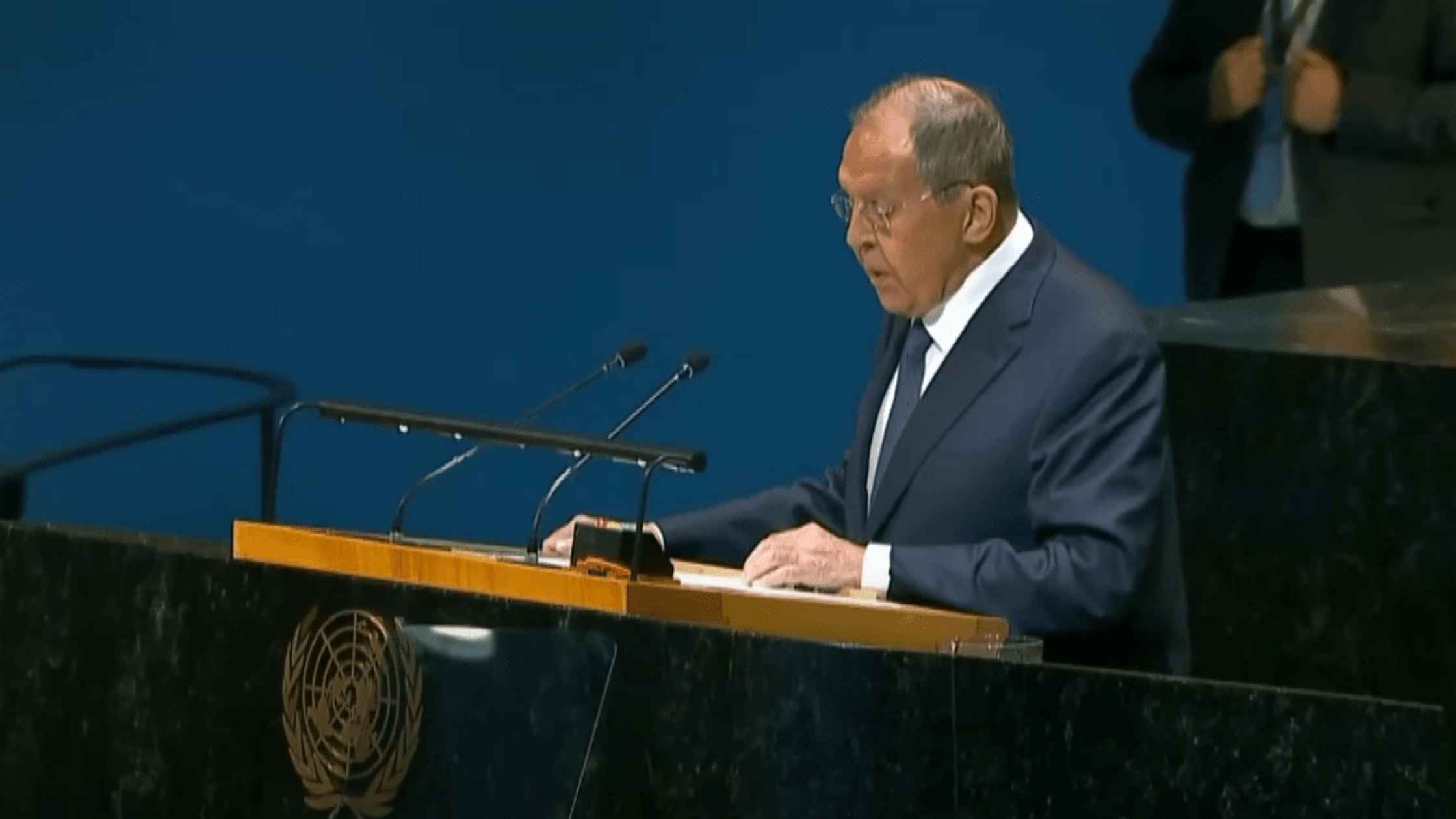
I now give the floor to His Excellency Sergey Lavrov, Minister for Foreign Affairs of the Russian Federation.
Sergey Lavrov (00:20):
Madam President, ladies and gentlemen, 80 years ago, the most terrible war in human history came to an end. More than 70 million people fell victim to the fighting, famine and disease. In 1945, the course of world history changed forever. The triumph over German Nazism, under whose banner most of Europe had rallied and Japanese militarism paved the way for peace, recovery and prosperity. This year, Moscow and Beijing held celebrations devoted to the 9th of May and 3rd of September holidays to mark the victory in the Great Patriotic War and World War II. The world witnessed grand military parades commemorating the decisive contribution of the people of the Soviet Union to the defeat of Nazi Germany and the particular role of the people of China in defeating militaristic Japan.
(01:16)
We sacredly honor the memory of our brotherhood in arms with all of our allies who stood on the side of truth in the fight against the forces of evil. One of the enduring outcomes of that war was the creation of the United Nations, the principles of its charter agreed upon by the founding fathers of our organisation continue to serve as a shining beacon of international cooperation they embody centuries of experience in the coexistence of states and remain fully relevant in the age of multipolarity. The only thing that remains is for all member states without exception to adhere to those principles in full in their entirety and as they are interconnected. In practice however things look different.
(02:03)
Widespread gross violations of the principle of the sovereign equality of states are undermining faith in justice itself and leading to crises and conflicts. The root of the problem lies in the incessant attempts to divide the world into us and them, into democracy and autocracy into a blooming garden and the jungle, those who are at the table and those who are on the menu into the chosen ones who are allowed everything and the rest, who for some reason are obliged to serve the interests of the golden billion. We advocate for unquestioning adherence to the principle of equality. It is the guarantee that all countries will be able to take their rightful place in the world order regardless of their military might, the size of their population or the size of their territory and economy. The principle of the non-use of force and threat of force has also been repeatedly flouted by the West.
(02:55)
The NATO bombing of Yugoslavia, the invasion of Iraq by the U.S.-led coalition and NATO's military operation for regime change in Libya all ended in tragedy. Today, Israel's illegal use of force against the Palestinians and aggressive actions against Iran, Qatar, Yemen, Lebanon, Syria, and Iraq threaten to blow up the entire Middle East. Russia firmly condemned the attack by Hamas militants on Israeli civilians on the 7th of October 2023. However, there is no justification for the brutal killings of the civilian population of Palestine or for terrorist attacks. There is also no justification for the collective punishment of Palestinians in the Gaza Strip where Palestinian children are dying from bombing and starvation. Hospitals and schools are being destroyed and hundreds of thousands of people are being left without shelter. There is no justification for plans to annex the West Bank. We are essentially dealing with an attempt of a kind of coup d'état aimed at burying UN decisions on the creation of a Palestinian state. Recently, a number of Western governments announced their recognition of the State of Palestine.
(04:15)
Moreover, they announced their intention to do so several months ago. The question then arises why did they wait so long? It seems that they had hoped that soon by the time the General Assembly session was convened, there would be nothing and no one left to recognise. The situation requires urgent action to prevent such a scenario which was strongly advocated by the participants at the high-level International Conference on Palestine. The strikes on Iranian facilities under IAEA safeguards to deserve condemnation as do the strikes on the capital of Qatar at a time when negotiations with Hamas were being held there with the participation of American mediators among others.
(05:01)
Yesterday in the Security Council, the West rejected a rational proposal by China and Russia to extend the 2015 agreement on Iran's nuclear programme in order to allow time for diplomacy. This has finally exposed the West's policy of sabotaging the pursuit of constructive solutions in the UN Security Council and its desire to extract unilateral concessions from Tehran through blackmail and pressure. We consider such a policies to be unacceptable and consider all manipulations to restore anti-Iranian, UN sanctions as well as the sanctions themselves to be illegal. The West is not a accustomed to observing the principle of non-experience in internal affairs. The colour revolutions have become a sad phenomenon of our time and illegal unilateral sanctions have long since become the main tool of Western diplomacy no matter what excuses are used to justify them, the essence of such sanctions is the same to suppress and intimidate competitors in the global economy and politics.
(06:04)
Russia together with an absolute majority of UN members calls for the immediate lifting without prior conditions of the trade blockade against Cuba, which has been in place for more than 60 years, and for it to be removed from the notorious list of state sponsors of terrorism. We express our solidarity with the people of Venezuela in the face of external sanctions, pressure and threats. We advocate for Latin America and the Caribbean to remain a zone of peace and cooperation. A flagrant example of the undermining of sovereignty and gross interference in internal affairs is the actions of the West in the Balkans where such a fundamental principle as the need for all UN members to comply with Security Council decisions is being violated. The unilateral recognition of Kosovo's independence contrary to resolution 1244 was essentially an attack on Serbia's state structure.
(06:59)
Now, the West has set a course for the collapse of the statehood of Bosnia and Herzegovina by sabotaging the Dayton Peace Agreement in both Kosovo and Bosnia, an attack has been launched on the vital interests of the Serbian people, including the ancestral rights of Serbian Orthodoxy. Similarly, the Kiev regime, which ceased ceased power as a result of an anti-constitutional coup organized by the West in 2014, has set a cause for the elimination of the canonical Ukrainian Orthodox Church and the legislative eradication of the Russian language in all spheres, in education, culture and the media. Ukraine is the only country in the world that has legislatively banned the use of the native language of almost half of its population. Arabic is not banned in Israel and Hebrew is not banned in Arab countries and Iran, but Russian is banned in Ukraine. Let me remind you that Article 1 of the UN Charter states the need for respect for human rights and fundamental freedoms for all without distinction as to race, sex, language or religion, Europe remains silent on this issue, obsessed as it is with the utopian goal of inflicting a strategic defeat on Russia.
(08:17)
To this end, the Ukrainian regime is permitted to do anything including terrorist attacks against politicians and journalists, torture, extrajudicial executions, indiscriminate bombings of civilian targets and reckless sabotage of nuclear power plants. As President Vladimir Putin has repeatedly emphasized, Russia has been and remains open to negotiations on eliminating the root causes of the conflict. Russia's security and its vital interests must be reliably guaranteed. The rights of Russians and Russian-speaking people in the territories that remain under the control of the Kiev regime must be restored in full. On this basis, we are ready to discuss security guarantees from Ukraine. So far, neither Kiev nor its European sponsors seem to realize the gravity of the situation or to be willing to negotiate honestly. The North Atlantic Alliance continues to expand right up to our borders, contrary to assurances given to Soviet leaders to advance not a single inch to the east.
(09:21)
Contrary to the commitments made by NATO members at the OSCE to respect the principles of the indivisibility of security and not to strengthen their own security at the expense of others and not to strive for dominance. We repeatedly propose that NATO capitals respect their commitments and agree on legally binding security guarantees. Our proposals in 2008 and the subsequent ones including in December 2021, have been ignored and continue to be ignored to this day, and moreover, threats to the use of force against Russia are increasingly being made. Russia is being accused of almost planning to attack in North Atlantic Alliance and the European Union countries. President Putin has repeatedly debunked these provocations.
(10:09)
Russia has never had and does not have any such intentions. However, any aggression against my country will be met with a decisive response. There should be no doubt about this among those in NATO and the EU who not only are telling their voters the war with Russia is inevitable and are forcing them to tighten their belts, but also openly talking about preparations for an attack on our Kaliningrad Oblast and other Russian territories. We have some hopes for the continuation of the Russian-American dialogue, especially after the summit in Alaska. In the approaches of the current U.S. administration, we see a desire not only to contribute to ways to realistically resolve the Ukrainian crisis, but also a desire to develop pragmatic cooperation without adopting an ideological stance.
(11:01)
Russia and the U.S. bear a special responsibility for the state of affairs in the world and for avoiding risks that could plunge humanity into a new war. The maintenance of strategic stability is the aim of a new initiative by the Russian Federation that was put forward by President Putin on the 22nd of September, it concerns Russia's readiness to adhere to the central quantitative limits of the New START Treaty for one year after its expiry on the 5th of February 2026. This is upon the condition that the United States acts similarly and does not take steps that would violate the existing balance of deterrence capabilities. We believe that the implementation of our proposal would create the conditions necessary for avoiding a strategic arms race to maintain an acceptable level of predictability in the nuclear missile sphere and to improve the overall atmosphere in Russian and American relations.
(12:03)
Colleagues, in December this year, we will mark the 65th anniversary of the adoption by the General Assembly of the Declaration on the Granting of Independence to Colonial Peoples and Countries. The decolonization process with a leading role play by the Soviet Union was a direct consequence of the realization of the right of nations to self-determination. The peoples of Africa and Asia refused to live under the yoke of the colonizers. Just as after the coup d'état in 2014 in Ukraine, Crimea, Donbas and Novorossiya refused to submit to the Kiev neo-Nazi regime that had illegally seized power. It not only does not represent the interest of the population, but has also unleashed a war against them. In both cases, the principle enshrined in the 1776 Declaration of Independence and subsequently reaffirmed by many American presidents was put into practice, the following principle, governments derive their just powers from the consent of the government.
(13:11)
Neither the colonizers nor the Kiev regime had any consent from the peoples that they sought to rule. This principle was also unanimously reaffirmed in the UN 1970 declaration, which states explicitly that all must respect the territorial integrity of those countries whose governments represent the entire population living on the territory concerned. Today, Africa and the entire Global South are experiencing a new awakening, striving for complete independence, and the UN must not be indifferent to that. Last December, the General Assembly resolution entitled Eradicating Colonialism in All Its Forms and Manifestations was adopted. We call for the next step to be a decision to declare the 14th of December, the international day for the elimination of colonialism. We welcome the role of the group of friends in defense of the UN Charter in consolidating efforts to counter neocolonial and other discriminatory practices against the global majority, and we invite all independent states to join the membership of that initiative and that group. The current balance of power in the world is radically different from that established 80 years ago.
(14:24)
The decolonization process and other major upheavals have changed the political map of the planet. The global majority is loudly asserting its rights. The Shanghai Cooperation Organisation and the BRICS play a special role as mechanisms for coordinating the interests of the countries of the Global South and East. The influence of the African Union, CELAC and other regional associations was growing. These new realities have not yet been adequately reflected in our organization's institutional framework. The issue of Security Council reform is particularly important, Russia calls for its democratization exclusively through the expansion of the representation of Asia, Africa, and Latin America. We support the application of Brazil and India for permanent seats on the council, while at the same time correcting the historical injustice towards Africa within the parameters that have been agreed by the countries of the continent themselves. Recently, Secretary-General António Guterres proposed a comprehensive reform of the UN.
(15:28)
We are not opposed to an open discussion of this initiative. The guiding principles should be the UN's return to the fundamental principles enshrined in its charter, which the West for many years has been seeking to replace with its rules-based order. It's important that the work be carried out transparently with the participation and consideration of the interests of all member states. We call on the Secretary-General and all Secretariat staff to strictly adhere to the principles of impartiality and equidistance in accordance with Article 100 of the Charter. Attempts at a palace coup in the Secretariat, its privatization by a small group of countries must not be allowed. The composition of the Secretariat should reflect the new realities that ensure a fair representation of the countries of the global majority. We look forward to a constructive discussion of the organization's development at a special meeting of the Security Council, which Russia as president plans to organize on United Nations Day on the 24th of October.
(16:31)
UN reform is only a part of the complex task of transforming the entire system of global governance, including the genuine democratization of the IMF, the World Bank, and the WTO commensurate with the weight and role of the Global South and East in the world economy, trade and finance. Discussions of global reforms cannot ignore the fact that the international security situation today is deteriorating. I have already spoken about the reasons for this and I'll repeat that the main one is the desire to maintain hegemony through military force. More and more countries and regions are becoming involved in confrontational schemes. NATO is finding itself cramped in Europe and is penetrating into the Pacific Ocean, the South China Sea and the Taiwan Strait undermining the universal mechanisms of ASEAN and creating threats not only for China and Russia, but also for other countries that are located in the region. This new stage of expansion is justified by NATO leadership with the slogan of the indivisibility of Euro-Atlantic and Indo-Pacific security, and they're trying to use this slogan to surround the whole of Eurasia with a military ring.
(17:38)
Russia and its like-minded partners are offering a constructive alternative to this dangerous course to build in Eurasia an architecture of equal and indivisible security, not just for NATO members and their allies, but for all countries and associations on the continent without exception, including the SCO, the CIS, ASEAN, the EAEU, CSTO, the Gulf Cooperation Council and others. To this end, Belarus and Russia as partners in the Union State are proposing the development of a Eurasian charter of diversity and multipolarity in the 21st century. A truly continent-wide process is unavoidable after the West's behavior has rendered the Euro-Atlantic security model based on NATO, the EU, and the OSCE meaningless. We see no prospects for restoring this model in Europe in its former form as some European capitals have suddenly started to contemplate when talking about the future. We must not forget the lessons of the past, especially in a situation where Nazism is rearing its head again in Europe and militarization is gaining momentum under the same anti-Russian slogans.
(18:50)
This is all the more alarming given that a number of politicians in power in Brussels and in some capitals of EU and NATO countries are seriously beginning to talk about third world war as a like scenario. These figures are undermining any efforts to find a fair balance of interests among all of the members of the international community, by trying to impose their unilateral approaches on everyone else in gross violation of the key charter requirement, which I have repeatedly mentioned already, that is the respect for the sovereign equality of states. It is this equality, which is the foundation for the objectively emerging multipolarity. Russia is not agitating for revolution against anyone. Our country has suffered more than others from revolutions. We are simply calling on member states and the Secretariat's leadership to strictly adhere to all of the principles of the UN Charter without exception, without double standards. Only then will the legacy of the founding fathers as the UN not be squandered in vain. Thank you for your attention.