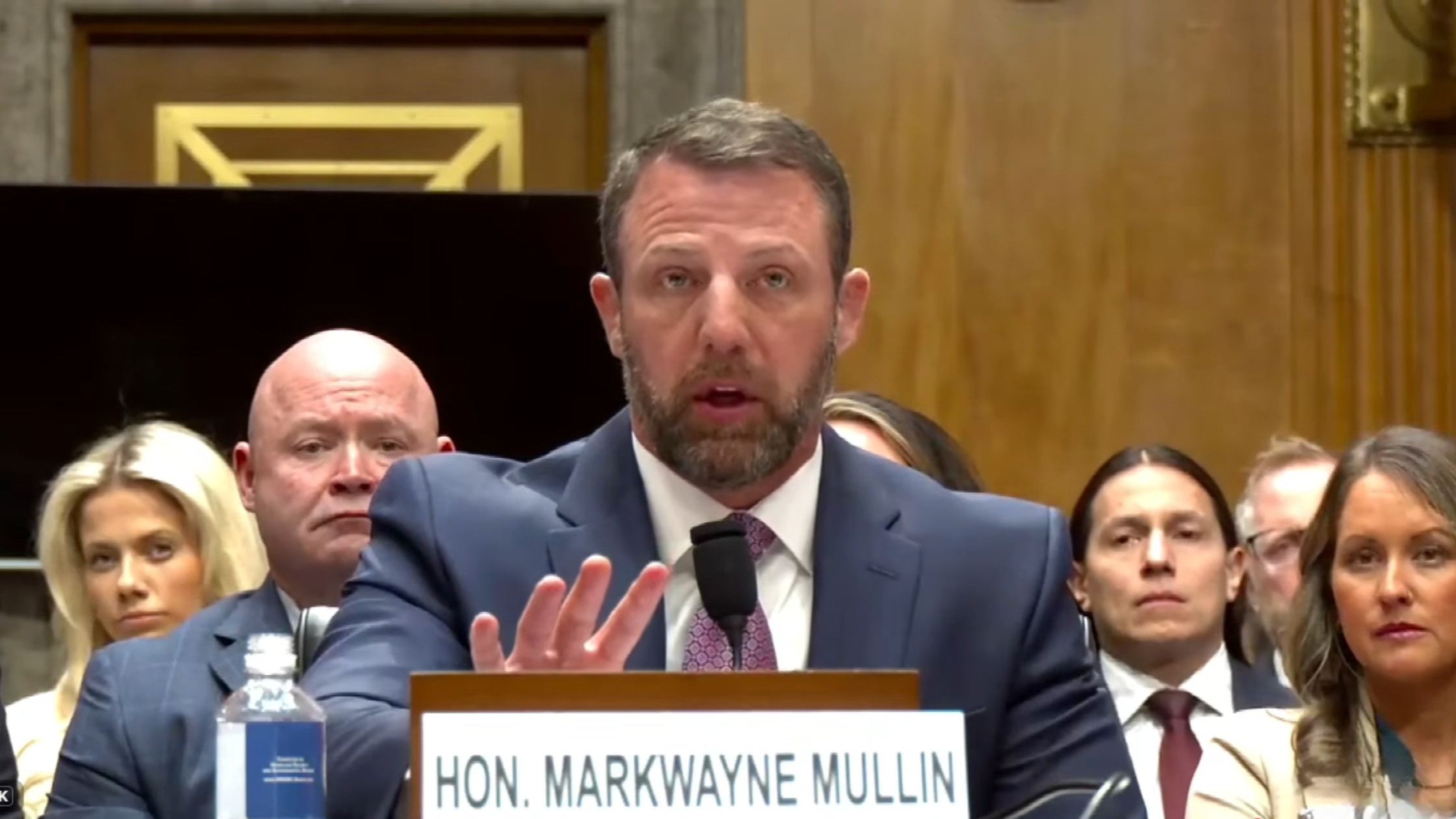
Chairman Paul (00:55):
Morning everyone.
(00:57)
I entered the Senate the same year that Representative Gabby Giffords was shot. I knew then that the state of political rhetoric was encouraging violence. I think it's imperative now more than ever that the leaders in our country disavow violence and lead by example.
(01:15)
Through the years, I've personally been exposed multiple times to political violence. I was in the right field batting cage when the crazed shooter unleashed nearly 200 shots at our congressional baseball practice. I'll never forget Steve Calise valiantly trying to drag his body away as the gunman continued.
(01:34)
Later that year, a Trump hating felon attacked me from behind in my yard. I was just straightening up from picking up a tree limb. I was wearing noise cancellation headphones. Never saw him coming. Running pell-mell down the hill. I was struck in the back. The force of the blow sent us through the air nearly 10 feet down the hill until his shoulder impaled me as we hit the ground. Six of my ribs were broken. Three of the ribs were completely separated such that for weeks, the ends of the ribs would grind upon each other. My lung was damaged. For weeks I could inhale but not have the rib strength to exhale. I developed two pneumonias. The pain was such that I could only sit up in bed by tying a rope to the foot of the bed and pulling myself up. But even then, the pain was that of a thousand knives.
(02:28)
Over the year of recovery, I began to cough up blood. I underwent removal of part of my lung. Complications led to an infection in the space between my lung and chest wall. I spent a week in the hospital having the infection lavaged every six hours through a chest tube.
(02:44)
Recently, Senator Mullin, if you have time to listen. You were confronted by constituents that were angry because you voted against my amendment to stop all funding for refugee welfare programs. Instead of explaining your vote to continue these welfare programs for refugees, you decided to transfer the blame. You told the media that I was a freaking snake and that you completely understood why I had been assaulted.
(03:13)
I was shocked that you would justify and celebrate this violent assault that caused me so much pain and my family, so much pain. I just wonder if someone who applauds violence against their political opponents is the right person to lead an agency that has struggled to accept limits to the proper use of force.
(03:31)
You might argue you were mad and upset about being confronted by your constituents. But Senator Mullin, your constituents are justifiably upset with you. By now, most of America knows that the Somali welfare fraud in Minnesota stole over $9 billion. But instead of defending your vote, you vote to continue these refugee welfare programs, you chose to lash out at me.
(03:57)
You went on to brag that you'd already told me to my face that you completely understood and approved of the assault. Well, that's a lie. You got a chance today you can either continue to lie or you can correct the record. You have never had the courage to look me in the eye and tell me that the assault was justified, so today you'll have your chance. Today, I'll give you that chance to clear the record. Tell it to my face. If that's what you believe, tell it to me today. Tell the world why you believe I deserve to be assaulted from behind, have six ribs broken and a damaged lung. Tell me to my face why you think I deserved it. And while you're at it, explain to the American public why they should trust a man with anger issues to set the proper example for ICE and border patrol agents. Explain to the American public how a man who has no regrets about brawling in a Senate committee can set a proper example for over 250,000 men and women who work at the Department of Homeland Security.
(04:57)
Senator Peters, you're recognized for your opening comment.
Mr. O'Brien (05:01):
Well, thank you, Chairman Paul. Thank you, Senator Mullen for being here today. Congratulations on your nomination. And I certainly appreciate your willingness to meet with me as well as my staff as we consider your nomination to serve as Secretary of the Department of Homeland Security.
(05:17)
I'd also like to welcome your family who is joining us today and to thank all of them for their commitment to public service. We do it as a family, as you know.
(05:27)
The Department of Homeland Security is a complicated organization with challenging operational dynamics. As everyone is well aware, many components within DHS are currently operating without funding. But let's be clear, Democrats are committed to funding TSA, FEMA, the Cybersecurity and Infrastructure Security Agency, and the Coast Guard, while we negotiate much needed ICE reforms. We tried to pass those bills by unanimous consent multiple times over the past two weeks. Unfortunately, Republicans have blocked those bills each and every time.
(06:06)
Yesterday, the White House sent a letter laying out their latest offer, but the devil is always in the details. Administrative action is not enough. We need to pass real reforms into law. If Republicans really do agree with us that TSA and other personnel need to be paid, then they should join us and pass the bills to pay them, today. We can do that while we continue to negotiate needed ICE reforms. But let me be clear, these are very straightforward reforms that we're asking for. We just want ICE to follow the same rules that our local police and our local communities follow every day.
(06:44)
The DHS has faced management challenges since the start of the Trump administration, and over the past year, many of those challenges have unfortunately only increased. As soon as President Trump was sworn in, he made deep cuts to counter-terrorism offices and programs, forced out or reassigned key personnel, and redirected the focus of limited remaining counter-terrorism resources away from the serious threats that we face and towards targeting the president's perceived political enemies.
(07:18)
The administration has also gutted our nation's main cybersecurity agency. Once again, forcing out or reassigning highly talented personnel. Slashing budgets and limiting the agency's work to help private companies address significant cyber attacks and protect Americans from criminal hackers and support secure elections.
(07:41)
The administration has also taken an act to FEMA, cutting staff and freezing or delaying critical grant funding for everything from emergency food and shelter after a disaster, to flood mitigation programs and security grants to nonprofits, including houses of worship. All these cuts and reassignments have been made at the expense of vital missions, including the core terrorism prevention and response mission the department was created to address. In doing so, the Trump administration has broken trust between law enforcement and the communities they are intended to protect. A break that will have a generational impact on public safety and security.
(08:23)
And now after President Trump's reckless war of choice against Iran, the threats to our nation have never been higher. In my home state of Michigan, just last week, we saw both a major medical device manufacturer get hacked by an Iranian backed group and a horrific violent attack on Temple Israel, a Metro Detroit area synagogue.
(08:46)
President Trump's unilateral and unchecked executive actions have put Americans at risk, and we need a steady qualified leader at the Department of Homeland Security to address these serious threats. How the Homeland Security Secretary responds to a crisis sends signals to everyone from the department's own personnel to the American people and to the entire world.
(09:10)
It's not the role of the secretary to be a cable news commentator in the wake of a crisis. The secretary's role is to lead, lead the response, and work to ensure the department that they are leading isn't actually the cause of the crisis. A secretary who jumps to conclusions without the facts, as we saw in the case of Renee Goode and Alex Pretti's killings, only worsens the situation and actually makes us less safe.
(09:37)
This is a role where temperament matters, where judgment matters and where experience matters. We have seen under Secretary Noem's leadership how shortcomings in these traits can compound the challenges that already come with leading a large and complex department. And now more than ever, we need a DHS secretary who is a steady hand, who will provide thoughtful leadership, follow the facts, tell the truth, and hold agency officials accountable when they need to be held accountable.
(10:12)
We need a DHS secretary who's committed to the rule of law and who will protect and cooperate with independent oversight, whether that's from the Inspector General or from members of Congress. And we need a DHS secretary who is free from distractions and conflicts of interest that only undercut the department's work and also break trust with the American people.
(10:37)
Senator Mullin, I appreciate you being here today to answer our questions about these concerns and your experience and qualifications for the job. And while I'm interested in hearing more about your vision for leading the department, I do have reservations about your readiness to take on such a significant role at such a critical time. I hope you will provide us with the substantive answers today and a candid recognition of where this administration has fallen short on safeguarding our homeland security as you seek to lead the department as our nation faces ongoing security threats and war with Iran.
Chairman Paul (11:17):
Senator Mullin is to be introduced today by Senator Lankford. Senator Lankford, you are recognized for your introduction of our witness.
Senator Lankford (11:23):
Paul, thank you.
(11:25)
Mark Wayne I'm proud that you're here. I get the honor of getting a chance to be able to recognize and introduce my friend, Mark Wayne Mullin, my fellow senator from the state of Oklahoma and somebody that I've seen work incredibly hard to be ready for every single task you've ever taken on and to be able to not only do it, but do it well.
(11:42)
There are a lot of folks that think they know you. I actually get to know you and I have had the opportunity to be able to serve beside you for now over a decade and have seen your tenacity in your work effort.
(11:53)
Folks may not know that the first time we really got to know each other, ironically enough, was around a natural disaster, a FEMA event. It was Briarwood Elementary in 2013 when a tornado came right through the heart of Oklahoma. You had literally just been elected a few weeks before that and had just taken the oath of office. The Oklahoma delegation all gathered together at the very tragic event there at Briarwood Elementary. And while we were meeting with the principal and meeting with teachers and families and walking through the debris field that was that elementary school, we turned around to be able to look for Mark Wayne and for a minute we couldn't find him because in one of the debris piles, there was water shooting out of the middle of it and his plumber instinct said, "I got to go find that and figure out how to solve that."
(12:41)
And so while everyone else was shaking hands and meeting people, he was digging through the debris field to find a way to be able to shut off the water that was shooting through the middle of that destroyed elementary school. And I remember smiling and thinking he's a guy that doesn't mind getting his hands dirty to actually go solve the problem. Where there's a problem he can solve, he's going to do whatever it takes to actually solve it.
(13:03)
Mark Wayne grew up in a very small town in far eastern Oklahoma, ironically named Westville, in the eastern most part of Oklahoma. Just 1,300 people call Westville home.
(13:15)
He grew up in a family of modest means. I think that'd be safe to be able to say. The youngest of seven children in a family that just didn't have much. His dad ran a very small plumbing company that then Mark Wayne took on and grew into being one of the largest plumbing companies in the entire state.
(13:32)
He married his high school sweetheart. One of the smartest things he ever did at just 20 years old, and he and Christie have developed a family that is a beautiful family of three children they had naturally and three children they chose that they adopted and took them in. It is a remarkable family and a remarkable success that you have actually led through a lot of hard work and a lot of love and tenacity. He is a person of faith that is not afraid to be able to talk about his faith in Jesus Christ, but he's also a person who has deep respect for all people.
(14:08)
Mark Wayne has served in Congress for 14 years, 11 years in the House of Representatives, three here in the Senate. He's passed legislation that he will now be charged with actually implementing it in the order that was actually passed. He served on the appropriations' committee here. He's served on armed services. He's served on the help committee here, and he's done an incredible job in the work that he's done with the Indian Affairs. He is somebody who has the rare gift of bringing people together on both sides of the aisle. And the one thing I would say to every single person on this dais is, regardless if you're a Republican or Democrat, if you want to sit down and talk about an issue, he's glad to be able to talk about it and to be able to work it out and has very good relationships in the House and in the Senate and he is not afraid to ask questions when he doesn't know the answer and to be able to research things. He and I have often talked about being up late, both of us working on researching through an issue to try to be able to learn more about it, because the crazy thing about being in Congress is you don't know everything. You got to do the work and Mark Wayne is not afraid to do the work.
(15:14)
Over the past year and a few months, we've seen incredible progress on our southern border. Our southern border, 18 months ago, I think we forget what it looked like. 12,000 people a day illegally crossing our border, just being waved in. No vetting, no background checks, 12,000 people a day. That is not happening anymore. Our numbers are down on the southwest border 96%.
(15:46)
So you walk into an agency that has finally restored some order to our southern border, but there's a lot of work still to do with FEMA, with other areas of Homeland Security and a very large agency with 250,000 people that are actually under your leadership there. So I am confident that you'll be able to take those things on.
(16:05)
Not only am I confident, the National Border Patrol Council has already sent a letter in strong support here. And Mr. Chairman, I'd like to ask unanimous consent to insert to the record the National Border Patrol Council, their letter of support, leadership of the Cherokee Nation, their strong support, and then my fellow Senator Katie Britt has an opening statement who I'd like to also submit for the record with unanimous consent.
Chairman Paul (16:30):
Without objection.
Senator Lankford (16:32):
Thank you.
(16:33)
This is a person that actually lives what we affectionately call in Oklahoma, the Oklahoma standard. That when hard things actually occur, you step up and you serve your neighbor and you find ways to be able to help people to do the hard things that have to be done. So Mark Wayne, I appreciate your leadership. I appreciate your willingness to be able to step up in a season where DHS needs a leader to be able to step into that role and to be able to help our nation in so many different complicated areas, especially at a time when right now we can't even get funding to DHS. We've got to be able to have good solid leadership there.
(17:07)
Thank you, Mr. Chairman.
Chairman Paul (17:09):
It's the practice of this committee to swear in witnesses would the nominee please stand and raise your right hand.
(17:17)
Do you swear that the testimony you will give before this committee will be the truth, the whole truth, and nothing but the truth, so help you God?
(17:28)
Senator Mullin, you are recognized for your opening statement.
Senator Mullin (17:32):
I think before I can start my opening statement, I have to address the remarks that the chairman made, calling me a liar. Sir, I think there's everybody in this room knows that I'm very blunt and direct to the point, and if I have something to say, I'll say it directly to your face. If you recall back in my house days, we actually did have this conversation because of remarks that I've made. You were in a room. I simply addressed that I said I could understand because of the behavior you were having, that I could understand why the neighbor did what he did.
(18:03)
As far as my terms as the snake in the grass, sir, I work around this room to try to fix problems. I've worked with many people in this room. Seems like you fight Republicans more than you work with us. I did address those remarks. I did explain your gimmicks by the amendment you put forth. And as far as me saying that I invoke violence, I don't. I don't think anybody should be hit by surprise. I don't like that. But if I do have something to say, everybody in this room knows I'll come straight to you. I'll say it publicly and I'll say it privately, but I'll never say it behind your back. So for you to say, "I'm a liar, sir," that's not accurate.
(18:42)
And I got proof to say that because you have spent millions of dollars in my campaigns against me because we just don't get along. However, sir, that doesn't keep me at all from doing my job. I can have difference of opinions with everybody in this room, but as Secretary of Homeland, I'll be protecting everybody, including Kentucky, as much as I will my own backyard in Oklahoma.
(19:03)
It's bigger than the partisan bickering that we have. It's bigger than the political differences we have. The truth is, I have a job to do, and I don't like to fail at anything, at all. So I can set it aside if you're willing to set it aside. Let me earn your respect. Let me earn the job. I won't fail you. I won't back down from a challenge, and I'll also admit when I'm wrong. I'm not perfect. I don't claim to be perfect. I make mistakes just like anybody else. But mistakes, if you own them, you can learn from them, and you can move ahead and I'll make that commitment to you.
(19:46)
Ranking member Peters, Chairman Paul, I do thank you for this opportunity. It is a humbling experience. A kid from Westville, Oklahoma that grew up with a dad that worked hard. He set the work example for all of us and all my families and my siblings, we all work hard and I'm proud of the family we have. But to say that a kid with a bad speech impediment would one day sit up here in front of you and be nominated to be the secretary of homeland. It was humbling enough to be selected by Oklahoma to be their US representative when I didn't even know how to tie a tie. And 10 years later, to be able to be called a United States Senator and serve with all you guys. And I respect every one of you guys. I do. Regardless if I have an opinion about you or not, you were elected by your state and I respect that. I may disagree with you, but I respect it because we all make decisions based on two things that we are raised, which never changes and our life experiences with constantly change.
(20:53)
For me, to be able to have a love of my life behind me, somebody I literally fell in love with in third grade. I knew I was going to marry her in eighth grade. She didn't know that yet. We had to work through that process. But at 18 years old and I was 19, she agreed to marry me. I didn't have anything. I was on a wrestling scholarship, living in a dorm. She was cheering at Northeastern State University. I think she fell in love with my truck because my truck was pretty cool. But the truth is, we didn't know what we didn't know, but we did know we loved each other. And I haven't been perfect. I apologize to her quite often and send her flowers all the time, but I still am humbled by the fact that we've got to enjoy this walk together. We've had God on our side and her right beside me.
(21:49)
And to our six children who's been on this adventure with me, what an adventure it's been. We have a saying in our family, you're never going to change anything you're willing to tolerate. That's how we live our life and that's how we move forward. And regardless of what's in front of us, we always take it on as a family and I'm not scared of a challenge. I am scared of failure.
(22:19)
And so I will work hard each day. I'll work hard to make the 280,000 employees at DHS with the 22 agencies that's underneath me, proud. I'll show them somebody that no one will at work. I'll work beside them every single day to not just secure a homeland, but to bring peace of mind and confidence to the agency.
(22:46)
My goal in six months is that we're not in the lead story every single day. My goal is for people to understand we're out there, we're protecting them, and we're working with them. My goal is to make everyone of you guys proud. My goal for those that don't support me, regret not supporting me.
(23:09)
But we have to get DHS funded. We have to. My friends, we have to set the partisan side down and we have to realize that we're putting our homeland and the peace of mind at risk for the American people. Sometimes it's political theater, sometimes it's true differences, but what we do know is that we're playing with fire.
(23:37)
We have 280,000 DHS employees right now that are on day 30 without pay and they're still showing up every single day to do their job. That is a dedicated group of people and we should all be proud of them. We should all be working together and we should all be trying to fund them.
(23:59)
So I pray, seriously, I pray that we can get past this, that once this hearing is over and once we go through this process, I get it. I get some of it's got to be political theater. I understand it. I've had to really pray about my attitude. But I will say, once it's over, I hope we can work together and get them funded. So when I walk in, if I'm fortunate enough to be confirmed, if I walk in, as secretary, that these guys are ready to go to work day one.
(24:32)
So God bless you. Thank you so much for this opportunity and I look forward to your questions.
Chairman Paul (24:40):
It's the standard practice of this committee for the chairman to ask nominees the following question. Do you agree without reservation to comply with any request or summons to appear or testify before any duly constituted committee of Congress if you're confirmed?
Senator Mullin (24:55):
I do.
Chairman Paul (24:56):
We'll now proceed to seven minutes of questioning. The record should show, and I think will show a lack of contrition, no apology and no regrets for your support. You completely understand the violence that was perpetrated on me. You're unrepentant. The only thing you quibble about is whether I met you somehow when you were in the house. I don't think we ever met when you were in the house. And this idea that the only thing you're upset about is not that you were for violence. What you're upset about is that I called you a liar because you said it to my face. Which is really more about this machismo that you have.
(25:39)
When in Oklahoma the media asked you about the refugee welfare programs, the programs you voted to continue funding. It was this whole idea that you were going to transfer it because you were uncomfortable, your anger, low impulse control causes you to then go after and decide that you're going to go after me as well. And so you say you completely understood that I was assaulted from behind, had six ribs broken, and part of my lung removed, and that was just fine. That's something that you, I guess, approve of as far as resolution of political problems.
(26:12)
When I talked to you privately on the phone, there was no apology. You just said, "Well, we can let our political difference go by." And you said a few minutes ago, "We can just set it aside." Well, political differences we can, but when you say that you agree with a felon, a Trump hating felon who attacked me, somehow you think I'm just going to set that aside. Oh, it's no big deal. I lay in pain for two months, had six ribs broken, three of them separated, grinding upon bone on bone for months, had part of my lung removed, and you think that's great and to be extolled. I mean, the sheer lack of any kind of self-awareness that you're going to be leading thousands of men and women who will have the use of force, and there's been great questions in our country about how that will be used and you think a violent attack is just fine.
(27:04)
So I guess my first question is, do you think that justifying that kind of violence sets a good example for the men and women of ICE and border patrol?
Senator Mullin (27:14):
Mr. Chairman, first of all, I didn't know the extent of your damage. When the phone call was made, I made it to you and I tried to talk to you. You didn't engage at all. In fact, you said, "Get your paperwork in. It's got to be three days in between between me and you."
Chairman Paul (27:27):
You offered no apology.
Senator Mullin (27:28):
Sir...
Chairman Paul (27:29):
And you offer no apology today and no regrets. Haven't heard the word apologize, haven't heard the word regret, haven't heard I misspoke and it was heated and I made a mistake. I haven't heard any of those words.
Senator Mullin (27:42):
Sir, actually it wasn't heated and I'm not apologizing for pointing out your character.
Chairman Paul (27:46):
Good, good. So you're jolly well fine and you want the American public and the people up here to vote that may or may not vote for you to know that you supported the felonious, violent attack on me from behind.
Senator Mullin (27:58):
I did not say I supported it. I said I understood it. There's a difference. By...
Chairman Paul (28:02):
Oh so that...
Senator Mullin (28:03):
Calling you...
Chairman Paul (28:03):
So that means you really didn't approve of it. Just completely understand it. What do you think most people would interpret, completely understand to be? Support for or a condemnation of the violence?
Senator Mullin (28:15):
Sir, as I said, we can have our differences. It's not going to keep me from doing my job as Secretary of Homeland Security. I'm going to secure Kentucky and take care of Kentucky as much as I am Oklahoma.
Chairman Paul (28:26):
If this were a one-off, it would be one thing. If you just disliked me so much that you approved of violence against me, people could just write it off. "Well, maybe they hate each other." But really there's a pattern of this. Let's go ahead and roll the tape.
Senator Mullin (28:42):
You know where to find me. Any place, any time, cowboy. Sir, this is a time, this is a place. If you want to run your mouth, we can be two consenting adults if we can finish it here.
Mr. O'Brien (28:54):
Okay, that's fine. Perfect.
Senator Mullin (28:55):
You want to do it now?
Mr. O'Brien (28:56):
I'd love to do it right now.
Senator Mullin (28:57):
Well, stand your butt up then.
Mr. O'Brien (28:58):
You stand your butt up.
Speaker 1 (29:00):
Oh hold it. Oh, stop it.
Mr. O'Brien (29:01):
Is that your solution to every problem?
Speaker 1 (29:03):
No, no. Sit down.
Senator Mullin (29:04):
That's right. You're a clown.
Speaker 1 (29:04):
You know you're a United States Senator. Sit down.
Mr. O'Brien (29:08):
Activism.
Senator Mullin (29:08):
Oh okay.
Speaker 1 (29:08):
Sit down, please.
Senator Mullin (29:10):
All right.
Mr. O'Brien (29:10):
Can I respond? Mr. Chairman.
Senator Mullin (29:10):
Hold it. Hold it.
Speaker 2 (29:12):
If he got up too, would you have gone at it right there in the hearing room?
Senator Mullin (29:17):
I would have probably jumped over the dais at that point. You have to be called out on it. If not, this guy continues to get away with this stuff. And it's silly, it's stupid, but every now and then need to get punched in the face.
(29:28)
Well, go back to the 1800s and 1700s. They used to have canines.
Speaker 3 (29:31):
And duels. They used have duels.
Senator Mullin (29:35):
And duals. Right. And there was a way that men used to settle their differences.
(29:37)
I ignored him four times prior to that and people say, yes, you're supposed to ignore it. Well, I'm not a very good Christian. I try to be a good Christian. And I know people say you're supposed to turn the other cheek. I prefer the David method.
Speaker 3 (29:49):
But we need to move from an almost like...
Senator Mullin (29:51):
By the way, I'm not afraid of biting. I will bite.
Speaker 3 (29:53):
Biting?
Senator Mullin (29:56):
Yeah. I'm in a fight, I'm going to bite. I'll do anything. I mean, I'm not above it. And I don't care where I buy bite, by the way. It just is going to be a bite.
Dana Bash, CNN (30:02):
In hindsight, any regrets?
Senator Mullin (30:03):
No, I really don't.
Chairman Paul (30:07):
So no regrets. In fact, even after your anger had cooled, you were still bragging that if he'd only been brave enough to stand up, you'd have jumped over the dais and taught him a lesson because that's how men should settle their differences. Do you think fighting as a resolution for political differences a good example for the men and women of ICE and Border Patrol?
Senator Mullin (30:27):
As you can notice over my shoulder here is my good friend Sean O'Brien. Both of us have had conversations. Both of us have shaken hands and both of us agreed we could have done things different. Sean is someone that has become a close friend. We talk all the time. I've been on his podcast. We've talked through this. That's how you handle your differences. Not like this, Chairman.
Chairman Paul (30:50):
I'm glad you guys are friends now and that you've reconciled, but really it doesn't get to the real point whether or not you think violence is the way we settle things. In the days after the fight, you said, and I quote, "Sometimes people just need to be punched in the face." Is that still your opinion that political disputes can sometimes and often only be resolved by violence?
Senator Mullin (31:13):
No, I don't always agree with that. I don't believe in political violence. I've made that very clear. But sometimes people do me.
Chairman Paul (31:21):
Unless perpetrated on me.
Senator Mullin (31:22):
Theoretically speaking, sir, I get it. It's about character assassination for you. That's the way this game is played. I understand it. And you are making this about you, which is fine, but that doesn't keep me as Secretary of Homeland Security from making...
Chairman Paul (31:32):
It's character assassination when you were the one lauding the assault. Who do you think started that character assassination? I'm just repeating what you have done in character assassination. I'm repeating your support for the assault. So that's somehow something I started?
Senator Mullin (31:48):
No, sir. What I'm saying is you're adding a lot to it.
Chairman Paul (31:52):
In the days after the fight, you did many interviews in which you justified the violence as historically justified by precedents, such as caning and
Chairman Paul (32:00):
... and dueling. Is it today your opinion that the caning of Charles Sumner was not only justified, but argues still for resolving our political differences with violence?
Senator Mullin (32:11):
What I would simply point out to some of the rules that still apply to this body. For instance, dueling with two consenting adults is still there. I was pointing out what is still-
Chairman Paul (32:22):
It's been illegal for 170 years. There's no precedent for legal dueling. Even then they fled the country. Do you realize that the man that beat Charles Sumner with a cane, he beat him till he was unconscious. You know why no Senators intervened? Because his friend held a gun on the other Senators, and he kept beating him and beating him until he crushed his skull. That's what you're insinuating as the President of the Senate and that's what you live by. That is a very, very dangerous sentiment.
(32:57)
After a half a dozen victory lap interviews where you pointed out that the union guy was just lucky that fear kept him from standing up, Dana Bash asked you if you have any regrets about bringing violence to a Senate committee, and you replied that you have no regrets. Today you've said you have no regrets about being happy, being completely understanding why I was attacked from behind. You had no regrets about instigating a brawl in a Senate committee hearing. Are those still your opinions?
Senator Mullin (33:27):
Mr. Chairman, you're going to have your opinion. I'm going to have mine. As the Secretary of Homeland Security, I'm going to bring peace of mind and security to this country, and I'm going to stay laser focused on that.
Chairman Paul (33:38):
Senator Peters.
Mr. O'Brien (33:43):
Senator Mullin, you have made several public statements suggesting that you were involved in Special Security Forces or combat operations overseas. In 2023, you said in a Senate Republican Conference podcast, and I say... I'll quote, "There's another side of my bio that I don't ever talk about, nor will I. I had to go do something overseas." On March 2nd of this year, you told Fox News interview, quote, "War is ugly. It smells bad. If anybody has ever been there and been able to smell the war that's happening around you and taste it and feel it in your nostrils and hear it, it's something you will never forget." On March 3rd in a podcast interview, you stated, quote, "I did special assignments outside of DOD, now DOW. I never wore the uniform or the flag on my shoulder, but I might have been in the same area."
(34:48)
Your statements in public interviews and your responses to the Committee, quite frankly, are confusing and they are inconsistent. And I'd like you to clear this up. You're under oath. We can clear it all up right now. And first, I'd like to ask unanimous consent to enter into the record my letter to you on March 11th, and your addendum to the committee of March 12th regarding any overseas special assignments.
Chairman Paul (35:10):
Without objection.
Mr. O'Brien (35:11):
So, my question for you, sir, is before your time in Congress, other than on vacations with your family, have you ever traveled to a foreign country?
Senator Mullin (35:22):
No.
Mr. O'Brien (35:24):
You've never traveled to a foreign country?
Senator Mullin (35:26):
Outside of vacation or mission work, no.
Mr. O'Brien (35:30):
Okay. Your FBI report does show some travel. I think it was to Georgia and Azerbaijan. You marked that that was not for tourist?
Senator Mullin (35:46):
Are you referring to August of 2021st when we went to go get the Americans out of Afghanistan?
Mr. O'Brien (35:52):
I'm just saying-
Senator Mullin (35:53):
That's what that travel was for, which we did clarify that.
Mr. O'Brien (35:56):
You have traveled. So, you've traveled to Azerbaijan and Georgia. That was in your FBI report, although you just said you've never traveled.
Senator Mullin (36:04):
Sir, I thought you were referring to a different time, but in 2021, it was well-documented. In fact, it was all over the news, and I actually did say that, and we put that down on the report. But that was us, which was all over the news, trying to go with an extremely experienced team.-
Mr. O'Brien (36:24):
I've got other questions. Thank you. So, you have traveled overseas, despite your previous comment. Were you ever... excuse me, ever an employee, volunteer, or otherwise involved with the Department of Defense, State Department, or other US agency or contractor for any of those departments?
Senator Mullin (36:41):
No. And Senator, I think there's a misunderstanding here that I could clear up if you want me to clear up for you.
Mr. O'Brien (36:46):
Please.
Senator Mullin (36:47):
Okay. So, which this is official trip and it is classified, but in 2015, I was asked to train with a very small contingency, and go to a certain area, which was scheduled for 2016. During that time, I was asked to go through... Had to meet certain training qualifications, certain qualifications, had to go through SERE training. The training and stuff was kind of fun. The SERE training was absolutely awful. And I've spoke in general about my experiences, but I've never spoke specifically on details, on dates, or on the mission. And that was official and there was nothing in the report to the Committee. Actually, it said, "You do not have to claim any official trips." And like I said, that was an official trip that is classified.
Mr. O'Brien (37:47):
This is an official trip while you were a member of Congress?
Senator Mullin (37:49):
Yes. 2015, 2016, I was a member of Congress.
Mr. O'Brien (37:53):
And it was-
Senator Mullin (37:53):
Some of it may be public, but it would be very small. Most of it, because of my recollection, which we're going back 10 years, I think there was only four people read in on it.
Mr. O'Brien (38:04):
So, where was that trip?
Senator Mullin (38:05):
I just said, it's classified, sir.
Mr. O'Brien (38:08):
It's classified. So, the letter that we sent to you said that we need to have information of any of these activities.
Senator Mullin (38:15):
It said not official trips. Your paperwork was very clear, excluding any official trips. This was an official trip as a member.
Mr. O'Brien (38:24):
Well, we have more questions we're going to have to ask. In the FBI report, I asked, " Is there anything in that report that is classified, that you were involved in any kind of classified operation at all?" And there's none.
Senator Mullin (38:40):
It also said, "excluding official duties". It says that, and you guys have the paperwork in front of you and it always says, "excluding official duties". We had this committee come to us and ask the same questions. We talked about doing mission work. We talked about doing mentorship, but they said, "Official duties that was in your official capacity does not have to be talked about."
Mr. O'Brien (39:06):
So, where did you smell war?
Senator Mullin (39:08):
Sir, I just said that this was classified, and that the dates, locations, and admission, I've never spoke specifically details about.
Mr. O'Brien (39:19):
Well, we can get that information [inaudible 00:39:21] Mr. Chairman.
Senator Mullin (39:20):
That's fine. You're welcome to get it.
Mr. O'Brien (39:23):
We will want to find out more information about that.
Senator Mullin (39:24):
That's perfectly okay, Senator.
Mr. O'Brien (39:26):
It's important to have the truth here and that you're portraying yourself in a truthful way-
Senator Mullin (39:30):
Sir, I'm not portraying myself in any way other than you're asking the question, I said I would try clearing it up for you.
Mr. O'Brien (39:35):
Well, we'll continue to work on that.
Senator Mullin (39:37):
Thank you.
Mr. O'Brien (39:37):
After DHS officers shot and killed two American citizens this past January, you joined top administrative officials in publicly blaming and disparaging the victims. Following the killing of Renee Good, Secretary Noem called her a domestic terrorist. You, sir, you called Alex Pretti, "A deranged individual that came in to cause max damage." Could we expect those kinds of quick responses if you are confirmed as Secretary? Would you be basically... Well, you did, you responded as Secretary Noem. Are we going to just expect that same behavior all over again?
Senator Mullin (40:15):
No, Senator. I have a deep amount of respect for you. We've had our differences, but I do respect you. I think I said this privately when we had a conversation. Those words probably should have been retracted. I shouldn't have said that. And as Secretary, I wouldn't. The investigation is ongoing. And there is... Like I said, there's sometimes, I'm going to make a mistake and I'll own it. That one, I went out there too fast. I was responding immediately without the facts. That's my fault. That won't happen as Secretary.
Mr. O'Brien (40:41):
So, you regret that statement?
Senator Mullin (40:43):
I already said that. Yes, sir.
Mr. O'Brien (40:45):
Would you want to apologize to the family of Alex Pretti?
Senator Mullin (40:49):
Well, sir, I just said I regret those statements.
Mr. O'Brien (40:52):
Is that the same as an apology?
Senator Mullin (40:54):
I haven't seen the investigation. We'll let the investigation go through, and if I'm proven wrong, then I will absolutely.
Mr. O'Brien (41:00):
How would you characterize your relationship with President Trump?
Senator Mullin (41:07):
He's a friend.
Mr. O'Brien (41:09):
How frequently have you spoken with him in the past year?
Senator Mullin (41:13):
Often. Most of the time about my family. If you want to explain the friendship, I'll tell you. My wife will tell you the same thing. When someone loves your kids when they're going through a difficult time like we have, the amount of outpouring of support from the President and the friendship we saw going back to 2000 or 2020 was quite remarkable. And so I speak to the President from a friend level more than I do a policy level.
Mr. O'Brien (41:38):
Okay. I have more questions, but my time is up.
Senator Mullin (41:41):
Thank you, Senator.
Mr. O'Brien (41:42):
But we'll be doing it in a second round. Thank you.
Senator Mullin (41:42):
Okay. Thank you.
Chairman Paul (41:44):
Senator Moreno.
Senator Bernie Moreno (41:46):
Thank you, Mr. Chairman. And thank you, Senator Johnson, Senator Lankford for letting me skip the line. I have to unfortunately go to Dover for the dignified transfer, so I appreciate taking the time. It's not often that I get to ask questions for somebody who I've known for a long time, meaning in politics, two and a half years is a long time. I've gotten to know you as a friend, as a colleague. I've seen you interact as a dad. I've seen you act as a husband, and I just want the American people to know you're a good man.
Senator Mullin (42:20):
Thank you.
Senator Bernie Moreno (42:20):
That doesn't always go through all the political shenanigans. And maybe you're not going to replace Shakespeare as the next greatest orator on earth. You talk from the heart, and that's okay. You are who you are. And I think that's what you don't apologize for is just being yourself. And sometimes we're imperfect. We don't do the 20-person focus group every time you say a word, and I think that's what people like about you, Markwayne. So, I appreciate you being here. I honestly just have one question for you: do you pledge to support and defend the United States of America nearly as much as you would protect and defend your family?
Senator Mullin (43:02):
Without doubt, sir, yes.
Senator Bernie Moreno (43:04):
So, I'm going to ruin everything for the audience. You will be confirmed. You will have the job, and you're going to make this country safer and better. And for that, I thank you and thank your family for supporting you. So, I will use the rest of my time now to make a little case to the American people. We have 260,000 families that have not received a paycheck in over a month, 260,000 American citizen families who have not received a paycheck in over a month. None of those people are in charge of policy. There's not one of those families that makes policy decisions, for the most part. That's on the people here. There isn't a single human being on this diocese that has missed a paycheck. Every single one of us has gotten a paycheck the last 30 days and before that, and yet we sit here and we do political theater.
(44:12)
And I said to my colleague, Senator Britt, the other day, that in my 14 months here, I only felt ashamed of this chamber once, and that was last Thursday when you saw the ultimate political theater colleagues going, "Let's fund TSA." " How about the Coast Guard?" "Oh, that's a different person that's going to talk about that." "How about FEMA?" "It's a different person that's going to talk about that." You can't have it both ways, by the way. You can't have Democrats saying, "I can't believe the Trump administration is cutting government employee numbers." By the way, over 300,000, we haven't missed a beat, and yet at the same time, not pay people who are actually showing up for it. That seems decently incongruous. We can't say President Trump isn't defending the homeland. Well, he is absolutely doing that every single day, and yet we're allowing these agencies to not be funded.
(45:03)
And I have tried really hard to learn how this place works. This is all very new to me. And I remember many, many Democrats saying to me, "We have the constitutional duty to fund agencies through appropriations." And then we have a separate piece where we argue policy differences, but we should never marry both together because when you marry both together, you don't hurt us, you don't hurt the people here in DC, you hurt the men and women who are going to work every day to defend this country, and that's a disgrace. I actually don't know how you would sleep at night knowing that you're hurting families like that. People can't make their rent payments, can't make their mortgage payments. Their cars are being repossessed. They're having to tell their kids they can't send them to dance recitals because they did everything right in life except got a job with the Department of Homeland Security, so that a politician can make a 30-second video online and then use it to fundraise for the next election.
(46:07)
That's disgusting. So, let me just say this. What are we not talking about? The ranking members said, "Oh look, we said we fund..." He's not paying attention right now, which is fine. We said we're going to fund FEMA... When... If you guys are done talking, I'll continue, if you like. Are you done? Okay, thank you. It's extraordinarily disrespectful. All right, so moving on. You've said you're going to fund all these agencies. Here's ones that you haven't funded. USCIS, near and dear to my heart. Near and dear to my heart. That's how I became a US citizen. We've defunded the agency that allows legal immigrants into this country. That is insane. Never hear the Democrats talk about that? 3,300 employees go to work every day, trying to process legal immigrants. They don't need the paycheck.
(47:04)
I'm going to skip the second one, go to the third one: Biological Nuclear Threat Prevention. That seems important. That seems like an agency we should fund. 200 employees not getting a paycheck. That's okay with the Democrats. The next one, 60,000 employees for US Customs and Border Patrol. People who are inspecting packages, they work with your teamsters, work with Customs, they're not getting paid. How do you look at those people in the face and know that you're doing that? Now let's talk about immigration customs enforcement. 7,000 special agents that are stopping transnational criminal organizations, drug smugglers, and human traffickers. Are you in the Democrat side asking not to fund that? Because ultimately what this is about is defunding ICE and law enforcement, are you suggesting that we not fund an organization that attacks transnational organizations?
(48:05)
Be specific. Be specific when you say you don't want to fund ICE. I want you to say the words, "We do not want to fund 7,000 special agents that are in charge of stopping transnational criminal organization, drug smugglers, and human traffickers." This job isn't complicated. The American people send us here to get things done, and yet for the third time in six months, we've shut down this government with total impunity. They will go home, and just make social media videos, and try to blame Republicans. It is a disgrace. It's even more of a disgrace, honestly, that you talked about the respect that Senator Mullin shares.
(48:55)
You guys have side conversations, don't listen, and that's fine. You don't have to. But what I'm going to do now is I'm going to leave. I'm going to go pay respects to three soldiers who died so that we can have the liberties that we enjoy her, and you guys continue with political theater, personal attacks, whatever you can do. I know that is a good man. I will vote for you. Our Republican colleagues will vote for you. You will get confirmed. You will do a great job and you will make this country proud, Markwayne. Thank you. And thank you for standing by a great American person.
Chairman Paul (49:27):
Senator Hassan.
Senator Maggie Hassan (49:28):
Well, thank you, Mr. Chair. Before I start with my remarks and my questions, just with regard to Senator Moreno, who has left the diocese, the American people should know this: ICE is right now funded with more money than it's had in past budgets. And the partial limited shutdown that we have right now has nothing to do with ICE. Meanwhile, Democrats have consistently over the last week moved to fund the rest of the Department of Homeland Security, and the Republicans have blocked that funding. So, let's just be clear about what's happening here. Now, I want to congratulate Senator Mullin and Christie for the nomination. I know your family is very proud, and I know how much you love them. I also want to thank Chairman Paul for speaking so openly about a really difficult thing, which is the actual physical impact of violence, and in this case, political violence.
(50:34)
It is a hard thing to do, but it is a really important thing to do at this time in our country's history, so thank you, Chairman. The Department of Homeland Security was created in the wake of the September 11th terrorist attacks with a clear mission: to keep our country safe, secure, and free. The department's work includes counterterrorism operations, disaster recovery, physical and cyber protection of critical infrastructure and immigration enforcement. The stakes for the success of the Department of Homeland Security could not be higher, and that's also why Granite Staters and Americans of all stripes have been deeply concerned about what they've seen from the Department of Homeland Security under this administration. People have been rightfully outraged about the lawlessness from the department's leadership, which has not only resulted in the death of two American citizens, but has also led to the hollowing out of agencies like FEMA.
(51:35)
So, to Senator Mullin and my colleagues, what happens here in this room today is not nearly as important as what happens at our border, on our streets, in our communities, and in our businesses tomorrow and every day thereafter. So, Senator Mullin, I'm going to start with a question I have asked every one of the president's nominees. If directed by the President to take an action that would break the law, would you follow the law or follow the President's direction?
Senator Mullin (52:08):
Senator, thank you for the questions and thank you for the concerns. First of all, I've enjoyed working with you on several different issues. We've had very blunt conversations. To answer your question, the President would never ask me to do that.
Senator Maggie Hassan (52:22):
Well, certainly everyday Americans who have served on juries would disagree with you about that, and the example he has set calls into question that answer. Sir, I have limited time, as you well know.
Senator Mullin (52:33):
Go ahead.
Senator Maggie Hassan (52:34):
In the past 14 months, Secretary Noem has fundamentally broken the American people's trust in the Department of Homeland security. The top priority of whoever leads this department next must be to rebuild this trust. If confirmed to lead the department, how will you be different from Secretary Noem?
Senator Mullin (52:56):
Senator, I think I've said this in a private conversation too. I love Senator Noem's family and I consider them friends, but everybody has different leadership styles. And throughout my businesses, when I would have to transfer one manager to the next or one executive to another area, and now you bring in a different one, they all have different management styles. My management style is empowering people. And as I said in my opening statement, I want to protect the homeland, I want to bring peace of mind and I want to bring confidence back to the agency. I'm not going to be the smartest guy in any room I walk into, but I know how to get talent and I know how to bring those people together-
Senator Maggie Hassan (53:33):
Let me interrupt you again. I'm sorry, sir.
Senator Mullin (53:35):
That's okay.
Senator Maggie Hassan (53:35):
Because our time is limited, but let's be really clear. What Secretary Noem did was give the green light to lawless behavior. Are you going to give the green light to lawless behavior?
Senator Mullin (53:45):
I will operate within the parameters and the policies and the laws that you guys set for me.
Senator Maggie Hassan (53:50):
And the Constitution of the United States?
Senator Mullin (53:52):
Of course the Constitution.
Senator Maggie Hassan (53:52):
The Fourth Amendment, among other things?
Senator Mullin (53:54):
Of course, the Constitution of the United States. I'll swear to uphold that when I get sworn in. But be very clear, I don't get to choose the laws that I enforce. You guys pass the laws. I enforce those laws. And the reason why we haven't-
Senator Maggie Hassan (54:08):
Right, but shooting a protestor who was exercising his First Amendment speech and carrying a lawfully licensed gun is not a lawful behavior. Now, let's move on to another issue. Granite Staters pushed back hard against ICE's plan to build a detention center in Merrimack, New Hampshire. And despite poor communication from the department, eventually Secretary Noem canceled the plans for this facility. Senator, will you ensure that the Merrimack plan remains off the table or will you consider restarting it?
Senator Mullin (54:42):
Ma'am, I haven't seen the facts behind it. As I stated when we spoke in your office, I will work with you on this. We want to be good partners in your state and in your community. I don't know the strategic purpose of it. I don't know what has happened, so it's hard for me to state something that I haven't got briefed on, but I have made this very clear to you in private and here too, I will work with the community leaders and make sure that we're delivering for the American people what the President set out.
Senator Maggie Hassan (55:08):
I appreciate that. In follow-up conversations with my office, ICE refused to comment on opening new facilities elsewhere in New Hampshire. They've said they won't do it in Merrimack, New Hampshire, but will you commit to me that ICE will not open any new facilities in New Hampshire or elsewhere in the country without the support of the local community?
Senator Mullin (55:28):
Ma'am, I will work with the local community and I'll work with you and your office. I won't be able to speak to that until I understand the risk and the reason behind delivering the mission that's set in front of us. We got to protect the homeland and we're going to do that, but obviously we want to work with community leaders. We want to go be good partners, and we're going to work in your state as hard to make sure we build relationships and work in that manner.
Senator Maggie Hassan (55:54):
Well, look, I will be here for a second round of questions because I have a lot more, but let me just point this out. Americans want to secure their country.
Senator Mullin (56:03):
I agree.
Senator Maggie Hassan (56:04):
We all love this country. We all know we need to be safe, secure, and we all want to be free together. The people of New Hampshire will take into consideration a request by ICE and the federal government to do its part, but transparency and local control and respect of local people throughout New Hampshire and throughout the country is an essential piece of our democracy. And what I've been hearing from ICE and from other DHS folks is, "Well, the pushback's too hard." You either can make the case for these facilities and explain how you're going to support the local community and deal with the fact that they'll lose property tax dollars, for instance, or if you can't make the case, it shouldn't be built. So, I really would encourage the department and all of us to remember that this is a government of by and for the people, and if you can't make the case to the people, you shouldn't be doing it. Thank you.
Chairman Paul (57:04):
Senator Johnson.
Senator Ron Johnson (57:06):
Thank you, Mr. Chairman. So, Markwayne, I'm going to use my time completely different than how I was going to when I walked into this hearing. I can't top what Senator Moreno, the comments he made about how unconscionable it is that we're not funding and we're not providing paychecks to those 260,000 men and women that you will be soon leading. Other than working with no labels, we don't serve on the same committees, have never gone on Codell together, and that's oftentimes how you get to know our colleagues. So, I don't know you as well as some of the other people on the diocese here. Certainly within conference, we've seen each other interact. We share a couple of things in common. I think we're both pretty passionate about our love for this country, about trying to fix the enormous messes left behind by President Biden, Democrats. We wear emotions on our sleeves.
(58:17)
But I will say that I've been here 15 years, I've been through a lot of confirmation hearings, I've listened to a lot of nominees, I've heard a lot of introductions, if one of your first decisions as a nominee was to pick the person to introduce you, you couldn't have done a better job. The introduction from Senator Lankford was probably one of the most genuine heartfelt I've ever heard. And I will say your opening statement was probably one of the more genuine and heartfelt testimonies I've ever heard, if not the most. I'm looking behind you at the people who have come here to support you, your former colleagues in the House, Chairman Smith, a former Speaker of the House, Senator Britt. But I see Josh Gottheimer there. He's not a Republican member of the House. He's a Democrat. I've seen you interact with him trying to get some permitting reform. Please briefly, because I want you to tell another story here yet, but just talk a little bit about your relationship with Josh and other members of the House.
Senator Mullin (59:19):
Josh and I, we may not always agree on every issues, but he's a friend. And our relationship started back in 2017 when he thought I was a staff member running a workout group because I've been running a bipartisan workout group that started actually with Speaker Kevin McCarthy and Jason Smith 13 years ago. And I still do that to this day. When he came in at 17, Joe Kennedy, who is also a friend of mine, he approached me when I was on the house floor and asked me, "Why is a trainer in the gym on the House voting?" And to which Joe Kennedy laughed and said, "He's a member from Oklahoma." And after that, we became friends. In fact, our daughters are writing a book together about bipartisanship. But when Josh asked me to join a bipartisan group called No Labels, that's when we really started seeing that there's a lot of common ground that we can work together.
(01:00:21)
Yeah, as I said in my opening statement that we all make decisions based on how we're raised and our life experiences, and Josh and I was raised different, just like everybody on this diocese raised different than me, and we've had different life experiences, but we all believe in that flag right there behind you. And what I say is, as long as you love that flag as much as I do and you're willing to die for that flag like I am, we can work together. We can set the differences aside, and we can work together. And Josh represents that too. Just for him being here, you guys know, he's got a primary in New Jersey. He's not a senator who has six years. He's up every two years and he's here. That's a friend, that says, "Hey, my political differences are beside, I still like you."
(01:01:14)
I cannot tell you how many members on the Democrat party, which I love and respect and I understand the politics, have came up to me since this nomination say, "Hey, I love you, but I'm running for this office, but I'm running for this office, but I'm up for reelection, I'd be killed in my state. In most cases, I would support you, but, but..." And it drives me crazy, but when you see a real friend like that, run through fire for the guy.
Senator Ron Johnson (01:01:41):
So, again, this is a nomination hearing. And from my standpoint, when you're trying to select somebody to run an operation, you want somebody with integrity, somebody with that passion toward the mission, keeping this nation safe, having this love for this country. It's also, I think, incredibly important that when you're serving the administration, you have a good relationship with the President. It doesn't work so well. I know you've got a good relationship with the President. And you told me a story, and I want you to repeat that story, of your son who was grievously injured and a visit that the President of the United States made to that hospital. I want you to tell the story because I think it's important that people understand why you are loyal to President Trump. I'd like them to hear a different side of President Trump as well. But I think also that'll serve you well as his Secretary of Homeland Security, but just tell that story.
Senator Mullin (01:02:34):
Ron, I'm going to try getting through without crying then. It's not about President Trump, it's about my son. So, my son was a really world-class athlete, and January 17th of 2020, which mind you was an election year, he had a really serious brain injury. Woke up 26 hours later and he was a different kid. We almost lost him. For 26 hours, he had extremely low pulse. There was a time that they thought that they lost his pulse altogether. And when he woke up, he was just different. Here you had a world-class athlete that wrestled all over the world since he was 12 years old and he couldn't touch his nose. He couldn't walk without shuffling his feet. He had short-term memory loss. And he couldn't control his muscles. Couldn't add five plus three. He was in high school at that time. Had to learn how to read, walk, everything.
(01:03:34)
And the President found out about it and he gave me a call immediately, and one thing that the President joked about was, he said, "Let me get this straight, he doesn't know who you and Chrissy are, but he knew I was?" Because the only question he got right is who the President was, and he said, "Trump," with his cocky grin on his face." But the President didn't understand the severity of it, but he heard it in my voice and immediately he went to work. I told him we had to get to Bakersfield, California to the Center for Neural Skills, which was one of the best
Senator Mullin (01:04:00):
... neural rehabilitation places in the world. And the president offered us in his plane, his personal plane. This is President of the United States. And I said, "Sir, we can't fly. We got to drive." We get there and he called almost every day for two weeks checking on Jim. And then he says, "I'm going to come see him." And now, this is the middle of the election. This is Bakersfield, California. Really not an area he's got to go campaign. And he took the time to come up there and see Jim. And the center told us that the short-term memory loss, something would trigger it. Some big event would eventually trigger where he'd start retaining stuff. Until then, he was still having issues. And the president arrived. And of course, there was cameras and everybody around. And of course, no one in media ever talked about it. Which was funny, because the president called him on stage and talked to him.
(01:04:48)
And then we went to the back, and the president didn't talk to me. He didn't know I was in there. He didn't even care if I was in the room. Here's a guy that's been over in his ties about as long as my son, because my son... It stunted his growth, and so he's 5'3" the rest of his life. And his team came to him twice and said, "Sir, we got to go. We got to go." On the third time they came over to him, he looked at them and he says, "Hey, I guarantee you that plane won't leave without me." And for the next 15 minutes, he did nothing but love on my son.
(01:05:26)
That one incident jogged his memory. And from then on, he started retaining things. And Jim's attitude went from this, "We're going to get through it," to this, "I'm going to get through it." And every week, if not most days, the president would call and ask how he could help. Ask how's his buddy doing, "How's Jim doing?" He didn't do it for publicity. He didn't do it for any show. He was running one of the toughest elections he had been in and the guy was still that concerned about my son. When we got released for a little bit... We had to go back. When we got released a little bit, the president said, "Come to Mar-a-Lago and see me." We go down there and it was amazing. And when we're leaving... Dang it. I hate getting emotional. See, if I talk about my kids, I get emotional. Other than that, you can't make me cry. But my kids can make me me emotional.
Sen. Johnson (01:06:20):
That's actually a good thing.
Senator Mullin (01:06:22):
So anyways, he grabbed my son and he said, "Do you know why I love your dad? Do you know why I love your dad?" Chrissy tells the story better than I do. And he goes, "No, sir." He goes, "Because he loves you. Because of you. Because of you." Man, he didn't do it for any other reason. I mean, here's the President of the United States and he did it just because he cared. And so when you want to say why he's a friend, yeah. We were acquaintances before that. We've been friends ever since.
Sen. Johnson (01:06:50):
The American people need to hear that. Thank you.
Senator Mullin (01:06:52):
Thank you.
Sen. Paul (01:06:52):
Senator Blumenthal.
Sen. Blumenthal (01:06:55):
Thanks, Mr. Chairman. Welcome, Senator Mullin. Thank you for being here today. And thank you to your family for your service and theirs. I hope that you will be as emotional about the children who are presently detained at Dilley and other camps in the United States of America, where they have been subjected to conditions that would outrage and have angered many Americans. We're here because of a lawless and reckless agency, that has broken into homes without judicial approval, shot United States citizens, detained them without any cause, and sometimes killed them. And I am looking for real substantive reform in that agency, as you and I have discussed when you came to talk to me, a break with the past, with former Secretary Noem and with the White House, Steve Miller and others who have used Kristi Noem, in effect, as a puppet to implement lawless policy. I welcome that you have stated you regret your statement after the killing of Alex Pretti. You said on Fox News, quote, "Unfortunately, an individual, a deranged individual that came to cause max damage with a loaded pistol, with an extra mag that was completely loaded, and shot and killed." And you regret that statement, do you not?
Senator Mullin (01:08:42):
I've already said that, sir, yes.
Sen. Blumenthal (01:08:44):
And what about what you said about Renee Good after she was shot and killed? You appeared on CNN, and you were asked whether you believed the shooting was justified. And you replied, quote, "Absolutely." Do you regret that statement as well?
Senator Mullin (01:09:00):
Senator, it's very clear that an officer had to make a split decision in that case as a car was running towards him and did strike him. At that point, that car becomes a lethal weapon. And there was another officer obviously giving her verbal commands to stop the vehicle.
Sen. Blumenthal (01:09:22):
So are you saying, and I apologize for interrupting you, but you're saying you do not regret that statement?
Senator Mullin (01:09:25):
I'm saying that the investigation is going on, but what we've seen-
Sen. Blumenthal (01:09:28):
There is no investigation, Senator. In fact, that was my next question to you.
Senator Mullin (01:09:33):
... my understanding, Senator-
Sen. Blumenthal (01:09:33):
Don't you think there should be an investigation?
Senator Mullin (01:09:35):
... my understanding is that there is. I will find out if I'm able to get confirmed. But those are two different incidences.
Sen. Blumenthal (01:09:44):
Well, in fact, the Department of Homeland Security and the Trump Administration has blocked state and local investigation of the killing of Renee Good. And I hope that you will permit that investigation to go forward.
Senator Mullin (01:09:58):
Senator, state and local investigation doesn't investigate federal. FBI does that through DOJ. And I believe the FBI is looking at this case. And I do want to say something to you. You said about the terrible conditions that this administration is putting in kids, but what you left out is that they've actually recovered over 160,000 kids that were trafficked or lost during the Biden administration. What is inhumane is the 12,000 to 13,000 individuals coming across the border every single day and we're not having tracked the kids. At one time-
Sen. Blumenthal (01:10:33):
Let me just move-
Senator Mullin (01:10:34):
... the number was up to 385,000. And that's sad.
Sen. Blumenthal (01:10:37):
... let me move on, Senator Mullin, because you said that you were going to be, and I'm quoting you, "Blunt and direct and to the point." So I regret that you don't retract that statement about Renee Good. But I want to ask you about a statement that was made regarding the Pretti killing by Steve Miller in the White House. He said, quote, "That Pretti was a domestic terrorist," who, quote, "tried to assassinate federal law enforcement." Don't you think it was irresponsible and reckless for Stephen Miller to post that claim on X without any evidence, just as you have retracted your statement?
Senator Mullin (01:11:19):
Senator, I believe that question is better asked to Stephen Miller, not myself. I can't speak for him.
Sen. Blumenthal (01:11:24):
Well, Stephen Miller also said again on Fox News, quote, "Under President Trump's leadership, we are looking to set a goal of a minimum of 3,000 arrests for ICE every day." If you're confirmed, are you going to be directing ICE to arrest 3,000 people a day?
Senator Mullin (01:11:44):
Sir, once again, can't speak for Steven Miller, but I can say the President has tapped me to be the Secretary of Homeland. And I will lead that department, and I'll lead it-
Sen. Blumenthal (01:11:55):
So will you continue that arrest quota of 3,000 people a day?
Senator Mullin (01:11:58):
... no quota has been set for me, sir.
Sen. Blumenthal (01:12:00):
Well, in effect, it's a quota if the White House directs the DHS Secretary to arrest 3,000 people a day.
Senator Mullin (01:12:05):
The President of the United States sets the policies, and I'll be working with the President. If you have a question for Stephen Miller, please ask him.
Sen. Blumenthal (01:12:13):
Well, I really regret that you are going to stick to those same policies and practices and condone the statements of the White House that are so demeaning to someone who was a victim of lawlessness and recklessness by an ICE officer.
Senator Mullin (01:12:28):
Senator, I didn't say that. You're putting words in my mouth.
Sen. Blumenthal (01:12:31):
Well, let me ask you then a different question. ICE has been breaking into people's homes without any judicial warrant. The sanctity of our homes is absolutely critical. I think you'd agree with that point. And it is the law that a judicial warrant is required to forcibly enter someone's home. Kristi Noem acknowledged in her testimony in response to my questions that at least 28 break-ins have occurred. My ranking member leadership on the Subcommittee for Permanent Investigation has produced a report that shows probably many more such break-ins have occurred. The result of a memo last May from the acting director, Todd Lyons, and it's behind me now, that instructed ICE agents to break into homes. I understand that during your staff interview last week, you said that there would be no more such break-ins into people's homes without a judicial warrant. If confirmed, will you commit to me and the chair and ranking member of this committee and the American people that ICE will no longer instruct agents to break into people's homes without a judicial warrant?
Senator Mullin (01:13:59):
Sir, you're using the word, "Break in to people's houses," very loosely. However, I have made it very clear to the staff, and I think when you and I spoke, that a judicial warrant will be used to go into houses and a place of businesses, unless we're pursuing someone that enters in that place. I have not mixed words with that and I haven't changed my opinion about that.
Sen. Blumenthal (01:14:21):
A whistleblower testified to our hearing that in fact, ICE agents have been instructed as part of their training to forcibly enter, I know you don't like the word break-in, but forcibly enter is breaking into somebody's home, bashing down the door, terrorizing children, instructed them to adopt this policy. Will you commit that no longer will ICE agents or CBP agents be instructed to forcibly enter people's homes without a judicial warrant?
Senator Mullin (01:14:56):
Sir, I've already answered this question for you. I said we will not enter a home or a place of business without a judicial warrant, unless we're pursuing the individual that runs into a place of business or a house.
Sen. Paul (01:15:07):
Senator Lankford.
Sen. Blumenthal (01:15:08):
Thank you.
Sen. Paul (01:15:09):
Thank you.
Senator Lankford (01:15:12):
Markwayne, right now, is FEMA currently funded?
Senator Mullin (01:15:15):
No, sir.
Senator Lankford (01:15:16):
Is CISA currently funded dealing with cybersecurity?
Senator Mullin (01:15:19):
No, sir.
Senator Lankford (01:15:20):
How about TSA?
Senator Mullin (01:15:21):
No, sir.
Senator Lankford (01:15:22):
Secret Service?
Senator Mullin (01:15:23):
No, sir.
Senator Lankford (01:15:24):
Coast Guard?
Senator Mullin (01:15:25):
No, sir.
Senator Lankford (01:15:25):
Customs and Border Protection?
Senator Mullin (01:15:27):
No, sir.
Senator Lankford (01:15:28):
The Weapons of Mass Destruction Office?
Senator Mullin (01:15:30):
No, sir.
Senator Lankford (01:15:31):
Customs Professionals?
Senator Mullin (01:15:33):
No, sir.
Senator Lankford (01:15:34):
This is something we got to get resolved. We can complain all we want to about where things are, but we have an argument and a disagreement on policy areas, and a quarter million federal employees and their families are the ones that are suffering because of our argument. There's a way to solve this. We've talked about it a lot. We should just stay here until we're done. Just keep arguing it out until we've actually solved the problem. But instead, we broke last weekend. Everybody flew home right past the TSA agents that are not getting paid while we flew home. Why didn't we stay to be able to try to get things resolved? That's my encouragement, has been my encouragement all along. We shouldn't walk away from a disagreement when there are families all over the country that are the ones suffering for it.
(01:16:29)
Unfortunately, the state of Oklahoma is pretty familiar with natural disasters, as you know well. You and I have been in multiple different natural disaster scenes. There's a lot of work that's happened at the border so far. The border has moved from 12,000 people a day illegally crossing the border and being released into the country, unvetted, unchecked, to now a handful of people even attempt to cross our southern border. And those that are are arrested and detained, as is the law. FEMA is still an undone project. And I'm not blaming that on Kristi. There's a lot to get done on it. But you're going to walk in with a project going on with FEMA right now. Love to get your ideas and your thoughts. You're very familiar with this area and have great experience on it. What are your thoughts on how to be able to get FEMA into a better place so that people aren't waiting forever for a response?
Senator Mullin (01:17:16):
FEMA was never designed to be the first responder. That's the states. FEMA was designed to be the assistance to the states when the disaster reaches certain levels. Which we need to discuss those too, because I think some of the levels are unrealistic. Senator Hassan and I have talked about this, that sometimes in rural areas, they're not able to meet those thresholds. But working with the state, allowing the state to have their emergency response, FEMA is simply helping write checks and assuring that they have the capability and the manpower if need be. But for the FEMA to walk in, like FBI walking in on a crime scene and taking over, no one's going to care more about their backyard than the people that live there in that state. And I think there's a lot of good ideas. In meeting with so many of you all, there were so many great ideas on how to make FEMA work better.
(01:18:11)
It's got a great mission. And I think people at FEMA want to do their job, but we can be more effective and be more direct and speed it up. Taking years to get reimbursed is not acceptable. Taking honestly months to get reimbursed is not acceptable. See, small municipalities, they can't afford it. They don't have that tax base to do it. And they're already going through a struggling time, which means they're probably losing tax revenue, especially if it hits their town. So we've got a lot of work there. I do believe that the definition of insanity is doing the same thing over and over again and expecting different results. That means we're going to look at each one of the 22 agencies that fall underneath DHS and say, "How can we deliver the mission better for the American people?"
Senator Lankford (01:18:54):
That's great. That'd be a huge help to everybody. Talking about the length of time it takes to get a response, you've been a part of, as I have, on the nonprofit security grants that are out there. We have some locations that are higher risk than others. Synagogues and temples have been one of those very high risk locations that are out there. Last week in Michigan, we had another situation where a absolute terrorist drove a vehicle packed with explosives into a Jewish daycare, intending to kill as many Jewish children as he possibly could. And that was his intent, was to be able to do that. That location happened to be one of the locations where there's also been this nonprofit security grant to help harden that facility.
(01:19:39)
We have multiple challenges here. One of them is when the decision is made, they make a request, go through the paperwork, get approval to be one of those locations that we say, "Hey, we need to harden this location." Once the approval is done, it may take months to over a year just for the dollars to actually come on it because there's more bureaucratic hoops to go through. So as you're dealing with things like contracts that are out there and the way decisions are made, or FEMA, that's one of the areas I would encourage you to take a look at, and I know you're very passionate about. How do you fix the issue where approval's been done and everyone's saying, "Great, can we get to work?" and the federal government says, "No. No, you can't actually get to work. You got to wait some more before the actual work can actually begun to be do that?" How does that get fixed?
Senator Mullin (01:20:23):
We got to streamline the process and cut out the redundancies. The amount of paperwork... Senator from Michigan and I had a long conversation about this. Amount of paperwork to just, once you're approved, to get the funding flowing and then the paperwork that's followed up on it is way too encumbersome. And there's a better way to do this. Some of these policies I have to work with you guys on. Some of these grants were written with checks and balances, which we all got to be very cautious on how we spend the taxpayer dollars. Things that I can change, things that I can cut out on the redundancy part of it, I will work with. Things that, as the Senator and I talked about, things that it may take you to make changes on, we'll bring it to your attention. I will work with you and we'll see how we can make it better.
Senator Lankford (01:21:10):
Great. As you know, Oklahoma's been one of the leaders in counter-drone. This is a big issue, of course, as a country. Every high school football game, every college football game, every gathering of people for every festival and gathering across the country has now become a risk location for drones and drone mitigation. FBI can't be everywhere. We don't want them to be everywhere. We do have to figure out some process. So as you begin to think about this issue... It's a tough one to be able to deal with, but it is a basic national security issue as well that's going to land on your desk pretty quickly, especially with the Olympics coming, with FIFA coming, all those things that are happening. We got to be able to figure out how to do counter-drone and to be able to not just identify, "There it is," but to also mitigate the risk. What are your initial thoughts?
Senator Mullin (01:21:55):
Well, yes, and I love to speak about that. With funding, talking to one of some of our agency heads, with a lack of funding right now we have people quitting because they got to go to work. Meeting these demands are even going to be tougher. So we just talk about FIFA, for instance. And then you talk about 2028, which is going to be the busiest year of DHS in history because we have the Olympics and we have the presidential election going on. It'll take four months once funding comes in to start replacing those that we've lost for training before we can get them out in the field. We don't have four months with FIFA. But that's what... And how do we expect these people to stay on the job and work? We're losing institutional knowledge. We're losing people we've already trained. It's going to be difficult to deliver this mission.
(01:22:37)
The way that I understand is we're behind UAS, and we're behind in FIFA right now on actually delivering the mission that we have to. We're also behind in reimbursing local communities that's also working with us. That's going to have to take a tremendous amount of focus and partnership. And we, like I said in my opening statement, failure's not an option, so we've got to deliver. But sometimes when you have to rush like this, especially trying to get people on the job because we just quit funding them for the third time in less than a year, and we expect these people to keep working, it puts the mission at risk. And we have a lot of work to do here.
Senator Lankford (01:23:20):
Yeah. Thanks for stepping up. Chrissy, thank you. This is a strain on the family, and everything else right now. So thanks y'all for stepping into this role. Look forward to supporting your nomination.
Senator Mullin (01:23:28):
Thank you.
Sen. Paul (01:23:29):
Senator Kim.
Sen. Kim (01:23:32):
Thank you, Chairman. Senator Mullin, thanks for coming out here. I wanted to just start, Secretary Noem said in a cabinet meeting about almost exactly a year ago today that we should be eliminating FEMA. Can you commit to us here that you don't support that approach and you wouldn't attempt to eliminate FEMA?
Senator Mullin (01:23:52):
As I said, I think it needs to be restructured, not eliminated.
Sen. Kim (01:23:55):
I think there's going to be bipartisan support for reforms. I think we all understand that. We certainly saw a lot of problems when it came to Superstorm Sandy. I asked Secretary Noem to work with us, especially as they were going about their FEMA review council. I'll be honest with you, that never materialized. We did not see the kind of engagement here that we're ready to have. We have a bipartisan group of senators that want to come up with reforms. Is that something you can commit to working with us on?
Senator Mullin (01:24:22):
Senator, I think all of us that's been either in the House or in the Senate always complain about the outreach of agencies. I will make a commitment to you that I'm going to have the best. It's going to take a couple months to stand it up, but we're going to have a [inaudible 01:24:39] shop that you're going to know who the person is. We're going to work with you. But most importantly, I think everybody on this dais has my personal cell phone. That cell phone isn't going to change. And if you call me, you're going to get a response. If you text me, you're going to get a response.
Sen. Kim (01:24:54):
So when we have this FEMA review council report finally come out, is that something you'll come to us first and engage with us on, rather than just implementing it straight out from the executive branch on your own?
Senator Mullin (01:25:04):
Senator, I'm pretty sure that you guys set the policies and the mission for FEMA. So for any serious changes, it may take actually policy changes, and I will be in your office talking to you about it.
Sen. Kim (01:25:16):
I appreciate that. But we've seen a lot of significant problems happen. For instance, we saw about 2,400 staff cuts at FEMA. And again, we're not talking about the reforms, but we're talking about those that are trying to respond to these disasters every single day. So I wanted to ask if you're confirmed if you will stop these dangerous staff cuts that have reduced FEMA's disaster readiness?
Senator Mullin (01:25:39):
Senator, I'm not trying to play politics, but what's been the biggest disaster is not funding them three times in a year. However, some of these agencies underneath the current administration, not some, all of them got very bloated with having too many employees in place.
Sen. Kim (01:25:55):
Do you think there's still too many staff at FEMA?
Senator Mullin (01:25:57):
Senator, I can't answer that. When I get there, we'll be adequately staffed to respond to our nation's disasters.
Sen. Kim (01:26:05):
One thing that has-
Senator Mullin (01:26:05):
But it's going to take some time to get there. Because like I said, people are quitting today because they're not getting paid for the third time in a year. And we can't allow that to take place.
Sen. Kim (01:26:13):
... I agree. And I hope that we can move forward on that. But one thing that has demonstrated a lack of priority by this administration is the fact that we never actually had a full nominee for FEMA. So I just wanted to ask, do you agree that we need an actual nominee to be a full FEMA administrator that has real experience in emergency management?
Senator Mullin (01:26:31):
Absolutely. We're already looking at some, in the case that we do get confirmed. Which I'm hopeful we do. We are making that a priority in each one of our agencies. But the confirmation also has to go through you and we know how partisan that can be.
Sen. Kim (01:26:47):
I get it, but at least we can get a nominee before us. And I think that that's something I hope to take away, that that is a commitment you'll make.
Senator Mullin (01:26:53):
Honestly, by the experience that I've had, which has been an interesting experience, it's a lot to ask someone. And they got to be fully committed. If they go through this process, it's tough. So I would ask you, if I do do this, give them a fair shake. For me, a lot of you guys aren't giving me a fair shake to even earn your support. So if I bring somebody else into you, maybe you'll give them a fair shake and you'll actually work with them. Because I'm going to find somebody that is capable of doing the job, that's smarter at me at doing the job, that has experience doing the job. But when they come to your office and ask for your support, don't tell them it's politics. Don't say, "I can't." Don't say that, "Hey, I supported the previous one, but I got burned on that one so I can't support you. We'll trust, but see..." Just give them a fair opportunity and you might actually like the person we choose.
Sen. Kim (01:27:41):
And look, it's not just about the person. It's about the policies writ large. And look, what we saw before, for instance Secretary Noem had this policy that required her approval for anything that was going out the door, grants, funding went over $100,000. And I'll be honest with you, it was disastrous. It held up so much of the funding to FEMA and other parts of DHS. Senator Peters and I did a review of this. Over 1,000 FEMA contracts, grants and disaster assistance awards were delayed. So I wanted to ask you if you can commit to revoking this $100,000 policy by Secretary Noem?
Senator Mullin (01:28:18):
Sir, we talked in your office about that. Absolutely. That's called micromanaging. And I don't know if Secretary put that in or someone else did. I'm not a micromanager. We put people in, we empower them to make decisions. What is required to come up to my level, we'll make decisions. We will have a very clear line of communication with every one of our agency's heads on their authority that you gave to them within their parameters, and we'll discuss. But we're also going to be very responsible for the taxpayer dollars. But it's unrealistic, to some degree-
Sen. Kim (01:28:49):
It's just adding so much red tape though.
Senator Mullin (01:28:51):
... yes, I agree.
Sen. Kim (01:28:51):
I mean, especially when it came to disaster response with the Texas floods.
Senator Mullin (01:28:55):
I agree.
Sen. Kim (01:28:56):
I wanted to switch gears here. This is something that you remember we talked about, but we have this effort right now, ICE has purchased a warehouse in Roxbury, New Jersey. It's a facility the size of eight football fields to house over 1500 detainees. Never once did an ICE official go and talk to the local mayor, talk to the local law enforcement, assess the situation alongside the local. So I just wanted to ask you, is that fair that DHS is imposing these types of large scale detention facilities without local engagement and input?
Senator Mullin (01:29:27):
Sir, being from small rural Oklahoma, it's a big impact, and the community should be visited with. Especially when you start taking a warehouse off, it takes it off the tax roll which can make a huge impact, and you got to deal with impact aid if they're eligible for it. And then you got to talk about infrastructure. One thing I do know is construction. When you start talking about infrastructure on these places, a warehouse sprinkler system is much smaller when you are housing individuals there. And if you say, I think you said the town was 60,000 people, and I believe you said this was-
Sen. Kim (01:30:01):
Smaller than that.
Senator Mullin (01:30:01):
... is it smaller than that?
Sen. Kim (01:30:02):
About 22,000 people, of which the detainees and the staff there would constitute about 10% of the population of that town.
Senator Mullin (01:30:11):
And realistically, most municipalities don't have the capacity in their infrastructure for waste and water. So it's important that we're talking to the communities. And if we're having additional needs, we can work with the cities, we can work the municipalities. But we should always communicate with them.
Sen. Kim (01:30:29):
TI agree with that. And this town has only 42 foot police officers, a volunteer fire department. Does that sound like the kind of town that has the resources to take on a warehouse of this magnitude?
Senator Mullin (01:30:39):
Sir, I don't know the circumstances behind this, other than what you and I talked about. I committed to you when I visited with you in your office, we'll talk. I even said let's you and I get on the phone with the mayor. If I'm confirmed, I'll make a trip out there and see it for myself, because it's a big concern of yours and we want to address those concerns. And listen, if it's not practical... But I also said it's got to be... There may be a specific reason why it's there. If I can't explain that to you, then that's a different story. But if there's a specific reason and I can explain it to you to make it make sense, let's talk about it. But if not, then maybe we can be better partners moving forward.
Sen. Kim (01:31:16):
I'm glad that you commit to talking about it. There are some documents I asked ICE to send us about their evaluations of the warehouse. We have still yet to get it. Will you commit that that is something that we can get once [inaudible 01:31:27]?
Senator Mullin (01:31:27):
Documents are available, yes. But I've also offered something much better. I'll go with you personally and look at it.
Sen. Kim (01:31:33):
That's something that the local community will appreciate. And I hope that you will reassess this warehouse.
Senator Mullin (01:31:38):
As I said in my opening statements, we want to protect the homeland, but we also want peace of mind and bring back confidence to Department of Homeland Security. And all this means that we got to work on that. And I will work on that.
Sen. Paul (01:31:52):
Senator Scott.
Sen. Scott (01:31:54):
Senator Mullin, congratulations on your nomination. This is a great honor that you have. And you have a great background, so I know you'll work your butt off in the job like you do everything else. President Trump was elected to secure a border, crack down on sanctuary cities, and keep our country safe. I want to thank the president for his leadership and Secretary Noem's help. Incredible progress has been made. Our streets are safer, our borders are respected, and the jobs we've created are going to people in this country legally. Now, as a result of Democrats' partial shut down, in the fourth week TSA agents are not getting paid, everybody in the Senate's getting paid. I've had a bill since I got up here. If we don't pass budgets, we shouldn't get paid. I've had one of my Democrat colleagues say, "I've got a mortgage. I have to get paid."
(01:32:39)
Well, think about all these people. TSA agents are not getting paid, airport lines are in gridlock, we got FEMA grants stalling, Coast Guard counter-tourism operations are shrinking amid rising Iranian threats to our homeland. My understanding is ICE agents are getting paid, but not ICE leadership is necessarily getting paid. Last week, two terrorists boldly and hatefully attacked our citizens right here on our home soil, killing at least one person. The president's decision to stop the nuclear weapons and the ballistic missiles was a reason. What he's doing is making sure we don't get these attacks on our soil. It was only as a result of brave actions of a class of future military officers, citizens and law enforcement that stopped these tragedies. They could have been massacres.
(01:33:22)
Still, even as Americans are losing their lives, my Democratic colleagues are refusing to fund DHS and give them what they need to uncover and stop plots like these and protect the lives of our families and neighbors. It seems like that's our job up here. So Senator Mullin, how do you view Senate Democrats recklessly holding DHS funds hostage at the expense of our national security interests amid threats from Iran and its proxies?
Senator Mullin (01:33:45):
Senator, it's unconscionable. How can you sit there with a straight face and say that, "We're trying to take care of the American worker," when you're choosing to not pay 260,000 people and you're affecting their families. We've heard the stories of families [inaudible 01:34:06] or getting a loan. And like I said, this isn't the first time. We're a month into this. They just came out of a 43-day shutdown that they were probably just recovering from. And yet, we're still going to sit there with a straight face and say it's not about politics?
Sen. Scott (01:34:23):
So in sanctuary cities, local authorities can decline ICE detainees, which means that criminals are released back into the community rather than transferred safely into ICE custody. First off, I can't imagine anybody elected that wants criminals back in their community. But that's happening. This creates opportunities for illegal fugitives to relocate or re-offend, like in the tragic murder of Kate Stanley. It also forces DHS officers to go into neighborhoods to root out violent criminals, which is way more dangerous for everybody.
(01:34:52)
Not only does this cost the taxpayer more, but also increases the risk for everybody involved, including bystanders, DHS officers, and potential future victims. We're seeing this play out right now just a few miles away, where local officials in Fairfax, Virginia are refusing to turn over an illegal immigrant who was arrested for groping 12 underage students. And the local elective want to put that person back out in the community, that's not even here legally. Instead of turning him over to ICE, Fairfax County prosecutors are trying to get him released. This is just one example of how sanctuary city policies choose to put illegal aliens over American citizens. How do you plan to deal with sanctuary cities like Los Angeles and Chicago to remove criminal illegal aliens?
Senator Mullin (01:35:37):
Sir, it's been a difficult conversation that's been had with these sanctuary cities. As I said going on, we don't get to choose which laws we enforce. As elected officials, you shouldn't choose which laws you enforce. We're not asking them to go out there and enforce immigration, we're just saying be good partners with us. If we've got to serve judicial warrants, let us go
Senator Mullin (01:36:00):
... serve the judicial warrants. If you pull over somebody that's wanted, that's in the country illegally and it's a municipality, we're saying just hold them. At least let us do a background check on them and see who they are. And working with the municipalities are going to be vitally important, but also you got to take a look at if they're not willing to enforce federal law and work with us, then where's the taxpayer dollars going to? And ideally, I would like to go in there and talk to the mayors. I'd like to go in there and talk to the sheriffs, talk to the police chiefs, say, "What is your concerns? How can we get past this?" Because the president has made it very clear. He wants to protect the streets for every American. He wants to restore law and order to every city. I don't think that should be controversial, but some people have for political purposes or maybe they didn't like the tactics.
(01:36:53)
Either way, I find it really hard to believe that law enforcement in those communities don't want to do their job. So maybe we sit down and we just work it out. It's like I tell my wife all the time. Sometimes when she gets mad at me and I'm right, she's wrong, by the way. But sometimes when she gets mad at me, I have to apologize because I simply say... That was a joke by the way, for everybody that's married. But I have to apologize. And sometimes I tell her, I said, "Honey, it's a misunderstanding. We still love each other. We still want the best for our family." And these law enforcement, and I would even say these mayors, they still love their community. They still love their cities. They still love this country. So maybe it's a misunderstanding we can work by. And I'm going to start with that.
(01:37:34)
That's what I'm going to start with. If we have to do something different, then we will, but that's where I'm going to start at. It's a misunderstanding, but we're going to force the nation laws and make sure we protect everybody in their city and hopefully work with them and never work against them.
Scott (01:37:47):
Senator Mullin, as secretary of Homeland Security, do you have any ability to ban funding to sanctuary cities that ignore the federal laws meant to make citizens' lives safer, but then turn around and ask for federal money for added protection?
Senator Mullin (01:38:01):
Sir, that would be a last option, but at the end of the day, taxpayer dollars have to be used for the right purposes. And if people are refusing to enforce the nation's laws, then I think it's really hard to justify why we're sending them taxpayer dollars that are coming out of Oklahoma, or coming out of Florida, or coming out of Kansas or Arkansas when they're making that decision. But I will say that is not going to be my first, or second, or even third approach, but that would be my last resort.
Scott (01:38:39):
Congratulations to the nomination. Good luck.
Senator Mullin (01:38:41):
Thank you.
Rand Paul (01:38:44):
Senator Fetterman.
Fetterman (01:38:47):
Thank you, Mr. Chairman. So hello, Senator Mullin. Thank you for coming in today. So Americans don't like chaos. America definitely didn't like the kinds of chaos during the Biden administration at the border. As a Democrat, I was alarmed that there were up to 300,000 encounters at our border once a month, once a month. And that puts that in perspective. That's the size of Pittsburgh showing up at our border. And that's not sustainable and that's not manageable and it's making it possible for us assimilate. And now if you care about immigration, as I deeply do, you can't possibly provide the American dream for people when the size of Pittsburgh showing up at our border once a month. That need to be brought under control. And that happened. That happened. I signed up that as a Democrat.
(01:39:56)
The second part is rounding up all of the criminals and deport them. I can't imagine why we can't agree with that as well too. That's another thing that I signed up. One name that often doesn't come from my side is Laken Riley. I agree for Renee Good and I agree for Alex Pretti, but I also deeply, deeply agree for Laken Riley and their family. And that all three were failures of our government there in that circumstances. And as I was proud to be the co-sponsor of the Laken Riley Bill, because we have to address that.
(01:40:37)
Two things must be true here. We need to have a secure border and we have to round up and deport every single criminal in our nation. I can't imagine why that's critical or controversial for anybody. So that's what I'm trying to find a way forward. And now you and I have had conversations on this and that's your commitment to focus on those things. I believe that's effective, accurate, correct?
Senator Mullin (01:41:05):
Yes, sir.
Fetterman (01:41:06):
Yeah. And now, another thing, I know there's a lot of hard, personal feelings here and absolutely. It's terrible what's happened. And political violence, it's rampant still now. But also President O'Brien's here not for round two. He's here because he fully supports your commitment, correct? Yeah. Round three. Okay. Yeah. Yeah. So it's about letting it go and moving on. And I've done that too. When I was in the hospital and things were touch and go, I know there were unkind things said about me, but I can just say that it's better to just let it all go and to find a way forward. That's the time that we're in right now in our country on that. Now, people might describe you in those kinds of moments, but I'm going to describe you. We got a chance to get to know better when we joined CODEL to Turks and Caicos, correct?
Senator Mullin (01:42:15):
Yes, sir.
Fetterman (01:42:16):
Yeah. And we did that. We did that because Americans were looking at over a decade in prison because they had a couple random bullets in their luggage. And those Americans ran the gamut of a Black grandmother from Florida, I believe, Florida and Pennsylvania that live in Western Pennsylvania that I did, and I was able to welcome him at the airport when he returned there. So that was about a commitment to working together. Imagine just because a couple random bullets, accidentally, they were looking at over a decade in prison. Now we worked together and now not one single American really faced that kinds of thing. So that's about committed to working together, so now.
(01:43:05)
And also as a Democrat, I made me the only Democrat that refused to shutting our DHS down. Some people might say that that doesn't mean I have any less commitment to reform ICE. That's just categorically not true, but it's a strange devotion. I don't understand why you would shut the entire agency down just because you want those kind of reforms on ICE that has absolutely no impact on ICE and doesn't force any of those things. I refuse to do that and I refuse to punish those union members that are working. And now especially parts of that, it's true, it's like the cybersecurity agency is part of DHS?
Senator Mullin (01:43:47):
Yes, sir.
Fetterman (01:43:48):
Yeah. And that's currently that's on the shutdown. And now two of the top agents of cyber attacks come from Iran and China. They must be elated to know that that part is all shut down because that's part of this shutdown that does not bring any reform to ICE that I want any less than other Democrats here. The difference is I refuse to punish and make our nation less secure part of that. So for me, I came in here and I committed to come here with an open mind and I'm going to continue to do that. And it's not going to be about got you moments. For me, it's about just saying my experience with you has been consistent kindness and professionalism. The first time I met, it was you and your wife behind you when I was here at the orientation here in the Senate. And even before you got the call for the big job, we were even discussing about getting together and having dinner as family.
(01:44:48)
So that's an ongoing relationship because that's also part of the fact here in this town. You got to get along and find a way to work together and now we have to come at it and just let things go in the past for that. Finding a way forward, that's my responsibility to represent Pennsylvania. And now for you, I just want to thank you for showing up. And now I'm going to engage and I'm going to remain with an open mind throughout all this as I made to my friend here and I'm going to do that. So thank you for bringing your family here too. And I look forward to hearing for the rest of my colleagues' views on you.
Senator Mullin (01:45:27):
Thank you, Senator.
Rand Paul (01:45:28):
Senator Ernst.
Ernst (01:45:29):
Thank you, Mr. Chair. Thank you, Christie, for being here as well. Senator Mullin, I have to say, I'm just going to be blunt, very honest with you. I hope that the President is watching. I am going to say to the President, I am really upset that he has made your nomination. Why? Because I will be losing from the Senate one of the best friends that I have here, truly. But in that same accord, I am so grateful to the President for making your nomination to Department of Homeland Security. So we've had a lot of discussion here. I know just as Senator Fetterman said, there are a lot of differences and opinions on the politics surrounding DHS. And Senator Fetterman mentioned that he grieves for all of those that we have lost. Those protestors, we grieve the loss of young women, young men that we have seen at the hands of those that have migrated illegally into the United States of America. We grieve them all, and I think we can acknowledge that, and it's important that we do that.
(01:46:47)
We're in really trying times right now. And one of the things that I want to focus on right now is the bipartisanship that you have had with so many members in the House, in the Senate, the relationships that you have outside of this body, because I think it's really important, because we get into political fights all the time, and we're all trying to score points back and forth. Bipartisanship is not very sexy, but I think we need a lot more of it. So Josh Gottheimer was here today. I respect him so much, and the fact that you remain friends today is incredibly important. I noticed you also gave Joe Kennedy a shout out. So I sent him a picture I took of you from the dais because I know Joe really well as well.
(01:47:46)
There are so many relationships that we have in this body, and I wish more people would see that we have those relationships, we carry them in our hearts. It means we are better people because we open our minds to listen. And to that point, I want to thank you, Mr. O'Brien, for being here as well, because what started out as a very big difference between you and Mr. O'Brien, you found a way to both of you come together to share thoughts and ideas and turn something really good out of that discourse. And I think more people need to learn how to do that. And so to all my friends sitting here in the dais and those that are watching, is that this is how America works, where we're able to take differences and come together and not just shout at one another, but come together and figure out a way forward. That's what makes this country such an incredibly brilliant country, is that we can recognize those differences.
(01:48:52)
So I want to talk a little bit about a trip that we took last year. So many folks know that you serve on armed services. I serve on armed services. We do Congressional delegation visits. And a little over a year ago or about a year ago, Senator Mullin led a Congressional delegation visit into a country that had not been visited by an official delegation trip in 15 years. Along on that trip, I was also there. Chairman Smith was on this trip as well, as well as Democrat Jimmy Panetta of California. We went to Syria. We sat down with the president there, al-Sharaa, for his first official visit from the United States of America.
(01:49:54)
Now, a lot of people will say, "He was a member of Al-Qaeda. What are you doing sitting down with somebody that was a member of Al-Qaeda?" It's the same reason we sit down with people that we have differences with, is to find a way forward. So Senator Mullin, I would like you to talk a little bit about that trip and why you believed it was important that we do that.
Senator Mullin (01:50:21):
Thank you. Thank you, Senator. You're right. The President of Syria wasn't really somebody we should have a lot of common ground with. And we actually talked about that. Him and I talked about that. I had a very blunt relationship about it. But the fact is our world is different and there's different leaders for different countries and different places, and you have to understand the region and the area they're in. We're not in the business of necessarily picking the leaders, but when we do, hopefully there's a way that we can work it out. And if you remember the president at the time, he said, "When I was younger, I was fed a lot of propaganda." And I'm paraphrasing this. He says, "But when I was in American prison in Iraq, he started looking at things different." And then he also went on to say, "Yes, I was affiliated with Al-Qaeda, but it's much like you guys being affiliated with Russia." It was interesting to me how he went through the history.
(01:51:20)
He said, "It's much like you guys being affiliated with Russia and China in World War II and look where you're at today. Sometimes in war, when we're fighting for our country, I left Iraq and came back and fought for Syria because that's my home. We had the most diverse population in the history of the world in Damascus and I don't want the foreign influence. And after I got out, I realized my fight is for my country, not for this necessarily organization, but for me to get resources, for me to get fighters, for me to be able to fight for my country." And hopefully, even though he said, "Openly, I never planned on being president of the country. I was just wanting to get my home back. I find myself here." And he was very open. He says, "I have made mistakes." And I said, "I've made mistakes too." And I said, "We're not perfect, but if we can work together to be a trust but verified," he says, "I want a relationship with the United States. I want to have that relationship."
(01:52:14)
That's not common for somebody with Al-Qaeda ties. That's somebody that says, "Yes, my past is my past, but I'm looking to the future." And I think we all have past. In past, we can learn from. We learn from successes and failures in our past, but if we can grab the past that we made a mistake on and say, "Yeah, that's a mistake. I'm not going to make it again." That's a lesson. That's where wisdom comes from. If you can also learn from your successes, then that's also where wisdom comes from, and that's considered someone that has the potential to be a leader. And I would rather work with those leaders like that than to continue to see the civil war that was going on, and in some cases still going on in Syria.
Ernst (01:52:51):
Yes, and thank you. And I just use this because my time has expired, just to demonstrate how we all have such significant differences. We can come from different backgrounds, but I've been on a lot of Congressional delegation visits, folks, a lot in the 12 years that I've been here. But to watch Senator Mullin lead this delegation and to be able to speak to someone that is far different than we are and bring our countries that closer together, I know that he will do that with every one of us serving in Congress. I know you will represent us very well. You will represent the administration very well. You will make our country safer. So thank you, Senator Mullin. Thank you, Christie, very much for your friendship as well. Thank you, Mr. Chair.
Rand Paul (01:53:37):
Senator Slotkin.
Slotkin (01:53:39):
Thank you. Thanks for being here. Thanks for our conversation yesterday. I want to just actually add on to what Senator Lankford were saying and just focus on the attack we had at a temple that's very close to my heart in Michigan, place I know well. Last week, we had an antisemitic attack meant to terrorize not just that synagogue, but the entire Jewish community. And I think the light is really blinking red and that is the feeling for the Jewish community. And just as an objective statement, the Jewish community is 10 times more likely to be the victim of a hate crime than all other religious groups combined. That's not a political statement, that's a factual statement from FBI data. And we talked about the need to work together. The Jewish community is spending about a billion dollars a year privately securing their own institutions. No religious group should have to spend that amount of money that could be going to lots of other things on their own security in the United States of America.
(01:54:53)
So I would just ask your help in reforming the nonprofit security grant program so it's agile, so you don't have to win the grant and then still do 100 pieces of paper, maybe even looking at a rapid reaction fund, but certainly asking for some sort of task force. I'm thinking about the community in Australia that went to the Australian government, the Jewish community, and said, "We're seeing just a real uptick in threats. We're terrified." And then we have Bondi Beach and a very horrible thing. So can we just agree in public again in a bipartisan basis to sit together to reform this program and figure out how we manage to the threat because we're not hitting it right now?
Senator Mullin (01:55:35):
Senator, you have a wealth of knowledge from your service in the intel community and you will know this issue probably better than me. And so I would welcome the opportunity to sit down and talk to you, figure out what we need to do. I know this is very personal to you, and that's great. We may have some differences on some political views, but this isn't one. You and I will be laser-focused and get this resolved if it's possible. But yes, I would absolutely welcome an opportunity to work with you on this.
Slotkin (01:56:04):
Great. I appreciate that. I think in general, your position or your future position as secretary of Homeland Security sits at the fulcrum of these big issues we're having as a country, just big cultural issues. The use of law enforcement in our streets and where our rights begin and end, and then our elections, our democracy. And given the importance of that, I think it's important that we state really clearly where you are on those two issues. I think first and foremost on the use of ICE, my state voted for Donald Trump in 2024. A lot of people supported the president's immigration agenda, but then they watched with their own eyes, not filtered through a news source. They watched with their own eyes, American citizens killed in their streets for protesting. They saw children caught in the crossfire and being teargassed. They saw people randomly being pulled out of their cars and walking down the streets because they happened to look like they could be an immigrant and checked for their papers, which for many of us has a real history.
(01:57:21)
They have seen law enforcement go into people's homes without a judicial warrant for a country that was invented because we were being oppressed by a foreign force that demanded entry into our homes. So you say you don't want ICE in the news, you say you want to rebuild trust. Your predecessor was fired because she couldn't manage that and people had to go in and bring the temperature down. Can you, without other words, just state clearly what you'd be willing to do to fundamentally reform ICE and put into law to do so since that trust is gone?
Senator Mullin (01:58:00):
Ma'am, as you know, I can't make the law. You guys make that for me. But I-
Slotkin (01:58:03):
But you're going to be the secretary.
Senator Mullin (01:58:04):
Yes, I agree, but I can't make the law. I can work within the parameters-
Slotkin (01:58:07):
No, but tell us what you'd be willing to put into law.
Senator Mullin (01:58:09):
So right now, the law that I'll work into is you guys' decision, we'll work through that. But I do believe there is a better approach. And I think working with municipalities, I would love to see ICE become a transport more than the frontline. If we can get back into just simply working with law enforcement, we're going to them and we're picking up these criminals from their jail. One, we're going to reimburse them for having the person there. And a partnership is vitally important. I don't think there needs to be a law to change that. I think I can work within what is there, but there's an approach that can happen, but we got to have partners.
Slotkin (01:58:50):
Yeah, I understand. I understand. But we're not going to agree to this here, but I would just say the ability, the trust is gone and not just with Democrats. That's why we're here. That's why your predecessor was fired. And there needs to be fundamental reform of this law enforcement agency. And I think that the public writ large is crying out for that. Let me turn to elections.
Senator Mullin (01:59:12):
Senator-
Slotkin (01:59:12):
No, no, no.
Senator Mullin (01:59:12):
Okay.
Slotkin (01:59:13):
Let me turn to elections. The Department of Homeland Security has the mandate since the Obama era for securing our election infrastructure. That's an important job, and you'll be secretary. The president has continued to say that he won the 2020 election, even though there's been 60 court cases saying the opposite. He has said he wants to federalize the elections. He has said name check cities, including Detroit. He has said voting machines are inaccurate. He has said in the State of the Union, I was on the Senate floor, paraphrase that if his side doesn't win in November, then the elections were rigged, which is exactly what he said eight months before the 2020 election. You have your own history. You did not certify the 2020 election. There are people at the Department of Homeland Security, three people specifically who are well-known election deniers now running election security functions. Who won the 2020 election?
Senator Mullin (02:00:19):
Ma'am, we know that President Joe Biden was sworn into office.
Slotkin (02:00:22):
We know that's not-
Senator Mullin (02:00:23):
He was the president for the last four years. But I do believe-
Slotkin (02:00:25):
Who do you believe won the election?
Senator Mullin (02:00:26):
I believe my job as Department of Homeland Security Secretary will be to make sure that we assure that the elections are fair and people can trust them. And moving forward-
Slotkin (02:00:36):
Does the federal government run the elections process or do states?
Senator Mullin (02:00:40):
It's very clear in the Constitution that the states control state elections and then there is some federal oversight that's on it, but the federal government can set some standards. So if you're talking about the Save American Act requiring you, which is within the Constitution, by the way, to requiring individuals to be citizens of the United States. I don't think it's too much to ask somebody to prove they're a citizen of the United States if we're going to talk elections.
Slotkin (02:01:02):
That's not what we're talking about. I'm talking about administering the elections. If you are secretary of Homeland Security, do you feel you have the authority to put uniformed officers at polling locations in 2026?
Senator Mullin (02:01:14):
Ma'am, we said this in your office. The only reason why my officers would be there if there was a specific threat for them to be there, not for intimidation, and I said we would be able to share that.
Slotkin (02:01:22):
So even though we didn't need it during World War II. We didn't need it during Vietnam or the war on terror. We never had to put uniformed military there. Now, you feel that there's going to be a reason that there's going to be an armed threat to the United States that you need to potentially be there?
Senator Mullin (02:01:36):
No, ma'am. I can't sit there and guarantee hypothetically of what threat would be and not. I'm not putting military, that's not within my purview.
Slotkin (02:01:41):
Uniformed, sorry, uniformed officers.
Senator Mullin (02:01:43):
But if there is a threat, a specific threat, say it's in a Jewish community and there is a threat that's specific to that polling area, then we will work with local law enforcement. There'll be a reason for us to be there and it'll be known why we're there.
Slotkin (02:01:58):
I think the reason you're here and not Kristi Noem is because Americans trust their local law enforcement now way more than they trust ICE. So I would just say if we ever get to the point where you are being asked to put armed ICE officers at polling locations, we have lost the plot as a country. We have fundamentally lost it. And until I hear someone tell me that this man, President Trump, will actually allow us to have a free and fair election, there is zero trust here and I cannot trust that he won't try and steal it. Again, I yield back.
Rand Paul (02:02:33):
Senator Moody.
Moody (02:02:36):
Thank you, Mr. Chairman. And congratulations on your nomination. Congratulations to your family. I can't think of a better person at this moment in time to lead such an important agency. Talking about Americans trusting their local law enforcement, I think that is true. I think that's one of the reasons as the attorney general in Florida, I worked so closely with our law enforcement, our local law enforcement to make sure we were triaging our resources and going after really bad people that wanted to harm our community in a way to make our state safer. And part of doing that is we supported them.
(02:03:23)
We made sure that they had resources, they had the support behind them, they knew that we had their backs. I'm proud that Florida was the first state to have every single county sign up to work with the federal government because we were dealing with an unprecedented situation following the last administration where you had people working with radicals in that administration to destroy the border, roll out a welcome map to everyone, and has left our nation reeling from an unprecedented surge of people we don't know who are here, many of which before they even got here, had committed crimes and have committed crimes since.
(02:04:08)
The way to recover and shore up our communities is to work with in partnership, local law enforcement who have an expertise in their communities. And it is disheartening to me, not just as a former attorney general or as a former prosecutor, but as the wife of a law enforcement officer and someone that worked very closely with them, it wrecks me to hear them refer to law enforcement in general, especially some of the men and women that serve currently in the Department of Homeland Security as breaking into people's homes and shooting Americans. And I think we can all acknowledge that we want law enforcement to meet professional standards, to act with the public safety in mind, to comply with the law. But we do not have to disparage an entire profession of men and women who put their lives on the line for you and for everyone in this room and said that they were going to dedicate their professional careers to stand on that line and put their safety behind yours.
(02:05:26)
When President Trump got in office, so many of these states on the Democratic side said, "I will never work with that man to come in and correct and rid the communities of people that are going to do it harm. We won't." In Minnesota, the first thing they said, "I will never help that person. I won't lift a finger," the attorney general said. So in Florida where you have 67 out of 67 counties signing up, tell me what I can do to help you. In Minnesota, they had 7 of 87. Does that surprise anyone? No, because their state leader said, "We will not help you. We will not go after the most dangerous in our communities. Have at it. See how it goes. We won't lift a finger."
(02:06:09)
And when the administration says we are dealing with an unprecedented situation, 11 to 20 million people that's never happened in the history of our country, how do we do this? We need to make sure we're focusing on triaging and getting people out that we know may do harm to our communities. They're like, "What are you talking about? You can't have quotas." They won't talk about the quotas where they said were put to border patrol, push more and more and more and more in, however you need to do it. Don't tell us how we can stop this influx or this surge. Tell us how we can push more in. They won't talk about that. And they want to tell you about focusing on children that are here, that are now here. Yes, you need to do that. As somebody that has pushed to protecting children and fought against trafficking with law enforcement's help, yes, you need to do that.
(02:06:55)
But I loved how you said, let's talk about the tens of thousands of children that the federal government helped traffic under the Biden administration that we lost. And when they were made aware of it, they ignored it. You will now have to take over an agency that is charged with cleaning up a disaster, a danger. The Biden administration did that. I cannot think of a better person, someone who acts passionately and fiercely fights for the people he loves and someone who loves this country and thinks of other people before himself. I am telling you, in Congress, there are all kinds of personality types, but this man came up to me time and time again as the newest United States Senator and said, "What can I do to help you? How can we make this place work? How can we get this done?"
(02:07:53)
And I look over the course of your life, you left school when your father got sick to go help your family business.
Moody (02:08:02):
... [inaudible 02:08:01], that's the kind of person you are. The kind of person that stands up for every person in this office. That's the kind of person, passionate, fierce, a fighter, loyal. That's who I want now protecting this country at the head of the Department of Homeland Security. You said in your testimony, "I'll fight for your family just as I fight for mine." Tell me about that personality trait and how you think that will help the Department of Homeland Security in this unprecedented time, where the last administration, the last President of the United States abandoned his role to secure this country. Tell me how you bring your personality and your character traits to this role.
Senator Mullin (02:08:45):
That's the way I was raised. It's the way my dad raised us, the way my mom raised us, the way they were raised. We love this country. I mean, think about it, I'm getting to live the American Dream. You're telling me a kid from West Oklahoma with a speech impediment would ever be able to be here? That only happens in America. Only in America. And we all probably have the same type of dreams, because none of us have royal blood. Maybe some of your parents might have served in public office or not. Mine most certainly did not. And the fact that I'm here, my goodness, that's why people want to come to our country, because they want the American Dream. And I want everybody to have the same opportunity that I have, but we have to secure the homeland. We have to make sure that they feel safe stepping out and being in the public eye. We got to make sure that people can have a peace of mind and trust our government, and right now there's a mistrust in our government. I think we have an opportunity to maybe work on that.
(02:09:46)
I meant it when I say that I hope in six months we're not. I can't guarantee it, because the news chooses what they're going to run, but I hope that I'm not on the news every six months or six months from now, every day. I hope DHS is just able to be laser focused on doing their job and it isn't controversial about taking care of the homeland. I hope people have confidence in our agency again. And I'm going to work every day to restore that.
Moody (02:10:11):
And you'll bring that same passion and zeal and protective instinct to protect every family and every community, working with local law enforcement because they know how to approach in a safe manner their communities?
Senator Mullin (02:10:24):
Nobody will take care of their backyard better than the individual.
Chairman Paul (02:10:30):
Senator Gallego.
Ruben Gallego (02:10:32):
Thank you, Chairman. Hello, neighbor. How you doing? Easy day.
Senator Mullin (02:10:35):
Hey, brother. Good to see you.
Ruben Gallego (02:10:36):
Som some very specific questions. What is the primary mission of Homeland Security investigations?
Senator Mullin (02:10:45):
From the IG or from us?
Ruben Gallego (02:10:47):
I'm sorry, from Homeland Security Department. There's HSI is within Homeland Security. What is their primary mission?
Senator Mullin (02:10:54):
Well-
Ruben Gallego (02:10:54):
It's not a trick question either.
Senator Mullin (02:10:55):
No, I understand that. And every agency, sir, we have specific missions that we are targeted to look at our aspect of protecting the homeland. And different directions have different paths, and in different agencies, reason why there are 22 of them there, we all need to be in the same boat, rowing the same direction, working for one common goal. And as I said, that's protect the homeland, bring peace of mind, and secure the confidence of the American people.
Ruben Gallego (02:11:25):
Okay. So HSI, and being from Arizona, we're very familiar with CP, ICE, and HSI. HSI specifically is very important because they specialize in dealing with human trafficking, human smuggling, counterfeit, bank fraud, things of that nature. Actually, I have a lot of friends that have worked for them forever.
(02:11:43)
The reason I bring this up is because there is confirmed reports that the Secretary of Homeland Security has ordered HSI agents, pulled them off what I just told you were very important missions, to go to Arizona and investigate the 2020 election results. Right? That's a very big concern of mine because these agents should be doing the work they're doing. A lot of them already are field ICE agents instead of actually doing these long term investigations. But now, they're not even doing the ICE enforcement, they're literally going back and looking into conspiracy theories.
(02:12:22)
So, from my experience and seeing you both on the House and the Senate, do you believe that Joe Biden won Arizona in the 2020 presidential election? The reason I ask is because, again, you're potentially deploying HSI agents to Arizona to check a result using our taxpayer dollars to follow up on a conspiracy theory.
Senator Mullin (02:12:41):
Sir, I'm not familiar with what the former secretary did here, and nor am I here to debate what happened in 2020. I do know that there's an opportunity to look at 2020 and make sure that anything that went wrong we can fix moving forward, because what we want to make sure is that in the next election, be it the midterms or in 2028, the American people trust our election system. Trust is vitally, vitally important. And so-
Ruben Gallego (02:13:07):
And I don't-
Senator Mullin (02:13:08):
I want to always look at past mistakes and past successes, because I've addressed this multiple times and I know everybody's busy here and I know you didn't get to hear me earlier. But Senator, I think we can always do better and I want to do that. Just like you and I, we've worked on immigration issues before, because we both know we can do it better.
Ruben Gallego (02:13:31):
But you're talking about perspective, I'm talking about going back. And the fact that we're using Homeland Security funds, investigators that should be using their time and value more to check onto something that, by the way, had multiple independent audits, even one run by the Senate Republican and Senate State House representatives that passed accuracy tests, hand counts, 14 court cases that were confirmed that Biden won in my state.
(02:13:57)
And so when I have personal friends that are HSI agents, friends that I know are telling me they are now being diverted from their duties and what they're doing is they're, instead of investigating child sex trafficking, child abusers, drug traffickers, which I don't disagree, we have not been doing the best at and certainly I think a lot of that was under the Biden Administration did not do that sufficiently. But now, instead of it not being done, now we have the opposite where some of these best trained people are being ordered by somebody, somebody within the chain of command in the White House, which I'll get to in a question later, to go investigate this false conspiracy theory. Right?
(02:14:33)
And as much as, for me, a concern of mine, because I do know you very personally and we've gotten to work together. I think you're an upstanding guy and I reject this idea that you're not qualified for this job, 100%. But when it comes to something as existential as this, that's when I have to start questioning, are you going to be in charge of a department that's going to say, "You know what? HSI should not be used for this. As a matter of fact, no one in the Department of Homeland Security should be used to do and investigate an election conspiracy." So, that's what I want to communicate on this is, I really urge you just to end the investigation. There's no reason why we need to be really getting back to 2020. There certainly isn't any reason why we should be using these highly trained professionals that should be going after some horrible people to be investigating conspiracy theories that have been litigated multiple, multiple, multiple times, and put them back where they were.
(02:15:27)
Moving on from there, my other concern is something that I saw with the previous secretary, and something that I've seen in myself in my time in the Marines, is that a chain of command is very important. I don't believe there was a real chain of command that was in the Secretary of Homeland Security. And when I say that, it's because I think Stephen Miller personally was actually calling the shots there, and you could see the results of what occurred. You had men and women in ICE and CBP that felt that they were unaccountable. Talking to actual ICE and CBP agents from Arizona that got deployed to Minnesota, they don't know who really was in their chain of command. They didn't have operational orders. A lot of them did not understand how to actually engage with the public at all.
(02:16:18)
And when there was a point of who is responsible for making decisions, they could not figure out if it was Miller or if it was Secretary Noem and her deputies. They couldn't figure out if there were quotas versus there are quotas, now we know that there are quotas. This is the problem, is I want to make sure that if you're there, you're in charge, and not Stephen Miller.
Senator Mullin (02:16:40):
Sir, the President has nominated me to be Secretary of Homeland, and I'll take full responsibility for that. Chain of command is important. I believe empowering people to make decisions, but I will still be talking to the President on a regular basis. And any policy that is within my realm of authority that you guys give us, if the President wants us to look at it, we'll look at it, because I serve at his discretion.
Ruben Gallego (02:17:10):
Yeah. One thing, I don't know if it's been mentioned here, you'd probably would be, what, the only second Native American in the history of the country to be a cabinet member, which I appreciate. And you know that I also do a lot of work with our Native American communities, the 22 fairly recognized tribes in Arizona.
(02:17:25)
And the one concern I also have is that when it comes to building some of these installations on the border, there has been very, very little to no tribal consultation, especially with some of our border tribes, Tohono Oʼodham Nation, where we are building walls in areas that just doesn't have much, much like you, ESL, so I have problems with English once in a while too. There's a border wall that is going through tribal land that is in very sacred land that is not crossed and used significantly by human smugglers. It's important that DHS actually speak to these communities. They actually have programs that they do where they actually are working with DHS and local law enforcement to stop illegal smuggling, called Shadow Wolf Program, that DHS supports.
(02:18:14)
But this last administration and DHS did not talk to them whatsoever, did not talk about, did not even give the vague idea of tribal consultation, and now they're just building into some areas that has unfortunately some burials of some of the people from their tribe. And so, I think it's important that we reestablish tribal sovereignty, and I hope because of your background, you'll understand and appreciate that.
Senator Mullin (02:18:37):
I respect tribal sovereignty and there's a lot of technology. And now, we do have a job to secure the border, but we will work with tribal nations because there's other ways to have a physical barrier where you can have technology there too, and I don't think anybody would complain about that. But yes, you know my background. We have worked on tribal issues a lot and I appreciate your passion. And I have a lot of good friends in Arizona with tribes that we've been able to have good relationships with.
Ruben Gallego (02:19:05):
And these tribal nations would absolutely work with you as long as-
Senator Mullin (02:19:06):
Absolutely.
Ruben Gallego (02:19:07):
... they felt that there was the respect and also respect for the land, because we have a history of that. Mr. Chairman, am I up? I can-
Chairman Paul (02:19:14):
We're going to come back around if you have another question.
Ruben Gallego (02:19:16):
Thank you. Senator Hawley.
Sen. Scott (02:19:19):
Thank you, Mr. Chairman. Senator Mullin, welcome to the committee. I see you have some supporters with you today. Chairman Smith, good to see you. My friend Sean O'Brien is here. I want the record to reflect that my money was always on O'Brien. I just want that noted, I want it noted for the record. Senator Mullin, let me ask you this. In your own words, could you tell us just in capsule form, what is it that DHS, what's the mission of DHS, as you understand it, as you would put it, as you would explain it?
Senator Mullin (02:19:51):
Quite simply, it's simple, to protect the homeland.
Sen. Scott (02:19:54):
Very good, to protect the homeland. Okay, let me ask you this. 10 days ago, there was a shooting at Old Dominion University that left one person dead, two people critically injured, the gunman had potential terrorist ties. Is this a good time for the Department of Homeland Security to be shut down and unfunded?
Senator Mullin (02:20:11):
It's the worst time. And keep in mind, we just came up a 43-day shutdown, as this is the third time in a year. And it's devastating to the morale of the men and women we have tasked to take care of all of us, all the homeland. Regardless if it's a blue state or it's a red state, we have to look at it all the same and they have that mission mindset, but they don't have the pay to follow it up.
Sen. Scott (02:20:33):
A few days before that, two individuals attempted to detonate bombs in New York City in a way that would cause mass civilian casualties. Both of those individuals have potential terrorist connections. In light of that, is it a good time for DHS to be shut down?
Senator Mullin (02:20:49):
Sir, I think with the current conditions, this is the worst time we could possibly do it.
Sen. Scott (02:20:53):
A few days before that in Austin, Texas, three people were fatally shot outside of a bar there when a gunman opened fire in the early hours of a Sunday morning. That gunman also had potential terrorist ties, and yet DHS is shut down. Just a week ago, a gunman loaded his truck with incendiary devices and rammed it into the Temple Israel synagogue outside Detroit, Michigan. As I'm sure you know, 40 law enforcement officers, 40, had to get emergency medical attention. It's a miracle by the grace of God nobody was killed, except for the gunman. But 40 individuals had to get medical attention, and yet DHS is still shut down. Let me just ask you this. Law enforcement dangers, I think I've got a poster that'll go up behind me here. In the last year alone, we have seen an 8,000% increase in death threats to law enforcement. A 1,300% increase in assaults. A 124% increase in vehicular attacks, attacks using a vehicle, against CBP law enforcement. Now in light of this, is it a good time for DHS to be shut down?
Senator Mullin (02:22:01):
Sir, it's a horrible time.
Sen. Scott (02:22:04):
Let's talk about children, let's talk about the dangers to children. The National Center for Missing and Exploited Children estimates that there are 20.5 million reports of suspected online and child exploitation. That includes almost 20 million reports of child pornography, 546,300 reports of online enticement of children for sexual acts, and 27,000 reports of child sex trafficking. Is it a good time for DHS to be shut down?
Senator Mullin (02:22:34):
No, sir.
Sen. Scott (02:22:36):
Let me ask you if you've seen this poster that I'm about to put behind me. Have you ever seen this before, Senator?
Senator Mullin (02:22:44):
I don't believe so.
Sen. Scott (02:22:45):
There's no reason you should have. I was introduced to this material by Tim Tebow, the Heisman Trophy winner, who now spends a lot of his time trying to help child... work with child victims of sex abuse. This poster reflects every individual IP address in the United States in about a one-month period that was sharing, distributing, posting, or trading child sex abuse material or child pornography of some form. You want to guess how many points there are on that map?
Senator Mullin (02:23:14):
It makes me sick. I have no idea.
Sen. Scott (02:23:16):
338,000. That's just a one-month period. Now, can you see any blue dots on that map, Senator Mullin?
Senator Mullin (02:23:23):
Yes, sir.
Sen. Scott (02:23:23):
Yeah, there's very, very... You got better eyes than I do. I mean, there's like very few of them. I'd be surprised if anybody in the audience could see them. The blue dots are the number of investigations that are open. Look at the red dots. 338,000. Look at the blue dots, you can hardly see them. Why would that be? Because in the best of times, the Department of Homeland Security has only 10 HSI agents who are fully dedicated to doing this. This is all Congress has given you, 10. Right now, none of those are funded. Is this a good time for the Department of Homeland Security to be shut down?
Senator Mullin (02:23:55):
I think any parent can look at that and it makes you sick, especially with teenage daughters like myself. That's scary. We have to focus on this.
Sen. Scott (02:24:04):
It's very scary, that's exactly right. I'm glad to hear you say that. The Biden Administration and your predecessor in this role, Alejandro Mayorkas, lost track of 450,000 children who were trafficked across our border over a four-year period. 450,000 children. It's the biggest child trafficking ring that was set up under the last administration in the history of this country. The President has been doing a tremendous job. They found in the last year over 145,000 of them, but that leaves almost 300,000 who are still missing, and yet the Department of Homeland Security is unfunded and shut down. Let me just ask you again, does it seem like a good time for that?
Senator Mullin (02:24:48):
No, sir.
Sen. Scott (02:24:49):
Let's talk a little bit about the challenges that are being faced by people across the country who are facing natural disasters as we have in my home state of Missouri. We had major tornadoes ripped through Missouri last spring, all across the state, particularly concentrated in the eastern part of the state, the St. Louis area, Southeast Missouri. We have thousands of thousands of people who are without power, who lost their homes, many who were injured. We have had much disaster aid approved by FEMA, but we're still waiting for some of that aid to get to us.
(02:25:22)
And now, FEMA is shut down. So, I've got thousands of people in Missouri who are awaiting the aid that the President has approved, by the way, and that FEMA has approved, but that's in the process of coming to the state. I've got probably hundreds of people who are not able to go back to their homes and who are applying for individual assistance that hasn't yet been processed by FEMA. And now they're being told, "Well, sorry, there's nothing we can do because FEMA's shut down." Does this seem like a good time for DHS and FEMA to be shut down?
Senator Mullin (02:25:53):
No, sir.
Sen. Scott (02:25:54):
In any airport in the country right now, if you go and look, you will find hours, backups of four and five hours. You'll find TSA agents, you alluded to this earlier, Senator, over 10% of TSA agents now are not able to come to the job. Why? Because they make on average $45,000 a year. They can't afford their rent, they can't afford to buy groceries for their kids. They've missed now two paychecks. This is endangering the security of our flyers, it's endangering the security of our airports. This is a terrible time for DHS to be shut down.
(02:26:25)
Here's my point. Whether we're talking about children who are missing, whether we're talking about the situation against our law enforcement officers, whether we're talking about the dangers to the homeland, we are involved in a major conflict overseas. This nation's homeland needs to be secured, and yet my friends across the aisle have shut down the Department of Homeland Security. They have defunded every agency we just talked about. And I just want to ask them, how long is it going to take? How long are these children going to have to wait in exploitation? How many more are going to have to go missing? How many TSA agents are going to be able to afford to put food on the table for their children? How long are the people of St. Louis and Southeast Missouri going to have to wait to get back into their homes before we can finally have a vote to reopen the Department of Homeland Security?
(02:27:07)
It is long past time. I welcome your nomination. You're going to be a terrific leader of Homeland Security. I can't wait to see you there, but it's time for this Congress to do its job and fund DHS and protect the homeland of the United States of America. Thank you, Mr. Chairman.
Chairman Paul (02:27:24):
All right. Thanks, everybody. We are going to do another round of questions. I want to let anybody ask a question that one stance ask a question, but I really don't want to give everybody seven more minutes. I want to keep it to pressing questions. We'll start on the Republican side. Does somebody have a pressing question they didn't get to ask or would like to ask?
Sen. Scott (02:27:39):
I'll yield back.
Chairman Paul (02:27:43):
Anybody else? Senator Ernst.
Ernst (02:27:47):
Yes, thank you. So again, Senator Mullin, I truly appreciate you being here. And I do want to ask some questions, I do want to follow up. So many people have pointed out the various departments that exist and are not being funded under DHS.
(02:28:05)
So we have a really, really significant anniversary coming up this year. So, most people will think it's our nation's 250th, which is extraordinary, but the other significant anniversary that has impacted so many of us, especially those of us that have served in uniform. Significant anniversary, the 25th year of September 11th, 2001.
(02:28:38)
So right now, we are currently in our 32nd day of the Department of Homeland Security being shut down. We have men and women serving in TSA, in FEMA, in the Coast Guard, Secret Service, in the Cybersecurity and Infrastructure Security Agency, all of them under DHS, not being funded. Now, I just heard in the first round of questions, one of my colleagues on the left say, "This has nothing to do with ICE. They are funded." If it has nothing to do with ICE, why are we not funding these agencies that protect Americans? Especially as we're coming up on the 25th anniversary of September 11th, this fall. It's a significant anniversary. I hope never to repeat it, but the fact of the matter is that there is a greater possibility of September 11th happening all over again because we are not properly funding the men and women that protect our homeland.
(02:30:04)
So, I don't want to hear folks say it has nothing to do with ICE, because I do believe when we get into the politics of this, it is about ICE. It is about ICE. So, I would love for my friends on the left to acknowledge it's about ICE, but acknowledge that protecting our homeland is much more important than the politics of this.
Chairman Paul (02:30:31):
Can we-
Ernst (02:30:32):
So, yes, question. Senator Mullin, do you think it's time to set aside the partisan politics and partisan games and fund DHS as a whole so that the department can be fully functioning to protect Americans, especially as we are approaching this fall, the 25th anniversary on one of the greatest attacks that we have ever seen on our homeland?
Senator Mullin (02:31:02):
Yes, Senator. I look at this as a political theater that we're playing games with and we're risking people's lives and we're disturbing people's lives. As I stated earlier, we have 260, 280,000 employees in DHS that's still on the job, still working, still keeping us safe, without pay. I don't know how in good conscious you could sit there and think that's okay.
Ernst (02:31:30):
It is not okay, and I look forward to your leadership at Department of Homeland Security. Thank you, Senator Mullin. I yield back.
Chairman Paul (02:31:38):
Senator Peters.
Mr. O'Brien (02:31:40):
Yeah. I have a couple questions for you-
Senator Mullin (02:31:43):
Yes, sir.
Mr. O'Brien (02:31:43):
... Senator Mullin, but before that, I just want to clarify what we're hearing about funding for Homeland Security. I think the political theater has been on the Republican side, because there is really no debate with any of my Democratic colleagues that we need to fully fund FEMA, that we need to fully fund the Coast Guard, we need a fully fund CISA, to fund all of those other areas, the TSA folks all should be fully funded. But unfortunately, my Republican colleagues who control the floor, you are in the majority, you determine which bills go on the floor and which ones are up for a vote. The way we can do that so we don't have a floor vote is we can go and move by unanimous consent and move a bill and say, "Is there anybody that objects to this bill?" And if they don't object, it immediately is passed. That's the procedure. So folks at home watching this, we have bills that will immediately pass and could pass today. We have put on the floor bills to fully fund TSA, and my Republican colleagues have objected.
(02:32:55)
I heard all this support for TSA today, so I hope you tell your colleagues, don't object to the TSA funding bill. Please don't do that. We could pass it today. God, that would be great, but we heard a lot of theater, all this stuff. FEMA, pass it today. Coast Guard, pass it today. CISA, cybersecurity, pass it today. So, as the nominee for Homeland Security, I would hope you would tell your colleagues, "Boy, this is really important. Don't object to the bill that allows us to pay for this."
(02:33:32)
Now, granted, the CBP and ICE are not in there because we are around negotiating about making sure that there are guardrails in place so that federal agents have to abide by the same rules as local police. When I go home and I say that, everybody says, "Really? They don't have to do that now?" I'm like, no, but Republicans are going to hold TSA hostage. They're going to hold Coast Guard hostage. They're going to hold FEMA, CISA, they're going to hold it all hostage because they don't want to give any ground on making sure we just have common sense guidelines. We have a solution for that. Pass the bills for all of these other agencies, pass them, it can happen today.
(02:34:12)
We've tried for the last two weeks and my Republican colleagues object. Don't object anymore. And then let's focus on trying to come together, and I appreciate your comments about how we come together. Let's come together and figure out how we put common sense guidelines in place for federal agents that are operating in our communities. You've expressed an interest in doing that today, and I take you at your word for that. So let's do that, but let's not make TSA a hostage in this whole thing. Let's pass the bills. We can do it.
(02:34:42)
So, I've heard it. I heard HSI funding from one of my colleagues here. I want to be clear, HSI is funded because both CBP and ICE are fully funded because of the big bill that passed last year. So, that funding isn't even in jeopardy. What's in jeopardy we can fix today? All the things that are not being funded, we can fund today. And every single Democrat is for it. There's only one Republican, it only takes one Republican to object, and apparently that keeps happening. I'd talk to that one Republican and say, "Stop objecting to this." If you truly all believe in that, stop objecting to it. HSI is getting money now because of the big bill, but what's the problem with HSI? And I agree with my colleague with child exploitation. I'm going to be at the top of the list when it comes to making sure we're doing as much as we can to stop that. But unfortunately, this administration has actually transferred all those HSI people to immigration enforcement. They're not even doing what they were supposed to be doing.
(02:35:40)
So, I would hope if you are confirmed, you will bring those folks back to their role that my colleague says is so important, which I agree with. But why did the administration send them off to immigration work then? Apparently the administration doesn't think this is as important as my colleague.
(02:35:57)
And I just want to wrap up here. Questions that we had related to your bio. And the biography is important, and it's important that we fully understand how you're presenting yourself and if there are any ambiguities, we want to work that out. On March 11th, I sent you a letter asking for information about any activity related to any special assignment, which you talked about here today, that you have been involved in. There was no exception for official travel or any of that, we just asked any of these special assignments that you have talked about.
(02:36:32)
You responded to the committee in that letter by saying, "My voluntary work included special assignments outside of DOD, was that I offered support and mentorship from a Christian perspective to both Afghans that supported our efforts and other personnel that served in war zones." You stated your special assignments occurred intermittently between 2006 and '11. My letter did not exclude official travel, and it also gave you explicit instructions in that letter for providing classified information, how we could do that, and do it in a way that protects that classified information. You didn't provide any of that. And today is the first time that I'm hearing about your classified activities from 2015 to '16.
(02:37:18)
Quite frankly, as we've had these conversations, you've not been forthcoming with me or this committee. The story always seems to change. And as you know, candor, honesty, transparency are absolutely critical, particularly at this time to try to build trust as the Secretary of Homeland Security. So, we have to clear this up. We feel pretty strongly we have to understand exactly what this is, especially with all your public comments that have raised a lot of questions. We've checked, the SCIF is available. We would love to have you come to the SCIF and tell us exactly what you're talking about. I think that'll put my colleagues' mind at peace. Would you be willing to go to the SCIF this afternoon and tell us the classified activities you're talking about?
Senator Mullin (02:38:04):
Sir, I think this committee made it very clear with the paperwork they gave me that I do not have to disclose my... Or not, my official travel. That was part of the documents. And it went over two or three times, I complied with exactly what the committee said. And there is no statement or no area for mission work and mentorship that was a volunteer basis that I did on my own time. And it was very specific over and over again that you don't have to claim official travel.
Mr. O'Brien (02:38:33):
We want to know what this supposed classified work was. We have real questions about it. I asked the FBI yesterday, I said, "And if someone had appeared in any classified document, any document, would that be in this report?" And they said, "Yes." I said, "Well, I don't see anything for Senator Mullin. Why is that?" They said, "Nothing showed up. We queried the Department of State, the Department of Defense, other intel folks." So you're in no classified document that the federal government has according to the FBI, and yet you're telling me you did all this classified work. I don't understand how that [inaudible 02:39:10].
Senator Mullin (02:39:10):
Sir, I didn't say all. I was very clear with what I said. I get what you're trying to get to here and that's fine, but I complied with everything the document said, and it was official travel and it was a classified trip.
Chairman Paul (02:39:23):
Well, let me just chime in on this. I've agreed this is the fastest hearing anyone's ever had. This will be the fastest vote anyone's ever had, and that's despite my qualms and problems with your nomination. And I'm willing to do that, but when the FBI came to my office, I asked them if you had done any kind of work for the CIA, the DOD or any other.
Senator Mullin (02:39:46):
I haven't.
Chairman Paul (02:39:46):
Let me finish. Any of these kind of agencies or any kind of classified work. And they said the way it works is you would have a separate folder if you'd been involved in classified missions somewhere, and we would get to see the folder and then we wouldn't talk about it. We would look
Chairman Paul (02:40:00):
... look at it privately and we would know what you're referring to. So it's confusing to us because there may have been some papers that said, "Your official trips were excluded." I don't know which ones were and weren't, but you've now mentioned today that you have activities you've done. And so I think it would be easy and I'm still willing to have the vote tomorrow, but I can cancel the vote tomorrow. I'm still willing to have the vote, get this done and get it over with. But I think that just to make clear, and it doesn't sound like it's a secret you're too concerned about divulging, if you would spend an hour and go to this SCIF for 30 minutes and just tell both the ranking member and the other, and it would be private and it won't be revealed. I think it would get this over with and we wouldn't have a complaint about going ahead with the vote tomorrow.
Senator Mullin (02:40:44):
I have no issue with that. If you guys get cleared on it, because my understanding was is there was only four people read in it and it was a special program inside the House. Just like I wasn't on intel at the time, I'm not saying I was, but I have no issue with that at all. I'd welcome being brought up. It's very unique and it was fun.
Chairman Paul (02:41:03):
That would be on you. We're not going to try to figure out who the four people are and whether we can have approval to it.
Senator Mullin (02:41:09):
I don't choose-
Chairman Paul (02:41:10):
If you're doing something that important, really it probably ought to be revealed and discussed in a classified manner.
Senator Mullin (02:41:17):
Chairman, it's not on me to, I don't have the authority to do that. And this is why I said I was very clear, sorry, that I never talked specific dates or locations on this. And so I have zero issue with talking about it.
Sen. Gary Peters (02:41:39):
Do it this afternoon.
Senator Mullin (02:41:40):
I don't have clearance to talk about this this afternoon. I don't. It's not me to release it.
Chairman Paul (02:41:44):
This is a legislative program. This is a program that Congress assigned you to?
Senator Mullin (02:41:49):
Yes. This was within my official duties.
Sen. Gary Peters (02:41:53):
Who assigned it to you?
Senator Mullin (02:41:55):
Sir, that's not for me to talk to you about on this. I'm sorry. This isn't a classified ... I'm sorry. I'm not trying to be ugly. You know how classified situations work in classified information.
Chairman Paul (02:42:03):
Which agency classified it?
Senator Mullin (02:42:07):
It wasn't an agency. It was done here, well, in the House on the time.
Sen. Gary Peters (02:42:11):
But the House classified it.
Senator Mullin (02:42:15):
I'm assuming. I wasn't on intel.
Chairman Paul (02:42:19):
We're just not really aware of how the House classifies them.
Senator Mullin (02:42:23):
I have no idea. I know every time we spoke about this, we had to go to the SCIF and visit about it. I know there was a paper that I had to sign before it even started. And I may be wrong and there may be more than four, but I know it was only me and three other people that ever discussed it.
Chairman Paul (02:42:39):
It's so secret that we can't know about it. I would think that there'd be some paperwork in the SCIF that they should show us saying, "This is so top secret and this was made classified."
Senator Mullin (02:42:47):
I have no problem. You're welcome to go to the House. This started in 2015, it ended in a little late in 2016. I have nothing to hide on this. This is too easy. I would really enjoy sitting there and have a conversation with you because I don't want you to question or question my character on this. So that's very simple for me, but I can't make that authorization. Do you guys know that?
Chairman Paul (02:43:09):
Well, it's a little difficult for us to go ask about a program that has no name and we have nobody that we know to talk to about it. So I don't know how we would begin doing this without your cooperation.
Senator Mullin (02:43:19):
I'm willing to cooperate.
Chairman Paul (02:43:20):
Willing to hold the vote tomorrow, but you brought this up that you were on a super secret mission that you can't tell us about it.
Senator Mullin (02:43:25):
No, I did not say super secret, sir. I said it was classified.
Chairman Paul (02:43:29):
Only four people know?
Senator Mullin (02:43:31):
Well, I only know that there was four people. There was maybe more people that understood it, but I know there was only three people plus me that was ever in the meeting. And so as far as I'm concerned, only four people was right in on this.
Chairman Paul (02:43:44):
You were on the intel committee?
Senator Mullin (02:43:45):
No, not at the time. No, sir. I was on the intel committee after that.
Sen. Gary Peters (02:43:50):
What committee were you on at the time?
Senator Mullin (02:43:54):
You got to think about 10 years ago. Energy and commerce.
Sen. Gary Peters (02:44:00):
So it was an energy and commerce top secret effort.
Senator Mullin (02:44:04):
Senator? I'm just asking What I'm getting upset about a little bit here is that your tone that you're saying that in a condescending way. I did what I was asking you.
Sen. Gary Peters (02:44:14):
I'm trying to find out who we would talk to.
Senator Mullin (02:44:16):
Sir, I told you exactly what happened here. I was not required to disclose this on any official travel. Your documents were very, very clear on that. So I don't know what else you want me to say. You said you can go find out. Go find out. And then when you guys say it's good for me to talk to, I'll be happy to talk to you about it. I can't talk specifics. If you want to talk about in general ideas, let's go down and talk in the SCIF. I'm okay with that, but I can't get into the necessary specifics or who made the decision to do it, but I can talk in general and I'll be very, very glad to do that with you. And even Senator Lankford, who I know is on Intel, he can come down with us and visit with us about it.
(02:44:58)
No issues with that at all. Perfectly clear and okay with it, but it's not for me to release this. So if you guys want to do that, we can leave here, go down there and talk about it.
Chairman Paul (02:45:09):
Did this mission involve exchange of fire?
Senator Mullin (02:45:13):
It wasn't a mission. It was an official travel with specific deals or for specific fact finding, just like any official travel is, that they wanted clarification on. And so like I said, be happy to talk to you about it if you guys want to.
Sen. Gary Peters (02:45:34):
And it was in a conflict zone?
Senator Mullin (02:45:36):
Sir, once again, I'm not talking about specific details or dates because we've revealed that this was a classified situation. Now I'm not going to talk about any, because anything I've talked about in the past wasn't referencing any of this, but I'm definitely not going to get into it now. It's talking about specific dates or details-
Chairman Paul (02:45:53):
We would have no way of exploring this unless you were willing to cooperate on who did this.
Senator Mullin (02:45:57):
I don't know. Chairman, I don't know what else you said. What else do you want me to do? I said I will go down there and talk about this with you in a SCIF, but I can't give all this specific people.
Chairman Paul (02:46:05):
There's no reason to think that somehow we're not qualified to look at classified information. And so the thing is we would know-
Senator Mullin (02:46:11):
There is a lot of programs out there, chairman, that you know is based on a need to know.
Chairman Paul (02:46:15):
Right.
Senator Mullin (02:46:16):
And maybe you can talk to Senator Lankford about this too. Senator Lankford, would you like to talk about-
Senator Lankford (02:46:21):
About I'm glad to jump on. This feels, as my mom used to say, a mountain out of a molehill where he is offered over and over and over again to say, "Let's get into a classified setting. I just left the worldwide threats hearing where I had to run over to be able to run back there." And meeting with all the folks there, there were several questions that I asked there that they gave me a partial answer and said, "I'll give you the rest of this answer in a SCIF." And everybody goes, "Oh, okay. I get that because there are some things that are sources, methods, or actions that we're all keenly aware of on this." And I don't know what else he could say at this point other than let's get into SCIF and let's actually talk about this.
Chairman Paul (02:47:00):
Why don't we start with that initial meeting and see how that goes?
Sen. Gary Peters (02:47:02):
Yeah. We'll have initial meetings. That's what we ask for, Senator. He said he couldn't do that because he wasn't authorized-
Senator Mullin (02:47:08):
No, I did say that. I said, I can't give you all the details to it because it's not for me to release it, but I can talk to you in general about it, but not in this setting.
Senator Lankford (02:47:15):
Yeah. And let's get the information out and be able to talk it through and be able to find out what this is. All of us have been in classified settings before.
Chairman Paul (02:47:22):
Let's try to get it done this afternoon so we can proceed with that.
Senator Mullin (02:47:23):
I'm available right after this. So, Chairman, if you want to, we can go leave from here and go straight there.
Chairman Paul (02:47:30):
Yeah, and let's try to get the hearing finished. So let's try no more speeches back and forth on all the ICE stuff if we can. You kind of just conclude that one, can I come back to you in a minute?
Senator Mullin (02:47:42):
Sure.
Chairman Paul (02:47:42):
All right. So, Senator Hassan, let's try to get off of funding ICE and stuff and let's just try to stick to the nomination for now.
Senator Maggie Hassan (02:47:50):
I appreciate that, Mr. Chair. I do have to take a moment because during my first round of questions, I discussed the current impasse we find ourselves in over ICE reforms and DHS funding, and I didn't speak clearly, so I just do need to clarify my comments now. ICE already has significant funding right now for the president's budget bill from the president's budget bill last summer, which provided the agency with several times more money than its annual budget and gave ICE broad discretion about how to use that money. That means that the partial shutdown that we have right now has nothing to do with whether ICE has the usual levels of funding it needs to operate since the agency already has many times its annual budget. It's about, instead, the need for policy reforms to help ensure that ICE operates using the same kind of standards that state and local law enforcement in New Hampshire and around the country uphold every single day.
(02:48:50)
Now, Senator Fetterman was right earlier when he pointed out that this shutdown is impacting other parts of DHS that handle cybersecurity and transportation security and other critical functions. We need to resolve it right now. And as Senator Peters just described, we have been pushing to do that in the ways that the minority can. We need to reach agreement on ICE policy reforms or by funding the rest of the department while we continue to negotiate on those reforms. Something I strongly support, but unfortunately Republicans have blocked. The reforms to ICE are critical. DHS is supposed to be prioritizing the removal of dangerous and violent criminals. Instead, we've seen DHS agents assault and even kill American citizens while wearing masks seeming without accountability. So now this is the question. Senator, if a masked ICE or other DHS agent kills an American citizen, should local law enforcement be allowed to investigate and hold that agent accountable?
Senator Mullin (02:49:55):
Unfortunately, local law enforcement isn't supposed to be investigating federal. That's what DOJ and FBI is for. Now, we will communicate with local law enforcement, but that's not their job. FBI, just same thing if in most municipalities, if there's a fatality shooting, there's another agency that oversees them. And in this case, it'd be the FBI who is set up inside the DOJ to investigate those.
Senator Maggie Hassan (02:50:21):
So you've answered no, and your answer would make ICE unaccountable, and that endangers not just the rule of law, but also the security of all Americans. I wanted to get to one other question. During the past year, DHS leadership cut CISA's expert workforce by nearly a third. Meanwhile, adversaries and criminal syndicates are accelerating their cyber attacks against the United States. How do you plan to restore DHS's cybersecurity force and better secure our critical infrastructure from cyber attacks?
Senator Mullin (02:50:56):
Ma'am, we've got to recruit the right people, but the best and brightest individuals in those areas. I know the University of Tulsa has a great program, but recruiting individuals that want to be there, that want to deliver the mission is vitally important. And so we will work to make sure that happens.
Senator Maggie Hassan (02:51:13):
So you agree we need to add people back into CISA and pursue this critical function and they need to be nonpartisan experts with experience and commitment to the safety and security of our country wherever that leads them.
Senator Mullin (02:51:25):
No one in Homeland should be looking at this from a bipartisan perspective. Now, if you want me to talk about staffing numbers, I don't know what the mission requires, but we'll be staffed adequately if we can find the right people to staff and to make sure that we're mission capable.
Senator Maggie Hassan (02:51:42):
Okay. Thank you. Mr. Chair, out of respect for your desire to move things along, I will submit for the record a question on non-intrusive imaging at the border. It's supposed to be ready to do for every vehicle entering the United States, especially to detect fentanyl. And I'd like your answer on that and a couple of other questions as well, but I'll submit those for the record. Thank you.
Chairman Paul (02:52:02):
Without objection, Senator Lankford.
Senator Lankford (02:52:05):
Thank you. We talked before about just trying to get information on time and such. In the transition that happened between the Biden administration and the Trump administration, data fell behind and it fell really behind. It was one of my complaints that I had with Mayorkas that was sometimes two or three weeks late on releasing normal data information, just how many encounters were happening at the border, how many arrests, some of those things on it. Last year, it wasn't weeks late, it was months and months and months late on getting data out. DHS has a really good story to tell. There's a lot of good things that are happening there, but my concern is that social media and some of the examples are coming out just to tell the story and DHS is not able to actually tell the story. And quite frankly, we've asked DHS several times, "Hey, give us more information, more data on this."
(02:52:56)
One of the things I'd love to know is just, you've been one of us for a long time in this. You know the importance of oversight and what that means on this, to be able to get data to members of Congress and to the American people. And so quite frankly, we can see the story as well. So I'm not asking for a pledge because I already know your heart on that, but want to just be able to open that up on how we can actually get more data and information.
Senator Mullin (02:53:17):
Our ledge affairs department, I'm going to have to stand up and make sure that we're communicating and getting the information you need. It's not going to be fixed overnight, but it does frustrate me as a former member of the House and definitely a current member in the Senate that when we make a request, it's not seen. Now, there is a difference between making actual requests because you're wanting to get to a solution versus harassment.
Senator Lankford (02:53:41):
Badgering people.
Senator Mullin (02:53:42):
Yes. There is a tremendous amount that happens. Both sides play the game and I'm just not going to play that game. I'll work with any senator. I'll work with any committee to make sure that we are getting the information you need to do your job. But just for harassment purposes, please, I ask you if you want me to do my job and do it right and be transparent with you, don't play games with me either. And if you have real concerns, like I said, everybody on this committee, and really for our colleagues for that matter, have my personal cell phone and that number, I have no intentions of changing it unless somebody leaks it.
Senator Lankford (02:54:17):
Yeah, hopefully that wouldn't occur on it. One of the quick question on this, Ali Mayorkas, when he sat at that desk before, he and I had a lot of conversations about what they was labeled the special interest aliens. These are folks that come from known areas of terrorism, but we didn't have any information on them specifically. And so the Biden administration just let them in. They may say, "Well, we know somebody in your family as acts of terrorism, but it's not you." So they just labeled them special interest aliens and released them into the country, that we know of about 70,000 of those individuals. The Trump administration in the last year and a couple of months has picked up 50,000 of those. That's part of this enforcement that's out there to be able to identify folks that I've been ringing the bell on over and over and over again saying, "Why are we letting people in?" That we literally say, "Yeah, they could be a terrorist. They could not be a terrorist. We don't know. Somebody in their family is, but we don't know them if they are on it."
(02:55:13)
So they were just released into the country on that and given that label. In fact, I was told, "We'll keep watching them." But when I went to the FBI and asked them directly, they were like, "There's no way we can track 70,000 people." So there's been a lot of good work to be able to try to identify where those people went, who they're associating with here in the United States on it, and then removing them from the United States. There's still about 20,000 left. Love to be able to get your promise to say, "We're not going to quit. We're going to continue to be able to find folks that were just allowed to come in the country that may be a terrorist and may not be a terrorist we don't know," but to be able to go identify those folks and make sure that American people are protected.
Senator Mullin (02:55:51):
Absolutely.
Senator Lankford (02:55:51):
Yeah. Thank you.
Chairman Paul (02:55:53):
We're almost done. We have two people left who haven't responded this round. We've had a lot of debate over ICE funding. I hope we can ask just some specific questions to the nominee. I can't control what you ask, but that's my hope. Senator Blumenthal.
Sen. Blumenthal (02:56:05):
Thanks, Mr. Chairman. Senator Mullin, just months before the war with Iran began, the Trump administration negotiated a back channel agreement, a deal with the Islamic Republic to deport Iranian nationals, including asylum seekers, dissidents. There have been public reports about it. CNN on January 26th, 2026, New York Times reported it in a couple of articles in September and December that flights around that time deported tens of those kinds of Iranian nationals back to Iran as part of this secret agreement. I want to tell you about one husband and wife, Christian converts from Islam who were sentenced in absentia at 9 and 11 year sentences by the Islamic Republic. They fled to the United States seeking asylum, but they were detained by ICE on arrival. The wife was deported. She managed to take refuge in Turkey. The husband, I'll call him Mr. H, is still here, but he's facing deportation despite showing scars from the beating he received by a government gang. I have both of their declarations. I'd like them to be entered in the record. There are Iranian American organizations like the Iranian American Legal Defense Fund that have further information. I have no doubt that you share my outrage about the treatment of this couple and other Iranian nationals who were deported possibly to torture and death in Iran. Will you agree with me and commit that we should stop deporting such people?
Senator Mullin (02:58:06):
Sir, I don't know the specifics behind this. I think before I can talk about in hypotheticals, I would need to know what the reasons behind it, but I don't want to deport anybody that's here illegally or here legally, I mean. And most definitely not individuals that have done everything possible to be a contributor to society, but in these specific cases, I don't know. I'm not familiar with them. I don't know if there's something else in the background that would cause the administration to-
Sen. Blumenthal (02:58:38):
I'm talking in general about tens of people, as many as 55 on 1 flight, 15 or so on another, not just this couple, but in principle, we should not be sending Iranian dissidents and asylum seekers back to Iran, wouldn't you agree?
Senator Mullin (02:58:54):
Sir, we do know that our enemies want to infiltrate us and use our rules and our generosity against us. And so I don't know the specifics of these. I don't know their background. I don't know what the reasons was, but I will be happy to look into it.
Sen. Blumenthal (02:59:11):
Let me ask you about another topic. I'm glad that you committed that there will not be the kind of review that Secretary Noem imposed on contracts above a certain amount uniformly by your office, but I'd like your commitment that you will help us investigate another abuse of authority. Corey Lewandowski apparently was in charge of approving all contracts. One of them was a $220 million contract that was related directly to Kristi Noem's being fired. They bypassed procurement rules to award that contract to a shell company that was created days before to benefit a Republican consulting firm with close ties to Secretary Noem and Mr. Lewandowski. Will you commit to cooperating with our investigation, the Permanent Subcommittee on Investigation, making documents and personnel available to congressional and other investigations into those contracts awarded by Secretary Noem and Mr. Lewandowski?
Senator Mullin (03:00:22):
Senator, I've heard these same reports. I know the IG, Joseph, I don't know him personally. That's why I say Joseph. Some people call him Joe. His open investigations, we will cooperate with him and-
Sen. Blumenthal (03:00:37):
And provide all the documents and records that are- [inaudible 03:00:42]
Senator Mullin (03:00:42):
I'll leave that to the Inspector General.
Sen. Blumenthal (03:00:42):
... this committee to do its work. That's what I'm asking.
Senator Mullin (03:00:46):
I'll do everything that's required of me by law, but the IG will be doing the investigation and we'll let the IG decide what documents he's going to share and maybe you can bring that up with him.
Sen. Blumenthal (03:01:00):
Well, in fact, Secretary Noem obstructed the investigations underway by the IG. In fact, in at least 10 investigations, they were the subject of a letter from the IG. Are you committing to immediately begin restoring the department's working relationship with the IG?
Senator Mullin (03:01:22):
If confirmed, absolutely. I will do everything required of me by law and in the policies that you guys give me, there won't be any gray area with me. We want to have a good relationship with the IG. He's got a job to do, and every other agency that's underneath DHS and-
Sen. Blumenthal (03:01:39):
And you'll cooperate with the committee in providing those.
Senator Mullin (03:01:40):
Sir, everything that is required of me to report and anything that you want the IG to do, that's between you and the IG.
Sen. Blumenthal (03:01:50):
Senator Mullin, I don't think I need to tell you that the American people have been appalled and angered by what they've seen in the excessive use of force. We've had hearings before the Permanent Subcommittee on Investigation that have shown Aliya Rahman, a woman suffering from traumatic brain injury, yanked from her car in Minneapolis, dragged by her arms, leading both of her shoulders to be torn. Javier Ramirez, a father of four from California, detained for four days and refused medical treatment for his diabetes. We documented these abuses in a report that we issued and in hearings that we conducted.
(03:02:34)
One of them was Marimar Martinez, who was on her way to donate clothing at a local church when she came across agents in an unmarked car. Agents sideswiped her car. Three masked agents in camouflage stormed out and one of them pulled out his gun and fired at her moving vehicle, hitting her five times. And the agent then bragged about it. He bragged about it in the text. He said, "I have an MOF." I won't detail it. "I fired five rounds and she had seven holes. Put that in your book, boys." Shouldn't we be disgusted by an agent that fires at a U.S. citizen, no criminal record? She was charged...
Chairman Paul (03:03:29):
Senator Blumenthal-
Sen. Blumenthal (03:03:29):
... the charges were dismissed. Wouldn't you agree with me that that agent should not be carrying a firearm?
Senator Mullin (03:03:36):
I'm not familiar with the investigation, sir. And I don't know if the investigation is completed. As secretary, I'm sure I'll be briefed on this.
Chairman Paul (03:03:44):
All right. Time's expired. I know these are important issues, but we just have to move on. We're going to finish up with Senator Kim, then we're going to make a statement that hopefully can be agreeable for a meeting later. Senator Kim.
Sen. Kim (03:03:54):
I'll be concise here, Chairman. Senator, there's just a couple last things here. A couple weeks ago we had a hearing here and I was engaged with the head of USCIS and I raised an issue that happened in San Diego of spouses of military members and veterans. They were going in to get interviewed for a green card and were arrested upon their arrival. I just wanted to get your reaction to that. Is that the kind of behavior you think is acceptable?
Senator Mullin (03:04:19):
Excuse me. Repeat that again.
Sen. Kim (03:04:20):
It was spouses of military service members as well as veterans. Their spouses were going for the purposes of a green card interview, but were at that point detained and arrested on arrival.
Senator Mullin (03:04:34):
I haven't heard about this. I've heard of different reports, Senator, and if people are going through the process and trying to obtain it legally, because we do have naturalizations ceremonies Monday through Friday in this country everywhere. We're going to continue working with those individuals. I don't know the circumstances. I don't know-
Sen. Kim (03:04:53):
I'll pass you the details, but it's something that we can talk through. But just in general here, I guess what I'm just trying to get a sense from you is what do you think is appropriate in terms of ICE agents being able to operate? For instance, do you think it is okay for them to operate and arrest people at hospitals?
Senator Mullin (03:05:08):
Sir, I will always support my law enforcement doing their job. I don't know the circumstances. If it's a felony warrant that the person's at a hospital, then they'll go pick up the felony warranty. Just like local law enforcement does the same thing. And so in general, I think you need to be more specific on what you're talking about, but if you're talking about just doing everyday law enforcement, I think there's a better approach.
Sen. Kim (03:05:38):
Senator, I just want to raise, I just hear a lot of this from my own community about concerns of these types of efforts in and around hospitals, schools, churches. These are things that I hope we can engage on. I know you talked about it with one of my colleagues about polling sites, but these are important discussions and we don't have clarity on what we are expected to see and it's causing just enormous amount of concern and challenge within our communities.
Senator Mullin (03:06:05):
Well, Senator, I don't understand what the concern about enforcing immigration at polling places is anyways, because honestly, if you're not a citizen, you shouldn't be voting anyway. So technically there shouldn't be any illegals at the polling spot. And so as I've said before, if we're at a polling area, it's because of a specific threat, not for immigration enforcement.
Sen. Kim (03:06:24):
What I will just convey here, it's not just about people who are undocumented. I'm hearing from American citizens that are now feeling like they need to carry their passports around for fear of being stopped on the street. There is a chilling effect that is happening that is wider. I had to give my father-in-law specific instructions in case he was stopped upon reentry back into the United States. There is real concern out there, and I just wanted to express that to you. Just a couple last quick things here. At the detention facility in New Jersey, a different one called Delaney Hall.
(03:06:58)
I was there right after a gentleman died there, and there was really no documentation, really minimal explanation of his cause of death. There was 32 deaths at detention facilities under ICE control last year, yet the oversight offices at DHS who do this, offices like the Office of Civil Rights and Civil Liberties, the Office of Immigration Detention Oversights, they've been gutted. And I just wanted to ask, do you commit to being able to ensure that there is the proper oversight there internally within DHS, working alongside us in Congress to ensure that people are being kept at the dignified levels that they should according to a law?
Senator Mullin (03:07:41):
Each facility falls underneath different standards of operation that are in statutes. We will operate within those statutes. Everybody deserves to be treated with a dignified hand, and we will follow those procedures that are set for those facilities particularly.
Sen. Kim (03:08:00):
Well, I hope to work with you on that if you're confirmed, because we need to make sure we have that oversight as we have not been able to see it. And in fact, some of our efforts have been impeded because we have not been able to have visitation at some of these sites, and I hope that that's something you will support us to be able to have. One last thing I just wanted to raise with FEMA there was a number of employees that sent an open letter titled the Katrina Declaration. This is something that warned about some of the reversals that are being made when it comes to disaster response and recovery. Your predecessor, Secretary Noem, she suspended a number of these FEMA employees. I just wanted to ask, can you commit that if confirmed you will adhere to whistleblower laws and ensure that these whistleblowers do not face retaliation for their protected disclosure?
Senator Mullin (03:08:48):
So there's already laws in place to protect whistleblowers. And I've said multiple times, I'll work within the law and the requirements of me as secretary.
Sen. Kim (03:08:57):
And I hope that means that you will ensure that these whistleblowers do not face unlawful retaliation for what they have done.
Senator Mullin (03:09:06):
It's against the law, as you said, unlawful, sir. I said I'm going to work within the law and that's unlawful.
Sen. Kim (03:09:11):
Okay. With that, I'll yield back.
Chairman Paul (03:09:13):
Thank you. As I said previously, we've scheduled a vote for tomorrow. I'm committed to that. There are several members on both sides of the aisle that would like a briefing in the SCIF. They have it from 1:00 to 2:00. If you're willing to do that, several members would like just to walk over and do it. And I think that makes it much more likely that we have the vote tomorrow.
Senator Mullin (03:09:31):
Sir, I would prefer to have the ranking member, yourself, James, and if you want to bring another Democrat member that's on-
Chairman Paul (03:09:39):
No, it's all or none. All the members need to be able to hear it directly. The problem up here is too many things are siloed and it just looks like resistance that you don't want everything to come out. If you must be more forthcoming, if you let any member of the committee and classified staff into it, I think we can get this done in this afternoon.
Senator Mullin (03:09:54):
I think that's fine as long as it's in a classified setting.
Chairman Paul (03:09:59):
As long as what?
Senator Lankford (03:10:00):
Classified.
Chairman Paul (03:10:01):
Yeah, that's fine. People classified, security, honor staff and staff.
Senator Lankford (03:10:06):
TS/SCI compliance.
Senator Mullin (03:10:07):
TS/SCI, yes.
Chairman Paul (03:10:12):
All right. All right. Thanks everybody for coming today. The nominee has filed responses to biographical and financial questionnaires answered prehearing questions submitted by the committee and had their financial statements reviewed by the Office of Government Ethics. Without objection, this information will be made part of the hearing record with the exception of the nominee's financial data, which are on file with the committee. Due to the quick turnaround between this hearing and the markup tomorrow, the hearing will remain open until 4:00 PM today, March 18th. This hearing is adjourned.