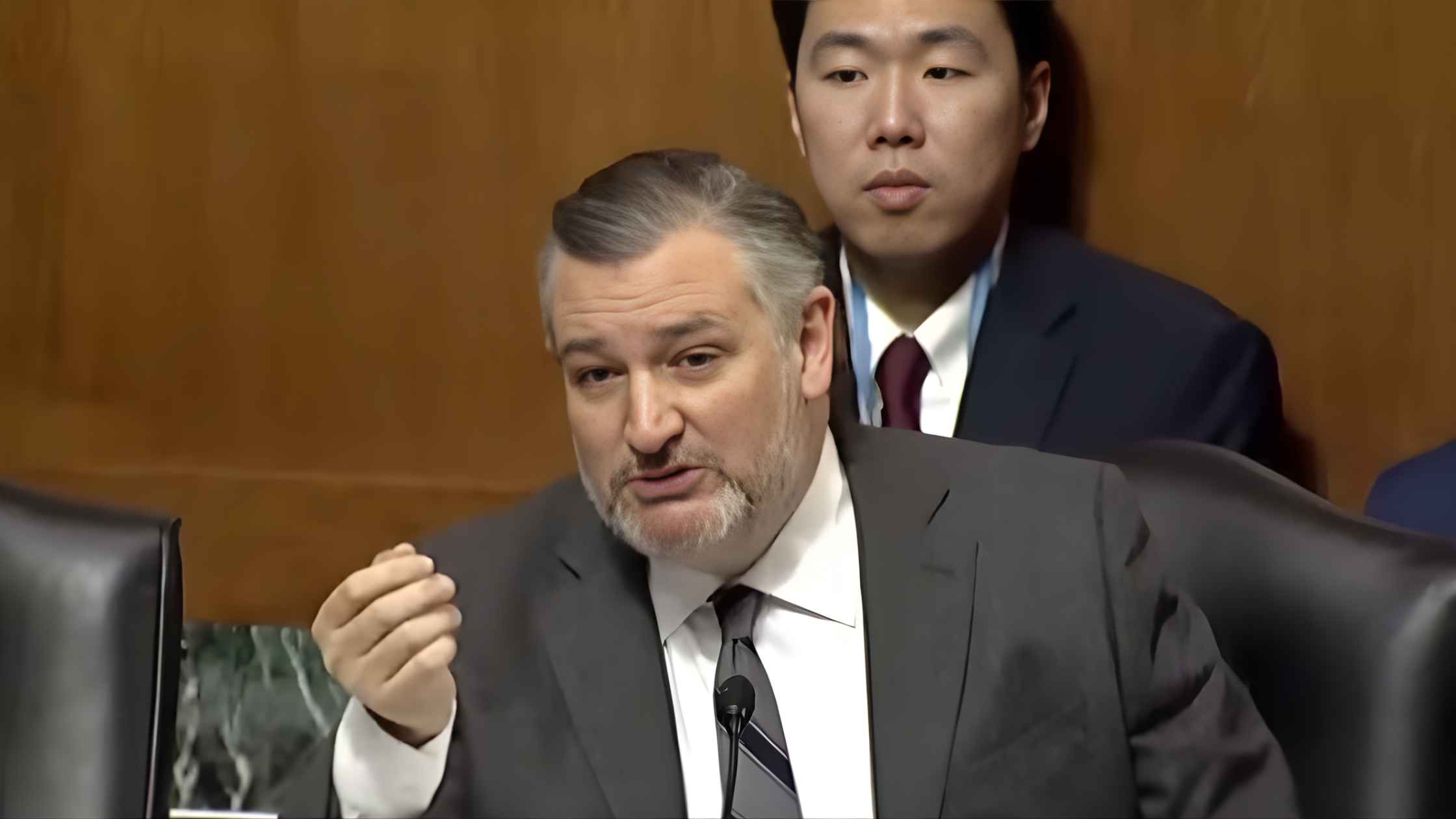
Sen. Cruz (16:08):
Good afternoon. The committee is called to order. Today's hearing is on impeachment, holding rogue judges accountable. The American Republic begins with a simple and radical truth. All power originates with the people. Before there is a Congress, before there is a president, before there are courts, there is the sovereign citizen. The founders place that principle on the very first line of our national charter. We, the people of the United States, in order to form a more perfect union, do ordain and establish this constitution. They did not say, we the judges, we the bureaucrats, we the elites. They said we the people.
(16:58)
James Madison wrote in Federalist 49 that the people are the only legitimate fountain of power. Each senator in this room, every judge, every government official is merely a temporary vessel of the power vested in the citizenry. We exercise it under their watch and when we would betray that trust, the Constitution empowers the people to cast us out of the offices we hold. That principle binds Congress established by Article 1 of the Constitution. Members of Congress stand for election at regular intervals so that the people may withdraw their consent if we fail to honor their trust. It binds the executive established by Article 2 of the Constitution.
(17:46)
The president, far from being a sovereign, is answerable to the electorate every four years. The people may renew his mandate or revoke it. The president can also be impeached. And this very same principle also binds the judiciary constituted by Article 3 of the Constitution, but solely by the mechanism of impeachment. Article 3 judges do not stand for election because the framers sought to shield judicial judgment from the temporary passions. Moreover, judges are given a generous standard of tenure, not as a princely privilege, but as a sacred trust to protect impartiality, but not to countenance misconduct. Because life tenure without accountability would be tyranny.
(18:44)
The framers provided a constitutional answer. Judges enjoy good behavior tenure enforced by Congress through impeachment. A judge who ceases to meet the standard of good behavior well ceases to hold office. As Hamilton explained in Federalist 81, impeachment "is alone a complete security against the danger of judiciary encroachments and judges misconstructions of the will of the legislature. When Hamilton identifies misconstructions of law as grounds for impeachment, he makes clear that the founders created impeachment to protect the government and the people from the wayward decisions of errant judges. But to grasp the full weight of that remedy, one must understand what the framers meant by impeachment.
(19:40)
If impeachment were confined to ordinary crimes, it would serve merely a symbolic purpose. When a judge commits murder or takes a bribe or defrauds the public, he or she will be indicted, convicted, and removed by a citizen jury because a man or woman in prison cannot sit on a federal bench. If criminality were the standard, impeachment would be a merely symbolic add-on to the criminal process. The framers rejected that narrow view. They knew that a republic requires two tribunals, one to publish crimes and another to protect the constitution. A jury of citizens has the power to judge crimes like theft and bribery and murder and fraud.
(20:23)
But only the Senate speaking for the states and for the people can render a verdict on public officials for the sins that escape the statute book, the quiet betrayals, the abuses of power, the subtle subversions that may violate no criminal statute, and yet strike at the very architecture of our republic. That's why the constitution adopts the broader term, high crimes and misdemeanors to describe the predicate offense required for impeachment. A phrase drawn from the English practice to denote breach of trust, abuse of official authority, and dereliction of constitutional duty.
(21:02)
As Hamilton wrote in Federalist 65, impeachable offenses are those offenses that involve "the abuse or violation of the public trust and injure society itself." And the historical record underscores that points. Criminal misconduct by federal judges has always been rare, bribery, perjury, fraud. In those cases, impeachment merely hastened what was already inevitable. But rarer still until now were the deeper offenses the framers feared most. Judges who, without necessarily breaking a criminal statute, violate the public trust, subvert the constitutional order, or wield their office in ways that injure society itself. That is why throughout history, Congress recognized that impeachable misconduct need not be criminal.
(21:54)
In 1803, Judge John Pickering was removed for drunkenness, mental deterioration, and unlawful rulings, conduct that rendered him incapable of faithful service. In 1936, Judge Halsted Ritter was convicted for behavior that brought his court "into scandal and disrepute." These cases are rare, but today the same category of constitutional injury is before us again in the matter of two federal judges. Chief Judge James E. Boasberg of the District Court for the District of Columbia and Judge Deborah L. Boardman of the District Court for the District of Maryland.
(22:38)
Judge Boasberg used the authority of his office to authorize and then to conceal targeting members of Congress, spying on the legislative branch and striking at the very heart of the constitutional speech and debate clause. No republic can survive if its judges help opposition officials surveil the people's elected representatives. In his own words, Judge Boasberg claimed that he "finds reasonable grounds to believe that such disclosure will result in the destruction of or tampering with evidence, intimidation of potential witnesses and serious jeopardy to the investigation." Now, about whom is he speaking?
(23:28)
Judge Boasberg signed that order concerning nearly 20% of the Republicans in the United States Senate. He made a judicial finding that multiple members of this committee "will result in the destruction or tampering of evidence." What basis did he have for that? He pointed to no evidence. The subpoenas were kept hidden from us contrary to law in violation of two USC Section 6628, which was enacted back in 2004 had been the law for 20 years. And we must view these in context. Judge Boasberg approved these subpoenas at the same time the Department of Justice was driving a politically charged prosecution of President Trump. An effort the voters themselves repudiated in last year's election.
(24:25)
Now, since then, it has come public that Judge Boasberg claims he did not know who he was authorizing those subpoenas directed to. That doesn't make it better, it makes it worse. When you have a judge printing out findings that the target of a subpoena will destroy evidence and he doesn't even know who the hell the target is, churning them out like place mats at a Denny's. That is directly contrary to the judicial oath and to the rule of law. Now to Judge Deborah Boardman. Judge Deborah Boardman's sentencing decision did not end with one defendant. It reverberated across the entire judiciary. She imposed a sentence 22 years below the sentencing guidelines.
(25:20)
On Nicholas Roske, a man who traveled, armed himself with a gun, a knife, duct tape, zip ties, and traveled across the country with the intent to assassinate Justice Brett Kavanaugh and other Supreme Court justices. The sentencing disparity is massive. The Department of Justice correctly recognized this as an act of domestic terrorism and sought a 30-year sentence. Judge Boardman, however, imposed a mere 8-year term, reducing the punishment by more than two decades, a sentence so drastically out of step with the gravity of the offense that it cannot be squared with any plausible understanding of the judicial duty and discretion.
(26:07)
She did so in her own explanation because Mr. Roske considered himself transgender. And because of that, instead of a 30-year sentence, he would be sentenced to eight years for the crime of attempting to murder at least one Supreme Court justice. To put that into context, Mr. Roske was 27 years old. In eight years, Mr. Roske will be 35 years old. And if Judge Boardman's sentence maintains, will be released and available to threaten judges and law clerks on the Supreme Court and throughout the country. That is a gross dereliction of duty.
(26:47)
For that reason today, I've sent a letter to the Speaker of the House calling on the House to immediately advance the pending articles of impeachment against Chief Judge Boasberg and Judge Boardman. Both of these judges, I believe, meet the standard for impeachment and for conviction and removal of office. And that is what this hearing today will address. With that, I recognize ranking member Senator White House.
Sen. Whitehouse (27:16):
Thank you, Chairman. Here are a few things that we know about calls for impeachment of judges. One, it's rare for a senator to call for a judge's impeachment because the senator would be a juror, but here we are. Two, impeachment isn't a remedy for judges getting decisions wrong. Appeal is the remedy for that as the Chief Justice has stated, and I offer as an exhibit, the news article reporting that statement by the Chief Justice.
Sen. Cruz (27:56):
It will be admitted to the record without objection.
Sen. Whitehouse (27:58):
Impeachment is a remedy for actual misconduct, as was the case with the last judge who was impeached. So when I first heard of this hearing about impeaching judges for misconduct, I thought maybe we'd get answers about Clarence Thomas paying his taxes. We know Justice Thomas failed to report on his financial disclosures more than a quarter million dollars in income from a forgiven loan. We know that people are regularly prosecuted for tax violations and false statements. That conduct would break criminal statutes. There's an obvious question. If income wasn't reported, wasn't declared on a judicial disclosure report, whether it was reported or declared to tax authorities. I've asked this question and it has been a matter of public concern, yet Thomas has offered no statement confirming any tax payment. Whether, when, and by whom his taxes on that income were paid are all unanswered questions. A simple answer was possible. Yes. I paid my taxes on that income on this date with these funds. No such statement came. Or this hearing could have been about the campaign of threats under the shadow of which the federal judiciary is now operating, a threat posture facing the federal bench unlike any time in memory. The threat campaign includes threats of impeachment that egg on other more nefarious and dangerous threats.
(29:55)
There is significant evidence of orchestration in the campaign of threats against Federal judges, yet the Marshal Service and our MAGA DOJ have repeatedly refused to confirm they'd investigate behind the utterer of a threat for orchestration or conspiracy or enterprise or other forms of joint liability. Again, a very simple answer was possible. Yes, we investigate for orchestration of threats. No such statement came. So instead of being hearing about the campaign of threats against judges, is this an effort just to egg on even more threats against judges? It is telling that it targets Chief Judge Boasberg, the Chief Federal Judge in the District of Columbia.
(30:47)
Five years ago this week, President Trump unleashed a violent mob on the US Capitol. Chief Judge Boasberg offended MAGA by sentencing January six rioters. MAGA World has decided that no crimes were committed that day. That's new. At the time, Senator Cruz described those crimes as a violent terrorist attack on the Capitol. Senator Cornyn said those who "planned and participated in the violence that day should be prosecuted to the fullest extent of the law." Senator Hawley said, "Those who attacked police and broke the law must be prosecuted." Chief Judge Boasberg also authorized temporary non-disclosure of requests for telephone toll records as part of the federal investigation into that day's crimes.
(31:41)
That is now regularly and falsely described as wiretaps. People on this committee should know the difference between toll records and wiretaps. MAGA faults Chief Judge Boasberg, because it was Republican senators whose records came up, but that's investigation 101. People under investigation had called senators. That's why Senator's toll records came up in the investigation. As Jack Smith testified, he did not choose those members, President Trump did. Moreover, Chief Judge Boasberg would not have known whose records these were.
(32:25)
As the Administrative Office of the Courts has explained, at the time when prosecutors applied for these orders, they did not include identifying indications like names of account holders, nor did they disclose the government's underlying subpoena. That was standard operational practice. And I'd offered the letter from the Administrative Office of the Courts as another exhibit.
Sen. Cruz (32:49):
It will be admitted to the record without objection.
Sen. Whitehouse (32:52):
So the applications would not reveal whether a particular phone number belonged to a member of Congress. Jack Smith's House testimony confirmed that he did not provide that information to Chief Judge Boasberg per DOJ's policy at the time. The administrative officer of the courts also made clear the judges do not approve grand jury subpoenas, and Smith's testimony, of course, confirmed that too. So if Chief Judge Boasberg didn't know whose toll records were the subject of the non-disclosure orders and he didn't approve the subpoenas, why did these attacks persist? Well, it appears that the grievances, the campaign, if you will, against Chief Judge Boasberg, seems mostly to involve the MAGA DOJ.
(33:43)
First, when FBI Director Patel lied to us that he couldn't describe his own grand jury testimony, he blamed it on a supposed court order from the "DC District Chief Judge," who is Chief Judge Boasberg. Boasberg exposed Patel's lie in a collateral civil proceeding saying Patel could divulge the contents of his own testimony and "nothing was preventing him from doing so before the committee." So when Patel came back, he had to lie again to us that his grand jury testimony given under immunity after he had asserted Fifth Amendment rights against self-incrimination had already been publicly released. That wasn't true either, of course.
(34:26)
Second, when DOJ wanted to illegally jet people in the dark out of the country to a Salvador and prison, Chief Judge Boasberg was on duty and ordered that stopped. This infuriated the MAGA DOJ. Then Principal Associate Deputy Attorney General Emil Bove told DOJ lawyers that if courts stopped these deportations, they'd need to be ready to tell judges F you, using the full four letter word. Boasberg, obviously a very likely FU target.
Sen. Whitehouse (35:00):
In that matter, considerable evidence of contempt of court by DOJ caused Boasberg to schedule contempt proceedings. We don't know all the facts, but we do know that two Trump judges on the DC Circuit stepped in and blocked that contempt hearing with a very unusual four month long administrative stay during which Bove, a subject of that DOJ contempt proceeding, was hustled through this committee onto the Third Circuit without any factual record from the contempt proceeding for the committee to see. Bove's judiciary hearing was so important to MAGA that Bonde and Blanche came over here to give the eyeball to colleagues present. After the full DC Circuit cleared Chief Judge Boasberg to resume his contempt proceedings examining Bove and DOJ, a handful of Republican senators within days, he was cleared Friday, the letter fell Monday, sent a letter to the DC Circuit Chief Judge seeking Judge Boasberg's suspension pending impeachment proceedings against him by House Republicans. Anything to stop the contempt proceeding into Trump's MAGA DOJ. And now we have the chairman's letter.
(36:26)
Adding to this, the MAGA AG had filed a misconduct complaint against Chief Judge Boasberg based on a private comment he allegedly made within the Judicial Conference. The Judicial Conference is an administrative, not adjudicative body, chaired by the Chief Justice whose proceedings are considered private. Here was the alleged offending comment. Chief Judge Boasberg raised his colleague's concerns that the administration would disregard rulings of federal courts leading to a constitutional crisis. The so called ethics complaint looks like yet another strategic tactic to block that contempt proceeding. Wait and see. Then in the recent CR, Republican senators retroactively made illegal Chief Judge Boasberg's lawful authorization of those NDOs, adding to the rhetorical heat. It gets worse. In November, Trump's personal lawyer, now MAGA's Deputy Attorney General, went before the Federal Society to urge war against certain federal judges, ones who are "repeat players," or "stop an entire operation or an entire administrative policy." He did not say Judge Boasberg's name yet, but this hearing today is not as coy. All of this looks very much like a MAGA coordinated strategy to bring pressure and threats to bear on a federal judge, an environment in which violent threats are prevalent, and in which Maga DOJ repeatedly refuses to assure us that proper investigative practices are being followed with regard to such threats. Presumably, the purpose is to scare Judge Boasberg off or block him from examining contempt of court by MAGA's Department of Justice. There was a time when I'd have hoped a Senate judiciary subcommittee would not be roped into a scheme to amplify pressure and threats against a sitting federal judge. But here we are in a hearing that specifically targets Chief Judge Boasberg, and look who wields the gavel.
Sen. Cruz (39:08):
There's an old line that when you have the law, you bang the law. When you have the facts, you bang the facts. And when you have neither, you bang the table. We've just seen an illustration of that. We've heard words like MAGA repeated over and over again. Trump repeated, "I've been called many things, but coy has never been one of them." And I would note nowhere in the ranking member's opening comment was one word about the orders that Judge Boasberg signed, the binding orders that concluded that he finds reasonable ground to believe that disclosing to the senators who were the target of the subpoenas will result in the destruction of or tampering with evidence, intimidation of potential witnesses and serious jeopardy to the investigation. There's a reason he didn't say a word about it because there is no evidence for a judge to conclude that 20% of the Republicans in the Senate would do that. And this is a judge who his actions indicate did not give a about actual evidence or the rule of law.
(40:11)
Likewise, two words that were altogether absent from the ranking member's comments were Deborah Boardman. He gave a speech about violence directed at judges, not acknowledging that for four years, the Biden Department of Justice refused to enforce clear laws protecting judges from being intimidated at their homes because the Biden Department of Justice agreed with that intimidation, and said not a word about this rogue judge who deviated downward by 22 years to a psychopath who traveled across the country with a gun and a knife and duct tape to murder Justice Brett Kavanaugh. My Democrat colleagues on this committee do not get to give great speeches about how opposed they are to violence against their judiciary and at the same time cheer on a judge saying, "Well, if you attempt to murder a Supreme Court justice and you happen to be transgender, not a problem, we're going to deviate downward by more than two decades." Facts matter. I need not bang the table because I'm happy to bang the facts and the law.
(41:24)
Now, I would note that both Chairman Grassley and Ranking Member Durbin asked to give opening statements. Chairman Grassley has yielded his time instead to Senator Lee, and so I will recognize Senator Lee, although… I'll give the ranking member an opportunity to respond if he would like.
Sen. Whitehouse (41:44):
We believe that the ranking member, Senator Durbin, will be here.
Sen. Cruz (41:48):
Good.
Sen. Whitehouse (41:49):
And with respect to at least two of your points, I'm not aware of anybody on our side of this committee who cheered on that sentence or even commented on it, so I don't think that's a factual statement. And second, with respect to me not discussing the Boasberg NDO, I stand by the administrative office of the court's letter, which I put into the record, which explains the problematic nature of the allegations against him in that regard, and I continue to stand by the letter from the administrative office of the courts.
Sen. Cruz (42:20):
Mr. Chairman. Senator Kennedy.
Chair (42:24):
You coy [inaudible 00:42:26].
Sen. Cruz (42:27):
Twice in one day.
Chair (42:29):
After Senator Lee makes his remarks, could we hear from the witnesses?
Sen. Cruz (42:35):
Unless Senator Durbin comes, because as ranking member, he's planning to come and address. So now in lieu of Senator Grassley, I will just note that Senator Grassley has suddenly gotten much younger and not nearly as good looking.
Mike Lee (42:48):
Yeah, but he's lost hair. He's lost hair.
Chair (42:51):
He's not as coy.
Mike Lee (42:53):
Right. Thank you, Chairman Cruz and Ranking Member Whitehouse for hosting, convening this subcommittee hearing on an important topic. This issue implicates a pretty significant role assigned to Congress by the Constitution, which is to determine under what circumstances actioned by a federal judge might warrant that judge's impeachment and removal. Judicial impeachment is and should remain, should always be, something that we would hope would be rare. The founding fathers granted life tenure for a reason, and that is to protect the independence of the federal judiciary. The point there is not to shield them in absolute terms from all accountability, but rather to protect their independence while also preserving a mechanism by which to address acts of significant wrongdoing. Article three itself guarantees that judges will hold their office for presumptive lifetime terms, but only during good behavior. When a judge disregards the rule of law, undermines the separation of powers, endangers public officials, or otherwise acts in a manner that takes him or her outside the universe of what we would call good behavior, as described in the Constitution, the Constitution requires, or at least contemplates, that Congress will take notice.
(44:26)
In such circumstances, Congress may use impeachment and removal to restore constitutional balance and public trust. Our republic would be undermined. I mean, some might argue that it couldn't endure properly if judges were permitted to display partisan bias, flout, binding legal authority, or otherwise disregard and disrespect their judicial role. We've recently witnessed some troubling developments in these areas. One that I'll mention at first is the attempted assassination of a sitting Supreme Court justice. On June 7th, 2022, Nicholas Roske traveled all the way from California to the Washington D.C metropolitan area, carrying a gun, a knife, and some other equipment, all with the intent of murdering Associate Justice Brett Kavanaugh. From the airport, he went directly to Justice Kavanaugh's home and abandoned his plan to murder Justice Kavanaugh only after observing the presence of law enforcement at the residence.
(45:34)
Evidence showed that Roske acted with intent to influence the court, not just in the abstract, but in a particular case then pending before the Supreme Court of the United States, its decision in the Dobbs matter, motivated by anger over a draft opinion that had been unlawfully leaked to the press. Roske pled guilty to the attempted assassination of Justice Kavanaugh. The Department of Justice sought a sentence, a sentence consistent with federal statute and consistent with the US federal sentencing guidelines, 30 years to life, and the defense did not dispute that calculation. Nonetheless, Judge Deborah Boardman imposed a dramatically lower sentence of only eight years. Now, at the sentencing, the judge emphasized personal circumstances, including family considerations and concern about prison placement based on Roske's asserted transgender identity. In so doing, the judge minimized the gravity of a crime intended to murder at least one Supreme Court justice to alter the course of one branch of government.
(46:50)
Now, had Roske succeeded in what Roske had planned to do, the stability of our constitutional system would've been gravely undermined in ways that I believe were calculated to send us into a constitutional crisis downward spiral. A crime warranting decades of imprisonment should not, in those kinds of circumstances, warrant a mere eight year sentence. Now, Judge Boardman, reasoned that the prospect of 10 years in prison, which is not what she imposed, it was eight years, but the reason that a decade long sentence would be sufficient to deter an irrational person from attempting such an attack, that assertion reflects a serious misunderstanding of history and of the unique circumstances presented by this case, not to mention the apparent motivation of the defendant in that case. President Trump was nearly assassinated not once, but twice in 2024, just in the few months leading to the November 2024 presidential election, and then conservative activist, Charlie Kirk was murdered just a few months ago.
(48:08)
Some cabinet members and some White House officials have been forced to move themselves and their families onto military bases just to protect them from violent threats. Then just this week, several windows in the private residents of Vice President JD Vance in Ohio were smashed during an attempted break-in of that residence. Thankfully, the vice president and his family were not at their Ohio residence at the time this occurred. When a judge treats the attempted assassination of a Supreme Court justice as an ordinary criminal case, and I'm not conceding here that that would've been appropriate in an ordinary case, but it certainly wasn't appropriate here. When that happens, particularly in a case like this one, it does raise pretty grave questions about judgment, about duty, about deterrence, such extreme leniency in those circumstances, accompanied by what can most generously be characterized as extreme naivete about the motivation and repercussions of these kinds of actions, risk encouraging others to use violence to influence the judiciary, especially at a time when politically motivated violence is rising.
(49:32)
Meanwhile, as Senator Cruz mentioned just a moment ago, you had protests occurring at the residences of individual Supreme Court justices throughout the Biden administration, particularly in the wake of the Dobbs opinion in 2022, and a few weeks before that, the illegally leaked copy of it, that inexplicably went unenforced, notwithstanding a prohibition in an existing federal statute. Then more recently, we've had other problems, and these should all be things that concern us. The second example I'll point to today concerns judicial interference with the constitutional functions of Congress and, to a degree, of the executive branch. Chief Judge James Boasberg of the US District Court for the District of Columbia made some decisions that affected congressional oversight in a meaningful way by imposing secret gag orders on telecom providers. Despite a longstanding federal requirement mandating notice to members of Congress under circumstances in which their data, their telephone data, has been requested, has been subpoenaed. Now, these gag orders required private parties to facilitate what many have fairly characterized as politically motivated actions taken by the Biden Department of Justice against certain members of Congress.
(51:15)
More recently, Judge Boasberg issued an order intruding into a confidential executive branch meeting involving a cabinet secretary and a federal appellate judge and senior Justice Department leadership. Again, raising serious separation of powers concerns. These matters are not mere garden variety day-to-day disagreements over judicial philosophy or statutory interpretation. There are a lot of different opinions on this committee and on this subcommittee on those matters, on how best to interpret a federal statute, on how best to ascertain the meaning of a federal statute, the importance to attach, for example, to the original public understanding of statutory text at the time of its enactment, but that's not what we're talking about here. These things that we're talking about here involve something much more fundamental. They involve the misuse of judicial authority, what Alexander Hamilton described as the abuse or violation of some public trust.
(52:18)
Such misconduct, Hamilton explained, constitutes an injury to society itself, to our constitutional order itself. Congress does not approach judicial impeachment, or any kind of impeachment, lightly, nor should it ever. Of thousands of federal judges, only 15 have been impeached and only eight of those convicted. But abuse of official power has always been recognized as impeachable, and under appropriate circumstances, where the Senate finds it, removable. When a judge disregards sentencing norms in the face of an attack on the Supreme Court or repeatedly interferes with the lawful functioning of Congress and the executive, these are not routine errors arising out of some good faith, genuine disagreement as to canons of statutory construction or otherwise. These are not things that can simply be corrected on appeal on a case by case basis. They're breaches of the public trust that have the ability to circumvent the constitutional order and they demand congressional scrutiny. I look forward to our witness's testimony. Thank you.
Sen. Whitehouse (53:27):
Mr. Chairman. Ranking Member Durbin is running late. We understand from your team that you've extended him the courtesy of making his statement when he arrives. I thank you for that, and I would ask consent that the following additional documents be entered into the record at this point. One is a statement by the Article Three Coalition of Retired District and Circuit Judges denouncing inappropriate calls to impeach judges for their decisions entitled 'Keep Our Republic'. Second is a statement by the American Bar Association from its president denouncing inappropriate calls to impeach judges for their decisions. The next is a statement by Professor Michael Gerhart, who is a leading impeachment expert on the lack of any historical or legal basis to impeach federal judges for their decisions. Next is a statement again by the Article Three Coalition, this on inappropriateness of Deputy Attorney General Blanche's comments regarding going to war against federal judges.
(54:26)
Next is a statement by citizens for responsibility and ethics in Washington on the inappropriate campaign to intimidate judges. And last is a statement by Judge Michael Ludig regarding this proceeding, whose punchline is to describe Professor Luther's testimony as contemptable.
Sen. Cruz (54:44):
Mr. Chairman. Without objection, all of the statements will be admitted. Senator Kennedy.
Chair (54:48):
I'd like to submit a statement and Kennedy would like to hear the witnesses.
Sen. Cruz (54:54):
Without objection, that will be submitted as well. At this point, I'm going to introduce each of the witnesses, recognize them for their opening statements, and as Senator Whitehouse noted, when ranking Member Durbin arrives, I'll give him the opportunity to present an opening statement. Our first witness is Rob Luther. Robert Luther III currently serves as a professor of law at the Antonin Scalia Law School at George Mason University. In his career, Professor Luther has served at high levels in all three branches of the federal government, and is the founder of Constitutional Solutions PLLC. Immediately before joining the Scalia Law Faculty, Professor Luther spent over five years in the Washington DC office of Jones Day. Before joining Jones Day, he served as associate counsel to the President of the United States and the White House Council's office. In the White House, he co-managed the judicial selection process and supervised the preparation of over 150 federal judicial nominees for their successful US Senate confirmation hearings.
(55:50)
Before joining the White House, Professor Luther served as counsel to then US Senator Jeff Sessions on the US Senate Judiciary Committee. Professor Luther was also a law clerk to Judge Daniel Manion of the US Court of Appeals for the Seventh Circuit. Our second witness is Professor Steven Vladeck. Professor Vladeck is a professor of law at Georgetown University Law Center and is an expert on the federal courts, the Supreme Court, National Security Law and Military Justice. Professor Vladeck is the author of a New York Times bestselling book and a co-author of Aspen Publisher's Leading National Security Law and Counter-Terrorism Law case books. Professor Vladeck is a highly regarded appellate advocate, having argued before the US Supreme Court and numerous lower federal civilian and military courts. Professor Vladeck is CNN's Supreme Court analyst, an editor and author of One First, a weekly newsletter about the Supreme Court.
(56:46)
Professor Vladeck graduated from the Yale Law School in 2004, a sin for which I suppose we can forgive him. After law school, he clerked for the honorable Marsha S. Berzon on the US Court of Appeals for the Ninth Circuit, and the honorable Rosemary Barquette on the US Court of Appeals for the 11th Circuit. Our final witness is Mr. Will Chamberlain, who currently serves as senior counsel at the Article Three Project. Will graduated from the University of the Pacific in 2010 with a BA in economics and received his JD Magna Cum Laude from the Georgetown University Law Center in 2015. After graduating Georgetown University Law Center, he joined Quinn Emmanuel Erkhart and Sullivan in Los Angeles as an associate where he practiced complex commercial litigation. He later worked as an attorney at the Competitive Enterprise Institute focusing on class action litigation. In 2019, he revived Human Events, the nation's oldest conservative magazine, where he served as publisher and editor-in-chief. And Professor Luther, you are recognized for your opening remarks.
Prof. Luther (57:48):
Chairman Cruz, Ranking Member Whitehouse and members of the subcommittee. Thank you for this opportunity to testify about the history of judicial impeachments with an eye towards whether recent conduct by federal judges warrants any action from Congress. Impeachment is an Article One response to misconduct, criminal or non-criminal, necessary to preserve the impartial administration of justice. In Federalist 65, Alexander Hamilton defines impeachable offenses as those done to society itself by the misconduct of public men. Importantly, Hamilton stressed that Congress as the impeaching body must be given broad discretion in that determination. When the Constitution was ratified, it didn't define impeachment expressly, but we know from its text that the House holds the power to impeach and the Senate holds the power to convict with a two-thirds vote, that judges hold their offices during good behavior, and the judges shall be removed from office if impeached for high crimes or misdemeanors.
(58:41)
But what standards should govern your votes? While the standards for impeachment are deliberately flexible, precedents where members of Congress have applied them provide valuable historical context for those concerned with institutional integrity and consistency. Of the thousands of federal judges confirmed by this body and appointed by the president, only 15 have been impeached by the House, with only eight suffering convictions here. There is something of a modern misconception, perhaps drawn from Article Two's high crimes and misdemeanors language, that Congress may only impeach a judge for extrajudicial conduct, such as perjury or tax evasion, but not for their conduct on the bench. It's easy to understand this modern misconception because the last seven judicial impeachments dating back to 1933 have followed this trend, but this trend is not the rule. To the contrary, the majority of impeachments from the founding until the 1920s involved abuses of power flowing from judicial conduct on the bench.
(59:35)
Consider these precedents. In 1804, Justice Samuel Chase was impeached by the House. The eight charges against him included revealing his interpretation of the law before defense counsel could be heard and failing to comply with state law regarding the arrest and confinement of a defendant. A majority of senators found Justice Chase guilty on three of the eight charges, but they did not secure the necessary two-thirds vote for conviction. In 1830, Judge James Peck, and then in 1904, Judge Charles Swain were impeached for abusing the contempt power and disbarring attorneys without cause. Both were acquitted by the Senate. In 1926, Judge George English was impeached by the House on charges of abuse of power and financial impropriety. Amongst his offenses, he summoned several government officials to appear before him in an imaginary case and berated them with profanity. Before his impeachment trial, Judge English resigned from the bench. So without a doubt, the House has impeached judges who abused their official power on the bench.
(01:00:29)
Now, turning to the recent conduct of Chief Judge James Boasberg of the US District Court for the District of Columbia. When I first read about Judge English resigning after summoning government officials in an imaginary case, both Arctic Frost and Judge Boasberg's jurisdictionally thirsty contempt proceedings against DOJ came to mind. This bipartisan body passed a law, two USC 6628, that imposed an affirmative obligation on telecom service providers to notify members of Congress when their records are subpoenaed. Inexplicably, 6628 was ignored when Jack Smith sought your phone records and Judge Boasberg entered a secret three sentence gag order that denied many of you the process required by the law and the protections of the speech and debate clause of the Constitution. Unfortunately, Jack Smith went fishing and Judge Boasberg handed him a reel. Now, Judge Boasberg will surely dispute this characterization by citing Jack Smith's House Judiciary Committee testimony where the former special counsel appears to confess that his team did not notify Judge Boasberg that congressional Republicans were subjects of the gag order. But even if true, one must ask on what basis Judge Boasberg found that the disclosure of subpoenas "would result in destruction of or tampering with evidence, intimidation of potential witnesses, and cause serious jeopardy to the investigation." Did Judge Boasberg merely rubber stamp the requested gag order, or was he willfully blind the identities of those subpoenaed? Equally troubling is Judge Boasberg's failure to enter a show cause order against Smith for withholding your identities. Smith had a duty not to ask for an order that violated 6628, yet he did so. Judge Boasberg had a duty to make sure his gag order could be lawfully entered, yet he failed to do so. Both owe this committee an explanation. Judge Boasberg's failure to require Smith to show cause for the special counsel's office's misconduct proves particularly troubling when contrasted with his behavior in the second imaginary case he handled, JGG versus Trump. That case involved petitioners who sought habeas relief from Judge Boasberg, even though they were not physically within the court's jurisdiction.
(01:02:32)
Undeterred, Judge Boasberg decided to pursue contempt proceedings, finding that there was probable cause that the Trump administration violated his TRO. Here, the imaginary case language again resonates as Judge Boasberg has continuously imagined he ordered something that he had in fact not ordered. Yet Judge Boasberg's abuse of power extends further still. In late November, he entered an order demanding the unprecedented public disclosure of an executive branch meeting between a cabinet official, a recently confirmed federal appellate judge, and the second highest ranking official at the Justice Department. The DC Circuit has not only stayed Judge Boasberg's order, it's directed briefing to state the legal basis. Not only is Judge Boasberg seeking to interfere with the executive branch's operations through the contempt proceeding, two weeks ago, he ruled that the Trump administration must either facilitate the return of illegal alien gangsters or provide due process hearings for them in Venezuela. These latest intrusions into the coordinate branches call to mind the old adage that a mistake repeated more than once is a choice.
(01:03:33)
Well, you too may have a choice. Judge Boasberg's contempt for the separation of powers fits not only comfortably within the impeachment standards described by Hamilton and the precedents referenced below, he deserves a unique category of his own. Professor Jonathan Turley observes, in relation to the secret subpoenas, "It is difficult to overstate the gravity of this intrusion to the legislative branch. The cloak of judicial independence does not shroud a judge from accountability, before this body or the public." For facilitating violations of the Constitution, federal statutory law and abusing members of this body and for pursuing a vengeful contempt expedition into the highest echelon of our national security officials, Judge Boasberg must be held accountable. I welcome your questions.
Sen. Cruz (01:04:15):
Thank you, Professor Luther. Now recognize Professor Vladeck.
Prof. Vladeck (01:04:19):
Thank you, Chairman Cruz, Ranking Member Whitehouse, distinguished members of the subcommittee. Thank you for the invitation to testify today. Judicial accountability is a subject in which I have long held a deep and abiding interest, and I would have welcomed an opportunity to explore with you how this subcommittee can better promote it across the entire federal judiciary, including at the Supreme Court. Unfortunately, today's hearing is focused on something else altogether, calls to impeach two highly regarded federal district judges, all because some members of the subcommittee and my fellow witnesses disagree with some of their rulings. As someone who spends a lot of time disagreeing with judicial decisions, I can certainly relate to that impulse, but I respectfully submit that the subcommittee's efforts here are deep Deeply misguided for at least three reasons. First, as we've already heard today, impeachment has not been, is not, and in my view, should never be a remedy for rulings with which some or even many of us disagree, even when one tries to characterize those disagreements as a separation of powers violation.
(01:05:16)
Rather, as Senator Whitehouse already introduced into the record, Chief Justice Roberts reminded us just last March that the normal appellate review process exists for that purpose and is indeed well underway in the case arising from Judge Boardman's courtroom. Since the 1805 acquittal of Justice Samuel Chase, 13 federal judges have been impeached none for the substance of their rulings or for claims of partisan bias or based on assertions that they were somehow rogue or activist, whatever those deliberately standardless descriptors are supposed to actually mean. It's not just that we haven't impeached judges because of disagreement with their rulings, it's that we shouldn't. If judges and justices could be impeached for no reason other than those kinds of disagreements, then the judicial independence enshrined in Article Three, and which has been extolled by members of the committee already this afternoon, wouldn't mean very much. That principle applies even when there's a consensus that the judges erred in the relevant cases.
(01:06:14)
It applies a fortiory to cases such as the ones at issue today in which no such consensus exists and in which one must radically distort and misstate the factual record and/or legal authorities, including describing very real cases about very real people as imaginary to even attempt to identify the type of misconduct here that has historically been impeachable. Second, it's not just that impeachment isn't and shouldn't be a remedy for judges who issue rulings with which we disagree. It's that now is an especially dangerous moment for this subcommittee to be suggesting otherwise, as we are seeing unprecedented attacks and threats against many of these same judges from senior executive branch officials. These include President Trump calling for the impeachment of specific judges. White House Deputy Chief of Staff Steven Miller claiming that any judge who rules against this administration is part of a judicial insurrection, Attorney General Bonde filing a frivolous misconduct complaint against Chief Judge Boasberg, and Deputy Attorney General Blanche's remarkable remarks at the Federal Society National Convention repeatedly suggesting that his department is "at war", not just with a handful of judges, but with the federal courts.
(01:07:26)
These attacks are not happening because all of a sudden hundreds of federal judges have lost their minds. They're happening because far more than any other government institution, including, I regret to say, this subcommittee, it has been these same federal judges who have done the most over the past 11 months to hold the executive branch accountable to the law. My written testimony cites the data, but suffice it to say that the hundreds of rulings against the Trump administration have come from a remarkably large number of ideologically and geographically diverse federal judges, including dozens appointed by President Trump. The point, Mr. Chairman, is not that this volume proves that any or all of these rulings are correct. Rather, is that judicial accountability is and ought to be a two-way street. And when so many different federal judges are enforcing the Constitution and statutes passed by Congress against the executive branch, it seems to me that the subcommittee should be doing everything it can to support them.
(01:08:22)
Holding this hearing is literally the opposite of that. After all, it's not just that these kinds of attacks erode public faith in the courts, it's that they provoke very real and very serious physical threats against the judges themselves, threats that the subcommittee at least used to take seriously. As Chief Justice Roberts warned a year ago, public officials certainly have a right to criticize the work of the judiciary, but they should be mindful that in temperance in their statements when it comes to judges may prompt dangerous reactions by others. The same can be said, I fear, of much of what's already been said this afternoon and much of what I suspect is to come. Finally, unless there be any doubt on this point, it is not my view that judges or justices should be immune from criticism. I would be out of a job if it were otherwise.
(01:09:05)
Indeed, I fully agree that informed criticism, to quote Chief Justice Roberts' 2024 year-end report, "Results in a better informed polity and a more robust democracy." But it seems to me at the very least worth articulating and doing our best to hew to a line between the type of substantive informed criticism of judges and judicial decisions to which the chief justice was referring and attacks that are light on analysis and that are instead focused either on ambiguous and untestable innuendo or easily rebuttable ad hominems. I harbor no illusion that I have perfectly respected this line throughout my career, but I've aspired to do so. And whatever you may think of my work in this regard, the subcommittee should be striving to do the same. Thank you again, and I welcome your questions.
Sen. Cruz (01:09:49):
Thank you, Professor Vladeck. Recognize Mr. Chamberlain for your opening statement.
Mr. Chamberlain (01:09:53):
Thank you, Chairman Cruz, Ranking Member Whitehouse and distinguished members of the subcommittee for the opportunity to testify today.
Mr. Chamberlain (01:10:00):
On June 7th, 2022, Nicholas Roske flew from his home in California into Washington Dulles Airport. His suitcase contained a gun, knife, and other equipment that would help him in his plan to assassinate Supreme Court Justice Brett Kavanaugh. After arriving at Dulles, he took a taxi directly to Justice Kavanaugh's home. Only upon noticing the presence of law enforcement did he realize that his plan is futile and give up, calling 911 and allow himself to be detained. Mr. Roske pled guilty without a plea agreement to violating 18 United States Code Section 351(c) for attempting to assassinate a Supreme Court justice. There was no dispute as to the proper application of the United States sentencing guidelines in this case. DOJ and Mr. Roske's attorneys agreed that the guideline sentencing range for Mr. Roske was 30 years to life.
(01:10:42)
Yet, despite the reprehensible nature of Roske's conduct and the threat it posed to our republic, Judge Deborah Boardman sentenced Nicholas Roske to just 97 months in prison. At sentencing, Judge Boardman described herself as, quote, "heartened" by how this terrible offense has drawn the Roske family closer and has helped them understand Ms. Roske's profound mental health struggles and accept her for who she is. Judge Boardman stated that when she weighed, quote, "How much additional incarceration is sufficient, but not greater than necessary to punish Ms. Roske", that she would, quote, "take into consideration the fact that she, a transgender woman, will be sent to a male-only Bureau of Prisons facility." Apparently, Judge Boardman saw her role as family therapist, healing the wounds of the Roske family and protecting Nicholas Roske's claimed gender identity, rather than a federal judge responsible for imposing a just sentence on a would-be assassin. Judge Boardman further stated that, quote, in her estimation, "no rational actor would choose to commit a crime like this if it will strip them of their freedom, ostracize them from society, and separate them from their family for 10 years." This statement shows a bewildering lack of historical understanding. Political assassinations have been with us for thousands of years. Four sitting presidents have been assassinated: Lincoln, Garfield, McKinley, and Kennedy. Gavrilo Princip's assassination of Archduke Franz Ferdinand was the catalyst for World War I. President Trump was nearly assassinated twice last year. And of course, my good friend and our good friend, conservative activist Charlie Kirk, was assassinated less than three months ago.
(01:12:05)
History tells us that evil yet rational human beings will commit inhuman acts, sacrificing their lives or liberty in the process if they believe they can effectuate political change. Nicholas Roske was no different in this respect to Thomas Crooks, Ryan Routh, Tyler Robinson, Gavrilo Princip, or John Wilkes-Booth. And Congress must have certainly understood this when it sought to impose the maximum penalty on assassination, which Judge Boardman blindly ignored when she declared that a sentence of roughly 10 years was sufficient to deter the would-be assassins. Impeachments of judges are relatively rare through our nation's history, to insulate the judicial process from politics and protect the rule of law. Judge Boardman's case, however, is the rare one where a judicial impeachment would vindicate the integrity of the judiciary and protect judges from improper influence. Nicholas Roske tried and failed to assassinate Justice Kavanaugh. The evidence presented at sentencing demonstrated that he did so because he wanted to change the Supreme Court's jurisprudence on abortion. Judge Boardman's slap on the wrist for Mr. Roske if left to stand will only encourage others upset with judicial decisions to try similar tactics. The danger is not hypothetical. President Trump was an inch away from being murdered on live television. Charlie Kirk is dead. A number of prominent cabinet members and senior White House officials have been forced to move their families onto military bases to protect them from violent threats.
(01:13:17)
Professor Frank Bowman has explained that a single act of sufficient gravity that inflicts sufficient damage on the constitutional order can constitute an impeachable offense when it, quote, "subverts the separation of powers or undermines judicial independence", end quote. That is the best way to understand why Judge Boardman should be impeached. Nicholas Roske's crime was no ordinary attempted murder. It was the attempted assassination of a Supreme Court justice of the United States. There can be no graver attack on our constitutional order or on the independence of federal judges. Judge Boardman's garden variety sentence of just 97 months ratified Mr. Roske's conduct as a garden variety federal crime. That one grave, destructive act is sufficient to justify her impeachment. Thanks for the opportunity to testify.
Sen. Cruz (01:13:59):
Thank you.
Sen. Whitehouse (01:13:59):
Mr. Chairman, as we turn to Ranking Member Durbin, may I also ask consent that an article by Jonathan Turley, whose name was mentioned by Professor Luther, be added to the record, whose title is No, The House Should Not Impeach Judge Boasberg.
Sen. Cruz (01:14:14):
Without objection, will be added to the record. Ranking Member Durbin?
Dick Durbin (01:14:16):
Thank you very much, Senator Cruz and Senator Whitehouse. Sorry I'm late to attend this meeting, but it's an important one. I just want to make a brief statement and then I'll take my turn in asking questions. I understand my Republican colleagues are upset that Special Counsel Jack Smith issued subpoenas for the phone records of several Republican senators who President Trump tried to enlist in his conspiracy to overturn the results of the 2020 election. If my Republican colleagues are concerned about this, they should call Special Counsel Smith to testify under oath before the committee in an open hearing, as he has repeatedly offered to do so. The Democrats have proffered him as a witness before this committee repeatedly; the Republican majority will not allow him to testify in public under oath.
(01:15:07)
Indeed, Mr. Smith testified under oath about his actions in a closed door deposition in the House Judiciary Committee. Here's what he said about why those records were subpoenaed, and I quote him. "Donald Trump directed his co-conspirators to call these people to further delay the proceedings. He chose to do that. If Donald Trump had chosen to call a number of Democratic senators, we would have gotten toll records for a number of Democratic senators. I did not choose those members, President Trump did." Thank you, Mr. Chairman.
Sen. Cruz (01:15:39):
Thank you, Ranking Member. I would now ask each of the witnesses to stand and raise your right hand for the oath. Do you swear that the testimony that you're about to give before this subcommittee is the truth, the whole truth, and nothing but the truth, so help you God?
Mr. Chamberlain (01:15:56):
Yes.
Prof. Luther (01:15:56):
Yes.
Prof. Vladeck (01:15:56):
Yes.
Sen. Cruz (01:16:02):
And ordinarily, I would've done that before your opening statements, but I'm hopeful you were truthful in those as well.
(01:16:14)
Let's start with Judge Boasberg. Professor Luther, is it consistent with a judge's oath of office to sign an order for which there is zero basis in law and zero basis in fact?
Prof. Luther (01:16:27):
Absolutely not.
Sen. Cruz (01:16:28):
Is it consistent with a judge's oath to do whatever a prosecutor asks him without inquiring as to the facts or the law?
Prof. Luther (01:16:38):
It's completely inconsistent.
Sen. Cruz (01:16:41):
Judge Boasberg signed multiple orders, I'm holding one of them in my hand, that's his signature at the bottom, ordering the phone companies who'd been subpoenaed not to disclose to the members of the Senate and the members of the House that their phone records had been subpoenaed. As you noted in your testimony, that order is directly contrary to federal statute. Congress in 2004 made it illegal for a phone company to disclose a senator's phone records without notifying the senator in question. Is there any basis for a judge to disregard unambiguous federal statutory language?
Prof. Luther (01:17:19):
Absolutely not.
Sen. Cruz (01:17:21):
Judge Boasberg signed an order that says, quote, the court finds "reasonable grounds" to believe "that such disclosure", in other words, informing the senators their phone records had been subpoenaed, "will result in the destruction of or tampering with evidence, intimidation of potential witnesses, and serious jeopardy to the investigation". Is there any conceivable basis for Judge Boasberg signing that, particularly given Jack Smith's testimony now that Judge Boasberg had no idea whose phone records he was signing off on?
Prof. Luther (01:17:59):
I've been struggling for the last few weeks to come up with one, but I can't. And I'll mention we wouldn't even know about this if it weren't for Chairman Grassley's oversight efforts.
Sen. Cruz (01:18:07):
That is true. And Professor Vladeck, you suggested the remedy for an erroneous decision is appeal. Judge Boasberg signed a secret non-disclosure order that was ex parte with only the Department of Justice in front of him. Is there any conceivable universe in which anyone could appeal that?
Prof. Vladeck (01:18:27):
So, Senator, as you know, there are circumstances in which the providers can decline to comply. Indeed, I believe in one of the cases, Verizon actually said it was not going to comply with the NDO. I believe that's part of the record as well. And those orders are themselves also subject to challenge in court. Now, Senator, you and I have had this conversation for a long time about how there are lots of gaps in federal law when it comes to the targets of surveillance not being able to object-
Sen. Cruz (01:18:53):
Did the targets of surveillance know about this?
Prof. Vladeck (01:18:55):
No, but I would also remind-
Sen. Cruz (01:18:56):
Could the senators whose records were subpoenaed, contrary to federal law, appeal it?
Prof. Vladeck (01:19:01):
So, no, but of course, Judge Boasberg didn't know first that these were senators; second, that their communications were covered by [inaudible 01:19:08].
Sen. Cruz (01:19:08):
Professor Vladeck, nor did he inquire. And in fact, I'm going back to Professor Luther's statement, because in an ordinary circumstance, a judge entering an order that he doesn't know who it's applying to, he doesn't know any facts, he doesn't know anything, in the ordinary basis, you'd say, "Yeah, there's zero basis in fact." But there is actually an explanation for why he did so. Because Judge Boasberg did know one thing; he knew that Jack Smith was a partisan Democrat engaged in an effort to go after Donald Trump, that he was subpoenaing over 400 Republicans. So, the one thing he knew is all of these targets were Republicans. So, the only conceivable basis for Judge Boasberg signing these orders one after the other is an animus that says every Republican on planet Earth, every American who voted for Donald Trump, there is reasonable basis to believe they are criminals.
Prof. Vladeck (01:19:55):
Senator, I don't-
Sen. Cruz (01:19:56):
I'm done with your question.
Prof. Vladeck (01:19:57):
I'm sorry.
Sen. Cruz (01:19:58):
There is no other basis for his signing that order. He knew that. He knew Jack Smith. "Welcome to the fast food counter at McDonald's. Whatever you want, all the fries you want, I will sign, ordered, ordered, ordered." That is perfectly fine if you are the chairman of the DNC, being a partisan hack. Or for that matter, the chairman of the RNC, either side can be partisan hacks. Judges are expected not to be.
(01:20:27)
And I would point out this is a pattern we've seen before for four years during the Biden DOJ. We saw the Department of Justice refuse to enforce the law when violent protestors were outside the homes of Supreme Court justices. It was directly contrary to 18 USC Section 1507. It was a felony on national television, being committed over and over and over again, and Merrick Garland, a rogue partisan attorney general, refused to enforce the law. Why? Because he supported the objectives of the protestors. That kind of hypocrisy, let me be clear, I would object to an order that found Democrat members of the Senate, absent real and meaningful evidence, were likely to be criminals. That's what Judge Boasberg signed off on.
(01:21:14)
By the way, Judge Boardman. Mr. Chamberlain, what are the consequences of a partisan, left-wing judge concluding, "Because of my ideology, coming to attempt to assassinate a Supreme Court justice is okay. I'm going to give you a slap on the wrist. I'm going to deviate down 22 years and release you when you're 35 years old so you can terrify other judges." What are the consequences of that?
Mr. Chamberlain (01:21:46):
Potentially devastating to the republic. You encourage a lot more people to try assassinations. And you guys have to think through what the consequences would be of successive successful assassinations. We'd get to a world something like Spain pre-World War II or Algeria. I think this country's had 160 years without civil war; they've been a lot better than the ones that we had a civil war in.
Sen. Cruz (01:22:08):
And I'm going to recognize in a moment Ranking Member Whitehouse. I will note, I'm going to make a prediction of my Democrat colleagues, that we're going to go through this hearing without any of them daring to talk about Judge Boardman. That they'd rather scream about Trump and MAGA. And Boasberg, they could sort of wrap into, "We really dislike Trump." But my Democrat colleagues want to claim they're against judicial violence. Let me be absolutely clear. If anyone attempts to assassinate a judge, even the most left-wing judge with whom I disagree strongly, I would advocate prosecuting that attempted murderer and locking them up as long as they were breathing on planet Earth. Unfortunately, I have not heard any of my Democrat colleagues be willing to express the same sentiment.
Sen. Whitehouse (01:22:52):
Pity that the same principle doesn't apply to the Capitol police officers who defended us five years ago yesterday. With respect to the… Let me just summarize the administrative office of the court's order, because some of the things that the chairman have said are not quite accurate.
(01:23:12)
First of all, it was standard operating procedure not to disclose the names associated with toll records when the toll records were sought by the government, under DOJs both Democrat and Republican. In fact, it was the Trump one DOJ that did this with respect to House members. And it was the Biden DOJ that fixed this problem to require that the disclosure now be made. And the suggestion that the basis for the need for a non-disclosure order would be the conduct of the recipient of the person whose toll records were obtained has been fairly well rebutted by Jack Smith in his sworn testimony in the House, where he pointed out that the basis for that order was the pattern and practice of Trump associates putting improper pressure to bear to intimidate witnesses over and over and over again. The fault lay in the conspiracy, not in the subjects of the toll records request.
(01:24:32)
Professor Vladeck, we've talked… I think there's a pretty good fault line here between adjudicative decisions whose remedy is appeal, and personal or administrative misconduct that traditionally forms the basis for an impeachment. On which side of that line would the failure to declare or pay personal income taxes fall?
Prof. Vladeck (01:24:58):
Yeah, I think it's certainly on the personal, off the bench side of that, Senator.
Sen. Whitehouse (01:25:01):
Yeah, that would be personal misconduct of the kind that impeachment would likely cover. And we still don't know the answers to those questions, which, to me, is quite surprising. Is it not also true that regular citizens have been prosecuted and convicted for failing to report income and pay-associated taxes?
Prof. Vladeck (01:25:24):
Fairly regularly, to my understanding, Senator.
Sen. Whitehouse (01:25:26):
Yeah. And if we look at this question of threats, which is the context for a great deal of what we're hearing today, it appears to me, and it appears to judges who've spoken out to this effect, that there is a pattern of threat, an unprecedented pattern of threat, that has arisen during this administration with, as you point out, judges who've been appointed by all presidents who have surviving appointees. And it's not just the threat that's part of it. It's also what the judges are saying about the Department of Justice and its lawyers.
(01:26:18)
So, back to the MAGA DOJ, just summarizing some of the words that have been used about their arguments and behavior in court: "disingenuous arguments" five times, "bad faith arguments" five times, unprecedented behavior, including, quote, "concerted effort by the executive to smear and impugn individual judges who rule against it, being both unprecedented and unfortunate." That's a Trump appointee speaking about this administration's behavior. "Shoddy work" three times, "DOJ losing credibility or being disrespectful", "having lied", "willful and intentional non-compliance with orders", "pretexts being offered", "unconscionable arguments", " nonsensical arguments". In that environment, what then comes into play is… I'll let you pick it up from here, how many senior people in the administration have made threats against judges, both generally and specifically, from the president on down, when they make a decision disagreeing with them?
Prof. Vladeck (01:27:27):
The number I can think of is five, Senator, but there's probably more, that's just what has been widely reported. And I think it's worth stressing that the point-
Sen. Whitehouse (01:27:34):
Mr. President?
Prof. Vladeck (01:27:36):
Including the president, and it's worth stressing that the point is not-
Sen. Whitehouse (01:27:38):
Stephen Miller?
Prof. Vladeck (01:27:39):
Stephen Miller, the attorney general, the deputy attorney general, the then chief of staff of the Justice Department, Chad Maisel.
(01:27:45)
And I think it's worth stressing that the point here is not that it is never appropriate for the executive branch to raise concerns about federal judges. The point is that there are processes for those concerns. And so I'm just struck that here we are, more than an hour into the hearing, and this is going to be the first mention of the Judicial Conduct and Disability Act of 1980, which Congress passed largely to recognize the fact that it was a impossible choice to have nothing or impeachment as the options for judges misbehaving. There is a JC&D process if there were actually serious charges to be brought against these judges, that would be the avenue. It hasn't been utilized except for the frivolous complaints against Chief Judge Boasberg.
Sen. Whitehouse (01:28:25):
Precisely. And I would argue that the context here is a pattern of threats against federal judges for unprecedentedly bad behavior by DOJ. When they call it out, they then have the cascade of threats fall in on them, and that it's a deliberate effort to try to intimidate the judiciary into not ruling against the Trump administration, no matter how defective the position that they take. And it's hard for me not to see this proceeding as supportive of that unfortunate effort.
Sen. Cruz (01:29:04):
Senator Lee?
Mike Lee (01:29:06):
Thank you, Mr. Chairman. Mr. Chamberlain, I'd like to start with you. Let's talk for a minute about Judge Boardman and her downward departure in this case involving Justice Kavanaugh's would-be assassin. Now, as I understand it, the sentencing guidelines, consistent with the underlying federal statutes, recommended, as the prosecution had recommended and as the defense hadn't disputed, a range of 30 years to life. So we're talking about a range beginning with 360 months. Judge Boardman then reduced that all the way down to just 97 months, significantly shorter. I mean, that's a dramatically reduced sentence. Now, downward departures are not unheard of under the sentencing guidelines, they happen with some regularity. Nonetheless, the nature of this case is itself unusual. The nature of this case doesn't seem to be the kind of case in which she'd want a downward departure, but more to the point, her reasoning makes little sense to me.
(01:30:06)
Now, in your view, did she provide any sufficient legal justification not just for departing, but for departing so dramatically in that case?
Mr. Chamberlain (01:30:15):
I mean, she provided a justification. It just certainly wasn't sufficient.
Mike Lee (01:30:18):
So, gender identity and personal circumstances?
Mr. Chamberlain (01:30:22):
I mean, she made a very bizarre argument about how general deterrence doesn't really work. And she made in particular this claim that no rational person would take a 10-year sentence to achieve a political assassination, which 4,000 years of history rebuts.
Mike Lee (01:30:35):
Right. Now, if that were the case, we could throw the sentencing guidelines out the door, could we not?
Mr. Chamberlain (01:30:39):
Sure, we don't need them at all.
Mike Lee (01:30:41):
Because if what she's saying is lengthy incarceration is never appropriate or rarely is appropriate because any sane, rational person, sane enough and rational enough to be guilty of committing a criminal offense, would be rationally deterred by a significantly shorter sentence. Where would be the stopping point in that?
Mr. Chamberlain (01:30:59):
I mean, there wouldn't be. We might see murderers regularly getting eight to 10 year sentences, especially if conditions were terrible because they were trans.
Mike Lee (01:31:07):
So, in your estimation, did the judge act outside of the typical bounds of permissible judicial discretion?
Mr. Chamberlain (01:31:12):
Absolutely.
Mike Lee (01:31:13):
And go rogue?
Mr. Chamberlain (01:31:14):
Yeah, I think this is a rogue decision.
Mike Lee (01:31:16):
Now, I'm not sure the answer to this. Did you know whether the government appealed-
Mr. Chamberlain (01:31:21):
Yeah.
Mike Lee (01:31:21):
… the sentencing decision? And that's now pending, I assume, before the D.C. Circuit?
Mr. Chamberlain (01:31:25):
Correct.
Mike Lee (01:31:25):
Okay. Now, given the threats, the increase in threats against government officials, including two significant and darn near successful attempts on the life of President Trump, then a candidate and former president, but a candidate for the presidency in 2024, and the more recent assassination of Charlie Kirk and the rise in threats against various political officials, including but not limited to members of Congress in both houses and members of the President's Cabinet and White House staff, how does a lenient sentence like this one impact the deterrence issue and the safety of those who might be affected by this kind of decision?
Mr. Chamberlain (01:32:17):
It sends a terrible message to would-be perpetrators. It says you could do something as dramatic as assassinate a Supreme Court justice or try, fly across the country with a handgun to do it, and you'll get eight years, maybe out in six. And it's just not about Republican/Democrat, it's bad for the country, it's bad for not just Supreme Court justices, but for everybody sitting here.
Mike Lee (01:32:38):
Now, you said earlier in your testimony that even a single grave act can be sufficient to justify impeachment and removal. What is the specific grave act here and how might it differ, in your view, from an ordinary disagreement regarding the appropriate length of a criminal sentence?
Mr. Chamberlain (01:32:57):
I think it's the fact that you're treating the attempted assassination of a Supreme Court justice as a garden variety crime. Doing so weakens the judiciary and the entire point of trying to restrict impeachment of federal judges is to protect them from improper influence and protect their independence. But if somebody's trying to kill them and a judge says, "Oh, that's not such a big deal," that puts federal judges at risk. So, this is the rare case where impeaching a federal judge would vindicate the independence of the judiciary.
Mike Lee (01:33:25):
Right, because the judges themselves could also be at risk, as they have been, as Justice Kavanaugh was.
Mr. Chamberlain (01:33:30):
Correct.
Mike Lee (01:33:31):
Now, from the standpoint of institutional integrity, what message does Congress send to the judiciary, to the public, and to would-be political assailants if it ignores this conduct? In this instance, if it ignores this sentencing decision.
Mr. Chamberlain (01:33:48):
I mean, it says that it's not that big a deal, that it's just like any other bad decision. And I think that's sort of some of the arguments you're hearing coming from the other direction, are, "Well, you shouldn't ever impeach a judge for a decision." Well, what if this judge had simply let the assassin off and freely let them go? There must be a limit to which a judicial decision can be bad enough that it justifies impeaching.
Mike Lee (01:34:07):
And finally, what relevance did the gender identity of the defendant, the would-be assassin of Associate Justice Brett Kavanaugh, help me understand what relevance that might have had to such a dramatic downward departure from the sentencing recommendation, and not disputed or refuted by defense counsel?
Mr. Chamberlain (01:34:28):
Judge Boardman suggested that the gender identity meant that incarceration would be more punitive than it would be for a normal defendant, and that was her reasoning for saying that a lesser sentence could serve the aims of [inaudible 01:34:42].
Mike Lee (01:34:41):
Now, wait a minute. Does that mean anybody with gender identity issues would also be eligible for a significant downward departure for that reason?
Mr. Chamberlain (01:34:50):
I mean, if you extended this logic more broadly, yes.
Mike Lee (01:34:53):
Thank you.
Sen. Cruz (01:34:56):
Thank you. Ranking Member Durbin?
Dick Durbin (01:35:01):
Mr. Chamberlain, in September, you posted the following quote, "I'm fine with a living constitution at the moment. There are a number of provisions that could be helpfully reinterpreted in light of the demands of our current problems to ensure that we can jail everyone celebrating Charlie Kirk's death." End quote. For the record, I condemn political violence, threats of violence and the like from either right or left. But do you believe personally those who celebrate political violence should be put in jail?
Mr. Chamberlain (01:35:39):
No.
Dick Durbin (01:35:41):
Despite your statement?
Mr. Chamberlain (01:35:42):
Yeah, it was a provocative X post. I don't think that as a matter of law, no. Or as a matter of what law should be, no.
Dick Durbin (01:35:48):
So, we're going to exempt something you call provocative?
Mr. Chamberlain (01:35:51):
I mean, a lot of people post a lot of provocative things on X.
Dick Durbin (01:35:55):
Do you believe individuals who advocate for political violence should be put in jail?
Mr. Chamberlain (01:35:59):
No, not on that alone.
Dick Durbin (01:36:01):
You currently work for something known as the Article III Project?
Mr. Chamberlain (01:36:05):
That's correct.
Dick Durbin (01:36:07):
Is your supervisor Mike Davis?
Mr. Chamberlain (01:36:09):
Yes, he is.
Dick Durbin (01:36:11):
Founder and president of the Article III Project?
Mr. Chamberlain (01:36:13):
Correct.
Dick Durbin (01:36:15):
On November 19th, Mr. Davis posted the following. "Dear US magistrate fake judges, we will start naming and shaming you for your pretrial release of violent criminals, even denials of criminal complaint. F you. We're going to make you famous." End of quote. On the day before Mr. Davis posted this, he posted the following, quote, "Dear US attorneys, stop being" P word. "Charge agitators with assault, obstruction, conspiracy, and harboring. Do your effing jobs or we will start calling you out by name, and very publicly seek your approval or your removal. Enough is enough." He followed up on that by writing, quote, "You know who's excellent at naming and shaming?" He then tagged you in his post. You responded to that by writing, quote, "You beat me to it this time." Why do you consider offensive statements to be jailable crimes when they're expressed by your political opponents, but acceptable and only just "provocative" when they're expressed by your boss?
Mr. Chamberlain (01:37:24):
Well, I just explained that I don't think offensive statements are jailable.
Dick Durbin (01:37:27):
Why'd you say it? Why'd you end up saying it?
Mr. Chamberlain (01:37:32):
What?
Dick Durbin (01:37:33):
Backing this statement by your boss.
Mr. Chamberlain (01:37:35):
Backing a misstatement by my boss? I don't think Mike Davis is calling for anybody's jailing in that, in the sense that he's not calling for the judges to be jailed.
Dick Durbin (01:37:43):
What point I'm trying to make here is we spend a lot of time in this committee deciding that violence, political violence is unacceptable.
Mr. Chamberlain (01:37:50):
Yes.
Dick Durbin (01:37:50):
Right or the left. There are members of this committee, not on this side of the rostrum, who argue that all the political violence is coming from the left. I don't think that's true. I think it comes, sadly, from both sides, and I condemn all of it. But loose language such as yours from the so-called Article III Project is not helpful in reducing the amount of violence in this country against elected officials and judges. Do you understand that?
Mr. Chamberlain (01:38:15):
I think that Judge Boardman's decision was unhelpful to that, Senator. I think Judge Boardman giving an eight-year sentence to a would-be assassin is a lot bigger deal than an X post.
Dick Durbin (01:38:23):
Does that give you permission to provoke-
Mr. Chamberlain (01:38:26):
Nobody needs permission to speak on X. It's a free country with the First Amendment.
Dick Durbin (01:38:29):
Yeah, I know what the Free Amendment is, but the point we're trying to make is what is acceptable conduct. And I think what the judge, what Justice Roberts said and others have added to, there are limits to what we say and do. This notion of impeaching all the judges we disagree with is a new, novel approach, and one inconsistent with the kind of democracy we've developed to this point. I find real problems with that. I yield.
Sen. Cruz (01:38:58):
Thank you, Ranking Member Durbin. I would note we've been through now 40% of the Democrats who are questioning, and so far my prediction that not a one of them would utter the words "Deborah Boardman", because they cannot defend her indefensible decision to deviate downward by 22 years to a would-be assassin of a Supreme Court justice, so far, 40% of the way in that prediction has proved 100% correct. Senator Kennedy?
John Kennedy (01:39:22):
Thank you, Mr. Chairman. I apologize for my voice. Professor Luther, I don't want to talk to you, sir, about Judge Boasberg or Booberg or whatever his name is, I don't know the man. I want to talk to you about federal criminal practice and procedure. Suppose the attorney general appoints a special counsel to investigate criminal conduct, and the special counsel goes to a federal district judge and says, "I want to subpoena these people's phone records." If that list of people include sitting United States senators, does the special counsel have a legal or moral obligation to tell the judge that they're members of the US Senate?
Prof. Luther (01:40:20):
Yes, it's my understanding, under 2 USC 6628, he would.
John Kennedy (01:40:25):
Okay.
Prof. Luther (01:40:30):
And as a senator, [inaudible 01:40:31].
John Kennedy (01:40:31):
And the Justice Department at that time had a policy-
Prof. Luther (01:40:34):
Yes.
John Kennedy (01:40:35):
… that that information was not to be passed on to the district judge. Is that correct?
Prof. Luther (01:40:41):
Yes, that policy was referenced by Jack Smith at his House Judiciary Committee testimony, and it's referenced in the letter that Senator Whitehouse introduced, written by the director of the administrative office of the courts in defense of Judge Boasberg. My response to that is DOJ policy does not supplant federal law.
John Kennedy (01:40:59):
Okay. So, if the special counsel in my hypothetical said what Mr. Smith allegedly said, which is, "The dog ate my homework. I couldn't do it because the DOJ had a policy," does the federal judge in my hypothetical have a legal or moral obligation to inquire?
Prof. Luther (01:41:24):
Yes. How can you enter an order without any facts?
John Kennedy (01:41:34):
Should the federal judge, in my hypothetical, hold some sort of hearing as to why the special counsel, in my hypothetical, alleges that these people, including but not limited to, sitting United States senators, would commit a federal crime of destroying evidence or tampering with witnesses?
Prof. Luther (01:41:59):
I think briefing would be an adequate place to start, ultimately culminating in a hearing. And I think Judge Boasberg should hold Jack Smith in contempt for not doing precisely that. I mean, Judge Boasberg's trying to put-
John Kennedy (01:42:14):
Would you expect a federal district court judge to know that, with all these subpoenas flying around, that there is a statute saying you can't turn over the phone records of a United States senator without them knowing about it? Would you expect that federal district court judge to know the law?
Prof. Luther (01:42:36):
Absolutely. If it's too hard for him, he can resign.
John Kennedy (01:42:43):
Would it be grossly negligent or malfeasance if this federal judge was a smart guy and he knew, but that these phone records might be for sitting United States senators, but he didn't inquire?
Prof. Luther (01:43:04):
I think that would be basis for judicial misconduct, and ultimately an impeachment inquiry.
John Kennedy (01:43:13):
Let's suppose that the federal district judge signed the order, and the federal district judge said, "Yeah, you can have the records, and I'm going to sign this order saying that this has to remain confidential because these people might destroy evidence." And let's suppose that the next stop for this special counsel was, let's just say, Verizon. Do you know a person by the name of Vandana Venkatesh?
Prof. Luther (01:43:52):
I don't, but before we get there, I think the judge would need an internal opinion under seal describing his basis for passing this order.
John Kennedy (01:43:59):
I appreciate that. Do you know a person by the name of Vandana Venkatesh?
Prof. Luther (01:44:03):
I'm not familiar with that individual.
John Kennedy (01:44:05):
Okay. She is the executive vice president and general counsel at Verizon. Did you know that?
Prof. Luther (01:44:10):
I did not.
John Kennedy (01:44:11):
Well, sure you do, I just told you.
Prof. Luther (01:44:12):
Oh.
John Kennedy (01:44:15):
Are you aware that last year she made $6.44 million?
Prof. Luther (01:44:19):
I am now.
John Kennedy (01:44:20):
Yeah. She must be pretty smart, huh? Would you expect someone this smart to say, "Whoa, Mr. Special Counsel, I've got this list you gave me. Are any of these people sitting United States senators?" Wouldn't you expect her to inquire?
Prof. Luther (01:44:43):
Yeah, I expect companies to give the Senate a little more respect than they gave here.
John Kennedy (01:44:48):
And if the special counsel didn't refuse to tell her, if he said, "Ms. Venkatesh, I can't tell you that. If I told you, I'd have to drown you in the Pacific,"
John Kennedy (01:45:00):
Wouldn't you expect her to seek a court order quashing the subpoena if for no other reason but to cover her elbow?
Prof. Luther (01:45:10):
I think the members here have a right to have expected that.
John Kennedy (01:45:15):
If she didn't do that, either out of ignorance, maybe she was tired from counting her money all day, I don't know. But if she didn't do that, would that be malpractice?
Prof. Luther (01:45:29):
I think it would be worse, Senator, as I mentioned in my written testimony, I think Judge Boasberg and Jack Smith subjected these service providers potential criminal or civil liability for not retiring.
John Kennedy (01:45:41):
But here's my point. In the situation I described, if the special counsel goes to the telephone companies, these are smart people. Their lawyers are paying a lot of money. They're supposed to be as smart as Professor Vladeck. If they just sat there like a bump on a log and said, "Okay, sure, anything you want, here's the records," without inquiring in this environment as to whether or not they were sitting US senators, without saying, "I better cover my rear end here and file a motion to quash." Wouldn't that be gross negligence and incur liability on behalf of Verizon and others who demonstrated this special kind of stupidity?
Prof. Luther (01:46:32):
It's a very significant risk, and Jack Smith and Judge Boasberg put them in that situation.
John Kennedy (01:46:38):
Boy, I've gone way over. Then you did too, Cruz. Thank you, Mr. Chairman.
Sen. Cruz (01:46:45):
Well, I thank Senator Kennedy and I would note that his hypothetical is not a hypothetical. While Verizon did willingly comply with handing over the phone records of multiple senators and House members, AT&T did not, and AT&T was subpoenaed by Jack Smith for my phone records, and AT&T's legal counsel concluded that handing my phone records over to Jack Smith would violate the speech and debate clause of the United States Constitution. And you know what Jack Smith and the Department of Justice did? Nothing. They didn't even go to court to try to enforce the subpoena because they knew it was unlawful.
Prof. Luther (01:47:23):
Yes, sir.
Sen. Cruz (01:47:24):
So there was no litigation over it. AT&T ignored the subpoena and DOJ knew they were engaged in a partisan fishing action.
John Kennedy (01:47:32):
Mr. Chairman, did AT&T tell any of the senators? No.
Sen. Cruz (01:47:36):
They did not.
John Kennedy (01:47:37):
Did Verizon tell any of the Senators?
Sen. Cruz (01:47:39):
They did not.
John Kennedy (01:47:39):
No. Did Verizon seek a motion to quash?
Sen. Cruz (01:47:43):
They did-
John Kennedy (01:47:44):
No.
Sen. Cruz (01:47:47):
And both were covered by the order signed by Judge Bozeman with zero basis in fact.
John Kennedy (01:47:56):
Well, let me make a request, respectfully, Mr. Chairman. I appreciate these witnesses. I want to get the general counsel of the CEOs of all these telephone companies before this committee.
Sen. Cruz (01:48:07):
I would love to do so.
John Kennedy (01:48:08):
We're preaching to the choir. As one columnist put it, we've crossed the river from Cinderella to what the hell.
Marsha Blackburn (01:48:17):
Mr. Chairman-
John Kennedy (01:48:18):
And I would like to have those telecommunication companies come here in front of God and country and explain why they did what they did or did not do.
Marsha Blackburn (01:48:30):
Mr. Chairman, we actually are having the general counsels and CEOs before our subcommittee on January 27th.
Sen. Cruz (01:48:39):
Oh, excellent. Good to know. Senator Hirono.
Mazie Hirono (01:48:42):
Thank you. I'm really glad that the chair and others have expressed concerns about using facts in order to make decisions, so that's good. So let's look at the facts. Let's talk about those facts. Chief Judge Boasberg issued non-disclosure orders for subpoenas seeking telephone records. My Republican colleagues object to the judge's decision. But then he issued these orders … When he issued those orders, he did not know that the phones belonged to senators because nobody told him. And that was the longtime DOJ practice at the time of his decision. Jack Smith testified to this under oath before the House Judiciary Committee last month, and if we have questions about that aspect of what was going on, yeah, we can invite Jack Smith to come and testify in an open hearing as he has offered to do.
(01:49:44)
Meanwhile, as for the judge, he was told that President Trump or those who tried to help him overturn the election made or received calls from these phone numbers on January 6th or shortly before. Courts are required to issue non-disclosure orders when there is reason to believe that not doing so would lead to witness intimidation or evidence tampering. That does not mean, as Jack Smith testified last month … in fact, here's his testimony. This is his transcript of the testimony he provided to the House Judiciary Committee. He testified that the senators whose records were ceased … He was not testifying that they were the ones who would tamper with evidence or intimidate witnesses, only that someone would. Instead, again, according to Jack Smith's sworn testimony, non-disclosure orders were sought because President Trump repeatedly tried to intimidate witnesses. We have all been witness to the fact that President Trump goes after people he doesn't agree with and he is very busy targeting people. We know that. So if my colleagues want more answers, they should invite, again, Jack Smith to testify publicly as he has offered to do. Or at the least, they should read the transcript of his sworn testimony. We care about facts. Well, hey, here are facts that he's providing. If my colleagues are looking for someone to blame for their phone records being seized, they should blame President Trump who tried to overturn an election on January 6th and called or had someone else call the senators in the process. But this impeachment crusade, this hearing is not about supposedly judicial misconduct. It is about intimidating and threatening judges who have the temerity to apply the law to Donald Trump and render decisions that Trump doesn't like. Come on, let's face it. We all know that President Trump doesn't think that the rule of law applies to him. He can do anything. That's what he said.
(01:52:04)
So this hearing is for show. And who's the audience? President Trump. If the standard for impeaching judges was that the issue decisions we disagree with, then I would call for the impeachment of the justices behind opinions like Citizens United, Dobbs, or the handpicked judges in Texas who are the targets of so much judge shopping. But a judge or justice's decisions should not be the basis of an impeachment, which is something the Senate has understood since the Jefferson administration. And that's why I, as so many of us, I mean, we don't call for judges to be impeached based on how they do their jobs and the fact that we disagree with how they do their jobs. And if we want to talk about judicial accountability, we should conduct further oversight of Justice Thomas's failure to disclose the many gifts he has received as an example.
(01:53:09)
That's just one example. In the meantime, let's stop with these kinds of historical and I would say dangerous attacks on the judiciary. And as for Judge Boardman, her sentencing decision is on appeal, and as the Chief Justice Roberts has said, the appellate process is the appropriate process and that is exactly what is happening. I am running out of time, but I just wanted to ask Professor Vladeck. So we're sitting here spending hours talking about impeaching judges whose decisions we don't agree with, and that there has also been criticism of Judge Boasberg for how he assigns cases in the US District Court in DC. And I think that there are guidelines on how he does that and it's, I think, random assignments. And that's different, for example, I would say, maybe you can explain the difference between the random assignments we're seeing in DC and the judge shopping in certain district courts within the Fifth Circuit.
Prof. Vladeck (01:54:28):
Sure. I mean, Senator, just very briefly, because I know time is short. So the DC District Court has a random assignment process. I believe this committee's in possession of a letter from the administrative office that walks through how that process works specifically in DDC. There's a Fox News story by a reporter named Brianne Deppish that I think concluded that in fact, Judge Boasberg has a disproportionately low percentage of cases challenging Trump administration policies. That is different from at least what is the one district court left that has judge shopping in the Northern District of Texas, where it's still the case that 100% of cases filed in Amarillo, for example, are assigned to Judge Matthew Kasmerik, or 100% of the cases filed in Wichita Falls are assigned to Judge O'Connor.
(01:55:08)
And Senator Hirono, I think it's a relevant point because even as I, I think, have visibly been one of the loudest public critics of the practice of judge shopping, never did I call for the impeachment of Judge O'Connor or of Judge Kasmerik, even for indulging this process, even for denying motions to transfer, even in the case of Judge Kasmerik for taking a shot at me. This is how the court system is supposed to work. When things go wrong in that process, we appeal or we reform. And just really briefly on the call records, that to me is the productive part of this conversation. If a majority of this committee, if the full committee thinks that the targets of call record subpoenas have a right to be notified, then so be it. And then that's a conversation about how we can change a law. That's a conversation we've had about foreign intelligence surveillance for the last 15 years. So I think we're trying to use the lens of judicial impeachment to get around the fact that there are actually meaningful substantive policy questions here that are much more fruitful to discuss.
Mazie Hirono (01:56:08):
I agree. Thank you, Chairman.
Sen. Cruz (01:56:10):
I would note that Professor Vladeck just said if a majority of this committee thinks that senators subject to subpoena should be notified that they could pass the law, well, magically we used a time machine to do that because Congress passed that into law in 2004. It is in the United States code. It is black letter law, and Judge Boasberg disregarded that. Now, he did so at the invitation of Jack Smith, and I would say my Democrat colleague said, "Well, gosh, it's standard practice not to tell a judge the number you're subpoenaing." It is not standard practice to subpoena 20% of the Republicans in the Senate and the opposing party, and I'm confident my Democrat colleagues would be really pissed if the Trump DOJ subpoenaed 20% of the Democrats in the Senate and concluded with no basis in the law. The mere fact that they are Democrats demonstrates that …
Mazie Hirono (01:57:01):
[inaudible 01:57:01].
Sen. Cruz (01:57:02):
Senator Hirono can respond, but … I'm happy to recognize you to respond, but I would ask you not to interrupt me because I am not interrupting you. I am certain my Democrat colleagues would be unhappy if the Trump DOJ … I'm asking you not to interrupt me, Senator Hirono. I did not interrupt you. I am speaking now and I will recognize you to respond when I conclude in speaking. I am confident my Democrat colleagues would be deeply unhappy if the Trump DOJ subpoenaed 20% of the Democrats in the Senate and concluded the mere fact that they're Democrats means they are likely to be criminals.
(01:57:36)
And I do want to note also, my prediction that no Senator would mention Judge Boardman's name proved wrong with the penultimate Democrat speakers. Senator Hirono did mention her name ,and 100% of what she said is the decision is on appeal. And I would welcome any of my Democrat colleagues to say that Judge Boardman's decision to deviate downwards by 22 years to reward an assassin, an attempted assassin of a Supreme Court justice is anything but disgraceful, brazen, and encouraging more political assassinations. To defend it as anything other than a complete dereliction and abuse of a oath of office. Senator Hirono, you're welcome to respond.
Mazie Hirono (01:58:18):
You talk about using facts. Well, the law that we refer to is not exactly clear on who bears the responsibility for asking who the heck's records are being subpoenaed. And by the way, if you want to blame somebody for the fact that 20% of Republican senators' records were subpoenaed, you can blame President Trump because he's the one who was calling all of you, or he had his minions calling all of you. So there you go. That's all I have to say.
Sen. Cruz (01:58:48):
It is an amazing statement that Democrats now believe that the fact that a member of the Senate speaks to the President of the United States is sufficient to subpoena their phone records and presume they're criminal.
Mazie Hirono (01:58:58):
Of course that's not what I'm saying. [inaudible 01:58:59] Why don't we move on?
Sen. Cruz (01:58:59):
Because, Senator, you don't get to say move on because you don't have the gavel, but I will say this.
Mazie Hirono (01:59:05):
Sad to say.
Sen. Cruz (01:59:06):
Sad to say. Well, perhaps if you hadn't presided over a disastrous economy and an open border and wars across the globe, you might still have the majority, but you don't, and my point is very simple. It is not a criminal conduct to speak with the President of the United States, and it is ludicrous to suggest that it is.
Mazie Hirono (01:59:24):
And of course I didn't make that suggestion. So that's why I'm saying, can we move on with this?
Mr. Chamberlain (01:59:29):
And while we're doing that-
Mazie Hirono (01:59:30):
Unnecessary hearing.
Mr. Chamberlain (01:59:31):
Since Professor Vladeck mentioned a letter from Director Conrad at the Administrative Office of the United States Courts, I'd offer that letter that he mentioned as an additional exhibit.
Sen. Cruz (01:59:42):
The letter will be admitted without objection. Senator Blackburn.
Marsha Blackburn (01:59:46):
Thank you, Mr. Chairman. Amazing how our colleagues across the aisle are all about the rule of law and different things now when they chose to really just go rogue on so many issues during the Biden administration. Mr. Luther, I do want to come to you and I want to return to this issue of the NDO. And I have found it … Being one of those that had my records subpoenaed, I have found it absolutely astounding that supposedly his basis for doing this was, and I'll quote, that notifying us would result in destruction of our tampering with evidence, intimidation, or potential witnesses and seriously jeopardize the investigation. And of course, that is ridiculous on its face. That we would be there. So talk for a little bit about the unique nature of Judge Boasberg issuing the NDO on top of the subpoena.
Prof. Luther (02:01:06):
Sure. So as I mentioned, he had a duty to make sure his gag order could be lawfully entered and he failed to do so. And nevertheless, he entered this order with the provision that you just mentioned, signed there, on what basis? I think the committee needs to know what evidence he consulted to reach that conclusion. Senator Hirono, I know she just left, but she said it's not clear who's ultimately responsible and whether there's a cause of action for invoking this provision. Subsection D1B2 of 2 USC 6628 says that a private cause of action exists when Senate data was acquired, subpoenaed, searched, accessed, or disclosed pursuant to a search, seizure, or demand for information without notice being provided as required. So I don't know how much more clear the statute needs to be. When you all are not notified, there is a cause of action to be had.
Marsha Blackburn (02:02:07):
Yeah. Talk for a little bit about your reference to the impeachment and resignation of Judge English, in the 1920s, you said that this reminded you. You thought it was very similar in construction.
Prof. Luther (02:02:23):
Sure. Well, I mean, certainly a lot has changed in the last hundred years, but Judge English had a number of charges against him, contempt without lawful basis, which is the same as the situation with the Venezuela case, with Judge Boasberg. Judge English was also apparently having some issues where he called in a number of government officials under the name of a fake case, the mayor, the sheriff, the county lawyer, and he just berated them, curse words, and then he sent them on his way. The use of the imaginary case reference is more of an analogy, but the reality is that there was no case in Judge English's case. In this case, the Venezuelan individuals had already been removed, and the language that Judge Boasberg is saying his order contained is not actually the language in the order.
Marsha Blackburn (02:03:21):
Okay. Thank you. I want to move on with you to the speech and debate clause. We touched on that just a little bit earlier, and there was an email exchange. Mr. Chairman, I don't know if we have entered this into the record or not, but it's a Wednesday, 17th of May, 2023 exchange between some of the attorneys. And I would ask that we submit this into the record.
Sen. Cruz (02:03:48):
Without objection, it will be admitted.
Marsha Blackburn (02:03:50):
And this is from some of the public integrity section, and they acknowledge that there is some litigation risk in moving forward in the manner that they chose to go forward. And he makes the point that compelling the disclosure of the phone records would be a blatant violation of the speech and debate clause. So talk a little bit about the importance of that in this case.
Prof. Luther (02:04:20):
Yes. I'm familiar with the email you're referring to. It is concerning. I mean, it shows that there's discussion amongst the special counsel's team that failing to disclose information about the individuals who are subject to subpoena could result in litigation risk, which I believe is the quote used, meaning that they could be found to have violated the Constitution or to have potentially engaged in misconduct. So I don't believe … I mean, look, lawyers need to be able to have candid conversations about risk via email, but I think what that email does show is they knew there was a problem here, and yet at the end of the day, they didn't do anything about it.
Marsha Blackburn (02:05:00):
Thank you, Mr. Chairman.
Sen. Cruz (02:05:04):
Thank you. Senator Welch.
Peter Welch (02:05:07):
Thank you very much. Mr. Chamberlain, did Joseph Biden win the 2020 election?
Mr. Chamberlain (02:05:14):
Yeah, he was the president of the United States from 2020 to 2024.
Peter Welch (02:05:17):
Did he win the election?
Mr. Chamberlain (02:05:19):
Yeah, in my view. Yes.
Peter Welch (02:05:19):
Okay. So was then President Trump right to say that the election was stolen?
Mr. Chamberlain (02:05:26):
I mean, he has an opinion of that. And I mean, he has some interesting arguments about … I mean, we saw something come out in Georgia recently about ballots being properly decertified. I mean, he had the right to challenge the election if he wanted to, and I mean, if he believes there's fraud, he's allowed to express his beliefs.
Peter Welch (02:05:41):
And you believe it was proper for him to tell folks that they should come because the election was stolen and it'll be wild in Washington, which he did?
Mr. Chamberlain (02:05:50):
I mean, I don't know. I haven't really thought about it, honestly. Would it be-
Peter Welch (02:05:55):
Well things happened five years ago yesterday as a result of him calling folks to Washington, right?
Mr. Chamberlain (02:06:00):
I mean, a lot of things have happened a few months ago. My best friend was murdered.
Peter Welch (02:06:04):
Professor Luther, did President Biden win the election in 2020?
Prof. Luther (02:06:09):
Joe Biden was certified as president and served four years as president.
Peter Welch (02:06:12):
All right. That's the line.
Prof. Luther (02:06:14):
That's facts.
Peter Welch (02:06:16):
There's also a question that I'm asking that is different that you evaded the answering, and that is, did President Biden win?
Prof. Luther (02:06:23):
Well, I wasn't there to count the votes, but I know Joe Biden served four years as president.
Peter Welch (02:06:27):
All right. So was President Trump acting appropriately to assert that the election was stolen?
Prof. Luther (02:06:35):
I mean, political officials say all sorts of things, and he was certainly within his rights to dispute it.
Peter Welch (02:06:41):
Were the people who came on January 6th and attacked the Capitol, attacked police officers, who injured and a couple of cases we lost lives of police officers five years ago. Were those defendants legitimately targets of prosecution?
Prof. Luther (02:07:01):
Violence is never acceptable against public officials, private officials, or anyone, period.
Peter Welch (02:07:05):
In your opinion, should President Trump have pardoned them?
Prof. Luther (02:07:09):
The pardon power is plenary to the president.
Peter Welch (02:07:12):
No, I'm asking your opinion. You've had a lot of opinions on other things. I know what the pardon power is. It's absolute.
Prof. Luther (02:07:17):
Well, I'm not going to second guess the president's decision.
Peter Welch (02:07:19):
Okay. Mr. Chamberlain, should those people who attack police officers have been pardoned?
Mr. Chamberlain (02:07:23):
Yes.
Peter Welch (02:07:25):
All right. Let me be clear. I don't have an opinion because I don't think you should have an opinion on every sentence, Mr. Chairman. That does seem light, but that's on appeal and that's the process. And if we're going to have as a committee a hearing on every sentence that a member of this committee or the chair of the committee disputes, we're going to be here for a long time. And I believe in the process and we'll see what the court appeals. But second, my view here, this is really a carryover of what happened on January 6th, and it was outrageous. This is my opinion. President Trump abused his authority. He had the trust of millions and millions of Americans who believed in him because of things he advocated for. I give him credit for that, but he abused that trust when he asserted that the election was stolen.
(02:08:19)
And when the people who put their faith and hope in him as their leader heard him say that they believed him, and he knew they'd believe him, and they came here and they were violent, they attacked the Capitol, and then during that time that that attack was going on and President Trump was tweeting out and calling Vice President Pence, telling him to cave and not certify the election. When that happened, there was violence here in this Capitol. In the first time in the history of our country, there was violence used in an effort to overturn an election and stop the peaceful transfer of power.
(02:09:06)
That's the agenda here. We're talking about Jack Smith. Let's bring him in. You can ask him questions and you're a pretty damn tough questioner, Mr. Chairman. He's willing to come. But Mr. Vladeck, on this question, I don't want members of the Congress to have their records subpoenaed, but just go through your narrative of what happened and how, because there is an assertion here being made by my colleagues that it was all a setup and a partisan deal as opposed to a legitimate prosecution as a result of the catastrophic events that happened on January 6th. Please.
Prof. Vladeck (02:09:39):
So I think the point that has largely gotten alighted in the conversation this afternoon is that federal judges receive a number of these requests and a number of these applications on an annual basis, and that there's a standard policy they follow. Senator, I don't love the policy. I think there's a rich conversation to be had about whether that policy really should be the policy. The point is that Judge Boasberg followed that policy per the AO letter that Senator Whitehouse introduced into the record. The point is that he did not know and would not have known that the phone numbers in the subpoena to which the NDO was going to apply belonged to members of Congress. The point is that contrary to what Professor Luther suggested, the cause of action that Congress created did not exist at the time of Judge Boasberg's ruling. It was implemented last year.
(02:10:24)
So it seems to me that it's one thing to say what the law ought to be, and I think there's a lot to be said about providing more protection, not just for members of this committee and the Senate, but for all Americans, when it comes to government access to phone records, when it comes to non-disclosure obligations, versus what actually happened in this case, which is Judge Boasberg following the rules, which is Jack Smith following what was then the Justice Department's guidelines, and which was the Justice Department changing those guidelines on its own when it realized that it was potentially acting in ways that would run up against Section 6628. And so it seems to me that one can think that the law didn't adequately protect individuals in this case and still think that the relevant individuals acted within the best traditions of the judicial power of the United States.
Sen. Cruz (02:11:11):
Thank you. Professor Vladeck, I would note you're a very talented law professor and appellate advocate. And you said, "Gosh, Judge Boasberg followed the law." Well, he plainly disregarded the law regarding non-disclosure senators, subpoenas targeting senators. But set that aside, your defense of him is he didn't know. Well, if he didn't know, that's because Jack Smith was engaged in wild misconduct by not telling the judge, but apparently the judge didn't give a damn because he didn't think to ask.
(02:11:42)
But let me just ask you, did Judge Boasberg have any factual basis whatsoever to sign multiple orders that says the court finds reasonable grounds to believe that such disclosure telling the senators will result, not may result, will result in the destruction or tampering of evidence, intimidation of potential witnesses, and serious jeopardy of the investigation. And I would note to you that the claim now is he didn't know who the hell it was. So did he have any possible factual basis other than a brooding animus to all Republicans and that all Republicans are criminal? Is there any other conceivable basis?
Prof. Vladeck (02:12:20):
Senator, I haven't seen the government's application. Perhaps you have, and I don't want to risk delving into areas that are confidential, but without having seen the government's application for the NDO-
Sen. Cruz (02:12:30):
You're very clever. What do you think?
Prof. Vladeck (02:12:31):
I mean, I can speculate that there was very likely information in the application given that the grand jury agreed to issue a subpoena.
Sen. Cruz (02:12:38):
All right. Assume for sake of argument there was no evidence, because Jack Smith said, "I didn't tell him they were senators." So you're leaving out a lot of details. So assume, this is a hypothetical, you've argued in court many times. The hypothetical is the Department of Justice told him nothing. I believe that hypothetical to be true, but assume the hypothetical. Is there any basis for signing these orders over and over again without the judge saying, "Gosh, can you give me one piece of evidence before I sign this order?"
Prof. Vladeck (02:13:06):
So Senator, you're asking me to answer whether the Justice Department provided no factual proffer and he approved the application.
Sen. Cruz (02:13:14):
No, I'm saying if DOJ provided no facts to support this, would Boasberg have any basis for signing it without any factual predicate whatsoever?
Prof. Vladeck (02:13:23):
I mean, I think the question would just then become, what was the standard of practice, and on that regard, I would defer again to the letter that you-
Sen. Cruz (02:13:29):
I don't care if the standard practice is to be lawless. My question is, you're a law professor. You've been an appellate advocate. As a judge, one day if there's a Democrat in the White House, you may be a judge. That wouldn't surprise me at all. Would any judge have a basis for signing an order with zero evidence and saying the court finds? Is that consistent with the judicial oath, yes or no, assuming the hypo of no evidence?
Prof. Vladeck (02:13:58):
If the Justice Department had provided no evidence in support of it, then I would think that an order that nevertheless approved it would be inconsistent with the law.
Sen. Cruz (02:14:06):
I do as well. Senator Hawley.
Josh Hawley (02:14:12):
Thank you very much, Mr. Chairman. Thanks for holding this hearing. I just want to … maybe I'll start with you, Professor Luther, and just see if I can figure out what the baseline here is. We've now learned today, it's been said over and over by our Democrat colleagues, that Judge Boasberg can't be held to account, he did nothing wrong because he had no idea, no idea whose records he was issuing subpoenas for. And he didn't inquire, he didn't ask. He just signed it, as Senator Cruz was just saying. That is despite 2 USC section 6628C. So is that just how it works, that it's fine? The judge can just, whatever DOJ says, he doesn't need to inquire, separation of powers concerns. He doesn't need to ask about it. It doesn't matter. He can just sign it.
Prof. Luther (02:14:59):
Certainly not how it's supposed to be, but based on the evidence that's publicly disclosed, that seems to be the best evidence of what happened.
Josh Hawley (02:15:06):
And is that how non-disclosure orders work as well, that you can get a non-disclosure order against specific individuals, not to notify specific individuals if there's some suggestion that somewhere someone in the universe might disclose or tamper with evidence somehow in some way? Is that how a specific non-disclosure order works?
Prof. Luther (02:15:30):
No.
Josh Hawley (02:15:30):
I've never heard of such a thing, but maybe I just missed it.
Prof. Luther (02:15:32):
That's the point where Smith's team should have told Judge Boasberg, "These are senators and there are different obligations under the law for how we treat them."
Josh Hawley (02:15:42):
I've never heard of a non-disclosure order … I was the attorney general of my state. We sought these things in the past. I've never heard of one where you said, "Well, actually we can't offer you any evidence that any of the people targeted in the order would actually tamper, but somebody out there somewhere might maybe take our word for it, sign the order," and he does it anyway. I mean, let me just say it this way. Does this actually exonerate Judge Boasberg? I mean, does this make it better? My Democrat colleagues have offered this as, "Oh, he's just doing his job." Does this make it better or make it worse?
Prof. Luther (02:16:12):
No, I think what has shifted from maybe a month ago when this broke for the first time is it's not so much that Judge Boasberg is being intentionally … It's not intentional, it's more negligent, and that's, I think, the situation.
Josh Hawley (02:16:27):
It's grossly negligent. But I'll just say this, here's my bigger issue, is that there's a pattern here with what happened in the last four years, where every time it comes to hold somebody accountable for something that happened to real people, there's always an excuse as to why it can't be done. And Senator sure, whatever. But let's talk about the individual private American citizens who had SWAT teams sent to their homes in the early morning hours to take them into custody for protesting peacefully, saying prayers outside of an abortion clinic. I'm thinking about Mark Houck and his family. An FBI SWAT team came to his home, armed, a SWAT team, took him into custody, dragged him off. He was later acquitted, by the way, by a jury for any wrongdoing. We had the anti-terrorism division of the FBI activated against parents who went to school board meetings and asked about their children wearing masks at these meetings. The anti-terrorism division.
(02:17:25)
We had the FBI recruiting informants that spies into Catholic parishes in this country, making a list of churches that the FBI, or at least the Richmond field office had serious security concerns about, singling them out for disfavorable treatment. As far as I know, nobody associated with anything I have just mentioned has been disciplined in any way. In any way. So maybe you think, "I don't care about the senators. They get what's coming to them." Fine. What about individual private citizens who are just exercising their constitutional rights? What about parents who are just going to school board meetings? What about parishioners who are coming to church, in a church of their choice in the United States of America and have their own government recruiting informants into the church? It is a gross pattern of abuse of law that went on for four years in this country like I have never seen or read about in the history of this country.
(02:18:27)
And nobody, to my knowledge, nobody has been held accountable. And now we're told today, "Well, you sure as heck can't do it for this judge or any other judge and you can't touch anybody who went after these parents or went after these parishioners. Nope, nope. Just move on." What is it that one of my colleagues said a minute ago, "This is just a show. This is just a show." No, actually it's not a show. All of these things happened. This is not a game. People's rights were violated. People of faith were targeted in extreme ways and nobody's been held accountable for it. And I don't recognize this country or a constitution and those practices. And if this is allowed to go on, we won't have either of those things in the future. Thank you, Mr. Chairman.
Sen. Cruz (02:19:13):
Thank you, Senator Hawley, here here. Senator Moody.
Ashley Moody (02:19:17):
Thank you, Chairman Cruz, and it's great to be here. Thank you for the witnesses for being here today. I think you're hearing concerns, at least from this side of the dais that … And really it should be on both sides because we know that this country was built on a very, very, very clear separation of powers and the importance of an independent, impartial judiciary. And I have repeatedly warned how dangerous it can be, coming from a family of judges, having been a judge myself, worked also in the executive branch, how dangerous it can be if someone trades in their black robe for a blue jersey.
Ashley Moody (02:20:01):
And I heard you use the term negligent. I think it is negligent when you have judges predicting what an executive may do before they even do it, and bringing that bias with them into their decision-making.
(02:20:17)
In fact, at a session of the Judicial Conference of the United States back in March of 2025, Judge Boasberg said to Chief Justice Roberts and roughly two dozen other federal judges, statements expressing his belief that the Trump administration would disregard rulings of federal courts and trigger a, quote, "constitutional crisis."
(02:20:40)
I think it is negligent, unacceptable, and abuse of power for a federal judge to go out and start talking about what an executive will do before they do it. It kind of reminds me about a federal judge that said maybe a senator or even eight senators would destroy evidence. And that is the exact kind of judge that should not be left on the bench wearing a black robe thinking that disguises him as being impartial, when in fact he's conducting partisan warfare with the protection and shield of a bench.
(02:21:18)
And this is dangerous. If we want… We've hit 250 years of this great country, I would like many, many, many, many more. So would all of the great Americans that value freedom, and what this country has offered to so many. And this is not just hyperbole, this is not just a show.
(02:21:39)
Let's look at Venezuela. Once a rich and thriving nation, Venezuela was taken over by narco dictators running a country as a cartel, and subjecting its people to an oppressive, dehumanizing, and the deadly forces of socialism. And how did that happen? Well, when I was attorney general, I met with exile supreme court justices from that country who had to flee. They said that all of it started happening, the freedom, their security, the legitimacy of government when they packed the court.
(02:22:20)
When Chavez packed the court with blatant partial judicial activists, the regime then had puppets of installed judges that made rulings based on what they thought the law should be, how they wanted it be, not the people's law. And when the situation in Venezuela continued to deteriorate and the regime eroded any sense of faithful constitutional government and governance, there was absolutely no one left to stop them.
(02:22:57)
The conduct of our federal judges and any departure by a judge from the rule of law in the advancement of a purely political end, or a personal bias must be dealt with. And it is our job here in Congress to make sure that is the case. In fact, it has been said historically, impeachment cannot just be a scarecrow.
(02:23:24)
I would like for you to comment on whether or not you believe right now this is happening, that judges are using the bench to shield themselves from predicting, encouraging, expressing a political bias and having that work into their decisions, embracing what they believe the law should be what they want it to be, rather than what the people's law actually is.
Prof. Luther (02:23:55):
Well, thank you, Senator. Unfortunately, I do think it's happening more than it should. You mentioned earlier on about the Judicial Conference meeting with Judge Boasberg and Chief Justice Roberts where he told Justice Roberts that judges on his court were concerned that the president would violate court orders, even though at that point the president had not, and of course the president has not since.
(02:24:19)
I think that was a very problematic engagement because it shows that judges on the D.C. District Court are prejudging the president. They're prejudging the President's Department of Justice on their ability to comply with the law. And so how can the president or his Department of Justice get a fair shake in front of those judges in the D.C. district courts, knowing that there are members of that bench who have prejudged that litigant?
(02:24:50)
I think Judge Boasberg owes an accounting on which judges told him that so that we can be sure they are not deciding cases involving the president or his Department of Justice.
Ashley Moody (02:25:03):
I see my time has expired. Thank you. Thank you.
Sen. Cruz (02:25:06):
Thank you.
(02:25:06)
Senator Schmidt.
Mr. Schmidt (02:25:07):
Thank you, Mr. Chairman, and thank you for calling today's very important hearing. I think this is an issue very important to the country.
(02:25:14)
And I want to focus specifically, I'm going to kind of try to stay on script to stay on time, on Judge Boasberg, who is the embodiment of a rogue judge, which I think is the subject of this hearing. I have a few questions, of course, I've called for his impeachment, and I want to go use this time to sort of explain why. Mr. Chamberlain, why do federal judges wear black robes?
Mr. Chamberlain (02:25:35):
I actually don't know the answer to that.
Mr. Schmidt (02:25:36):
Well, it's to show, I think, impartiality, right? They're certainly not wearing red jerseys or blue jerseys. They wear them to symbolize the impartiality that's supposed to come with that very important commission. And do you know what color robes Judge Boasberg wears in the courtroom? [inaudible 02:25:52].
Mr. Chamberlain (02:25:53):
I would assume they're black.
Mr. Schmidt (02:25:54):
Well, it turns out it's probably blue, and I'm going to explain why.
(02:25:59)
I'd like to enter into the record, Mr. Chairman, the Department of Justice July 28th Judicial Misconduct Complaint against Judge Boasberg, which reads as follows. "On March 11th, 2025, Judge Boasberg attended a session at the Judicial Conference of the United States. While there, Judge Boasberg attempted to improperly influence Chief Justice Roberts and roughly two dozen other federal judges by straying from the traditional topics to expand on his belief that the Trump administration would, quote, 'disregard rulings of federal courts,' end quote, and, quote, 'trigger a constitutional crisis.'"
(02:26:36)
This was on March 11th. What happened on March 15th, Mr. Chamberlain, later that week?
Mr. Chamberlain (02:26:42):
Well, he managed to enable the [inaudible 02:26:45].
Mr. Schmidt (02:26:44):
That's right. Judge Boasberg issued the turn the planes around order just a few days after that. Within the next week, Judge Boasberg was acting on his preconceived belief that the Trump administration would not follow court orders. Although he lacked authority to do so, he issued a temporary restraining order preventing the government from removing violent Tren de Aragua terrorists, which the Supreme Court, by the way, summarily vacated shortly thereafter.
(02:27:14)
Not only that, he forced his way onto the case. In the dead of night, while he's on vacation, Judge Boasberg abused his power as Chief Judge to force himself onto that case. Judge Boasberg doesn't judge cases involving President Trump impartially. He has made it clear time and time again in his rulings and his comments that he, instead of wearing that black robe, wears, in fact, a blue jersey. He has continually abused the power as chief judge in five separate ways.
(02:27:43)
One, forcing himself onto hot button cases. Two, abusing his power on the Judicial Conference to fear-monger to the judiciary about the specter of a non-existent constitutional crisis. Three, rubber-stamped gag orders on subpoenas against US senators. Four, trying to hold DOJ lawyers in contempt for a case the Supreme Court said he had no jurisdiction over. And five, he sits on the Circuit Judicial Counsel, which would be able to overturn any disciplinary action taken against him, interestingly.
(02:28:13)
Article III has not print policed itself. That's the reality. We have to be able to check a rogue judge through the impeachment process, and I don't say that lightly. The House must exercise that power.
(02:28:24)
I want to also note, Professor Luther, it's good to see you again. I appreciate your testimony. You're an expert on the American judiciary and judicial power. Article III states that judges should hold their offices during, quote, unquote, "good behavior." If a judge then steers a case involving that litigant from another judge to himself by reassigning that case outside of normal procedure, is that good behavior or abuse of the judicial process?
Prof. Luther (02:28:48):
That is not good behavior. There's surely an internal operating rule on how cases are assigned, and to violate it would be violation of his judicial duty.
Mr. Schmidt (02:28:57):
If a judge were aware of a federal statute prohibiting him from issuing a certain type of order and then issues that prohibited order, is that good behavior or abuse of judicial power?
Prof. Luther (02:29:06):
I think that's a violation of the judicial oath and abuse of judicial power.
Mr. Schmidt (02:29:10):
On the flip side, if that judge were unaware of the statute, the facts in the case or the parties being subject to the prohibited order yet granted the order anyways, is that good behavior or a violation of the Article III duty, and an abuse of judicial power?
Prof. Luther (02:29:24):
Well, if he didn't know about the rule, that's maybe a little vaguer. But we expect our federal judges to be aware of the law just like we expect citizens to be aware of the law and we hold them accountable even if they weren't. So in that case, it would probably be a violation of judicial duty.
Mr. Schmidt (02:29:44):
I just want to close. Chief Justice Roberts said, "You don't impeach judges you disagree with. You get them overturned on appeal." With Judge Boasberg, this is not about disagreeing with some interpretation of the law. Judge Boasberg has abused his role as Chief Judge, which are non-appealable ministerial acts.
(02:30:03)
He is a rogue judge. The House should vote to impeach Judge Boasberg based on the articles they have before them. Once the House impeaches, we should hold a trial and hold Judge Boasberg accountable.
Sen. Cruz (02:30:14):
Thank you, Senator Schmidt. As I referenced earlier with no objection, I'll introduce into the record, number one, Judge Boasberg's order. Number two, my letter urging Speaker Johnson to advance pending articles of impeachment against both Judge Boasberg and Judge Boardman that was transmitted today. And number three, the record of the Boardman's sentencing decision without objection, all three will be admitted.
(02:30:37)
Senator Blumenthal.
Mr. Blumenthal (02:30:40):
Thanks, Senator Cruz. I was here earlier. I apologize that I had to go to other hearings and meetings. But when I was here, Professor Vladeck, you were asked a number of questions and you were interrupted in your responses. I don't know whether that's happened since again.
(02:31:03)
But I'd just like to give you the opportunity to comment on the questions Senator Cruz was asking, as well as any other questions that any of us here have been asking you where you'd like to further elaborate on your responses?
Prof. Vladeck (02:31:20):
Sure. Thank you, Senator. I appreciate it. Just really briefly to just close one, I think, open thread from my exchange with Chairman Cruz.
(02:31:28)
I do think it is worth taking seriously the summary of the NDO process that's provided by the administrative office in its letter of, I believe it's December 1st, which I think explains in detail both how that process runs, how it ran at the time, and how numerous factual assertions about how that process was not followed in this case from both members and the witnesses today have been untrue.
(02:31:51)
To Senator Schmidt in particular, I actually think it's worth pointing to the other AO letter, which Senator Whitehouse introduced into the record, which specifically addresses the question of whether there was any impropriety in the assignment of the JGG Alien Enemies Act case to Judge Boasberg and says, and I quote, "The court has confirmed to the AO that there were no deviations from the standard assignment process." And that's on page four of that letter.
(02:32:17)
So again, I think the point that just should loom over all of this is that I do think there are rich conversations to be had about randomized case assignment procedures across the federal judiciary, further to my exchange with Senator Hirono. I think there are rich conversations to be had about the burden the Justice Department should have to meet in all NDOs.
(02:32:35)
And I think there are rich conversations to be had about who should be able to challenge those orders when they're signed by a federal judge. Those conversations are the ones that to me we ought to be having today and not trying to distort the record to place the blame on a judge who by all accounts was by the book.
Mr. Blumenthal (02:32:51):
For me, the central question is the one that Senator Whitehouse asked you about the distinction between substantive decisions and ethical or misconduct that properly is the basis for potential impeachment.
(02:33:14)
But in none of the impeachments so far in the history of the United States have any centered on the substantive outcome of a judge's ruling. And I take to heart the comments made by Chief Justice Roberts. Would you agree?
Prof. Vladeck (02:33:36):
I would. I would even add to Chief Justice Roberts. I would add Chief Justice Rehnquist, who in his book, Grand Inquests, which among other things, carefully recounts the narrative of the impeachment and unsuccessful trial of Justice Samuel Chase in late 1804, 1805, talked about the significance of the Senate's acquittal of Justice Chase.
(02:33:57)
In a context in which at least some, Senator Blumenthal, some of the eight articles of impeachment were related to the specific outcomes of cases. And Chief Justice Rehnquist in his book says the fact that the Senate did not conclude that that was the ground and that was a basis for removing a Supreme Court justice has been a critically important, I'm paraphrasing, but a critically important feature of the judicial independence we've enjoyed in this nation for the 200 years since.
(02:34:22)
And so again, it seems to me that judicial misconduct happens. We are all, I think, familiar with the recent case of former Judge Kindred in Alaska, but there are processes in place, including the JC&D Act, to handle those cases when they are appropriately raised versus just these kinds of innuendo allegations that we've seen today.
Mr. Blumenthal (02:34:43):
And finally, I would just comment, I think it's fairly been stated that the purpose of this proceeding more than anything else is to intimidate and threaten the public servants, and they are public servants. Many of them take a pay cut. They put themselves in difficult positions, even under threat, which cannot be condoned.
(02:35:12)
But that intimidation often can have an effect. I've clerked for two judges, one of them, a district court judge, the other Supreme Court justice, others in this room have as well. And we know that a Congressional hearing, even though an impeachment may seem completely unrealistic, can have an effect. Do you agree?
Prof. Vladeck (02:35:37):
I do. And I think it's unfortunate that with the limited resources this committee has, that we're having this conversation as opposed to even the other ones to which I've alluded about how we could make the laws more protective in all of these cases to ensure that what many people in this room might view as judicial misconduct actually has meaningful remedies, and to ensure that there's a neutral arbiter as opposed to the court of public opinion. It's part of why we have a Bill of Attainder Clause in the Constitution because Congress doesn't punish.
Mr. Blumenthal (02:36:03):
Thank you, Professor Vladeck.
(02:36:05)
Thank you, Mr. Chairman.
Sen. Whitehouse (02:36:07):
Can I make a closing comment before you wrap up, Chairman?
Sen. Cruz (02:36:10):
Sure.
Sen. Whitehouse (02:36:11):
I wanted to make two points. As Professor Vladeck has suggested, we have not seen the government's proffer that supported its request to Judge Boasberg for the non-disclosure orders. That would be something that I think we could well ask about and Jack Smith, the prosecutor who asked for those non-disclosure orders, has offered to testify.
(02:36:38)
So we're not in a position where we are unable to obtain information and therefore can speculate at will as to what it might be. We actually can obtain that information and we can find out.
(02:36:50)
From what he told the House Committee, it very much looks like his concern in getting the non-disclosure order was not that there would be misconduct by the subjects of the order, the senators, but there was a pattern and practice of misconduct by Trump's election conspiracy to intimidate witnesses, to interfere with evidence, and to try to interfere with the investigation.
(02:37:18)
And I'm more than happy to have him come in and explain what was said behind that. But when we don't know it and are just speculating, I think it's really irresponsible to lay an enormous burden of alleged misconduct on a judge when the actual answer of what he was told and why he was told it is available to us. We should do that.
(02:37:42)
The second point I want to make is that just recently, one of my colleagues read from a complaint against Judge Boasberg, and it's worth noting that that complaint was made by Attorney General Bondi. If I am right, that there is a multi-part pressure campaign on Judge Boasberg being brought to bear on him because they don't want the contempt proceeding that he is pursuing to go forward, then a complaint that has been brought by the Attorney General whose department is the subject of that contempt proceeding has enormous conflict of interest and bad motive potential.
(02:38:35)
If it is designed to confect an allegation of misconduct against a judge in order to disable his ability to follow through on the contempt proceeding, that's a pretty wrongful motive in my view. And we also don't have any notice of what has become of that complaint. It may have no merit whatsoever. Just on its face, it looks to me non-meritorious.
(02:39:06)
So as long as we're going to bring an allegation like that into this proceeding, I think it's only fair to point out the conflict of interest behind the individual making the allegation and the fact that that allegation, there's no record here that there's any truth to the allegation at all. Indeed, it's under consideration in precisely the same way that Judge Boardman's sentence is still under consideration because a notice of appeal has been filed. So I leave those as my final thoughts and [inaudible 02:39:40].
Sen. Cruz (02:39:40):
Well, I will note that multiple Democrats, and including Professor Vladeck, claimed that the purpose of this hearing was intimidation. And I do find some irony in that, particularly given the last four years we've seen Senate Democrats engage in a shameless effort and intimidation that featured among other things, Chuck Schumer standing on the steps of the Supreme Court, threatening to unleash the whirlwind, threatening violence, calling out justices by name and threatening violence if they ruled in the Dobbs case in a way that Democrats did not like.
(02:40:16)
There is a reason that the Biden Department of Justice did not enforce 18 USC Section 1507, because every Democrat on this committee agreed with the violent protestors committing felonies. They did not like the decision. They wanted judges intimidated. And I would point out the ranking member takes great joy slandering Justice Clarence Thomas. He has done so in this hearing room more times than I can count.
(02:40:43)
That again is a very open intimidation campaign cheered on by left-wing dark money outfits that want to attack Justice Thomas. It is my opinion that Justice Clarence Thomas is one of the finest jurists who have ever sat on the bench, and the intimidation effort against him is utterly shameless.
(02:41:02)
One of the more ironic ones is they focused on that he accepted travel at a time that the rules did not require disclosure of travel without acknowledging that left-wing justices like Stephen Breyer accepted much, much more travel from left-wing Democrat billionaires, and yet they're happy to engage in hypocrisy.
(02:41:21)
At the end of the day, this is not about generically disagreeing with particular merits rulings of judges. This is about two judges whose behavior violated their judicial oath. And I would note, number one, Judge Boasberg. Not a single Democrat on this committee, nor Professor Vladeck, could present any basis for his signing these orders, concluding that 20% of the Republicans in the Senate would violate the law.
(02:41:54)
Now there's a reason for that. He didn't know who the hell he was signing this about. So understand this judge signed an order. Let me say you at home, if you voted for Donald Trump, understand this partisan hack would have assign this damn order for you too. Because the only thing you knew about it is it's a Republican. And that may be fine if you're a wild-eyed partisan. That may be fine if you're a loud mouth on social media. That is not fine if you are an Article III judge appointed by the president confirmed by the Senate. You have an obligation to follow the law.
(02:42:28)
I asked Professor Vladeck, is there any conceivable basis on facts given what he knew? And he agreed if the Justice Department did not present a factual predicate, I believe they did not, that this was a violation of his judicial oath.
(02:42:45)
Now, Senator Whitehouse has said, "Let's bring Jack Smith to testify." Fabulous. You know what we're going to. Be careful what you ask for. Clearly the talking points went out to Senate Democrats. Let's call for Jack Smith before this committee. I promise you, Jack Smith is coming. Chairman Grassley has made clear he will testify under oath in front of this committee as soon as the due diligence and deposition process is over, but that will happen and I would like it to happen sooner rather than later.
(02:43:18)
And you better believe, I'm actually quite glad because Senator Whitehouse said he wants to see Jack Smith's proffer of evidence to justify those subpoenas. I would ask Senator Whitehouse, would you join me in a bipartisan request to the Department of Justice to hand those over immediately to this committee?
Sen. Whitehouse (02:43:36):
I'd be glad to work with Senator Durbin and the chairman on that, but I think the protocol is that they have the wheel on that.
Sen. Cruz (02:43:43):
I would more than-
Sen. Whitehouse (02:43:44):
I do believe it was actually Ranking Member Durbin who first proposed it. So happy to work together.
Sen. Cruz (02:43:48):
He did not propose handing the information over and indeed, I want to see every bit of that information.
(02:43:55)
I'll also say the prediction I made about Judge Boardman. So look, Boasberg, my Democrat colleagues could get away with screaming Trump, MAGA, January 6th, ha-ha-ha. Okay. Not actually a response to the fact that he signed an order with zero basis, in fact, and zero basis in law, but at least you've got some partisan language and bells you can ring.
(02:44:20)
Judge Deborah Boardman, it says something that every Democrat on this committee is too embarrassed to defend in any way, shape, or form the merits of her indefensible ruling. It says something that not a single Democrat said her ruling was not an abomination and a complete dereliction of her judicial duty. And by the way, Nicholas Rosski pleaded guilty. There's no dispute. He got on a plane with a gun and a knife and duct tape with the intention of murdering Justice Brett Kavanaugh. By the way, not just Justice Kavanaugh, but his wife and young children.
(02:44:59)
And every Democrat who preens violence is wrong against judges, just one of you, stand up and say it is grotesque to deviate downward by 22 years for a left wing judge to say, "Fine by me," you gave a slap on the wrist to this attempted murderer. And not just murderer, assassin. One of the Democrats said, "Well, gosh, we can't review every sentence in America." That's true. We don't review every sentence in America. If you mug someone in Central Park, we're not going to review that sentence.
(02:45:35)
If you attempt to assassinate a Supreme Court justice with the stated intention of changing the majority on the Supreme Court to change the outcome, my Democrat colleagues love the word insurrection. There is a word for that. That is an actual insurrection. That is attempting through violence and murder to overturn a branch of our government and change the law.
(02:45:59)
And not a single Democrat here can screw up the courage to condemn it. They can say, "Oh, all violence is wrong." And yet Judge Boardman stated reason for letting this psychopath out at age 35 as well, he says he's transgender. And I guess in today's Democrat world, if you say you're transgender, no problem if you try to assassinate Supreme Court justices because our party cares more about gender identity than the rule of law. Alice in Wonderland would truly say we've gone through the looking glass.
(02:46:38)
I will say for senators here, written questions can be submitted for the record until Wednesday, January 13th at 5:00 PM.
Sen. Whitehouse (02:46:46):
May I take a moment to defend my colleagues in two respects when you're done with this?
Sen. Cruz (02:46:49):
You can, as soon as I lay out. I'm going to ask the witnesses to answer and return the questions to the committee by January 27th at 5:00 PM.
(02:46:56)
Go ahead, Senator Whitehouse.
Sen. Whitehouse (02:46:57):
Two things. One, while a legal proceeding is ongoing and a notice of appeal has been filed with respect to Judge Boardman's sentencing and having been a prosecutor, even from the prosecutorial side, I don't think that hectoring the judicial appellate process from Congress is appropriate or helpful. That is an ongoing process.
(02:47:23)
The second is, you said that none of us had presented any basis by which Judge Boasberg could have justified the NDOs. We actually did in three respects. First, there's a proffer of some kind out there. We can always get access to that, and I'm happy to pursue that. Second, we can get answers from Jack Smith. What did he say? What did they know? And the third is that it's not hard to deduce from his testimony in the House that his rationale for allowing that, was that the Trump conspiracy had a track record of interfering with investigations and attempting to intimidate witnesses, an established track record.
(02:48:17)
So I've never done a case involving a sitting president, but I've done cases involving criminal groups, and the fact that people's toll records have been sought, and a non-disclosure order has been sought, can often mean that the danger in the case is not that those witnesses will misbehave, but the subject of the criminal investigation will endeavor to interfere with those witnesses, tamper with those witnesses, destroy related evidence to what those witnesses might say to try to undermine the investigation.
(02:48:58)
It is at least plausible that the entire responsibility for the non-disclosure order was foreseeable misconduct by Donald Trump and his co-conspirators and not any foreseeable misconduct by colleagues. Thank you.
Sen. Cruz (02:49:22):
And I would note that Senator Whitehouse's novel defense there, which is that Donald Trump was engaged in a massive conspiracy. It's essentially a longer version of Orange Man Bad. That might conceivably justify a non-disclosure order to President Trump. I don't think it would, but it conceivably would. You're suggesting it relates to his conduct, except, except, except, except, hold-
Sen. Whitehouse (02:49:49):
I don't think you understand how non-disclosure orders work, but I've got to go because I'm due on the floor.
Sen. Cruz (02:49:51):
I will point out that Judge Boasberg did not know or allegedly did not know who the targets were, which means it was any of 330 million Americans. He had no idea and yet he was willing to enter a finding with no basis in fact. If you don't know who it is, you can't have a basis for fact.
(02:50:10)
But he didn't care. He didn't care because Republicans bad, and as Senator Hirono said, "Well, gosh, the fact that you spoke to President Trump on the phone…" And I'm going to confess, I spoke with President Trump on the phone the day before yesterday. And if that is sufficient to subpoena the phone members of any member of the United States Senate, then we are seeing the separation of powers and the rule of law profoundly undermined.
(02:50:32)
I'm going to make a prediction. The letter that I sent today to the Speaker of the House urging that Judge Boasberg and Boardman be impeached, I believe the House will impeach both of them. And I believe both of those impeachments will go to the Senate and my colleagues on the Democrat aisle will have every opportunity to make all of these arguments.
(02:50:51)
In the trial that we have, although I will tell you, particularly for Judge Boardman, it ought to be ominous foreshadowing that not a single Democrat was willing to defend her the first time, we'll see what happens when it's an actual impeachment trial. And with that, the witnesses are thanked again and this hearing is concluded.