
Chairman Tillis (00:02):
We're going to bring the hearing to order. I want to welcome everyone. And today we're going to examine public performance rights and further explore how American Music Fairness Act is able to close the longstanding loophole in copyright law. Under existing copyright law, songwriters and lyricists who own copyrights on a musical composition are entitled to royalties. When the songs play it on terrestrial AM/FM, think AM/FM radio, satellite radio, or otherwise publicly performed.
(00:31)
However, the recording artists and producers who own the copyright and a sound recording of a musical composition are usually different from those who hold the copyright to the composition. The holders of the recording right do not enjoy the same protection and right to royalties as composition rights holders do when the recording is publicly performed. Though the global leader in music, America remains the only Democratic nation and one of the few countries globally that does not compensate performers or copyright holders when their songs are played on AM/FM radio. This denies American artists an estimated $200 million a year in performance royalties that would be due to them in virtually any other country.
(01:20)
Now, the purpose of this hearing, I think most of you all know that you've met with me in my office or talked to me about other bills. I like to bring people to the table and come up with a reasonable and fair outcome. The purpose of this hearing is to get everybody at the table to hopefully keep them at the table versus being on the table. I want to try and come up again with a just and fair solution, and I think it starts with hearings like this. I'm going to turn to Senator Schiff. I see Senator Padilla's here. I also expect Senator Blackburn, if they get here before it is time to open up and introduce the witnesses, I will give them an opportunity to speak. But now I'll turn to Senator Schiff, my ranking member.
Senator Schiff (02:08):
Thank you, Chairman Tillis, and thank you to all our witnesses for joining us today. This subcommittee has always been guided by a simple principle that creators deserve to be compensated for their work. Whether we're discussing patent protections for inventors, trademark rights for businesses, or copyright protections for artists and writers, our intellectual property system exists to ensure that those who create value can share in the benefits of their creativity.
(02:33)
The principle goes back to our country's founding when the Constitution granted Congress the power to promote the progress of science and useful arts by securing for limited times to authors and inventors the exclusive right to their respective writings and discoveries. Which brings us to today's hearing and the opportunity to address an inequity in the creative ecosystem in which performing artists in America go uncompensated when their recordings are played on terrestrial radio. Songwriters get paid, music publishers get paid all as they should, but the artists whose voices we actually hear get nothing.
(03:10)
This anomaly places the United States in troubling company. We stand alongside only Iran and North Korea in refusing to recognize performance rights for sound recordings on terrestrial radio. Nearly every other industrialist nation, including China, has recognized that artists deserve compensation when their work is broadcast. This isn't just about fairness at home. American artists are losing an estimated 70 to $100 million annually in foreign royalties because other countries won't pay our artists when we refuse to pay theirs. The American Music Fairness Act led by Senators Blackburn and Padilla, offers a bipartisan strategy to address this inequity. And in acknowledging the benefits local radio provides while also recognizing that artists deserve to be paid for their work, this bill includes protections for small and local stations as well.
(04:02)
I deeply value the role of local radio in our communities. Local broadcasters provide vital news, emergency information and entertainment, all of which relies on the hard work of local journalists, studio staff, and others, all whom must be fairly compensated for their labor. The artists whose songs we hear on those same airwaves deserve the same.
(04:23)
Compensating performers is common sense, and it also should not come at the expense of any other group of artists or other forms of copyright. This bill aims to mirror the performance royalty afforded to songwriters for their work and should no way dilute songwriter royalties.
(04:39)
I want to take this opportunity to briefly address one other pressing concern for creators, which is not the focus of this hearing, but worth mentioning while we have so many of the valued stakeholders in this room. This includes recent reports that the White House has drafted an executive order that may be signed as early as this week to preempt state AI regulations. While AI has the potential to improve our lives and change the way we work and live, we need a unified approach to implementing AI guardrails to mitigate potential harms to users, consumers, and creators alike.
(05:14)
So we need to make sure that we have common sense AI regulation, which protects artists from the unauthorized use of their work or likeness. And while the Congress and the federal government should certainly take the lead in crafting rules of the road for this revolutionary technology, in the absence of federal leadership, the states can and must exercise the power they have to protect their residents.
(05:36)
Members of both parties, including several Republican governors have spoken out against this potential federal preemption and urge Congress to protect state level AI protections. This bipartisan concern reflects a fundamental truth. The challenges posed by AI to copyright and to creators' livelihoods demand thoughtful legislation, not overreach, and we must not preempt the important work that's going on. The Music Fairness Act is the kind of considered balanced legislation we should be pursuing to address complex policy challenges, and I look forward to hearing from our witnesses. Thank you, Mr. Chairman.
Chairman Tillis (06:14):
Sure. Padilla, would you like my comments before the witnesses?
Mr. Padilla (06:18):
Sure. Thank you, Mr. Chairman, and I appreciate your prioritizing this topic and the proposals for this subcommittee. Hardworking artists make it possible for us to enjoy the music that ultimately becomes the soundtrack of our lives, right? The holidays are upon us. Everybody has some favorite songs we sing with our families back at home, or we think back nostalgically to our younger days and what music we were fans of when we were in high school or college or other happy times throughout our life.
(06:53)
But today I'm also reminded that everybody's struggling with the cost of living in so many categories. And though it may be surprising to some, I know that artists are no exception to that struggle. Now more than ever, the United States needs to join every other democratic countries you pointed out in recognizing a public performance right for artists whose sound recordings are played on AM and FM radio among other places.
(07:22)
The issue, in my opinion, is about doing what's right and what's fair. And so I'm glad we're moving forward with the American Music Fairness Act. And I want to be clear that my support for this measure, which I'm co-sponsoring with Senator Blackburn here is in no ways mutually exclusive with my support for local radio, which also plays an irreplaceable role in our communities from facilitating emergency responses, to uplifting local culture and local news.
(07:56)
I actually believe the American Music Fairness Act would allow both artists and radio to thrive. So looking forward to discussion today to exchange with our witnesses and for this committee as a whole in our sentence to take action sooner rather than later. Thank you, Mr. Chair.
Chairman Tillis (08:14):
Senator Blackburn.
Senator Blackburn (08:15):
Thank you, Mr. Chairman, and welcome to our witnesses. We are so pleased that you are here. I appreciate the support in holding this hearing and bringing the issue forward. This is one that I've worked on since about 2008. And as Senator Padilla said, this is an issue about fairness. It is an issue about allowing a creator to exercise their constitutional right, an Article 1, Section 8, Clause 8, right. Which is a right our Constitution gifts to creators to benefit from their creations. And of course, we know when it comes to AM/FM radio, there has been an inequity in this. Times change, delivery changes, and of course our creators should be compensated. I will tell you, I have found it really so interesting that when you look at the civilized world and you look at all the countries that compensate our artists, we are unfortunately in a league with North Korea, and Cuba, and Iran in not valuing what the creator comes up with, what the musician comes up with.
(09:51)
So now we have the opportunity to write this wrong, and I think that we can all agree the United States needs to be standing in the same position that other entities, other countries are standing. Now, the American Music Fairness Act fixes this issue by closing a loophole in copyright law and ensuring that artists and music creators are paid for the use of their songs on terrestrial radio stations. AMFA would bring corporate radio broadcasters in line with all other, get this, all other music streaming platforms. Terrestrial radio is the outlier. They're the ones that want special treatment, and we need to end that by passing this bill.
(10:55)
Now, Apple Music, Spotify, Pandora, Sirius, XM, YouTube, and others already pay performers, I think maybe not enough, but they get paid for their work. And this bill is about common sense and fairness. So let's be clear, despite what the critics of this bill say, and we have some big radio that doesn't agree with this, I know Mr. Hinton probably doesn't agree with me on this issue, but this bill protects small and local radio stations. This bill provides strong protections for small college and non-commercial radio station.
(11:40)
America's artists and music creators, including our witness today, and we're so pleased to have Mr. Simmons with us. Thank you, sir. They have created the soundtrack of our lives. In my state of Tennessee, from Music Road, to Bill Street, to the hills of East Tennessee, artists and music creators have made their marks. We have an obligation to protect them and to ensure that they have the right to be paid for the product that they create. It is as simple as that.
(12:21)
The creative community has waited a very long time for fair compensation for radio play. And this Congress owes it to our American artists to ensure we finally pay them. We pay them, and they deserve to be paid. So thank you, Mr. Chairman. Welcome to our witnesses. I look forward to a thoughtful exchange.
Chairman Tillis (12:49):
Thank you, Senator Blackburn. I'm going to introduce the witnesses then we'll go to the oath and then get started on opening statements. Henry Hinton, serves as the National Association of Broadcasters, NAB, Radio Board of Directors and as president of the Inner Banks Media Company. He operates five FM radio stations across Eastern North Carolina. I also have to say I've known Henry for probably 16 years, and I view him as a upstanding citizen and somebody who's always been there through several disasters and through Covid and a number of other things. So Mr. Hinton, I appreciate you being here. I appreciate your show, Talk of the Town. I know that we're not necessarily on exactly the same page on this issue, but I still count you as a very thoughtful person. We appreciate you coming here.
(13:45)
Mr. Huppe is the President and CEO of SoundExchange. SoundExchange has distributed over 11 billion in royalties to more than 700,000 creators and continues to be the industry's premier sound recording metadata resource, making up 12% of all US recorded music revenue and distributing 90% of the royalties within 45 days.
(14:07)
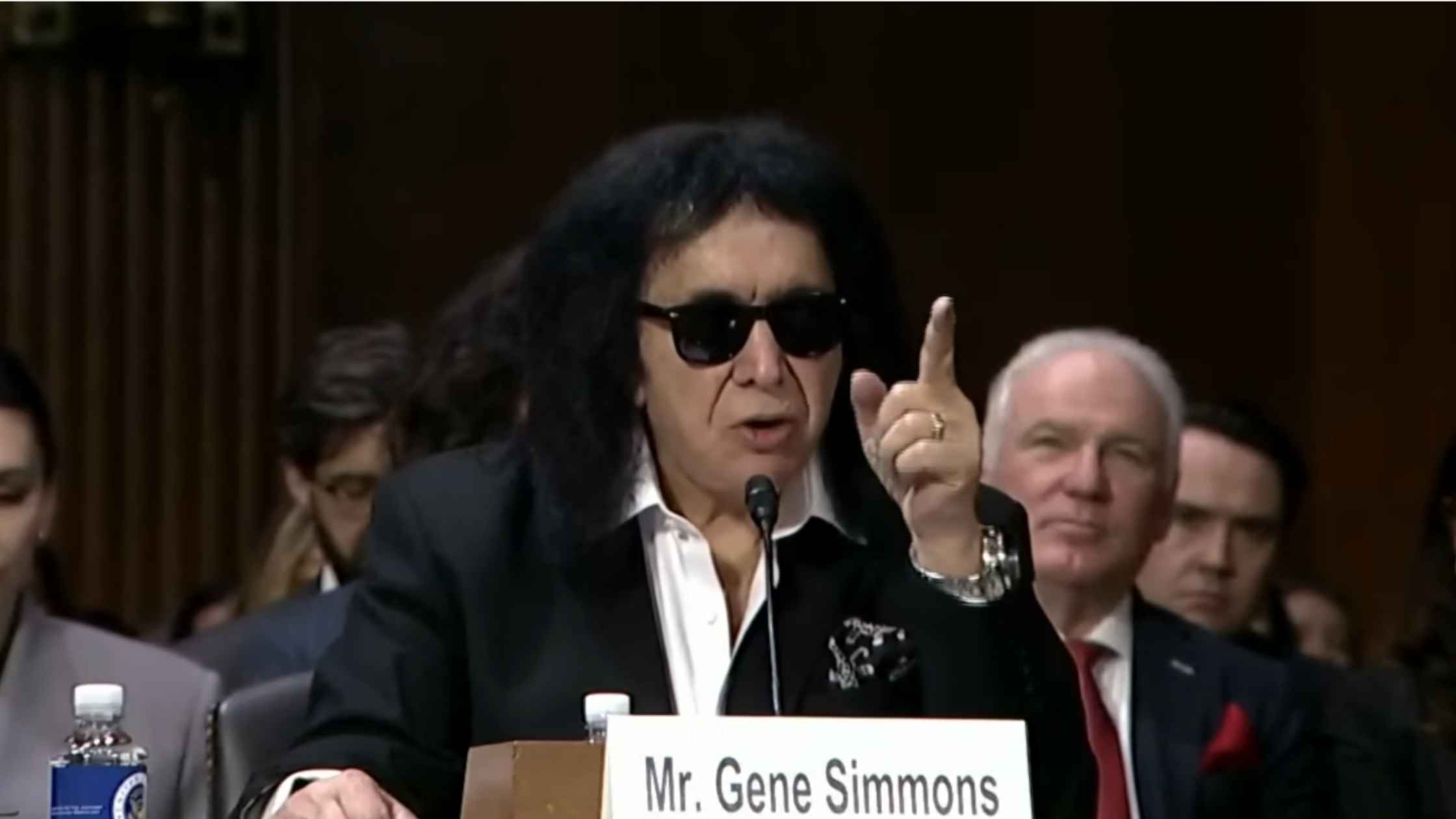
Gene Simmons, probably needs no introduction. He's a musician and best known as the co-founder, bassist, and co-leader of the hard rock … I don't necessarily call it hard rock band, this was in my staff notes. I'm going to call it just a good solid rock band. He co-founded KISS in 1973 when I was 13 years old, and I remember it. Alongside bandmates, Paul Stanley, Ace Frehley and Peter Chris. The band was inducted into the Rock and Roll Hall of Fame in 2014. Since its start, KISS has sold more than 100 million records globally and produced over 30 gold albums. This past Sunday, KISS was honored at the 2025 Kennedy Senate Awards.
(14:56)
At this point, I'm going to just have you all stand, if you will. We'll do a quick oath and then we'll get to the opening statements. If you'll please raise your right hand.
(15:10)
Do you affirm that the testimony you're about to give before this committee will be the truth, the whole truth, and nothing but the truth, so help you God?
Henry Hinton (15:19):
I do.
Mr. Huppe (15:19):
I do.
Gene Simmons (15:19):
I do.
Chairman Tillis (15:19):
Thank you. You may be seated. Mr. Hinton, we'll start with you.
Henry Hinton (15:27):
Good afternoon, Chairman Tillis, ranking membership and members of the subcommittee. As Senator Tillis said, my name is Henry Hinton, and I'm honored to be here today testifying not only as a local broadcaster from Greenville, North Carolina, but also on behalf of the more than 5,100 free, local, over the air radio stations across America that serve your constituents. I'm the president of Interbanks Media, where I proudly work alongside my son to operate five FM radio stations in Eastern North Carolina.
(15:53)
I'm also privileged to serve as a longtime host of the locally focused radio show, Talk of the Town. I know firsthand the value and collaborative partnership of our stations and what we have with recording artists. But make no mistake, I also know firsthand that a new performance royalty imposed on local radio will create harm for stations, listeners, and these very same artists.
(16:16)
I've worked in radio since I was in high school in the '60s. I started as a DJ, worked in sales, moved into management and ownership. I also spent years in sportscasting, having done Play by Play and Color at both UNC Chapel Hill and East Carolina University, my alma mater. My first year in Chapel Hill in 1983 was Michael Jordan's last year in Chapel Hill.
(16:37)
I've always loved the broadcaster credo doing good and doing well. A theme that's played out time and time again throughout my career. We are a uniquely free service and the backbone of our local communities is evident. We serve our communities in ways that no other media can. Just last week, I want to tell you about what we did in Eastern North Carolina. We had all day radiothons Thursday and Friday of just this past week. We raised over $105,000 for local families this Christmas. It's a program we do every year in partnership with the Salvation Army.
(17:12)
That gives back directly to our North Carolina neighbors in need. Our stations are not only the source for the latest music, but the place that listeners turn to for entertainment, inspiration and information, including as a trusted voice during emergencies and natural disasters. Our market in Eastern North Carolina sits in the path of nearly every hurricane. That's when radio's resiliency truly shines. We inform people of the approaching danger. We remain on the air during the storm and its aftermath to provide reliable updates when it matters most.
(17:44)
I remember in 2016, when Hurricane Matthew ripped apart entire communities, our stations became the only means of communication for many people. Cell service failed. They had no other way to communicate. We stayed on the air for days, keeping people informed and providing a 24/7 platform for emergency personnel to communicate with the public. After the hurricane, we worked with the Avett Brothers at their request and we raised $365,000 to help communities rebuild.
(18:17)
I personally went from town to town in our listening area delivering checks to help with local needs in those areas. I'm proud of the real life partnership that exists between radio and recording artists. Broadcasters around the country are known for spotlighting new and upcoming artists and serve as an integral part of artist's promotion.
(18:39)
The continued relevance and value of radio is affirmed by daily local radio broadcasters around the country as record labels continuously contact stations to promote new artists and music and look for radio airplay to help them launch their next hit. We're immensely proud that over the air radio is free to our listeners, but it is not free to those of us who provide it.
(19:03)
Radio stations pay countless fees, including annual FCC regulatory fees, copyright royalties to performing rights organizations like ASCAP, BMI, CSAC, GMR, and streaming collectives like SoundExchange. Local broadcasters today compete against tech giants and global streaming services, some of whom ironically are now trying to emulate the essence of radio on their platforms. Streaming services are able to recoup costs through subscriptions and fees that they charge to their users. We cannot.
(19:37)
This makes the imposition of a new performance royalty economically untenable for local radio broadcasters. When new fees are imposed, free local radio's only option is to cut elsewhere. Stations have to make the choice between covering local football games, or paying new fees between making their payroll or sending more money to the recording industry an industry currently making record profits, I might add.
(20:03)
Imposing a new fee on radio's free service with jeopardized jobs, require stations to cut back local involvement in the community, and place more pressure on radio stations already struggling to survive. This not only hurts radio stations, but local communities and the artists who rely on radio's unprecedented reach to engage new and existing listeners.
(20:25)
In conclusion, I want to applaud the senators and nearly half of the House of Representatives that support the Local Radio Freedom Act, which opposes the imposition of this fee. I encourage this committee to follow suit and refrain from imposing a performance fee on radio. Thank you for inviting me to testify today, and I look forward to your questions.
Chairman Tillis (20:46):
I saw Mr. Huppe, you're going to come next. You're taking notes. I kind of do things a little bit differently as a chair. I kind of like debate club. So number one, after you finish your opening statements, I'm going to turn to Senator Blackburn to take my spot. I'll be asking questions last, but you all take notes if you hear anything and you want to do it in a professional manner. When it is your opportunity, I'd like for you to address the issues that you may have a disagreement with. Mr. Huppe.
Mr. Huppe (21:14):
Thank you, Mr. Chairman. It's an honor to be here today to testify about the American Music Fairness Act. This is the first hearing the Senate has held on this issue in roughly 16 years. During that 16 year period, radio corporations made roughly $250 billion in advertising revenue while recording artists were paid exactly zero. At that 2009 hearing, former Chairman Lahey said, "It appears the broadcasters are using someone else's property without compensation. That might be okay in other countries, but it's not consistent with American property laws."
(21:48)
Mr. Chairman, it was true then, and it's true now. As Senator Blackburn posted last week and stated again here, "The United States is the only industrialized nation in the world that does not pay performers
Mr. Huppe (22:00):
… when their music is used on AM/FM radio. In fact, even Russia and China pay, we are in the company of the most notorious abusers of property rights in the world, joining North Korea, Iran and Cuba. Let that sink in for a moment.
(22:17)
And because we don't pay artists for radio in the US, other countries use that as an excuse to avoid paying Americans. It's gotten so bad that countries like France will actually collect American royalties, yet give those American royalties to French artists. Americans are losing out on hundreds of millions of dollars overseas every year on top of what they are already losing here at home.
(22:41)
And Mr. Chairman, the music landscape has changed dramatically since the last time the committee took up this issue. Back then, broadcasters argued that radio promotes artists by exposing listeners to new music, but that is no longer the case. Streaming platforms like Spotify and Apple Music now account for 85% of music industry revenue, while music discovery actually happens on social platforms like TikTok and YouTube. The days of hearing a song on the radio and going out and buying your CD or an album at a store are long gone.
(23:16)
All other music delivery platforms pay the performer, but for some reason, AM/FM just can't, even though they made nearly $14 billion last year in advertising from playing music. They pay their DJs, they pay their talk show radio hosts. They even pay artists when the very same AM/FM programming is streamed online, but they argue that extending that right to analog broadcast of FM radio is a step too far and that it will put small stations out of business, which is simply not true.
(23:51)
Mr. Chairman, the system is so broken that whether or not an artist gets paid boils down to which button you push on your card dashboard. If you select Sirius XM or Spotify or Apple Music, or even the iHeart streaming app, the artist gets paid. Yet if you choose an FM station, they do not. Mr. Chairman, no legitimate business or policy reason can justify that difference.
(24:21)
The title of this hearing recognizes the need to balance interest in the music community, and we share that desire. We care about and recognize the value of small, local, and independent radio, which is why the bill has carve outs to protect small broadcasters. Under the bill, small stations would pay $500 or less a year for music. That works out to $1.37 a day for unlimited music.
(24:46)
We also recognize the great importance that songwriters bring to the creative process. That is why the bill explicitly prevents radio from paying artists out of the songwriter's share of the royalties which they have collected for decades. All participants, all participants, in the creative process deserve to be fairly paid.
(25:07)
Mr. Chairman, the NAB will say and do anything to make sure they don't have to pay artists for their music. Their playbook has always been to confuse the issue and run out the clock, and it's been effective. Unfortunately, the only way to fix this problem is by changing the law, and that is why we are here today.
(25:23)
This isn't about going into a backroom and working out a deal with the broadcasters. Congress must create a property right in order to make those discussions meaningful. AMFA is a bipartisan bill that ensures every drummer, guitarist, singer, and musician gets paid fairly for the work they do.
(25:43)
And not only is AMFA supported by legislators on both sides of the aisle, but every administration in the past 50 years, including the Trump and Biden administrations, as well as the US Copyright Office, have consistently supported the creation of a performance right in terrestrial radio. In fact, just this morning, the US PTO issued a letter in support of this bill reaffirming the Trump administration's support for this effort.
(26:09)
Congress has stepped up time and again to modernize the law and ensure that artists are paid when their music is paid for digital, streaming, and satellite radio, but it has yet to fix the problem for AM/FM radio.
(26:20)
In closing, Mr. Chairman, we're simply asking you to finally close this glaring loophole on our copyright law, which has been giving one of the oldest music delivery platforms a free ride for too long. Just two months after the Senate hearing 2009, the Judiciary Committee marked up and approved the bill on performance rights. Mr. Chairman, I hope this committee repeats that history and moves to mark up the American Music Fairness Act without delay just as it did 16 years ago.
(26:48)
Thank you for your time and look forward to your questions.
Chairman Tillis (26:50):
Mr. Simmons?
Gene Simmons (26:54):
Thank you, Mr. Chairman.
Chairman Tillis (26:56):
Mr. Simmons, the button needs to be red. Yeah. Red means on here.
Gene Simmons (27:02):
Thank you, Mr. Chairman. I was happy to see many of you this Sunday where Kiss, our little band, was honored at the Kennedy Center with President Trump.
(27:15)
I'm proud to say I first met President Trump years before he got into politics. And I'm happy to remind everyone here in this room that our President Trump signed the Music Modernization Act in 2018. This bill updated copyright protection for the digital era. The world is changing. We've got to stay ahead of the curve, and legislators need to be informed on all of these things because let's face it, you do the work of the people. We elect you and we hope and we expect you to do the will of the people.
(27:57)
I'm grateful to President Trump for his leadership on issues important to our artists, past, present, and future. I'm here to kindly ask all of you, both Republicans and Democrats, to help us remedy a situation, an injustice, let's call it for what it is, an injustice that's been ongoing for many, many decades. I'm going to tell you what I mean.
(28:26)
Bing Crosby recorded perhaps one of the biggest songs of all time, White Christmas. What's more American than that? Written by Irving Berlin. It's been on radio, AM and FM, later FM, originally an AM, millions of times. Every Christmas we and around the world are listening to, "I'm dreaming of a white Christmas." That's America's song.
(28:56)
Everyone received money. The radio station sold advertising. The plumber who fixed the plumbing got paid. Everybody. The disc jockey got paid. The only person that was never paid for the airplay was Bing Crosby, which is astonishing.
(29:15)
And I want to talk about why this is called the American Music, you got to stop there, american Music Fairness Act. Yes, it's an act that's fair because there isn't fairness ongoing right now, but it's American music. America. Last time I checked, Zimbabwe gave the world no music. I can't sing you a French song and nobody else. It's America's music that rules this planet. Elvis, baby, the king.
(29:49)
Elvis, who sang hundreds and hundreds of songs. And I met the gentleman when he was alive and sadly, Elvis never got a penny for all the times, all the millions of times that his music was played around the world. If you go to Africa, "You ain't nothing but a…" You hear that music. That is our emissary. That's bigger and cooler and better than any foreign minister that goes on. American culture spreads with our music, with our pop culture. Elvis never got a penny.
(30:26)
You know who got all the money? And this is not to demonize Mr. Hinton, who's a powerful and attractive man. He came over and tried to dissuade me, which is a big word like gymnasium. But I'm a big fan of his and more power to him. He works hard and he's got four radio stations. God bless America. I hope you have 400.
(30:50)
This bill, when it's passed, because the word if is for losers. We are going to pass this bill. It is bipartisan. You will do the will of the people because 70% of the United States of America in a recent poll said, "We want this injustice cured now and once and for all. " Getting close to the finish line does not work.
(31:13)
And Mr. Hinton, I understand everything you talked about when emergency reliefs and hurricanes came and I'm important. We're only talking about AM and FM radio and paying our Frank Sinatra, Elvis Presley, Whitney Houston, Celine Dion, even my newest best friend, George Strait, who's a co-winner, a proud winner of the American… I'm sorry, of the Kennedy Honors. I walked up to George and we started talking about family and where are you from? "I'm from Texas." And I said, "I'm from Israel." Same thing. Planet Earth.
(31:49)
And we started talking and trading stuff. And I told him, "George, do you know one of your biggest songs, Amarillo," which has been broadcast on AM and FM radio hundreds of thousands of times, "Do you know you never got a penny for any of those broadcasts?" He looked around, he said, "What do you mean?" Because he sings other people's songs. "What do you mean?" He turned to his handlers. "No, that's true." How do you defend that?
(32:19)
Mr. Hinton, God bless him, we all live in America. We disagree, but he's wrong. He said that the four radio stations, I beg your pardon, may have some financial issues add infinitum, ad nauseum. Four of those stations, sorry, three of the four stations may have to pay $500 when, not if, this bill is passed. What's your problem?
(32:48)
How do we dare come in second to Russia, an alleged country led by a despot when they do a better job of paying our king of rock and roll, and we're going to stand by and not pay today's artists and future artists, because let's face it, our children are tomorrow's stars. They're going to claw and fight their way up to the top and it's really hard to do it.
(33:14)
And once you reach the top of Mount Olympus, which is in the center of America, baby, don't kid yourself. It ain't in Greece. This is the land of opportunity where greatness is possible. If you put your mettle… I'm talking about heaven [inaudible 00:33:30], it was a joke. When you work hard and you get to the top, what do you got? Zipperooni. That's not the American way. If you are against this bill, you are un-American.
(33:41)
You cannot let this injustice continue. It looks like a small issue. There are wars going on and everything, but our emissaries to the world are Elvis and Frank Sinatra. And then when they find out we're not treating our stars right, in other words, worse than slaves. Slaves get food and water. Elvis and Bing Crosby and Sinatra got nothing for their performance. You got to change this now for our children and our children's children.
(34:11)
And I know you will. The president will sign this once all you guys respectfully get your act together and put this across the board. Let's do the right thing. God bless America.
Chairman Tillis (34:25):
Thank you, Mr. Simmons.
(34:26)
Senator Blackburn, I'm going to let you take my first time.
Senator Blackburn (34:29):
Absolutely. Thank you so much, Mr. Chairman. Thank you each for your testimony.
(34:34)
Mr. Hinton, I want to come to you first. I guess you could probably imagine that. I've worked with the NAB for years trying to get them to agree to a template like we have. I want to clear up a couple of things.
(34:49)
You mentioned in your testimony that this would cause harm. Let me ask you this. Not paying artists for their sound, their voice being on radio, they're getting zero money. Do you think that causes harm to the artist?
Henry Hinton (35:06):
Well, Senator, thank you for that question.
Senator Blackburn (35:08):
Don't say thank you for the question through this. It eats up my time. Go ahead.
Henry Hinton (35:13):
All right. The-
Senator Blackburn (35:14):
Quickly.
Henry Hinton (35:15):
The reality is American radio reaches 79% of Americans every week. 226 million people listen to radio every week. But the problem that we have-
Senator Blackburn (35:27):
I asked you about causing harm, not about your audience. So let me move on. Because you are causing harm. You've got an oldie station. You've never paid Sam Moore's estate a dime for Soul Man. And I bet you you use that as bumper music a good bit.
(35:46)
And you talk about being a free service. Your free service, do your advertisers look at you and say free service? The answer to that is no, they don't. Because they're paying what you say is the rate. And the more listeners you have, the more they're going to pay you for that advertising. And the better music that you play that people actually want to hear, then the more you're going to be able to charge them. If we shut down all the music, you wouldn't have anything but a talk station. So I think we need to realize that.
(36:26)
Also, you talked about being on the air for emergencies. The FCC requires you. They have that override when there is an emergency. You did not do that out of the goodness of your heart. You do that because you are mandated to do that, and thereby you provide that public service and we appreciate that our radio stations do that.
(36:52)
I would also remind you that when you talk about being a partnership between the artists and the radio stations, there is a new form of payola that is out there. And it's called having these artists do private shows for your advertisers, again, so that your worth is more to your advertisers.
(37:18)
So indeed, it's kind of lopsided because they're making nothing and you're making millions of dollars. You and your son started this business, not to be charity, but to make a profit and to serve your communities and to allow local radio.
(37:39)
And for football games, you have advertisers. Again, you're providing a service, but you're being paid. The people that do not get paid are the performers.
(37:51)
Mr. Simmons, let me come to you. You like it-
Henry Hinton (37:55):
Can I respond to any of that?
Senator Blackburn (37:57):
No, sir. It's my time.
Henry Hinton (37:59):
Okay.
Senator Blackburn (37:59):
Thank you, sir. If we do a second round, I'll give you the opportunity to respond.
(38:06)
Mr. Simmons, it's well past time to pass the American Music Fairness Act. I want you to very succinctly say this is why we need to do it today.
Gene Simmons (38:19):
We have to do it today because AI is right around the corner. This is an archaic injustice that's been around for a long time, and there's no reason why we should get in the middle of it. It's un-American. The basic premise of America is, pardon me for simplifying it, I was a sixth grade teacher. If you work hard, you should get paid.
Senator Blackburn (38:46):
Okay. Let me ask you about something else. I go to church and I live in a neighborhood in Nashville where we have a lot of session singers and musicians, background vocalists that are there. Talk about the significance to those artists of getting those pennies on the spin.
Gene Simmons (39:08):
It's often… See, when you mentioned Elvis and Frank Sinatra and everything, we're talking big ideas because they've scratched and worked their way to the top. The new artists really need these pennies when they get heard as their career starts on radio, but there's no income. How do they get there? How do they claw their way up to the top with the help of radio?
(39:33)
And again, I'm not here to demonize Mr. Hinton or the radio stations. We need each other. Performers need radio, radio needs performers. But for God's sakes, equitable doesn't mean you get zero and radio makes $14 billion just this last year. That's not equitable. I know it's a big word like gymnasium, but come on, Hinton. Let's get with it. Let's become American.
Senator Blackburn (40:02):
Thank you, Mr. Chairman.
Chairman Tillis (40:04):
Senator Schiff?
Senator Schiff (40:06):
Thank you, Mr. Chairman. And thank you to my colleague, Alex Padilla, for this legislation.
(40:13)
Appreciate all of you testifying today. Mr. Simmons, I want to ask you about the song, Beth, but you're not here for that, so I'm not going to. And I love that song. I love all your songs. And thank you for bringing Mike Cusumano constituents with you.
(40:28)
What I'd like to ask you, you've been obviously performing for quite a while. When you began your career, there was a kind of understanding that I think was the rationale for this injustice that, well, if radio stations are playing your music, you're getting advertising where people are buying your albums.
(40:47)
Obviously, the industry has completely changed and the way people access music has completely changed. But if you could talk a little bit about how the industry has evolved and what it means today not to be compensated, that is, I would imagine whatever promotional value you get of your songs played on the radio doesn't somehow create enough recompense to make up for the lack of being paid for those songs being played on the radio.
Gene Simmons (41:14):
Well, first and foremost, what you say is so, but I want to cut to the chase, which is when we first began, we were four knuckleheads off the streets of New York who could barely spell, read or write. We just happened by ourselves. We never knew no one. Artists are not qualified to understand the business model. We didn't have a business manager.
(41:37)
I didn't know that once you get a song that goes on radio, radio is not going to pay you to play the song, but they will have the right, I will say this again, they have the right to use our name and likeness, and you're talking about trademarks. You use my trademark without my permission, otherwise, I'm going to take your house and your firstborn. Are you kidding me? So radio uses billboards across the country's highways of America to promote the radio stations so that people will tune into their station because they are hearing our voice on their station so they can sell advertising, and more power to you. You should be making more money, become more successful.
(42:18)
But the new artists are not going to get their fair shake. There are barely record companies left. The entire music industry is in disarray, and all these pennies are so important, especially for tomorrow's stars who are being born today. This is for our children and for our children's children. We can't just let them out in the cold and not have a way to get paid for their hard work.
Senator Schiff (42:45):
Thank you. And Mr. Huppe, I know when your son was very young, he ran for school office with the theme song, Don't Worry, Be Huppy. Which was brilliant, by the way.
Mr. Huppe (42:56):
Yes. That is correct.
Senator Schiff (42:58):
When that song is played on a streaming service, you're able to identify where the royalties should go, and as the chair was saying, do so very rapidly, very quick order.
(43:09)
Let's say that song is played on terrestrial radio. Are there any challenges to being able to determine when that's being played, providing the same kind of mechanism for compensation that you do with the streaming services?
Mr. Huppe (43:21):
The mechanics behind doing that, Senator, would not be that difficult at all. As you well know, we already receive much of the data about plays and artists and songs when almost all of these FM stations rebroadcast online. So in a way, we're already paying for the digital part of their business.
(43:43)
And the FM part of their business is the much larger part, $14 billion a year. And the mechanics of getting the payments out would be quite doable.
Senator Schiff (43:53):
Thank you. Mr. Hinton, there are provisions in the bill that are designed to try to help smaller broadcasters.
Senator Schiff (44:00):
… casters. Tell us if you would, why you believe those provisions are not workable for, I think, college stations that might be $100. For smaller stations, it might be $500. Why are those carve-outs not adequate for the smaller stations? And for the larger stations, why shouldn't they pay the compensation of the artists they're airing?
Henry Hinton (44:23):
Well, the $500 exemption is going to apply to a small number of stations, but there are over 4,000 FM stations in a country, including some of mine that would not fall under that exemption. And there are a lot of small market broadcasters right now that are barely hanging on. And understand, it's not $500, it's another $500 on top of FCC regulatory fees and all the PROs that we're already paying. Radio stations are being inundated with PRO fees. Senator Tillis and I've had this conversation for the last couple of years. The whole landscape, the ecosystem that's worked for 100 years is under strain because streaming services. Streaming services are a problem for the performers. They're a problem for radio stations. We are competing with streaming services that are owned by the largest big tech companies in the world. And our revenues as a result of that are dropping.
(45:26)
BIA, who is the organization that tracks revenues for the broadcast industry, this is a very important fact. You may not be aware. Since 2019, radio's gross receipt revenue has decreased 20%, projected to be down another 5% this year, three and a half percent next year. So small market radio stations can't take any more fees. It's not 500. It's another 500 on top of everything else that we're paying. And I'll tell you, anybody that thinks $500 is a small chunk of change has never had to run a small market radio station.
Senator Schiff (46:06):
Thank you. I yield back, Mr. Chairman.
Chairman Tillis (46:08):
Mr. Hinton, you'd ask if you want to make a brief comment and response to Senator Blackburn's questions, you can, then I've got questions for you.
Henry Hinton (46:16):
Yes. I'm a little bit surprised that radio is being demonized the way it is. I want to remind people that this ecosystem that we operate in has been working for both the radio industry and the music industry for 100 years.
Chairman Tillis (46:32):
Because you're answering the question, can you give me a sense of what's different about Europe and the stressors that they have economically and they're still achieving the reimbursement? What's different about the American terrestrial radio option and the European option where they seem to have resolved this issue?
Henry Hinton (46:52):
Well, the first thing I would say to you is that radio stations in America are free and we're part of a free market system. If you go to European countries and some of the countries that have been mentioned, radio stations are owned by the government. The relationship between the music industry and the radio industry has been fantastic and it's worked beautifully for years. It's been said that the promotional angle that radio station provides to the recording industry is not there anymore. It's not important. If you allow me, I just want to read something that I received from a good friend of mine, Mike Biddle, who is the program director. He used to be my program director. He's now program director at WQDR in Raleigh, which is one of the legendary country music stations. I asked Mike last week, "Mike, tell me what kind of contact you get on a week-to-week basis with the recording industry and music labels?"
(47:47)
And if you don't mind, I'd like to read a couple of lines from that email. 16! That's the number of record label representatives I've communicated with over the past five days. Four of them are at the vice president level or higher. The reason they want airplay from our radio stations. Based on the ratings research provided by Nielsen and Eastlan, and I've done the math, our radio station alone can match the exposure of an artist, a song gets with 30,000 streams in one week with just a handful of spends in primetime listen ing. And one other thing I'd like to respond to is the issue that Senator Blackburn brought up regarding her letter to the chairman of the FCC for Payola. First and foremost, I would say in my experience, and I've been in this business a long time, Senator, I have never… My experience has been exactly the opposite of what you are describing. It's normally artists coming to radio stations wanting us to provide promotion for something that they're promoting with a relief concert or something.
(48:51)
Just like happened with us after Hurricane Matthew, the Avett Brothers came to us and said, "Will you help us promote a hurricane relief concert?" Which we did and raised $365,000. I can tell you this, that we take the issue of Payola very seriously. NAB has a policy. We all follow it. We are very serious about following Payola and not breaking any federal laws, especially that one.
Chairman Tillis (49:18):
Last question for you or for me. Have you modeled what the economic impact would be on your stations or has NAB done any modeling on what the economic impact would be on various stations if this bill is ratified?
Henry Hinton (49:38):
Well, let me start with this, Senator. The radio industry is free over the air. When we hear about these other streaming services that are paying performers rights, remember this, they can pass their fees onto their-
Chairman Tillis (49:54):
Yeah, I get that. But I'm trying to get at is the economic impact and what stimulated this isn't from my staff notes. What stimulated the-
Henry Hinton (50:01):
You and I've had this conversation before. What I think we should be advocating for is for Congress to take a look at the entire ecosystem, all PROs-
Chairman Tillis (50:10):
I got you, but I'm just trying to get back to the NAB in particular. I wouldn't expect you and your radio station to have done some modeling about what the impact would be.
Henry Hinton (50:20):
You're asking me for a percentage of how it would impact us?
Chairman Tillis (50:25):
There's a stipulation that some of the smaller market or college radio stations be their $100 or $500 impact. So I'm trying to get what that's not a lot. It would have a de minimis impact in terms of performers compensation. I'm just trying to get a sense of what this would represent to a radio station like yours that would not necessarily enjoy the carve out or the exemption, roughly what it's going to cost? And I would assume, I want us to look back and determine-
Henry Hinton (50:54):
I actually don't know the answer to that question. It's going to be on a per station basis.
Chairman Tillis (50:57):
I think it'd be helpful as we move forward to get… It would seem to me it'd be deterministic. You look back 12 months, look at what you played and then determine if the law would pass, what it would be. But I think that'd be helpful for the record. Mr. Huppe, do you have any insight? Well, here's the other thing when I'm talking with the NAB. They talk about bad actors. They talk… I'm not going to name three letter players in this industry, but they talk about some other folks that are constantly breathing down the broadcasters back. Are you sympathetic to any of that with some of the music distributors? And the way that they're treated yours is a very different model, but I'm just kind of curious.
Mr. Huppe (51:38):
Yeah. We're not in the radio promotion business, so I'm not as familiar with that, Mr. Chairman. I will say, in terms to answer to your last question you asked about sort of modeling out. I will say, again, I share the respect for Mr. Hinton and the amazing network that he's built out, but four of his five stations would be eligible for the $500 a year carve out. And the other comment, if I could, Mr. Chairman, there's a lot of talk about promotion here. The bill takes into account any promotion effect. If there truly is promotion, then I would suggest the broadcasters can put their money where their mouth is and recognize it will be a factor expressly, expressly considered by the people that set the rates for this. We could debate whether there's promotion or not. I mean, as you heard earlier, 85% of all revenue comes from streaming.
(52:27)
I think you've heard Mr. Hinton say twice that they compete with those streaming platforms now. It's no longer about promotion. It's about competing. And one last point, Mr. Chairman, let's say there is promotion, hypothetically. I don't know why that should be a free ticket to take people's property with neither permission nor payment. Radio broadcasts, Major League Baseball games. It is undoubtable that that increases the promotion from baseball. It raises the value of the franchise and no one for a minute would suspect or suggest that they don't get licensed by Major League Baseball. I don't know why music should be any different.
Chairman Tillis (53:00):
Thank you. My time is over before I recognize Senator Padilla. I think Beth was a good song. It was Peter Criss who sang leads the drummer. Senator Padilla.
Mr. Padilla (53:12):
Thank you, Mr. Chairman. Thank you to all the witnesses for your participation today. I do want to begin with questions for Mr. Simmons. And I especially appreciate you because you're not just here advocating for your own self-interest, you're advocating for all arts-
Gene Simmons (53:28):
No, I think that's not the headline. The headline is, I've done well thanks to the American dream. And I often say, "God bless America," and people think I say it for a soundbite. I'm the proud son of a concentration camp survivor. And for me, those words mean something and we should all get over the cornball, eye raising things and realize where we're living. This ain't about me, my friend. Because I've done very well because America gave a first generation legal immigrant the chance to do well. And it was not easy. I had to learn the language. I had to start talking like this. Dress British, think Yiddish. You know what I mean? You have to learn the culture, claw my way up to the top with three other guys that understood it with no managers, no nothing. Do it the old-fashioned way. Roll up your sleeves. America's giving you the chance. The rest is up to you. It's not about me. I'm on top of Mount Olympus. As I said before, I was thinking of buying the building. This is about the future of our children.
Mr. Padilla (54:51):
That's the point I'm trying to make because you've been blessed and you've done well. And I think there's a misperception in the general public that most artists, if they kind of recognize the name, " Oh, they must have made it. They're all on top of Mountain Olympus," but that's not the case. So what I want to hear from you is to kind of reflect back to the earlier stages of your career. What would these type of royalty payments mean for emerging artists who are trying to build their career?
Gene Simmons (55:17):
Every little bit helps. At the outset, I understand that a brand new artist isn't necessarily going to help a radio station get to a point, but perhaps I scratch your back. When they get bigger, they'll be more appreciative of WXRP or whatever that's called and say, "You were there for me then. I'm going to be…" It's about relationships, but if you work hard, the American way is you must get paid. You cannot verbally or otherwise ethically, morally, and perhaps once this bill is passed, legally validate the notion that somebody who works hard is going to get nothing while a corporate entity, well-meaning though it may be, is receiving $14 billion just this last year.
Mr. Padilla (56:11):
And as you articulated in your opening remarks, there's a reason this is called the American Music Fairness Act because the way-
Gene Simmons (56:18):
Yeah, we're not asking-
Mr. Padilla (56:19):
Unfair. Hold on.
Gene Simmons (56:20):
That's fine.
Mr. Padilla (56:20):
If it was unfair decades ago, is it more or less fair today given the change in technology and the change in the industry? It's not just major-
Gene Simmons (56:29):
It's more unfair now because once, 1988 or so when Napster started downloading and all that, and remember we're only talking about in this bill AM/FM. We're not talking about streaming or anything else. That's for another bill, another time with other folks. It's a simple idea. My friend, when I go on the highways of America is my radio station and I'll turn to AM or FM to hear the music I want to hear and they're playing it and charging advertising and so on. The people who are on that, who are singing my favorite song are getting zero for that performance that's got to change. I don't know if I answered your question, but I thought I was profound anyway.
Mr. Padilla (57:17):
Absolutely. My last question, my time remaining is for Mr. Huppe. Can you talk, we've focused on radio station owners, the broadcasters, we focus on artists? Are there other folks in the industry who stand to benefit from this bill? As Mr. Simmons says, not if, but when it is passed and signed into law, do producers get impacted one way or the other, engineers, other behind the scenes folks?
Mr. Huppe (57:43):
The answer, Senator is, yes. This impacts the entire recorded side of the business. Many people participate in the creation of a recording. It's a huge part. It's a huge investment for the industry. It's what we all listen to when we turn on the radio. So it's artists and record labels, studio producers, background musicians, background vocalists, engineers. It's a very hard job to bring a successful recording to the world and all of those folks would benefit from this bill.
Mr. Padilla (58:17):
Last quick question, Mr. Chairman, if you'll indulge me for Mr. Simmons. Not on the bill itself, but my youngest son, his name is Diego. He's 10 years old. He has quickly fallen in love, not with the bass, but the electric guitar. What advice do you have for him?
Gene Simmons (58:35):
Have a fallback position. And I say this seriously because since the advent of downloading and file sharing where artists are actually getting minuscule amounts, barely able to get by. And by the way, I was a sixth grade teacher at a college education. . I was the assistant to the director of the Puerto Rican Interagency Council. Boricua, you know what I'm talking about? The original Indians in Mexico, Magdalena Miranda, who was a government research and demonstration project. And because I had skills, I could type 90 words a minute, texagraph, mimeograph, ad infinitum, ad nauseum. I was making 23 grand a year when that meant a lot of money. But doing the Jewish way, living with your mother, not paying rent and so on. So I amassed a large enough amount that I could support the band. We were forming together without managers and everything else.
(59:37)
The advice I have for everybody is always have a fallback position because everybody believes and God bless him for believing. I can reach the stars. Well, what happens if you don't? What's your fallback position? How old is he now?
Mr. Padilla (59:51):
10 years old, sir.
Gene Simmons (59:53):
Okay. He's got time. What kind of music?
Mr. Padilla (59:58):
Oh, heavy metal. Metal.
Gene Simmons (01:00:02):
You know what? There's the 10,000-hour principle. There was a book about it. The harder you work, the luckier you'll get and always have the fallback position. By the way, if it's not a musician, there are managers and other things and personal. America's largest export besides aerospace, aerospace is entertainment. Our emissaries are our pop culture heroes, and that includes rock stars. The term rock star is not just applied to music, but to politicians. When somebody's really good, you see Mr. Schiff over there, that's a rock star. You're applying a music term to that when you want to-
Senator Schiff (01:00:44):
Past the bill.
Gene Simmons (01:00:47):
When you're using it as a verb, let's rock.
Chairman Tillis (01:00:50):
We're going into extended play here.
Mr. Padilla (01:00:52):
Thank you very much. Thank you, Mr. Chair.
Gene Simmons (01:00:55):
This is important. Around the world, rappers call themselves rock stars. You go to anywhere in Africa, Europe, it's American culture. I'm getting the kick that says basically, shut up, let them talk. But I'm passionate about this because it goes back to our children. Don't let the future our children not have an opportunity to make a few pennies. We're not asking for a lot. You guys are making… Respectfully, Mr. Hinton, you guys are making $14 billion a year pre-tax. I understand the hardships of the American tax system. That should be changed also. Flat tax everybody.
Chairman Tillis (01:01:32):
We're going to have to move to Senator Welch. Okay. If you've got a solution for that, we'd like to say the bill tax-
Senator Welch (01:01:38):
I've been enjoying the concert.
Gene Simmons (01:01:41):
No charge.
Senator Welch (01:01:42):
All right. I mean, there's two values, all right? Radio is incredibly important, and it's a lot of stress, but local radio especially, I think is really important because our communities don't have the glue that holds them together. And local radio can do that. You mentioned the radio that was done to help raise money for aid, but we can't have radio without artists and artists struggle. And the proposition that it's free because the radio is free, that's like tech is saying it's free Gmail, but there are a lot of other collateral consequences that we have very little control over and are struggling with. So how do you answer the basic question that if you broadcast somebody's creative work, they shouldn't get paid? Yeah, it is.
Henry Hinton (01:02:44):
Well, again, this is the system that we operate under. It's worked for 100 years. We've had a system-
Senator Welch (01:02:49):
No, but seriously, it's worked for you for 100 years.
Henry Hinton (01:02:54):
Well, respectfully, Senator-
Senator Welch (01:02:56):
14 billion.
Gene Simmons (01:03:00):
Last year.
Henry Hinton (01:03:01):
Well, let me clarify that I did not make $14 billion last year. And I will say, again, I'll repeat what I said earlier. The latest statistics are that radio revenues are down 20% since 2019.
Senator Welch (01:03:18):
No, here's why I'm interrupting. It's just a basic fact. It should be a basic value. If you provide a service to me, I come in and I want to get radio advertising, you charge me money for that and I benefit. And the tool you use to sell your advertising is the creative work of artists. And it's hard for me to understand how it is that those artists shouldn't be recognized for their contribution, even though people turn that radio on are turning it on for free.
Henry Hinton (01:03:55):
May I answer?
Senator Welch (01:03:56):
Yeah.
Henry Hinton (01:03:56):
Again, the promotional value that radio stations provide is phenomenal and it continues to be phenomenal. It's being downplayed here today. But let me say people like Lainey Wilson, who just one of the top stars in the country right now, just won a BMI award. One of the first things she said when she won the award was, "Thank you to radio for helping me get where I am." I just mentioned-
Senator Welch (01:04:20):
No, I get that. And politicians, if they go viral, that's a good moment for them, and that's over the media that is free. But there is the point that Mr. Simmons has been making, and that is that a lot of artists have to struggle an awful long time and with very little compensation. And what motivates them is their dedication to their craft wanting to express that and the healing power that music can have and them having the opportunity to contribute. So that system doesn't work for many of the artists. The concern I have is to make sure that a lot of these small radio stations that don't make the big money, and they play an incredibly important role in Vermont, and they might be college stations, and they play a role to get a person started, to have some sense that they can have a career, but that radio station can't afford anything.
Chairman Tillis (01:05:20):
Yeah, Senator Welch, just for the bill we're talking about today, there is a $100 cap for college stations, $500 cap for certain low market stations.
Senator Welch (01:05:31):
And I think that's great. It makes it possible. There's been a lot of progress on that, but you wouldn't have a problem with that, right, Mr. Simmons?
Gene Simmons (01:05:38):
I'll take it case by case, Senator, but it should be up to performers to decide, not for an industry that's rich in their pockets with $14 billion. I understand we are sensitive.
Senator Welch (01:05:53):
Let me push back a little bit in the sense that the performer's not going to be negotiating with the college radio
Senator Welch (01:06:00):
… video station in Vermont State College, right? That's the whole point of the legislation, is to try to provide some fairness. My question to you is, do you have any issue with the legislation, including some carve-outs for stations whose revenues are below a certain amount, where reasonably speaking …
Gene Simmons (01:06:24):
You're speaking to possibly the most unqualified person in this room. However, as a voting citizen of these United States, I and the rest of the population hold the ultimate power. As one voting member, I think all radio stations must pay something. Somewhere between something and $14 billion is the answer.
Senator Welch (01:06:51):
All right. Just one final plug. Senator Blackburn and I have the TRAIN Act, and it's really an effort to try to protect exploitation of the artistic output of products through AI. I would just like to hear from each, just a yes or no. Do you think we should protect intellectual property, the creative content …
Gene Simmons (01:07:15):
Respectfully …
Senator Welch (01:07:16):
… [inaudible 01:07:16] exploited with it, AI.
Gene Simmons (01:07:18):
May I take some of your time, Senator?
Chairman Tillis (01:07:22):
It's already 40 seconds over. Yes.
Gene Simmons (01:07:25):
Very clearly, in some of the contracts that I've signed and negotiated myself … although I'm not a lawyer, in the interest of full disclosure … perhaps there should be an escalation clause. Smaller stations, you play our songs a few times, it's X. If you're finding out that you're playing our songs and it's really increasing your … and you start making a lot more money, perhaps there should be an escalation clause, for the reason you're making more money and selling more advertising. That's fair.
Chairman Tillis (01:07:57):
Yeah. I do thank Senator Welch on the issue of AI and the real threat to creators. We're discussing that as another subject for a hearing in this Congress. I think it's very important. Senator Blackburn, would you like to go second round?
Senator Blackburn (01:08:10):
I would indeed, and Mr. Chairman, I have several letters of support for the AMFA, and they are letters from the Recording Academy, RIAA, American Association of Independent Music, SAG-AFTRA, Society of Composers and Lyricists, the Christian Music Trade Association, over 300 performance artists, a group of conservative property rights organizations supporting the bill, a letter from USPTO Director John Squires supporting Congressional action on over-the-air public performance rights, and a letter from the director of the USPTO and Registrar of Copyrights during the first Trump administration supporting over-the-air public performance rights.
Chairman Tillis (01:08:58):
That objection will be included in the record.
Senator Blackburn (01:09:00):
Thank you. Mr. Hinton, I know that Senator Tillis was asking you about any modeling you had done of what this would cost you. I would like to see if you have done that, because we're talking about a fee as low as $500, and stations with annual revenue of 1.5 million would only be paying $500. Have you all looked at this? Because this bill is really a tiered approach. How much do you think is too much to pay the artist for the music that you're using?
Henry Hinton (01:09:53):
Senator, my understanding is that the rates have not been set. My colleague at NAB just passed me a note that the rates have not been set. We have not done any modeling. They'll be set by the Copyright Royalty Board, but we don't know the answer to that yet.
Senator Blackburn (01:10:09):
Okay, so you've done no modeling to look at …
Henry Hinton (01:10:12):
That's correct.
Senator Blackburn (01:10:13):
… at any of this. Well, I think we've gone over and above to try to protect radio stations. Have you had the opportunity to read the bill?
Henry Hinton (01:10:25):
I have.
Senator Blackburn (01:10:25):
Okay, great. Looking at that bill, then how much is too much to pay an artist for their music? What would you set that at?
Henry Hinton (01:10:40):
Senator, again, the promotional value that radio stations provide …
Senator Blackburn (01:10:45):
You're on the NAB board, sir, and what I'm looking for is fairness for these artists.
Henry Hinton (01:10:51):
You're asking me for a number that I don't have.
Senator Blackburn (01:10:52):
You don't have a number. You just know paying anything is too much?
Henry Hinton (01:10:58):
I just know what I'm paying already, and this is going to be added to what radio stations are already being burdened with in the copyright space.
Senator Blackburn (01:11:07):
Since there are other fees, you think that that gets you off the hook from paying musicians and artists, since you're already paying fees. By the way, we take promotional value into account in the bill. You might want to gloss back over, give that section another read, because we do account for that promotional value.
(01:11:39)
You talked about that radio, that artists benefit, and indeed they do. Radio stations are important partners, but we want radio stations to be fair to the artists, because you buy clothes, you benefit from clothes. You buy food, you benefit from the food you buy. You benefit and your advertisers benefit by the music that you play, but the people that create that music don't get anything at all. They get nothing. This is why passing this bill is important to do, and we've tried since 2008 to work with NAB on this issue.
(01:12:29)
Do you think that we should be proud of the fact that we sit there with Cuba, North Korea and Iran and refuse to pay a royalty for a product that is created? Do you think that NAB should be pleased that they hold that as a position, that they're intransigent on this, that they are refusing to pay compensation for something that they are using?
Henry Hinton (01:13:01):
Do you want me to answer that?
Senator Blackburn (01:13:02):
Yes, sir.
Henry Hinton (01:13:03):
The answer to your question, Senator, is that it's a free-market system in this country, and it's much different than some of the countries that you're talking about. The system has worked for a long, long time that benefits radio stations and recording artists. In fact, I would say to you that the radio industry and recording business have gotten along great and need each other, and outside the walls of this building and in Washington, D.C., it's not a controversial or adversarial relationship at all.
Senator Blackburn (01:13:35):
Sir, I would invite you to come …
Henry Hinton (01:13:35):
It's very symbiotic.
Senator Blackburn (01:13:37):
I would invite you, sir, to come to Nashville with me. Come to Tennessee with me …
Henry Hinton (01:13:44):
I'd love to. I'd love that.
Senator Blackburn (01:13:45):
… and do a roundtable with me with some of these musicians and entertainers, and I will guarantee you, you will hear quite a different story. This is an issue of fairness. This is an issue of meeting the Constitutional prerogative for creators. As I said, it's an Article I, Section 8 prerogative. You have to compensate creators. They have that right. Sir, broadcast has blocked this.
(01:14:24)
You wouldn't be in business if you didn't have access to spectrum. You wouldn't be in business if the FCC didn't give you a license. You wouldn't be in business if there was not music to play. This is the fairness issue, and I know you want to grow this business and hand it to your son when you're ready to retire and head to Florida and play golf. What we want to do is make certain radio can flourish and that entertainers can also flourish. Thank you, Mr. Chairman.
Chairman Tillis (01:15:02):
Senator Schiff.
Senator Schiff (01:15:03):
Thank you, Mr. Chairman. Mr. Hinton, I just wanted to underscore something that Peter Welch said earlier. I certainly have no interest in demonizing radio, broadcasters, local radio. I admire what you do. I like what you do. I listen to it all the time. I'm a fan, and I understand there's enormous financial pressure on your industry, particularly with the explosion of the streaming services, and you're competing with the giants.
(01:15:28)
I just want to let you know, I acknowledge all the concerns that you've raised. I think we've tried to strike a fair balance in this, but I am mindful of the financial pressure you describe, and I don't want to act as if we're not aware of that. As you say, there have been ways in which your industry and artists have collaborated and come together, on things like the NO FAKES Act and other legislative initiatives, and I'm grateful for that kind of collaboration. I think it's really important. Mr. Simmons, I want to ask you. There was probably a point in your career, as there is in almost every musician, where you wondered, "Are we really going to be able to make a go of this? Am I going to be able to earn a living this way?" At that critical crossroads, where probably a lot of artists decide they just can't make a go of it, what would it mean to have that additional revenue from hearing their works performed on the radio?
(01:16:28)
Can you tell us what that moment was like, if you ever experienced that? Maybe you knew from the beginning you were going to be a hit no matter what, so maybe the exception, but tell us what that moment was like for you, if you experienced it, and what it means to others to have that little extra help to get you to the next level.
Gene Simmons (01:16:45):
At the outset of any career, all those pennies, bits and pieces, are so important, it sometimes is the difference between success and failure. There was a band that just recently announced … a band called Garbage. Successful, they sold a million records of something. Shirley Manson, the lead singer, announced they were quitting the music business because for them it was not financially feasible. There are different income streams. When you play a concert, if you do well, you do well. There's some bands that do better in concerts like The Grateful Dead, who didn't sell as many records and so on. Every one of those pieces of the puzzle gives a band a chance to survive.
(01:17:37)
At the outset, as I said before, radio is important. Radio is important for both of us. Radio needs artists and artists need radio. That's fine. I'm going to keep going back to the same old point. One of those two is making a fortune, and the other one, for doing all the hard work, is getting zip-ola. I'm going to say it again. For the new artists, often it comes down to death or life. Those few pennies that radio would pay once this bill is passed … because I don't play with if. This will go through. I know the president well enough. He will sign this as soon as we all put this paper in front of him. It will give new bands a chance. Those extra pennies and dollars and so on will give them a little more to devote more to their craft.
(01:18:39)
Again, this idea that, "Oh, it's just music." No, it's not. It represents America. They are our emissaries to the rest of the planet. We want to have big superstars so they can tour overseas, so everybody says, "That music comes from America. I want to go to America." One of the reasons my mother and I wanted to come to America, I wanted to come, is Elvis. Where was he born? I can't think of a single performer, artist or anything that comes from … "I gotta go to France to hear [Inaudible 01:19:12]." It's like, "Shut up. You want to come to America, the land of dreams, the land that creates superstars and superheroes." Those are our emissaries. Pay new artists, especially. Pay them something, between something and $14 billion, Mr. Hinton.
Senator Schiff (01:19:32):
Thank you, Mr. Chairman.
Chairman Tillis (01:19:34):
Senator Schiff, you may also want to note that Garbage's best song was I'm Only Happy When It Rains. Mr. Huppe, can you talk a little bit about some of the royalties that the broadcast industry already pays?
Mr. Huppe (01:19:51):
Sure. The broadcast industry does already. As Mr. Hinton has referenced, they do pay songwriters across all platforms, as they should. Songwriters are a very important part of the system. They also do pay royalties to sound recording artists when the very same content we're talking about here, when that is simulcast online or streamed over the internet. They also do pay there. As I mentioned, they do not pay when this biggest part of their business, $14 billion, over-the-air transmissions, they do not pay recording artists for that.
Chairman Tillis (01:20:22):
If we were to pass this bill, it's my understanding now that certain jurisdictions withhold compensation for U.S.-domiciled artists when we don't their own. Do we have any earthly idea how much money would potentially flow to the artist and into the U.S. economy if this bill were to pass?
Mr. Huppe (01:20:40):
I think one estimate we like to reference, the first Trump administration put out a letter that estimated the loss of that money at around $200 million. Certainly hundreds of millions is a safe number to go with, but 200 million I think was mentioned by the first Trump administration in their letter of support.
Chairman Tillis (01:20:58):
Mr. Hinton, one thing that may be helpful just so that we get a better idea of economic impact, I think about other things broadcast radio does, like the Emergency Broadcast Network, those sorts of things. They do play a different role than say a YouTube Music or other streaming platform, but I think it would be helpful for us to get a better understanding of the real economic impact. We've heard about the exemptions or exclusions for college and small-market radio stations, that maybe you take a market basket of any analogs that makes sense in foreign countries, whatever their reimbursement model is. Even if you don't know what rate could be set by the board, you can at least know what the norms are out there so that we get some sort of idea for economic impact. I'm going to have my staff work on it, but NAB may be in a better position to do that and potentially submit something for the record.
(01:21:56)
Seeing no other members here, we're going to bring the hearing to a close. This is an area, again, I mean, most of you who know me know that I try and strike a Goldilocks balance on policy, but I think that this is an area we've heard testimony where we're probably going to see some action. I think there's a growing sense in Congress that they're going to move forward, and so let's talk about the disparate impacts that we should take into account, potential unintended consequences. That's an assignment for NAB, and I would like to see anything submitted to the record or subsequent meetings with you all. We're going to hold the record open for a week. If you'd like to submit any other testimony, any other data, we'll allow you to do it. I think … did we set a specific deadline, week from today? Yeah, one week from today, close of business. If you'd like to submit any other record, any brief comments before we …
Mr. Huppe (01:22:54):
Mr. Chairman, if I may, you said you encourage debate-style format. I just wanted to respond to one thing about radio not being able to pay. Mr. Pittman, the head of iHeart, recently talked about radio's renaissance. When you look at some of the margins in radio stations, I had the opportunity to see some numbers from last year, and some of the biggest radio conglomerates have margins in the 18 to 24% range. Radio pays for the rent, they pay for the electricity, they pay for their station managers, they pay for the executives, as they should. I'm just at a loss. By the way, talk radio also manages to afford to pay their talent, and they manage to work that into their business model as well. I think the concept that radio can't work this into their business model is really not really a supportable statement. Artists deserve to get paid just like everybody else at radio.
Chairman Tillis (01:23:42):
Mr. Hinton, I'll give you equal time. That'd be 30 seconds.
Henry Hinton (01:23:46):
Well, first of all, I'd like to thank the committee and you, Chairman Tillis, for allowing me to testify today. It's been an honor to testify, especially on the same table here with such an iconic music hero of mine for many, many years, Gene Simmons. Radio is facing a lot of different issues. I've talked about the economic pressures and the economic realities that we're facing with streaming and losing revenues, and a lot's been talked about today with regard to where we are with these declining revenues. I would point out that the recording industry grew 3% last year, to a record high $17.67 billion.
(01:24:29)
I think radio's had a big part in promoting artists. We want to continue to have a great relationship with the music industry, but we want everyone to understand that a new performance fee on radio stations is going to … again, it's going to be an additional fee while our revenues are declining, but these fees are exploding exponentially on us.
Chairman Tillis (01:24:52):
Okay. That time has expired. Mr. Simmons, thank you for being here. Congratulations on your recognition.
Gene Simmons (01:24:57):
Thank you.
Chairman Tillis (01:24:58):
Thank you for having an impact on so many people.
Gene Simmons (01:25:03):
Thank you. In the following week, if you need me to fly back here and state our case again, I'd be more than happy to. Thank you.
Chairman Tillis (01:25:10):
Thank you. The hearing's adjourned.