


Speaker 1 (00:00):
[foreign language 00:00:16].
Speaker 2 (05:57):
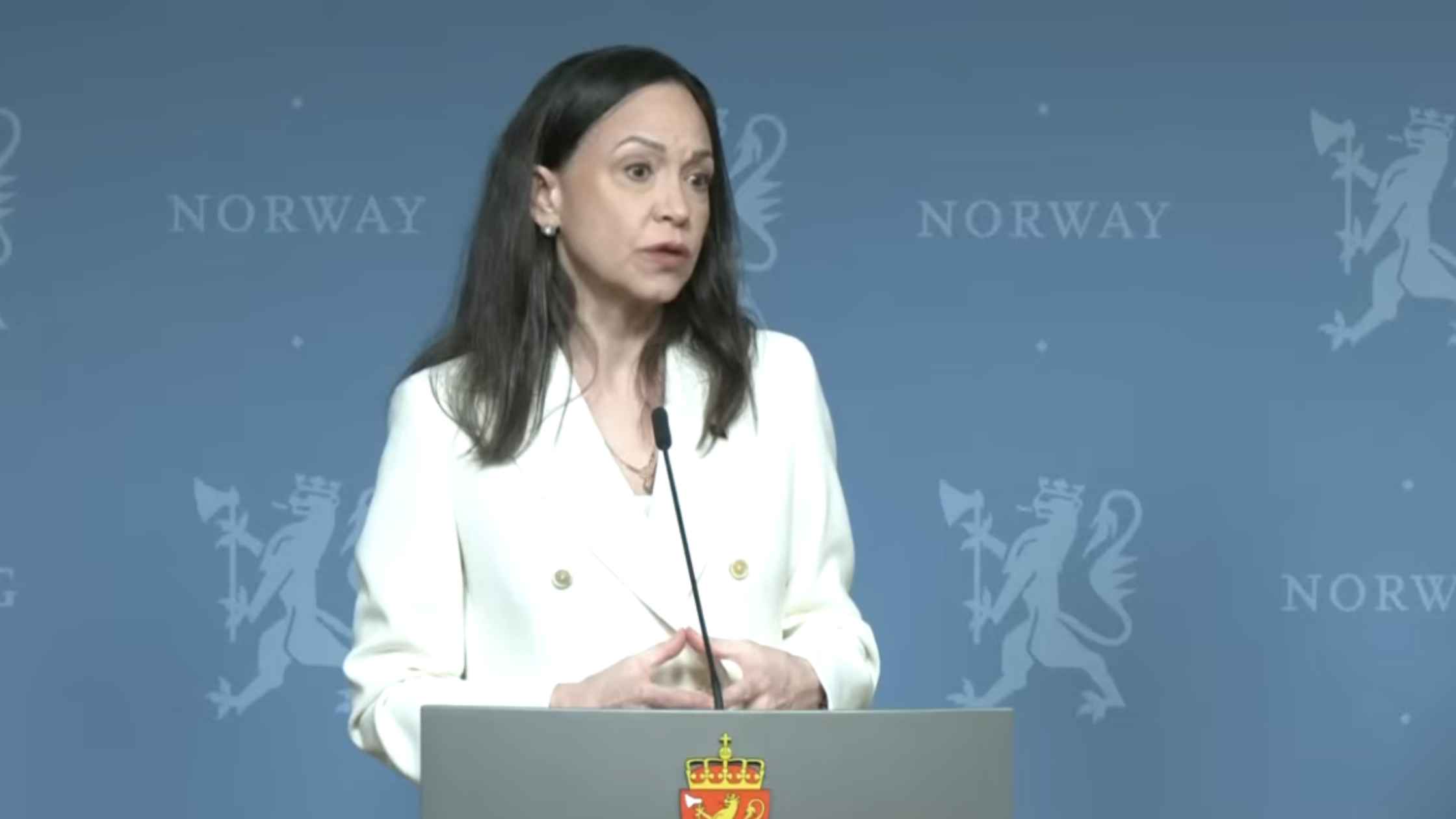
So welcome to this press conference with the Prime Minister of Norway, Jonas Gahr Store and the Nobel Prize laureate, Maria Corina Machado. First we'll open up for a two short introduction and then we will open up for questions. So please Prime Minister.
Jonas Gahr Store (06:12):
Well, first I'd like to express a very warm welcome on behalf of the government of Norway, and may I say on behalf of all Norwegians, to this year's Nobel Peace Prize laureate, Maria Corina Machado. To see you safe and sound at last, we waited for you, and I told you today that that Nobel ceremony was not without you. You had a tremendous presence in that hall, not only the picture, but also the voice of your daughter with reading your message. And the dinner at the hotel yesterday where we all kind of were counting down to see you arriving in Oslo was an emotional moment. And I think it brought your message, your story, and your struggle for democracy very close to the Norwegian public. And that was a strong moment. All the better to see you here standing today. You are hardy welcome.
(07:08)
The Nobel Committee makes its choice on every year's price based on interpreting the will of Alfred Nobel. And I think this year's prize has a special significance by the very strong emphasis of the link between a democracy that works as a democracy and the way to freedom and peace. Not only between nations, but in nation. So in Venezuela, we have a situation where authoritarian regime is waging war on its people with millions of refugees and unjustice. And there cannot be peace until democracy and elections are respected. So that is the message that we are receiving of great importance for Venezuela, but also a message that has universal vary. And this is all about fighting for your fundamental human rights at a time when democracy is under threat. There are so many countries where this is relevant today. Unfortunately, there are fewer democracies, more authoritarian regimes, that is the trend.
(08:20)
So I would like simply to salute you, Madame Laureate, for your struggle. It has cost you a lot. It costs you and your family and your people a lot. And I think what we heard from your daughter yesterday and from your family and the people who came here, thinking about those who are today in jail, those who suffer, those who have aspirations for democracy, that is a strong message of these Nobel laureate days in Oslo. But Maria, please, you have the floor.
Maria Corina Machado (08:53):
Thank you very much, Prime Minister. And thank you all. And I want to speak to the Norwegian people, to European people, to the Venezuelan people. I would say to all citizens of the world in this hour, and assure you that I am very hopeful Venezuela will be free and we will turn a country into a beacon of hope, an opportunity of democracy. And while we will welcome not only the Venezuelans that have been forced to flee, but citizens from all over the world that will find a refuge as Venezuela used to be decades ago. And as I mentioned, well, Ana Corina read yesterday, I believe that our experience in Venezuela conveys to the world a testimony that certainly in order to have peace, you require democracy. Democracy is the system that enables peace in a society, but you cannot have democracy without freedom. And freedom is an individual decision, a rational decision.
(10:10)
And it's some of these individual conscious decisions that bring that collective ethos that creates the force, the strength, and the courage to fight for freedom, to defend when you got it. And that courage comes from the things that truly matter in your life, the things that you love. And when you feel that those things are most in danger, then the courage increases. That's why I am convinced that peace ultimately is an act of love. And that's what brought me here. The love of millions of Venezuelans for a country, for freedom, and for children. And I believe there's no other generation in the history of Venezuela that loves more freedom, our family, and our soul or territory, the possibility of actually being in your homeland, in moving freely in your homeland, because we have lost that.
(11:23)
And as I mentioned to you, the force that brought this country, our nation together, was this longing that we want our children back home, and we will not stop until they do that, and we give them a country in which they can live with dignity, with justice, and the responsibility that comes with freedom. So we have great admiration for Norway's institutions and democracy. We shared benefits that nature has given us, and we admire the way this society has used them on behalf of your people, quite the contrary of what has happened in Venezuela. So we have to learn, and we have used Norway as an example several times during these decades. And believe me, we will turn Venezuela into that energy, technological and democracy hub of the Americas. And we count on you and I long for that day and we will host all of you in a bright democratic and free country, and it's going to be soon.
(12:43)
So thank you very much and very honored and grateful to the Nobel Committee for this recognition to the Venezuelan people, to a great movement. I'm just one of the millions of people that form it. And I do believe it is a recognition to democracy as well. So thank you very much.
Speaker 2 (13:08):
Thank you. So then we open up for questions, and the first question comes from the Norwegian broadcaster, TV 2.
Speaker 5 (13:16):
[inaudible 00:13:15] from TV2 in Norway, I have a question for you, Maria Corina Machado. You arrived just a few hours ago and you got to reunite with your family in a very long time. How was that first meeting and how has your first hours in Oslo been? Thank you.
Maria Corina Machado (13:37):
I couldn't sleep last night going over and over again the first instant when I saw my children, and for many weeks I had been thinking of that possibility and which one of them I would hug first. And to tell you something, I hugged them, the three at the same time. And it's been one of the most extraordinary spiritual moments of my life. And that happened in Oslo. So I'm very grateful to this city, something I will never forget, because at the end, I'm just one of millions of Venezuelan mothers that are longing to embrace their children and are not able to do that. That brings us together. And I made a promise to them. I would come here on their behalf to receive the prize and I will take that prize back to them, because we will make it what I experienced hours ago, we will make it a reality for every one of them, those that have their children in jail, persecuted in exile. We will make that happen.
Speaker 2 (14:52):
The next question comes from the Swedish broadcaster, Sveriges Radio.
Dave Rasmusson (14:58):
Hello, Dave Rasmusson, Swedish Radio. Yesterday, the US ceased a ship outside the coast of Venezuela. Would you welcome a US military intervention in Venezuela?
Maria Corina Machado (15:14):
Look, some people talk about invasion in Venezuela, the threat of an invasion in Venezuela. And I answered Venezuela has been already invaded. We have the Russian agents, we have the Iranian agents. We have terrorist groups such as Hezbollah, Hamas, operating freely in accordance with the regime. We have the Colombian Gorilla, the drug cartels that have taken over 60% of our populations, and not only involving drug trafficking, but in human trafficking, in networks of prostitution. So this has turned Venezuela into the criminal hub of the Americas, and what sustained the regime is a very powerful and funded, strongly funded, repression system. Where does that funds come from? Well, from drug trafficking, from the black market of oil, from arms trafficking, for human trafficking. We need to cut those flows. And once it happens and repression is weakened, it's over because that's the only thing the regime has left, violence and terror.
(16:21)
So we ask the international community to cut those horses, because the other regimes that support Maduro and the criminal structure are very active and have turned Venezuela into the safe heaven for their operations into the rest of Latin America. Thank you.
Speaker 2 (16:42):
The next questions comes from the Norwegian broadcaster, NRJ
Speaker 7 (16:47):
[inaudible 00:16:47] from Norwegian Broadcasting. You have had meetings with politicians at Norwegian Parliament and Prime Minister this morning. Have you asked for any kind of support from the Norwegian government for your fight for democracy in Venezuela?
Maria Corina Machado (17:02):
We had a great conversation this morning and I am very excited also with what I experienced at the parliament. I'm a former member of a parliament, and to see an actual parliament working with representatives of parties in all the spectrum, passionately and respectfully defending their views is something I mean so much. And yes, the answer is yes.
(17:30)
Not only right now, we need to speak out to tell the truth so that people understand what our country is suffering, what our political prisoners are going through. Children in Venezuela only go twice a week to public schools because teachers earn $1 a day, so they have to get other jobs. So we have our children in the streets and you know what it means in terms of the future and the risks they run. So yes, we need to speak out. We need to cut these resources that support repression now, but also we will need a lot of ideas and advice regarding building up institutions such as the energy agency that we want to build in Venezuela for the new hydrocarbon sector that will arise in our country.
Jonas Gahr Store (18:38):
Can I just follow up to say that the laureate does not have to ask for that support because we respect the will of the Venezuelan people and that is clear. They expressed under very difficult circumstances, the reviews in an election, which gave according to all sources, international and domestic, overwhelming response. They want to know the course. They want a democratic regime. And for Norway, respecting the rule of law and the main principles of the UN charter is key. So we want to see that change happen. I think what we learned from these days talking to not only Venezuelan guests, but also representatives of Latin America, is that you need a combination of what comes from inside and what comes from outside. And we are from outside and we are of course ready to support Venezuela, democratic Venezuela, in building new and sound institutions. They can count on that.
Speaker 2 (19:32):
And the last question today comes from CNN.
Pau Mosquera (19:35):
Hi, Maria Corina. I'm Pau Mosquera with CNN. So now you've been in hiding for many, many months. Do you think that the government may have known where were you during this time?
Maria Corina Machado (19:47):
I don't think they have known where I have been, and certainly they would have done everything to stop me from coming here. And actually, I want to take advantage of your question to thank all those men and women that risk their life so that I could be here today. One day, I will be able to tell you, because certainly I don't want to put them in risk right now. It was quite an experience, but I think it's worthwhile being here with you telling the world what's happening in Venezuela, what it means to you as Norwegians and as Europeans or from all the places where we come from, why Venezuela matters for the world. I mean, when you fight for freedom, you're fighting for humanity. And when we win, because we will, this will be an extraordinary example for those countries that today do not have freedom and that people are telling them what we used to hear that it was impossible, impossible to achieve it.
(21:09)
And we decided to fight until the end and Venezuela will be free. And of course it's worthwhile. And when I go back, the regime will… Well, there are two possibilities, certainly where the regime will be, but if it's still in power, certainly I will be with my people and they will not know where I am. We have ways to do that and take care of us.
Speaker 9 (21:39):
[foreign language 00:21:43]. [foreign language 00:00:10]
Speaker 2 (21:43):
I'm sorry? Well, so this is the end of this press conference. So-
Maria Corina Machado (21:48):
I think we're going to have another conference right now and I'm going to speak in Spanish. I want to respect the decisions of the Prime Minister.
Jonas Gahr Store (21:56):
Great. Thank you so much for coming.
Maria Corina Machado (21:59):
Thank you very much.