


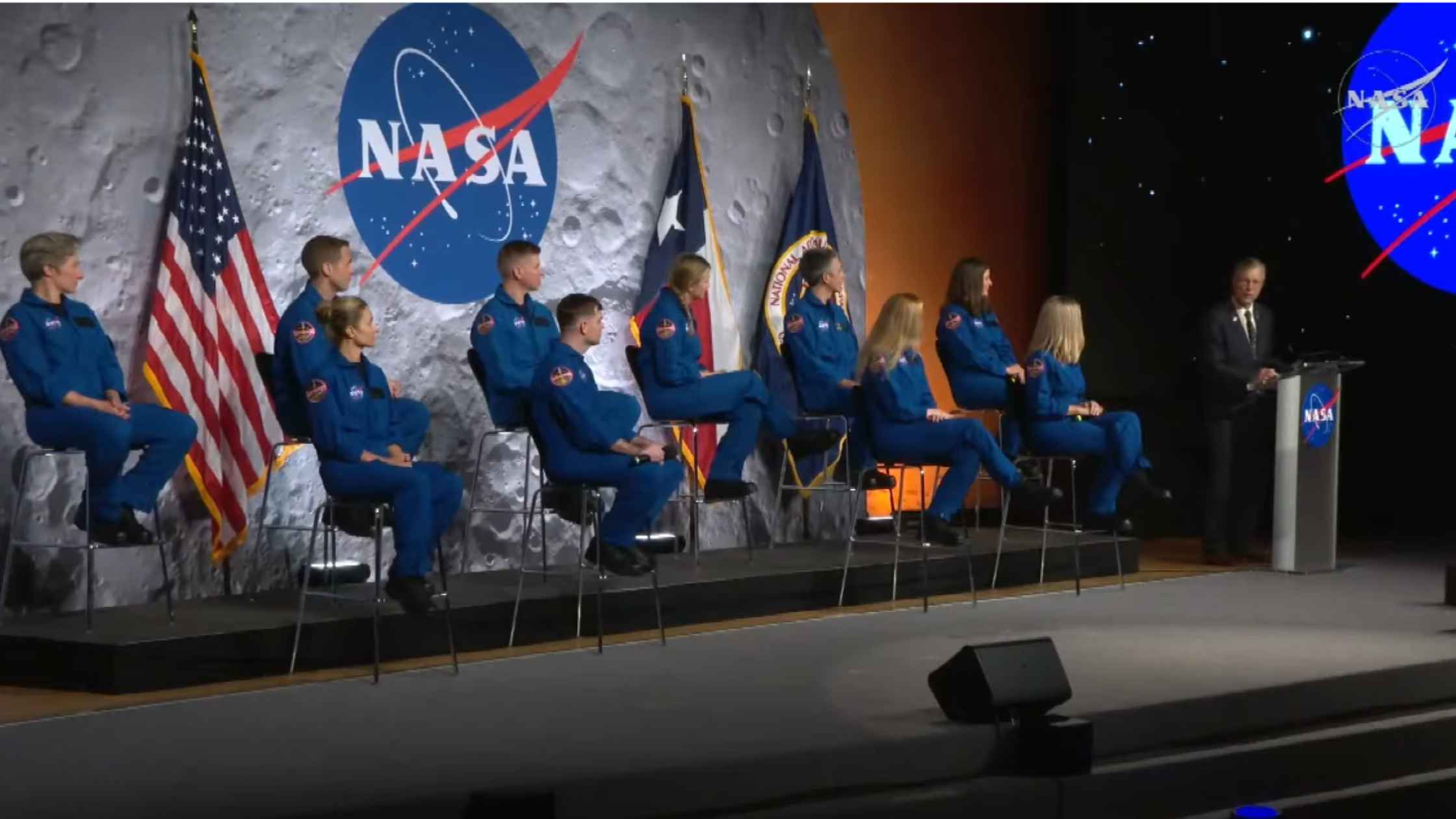
Vanessa White (00:24):
Good morning. I'm Vanessa White, director of NASA's Johnson Space Center, and I'm joined by Deputy Director Steve Kerner.
(00:33)
Thank you for joining us today as we debut NASA's 2025 Class of Astronaut Candidates. We are honored to have some special guests with us today. Please join me in welcoming Senator Ted Cruz, Congressman Brian Babin, and Congressman Jake Ellzey. We'd also like to recognize the Offices of Representatives Randy Weber and Dan Crenshaw, and Texas Representative Dr. Greg Bonnen, and we also have a representative from Senator John Cornyn's office.
(01:40)
Additionally, we have some NASA guests, senior leadership that are here today that are not on the program, so I'd like to introduce to you Ms. Casey Swails, our Deputy Associate Administrator; Ryan Hughes, NASA Chief of Staff; Ken Bowersox, our associate Administrator for Space Operations Mission Directorate; Laurie Glaze our acting associate Administrator for our Exploration Systems Development Mission Directorate, and she's also serving as our Moon to Mars program manager.
(02:25)
And from Marshall Space Flight Center, we have Director Joseph Pelfrey and Stennis Space Center Director John Bailey. Today is a very exciting day for all of us here, for our nation, and for all humanity. As we will announce the newest class of astronaut candidates, 10 American men and women will begin their basic training that spans two years to eventually earn their wings and join NASA's active Astronaut Corps.
Steve Kerner (03:03):
That two-year journey begins today. The next two years will be spent studying and training in our world-class facilities. They will learn NASA's history and our vision for the future. They will take classes in geology, land and water survival, and space health. They will even get to train in our high-performance jets. They will engage in a variety of technical activities to prepare them for the missions that will help NASA push the boundaries of exploration, travel to new destinations in the solar system, and inspire the world through discovery. We look forward to supporting them and their families along the way.
Vanessa White (03:41):
That's right. The Johnson Space Center is proud to be home to America's Astronaut Corps, but we are also proud to lead several key programs and organizations for NASA. We lead the management and operations of the International Space Station, while supporting several companies as they design and develop commercial LEO, Low-Earth Orbit, destinations and through the Commercial Crew program, we partner with industry to develop and operate a new generation of spacecraft and launch systems. Artemis flight planning and operations are also conducted here, and the Johnson-based Gateway and Extravehicular Activity and Human Surface Mobility programs are working with industry to develop lunar outposts, the next generation of spacesuits and lunar rovers. In addition to the significant human spaceflight programs, Johnson implements for the agency commercial lunar payload services, an instrumental part of Artemis through partnerships with industry to provide robotic capabilities for the moon and Mars.
Steve Kerner (04:50):
All of these efforts are positioning us for our next giant leap, one that ushers in a new golden age of innovation and exploration.
Vanessa White (05:00):
The astronaut candidates we announce today will help us get there. They were selected from a pool of about 8,000 applicants because they represent America's finest. I would like to thank the team of NASA employees who helped with the selection process. Human spaceflight is a team sport, and it requires the passion and dedication of all of us.
(05:25)
Now that you've heard a little bit about the home of spaceflight, it's now time to announce our newest astronaut candidates. And to help us kick that off, please give a warm Houston welcome to our flight operations director, Norm Knight.
Norm Knight (05:55):
Thank you, Vanessa. Thank you, Steve, and good morning. Four years ago, we named 10 exceptional individuals in our most recent class of astronaut candidates. I often look back at what we've accomplished over these last four years in human spaceflight, and those accomplishments have been significant. Much of what's been achieved has been made possible by the International Space Station, where many of these candidates sitting here today will have the opportunity to visit. Every lesson learned aboard Station has paved the way for where we're headed next to the moon this time to stay and onto Mars.
(06:37)
Just think, four crew members who are preparing to fly around the moon early next year, farther away from Earth than any human since Apollo 13. In 1970, they were also once astronaut candidates. Today, 10 more distinguished individuals are joining the NASA family as the newest generation of explorers.
(07:00)
To further our reach into the golden age of innovation and exploration, this selection was challenging, competitive, and very difficult. But what we have for you here today is a group of individuals who are not only exceptional, but who will be inspirational for the United States of America and for our planet. For those of us in flight operations, the astronaut candidates we're naming today may be the most visible representatives of human spaceflight, but they are also the emissaries to an entire cadre of talented flight controllers, trainers, engineers, and frankly, everyone across this great agency, who are the heartbeat of human spaceflight. With that, I'd like to invite my deputy, Kjell Lindgren to join me in introducing the 2025 Class of Astronaut Candidates to the world. Kjell.
Kjell Lindgren (08:05):
Thank you, Norm. It is an honor to be out here today. Now I come to you from the 20th Astronaut Group, the Chumps, and we can't wait to see what the Flies name this new class.
(08:15)
Now, the 10 individuals you're about to meet come with fantastic experience to lead us here on earth and in space. Are you ready to meet the 24th group of Astronaut Candidates? All right, let's get started.
(08:35)
He's a Chief warrant officer and experimental test pilot in the United States Army. From Charlottesville, Virginia, Ben Bailey. She is a geologist who worked on the Curiosity Mars Rover and Artemis III science team. Originally from Sammamish, Washington. Lauren Edgar.
(09:13)
He is a test pilot and a major in the United States Air Force. From Leesburg, Virginia, Adam Fuhrman.
(09:38)
He is a test pilot and weapons officer in the United States Air Force. From Savannah, Illinois, Major Cameron Jones.
(10:09)
He's a launch director and engineering executive from Columbus, Indiana. Yuri Kubo.
(10:52)
She is a former United Airlines test pilot, NOAA hurricane hunter, and naval aviator from Little Elm, Texas. Rebecca Lawler.
(11:02)
She flew to space as a SpaceX engineer on the Polaris Dawn Mission, and as a native to Houston, Texas, please welcome Anna Menon. She is an anesthesiologist from Coupe Falls, New York, Imelda Muller.
(11:55)
She is a Lieutenant commander in the United States Navy, and a test pilot in the F-18 Super Hornet. From Goshen, Kentucky, Erin Overcash. She is a former flight test engineering director at Gulfstream Aerospace, and United States Marine Corps test pilot. From San Diego, California, Katherine Spies.
(12:49)
These 10 men and women are your 24th astronaut candidate class. We can't wait to see what you achieve. Congratulations, and please join me in giving them another round of applause.
Vanessa White (13:45):
Wow. At NASA, we are more than just a team. We are a family. To share some words of wisdom with you, we have three astronauts here with us today who sat in this very stage some years ago and received their astronaut pins. Please welcome NASA astronauts Chris Burch, Nicole Ayers, and Chris Williams.
Chris Burch (14:25):
Lauren, Yuri, Becky, Adam, Cameron, Erin, Kate, Ben, Mel, and Anna. Congratulations and welcome to the team.
(14:40)
My name is Chris Burch and I'm a member of the 2021 NASA astronaut class. I'm here with two of my fly classmates, so this is officially a swarm. Your astronaut class is a very special group. That's why there's a tradition among astronauts that the newest astronaut class is named by the class before it. Our class was named by The Turtles who lovingly gave us the name "The Flies" because among more humorous reasons, they hoped we would fly early, and indeed we have. Nicole just returned from her five-month mission aboard the International Space Station, and Chris is preparing to launch for his eight-month mission this November. The bonds formed with your class…
(15:27)
The bonds formed with your class are very special. Astronaut training is an apprenticeship. We learn from our trainers and our instructors, and we are constantly learning from each other. Your training builds a foundation of trust that will carry you throughout your career and on to your future missions. On behalf of all the Flies, we look forward to getting to know your class so we can give you a name befitting your personalities, and appropriate for the exciting and dynamic time that we are in human spaceflight.
(15:57)
Thank you.
Chris Williams (16:03):
As Chris mentioned, your next few years are going to be all about learning and training. In many ways, it's like drinking from a fire hose. You'll be asked to learn, not just learn, but to master new skills and disciplines. Some of these might be familiar to some members of your class, like flying an aircraft or characterizing crystals in a rock, but others are going to be totally new to you. I know for me in my class, it was an incredible experience the first time we were underwater in a space suit under 40 feet of water in our neutral buoyancy lab, practicing a space walk to repair a space station that was totally new and just an awesome experience.
(16:36)
Thankfully, you're going to have some of the most talented and passionate instructors, and an incredibly dedicated team here at NASA who are going to help you through this. We could not do what we do without the amazing support that we have here at the Johnson Space Center and from the entire NASA community. But some of the most special moments will come as you find how much you get to learn from each other, from your classmates, your peers. It's really a rare opportunity to be surrounded
Chris Williams (17:00):
Headed by a group of individuals that all come from different backgrounds, different fields, and with different experiences, but who are at the highest levels of their professions. When I have a question about the nuances of flying a T38 information can turn to my fighter pilot classmate with thousands of flight hours and ask her a question. When I'm wondering about the design of a biology experiment on the ISS that we're learning about, I can turn to my bioengineering classmate and ask, why is this experiment designed the way it is so I can understand how it works? The knowledge and experiences that you all bring and share with each other will not only make you a stronger class, but make us a stronger astronaut corps.
(17:37)
It also makes it an absolute pleasure to come to work every single day. Learning is not unique to your initial training, it's going to continue after you graduate and go into supporting other crew members who are flying in space, helping to develop the systems that are going to take us to the moon and beyond, and training to be a crew member on a future mission. I can personally vouch for this. Training for my upcoming mission has been a constant learning process, but it builds on the foundational skills that I learned in the initial training that you all are about to embark upon. And we've seen how it sets you up to excel. My classmate Nichole, just returned from a fantastically successful five-month mission to the International Space Station.
Nichole Ayers (18:13):
Thank you, you Edim, well said. We all look back fondly on our time in those seats being welcomed into this NASA family. The next two years will be a whirlwind, but there'll be some of the best moments with the best people. As NASA furthers human spaceflight, we can't wait to see you all get assigned to a crew and get welcomed into a smaller family that is that crew. Whether on a space station crew or a crew that's headed to the moon and eventually onto Mars, we build bonds that span generations and borders.
(18:53)
We're so excited to see you all eating a family dinner with your crew somewhere on potentially an exploration vehicle or even a habitat somewhere. I know I personally loved our family dinners on the International Space Station, but before we go, we have some very special guests who couldn't be here today. My space brothers and sister and the family, I got to share some amazing moments with. They're currently living and working aboard the International Space Station 260 miles above the earth and they're also cheering you on and they prepared a special message for you guys. So please join me in welcoming NASA astronauts, Johnny Kim, Zena Cardman, Mike Fink, and Jack's astronaut, Kim Agui.
Mike Fink (19:39):
Hello from the International Space Station orbiting 250 miles above beautiful planet Earth. I'm NASA Astronaut Mike Fink, a proud member of the class of 1996 sardines, and we wanted to offer a huge congratulations to the 2025 NASA astronaut candidates. That's you.
Zena Cardman (20:00):
We wish we could be there in person to welcome you, but we're so grateful to be up here. We're nearing 25 years of continuous human occupancy aboard the Space station and the work we do will prepare us for missions beyond low earth orbit. You're joining NASA at an exciting time. We're in a new era of space exploration, going to the moon and onto Mars. We can't wait to see where your journey takes you.
Kim Agui (20:19):
We're close to a group in the Ashen office and we're thrilled to welcome you into the fold. You can always count on us for support, but you should also lean on each other as a class too. The people sitting beside you right now will become more than colleagues. They'll become lifelong friends.
Zena Cardman (20:33):
We can't wait to meet you when my crew mates and I are back on the ground. Until then, learn everything you can, get to know each other and most importantly, enjoy the ride. We'll keep the space station in great shape for when you get here.
Vanessa White (21:02):
Thank you, Johnny, Zena, Mike and Kim, and we can't wait to welcome you back home soon. Next, I'd like to introduce NASA acting Administrator Secretary Sean Duffy. Administrator Duffy stepped into this role a little over two months ago and has already demonstrated his commitment to leading our agency forward with vision and purpose. He also serves as the Secretary of the US Department of Transportation. Please help me welcome NASA's acting Administrator, secretary Sean Duffy.
Sean Duffy (21:40):
Well, it is great to be with all of you today and to join the chorus of congratulations to our new class of astronauts. Well done everybody. Listen, we know that you represent your families, you represent your communities. You represent NASA, which is the most respected and revered agency in the whole wide world. No pressure, but most importantly, you represent America, the greatest, most innovative creative country that's ever existed on the face of the earth. And so we couldn't be prouder to welcome you and congratulate you on your work to get to this moment. Now, as we mentioned before, that over 8,000 people applied to get one of these 10 spots and there were pilots, there were scientists, engineers, they were dreamers, and they were hoping to be here today. But we picked the best and the brightest, the most skilled, the best looking, the best personalities to take these 10 spots. And again, you represent your country and I know the President extends his congratulations as I extend mind as well to you. And oftentimes we talk about the American dream. And if you think about the American dream, I think that there's nothing that embodies the American dream more than the 10 of you today having these spots. I know it was hard work, a lot of effort, a lot of studying, a lot of training for you to win these spots at NASA. But you truly today are living the American dream. And again, congratulations for that.
(23:45)
You are America's best and brightest and we're going to need America's best and brightest because we have a bold exploration plans for the future. As we've talked about, we are going back to the moon. This time we're going to stay, and from what we learn on our mission to the moon, we're going to go to Mars and we're going to go beyond into the unknown. Now, some are challenging our leadership in space, say like the Chinese. And I'll just tell you this, I'll be damned if the Chinese beat NASA or beat America back to the moon. We are going to win. We love challenges, we love competition, and we are going to win the second space race back to the moon with all of you participating in that great effort. We also talked about the golden age of transportation and the golden age of exploration.
(24:43)
And again, our future is bright. We have bold missions ahead of us. It's going to take money, it's going to take grit, it's going to take courage to actually meet this moment with these missions, with this vision. And I know all of you have the heart to do that. What I find most exciting is, I know you guys, they've been NASA employees for a week, I think seven days, and I got to meet them earlier today. What I found interesting as I met our new cast of astronauts is that one of these 10 could actually be one of the first Americans to put their boots on the Mars surface, which is very, very cool. Again, no pressure NASA, we have some more to do.
(25:41)
So at this moment in time, I couldn't be more honored to be the acting administrator and to lead this organization at this moment in time as we make our vision clear, our mission clear as we move forward. And I do have now the honor and privilege of introducing our next speaker, who by the way is also very handsome. He's also very smart, but he is also one of the great leaders in the US Senate. He is a champion for NASA. He's a champion for the Johnson Space Center, which you're very lucky to have him, but not only that, he authorizes the money that gets through the Congress to come and fund NASA. So he's really, really important because he writes the checks actually. Help me give a warm welcome to one of Texas's finest, chairman Ted Cruz.
Ted Cruz (26:43):
Well, thank you very much, Sean. Let me say you're doing a fantastic job. Thank you for your hard work, your Secretary of Transportation, you're the acting administrator of NASA. I think you're trying to compete with Marco Rubio to see who can have the most jobs. And I look forward to seeing you named as the Archbishop of Washington DC, I think you could do that job, an excellent job as well. Let me say at the outset, I am really, really glad in the United States Senate that an incoming class is not named by your predecessors. That just would not work out well. So y'all are brave and I assume you want to be really nice to your preceding class so that they don't give you some terrible names.
(27:59)
Speaking of terrible names, actually I have a call on you, Mr. Administrator, Mr. Secretary, for some strong executive leadership, which is the name of this event is ASCAN. Now I recognize that these guys are capable of pulling out a can of whoop-ass, but I would humbly suggest next time maybe we go with a different name than ASCAN, like the collective branding can come up with something suitable to the occasion. I want to say to each of you guys are amazing. You're the best and the brightest. You are incredibly educated, you're incredibly fearless, you're willing like sardines to get in a tiny can and sit up on top of an exploding rocket going up into the sky. And I'll tell you, little boys and little girls, they look at you and they dream of doing what y'all are doing.
(29:14)
That's powerful. That is the future. Mr. Secretary, you're in my hometown of Houston, and Houston has a long and deep connection to space. One of the very first words uttered on the surface of the moon was Houston. Houston, the eagle has landed. There is a reason our baseball team is the Astros. By the way, they have all committed, they are all now Astros fans. And there's a reason our basketball team is the Rockets and the Rockets are winning it all this year. That's my prediction right now. There's also a reason that when JFK was president, that he came to Houston, to Rice Stadium and he announced the commitment that we would go to the moon within a decade. And JFK explained why we were going to the moon.
(30:22)
And he said, "We are going to the moon for the same reason that Rice plays the University of Texas. We do not do so because it is easy, but because it is hard." So that's what y'all are here to do, is to do what is hard. And I will say on the 4th of July, the president signed in the law the One Big Beautiful Bill, that included among other things $10 billion directly for NASA. I was proud to have added that $10 billion. And that funding is there because we will go back to the moon, we will beat the Chinese to the moon. We will have a sustained human habitation on the moon or in Cislunar space. We will continue to beat the Chinese in low earth orbit. And with all of the learning from going to the moon from Gateway, from the ISS, we will go to Mars.
(31:44)
And the first boot that ever sets foot on the surface of the red planet will be an American astronaut on it and could well be one of these boots right here. And I have to admit, as a girl dad with two teenage girls age 14 and 17, I'm particularly proud of all the women here. And the fact that with Artemis, America is going to put the first woman on the surface of the moon in the history of mankind. That is powerful. That is beautiful. And to everyone here who is so integral to JSC head to the space, mission and commercial space, and to the mission of American leadership in space, I want to tell all of you how incredibly proud I am of you.
(32:47)
And to put very simply, my job is to have your back and you have my word, I will continue to do so each and every day. With that, I want to welcome my dear friend Congressman Brian Babin. Congressman Babin has been in Congress since 2015. He is the chairman of the House Committee on Science Space and Technology. He's been a dentist for 35 years, so if you piss him off, he'll rip your teeth out, but don't worry, he'd give you the happy gas, you won't feel it at all. And he was also in the Air Force from 1975 to 1979. So if he's honest, he really is jealous that he's not in a blue jumpsuit sitting up here as well. But he gets to be in Congress and he is a champion for JSC. He's a champion for space and he is a good friend, Congressman Brian Babin.
U.S. Representative Brian Babin (34:05):
Thank you, Ted. It's always tough to follow Ted Cruz. There's no way. With my old East Texas twang, there's no way I'm quite as articulate. But I just want to say how pleased I am to be here to meet every one of you young folks that are going to be stepping your feet on the lunar surface, the ISS, and maybe the red planet as well. It is more exciting than I can even gather. Well, good morning. Great to be here with everyone. What an incredible privilege it is to be here to welcome this new class on this exciting day of astronauts. Unbelievable. Today's announcement concludes a rigorous selection process that began more than a year ago with thousands, literally, these people were chosen from a cast of many thousands of people, of individuals applying to join the ranks of our esteemed Astronaut Corps. And I want to thank every astronaut in here and former astronauts as well for your service.
(35:08)
Space exploration has always stirred something deep within the soul of the American people. It is impossible not to be inspired by those who devote their lives to it. And I just want to say congratulations to each and every one of you. Each of you embodies the qualities that have defined NASA astronauts for more than 60 years. Think about that, 60 years. Courage, ingenuity, curiosity, and so much more are the virtues that you have. This class of astronauts will help lead the next chapter of human spaceflight. Some of you as already been stated, will have missions on the moon. Some of you may take humanity's first steps on the red planet of Mars. All of you will carry forward missions that today exist only in our dreams, but together we're going to make these dreams a reality.
(36:08)
For generations. American astronauts have been a source of national pride for our country. You will now take up that mantle, carrying our flag proudly and fearlessly into space. But your mission is larger than exploration alone. At a time growing global competition, NASA's work is more important than ever. It is national security, folks. We must be on that lunar surface first. We must remain a presence of America in low earth orbit. This is important. We cannot fail there. We also have to hope and that the stars will guide us into all the endeavors that we are dreaming about. There's much work ahead, but the challenges will shape you, will strengthen you, and will embolden you.
(37:06)
As a representative for Johnson Space Center, I'm so very proud that many of you will soon call Houston home and join this community that has long been the very center of America's space legacy. So please know that we believe in you, we are counting on you, and we are praying for you and for your great success. May God bless you all and may God bless our space program. Thank you so very much. Thank you.
Vanessa (37:46):
Thank you. Senator Cruz and Congressman Babin. We truly value all the support you give to NASA's efforts and we value you as being our elected officials. And a huge thank you to Secretary Duffy.
(38:02)
Now, I'd like to invite Chief Astronaut Joe Acaba and Deputy Chief Astronaut Nicole Mann to help us get to know the class. Joe and Nicole are responsible for managing astronaut resources and operations. They help develop astronaut flight crew operation concepts and make recommendations for crew assignments for future spaceflight missions, including astronauts to be assigned to fly on Artemis. Welcome, Joe and Nicole.
Joe Acaba (38:48):
All right. Thank you, Vanessa. And welcome to our newest astronaut candidates. I hope you are ready for the wild ride that is coming. We asked a lot of tough questions of you During the interviews, now's a chance for you to relax and share a little bit about yourself as individuals.
Nicole Mann (39:10):
All right. Now, for some of you, this is not your first introduction to NASA and we are excited to have you back. So Lauren, Yuri, and Becky, tell us about your previous experiences here at NASA and what your job was at the time of selection.
Lauren Edgar (39:27):
All right, well, I'm happy to kick things off. I'm Lauren Edgar and I am so excited and honored to be here today. My NASA experience actually dates back to my days as a NASA intern working at the NASA Goddard Space Flight Center. I spent two summers there and then I participated in a number of NASA programs throughout college and grad school. More recently, I've been working at the US Geological Survey and helping to contribute to the exploration of the moon and Mars. So I've participated in NASA missions. I've contributed to some of the geology training and testing. I've worked on the Mars Exploration Rover mission, Curiosity Mars Rover mission, working with JPL and most recently the Artemis III science team. And through these experiences I've had the chance to see the amazing team that makes this all possible. And I just wanted to say I'm so excited to be officially part of the NASA family and can't wait to be serving in this role along with all of my new classmates here. Thank you.
Yuri Kubo (40:25):
Hi, my name's Yuri Kubo. Super excited to be here and deeply honored to be a part of this class as well as the NASA family. Actually, much like Lauren, I started here back in college. I was a co-op here, right here at the Johnson Space Center, actually. It feels a lot like kind of a homecoming, a really nice homecoming to come back. So I spent seven tours here at Johnson Space Center across both the engineering side of the house as well as the flight operations side. So I got a good taste of what it was to be a part of this incredible community of dedicated people.
(40:58)
Fast-forward to more recently, at the time of selection, I was a senior vice president of engineering, had a company called Electric Hydrogen where I was working with an amazing team trying to build electrolyzers that split water into oxygen and hydrogen to make energy for a lot of key industries. Thanks.
Becky Lawler (41:26):
Hi, I am Becky Lawler and it is just an awesome honor to be able to be up here today. My previous work with NASA was actually through interagency work that NASA does. When I was in the Navy, I flew as a guest research pilot on Operation IceBridge in the NASA P-3 out of northern Greenland. I was giving away the next part. My second time working with NASA was I working for the National Oceanic and Atmospheric Administration, sometimes referred to as NOAA, and I was a NOAA commissioned officer. And I got to work with NASA on certifying instruments that were really important in forecasting hurricanes during hurricane seasons for the NOAA hurricane hunters. And at the time of my selection, I was a United Airlines flight test captain and technical pilot, which is a test pilot. And I'm so excited to use all those experiences and everything to be a part of this incredible team and play my role in our endeavors as a class.
Nicole Mann (42:22):
Okay. And now two of you come to us with a medical background. So Anna and Mel, tell us a little bit about your background and what you're excited for in the future of space medicine.
Anna Menon (42:40):
Hi, I'm Anna Menon and my background is actually in biomedical engineering. My first role out of graduate school was here at NASA's Johnson Space Center. I worked as a biomedical flight controller and in that role our job was to support the medical hardware and software on the International Space Station and help keep the astronauts healthy and safe for mission control. I am so thrilled to be back here with the NASA family. And as I reflect on the future of space medicine, I think it's really bright. We are born into 1 G. And so when you go into 0 G, so many things change. As more and more people venture into space and we seek to go further than ever before, we have this awesome opportunity to learn a tremendous amount to help support those astronauts and those people that are flying in those adventures and help keep them healthy and safe. So it's an exciting time to be here and I couldn't be more thrilled and honored.
Imelda Muller (43:45):
My name is Imelda Muller. I sometimes go by Mel. And previously I was an undersea medical officer with the Navy. And that experience gave me the opportunity to work with multidisciplinary teams in experimental and saturation diving. And I developed a passion for learning about the way the body adapts in extreme environments. And this led me to pursue medical residency training in anesthesia where I deepened that understanding of how our body responds when it's under stress.
(44:15)
I'm incredibly excited to be here alongside this team and to build on that foundation with the greater NASA community because as Anna alluded to, with upcoming exploration missions, we are pushing the boundaries of human performance and the lessons that we learn, the knowledge that we gain, all of these things are going to help us to excel not just in space, but in areas of human health here on earth. The future of space medicine is now, and I'm incredibly honored to be here with this team.
Joe Acaba (44:56):
We have six test pilots in the group. The following questions are for a few of you, our jet pilots, Adam, Cameron, and Erin. One of the highlights of my career was being the person, along with April Jordan, to let you know that you had been selected to join the Astronaut Corps. The responses were varied and they were awesome.
(45:25)
So two questions. What was it like to get that call and how do you think your flight test background will help you in your astronaut training?
Adam Fuhrmann (45:37):
Hello everyone. I'm Adam Fuhrmann, and when I received the call, I was driving home from work and it was a pretty busy rush hour. At first, I was just in disbelief. I had to take the first exit, but then came the excitement and just extreme gratitude for the opportunity to join this amazing team. And I was happy to finish the drive home and share that news with my wife and kids who are here with us today.
(45:58)
As far as experience and flight test, as test pilots, we don't do anything on our own. We work with amazing teams of engineers and maintenance professionals to plan, simulate, and then execute complex and sometimes risky missions in aircraft to collect data and accomplish a mission, all while assessing risk and making smart calls as a team to do that as safely as possible. And I'm happy to try to bring some of that experience to do the same thing with the NASA team and learn from everyone at Johnson Space Center how to apply those lessons to human spaceflight.
Cameron Jones (46:31):
Hey, everybody, I'm Cameron Jones. Got the call from Joe in April about two months ago and about two months and three days ago I just finished a cross-country move from California to D.C. So we were sitting on the floor of our new empty house, my wife, my daughter and I with no furniture. And the call came through and I don't think my one-year-old knew exactly what was going on, but I must've had a pretty big smile on my face because she let out a perfectly timed gleeful scream that went through both sides of the call and got good laughs from the other end of the phone as well. So also really excited to be here, but that brings up my test pilot skill that I'm going to focus on, which is adaptability and resiliency. So maybe it's a move cross-country, maybe it's a dynamic situation up in an airplane, but I think that'll transport into this domain.
Erin Overcash (47:32):
Hello, I'm Erin Overcash, call sign, LOFT. And when I got the call, I was about a week away from joining my next squadron on deployment. So I had my sea bags packed, ready to go meet the aircraft carrier. I had just finished flight training for the day. And my spouse and I were on the couch. We get a call from an unknown number and we both look at each other and then we are throwing blankets and pillows. "Oh my gosh, where's a remote? Turn the TV off." And we had one last pause of a moment making eye contact knowing that this phone call could change our lives. And it did. Then the way Joe phrased his part of the conversation, he effectively said, "Do you still want the job?" And the first words that I said on the phone were, "No way. I mean, I mean, yes, of course. But no way."
(48:19)
And then not specific to my flight test, but just being in the Navy, I think any sailor would tell you, we spend a lot of time stuck in a hot metal box or sometimes a cold metal box in the middle of the ocean. And when you share that space with 5,000 people, there's no such thing as privacy or personal space, and you really have to get to know your people that you work with very well, both good and bad. You have to learn how to set clear boundaries and respect each other, not just to survive but really thrive as a team. And so that's some perspective I hope to bring to our astronaut candidate group.
Joe Acaba (48:57):
We're all very glad that "no way" meant yes. So thanks for that.
(49:02)
Now let's talk to our two helicopter pilots, Ben and Kate, what are you most excited about for your upcoming training?
Ben Bailey (49:13):
Yeah, good morning. I'm Ben Bailey and the next two years of ASCAN training are exciting. Language training, flight training, spacewalk training, robotics, all of that, each one of those would be very exciting in its own right. I would be excited to do any one of those individually and to look and combine all of those over the next two years is extremely exciting. So I can't pick out a single one alone, but all of them together are just fantastic. And more than that, I'm really excited that the next two years will be spent with the other nine here on stage with me, I'm really excited to see everybody's strengths as we tackle those challenges together.
Katherine Spies (50:02):
Good morning, I'm Katherine Spies, and Ben knows this, but when you're flying a helicopter and you're sitting in the cockpit, there is a lot going on. The rotors are vibrating your seat and you can see the flicker of the blades over the top of your field of view and you're reading the instruments and you got voices coming into the radio and your helmet and all of these inputs are the language of your aircraft. And it's the same language that connects us across squadrons and other disciplines and even countries and this is what makes big things happen. And I think in the next two years of astronaut candidate training, the thing that I'm super pumped about is learning the language of human spaceflight.
Nicole Mann (50:47):
Not that we're
Speaker 1 (51:03):
… not that we're not having fun already, but how about a little more fun? So y'all have worked around the world and trained for various career or personal events, so why don't you share with us something that maybe not everyone would know about you?
Speaker 2 (51:18):
Okay, I'll start. I spent my first year as a Naval officer in the Navy's World Class Athlete Program, so I was effectively a professional rugby player. I lived and trained full-time at the Olympic Training Center with the USA Rugby team.
Yuri Kubo (51:33):
Okay, I'll go next. Some of you might be familiar with a sport called Ultimate Frisbee. What some of you might not know is it became a professional sport actually in 2012, and I had the honor of representing Indianapolis, Indiana as a professional athlete for the inaugural year of that sport.
Lauren (52:01):
All right. Well, those who know me well, including my nine new best friends on the stage here, know that I love to do handstands everywhere that I go. I grew up doing gymnastics and I've always loved the outdoors, so it kind of evolved from climb a mountain, do a handstand at the top, but it seems to have followed me everywhere around the world on tops of mountains, on top of glaciers, the bottom of the Grand Canyon. Pretty much everywhere that I've gone except on this stage today.
Speaker 3 (52:34):
Well, Lauren, that is great news. My New Year's resolution this year was to learn to walk on my hands. I have made zero progress, but maybe before the end of December, I can get a few pointers. Thank you.
Joe Acaba (52:56):
America's finest with lofty goals. We love it. So you all come to us with a variety of experiences, and each of those will help you during all of your training. The next few years will be filled with hard work and new adventures. This will allow you to carry that spirit of human space flight to the golden age of innovation and exploration. Here's a little glimpse of what lies ahead for you. Good luck.
Frank Rubio (53:32):
Hi, astronaut class of 2025. I'm NASA Astronaut, Frank Rubio, and I'm honored to welcome you to the NASA family. Congratulations on making it this far. We'll be starting on your training right away, so I hope you're ready because this is where the fun begins.
(53:46)
For more than 60 years, NASA has been gathering data on how humans live and work in space, and now we're going to share that knowledge with you. Whether a mission takes you to low-Earth orbit, further into space on the surface of the moon, or perhaps one day, on the surface of Mars, we're going to get you ready.
(54:09)
You'll push yourself to reach new heights, working with high-performance aircraft, experiencing the challenge of flying the T-38 supersonic jet. You'll suit up, and through the facilities here at the Johnson Space Center, you'll feel what it's like to live and work in space. The Neutral Buoyancy Lab helps simulate the weightless feeling of microgravity. You'll learn how to maneuver yourself and conduct maintenance on a spacecraft using a full-scale underwater mock-up of the International Space Station as your work site.
(54:42)
Back on land, you'll train inside other mock-ups of space vehicles, learning emergency procedures, maintenance, and repair of spacecraft, along with how to contribute to future developmental programs. You'll grow and discover what it means to work as a team, bonding with your fellow classmates as you endure and share experiences. You'll learn survival skills in the wilderness where working together is the best way to overcome the challenges of a rough terrain.
(55:08)
You'll splash into water survival training where your crew mates are as essential as your gear to keep you afloat. You'll see things in a new way by using the latest in virtual technology. You'll take command, controlling a robotic arm made for moving spacecraft, hardware, and astronauts around the International Space Station. We're going to get you into shape as you learn about staying healthy for long-duration space missions, from mitigating bone and muscle loss through exercise, to practicing first aid and understanding the basics of nutrition and self-care.
(55:40)
But there's more to learn. You'll play a part in mission control, where you'll experience a day in the life of the people who keep watch over the astronauts and their vehicles. All these tasks and more will make up your astronaut training. These basic skills can be transferred and built upon for any space mission in your future no matter where you go. You'll become part of a legacy of those who trained before you, continuing the adventure they started and looking ahead to the future of human exploration. So suit up: it's time to get to work and let the astronaut training begin.
Vanessa White (56:27):
Next up, we have NASA's Associate Administrator, Amit Kshatriya, who serves as the highest-ranking civil servant at the agency. And as a senior advisor to the administrator, Amit leads the agency's 10 center directors as well as the mission directorate associate administrators at NASA headquarters. Please join me in welcoming Amit to the stage.
Amit Kshatriya (56:53):
I'm going to get us on track time-wise. It's great to be here. It's really an honor. Just since I do want to add a little bit to the concept of the astronaut candidate, just for Chairman Cruz's benefit. I'm not an astronaut, obviously. I was the flight director several careers ago in the agency, and I was with the 2013 astronaut class. That was when we combined parts of the astronaut office with the rest of flight operations, and we were combining our parties too.
(57:39)
So we had a small class, there was three of us. The 2013 class, the Eight Balls, they were there. We were combining our parties, and it was funny because Christina Koch, who I think is here, she said, "Hey, we're called Ascans. What do you call new flight directors or flight director candidates?" And all three of us said, "Flight directors." So you'll get used to that after a while, I promise you.
(58:07)
So again, I'll be really brief here. You guys all took the oath. You know what it means. Some of you took it before, you took it again here. Now, your role, you guys are all amazing people. Everything you've done, you've represented yourself, represented your families. Everything that you've done, put into the world came from you. Now, everything you do flows from the majesty of the United States. Don't ever forget that.
(58:29)
And all your families that are here, they're part of our family now too. I love to hear the kids, I love to hear everybody here that's joined to support you. You're part of our family as well. Everyone here, their job is to make sure that you can be successful, that you're part of our family.
(58:45)
Exploration, many people have talked about in many more eloquent ways than I can talk about, what exploration means. I'll tell you, I'll just add one thing: exploration, also, it's about coming home. And my commitment to you as your leader is to make sure that you come home, and I'll ask everybody in this room that feels responsible to make sure that they can bring the crew home as well. On your feet, please.
(59:13)
We're going to tell you, we're going to bring you home. Congratulations. Welcome to the NASA family. I look forward to you guys doing amazing things. We'll be right there beside you. So I'll leave it to the director, Vanessa Wyche.
Vanessa White (59:39):
Thank you, Amit. That was awesome. This class is as spirited as they are talented, and we cannot wait to see what their skills, creativity, and promise bring to our Astronaut Corps. Thank you all for joining us today and celebrating in this moment. And thank you to our esteemed guests and speakers. We appreciate your support for this new class of astronaut candidates as they embark on their training journey.
(01:00:18)
Today has been a celebration of drive, determination, and devotion. As we wrap up, I want to invite all of our astronaut candidates to center stage because this next part is for you. Let's give them a round of applause.
(01:01:15)
Astronaut candidates, as you begin to take your first steps in your training journeys, you are gearing up to join a rich and storied history of humans who have dared to reach beyond. You will build on over 60 years of human spaceflight exploration experience. You will seek knowledge and understanding and share it with the world. And when you go, you will go together, and we will all be with you.
(01:01:51)
Astronaut Candidate Group 24, we are proud of you, and your country is proud of you. Your next giant leaps start here. Thank you, and Godspeed.