Mr. Grassley (39:32):
Morning, everybody. Mr. Smith, thank you for being here. This hearing will highlight the committee's investigation into the special council's political work and weaponized conduct. Today, the special council's own record and those of his staff will tell the tale. The ranking member has repeatedly pushed to have this hearing much earlier, and he'll probably mention that today. But if we had followed that misguided and dangerous demand, we wouldn't have had most of the necessary records needed to show how Jack Smith's corrupt operation undermined the rule of law and threatened our very political institutions. Of course, that was the strategy of the Democrats, call a preventor hearing. So all we had were Mr. Smith's account that would bury the story. That's exactly the wrong way to do this. And it would've broken faith with the American people that Jack Smith has wronged. Let us begin with Operation Rampart 12. That operation was a preliminary investigation opened into some of the members of the House of Representatives. Rampart 12 appears to be a predecessor case to Arctic Frost and was opened January 2021. The investigation was based on allegations that House members led reconnaissant tours in advance of January 6th, but the available records show the evidence did not exist, and the government knew it. Even so, J.P. Cooney personally concurred with opening the investigation even though his text messages with a colleague questioned predication. Cooney became Jack Smith's deputy and wanted to, in his own words, "Prosecute any nun who still wears a head habit." Cooney also, along with anti-Trump FBI agent Thibault, kept Rampart 12 active for a full year after it was improperly opened. Rampart 12 shows how partisan agents and prosecutors lacked evidence, but still tried to fix a case against Republicans.
(42:54)
Now, let's look at the Willard inquiry. On January 2022, before Arctic Frost formally opened, Thibault, an FBI special agent in charge, Wayne Jacobs, tried to create a case. Notably, documents show FBI Agent Jacobs was recused from Arctic Frost, and that may relate to the fact that his wife was on the J6 committee staff. Months after recusal, documents show he was still involved, which would violate his recusal requirements. According to Thibault, at the time, "Supervisor Special Agent Leanna Saylor has been in regular contact with Thomas Windom with a goal of opening a case to allow us to accomplish many of the investigative activities" that they wanted. He's referring to the desire to open a case on Republicans who stayed at the Willard around January 6th. Windom became a senior staffer for Jack Smith and later pled the fifth to most questions about his work.
(44:35)
Thibault said the discredited Washington field office "is hard at work, attempting to predicate a preliminary investigation." Yet again, partisan agents and prosecutors admitted they lacked evidence, but they continued anyway. DOJ prosecutors John Crabb and Windom sought and obtained invasive hotel booking information, which scooped up customer data about many innocent parties. But before we had Jack Smith, there was Arctic Frost. FBI agent Thibault, Department of Justice, Prosecutors Windom and Crabb were instrumental in opening Arctic Frost, and Thibault's conduct violated the FBI's so-called no self-approval rule. Thibault violated that rule when he advanced Arctic Frost, but used subordinate staff as cutouts to prove his own case. Thibault also violated the Hatch Act for his anti-Trump political conduct on the taxpayer's dime. Thibault also emailed naked photos of his girlfriend using an FBI government email account, and that's not the type of a guy that you want to justify opening a case.
(46:29)
Thibault also worked closely with FBI agent Walter Giardina. Giardina reportedly filed a false FISA on Wallad Ferez, which if true, is a common criminal act. Giardina was one of Jack Smith's financial experts analyzing subpoena returns from hundreds of Republican groups, the perfect man to put the fix in and map out the Republican apparatus, which is exactly what happened. And as you'll see today, the Smith election case ultimately wasn't just about Trump, it was about partisan agents and prosecutors mapping out the Republican apparatus. That scope, looking at the apparatus, was what J.P. Cooney briefed to Deputy Attorney General Monaco. He and Smith used J6 as a pretext to go way beyond, way beyond J6.
(47:50)
Now it is obvious Thibault and his crew wanted Trump from the get-go, which Jack Smith ultimately did for them. In January 2022, Thibault said Trump should be included in the subject as a subject in Arctic Frost. Then Trump was removed, but in March 2022, Thibault emailed, "We are removing the former," meaning Trump, " as a predicated subject. However, this document provides a sort of roadmap." So you see, Thibault set the stage for Jack Smith to take the lead, and Thibault's draft case opening, used liberal media outlets as sources, but the version sent to then Attorney General Garland had those liberal mentions removed. Of course, Garland turned a blind eye to Arctic Frost's political origins. Arctic Frost was formally approved April 2022. Thus, the foundation Jack Smith took over in November 2022 was built by partisan agents and prosecutors, many of whom staffed Smith. And Jack Smith took partisanship to a new level.
(49:41)
Before Jack Smith, the government sought toll records from at least four members of Congress. Jack Smith sought the toll records of 16 members of Congress and also obtained the content of members' communication breaching the constitutional speech and debate clause. Smith subpoenas targeted hundreds of Republican groups and individuals. He subpoenaed communications those folks had with media and with the legislative branch. He also subpoenaed 87 Trump White House phones knowing that they'd include communications with members of Congress, 44 members, just to be exact. He failed to filter out speech and debate privilege information even though he and his teams knew that they'd scoop it up with their request.
(50:54)
What I can say today is that Smith also obtained communications from members of the media to include 60 Minutes, Associated Press, Bloomberg, CBS, CNBC, CNN, Fox News, LA Times, Mark Levin Show, Media Research Center, NBC, NPR, New York Magazine, Reuters, The Federalists, The Washington Post, Washington Times, and The Wall Street Journal. Now, what will partisan media say about this disgraceful government overreach? I want to hear their response, and I will if they are responsible media.
(51:52)
This wasn't a normal prosecution by any means, yet today, you'll absurdly hear from Democrats that it was. Importantly, Mr. Smith has claimed his focus was on January 6th, but his own conduct contradicts that assertion. Listen, when his team subpoenaed records, sometimes the date ranges extended weeks, months, or years before and after January 6th. Indeed, some examples, Mr. Smith subpoenaed and obtained information on Republican groups as early as 2019 and as late as 2023. You see, that's what you must do if your case is designed to map out and target the entire Republican party.
(53:04)
Messages obtained between Jack Smith's senior officials also expose how they were aware of constitutional speech and debate clause concerns and targeting congressional toll records. In these messages, his future staff discussed how they can circumvent the statutory barriers Congress put in place to obtain congressional toll records. Then, in 2023, Cooney, Gaston, Windom, and Ray Holzer were giving warnings that subpoenaing congressional records could violate the speech and debate clause. They were warned that legislators may intervene and oppose that subpoena process. They didn't care then or when they obtained the content of messages from 44 members, including this senator. In fact, Smith's deputy, J.P. Cooney, said this about the speech and debate clause, "I'm an advocate for repealing the clause." In effect, he and Smith did exactly that. They ignored the Constitution. This wasn't a normal prosecution.
(54:40)
Accordingly, Mr. Smith's secretive efforts obtained members' toll records and ultimately content. Then he sought non-disclosure orders to hide his effort from members while also apparently failing to apprise the court of the targets. Judges Boasberg and Howell also didn't bother to raise any questions, and instead, complicitly rubber stamped this political charade. Judge Howell, who was a former Democrat deputy staff director of this very committee, even met privately with partisan prosecution to help them map out strategy.
(55:37)
Then Smith appeared before the House and gave dishonest testimony. Indeed, the FBI at Mr. Smith's request also issued preservation letters to Apple against members of Congress. Those letters also sought the preservation of a range of content, not just tolling data. It's worth noting that Cooney and Ray Holzer killed an investigation into the Clinton Foundation and the Clinton campaign. So on the one hand, they covered up for Democrats, but on the other hand, went full scope on Republicans. Another example of Mr. Smith's partisan operation.
(56:33)
Now, because of Mr. Smith, the Department of Justice and FBI have reams of very personal information on thousands of Republicans. Once the Department of Justice and FBI obtained these records, we all know they'll never delete them. The exception, of course, is Hillary Clinton. In that case, the Comey FBI agreed to destroy information on her behalf, including laptops associated with her staff. Just another example of outrageous double standard.
(57:13)
In the end, Mr. Smith indicted one person. That one person was President Trump, but in the process, successfully mapped out the Republican apparatus of fact that he didn't put in his report. I'll have more to show the public later today on that point. Now Mr. Smith prosecuted Trump for allegedly mishandling classified information. While doing so, getting back to classified information, his team left a classified facility open, causing a security violation while prosecuting Trump for effectively the same offense.
(58:06)
On at least one occasion, J.P. Cooney asked that the door to the classified facility remain unlocked. So talk about hypocrisy. As they throw the book at Trump, the prosecutors are playing fast and loose with the rules. In July of 2022, before the raid on Mar-a-Lago, FBI officials raised strong concerns about the lack of probable cause and overzealous prosecutors. Moreover, in February 2022, emails show that the FBI was actually going to treat Mar-a-Lago as a spillage, not a criminal investigation. And Mr. Smith represented to the court that the National Archives didn't substantially help the case in response to Trump's team arguing they did. These representations to the court were absolutely false. Records from the archives show that Gary Stern, the archives general counsel, substantially assisted. Smith said he and his staff responsibly, "Is to do the right thing, the right way, for the right reasons."
(59:42)
Mr. Smith's operation was a partisan weapon that broke the rules, lied to the court, and engaged in bad faith throughout. His operation has no credibility only to the partisan media and Democrats who cheered him on as they will do today.
(01:00:03)
Senator Durbin.
Mr. Durbin (01:00:04):
Thank you, Mr. Chairman. I'm glad my Republican colleagues have finally accepted Special Counsel Jack Smith's offer, longstanding offer to appear before this committee and testify under oath. Republicans have spent months spreading baseless conspiracy theories about Mr. Smith's investigation instead of hearing from him directly. Nearly a year ago, Mr. Smith volunteered to testify under oath before this committee. We Democrats joined in that offer saying, "Let's get to the bottom of it. Put him under oath, and let's ask questions." And then almost a year passed.
(01:00:49)
House Republicans called Mr. Smith to testify in January, but Senate Republicans refused his offer to testify and instead held eight hearings on his supposed wrongdoing, never calling him directly. In fact, this committee held only three hearings to question telecom companies for following the law and hear from MAGA loyalist witnesses with no firsthand knowledge of Mr. Smith's investigation. Finally, the Senate Republicans relented, and we have today's hearing.
(01:01:25)
Here are the facts. Mr. Smith was tasked with investigating President Trump's efforts to overturn the 2020 presidential election and his unlawful retention and distribution of sensitive classified documents after President Trump left office. In the weeks following President Trump's 2020 election loss, and yes, for the record, the President did lose the election, he tried to subvert the will of the people and steal the presidency. The President did all of this while knowing and privately admitting he'd lost the election to Joe Biden by seven million votes. President Trump threatened state election officials in battleground states where he lost, urging them to submit fraudulent election certificates to overturn the votes in those states.
(01:02:23)
Now, that's a pretty tough allegation, that the president asked election officials in various states to change the outcome to overturn the election. What proof do you have, Durbin? The voice of the president himself. How do we know this? The president said it. He called the election official in Georgia and asked him to find, find was his word, 11,780 votes. I hope that that never happened before in American history and I hope it never happens again. President Trump pressured two attorneys general to have the Justice Department falsely declare election fraud and pressure states to overturn the will of the people. One of these attorney generals resigned. And when his successor still refused, Trump threatened to replace him with a loyalist who would do his bidding. The president's own White House counsel called this threat, "A murder suicide pact." Trump only backed down when he was informed that his entire Department of Justice leadership threatened to resign en masse rather than violate their oaths to the Constitution.
(01:03:40)
President Trump's efforts to steal the election reached a crescendo on January 6th of 2021 when he exhorted his supporters at a rally by the White House to "fight like hell" and told them, "We're going to the Capitol," the words of the president. I was here on January 6th when that armed mob overran this building in a violent attempt to stop the election certification process, which was taking place in the House and the Senate. In the wake of that attack of January 6th, and you saw it on video, exactly what happened, five law enforcement officers who defended us and the visitors to the Capitol and the ideals they represented lost their lives. More than 140 policemen were injured.
(01:04:40)
It's been my honor to serve for 30 years in the United States Senate. There are moments I'll never forget. 25 years ago, nine eleven was one of those moments when we were asked to evacuate the Capitol for fear of what might happen if the terrorists attacked. But today I'll also remember as long as I live is January 6th, 2021, when this cathedral of democracy was overrun by violent insurrectionists at the direction of the President of the United States.
(01:05:12)
When he finally left office in 2021, President Trump seized boxes of classified documents containing top secret information on our defense and weapon capabilities, our nuclear programs, and potential vulnerabilities of the United States and its allies to military attacks. These were government documents the president took, not his personal effects, yet he stored these extremely sensitive documents haphazardly in a Mar-a-Lago ballroom, a bathroom shower, his bedroom and other unsecured spaces. And then he showed off these secret documents to seemingly anyone at random, including his publisher.
Mr. Durbin (01:06:00):
Anyone at random. Including his publisher, staff members, and representatives of his political action committee. When members of the Senate are shown documents like this, it is in a closed setting and guarded document room, where we are told, "Don't take anything in writing out of this room, afterwards." The president was showing these things off at Mar-a-Lago.
(01:06:26)
In both his theft and distribution of these classified documents, and his attempts to steal the 2020 election, President Trump demonstrated a wanton disdain for the laws of the United States, the will of the people, and our national security. Malfeasance by government officials is sadly not a new phenomenon, but President Trump's misconduct was egregious, differing in kind and scale from what we had seen by any president beforehand.
(01:06:58)
Investigating misconduct by government officials requires scrupulous care. Thankfully, Mr. Smith, who is here today and will be under oath, and his team of nonpartisan career prosecutors, had the necessary experience to tackle this assignment. Mr. Smith's resume as a professional prosecutor is solid and extensive. He's done everything from securing a capital murder conviction against a gang leader, who murdered two New York Police Department officers, to securing convictions against war criminals from the Kosovo war. But in return, Mr. Smith and his special counsel staff have had their names dragged through the mud by the MAGA machine.
(01:07:50)
Timothy Thibault. Heard his name this morning? It was said repeatedly by the chairman. Timothy Thibault retired from the FBI in August of 2022. Mr. Smith was appointed special counselor three months later, in November of 2022, as an example. This is the result of the President Trump's campaign, aided and abetted by many congressional Republicans, to whitewash the history of the 2020 election, and the January 6th insidious attack on this Capitol building. Republicans have released documents and details related to these investigations in a haphazard, non-chronological order, to muddle the professional nature of Mr. Smith's efforts in a manufactured controversy where there is none.
(01:08:51)
They decry Mr. Smith for following the facts in the law, and say nothing, nothing about a president who continued to break the law in an effort to prevent the truth from coming to light. Trump frequently threatened public officials, and likely witnesses in the election interference case, by name. Which encouraged further threats and intimidation by his supporters. In the classified documents case, Trump took obstruction to a new level. He suggested to his attorneys that they lie, and say they had submitted all the documents, or did not have them. He suggested they remove some documents prior to returning them, directed his employees to hide documents, directed his employees to delete video footage of the boxes being hidden at his home in Mar-a-Lago.
(01:09:41)
It is sad to see my Republican colleagues contort themselves to support President Trump's lies. I expect that will continue today, because of the limits placed on Mr. Smith's ability to testify by MAGA loyalist judge Aileen Cannon, and the Trump administration. Judge Cannon has enjoined the release of Volume Two of the Special Counsel Report on classified documents, and Mr. Smith himself is enjoined from providing information about that investigation unless the Justice Department makes that information public.
(01:10:19)
Let me be clear, there was nothing untoward about Special Counsel Smith and his fellow prosecutors conducting this investigation. The aspersion cast on Mr. Smith, nonstop, are petty, personal, and political. They are nothing but a smokescreen to distract from the president's own clear, unlawful conduct. After years of whitewashing President Trump's crimes, my Republican colleagues can finally raise their concerns with the one person who can address them. Maybe this will finally free the committee from the endless, endless debate, and based on baseless conspiracy theories, and allow us to address real problems affecting the American people. I yield.
Mr. Grassley (01:11:09):
Mr. Smith, would you please rise? Do you affirm that the testimony you're about to give before the committee will be the truth, the whole truth, and nothing but the truth so help you God?
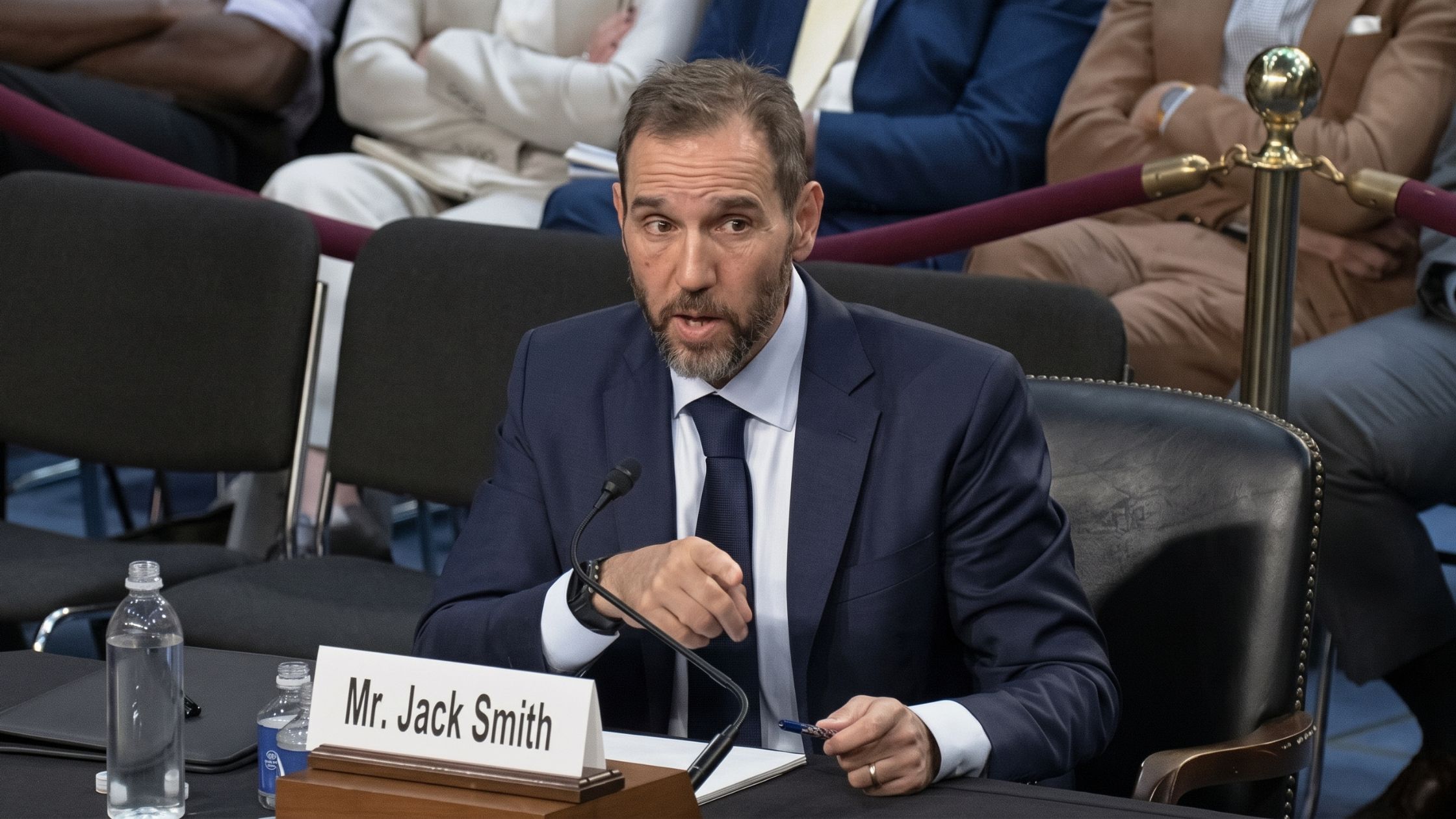
Mr. Jack Smith (01:11:21):
I do.
Mr. Grassley (01:11:24):
Thank you. You may proceed to your opening statement.
Mr. Jack Smith (01:11:26):
Chairman Grassley, Ranking Member Durbin-
Mr. Durbin (01:11:36):
Is your microphone on?
Mr. Jack Smith (01:12:34):
Oh wait, I think we have it.
(01:12:39)
Chairman Grassley, Ranking Member Durbin, members of the committee, thank you for the opportunity to discuss my work as special counsel. I've been fortunate to serve a country that I love for nearly 30 years, in local, national and international settings. My service has spanned both Republican and Democratic administrations. I am not a politician and I have no partisan loyalty. My career has been dedicated to serving our country by upholding the rule of law and the core principles upon which our country was founded.
(01:13:17)
I believe there is no role for politics in the proper administration of justice. A prosecutor's decisions must be based on the facts and the law. The status, power, prominence, or political affiliation of the subject of an investigation must play no role in the decision to investigate, prosecute, or decline to prosecute. I approached my role as special counsel following these principles. The special counsel's office followed Justice Department policy, observed legal requirements, and took actions based on the facts and the law. I stand by my decisions as special counsel, including my decision to bring charges against President Trump. I made those decisions without regard to President Trump's political association, activities, beliefs, or candidacy in the 2024 presidential election.
(01:14:18)
Our investigation developed proof beyond a reasonable doubt that President Trump engaged in serious crimes against our nation. If asked whether to prosecute a former president today, based on the same facts, I would do so regardless of whether that president was a Republican or a Democrat.
(01:14:41)
The charges against President Trump were the result of the evidence. Grand juries in two separate districts reached this conclusion based on his actions, as alleged in the indictments they returned. Rather than accept his defeat in the 2020 presidential election, President Trump engaged in a criminal scheme to overturn the results and prevent the lawful transfer of power.
(01:15:08)
After leaving office in January of 2021, President Trump illegally kept classified documents at his Mar-a-Lago Social Club, and repeatedly tried to obstruct justice to conceal his continued retention of those documents. Highly sensitive national security information was held in a bathroom, and a ballroom, where events and gatherings took place.
(01:15:34)
As with my appearance before the US House of Representatives Committee on the Judiciary, I am prepared to answer your questions truthfully. I stand by my testimony before the House of Representatives, and I will not be silenced by continued threats of prosecution from the president or others.
(01:15:57)
As I appear before you today, it is my belief that the rule of law faces challenges unlike any we have experienced in our lifetime. Individuals are threatened with criminal prosecution because they are perceived to have opposed the president. Predetermined outcomes increasingly seem to take precedence over the Justice Department's longstanding core values and traditions.
(01:16:23)
History teaches that the rule of law is rarely destroyed all at once. It's often weakened by attacks on the institutions and the public servants sworn to uphold it. Since January of 2025, we have witnessed precisely such an effort, including the vilification of the agents, prosecutors, and staff who worked on my team, simply because of their unwavering dedication to the rule of law.
(01:16:52)
I myself have been threatened with jail by the President of the United States. However, I remain confident that the rule of law will endure, because so many continue to uphold it faithfully each day. Throughout our legal system, public servants have remained faithful to their oaths, despite extraordinary pressure to do otherwise. Their example demonstrates that while fear may be contagious, courage is as well.
(01:17:26)
Thank you for the opportunity to testify today. I look forward to your questions.
Mr. Grassley (01:17:31):
Thank you, Mr. Smith. We'll have 10-minute opportunities to ask questions, and we'll only have one round for each member.
(01:17:42)
In your public statements and testimony here today, you've given glowing assessment of your staff, saying that they had an unwavering commitment to justice regardless of personal costs. That is blatantly untrue. You're apparently in denial, based on the litany of wrongdoing and political bias supported by reams of evidence that I've referenced in my opening statements, and I've either released documents or will today that proves this.
(01:18:17)
Moreover, in your public report, you said in part, quote, "Those materials comprised a small part of the office's investigative record," end of quote. You were referring to the J6 committee materials. Records show that in your briefing memorandum for a meeting with Garland, you said your team, quote, "fully read and reviewed," end quote, the J6 committee report. That memo also said your staff, quote, "went over it page by page, and incorporated it into investigative plan," end quote. The memo also said you, quote, unquote, "will leverage the report to avoid certain interviews." Your report provided false information to the public.
(01:19:18)
Your staff also obtained subpoena returns that included the content of messages of 44 members of Congress, not just toll records, as you testified previously. Based on information provided to the committee, that content was shared with case agents and prosecutors before it went through any filter review for privileged information, which should have been done like it's been in other cases. Those are clear violations by your staff.
(01:19:56)
In addition, your deputy, J.P. Cooney, said he'd, quote, "prosecute any nun who still wears a head habit," end of quote. Then Cooney also said, regarding the speech and debate clause, quote, "I'm an advocate for repealing the clause," end of quote. Lastly, Cooney and Molly Gaston filed a complaint with the Justice Department Inspector General. Your staff asked for the Inspector General to investigate whistleblowers who bravely exposed abuses of authority to Congress by you and your staff.
(01:20:39)
These are just some of the violations of law or policy that your staff and office committed, and that doesn't include all the violations of disgrace former FBI agents like Thibault and Giardina committed while creating false predicate for your cases and others.
(01:20:59)
So question number one, out of six I have, should whistleblowers who made lawful disclosures to Congress about your taxpayer funded work be investigated?
Mr. Jack Smith (01:21:16):
I'm not aware of any whistleblowers being investigated. I believe public servants should be protected. The members of my team, that you just mentioned, I'm extremely proud to have worked with them. And the fact that they have been targeted illegally, lost their jobs illegally, and had their lives turned upside down by this Department of Justice is an outrage.
Mr. Grassley (01:21:40):
Well, you said you didn't know about it, and I gave you evidence that they asked for investigation by the Inspector General. Question number two, did your special counsel operation obtain possession of donor data including financial information? Yes or no?
Mr. Jack Smith (01:22:04):
Our investigation was focused on investigating matters under my mandate, including whether any person or entity violated the law with attempts to block the peaceful transfer of power.
Mr. Grassley (01:22:19):
Let me ask the question again. Did your special counsel operation obtain possession of donor data to include financial information, yes or no?
Mr. Jack Smith (01:22:31):
Yes, we acquired financial information. As I sit here right now, I cannot recite to you every subpoena we issued. I can tell you why we issued subpoenas, and it was to conduct a criminal investigation of one of the most serious crimes that's ever happened in our nation's history.
Mr. Grassley (01:22:47):
Let me say-
Mr. Jack Smith (01:22:48):
I had a duty to collect facts.
Mr. Grassley (01:22:50):
... let me say, indeed you did, and you answered yes. Accordingly, to protect disclosures to my office, you obtained at least 4,782 donor checks. Many of those checks were five to $10. The list includes checks from constituents in every state of every single member of this committee, both Republicans and Democrats. It included 42 checks from Iowans who dared to donate money to Republicans. No matter what you say, there is no legitimate basis for what you did, especially since your staff killed an investigation into the Clinton campaign. Donations to Republican groups wasn't necessary for your investigation, which is proved out by the fact that it was not mentioned in your public report.
(01:23:44)
Now, the Justice Department and the FBI, will forever possess thousands of people's address, phone number, bank, and bank account number, bank routing number, and a copy of their true signature. Every member of this committee ought to be outraged for what happened to their constituents. I hope my Democratic colleagues will join me in this outrage.
(01:24:09)
Question number three. In October last year, I asked you this question, but you never responded. Did you ever use a personal device for work purposes to include communications such as email, text, or creation or editing of work product? If so, do you commit to providing that material to the committee? If not, are you testifying that you've complied with all federal record requirements?
Mr. Jack Smith (01:24:43):
Yes. When I first became special counsel, I did not have a government phone or government computer. And so, in the initial days when I was appointed and I was still living in the Netherlands, I did use a personal device and email to communicate with folks in the Justice Department. What I did when I got government accounts is, made sure to the best of my ability, that that information was forwarded to government accounts so it would be within the Federal Records Act.
(01:25:16)
I sought at all times to comply with the Federal Records Act, as I expected my attorneys to do, as well.
Mr. Grassley (01:25:25):
Following up on my opening statement for the classified document case, where did you store the classified material? Describe the SCIF arrangements for both DOJ and FBI personnel during and after the court sessions.
Mr. Jack Smith (01:25:47):
I can't speak to FBI facilities. I can explain, our office had a SCIF, a place to store classified information. And my recollection is that there was, at least in Florida, an ability to store it there. I can't recall if it was at the FBI field office or at the courthouse, but we had a SCIF at our office as part of our investigation, knowing that classified information would be involved in the investigation.
Mr. Grassley (01:26:19):
Yeah. I said in my opening statement that one of your staff members suggested leaving the door open, which is obviously, be a violation of law. Question number five, have you ever received any consultation or counsel by John Brennan, former CIA director, whether during your time as special counsel or otherwise? If so, when and for what purpose?
Mr. Jack Smith (01:26:47):
I've never met John Brennan.
Mr. Grassley (01:26:50):
Okay. Have you ever... Well, I guess you've answered my follow-up question. Question number six, and the last question. When you became special counsel, what direction did you give your staff to handle speech or debate, and attorney-client material? Did you issue any directories? If so, to whom? And please explain.
Mr. Jack Smith (01:27:23):
So with respect to the speech or debate clause first, we took our obligations seriously, under the speech or debate clause. It's, in my view, an important part of the separation of powers. I had members of my staff who were very familiar with the clause, having worked in the Public Integrity Section for years. We also, when it was appropriate or required, consulted with the Public Integrity Section regarding application of that clause.
Mr. Grassley (01:27:52):
Let me follow up with this. Mr. Smith, no amount of explanation can take away from documentary record. My opening remarks, and the statements I made about your staff's clear failure, show unequivocally how you breached constitutional parameters and failed to require your staff to comply with relevant rules, using the terrible acts on January 6th as a predicate for your misguided investigation is irresponsible. To that end, either you or the world's worst manager, or you shared your staff's political animus to fuel your partisan investigation, an investigation that ruined the lives of many innocent people.
(01:28:35)
Senator Durbin.
Mr. Durbin (01:28:37):
Mr. Smith, thank you for being here. There is, I think, appropriate concern by members of this committee and members of Congress, as to your activities related to their telephone conversations, text messages and records. Please explain to us what involvement you had with any information from members of Congress.
Mr. Jack Smith (01:29:08):
First, with respect to toll records. Toll records are non-content records. They show who a call was to, who a call was from, and the length of that call. My office did secure toll records from third parties, third party telephone companies in the course of our investigation, that were records for members of Congress. Before we did that, we consulted with the Public Integrity Section regarding whether those toll records subpoenas were appropriate. I approved those records, and those records were materially relevant to our investigation.
Mr. Durbin (01:29:48):
Why were they relevant?
Mr. Jack Smith (01:29:51):
For a number of reasons. First, with respect to the toll records regarding the evening of January 6th, those records corroborated evidence that we had that the president, President Donald Trump, and his co-conspirators were seeking to exploit the violence on January 6th in furtherance of their criminal scheme. They were taking the fact that law enforcement officers had been brutally assaulted at this institution, and using that to seek to delay the proceedings further, in violation of the law. It was an important part of our investigation. We had interviewed co-conspirators who talked about the calls that were made to members of Congress. We had recordings of voicemails that showed that, and these voicemails are public, where the co-conspirators were again providing false information to try to delay the proceedings. It was an important part of our investigation, and it was centrally relevant to the issue of criminal intent. To seek to further delay the proceedings in violation of the law, given what had happened that afternoon, at January 6th, in my view added to the powerful evidence we had of Donald Trump's guilt, and the participation of his co-conspirators in his criminal scheme, at his behest.
Mr. Durbin (01:31:23):
So we have the Capitol under siege. We have the Vice President removed from presiding over the Senate by the Secret Service. We have members of the Senate and House in both political parties, who are told to leave the building because of the danger. I want to ask, is it fair to surmise from what you have said that the President was in contact with some members of Congress during this period of time?
Mr. Jack Smith (01:31:54):
Yes, that is correct. Both members of Congress, we gained evidence, reaching out to the White House asking, "Please help us. Please stop what's happening. Please have your supporters stop attacking the Capitol." And then also, again, after the attack had occurred. Telling his co-conspirators, there's a message, I believe it's between Mark Meadows and one of the co-conspirators, that, "The president wants you to call these senators," and that record should be in the material that you all have. Co-conspirators, including Rudy Giuliani, then sought to make those calls. We also had evidence that the president himself was trying to reach out to individual senators.
Mr. Durbin (01:32:46):
Now, this has been characterized by some as a wiretap. Did you initiate any wiretaps relative to members of Congress of either party?
Mr. Jack Smith (01:32:59):
No. The records that we're talking about are non-content records, the toll records, are non-content records that we sought to corroborate evidence we had, and also to assist us in questioning witnesses about these events. Among other things.
Mr. Durbin (01:33:13):
So what did the records disclose to you, if they didn't disclose the content and conversation?
Mr. Jack Smith (01:33:19):
Well, they were relevant for a number of reasons. First, they corroborated other records we already had. Some of those records were helpful, but they had gaps in them, in terms of when certain calls happened.
(01:33:33)
There was also the issue of, when we interviewed one of these co-conspirators who was involved in making these calls, it was unclear from that interview how many phones were in fact being used to make those calls. And so, getting these records would help us figure out how many phones in fact were being used to make these calls, and to see who else, if anyone, was involved in that.
Mr. Durbin (01:34:00):
It is possible, and certainly as I understand, legal, for a member of Congress to have more than one phone. The official business of the Senate may require one phone number, there may be a personal phone number for you and your family, there may even be a political phone number, which you could resort to if you were involved in political activity. Did you make any distinction in terms of the phone messages which you were investigating, of these three possibilities?
Mr. Jack Smith (01:34:35):
My recollection is being focused on the phones of the co-conspirators. And so, [inaudible 01:34:41]-
Mr. Durbin (01:34:41):
When you say co-conspirators, do you mean members of Congress?
Mr. Jack Smith (01:34:43):
No, no. I'm thinking specifically of Rudy Giuliani. One of the things that we learned, in this interview of another co-conspirator, is that he had multiple phones. And so the question was, if we had records, did we have all the records of the phones that were making calls to try to exploit the violence?
Mr. Durbin (01:35:06):
But in terms of the phones themselves, of the members of Congress, where did you find those phone numbers?
Mr. Jack Smith (01:35:17):
As I sit here, I do not recall. What I recall, my role in this aspect of the investigation was, I was asked by my staff to approve toll records subpoenas for these sort of records. After discussing the matter with my staff, I told them I wanted to make sure the Public Integrity Section approved of that process. That process happened, and they did. With respect to how agents figured out, or thought they'd figured out which phones belonged to which senators, I don't have an answer to that.
Mr. Durbin (01:35:53):
Assume for a moment that one of the phone conversations was between the President of the United States and a member of the Congress. Does the White House maintain any records of calls made by the president, or on his behalf?
Mr. Jack Smith (01:36:10):
My understanding is the White House does. But my recollection, and I think the terminology is "the White House switchboard", my recollection is that we had discovered at various points in times those records were incomplete. Or, certainly, we didn't have all the records. And so that was another important point to corroborate, for example, evidence of an email where someone says, "The president is trying to reach out to these people," but then to find the actual records of the actual call.
Mr. Durbin (01:36:44):
Mr. Smith, my colleagues have spent an extensive amount of time discussing Timothy Thibault, who retired from the FBI in August of 2022. According to our information, you were appointed special counsel three months after his retirement in November of 2022. Was Timothy Thibault a part of your special counsel team?
Mr. Jack Smith (01:37:07):
No.
Mr. Durbin (01:37:09):
Did you ever meet him during your work as special counsel?
Mr. Jack Smith (01:37:13):
No, not that I recall.
Mr. Durbin (01:37:15):
Did Timothy Thibault, or the work that he had done, whatever it was, influence any of your decision making as special counsel?
Mr. Jack Smith (01:37:23):
No. We made our decisions based on the facts, and based on the law, based on the investigation that my team conducted.
Mr. Durbin (01:37:31):
So I would say to those who were following the hearing, after hearing all these references to Timothy Thibault, he was gone. He was gone from the FBI by the time Mr. Smith was appointed, and he never met him. And he was not part of his team. Some of these conspiracy theories just keep mushrooming, despite the evidence to the contrary.
(01:37:53)
Mr. Chairman, I yield.
Mr. Grassley (01:37:57):
Say, before we go to the next person, which will be Mr. Lee. You said you never met John Brennan, but have you ever had any conversation with John Brennan?
Mr. Jack Smith (01:38:16):
I have no recollection of having a conversation with John Brennan.
Mr. Grassley (01:38:25):
Okay. Oh, Senator Lee's not here, so then that'd be Senator Kennedy. No, Cruz. Oh, Cruz isn't here. Senator Kennedy, you're up now. Are you ready? If you are, go ahead.
Mr. Kennedy (01:38:51):
Mr. Smith, you were pretty well known around Washington, even before you decided to prosecute-
Senator Kennedy (01:39:00):
... and even before you decided to prosecute President Trump, weren't you, and aren't you?
Mr. Jack Smith (01:39:08):
I would say a number of people in the Justice Department knew me. I don't know about Washington, D.C.
Senator Kennedy (01:39:20):
What does the word arrogant mean?
Mr. Jack Smith (01:39:28):
I suppose it means that you feel full of yourself, that sort of thing.
Senator Kennedy (01:39:31):
Yeah. Would you pull that mic closer to you?
Mr. Jack Smith (01:39:33):
Sorry. Is that better?
Senator Kennedy (01:39:36):
Yeah. What does the word self-righteous mean?
Mr. Jack Smith (01:39:46):
I think it's pretty similar to arrogant.
Senator Kennedy (01:39:52):
Have you ever heard the expression, "Often wrong, but never in doubt?"
Mr. Jack Smith (01:40:00):
I don't believe I have.
Senator Kennedy (01:40:01):
You haven't? You used to work for the International Criminal Court, did you?
Mr. Jack Smith (01:40:15):
Yes, I did.
Senator Kennedy (01:40:19):
Is that a worthy organization, in your opinion?
Mr. Jack Smith (01:40:24):
I believe the mission of the International Criminal Court is a worthy one. I think it's had numerous challenges and numerous problems over the year, but I think the idea that no one should be above the law and that we should apply that principle around the world, I think that's a good one we should aspire to.
Senator Kennedy (01:40:41):
And that would be the same International Criminal Court that has threatened to prosecute American soldiers, is that right?
Mr. Jack Smith (01:40:54):
I am not aware of a single American soldier ever being prosecuted by the International Criminal Court.
Senator Kennedy (01:41:01):
I didn't say they'd been prosecuted. I said they'd been threatened.
Mr. Jack Smith (01:41:03):
I can tell you during my time at the court, which was a short period of time, it was about a year and a half, I don't recall any threats to prosecute American soldiers. I don't.
Senator Kennedy (01:41:15):
You don't get around much, do you? When President Trump defeated Secretary Clinton, you were bitterly disappointed, weren't you?
Mr. Jack Smith (01:41:30):
I don't recall that.
Senator Kennedy (01:41:35):
You don't recall at all? Mrs. Smith was, wasn't she?
Mr. Jack Smith (01:41:45):
I'm not going to talk about my family. What I can share is that I accepted a position in the Trump administration as the acting US attorney in Tennessee after that election. And then I accepted a second position in the Trump administration as a war crimes prosecutor.
Senator Kennedy (01:42:02):
Your spouse, it's certainly her right, I'm not being critical, is an ardent supporter of President and First Lady Obama. Is that right?
Mr. Jack Smith (01:42:16):
I'm not going to talk about my family here today. I'm here to talk about my work as special counsel.
Senator Kennedy (01:42:20):
In fact, she made a glowing saccharin-sweet documentary about First Lady Obama, didn't she, that she sold to Netflix?
Mr. Jack Smith (01:42:35):
I'm not going to speak about my family here today. I'm happy though, to answer any questions you have about my actual work as special counsel.
Senator Kennedy (01:42:46):
You asked General Garland to appoint you special counsel, didn't you?
Mr. Jack Smith (01:42:53):
I don't think that's accurate. He made the decision to appoint me.
Senator Kennedy (01:43:02):
In fact, you had people call General Garland to lobby him to appoint you, didn't you?
Mr. Jack Smith (01:43:12):
I don't recall anything like that.
Senator Kennedy (01:43:15):
You really wanted to be special counsel, didn't you?
Mr. Jack Smith (01:43:23):
I accepted the position as special counsel because I had spent 30 years as a nonpartisan prosecutor. I had investigated every sort of criminal case you could possibly imagine, and I thought I was qualified to do the job. I knew that I would do it independently and I would conduct it the same way, whether a Republican or a Democrat.
Senator Kennedy (01:43:46):
You really wanted President Biden to be reelected, didn't you?
Mr. Jack Smith (01:43:54):
I have no views about that. My job as a prosecutor was to enforce the law. I wanted to prosecute our case. That's absolutely true because I felt that we had proof beyond a reasonable doubt that Donald Trump committed incredibly serious crimes, and I did want those-
Senator Kennedy (01:44:11):
I got that part. I got that part. When you decided to prosecute President Trump, you told General Garland, is that right?
Mr. Jack Smith (01:44:29):
There were two separate decisions, one in the classified documents case and one in the elections case. In both instances, once I determined-
Senator Kennedy (01:44:38):
I'm sorry, Counselor, I don't mean to be rude, but you know I've got only 10 minutes and you've been around. Please don't filibuster me. It's a simple question. Did you tell the attorney general of the United States that you were going to prosecute the former president of the United States?
Mr. Jack Smith (01:44:56):
I did so twice.
Senator Kennedy (01:44:57):
Okay. And the attorney general checked with President Biden, is that right?
Mr. Jack Smith (01:45:07):
I have absolutely no idea.
Senator Kennedy (01:45:10):
Well, you know General Garland, right?
Mr. Jack Smith (01:45:15):
I know Attorney General Garland in a professional-
Senator Kennedy (01:45:18):
Is he a smart guy?
Mr. Jack Smith (01:45:18):
I know him in a professional setting, and in that setting I found him to be an intell-
Senator Kennedy (01:45:18):
Is he an experienced guy?
Mr. Jack Smith (01:45:27):
In a professional setting, I found him to be experienced and intelligent.
Senator Kennedy (01:45:31):
Is he a dummy?
Mr. Jack Smith (01:45:36):
That was not my experience.
Senator Kennedy (01:45:37):
Yeah, mine neither. So you're telling me that you're about to prosecute a former president of the United States, first time in history. Not only that, you're about to prosecute a former President of the United States who's also the current opponent of Judge Garland's boss. And you told Judge Garland, "Here's what I'm about to do." And you don't think he checked with President Biden to see if it was okay?
Mr. Jack Smith (01:46:19):
I have no idea what he did. My job as a prosecutor on the special council regulations was to make an independent decision, and Attorney General Garland could have countermanded that decision. But I made that decision on my own, consulting with my staff and reviewing the incredibly strong evidence that we had accumulated.
Senator Kennedy (01:46:39):
In fact, President Biden and/or his White House staff told General Garland to prosecute the president, didn't they?
Mr. Jack Smith (01:46:49):
Again, I have no idea about that. What my job was, was to make it-
Senator Kennedy (01:46:54):
Don't know anything about that. Do you believe in the Tooth Fairy?
Mr. Jack Smith (01:46:58):
I do not.
Senator Kennedy (01:47:00):
How about the Easter Bunny?
Mr. Jack Smith (01:47:04):
I no longer believe in the Easter Bunny.
Senator Kennedy (01:47:06):
Do you think Jimmy Hoffa died of natural causes?
Mr. Jack Smith (01:47:10):
I do not.
Senator Kennedy (01:47:11):
Okay. Now, you sought the phone records of a bunch of US senators, right?
Mr. Jack Smith (01:47:24):
We sought the toll records, non-content records-
Senator Kennedy (01:47:27):
Any Democrats? Or just Republicans?
Mr. Jack Smith (01:47:31):
If President Trump had reached out to Democrats to further his-
Senator Kennedy (01:47:36):
I'm just trying to get the facts. Were there any Democrats you sought their phone records? Just Republicans, right?
Mr. Jack Smith (01:47:42):
The toll records that we sought were relevant to the investigation and they were Republicans.
Senator Kennedy (01:47:47):
I'm asking you. You stalled me again, Counselor. You know that. You sought just the records of the Republicans, and you knew that violated the Speech and Debate Clause, didn't you?
Mr. Jack Smith (01:48:02):
That is incorrect. We sought to comply with it.
Senator Kennedy (01:48:04):
Did you take common law?
Mr. Jack Smith (01:48:08):
I'm sorry, Senator-
Senator Kennedy (01:48:08):
Were you in the quad playing Frisbee during common law at Harvard Law School?
Mr. Jack Smith (01:48:17):
I did take constitutional law, yes.
Senator Kennedy (01:48:18):
Well, then you had to know it violated the Speech and Debate Clause. In fact, when you went to Judge Boasberg, you didn't even tell him you were seeking the phone records of members of Congress, did you? Because you knew he wouldn't agree. He would say, "Hey, Counselor, anybody who knows a law book from a J.Crew catalog knows that this violates the Constitution." But you didn't tell him, did you?
Mr. Jack Smith (01:48:48):
We sought non-disclosure orders from the court-
Senator Kennedy (01:48:51):
You didn't tell him, did you?
Mr. Jack Smith (01:48:53):
In seeking non-disclosure orders, we did not disclose-
Senator Kennedy (01:48:56):
Didn't tell him. But you're unbiased. You have no personal feelings. You make me want to throw up in my mouth.
Senator Durbin (01:49:08):
Mr. Chairman. Mr. Chairman.
Mr. Grassley (01:49:12):
His time's up.
Senator Durbin (01:49:14):
I'd like to say a word. This hearing is of constitutional and historic importance. This witness should be allowed to answer the questions, complete a sentence. We have given that courtesy to witnesses from both political parties, and it should be extended to Mr. Smith.
Mr. Grassley (01:49:32):
Okay. Your time's up, Senator Kennedy.
Senator Kennedy (01:49:33):
Well, I'd also like, with respect, Dick, for the chairman to instruct the witness. He's not Bambi's baby brother, okay? He's been around. Everybody knows him. And he was famous or infamous even before he was hired to prosecute President Trump. And I'd like you to instruct him not to filibuster us.
Mr. Grassley (01:49:57):
Okay. Thank you. Before I call on Senator Coons, before, without objection, I will enter it into the employee payroll records for a conservative entity where Jack Smith's team obtained the personal and pay information for every employee on staff. That includes monthly tax and health insurance payments. Senator Coons.
Senator Kennedy (01:50:24):
Mr. Chairman, I'd also like to enter into the record Mrs. Smith's documentary about former First Lady Obama.
Mr. Grassley (01:50:34):
Without objection, it's ordered.
Senator Kennedy (01:50:36):
It's called, Becoming.
Senator Coons (01:50:38):
Thank you, Mr. Chairman. Thank you, Mr. Smith. Thank you for your testimony, for your service to our government, and your decades of work supporting our constitutional order. I appreciate you being here today to testify, something you have long offered to do, something the ranking member and my colleagues on this side of the dais have been asking for, for almost a year. I want to be very clear about why we are here today. Centrally, it's the events of January 6th, 2021. I was here that day, as were many of my colleagues on both sides of the dais.
(01:51:13)
On that day, armed insurrectionists poured into the halls of this Capitol Complex looking for members of Congress, assaulting more than 100 law enforcement officers, and seeking to overturn the results of a free and fair election. They assaulted members of the Capitol Police, like those who are with us today, and like a friend of mine, former Capitol Police Officer Howie Liebengood. They were doing so at the direction encouragement of one man, President Donald Trump. You, Mr. Smith, were later charged with investigating whether anyone interfered with the peaceful transfer of power that day or in the weeks after the 2020 election, including the then former president.
(01:51:59)
This was not an assignment you sought out. You were a private citizen at the time, but you accepted this request to serve your country, and you served with distinction. You and your team uncovered an unprecedented coordinated effort to obstruct the peaceful transfer of power following a presidential election, the creation and presentment of fake slates of state electors, knowingly false claims of election fraud repeatedly rejected by federal courts across our nation, and ultimately, a mob sent to attack the Capitol to interfere with the peaceful transfer of power through the certification of an election.
(01:52:40)
Twice, federal grand juries agreed with you that there was sufficient evidence to bring federal charges against the then former president for his role in that insurrection, but that wasn't all. Your team also discovered former President Trump hid dozens of classified documents at Mar-a-Lago, and when this issue was raised with him, tried to hide them rather than return them. Our nation's most sensitive nuclear and military secrets stashed in a bathroom and in a ballroom. Again, a federal grand jury agreed there was sufficient evidence to bring charges, more than three dozen counts. You and your team chose to pursue justice, and I'm sorry to say, some of my Republican colleagues have made you pay personally for that, spreading conspiracy theories about your work, calling your reputation for fairness into question.
(01:53:29)
But President Trump has gone further. He carried out mass firings of men and women at the Justice Department, prosecutors, and FBI agents assigned to assist in your investigation, non-political government servants who lost their jobs, saw their careers destroyed, for being asked to stand up for the rule of law. And one of his first actions when reelected was to issue sweeping pardons for everyone convicted of their actions on January 6th, including many who assaulted law enforcement officers. I am grateful that Chairman Grassley has scheduled this hearing, and I appreciate your candidness today. Our responsibility is straightforward, to protect the independence of the Justice Department, defend the rule of law, and make sure that all presidents, Republican or Democrat, are accountable to our people.
(01:54:18)
Mr. Smith, can you explain how you staffed your team? Did you work with rank-and-file line prosecutors and agents, and what happened to the members of your team after President Trump returned to the White House?
Mr. Jack Smith (01:54:34):
My team was composed of career prosecutors, people who had spent their lives in service of this country. The prosecutors and agents on my team, many of them veterans, are people who had devoted themselves to public service. Many of them had expertise in investigating complex criminal matters. Those people, as I think we all know, have been fired illegally for doing their jobs, and their firing is something that, in my view, is unfair to them, but it makes our country less safe. These are people who stood sentry for us. Experts in national security, experts in corruption investigations, who were simply fired because they worked on the wrong case. That has never happened in my career. I have never seen anything remotely like it in any Republican or Democratic administration.
Senator Coons (01:55:37):
In your time as special counsel, did then President Biden or Attorney General Garland ever try to influence your decision-making and your actions as special counsel?
Mr. Jack Smith (01:55:47):
No.
Senator Coons (01:55:48):
What sort of safeguards were in place to ensure that your investigative efforts as special counsel were shielded from partisan politics and independent?
Mr. Jack Smith (01:56:01):
Well, first, it's the appointment of special counsel. The regulations define the relationship between a special counsel and the attorney general, and I was brought in to make an independent decision in this case. I think anybody who has worked with me and knows me during the course of my career knows that I would not let politics play a role. And I would just add that if you knew the people I worked with, they would not either.
Senator Coons (01:56:28):
Mr. Smith, you've been accused of targeting Republicans throughout your investigation. My understanding is you worked extensively with Republicans during your investigation. Can you say more about that? And why was it important for you to speak with and work with Republicans during your investigation into the incidents of January 6th and the transfer of power after the 2020 election?
Mr. Jack Smith (01:56:53):
The criminal scheme we investigated was predicated upon Donald Trump preying on party loyalty. He preyed on party loyalty and fear, fear that he could force people to do things. The reality is, one of the reasons our democracy held up, one of the reasons he was not able to take power even though he was seeking to do these things is because Republicans stood up. Our witnesses, the strongest witnesses would have been Republican members of Congress. I personally find it very hard to understand how our investigation can be viewed as partisan when the strongest witnesses, the people who were the difference between the rule of law standing and not in our case, were Republicans. People like Rusty Bowers in Arizona, people like Mike Pence, who did the right thing and put the interest of the country over the personal interest of Donald Trump. I just don't understand how an investigation predicated on witnesses like that can be partisan.
Senator Coons (01:58:05):
Mr. Smith, what signal do you think it sends that President Trump, when he was reelected, carried out mass firings of career nonpartisan prosecutors? What message do you think that sent to Americans interested in raising their hand to serve their nation or to law enforcement, prosecutors, judges throughout our system of law?
Mr. Jack Smith (01:58:28):
I think the message it sends is that public servants will not be protected, and if we cannot protect public servants who enforce the rule of law without fear or favor, the Justice Department cannot work and it cannot have credibility. That is why we have seen the erosion of the credibility of the Department in courts across this country. It's important, I believe, incredibly important to protect public servants if we want to have a rule of law that works.
Senator Coons (01:58:56):
I want to focus my last two minutes on NDOs, or so-called non-disclosure orders. The special counsel's investigation into unprecedented efforts to unturn a presidential election was lawful and necessary. I want you to briefly walk me through the process by which you obtained non-disclosure orders for the toll records of members of Congress. These types of NDO requests are fairly typical in DOJ investigations, and your NDO requests were fully compliant with the Department of Justice policy at the time. Is that correct?
Mr. Jack Smith (01:59:28):
That is correct, and we had, in my view, an ample legal basis to seek non-disclosure orders in this case.
Senator Coons (01:59:37):
In fact, the same thing happened to Democratic members of Congress during the first Trump administration, confirmed by a 2024 DOJ IG report. Is that correct?
Mr. Jack Smith (01:59:47):
I believe that's correct. The thing that was unique to our case is the extreme concern over obstruction of our investigation, intimidation of witnesses, destruction of evidence, and interference with the integrity of the investigation by Donald Trump and his co-conspirators.
Senator Coons (02:00:06):
Let me close on this point. My Republican colleagues, including some longtime friends, have tried to suggest there was something wrong with your decision to obtain non-disclosure orders during your investigation. I believe the government bar, the current bar for granting NDOs may be too low, and that government requests for secrecy are too often granted. My NDO Fairness Act with Senator Mike Lee would ensure NDOs are only issued in circumstances requiring secrecy, in a way that would better protect all Americans, including members of Congress. This bill has already passed the House by voice vote. The Constitution protects Americans' right to privacy in their personal communications, but we can only assert that right if we know our privacy has been violated.
(02:00:50)
I'm not suggesting you've done anything wrong. I'm just suggesting that if I have colleagues who were enraged by your legal and appropriate and timely pursuit of NDOs, there's something we can and should do about it. You said in your opening that, "While fear may be contagious, courage is as well." I want to thank you for your courage, for standing up to relentless, biased attacks on you and your family, for groundless conspiracy theories, and for frankly, the shocking lack of forceful engagement by my colleagues to defend the rule of law in the face of one of the most challenging treacherous moments in our democracy's history, the assaults on this Capitol and our constitution of January 6th. Thank you, Mr. Smith.
Mr. Grassley (02:01:38):
Without objection, I'll enter into the record emails showing the Department of Justice was looking for predication so they could open a classified document case against President Trump. Without objection. Hearing none, ordered. Senator Schmitt.
Senator Schmitt (02:01:56):
Thank you, Mr. Chairman. Mr. Smith, you used to lead the Public Integrity Section at DOJ, is that correct?
Mr. Jack Smith (02:02:02):
Yes, sir.
Senator Schmitt (02:02:03):
You told Senator Durbin that you followed the Public Integrity Section's advice and worked closely with them on getting the toll records of members of Congress, is that correct?
Mr. Jack Smith (02:02:12):
I directed my staff to consult with them and seek their approval with regards to the toll records we sought regarding members of-
Senator Schmitt (02:02:20):
But you said you followed their recommendation, correct?
Mr. Jack Smith (02:02:26):
I believe what I said is that I asked my staff to consult with them and seek their approval. My understanding is that the Public Integrity Section did in fact approve these subpoenas.
Senator Schmitt (02:02:38):
Okay. In your time as special counsel, did you always follow the Public Integrity Section's advice?
Mr. Jack Smith (02:02:44):
In my time as special counsel?
Senator Schmitt (02:02:46):
Correct.
Mr. Jack Smith (02:02:49):
What I did is that my-
Senator Schmitt (02:02:52):
But yes or no would be sufficient. I don't have a ton of time. I know what you're doing.
Mr. Jack Smith (02:02:56):
We consulted with them where required by department regulations, and they had approval of certain charges. They had approval-
Senator Schmitt (02:03:05):
Was there a time that you did not follow their advice or went against their advice?
Mr. Jack Smith (02:03:14):
I can't think of one as we sit here now.
Senator Schmitt (02:03:17):
Well, I got one for you. In August of 2024, you were advised not to file a superseding indictment by the Public Integrity Section. Same public integrity section you led. Is that correct?
Mr. Jack Smith (02:03:28):
In August of '24?
Senator Schmitt (02:03:29):
Correct.
Mr. Jack Smith (02:03:30):
I disagree with that. The Public Integrity Section-
Senator Schmitt (02:03:32):
Well, you may not know this, but we have a readout of your phone call with the Public Integrity Section where they explicitly told you in violation of the 60-day rule that you shouldn't file the superseding indictment that close to election. Now, do you recall that advice that you ignored?
Mr. Jack Smith (02:03:49):
What you stated is inaccurate and I'm happy to clear it up.
Senator Schmitt (02:03:52):
Well, I have the highlighted version of the readout with the phone call with the Public Integrity Section. And I would remind you, Mr. Smith, you are under oath. So is it your testimony that they did not advise you to not file the superseding indictment that close to the election?
Mr. Jack Smith (02:04:10):
We consulted with the Public Integrity about filing a superseding indictment.
Senator Schmitt (02:04:14):
Okay. What'd they say?
Mr. Jack Smith (02:04:15):
There were multiple drafts of the indictment that went back and forth. The first draft that we submitted, they did not approve. Subsequent to that, there was a draft that we submitted that they did approve. And the Public Integrity Section, to be very clear, Senator, concurred that we followed the election year sensitivities policy in all respects.
Senator Schmitt (02:04:37):
You did not. After you lost the immunity decision, you filed a brief in the district courts based on your superseding indictment. So not only did you file the superseding indictment, you filed a brief that was essentially your plea to the American people in violation of the Public Integrity Section advice. Isn't that correct?
Mr. Jack Smith (02:04:55):
That is incorrect.
Senator Schmitt (02:04:56):
Okay.
Mr. Jack Smith (02:04:56):
My recollection is that we consulted the Public Integrity Section. That brief was required by the court to litigate the issues that had come up as a result of the immunity decision that was filed-
Senator Schmitt (02:05:09):
Normally I would cut you off, but keep digging. This is great.
Mr. Jack Smith (02:05:12):
It was filed pursuant to our duty to litigate our case in court, and the Public Integrity Section concurred that we complied with the executive... I'm sorry, the election year sensitivities policy in all respects.
Senator Schmitt (02:05:30):
I have a feeling that your testimony is going to be read back to you in subsequent hearings. You've lost a lot of big cases in your career, haven't you?
Mr. Jack Smith (02:05:41):
I have lost cases in my career.
Senator Schmitt (02:05:42):
I'm just curious, what are you writing down there?
Mr. Jack Smith (02:05:47):
I'm sorry?
Senator Schmitt (02:05:47):
Nevermind. You were the chief of DOJ's Public Integrity Section when John Edwards was prosecuted, correct?
Mr. Jack Smith (02:05:56):
That's correct.
Senator Schmitt (02:05:57):
And you lost that case, right?
Mr. Jack Smith (02:05:59):
I believe it was a hung jury and we decided not to retry.
Senator Schmitt (02:06:02):
Well, he was acquitted on one count and a hung jury on five. Does that jive?
Mr. Jack Smith (02:06:07):
I think that's right.
Senator Schmitt (02:06:08):
Okay. While you were head of the Public Integrity Section, you also prosecuted Governor Bob McDonald, correct?
Mr. Jack Smith (02:06:14):
That's correct.
Senator Schmitt (02:06:15):
And you lost that case, right?
Mr. Jack Smith (02:06:18):
We won that case at trial. It was upheld on the Fourth Circuit, and the Supreme Court-
Senator Schmitt (02:06:23):
And unanimously vacated by the Supreme Court. That doesn't happen very often, does it?
Mr. Jack Smith (02:06:29):
I can't speak to that.
Senator Schmitt (02:06:30):
It's pretty rare. The Bob Menendez investigation while you were Public Integrity chief, that prosecution resulted in a loss, is that correct?
Mr. Jack Smith (02:06:39):
I had left the Public Integrity Section by the time that case was tried.
Senator Schmitt (02:06:42):
After you lost all these high-profile cases in America, you fled to The Hague, correct? And prosecuted the President of Kosovo in 2020?
Mr. Jack Smith (02:06:52):
Yes. And he was just convicted of over 300 acts of torture and 96 murders.
Senator Schmitt (02:06:58):
And then you got a chance to come back to get Trump, is that right?
Mr. Jack Smith (02:07:04):
That's not right at all.
Senator Schmitt (02:07:05):
Okay. Did you purposely assemble a team of partisan hacks for your special prosecution of President Trump?
Mr. Jack Smith (02:07:15):
No, and I'm extremely-
Senator Schmitt (02:07:16):
Okay. I'm going to talk about a couple of them real quickly. Walter Giardina, FBI agent who helped analyze the 197 fishing expedition subpoenas you sent to Republican organizations. Basically, the crime was if you were associated with a Republican organization, you got a subpoena. Multiple FBI agents have stated in sworn statements that Giardina had a history of openly ... Open with his desire to investigate President Trump, instructed other agents to quote, "dig around" on President Trump and sign the FISA application against the Trump campaign advisor he knew contained materially false information. It's been talked about, Cooney, already, who famously said he'd like to prosecute any nun who still wears a head habit. Before joining your team, a federal district judge criticized his improper investigation and his conduct of obtaining communications in the Steve Bannon case. You previously testified Cooney was not interested in politics. Do you know what? Cooney just ran for office recently as a Democrat. Did you know that?
Mr. Jack Smith (02:08:22):
I'm aware of that.
Senator Schmitt (02:08:23):
Yeah. And his central plank of his team, of his campaign was that he had prosecuted President Trump. The limited time I have left, I do want to ask you about a couple of things. Did you go to an NBA game between the Golden State Warriors and the Atlanta Hawks on February 3rd, 2024?
Mr. Jack Smith (02:08:47):
I'm sorry, could you say that again?
Senator Schmitt (02:08:48):
Did you go to an NBA game between the Golden State Warriors and the Atlanta Hawks on February 3rd, 2024?
Mr. Jack Smith (02:08:56):
What city would that be in?
Senator Schmitt (02:08:57):
Atlanta.
Mr. Jack Smith (02:08:58):
No.
Senator Schmitt (02:08:59):
Okay. So your testimony today is that you did not go to a Hawks game on February 3rd, 2024. Is that correct?
Mr. Jack Smith (02:09:10):
I have no recollection of that.
Senator Schmitt (02:09:12):
Okay. Is it your testimony that you were not in Atlanta on February 3rd, 2024? Let me just give you a little context.
Mr. Jack Smith (02:09:21):
Yeah.
Senator Schmitt (02:09:21):
The day before, Fani Willis came clean with her affair with the prosecutor. You know the Atlanta prosecutor that was also trying to get Trump? The next day were you in Atlanta?
Mr. Jack Smith (02:09:31):
I do not believe so.
Senator Schmitt (02:09:33):
Okay. Did you ever go to Atlanta during your time as special counsel?
Mr. Jack Smith (02:09:40):
I really don't think so. It's possible I flew through the Atlanta airport on the way to Florida, but I do not have a recollection of going to Atlanta. I definitely did not go to a Hawks game, I'm sure of that.
Senator Schmitt (02:09:54):
Okay. Did you ever meet Nathan Wade or Fani Willis in your time as special counsel?
Mr. Jack Smith (02:09:59):
No.
Senator Schmitt (02:10:00):
What would you say if I had a series of text messages from your team that said you were in Atlanta at a Warrior-Hawks game on February 3rd, 2024, the day after Willis and Wade announced their affair? I don't think you know that we have this stuff.
Mr. Jack Smith (02:10:20):
Yeah.
Senator Schmitt (02:10:20):
So I'll give you a second to process it so you don't perjure yourself.
Mr. Jack Smith (02:10:24):
You just took it down really quick. If I could look at that again.
Senator Schmitt (02:10:28):
Okay.
Senator Durbin (02:10:28):
Mr. Chairman, can we give the witness a copy so he can see what's being read to him?
Senator Schmitt (02:10:34):
Well, I think you've already sufficiently answered. I want to run through ... We'll put it in a file. You can respond. I think you've already perjured yourself, but did you or your office-
Speaker 42 (02:10:46):
Can we see it? Can we see it?
Senator Schmitt (02:10:47):
Did you or your office seek ... This is my time.
Senator Durbin (02:10:50):
Senator, can we see?
Senator Schmitt (02:10:50):
If you want to use your time to criticize my question, go ahead, Ranking Member. Did you or your office seek the contents of members of Congress' emails or text messages?
Mr. Jack Smith (02:11:04):
We sought toll record subpoenas that did not contain the content of calls. I am also aware that we sought White House phones for individuals who are relevant to our investigation, government phones in which they had no expectation of privacy.
Senator Schmitt (02:11:24):
Let me ask you this way. Did you seek the content of messages from members of Congress by other means, meaning the subpoenas you sent to the other 197 organizations asking for communications from members of Congress? Because you've said you didn't as it relates to members of Congress, but did you do it through another means, the other 197 subpoenas?
Mr. Jack Smith (02:11:46):
I can't address every subpoena we issued. What I can say is that I am aware that in the example of Congressman Perry, prosecutors, this is before I was special counsel, did in fact seek a search warrant and receive judicial authority for a-
Mr. Jack Smith (02:12:00):
... a search warrant and receive judicial authority for a search warrant of his telephone.
Senator Schmitt (02:12:05):
Okay.
Mr. Jack Smith (02:12:05):
So that definitely happened.
Senator Schmitt (02:12:07):
Thank you, Mr. Smith. In closing, I just want to say, in the famous words of the chief of the secret police under Stalin of show me the man, I'll show you the crime. You may think you're a hero in this story, but let me tell you something. You're the villain. You've done so much damage, as a former prosecutor, I can say this, so much damage to the trust and faith people have in our system. You have weaponized the Department of Justice against political enemies to an extent that has never happened in the history of this country. You will go down as a total dirtbag. I yield my time.
Amy Klobuchar (02:12:41):
Mr. Chairman.
Mr. Grassley (02:12:42):
Before I call on Senator Klobuchar, without objection, I'll enter into the record emails showing the FBI of all agencies raised concern with the DOJ that there was a sufficient probable cause to obtain the search warrant at Mar- a-Lago. Senator Klobuchar.
Amy Klobuchar (02:13:03):
Mr. Chairman, then you're going to be able to allow the witness to see this vast poster board that we saw? Is that going to be included then so the witness can look at that at some point here before the hearing's over? Because we couldn't see what it said. And I'm a former prosecutor too, and I have never seen anyone just say, "What do you think of this?" And put it down.
Speaker 43 (02:13:30):
We need a copy of the actual text.
Amy Klobuchar (02:13:33):
We need a copy of the actual text. Can you give the witness the courtesy of giving him a copy of that?
Senator Schmitt (02:13:43):
I would love for him to further [inaudible 02:13:44] though.
Amy Klobuchar (02:13:44):
Thank you.
Senator Schmitt (02:13:44):
Can the witness be allowed to comment now that he can see the chart?
Amy Klobuchar (02:13:52):
Should we maybe give him the chance to look at it and then go back at it so he can see it?
Mr. Jack Smith (02:13:56):
I think I can address it.
Mr. Grassley (02:13:57):
Go to your-
Amy Klobuchar (02:13:57):
Okay. This isn't in my time, but yes, Mr. Smith, please address it.
Mr. Jack Smith (02:14:02):
Just very briefly. If this is the correct basketball game, I recall going to a University of Maryland basketball game where Caitlin Clark was playing right around that time, and the Marshals Service was there with me. You could check if that was the exact date. It was Maryland playing Iowa, I think February of 2024. But again, you could check that out if that's what we're talking about.
Speaker 43 (02:14:31):
University of Iowa.
Amy Klobuchar (02:14:32):
Is it the Hawkeyes?
Speaker 43 (02:14:33):
Yes.
Amy Klobuchar (02:14:35):
Could it then be that University of Iowa's the Hawkeyes? Could that be it? And maybe before we show this kind of thing... Hmm? I know, but if he was at an Iowa game. Is that correct?
Mr. Jack Smith (02:14:49):
It was because Caitlin Clark was coming to Maryland to play, and so we went to the game [inaudible 02:14:54].
Amy Klobuchar (02:14:53):
I know, but that might be the confusion over the names of the team. But perhaps you should have looked at it more carefully.
Senator Schmitt (02:15:00):
Whose questioning is this, by the way, Mr. Chairman?
Amy Klobuchar (02:15:03):
Well, you are the one that-
Senator Schmitt (02:15:03):
Are you using your time, Senator? Is this what this is?
Amy Klobuchar (02:15:05):
No.
Senator Schmitt (02:15:06):
Are we just having an open session here?
Amy Klobuchar (02:15:08):
I will begin my questions. I'm just in shock that-
Senator Schmitt (02:15:10):
Yeah. Well, I'm glad you're trying to rehabilitate the witness, but it's not your time.
Amy Klobuchar (02:15:13):
When you are calling a witness a dirtbag and showing him these things-
Senator Schmitt (02:15:14):
I presented him with text messages about him wanting to meet with people that could have obviously been related to the prosecution-
Speaker 44 (02:15:24):
Can we get a little order, Mr. Chairman?
Senator Schmitt (02:15:24):
... that was coordinated with his office in Atlanta.
Amy Klobuchar (02:15:26):
Okay. Well, I'm going to begin my questions now, but I think that people should have their facts straight-
Senator Schmitt (02:15:30):
We had [inaudible 02:15:31] on here.
Amy Klobuchar (02:15:30):
... before they accuse someone of being a dirtbag and not get the teams wrong.
Senator Schmitt (02:15:34):
I stand by that statement.
Mr. Grassley (02:15:36):
Klobuchar-
Amy Klobuchar (02:15:37):
Teams. You had teams wrong, sir.
Mr. Grassley (02:15:38):
Senator Klobuchar-
Amy Klobuchar (02:15:39):
Mr. Chairman.
Mr. Grassley (02:15:40):
... has the floor. Proceed with your questions.
Amy Klobuchar (02:15:43):
Thank you. From the state of Minnesota where we have the Gophers so there's not a lot of confusion. There's not a lot of professional teams with those names.
(02:15:51)
Mr. Chairman, many of us in this room were here on January 6th, one of the hardest days our democracy has faced. Insurrectionists tried to overrun this Capitol and overturn an election. They assaulted our heroic Capitol Police officers and attacked not only the Capitol, but American democracy itself. As incoming chair of the Senate Rules Committee, it was my job with Senator Blunt to ensure that the electoral ballots were counted. That morning began with pomp and circumstance. Senator Blunt, Vice President Pence, and I led a train of senators from the Senate to the House to start this ceremony. Three pairs of young women held the mahogany boxes with the electoral ballots for the entire country.
(02:16:46)
And then came the insurrection. Capitol Police were attacked, pepper sprayed, clubbed, and trampled. I remember senators gathered in a room trying to call the National Guard to see if anyone would help. And I will always remember the second walk, and that was when all the senators had been sent home except for Senator Blunt and myself. That walk with Vice President Pence, who of course had been threatened to be hung at the time, many people had told him to leave the Capitol, but he stayed. Vice President Pence and Senator Blunt and I made that walk again with the same three pairs of young women holding the mahogany boxes with the electoral ballots that were in those boxes only because someone had the presence of mind to secure those boxes.
(02:17:39)
But this time, the walk wasn't a pageantry. We were walking over broken glass. We were walking over marble pillars spray-painted with vulgarities. But we did our jobs and we made clear to the world before the sun came up, and that was our goal, that democracy prevailed. Since then, the president has repeatedly tried to rewrite the story of what happened that day. He wants us to forget that he tried to overturn the will of the American voters. He wants us to forget that his supporters tried to carry out an insurrection where Capitol Police officers were assaulted. Tragically, five brave officers who reported for duty that day ultimately passed away. And the president and his allies have repeatedly attacked the heroes who defended us that day.
(02:18:35)
He called January 6th a day of love. He has pardoned more than 1,500 criminals who attacked the Capitol, described the prosecutions of those who attack law enforcement as a grave national injustice, and even set up a fund to use taxpayer dollars to pay those convicted of crimes. He and his allies have tried to discredit the investigation into these events and smear the people who worked to hold him accountable. As President Trump continues to spread falsehoods about the 2020 election and is trying to undermine our democracy ahead of the 2026 elections, I'm grateful that you are with us today, Mr. Smith, to set the record straight.
(02:19:19)
So I will begin with these questions. Through the evidence you obtained, can you describe the threats that law enforcement faced that day?
Mr. Jack Smith (02:19:33):
On January 6th, law enforcement officers who sought to protect the people in the Capitol were brutally assaulted. Over 140 officers were assaulted. They were assaulted with weapons. As you mentioned, some of them lost their lives. These are people, in my view, who we do not thank enough. And the fact that people are forgetting what happened that day and the sacrifices and the courage these people showed to protect people and this institution, I find that troubling. I will never forget their sacrifice.
Amy Klobuchar (02:20:13):
Thank you. You previously wrote this about the investigators and prosecutors who worked for your office as you investigated what happened. You said they are people of great decency and the highest personal integrity. The intense public scrutiny of our office, threats to their safety, and relentless unfounded attacks on their character and integrity did not deter them from fulfilling their oaths and professional obligations. What do you want the American people to know about the public servants who worked with and the work they were doing for the American people?
Mr. Jack Smith (02:20:52):
These were good and decent people. These were people who devoted their lives to working for their communities, working for our country. They were much like the agents and prosecutors and staff that I worked with throughout my career as a prosecutor in the Department of Justice. It's the privilege and honor of my life to work with people like that. Many of these people, in addition to their work with me as a prosecutor, have served in other branches of our governments, people who served in the military and literally put their lives on the line for our country, FBI agents who have stood to protect our national security. My view, these people are heroes, and I believe our country does not recognize and pay enough attention to people like that. I think if we did, the partisan things that we're discussing today, a lot of that would go away.
Amy Klobuchar (02:21:56):
Thank you. The Trump administration has fired career prosecutors and agents who worked on matters involving President Trump and the January 6th attack. We heard from one of those fired prosecutors who couldn't hold back the tears when describing how she had evaluated over 1,500 cases, examining each one based on the law and the evidence to determine if charges should be brought, and the Trump administration fired her simply for doing her job. One of the things that really bothered me about this, as having run a prosecutor's office with 400 employees, is just sometimes how you are assigned to a case is just serendipity. You're a new person, you get assigned to a team, you're on a case. You are a more experienced person and you have certain skills, you're assigned to a case. Is it true that they don't often choose which cases they're assigned to, Mr. Smith?
Mr. Jack Smith (02:22:52):
It is true, and it's also true that, I think you may have had the same experience, these are not people who toot their own horn. These are not people who are seeking self-promotion. They're people who get satisfaction out of doing their work and doing it on behalf of the American people.
Amy Klobuchar (02:23:09):
And how does firing career prosecutors and agents just because they worked on January 6th cases weaken public safety and send the wrong message to law enforcement?
Mr. Jack Smith (02:23:20):
It weakens public safety in a number of respects. If you fire people who have the expertise to conduct investigations properly and to represent the United States in court properly, you are making our country less safe. If you drive those people out of public service, the institutions we rely on for justice, for protecting our country, those institutions are weakened. We have seen this with courts across the country losing credibility in the department because the department is no longer credible in their eyes.
Amy Klobuchar (02:23:58):
Thank you. Isn't it true that immediately following the tweet where the president put intense pressure on Vice President Pence, telling him that hundreds of thousands of people would hate his guts, and then he tweeted, leading up to this, he said this, "Mike Pence didn't have the courage to do what should have been done." Isn't it true that immediately following that tweet, Pence's Secret Service detail was forced to evacuate the vice president?
Mr. Jack Smith (02:24:33):
My recollection is that those two things were very close in time, and our view was that that conduct endangered the vice president, and it also provided further evidence of the president's intent, criminal intent to obstruct the certification procedure and have his supporters who were attacking the Capitol continue to obstruct it.
Amy Klobuchar (02:25:00):
Thank you. And I wanted to end with this, Mr. Chairman, since it involves your state. We have confirmed that, in fact, you are right, Mr. Smith, Iowa, the Iowa Hawkeyes played Maryland on February 3rd, 2024. The final score was 93 to 85, Iowa won, and Caitlin Clark scored 30 points, so it must have been a pretty good game. The game was in fact in Maryland, Mr. Smith. And I would just say for a US senator to have false information and imply based on a confusion about the name of a team, which I knew, knowing my Midwestern sports, and imply that you were in another city, that you were somehow involved that day in what was happening in Georgia and then call you a dirtbag is something that deserves an apology. Thank you, Mr. Smith.
Mr. Grassley (02:25:55):
Before I call on Senator Britt, before that, without objection, I'll enter into the record a statement from Senator Blackburn. I appreciate that, Senator, chairing the subcommittee hearing on Arctic Frost as part of this committee's investigation. Also, without objection, I'll enter into the record a statement from Senator Hagerty. Both these senators were victims of Smith's prosecution campaign, and I appreciate their words concerning the importance of defending the constitution and independence of the legislative process. Senator Britt.
Katie Britt (02:26:34):
Thank you so much, Mr. Chairman, and I'm also glad that we can talk about women's sports in the Judiciary Committee hearing. We certainly missed our colleagues on the other side of the aisle last week when we were talking about protecting women's sports, making sure that women have that space, and they can learn to grow and learn to lead in a fair way that is safe and that is common sense. So I enjoy watching Caitlin Clark, and I want to make sure that we continue to protect those spaces for young women to come, and I would hope our colleagues on the other side of the aisle could join us in that, so I'm glad we got to bring that up.
(02:27:15)
Mr. Chairman, I appreciate you convening the hearing today on such an important topic, and thank you for the work that you've done over the last several years conducting rigorous oversight of the Arctic Frost investigation. We appreciate your leadership on this. And we need to bring public attention to this investigation and those that followed it. The issue really gets at the heart of one of the most fundamental principles of our republic, and that is that justice must be blind, and that no American should be targeted by our justice system as a result of their politics. Unfortunately, we've discovered that that principle was far too often violated in the course of Arctic Frost and the ensuing investigations, and it's right that we focus on, shed light on, demand answers, and also accountability so that we can better ensure that it doesn't happen again moving forward.
(02:28:10)
Mr. Smith, I wanted to start with the initiation of Arctic Frost investigation. The Arctic Frost investigation was opened by the FBI in April of 2022 before ultimately being sustained by your work after being appointed as special counsel in November of that year. While I understand you weren't personally involved in the initiation of Arctic Frost, it was the investigation that ultimately evolved into your 2020 case against President Trump. Yes or no, do you accept that the Arctic Frost was initiated by FBI personnel that were clearly infected by political bias? And before you answer, if you will pull your microphone closer to you, I find it interesting that I'm the only one that's having a hard time to hear.
Mr. Jack Smith (02:28:58):
Sorry about that. How's that?
Katie Britt (02:29:00):
That's better.
Mr. Jack Smith (02:29:00):
Okay. I can't really speak to what happened before I was special counsel. What I can share is that the investigation I took over, I made sure politics played no role in it whatsoever.
Katie Britt (02:29:12):
Yeah, but beforehand, just yes or no. I mean, you know the same things that we do, and probably even more. You know the political bias of Timothy Thibault, you've seen that laid out for you. You don't believe in any way that that affected his work and Arctic Frost? Yes or no?
Mr. Jack Smith (02:29:30):
I do not know necessarily-
Katie Britt (02:29:32):
No. But do you believe that it affected his work? Yes or no?
Mr. Jack Smith (02:29:37):
I can't speak to that. I did not work with Timothy Thibault.
Katie Britt (02:29:39):
You can't speak to it? It is your job to actually look at these things and figure out where there is bias, where there is fact, where there's fiction. You know what ensued. You know what happened. You've seen some of the same things that he said online. You saw what he said about President Trump. You've seen the posts there that he made about Catholic priests and slurs towards Catholicism. You've been presented with the information that he's made about President Trump, his LinkedIn profile picture there with the Washington Post being on his profile saying the Trump administration abuses justice. You know that stuff, yes or no? You know some of that. You're saying, whoa, whoa, none of this has ever been brought to your attention? Yes or no?
Mr. Jack Smith (02:30:27):
I-
Katie Britt (02:30:28):
Never? In all of this, Timothy Thibault, no one's ever brought any of this, this political bias that he has clearly shared on social media accounts, bias against Catholicism, bias... No one's ever shared that with you, yes or no?
Mr. Jack Smith (02:30:44):
Senator, I'm here to testify about my work as special counsel.
Katie Britt (02:30:48):
Sir, I get to use this time to ask you a question, and you know that. This is very simple. Yes or no? Can you not answer that?
Mr. Jack Smith (02:30:56):
I can. I'm sure there are things in the media about this agent.
Katie Britt (02:31:00):
No, I didn't ask what's in the media. I asked what's in you. Do you know? Has this ever been brought to your attention? This is not hard. This is not a trick question. You're telling me that you took over this guy's entire investigation and you never looked at any of these things that all of us can see in open source? That's a lie. It's not true. Yes or no? Do you know any of these things I just said or anything similar to this about Timothy Thibault?
Mr. Jack Smith (02:31:30):
I don't know the things you're saying to be true because I was not there at that time.
Katie Britt (02:31:35):
Okay. So you took over an investigation. Ultimately, in 2024, Thibault was found to have violated the U.S. Office of Special Counsel, violated the Hatch Act for anti-Trump political conduct while at the FBI. And you are saying you took over his investigation and nothing? You didn't look into any of this, you know none of this? So I guess that that goes to say that you didn't go back and check his work? Yes or no?
Mr. Jack Smith (02:32:04):
I did check the work that was done before I was there, and I did not see in that work any evidence of political bias whatsoever. I looked at that closely.
Katie Britt (02:32:15):
Were you ever brought to your attention that he had political bias statements out in the public? Yes or no?
Mr. Jack Smith (02:32:23):
I do not recall discussing this-
Katie Britt (02:32:25):
Look, you're really smart. You can recall that. Surely, surely, surely. Either that or you skated through Harvard some other way. I mean, come on. It's not hard. This is not a hard question. Look, it's clear that Mr. Thibault actually made investigative decisions related to President Trump and Arctic Frost and had a political bias and had an agenda. It's unbelievable that you would take over such a case that would have such ramifications on our nation and you wouldn't do your due diligence. I don't believe it. I don't believe it. And for you to sit in front of this committee and not answer a simple question when you say you're here to tell us all about it, and you can't tell us whether or not you looked at the bias of the gentleman before you, it's just absurd.
(02:33:34)
And look, in that vein, I want to turn to some of the excesses that occurred once you and your team fully took over the Arctic Frost investigation, starting with the erosion of the separation of powers. It's been widely reported that you and your team issued some 44 subpoenas related to the tolling records of at least 20 Republican members of Congress, including at least eight US senators, including at least four members of this committee, and the subpoenas issued to telecom companies for member toll records included court records, non-disclosure orders attempting to bar telecommunication companies from providing any notice, any notice to impacted members. The NDO attached to the subpoenas stated that non-disclosure was necessary because among other things, disclosure of subpoenas would lead to "destruction of or tampering with evidence" and "intimidation of potential witnesses."
(02:34:33)
So with respect to members of this committee, whose records were subpoenaed, do you believe that there were reasonable grounds to conclude that the senators on this committee were going to engage in destruction of tampering with evidence or intimidation of a potential witness if notified about a subpoena? Yes or no?
Mr. Jack Smith (02:34:54):
No. Our concern was that President Trump-
Katie Britt (02:34:57):
Right. Whoa, whoa, whoa. But that's what you said.
Mr. Jack Smith (02:34:59):
No. That's-
Katie Britt (02:34:59):
That's what you said.
Speaker 45 (02:35:00):
Mr. Chairman, can we let the witness answer?
Katie Britt (02:35:03):
You know what? That is what you said. You said... And my question is a yes or no, and he answered it. He answered it.
Mr. Jack Smith (02:35:11):
That's incorrect.
Katie Britt (02:35:12):
So based on the records released by Chairman Grassley, it appears the actual reason for the NDOs was to avoid giving those members the opportunity to challenge the subpoenas pursuant to the protection that they enjoyed under the Constitution's Speech and Debate clause. At the beginning, you said that you had no partisan loyalty, and you said you were very familiar with all of this law. But you and your team were aware of the protections and chose a course of action that nonetheless was designed to undermine them, to undermine Senator Graham, to undermine Senator Cruz, Senator Hawley, Senator Blackburn. It's ironic to me that in carrying out an investigation framed by many, particularly on the left, as a righteous crusade to defend democracy and the Constitution, your team took actions to directly undermine the separation of powers at the heart of the Constitution. The fruit of the poisonous tree continues to grow.
(02:36:26)
I'd like to ask several more questions. Yes, sir. Well, a lot of people got back and forth time that wasn't included and people have gotten minutes afterwards, so I'm going to ask one more question please, sir. Mr. Smith, it's your testimony to this committee that you observed the proper investigative protocols at all times, including the filter team protocols.
Mr. Jack Smith (02:36:58):
Yes. We sought to do things consistent with the law and department policy at all times.
Katie Britt (02:37:03):
And just a clarification, you never said that you wanted this case, not to one person, in any way, shape, or form did you seek this case?
Mr. Jack Smith (02:37:15):
I previously explained that I had contacted a former colleague and indicated to him I wished to come back to the Justice Department if there was a case where I could be of use. This ended up being that case and I accepted the position when-
Katie Britt (02:37:31):
You never mentioned this case? Never?
Mr. Jack Smith (02:37:35):
When I brought up the idea of coming back to the Justice Department, I do not recall mentioning this case. I'm not even sure the exact timeline of that. What I can say is that eventually, it is correct that this position was offered to me and I did accept it.
Katie Britt (02:37:53):
Thank you.
Richard Blumenthal (02:38:07):
Thanks, Mr. Chairman. Mr. Smith, thank you for being here. You're here voluntarily, correct?
Mr. Jack Smith (02:38:16):
Yes.
Richard Blumenthal (02:38:17):
You offered to come repeatedly more than a year ago, correct?
Mr. Jack Smith (02:38:22):
I believe it was last October.
Richard Blumenthal (02:38:24):
And you didn't need to be subpoenaed to come here. You came here to tell your story. I want to give you the opportunity to respond to some of Senator Britt's questions if you feel that you have anything to add, because you were interrupted repeatedly and I'm willing to take some of my time to give you an opportunity to clarify anything you'd like.
Mr. Jack Smith (02:38:47):
Just very briefly. Our non-disclosure orders were not predicated on the idea that members of Congress or members of this committee would commit acts of obstruction. It was based on a real concern that Donald Trump and his associates would do that because they had done it and they did it again. Donald Trump, in our case, in the elections case, later suggested that a witness, General Mark Milley, should be put to death. He said, "If you come after me, I'm coming after you." Election workers in Georgia, Ruby Freeman and her daughter faced vile, racist death threats because of the things that Donald Trump said and how he targeted her. We had an absolute basis to seek protection of our investigation from that sort of obstruction.
Richard Blumenthal (02:39:41):
Pretty chilling stuff. I think everybody watching should be chilled by what you've just recounted. I want to remind folks why we're here today, and I think a picture is worth a thousand words. We're here today because Donald Trump incited a mob to attack us, the Capitol, members of Congress to stop the counting of votes. He objected to the results of an election and he tried to stop the peaceful transition of power by inciting rioters to attack the Capitol, including everybody here today. And we came to this very room on that day seeking safety, finding refuge. We were kept here for hours, and then we were given the choice to secretly go home, to leave here, as armed guards sought to protect us in this room. And I remember sitting over in that corner trying to recharge my phone so I could call my wife to tell her I was okay.
(02:41:11)
That's what Donald Trump did on that day. And we decided it was a really great moment in the history of this body, at least recent history, that we would not go home, that we would continue the counting of votes. And we decided, I was so inspired by this moment, Republicans and Democrats alike, all of us, that we wanted that transition of democracy to go forward, and it did, in spite of Donald Trump. I want to read to you what you told the House Committee. "Our assessment of the evidence is that the person most responsible for what happened on January 6th, that he is the person most responsible for what happened on January 6th. He caused what happened. It was foreseeable to him. And then when it happened, he tried to exploit it in furtherance of the conspiracy." Do you stand by that statement?
Mr. Jack Smith (02:42:20):
I do.
Richard Blumenthal (02:42:21):
And you conducted this investigation. It lasted months, correct?
Mr. Jack Smith (02:42:27):
That's correct.
Richard Blumenthal (02:42:28):
And you concluded that on January 6th, Donald Trump directed an angry mob to the U.S. Capitol to obstruct congressional certification of the presidential election, correct?
Mr. Jack Smith (02:42:43):
Yes.
Richard Blumenthal (02:42:44):
And he exploited the rioters' violence to delay the counting of the vote, correct?
Mr. Jack Smith (02:42:52):
Correct.
Richard Blumenthal (02:42:52):
It was the result of a criminal conspiracy that resulted from his denying the results of the 2020 election, correct?
Mr. Jack Smith (02:43:03):
Yes.
Richard Blumenthal (02:43:04):
And he knew those claims were false?
Mr. Jack Smith (02:43:09):
Yes. That's what we alleged in our indictment and that's what we intended to prove at trial.
Richard Blumenthal (02:43:14):
You intended to prove it beyond a reasonable doubt, correct?
Mr. Jack Smith (02:43:17):
Absolutely.
Richard Blumenthal (02:43:18):
And you brought that indictment, even though the standard was probable cause, because you had proof beyond a reasonable doubt?
Mr. Jack Smith (02:43:28):
Yes. We had evidence from a variety of sources. As I mentioned earlier, we had Republicans who wanted Donald Trump to win the election, people who had hoped he would win, but who put country before party. We felt those would be very powerful witnesses. We also had law enforcement officers who sought to defend this Capitol, who put their lives on the line for our democracy. Those two would be very powerful witnesses.
Richard Blumenthal (02:43:55):
And in fact, more than 140 were assaulted, correct?
Mr. Jack Smith (02:43:59):
Yes.
Richard Blumenthal (02:44:00):
Now, the inciting of that mob and the riot was following his attempt to induce state officials, this point is really important, induce state officials to ignore the true vote count and manufacture fraudulent state electors slates in not just one or two, but seven separate states, correct?
Mr. Jack Smith (02:44:29):
Yes.
Richard Blumenthal (02:44:29):
And again, these charges were not brought by you personally. They were the result of a grand jury indictment involving... How many people sit on a grand jury?
Mr. Jack Smith (02:44:44):
Up to 23.
Richard Blumenthal (02:44:46):
They're everyday Americans, correct?
Mr. Jack Smith (02:44:49):
Yes.
Richard Blumenthal (02:44:50):
Who hear all the evidence, and they make a judgment without fear or favor, and their identities are protected, correct?
Mr. Jack Smith (02:44:58):
Yes.
Richard Blumenthal (02:45:00):
And this indictment was not the result of some-
Richard Blumenthal (02:45:00):
And this indictment was not the result of some extraordinary process. I'm a former federal prosecutor. I was US attorney in Connecticut. I was a state attorney general in Connecticut. Indictments are returned by grand juries composed of 23 everyday Americans in the course of criminal proceedings throughout the country. And that's the way the process works, correct?
Mr. Jack Smith (02:45:28):
That is correct.
Richard Blumenthal (02:45:29):
Now, there is something larger at stake here, I think, and I think you've alluded to it. The reason why these criminal charges, and they are serious felony counts against Donald Trump, are so important is deterrence. That's why conviction would have been important. And it was forestalled by forces beyond your control. But deterrence of criminal conduct is one of the valid goals of criminal proceedings, correct?
Mr. Jack Smith (02:46:09):
Yes, it is.
Richard Blumenthal (02:46:10):
And what we're trying to deter here is an attack on democracy, another assault on the Capitol or some other symbol of democracy. And more than a symbol, it is the fulcrum, one of the central points of our democracy. We want to make sure that this attack on our election system doesn't happen again, correct?
Mr. Jack Smith (02:46:42):
Yes.
Richard Blumenthal (02:46:44):
So this criminal proceeding is not about personal retribution against Donald Trump. It really is, in a sense, a defense of our democracy to stop another attack on our democracy, correct?
Mr. Jack Smith (02:47:02):
We brought the case based on the facts and the law. My view is that those facts amply supported the prosecution we brought.
Richard Blumenthal (02:47:11):
But you didn't bring it as a matter of public policy, you brought it as a prosecutor following the facts and law, correct?
Mr. Jack Smith (02:47:19):
That's correct. As a prosecutor, I work within the confines of my profession and the rules of the department as well as the law. My job is to follow the facts and law and bring a case if it's appropriate and not bring a case if it's appropriate. And that's what we did.
Richard Blumenthal (02:47:36):
I want to show you a picture. You're going to recognize it, even though I know it's going to be difficult to see. It comes from one of the indictments from the grand jury. It is of how Donald Trump stored classified documents in his ballroom and bathroom in his personal home. These were classified documents that he bragged were secret. He showed it to visiting journalists, he showed it to friends and he stored it in this way with the documents strewn across the floor, classified documents about American vulnerabilities to attack by our enemies and plans to counter those attacks. Is that the way classified documents ought to be stored, Mr. Smith?
Mr. Jack Smith (02:48:29):
No.
Richard Blumenthal (02:48:31):
And he was indicted by a grand jury for taking those classified documents without authorization and without safeguarding them in even the most minimal way. He didn't even put them in a safe or in a closet. They were strewn across the floor, correct?
Mr. Jack Smith (02:48:53):
The indictment lays out the allegations that we brought and that the grand jury voted.
Mr. Grassley (02:48:58):
Senator Lee.
Richard Blumenthal (02:49:00):
Thank you for your answers to my question, Mr. Smith. Thank you, Mr. Chairman.
Mr. Lee (02:49:04):
Thank you, Mr. Chairman. Mr. Smith, in your testimony before the House of Representatives, you testified under oath that the information you sought... For many of your targets, including members of Congress, you sought only toll records. Is that correct?
Mr. Jack Smith (02:49:25):
I did not testify that members of Congress were targets of our investigation. I did answer questions about toll records and each question I was asked, I answered truthfully.
Mr. Lee (02:49:37):
Okay. But your statement was to the effect that for the records that you requested as to cell phones of members of Congress, you were seeking only toll records, did you not?
Mr. Jack Smith (02:49:52):
No.
Mr. Lee (02:49:53):
Did you seek more than toll records from members of Congress?
Mr. Jack Smith (02:49:57):
The records that we sought were the toll records subpoenas that we talked about. There was also, previous to my time as special counsel, a search warrant executed on the telephone of a member of Congress, Congressman Scott Perry. In addition to that, we did request records from the National Archives, another executive agency regarding White House phones. I understand that those White House phones ended up having-
Mr. Lee (02:50:29):
Incidental communications involving some members of Congress. Yeah, I get that. By the way, when you use the term, toll records, just define for us what you mean.
Mr. Jack Smith (02:50:40):
My understanding of what a toll record gives you is who placed a call, who the call was to, and the duration of the call. That's my understanding of the primary information you get from a toll record subpoena. It does not include, for example, the content of the call.
Mr. Lee (02:51:02):
Okay. Now in December of 2022, you and your team sent preservation requests to Apple. These are preservation requests that went not to the telecom providers, not to T-Mobile, Verizon, AT&T, but rather to Apple, demanding that Apple preserve the entire contents of targeted phones. Everything contained on the targeted phone, on the targeted Apple ID, which would include all devices attached to that Apple ID account. This could include information, naturally would, in some circumstances that would cover not just the days, weeks, or months in question, but many years, perhaps a decade or more of information. You specifically directed, you and your team, you ordered Apple not to disclose the request and to contact you and your team first if the users were about to be alerted. Is that correct?
Mr. Jack Smith (02:52:08):
I don't have a recollection of specific requests. I can say though, just to be clear-
Mr. Lee (02:52:16):
I'm going to hand you two copies of these requests.
Mr. Jack Smith (02:52:19):
Thank you.
Mr. Lee (02:52:19):
One in December of '22 and another one in March of '23, extending the timeframe and asking for an additional 90 days of that information.
Mr. Jack Smith (02:52:31):
And what I wanted to make clear, Senator, is that a preservation request gives a prosecutor no information whatsoever.
Mr. Lee (02:52:38):
No, I get that.
Mr. Jack Smith (02:52:38):
It just leaves open the possibility for a request in the future.
Mr. Lee (02:52:42):
Yes, yes. Now, so with these preservation requests, you cover a lot more than toll records in the preservation request, and the preservation request requests basically everything on that phone or on that Apple ID, sweeping. One question I've got for you is why make such a broad preservation request if you intended only to seek toll records?
Mr. Jack Smith (02:53:11):
Do you want me to take the time and read these records now or do you want me to tell you how I understand this works?
Mr. Lee (02:53:16):
Well, tell me how you understand it works. The part of it that I'm most interested in, I believe appears on the second page of both the December '22 letter and the March of '23 letter. It basically just says, "Send us everything, all documents and all data on the phone in question." But tell me why it is that you make such a broad preservation request if you did not intend to get anything beyond toll records.
Mr. Jack Smith (02:53:42):
Sure. Not having seen these in some time, my understanding is that preservation requests are by their nature broad because when you're early in an investigation, you don't know what will be relevant later on. Again, my understanding generally as a prosecutor for a number of years is these preservation requests are pretty boilerplate in the sense that prosecutors request kind of the same information, a broad array of information to be preserved-
Mr. Lee (02:54:12):
Understood.
Mr. Jack Smith (02:54:13):
... in any case.
Mr. Lee (02:54:15):
I get that. And these preservation requests signed by members of your team asked them not to disclose anything about this. I want to get back for a moment to subpoenas that actually were issued, and then I'll circle back to the gag orders in a moment. The speech and debate clause of Article I, Section 6, Clause 1 should factor into some of these insofar as you and your team are looking into communications of individual members, officers of a coordinate branch of government here, the legislative branch, members of the House and of the Senate. And it's there to give them a type of privilege as to their internal deliberative processes involving their legislative actions, including things like Congress's obligation to open and count electoral votes. Now on this and matters broadly, the Department of Justice's own public integrity section, it did give you explicit warnings that going after the phone records of members of the legislative branch carried what they referred to as litigation risks due to these constitutional privileges.
(02:55:45)
Yet with your express reproval, your approval, your office issued 44 subpoenas that were wrapped in very strict gag orders. At least 19 of those targets were in fact officers of a coordinate branch of government, that is the legislative branch. Now, Chief Judge Boasberg of the US District Court for the District of Columbia signed those gag orders. But as you admitted on page 42 of your deposition before the House Judiciary Committee, you never actually told Chief Judge Boasberg that you were targeting 19 members of a coordinate branch of government, the legislative branch. Is that right?
Mr. Jack Smith (02:56:28):
Are we speaking about the toll records subpoenas?
Mr. Lee (02:56:30):
No. Yeah, we're talking about the subpoenas that were signed by Chief Judge Boasberg involving the toll records. Yes.
Mr. Jack Smith (02:56:37):
I think Judge Boasberg didn't sign the subpoenas. I think he signed off on the non-disclosure order that went with the subpoenas, but you are correct in that my recollection is that pursuant to department policy, we did not share with him who the underlying toll records were for at that time. I think that's correct.
Mr. Lee (02:56:57):
Okay. Now this highlights and underscores something that my friend and colleague, Senator Coons, a reference. He and I have a bill, a bipartisan bill called the NDO Fairness Act. It seeks to guarantee, as the name implies, fairness in non-disclosure orders issued by courts. There should be an articulated basis for secrecy when you're asking for a gag order. Now that bill has been passed unanimously by the House of Representatives. The Senate has yet to pass it. The Senate needs to pass it. It must pass it. But even without that passing, obviously it's not law now and it wasn't law in December of 2022 or 2023 or any point, but still the speech or debate clause of Article I, Section 6 was intact and has been since 1789 when the Constitution was ratified. Shouldn't that play some role here and shouldn't that have been more carefully considered as you were seeking these records involving members of a coordinate branch of government, the legislative branch, when you were seeking these documents?
Mr. Jack Smith (02:58:15):
When we requested the toll record subpoenas, I had staff who were familiar with the speech or debate clause. They litigated issues related to it. I made it a condition of getting these subpoenas that the public integrity section, which is familiar with these issues, be consulted. My recollection is that they approved of the subpoenas, and as a result of that, that is why we sought the subpoenas. So in my view, we did consider these issues with respect to the bill you mentioned. I'm not familiar with that. As a prosecutor, my job is to follow the law and department regulations as they exist.
Mr. Lee (02:58:56):
I get it. My point is to make the case for this, but I want to make sure that I understand. Do you define toll records to include geolocation data?
Mr. Jack Smith (02:59:07):
I would have to look at the subpoena. My understanding of what was most relevant to us would be the to and from and duration. I haven't looked at one of those subpoenas in a long time. Again, like the preservation requests, I think the information requested is pretty standard in those subpoenas. I don't recall, as I sit here, whether there were other things. What I focused on was the to, from and length.
Mr. Lee (02:59:37):
I get it and I'm out of time. My point is this, even without that bill, NDO Fairness, becoming law, it's not yet law, needs to become law, there still were all kinds of limitations, even separate and apart from the speech or debate clause. A Supreme Court precedent involving Jones. Carpenter, more recently Chatrie recognizes that the Fourth Amendment, especially in so far as you're seeking things like geolocation data, you can get such an exquisite view into someone's life by tracking them that when you request it this way with new technology, that implicates the Fourth Amendment in a very direct way, in a very direct way that often requires compliance, not only with the Fourth Amendment's probable cause requirement, but also with the particularity requirement. The American Revolution was fought and won because of the flagrant abuse by the Crown and Parliament of those privacy protections, which have their origins in many centuries of Anglo-American legal precedent and tradition prior to the American Revolution, prior to the Constitution. You trampled on those, sir, and you did so in a way that arguably makes what Richard Nixon did in Watergate look like a Sunday picnic. Thank you.
Mr. Grassley (03:01:01):
Thank you. Before I call on Senator Hirono, without objection, I'll enter into the record, preservation requests from the FBI, the majority of which were Mr. Smith's request to Apple and Google for member of Congress records. Senator Hirono.
Ms. Hirono (03:01:20):
Thank you, Mr. Chairman. Mr. Smith, thank you very much for volunteering to testify today. And it's been about a year since you offered to do that, and I'm glad that my Republican colleagues have finally allowed you to come and testify. But from what I've been hearing, I don't think a number of my Republican colleagues really want to get to the bottom of what happened and what happened that led to your lawful investigations into the crimes committed by President Trump, including, by the way, we were witness to a narrative, a false narrative of accusing you of being at a game that you were nowhere near. And I suppose that was supposed to be in furtherance of some sort of conspiracy or something. I really don't know, but you would hope that members of this committee would not make those kinds of accusations and then to call you names on top of that. Well, we want to get to the bottom of what happened when you were special counsel. And a lot of the facts surrounding what happened on January 6th are facts. And as John Adams once said, "Facts are stubborn things," and the facts here again are damning. In August 2024, you obtained a revised indictment from a grand jury. Mr. Chairman, I'd like to have this indictment included in the record and ask unanimous consent that this 36-page indictment be included.
Mr. Cornyn (03:03:13):
She just asked for unanimous consent.
Mr. Grassley (03:03:15):
Without objection.
Ms. Hirono (03:03:18):
This 36-page indictment lays out in detail the way President Trump and his co-conspirators pressured and harassed state officials and election workers to undermine confidence in the 2020 election, including calling Georgia's Secretary of State and telling him to find over 11,000 votes and suggesting he could be prosecuted if he failed to find these votes. The indictment then outlines a coordinated multi-state scheme to assemble groups of fake electors to set up a legal dispute in Congress over certification of the election. The indictment next details a campaign by President Trump to coerce Vice President Pence to derail the electoral certification process on January 6th, seeking to have him fraudulently alter the election results. And when Pence said there was no constitutional basis for him to do that, President Trump told Vice President Pence, " You are too honest." Finally, the indictment outlines the way President Trump and his co-conspirators exploited the violence and chaos at the Capitol... And as the Capitol was attacked by a violent mob.
(03:04:45)
This included President Trump having a co-conspirator call to lawmakers to try to delay the certification of the election. Only the heroic actions of law enforcement allowed a restoration of order and the completion of the legitimate certification of the election and of the process. It was a chaotic, violent day. I was there. Many of us were there. Now, legally, the allegations in the indictment I just summarized are only allegations because thanks to President Trump's delaying tactics and a willing Supreme Court, Mr. Smith never got the chance to prove these allegations to a jury, but those events happened. We were all here. Those crimes were committed. President Trump lost the 2020 election and he wouldn't accept his loss and committed a series of crimes in his attempt to keep power. In fact, to this day, President Trump cannot admit that he lost the 2020 election and every single one of his nominees, all his judicial nominees, his executive branch nominees, every single one of them, when they are asked who won the 2020 election are unable to say that Joe Biden won the election.
(03:06:12)
That is how much President Trump is hanging on to this lie, to his lie that he lost the 2020 election. I'd like to turn to you, Mr. Smith, for a question now. Under federal law, each of the allegations in the August 2024 indictment had to be found to be supported by probable cause by at least 12 grand juries, correct?
Mr. Jack Smith (03:06:42):
That is correct.
Ms. Hirono (03:06:44):
And as a federal prosecutor under the Justice Manual, ethics rules and case law, you had to believe in good faith that the allegations contained in the indictment were true and provable beyond a reasonable doubt in court. Is that correct?
Mr. Jack Smith (03:07:05):
Yes. We believe we could prove our case in court beyond a reasonable doubt.
Ms. Hirono (03:07:08):
And you never got that chance. Mr. Smith, it's not clear whether critics of your investigation are upset about those investigations being opened or about where they led. So let's start with the investigations being opened. Both the classified documents case and the election conspiracy investigations were already open when AG Garland appointed you in November 2022, correct?
Mr. Jack Smith (03:07:42):
Yes.
Ms. Hirono (03:07:44):
Mr. Chairman, I'll put two documents into the record, I ask unanimous consent, detailing the basis for the investigations, docket 2770277 in the Florida documents case and an April 2022 memo from the FBI to DOJ about the election conspiracy. I ask unanimous consent that these documents be included in the record.
Mr. Grassley (03:08:10):
Without objection, so ordered.
Ms. Hirono (03:08:14):
It's rich for my colleagues to talk about weaponization of the DOJ. When they sat in this room last year as Pam Bondi, no longer with us, admitted that a social media post from President Trump directed her to investigate his perceived enemies. We all know this. The president makes no bones about the fact that he considers the Department of Justice his law firm and he considers the attorney general his lawyer and they are supposed to do whatever he wants and he says, "Hey Pam, go after so-and-so." Mr. Smith, did President Biden direct you to do anything using social media?
Mr. Grassley (03:08:59):
No.
Ms. Hirono (03:09:01):
Did President Biden, AG Garland, or anyone at DOJ interfere with or improperly influence your decision to bring charges?
Mr. Jack Smith (03:09:14):
No.
Ms. Hirono (03:09:16):
I think you testified as to how you bring charges. Can you remind us on what basis you bring charges?
Mr. Jack Smith (03:09:23):
As a federal prosecutor, we bring charges after we do an investigation and collect the facts and review the law.
Ms. Hirono (03:09:30):
Facts and the law. I think we should all be reminded. Facts and the law. That is my expectation of all of our prosecutors, but believe me, that is not what we have in this regime. Mr. Smith, to quote volume one of your report, "President Trump's attempts to overturn the election were," and quoting volume one, "without historical analog." Can you expand on that point? What was unique about President Trump's conduct here?
Mr. Jack Smith (03:10:04):
In the history of our country, this Capitol where the votes were being counted had never been violently attacked. There had never been a campaign, an unprecedented criminal scheme that we alleged in the indictment to block the peaceful transfer of power as there was in this case. And we felt that we had very strong proof from a variety of sources to make that case. The challenge of our trial presentation would've been how to present that in a concise way, given the number of witnesses and the number of types of corroborative evidence we had in our case.
Ms. Hirono (03:10:50):
I think we should all remind ourselves that what happened on January 6th was untoward. It's not normal, and it is certainly not normal for a president to commit the kinds of crimes that your indictment alleged. And our nation is poor for the fact that you could not prove your case to events beyond your control. Thank you, Mr. Chairman.
Mr. Cornyn (03:11:19):
Mr. Smith, the Attorney General of the United States, Merrick Garland, appointed you special counsel on November the 18th, 2022, three days after President Trump announced his candidacy for office in 2024, correct?
Mr. Jack Smith (03:11:39):
Yes, sir.
Mr. Cornyn (03:11:42):
Well, trying to make some sense of all of this, how is it that any supporter of the president of which, let's say, roughly half the country, President Trump in this case, would view that as a non-political or nonpartisan act?
Mr. Jack Smith (03:12:02):
I understood it as an act to take politics out of the decision. My job was to be an independent prosecutor and make an independent judgment regardless of what anyone from a political party though or wanted.
Mr. Cornyn (03:12:17):
You didn't make the decision to appoint you as special counsel three days after President Trump announced his candidacy in 2024. That was Merrick Garland's decision, a member of President Biden's cabinet, correct?
Mr. Jack Smith (03:12:33):
Yes, sir.
Mr. Cornyn (03:12:35):
Well, let's put the shoe on the other foot. So let's say President Trump is President of the United States and three days after someone announced their candidacy to run against him for that position, his attorney general appoints a special counsel to investigate and potentially prosecute that political opponent. Would you agree with me that that creates some perception problems? In other words, it may not be something that you did as special counsel, but the fact that so close to the election, shortly after the opponent was announced that the incumbent President of the United States, through his attorney general, makes a decision to investigate that political opponent.
Mr. Jack Smith (03:13:27):
I understand your concern. I think the factor here is that in my case, the investigations were already pending, and so that meant if they were going to go forward, did you want to make sure someone independent was reviewing them?
Mr. Cornyn (03:13:42):
Well, as special counsel, you're not truly independent, you report to the attorney general, correct?
Mr. Jack Smith (03:13:48):
Yes. My understanding on the regulations is I was to make an independent decision and he could overrule that decision.
Mr. Cornyn (03:13:55):
Well, he could fire you at will, correct? The attorney general could?
Mr. Jack Smith (03:14:00):
I believe... I'm not sure. I'd have to look at the regulations. I can't remember if it's with cause or at will.
Mr. Cornyn (03:14:06):
I'm sure that once appointed special counsel... You know what? We're not special counsel for life. You were subject to being dismissed by the attorney general, the very person who appointed you in the first place. So it seems to me that the original sin of this ill-conceived prosecution of a political opponent really occurred because of Attorney General Merrick Garland, a member of President Biden's cabinet. Are you aware of whether this has ever happened before in the 250-year history of the United States of America where an incumbent president, attorney general, appoints a special counsel to investigate his or her political opponent. Has that ever happened before?
Mr. Jack Smith (03:15:05):
I know special counsels have been appointed in a number of instances where there was a need for an independent prosecutor. As I sit here now, I can't recall an exact situation like this.
Mr. Cornyn (03:15:16):
Yeah, I can't either. Ultimately, the Supreme Court of the United States and Trump versus United States decided on July the 1st, 2024, decided that a president enjoys immunity for official acts. Is that your understanding of the Supreme Court's decision?
Mr. Jack Smith (03:15:42):
Yes. Immunity for core acts and then presumptive immunity for other official acts.
Mr. Cornyn (03:15:48):
Right. And the court remanded the case arising out of the January 6th prosecution back to the trial court that eventually dismissed the case based on that Supreme Court decision. Is that right?
Mr. Jack Smith (03:16:13):
That's not correct. I moved to dismiss the case because-
Mr. Cornyn (03:16:18):
So you moved to dismiss it?
Mr. Jack Smith (03:16:20):
Yes, because Justice Department policy from the Office of Legal Counsel does not permit the prosecution to go forward given Donald Trump's reelection. That's the department policy, and I was committed to following the department policy at all times.
Mr. Cornyn (03:16:37):
Well, isn't it true that Judge Cannon, throughout the documents case, partly on the theory that it violated the Appointments Clause of the United States Constitution, this is something that Justice Scalia previewed back in 1988, was that part of the reason that the judge decided to throw the case out?
Mr. Jack Smith (03:17:02):
My recollection is that she dismissed the case because she believed that the attorney general did not have statutory authority to appoint me. Our position was that there is decades of precedent and Supreme Court precedent on point, and we were in the process of appealing that decision when I was required to dismiss the case.
Mr. Cornyn (03:17:24):
So Judge Cochran basically said it was illegal to appoint you as special counsel. It was unconstitutional. That was the basis of her decision because it violated the Appointments Clause of the constitution, correct?
Mr. Jack Smith (03:17:40):
My recollection is that Judge Cannon dismissed the case because there was not a statutory basis of the four statutes we cited, even though those statutes had been used to appoint prosecutors like the Watergate prosecutor. And I believe that Judge Cannon is the first judge of several to have considered this issue and come to that conclusion.
Mr. Jack Smith (03:18:00):
... Judge of several to have considered this issue and come to that conclusion. Other courts who had reviewed these very same statutes had concluded that these were a legitimate basis, and that is why we appealed the decision. And I was confident that if the 11th Circuit heard this case, we would prevail.
Mr. Cornyn (03:18:18):
Well, I've heard a lot of lawyers predict what appellate courts are going to do, and I guess they have a 50/50 chance of being right. But in this case, you dismissed the case before any appellate court could review the decision made by Judge Cannon, correct?
Mr. Jack Smith (03:18:33):
That's correct. But I want to be clear, I did not dismiss it because of any infirmity in the case. I felt we could prove our case beyond a reasonable doubt. I did it because department policy requires it to be dismissed regardless of how strong the case is.
Mr. Cornyn (03:18:49):
Mr. Smith, in your opinion, is it a good idea for a sitting President of the United States, the Commander in Chief of the armed forces, the leader of the free world, to have to be subjected to criminal investigations and indictments and prosecutions while he or she is sitting as President? This isn't a policy matter, that's why the Supreme Court held that the President enjoys immunity while he or she is in office, because that would totally divert and distract their attention from performing the duties of their office. Wasn't that in essence what the Supreme Court said?
Mr. Jack Smith (03:19:28):
The Supreme Court did take those factors into consideration. I believe that nobody should be above the law, regardless of what job they hold. And I have a concern. Obviously, as you know, we followed the Supreme Court decision and we litigated consistent with it, but I do have a concern that when we create exceptions for powerful people, it can be very dangerous for the rule of law.
Mr. Cornyn (03:19:55):
Well, I've been a lawyer for a long time and you have too, so I know lawyers have different opinions about different things, but ultimately the Supreme Court of the United States is final on these matters, correct?
Mr. Jack Smith (03:20:07):
That's correct.
Mr. Cornyn (03:20:08):
Thank you, Mr. Chairman.
Chairman (03:20:12):
Thank you very much. Thank you, Mr. Smith, for being here. As I've listened to the questions and I'm trying to understand what's really behind the inquiries and also behind the attacks on the prosecution, I think it divides into two things. Number one, we have a very divided country politically. Half the country voted for President Trump. They liked his policies and preferred them over the Democrats. Half the country voted for his opponent, and here we are. That battle, that political battle is raging as we sit here in this committee and in this country.
(03:20:58)
But there's a second issue that's really quite distinct and separate. And that issue is what happened with those documents that were in Mar-a-Lago, but more importantly, what happened on January 6th and was that a crime? So many of the questions or statements directed towards this prosecutor, you could put any other prosecutor there, but whoever was the one that was pursuing the question of legality of January 6th and documents in Mar-a-Lago would be facing the same personal attacks, system attacks as Mr. Smith.
(03:21:40)
And what keeps puzzling me is why we can't make a distinction between our legitimate political differences, we can fight it out, and the reality that January 6th happened? That happened. I mean, you heard Senator Klobuchar walking with Senator Blunt and with Mike Pence. I was out on the mall where there was a gallows set up that said, "Hang Mike Pence." I was 30 feet from where the shot was fired. I was in the house when the mob was breaking the doors down. That happened.
(03:22:23)
So it's a separate question about even the timing. Senator Cornyn, you make a very good point. A lot of people who look at this would say, "What's going on? Is there an agenda here?" That's a fair question. But what continues to be beyond dispute is that January 6th did happen. And the question is, do you look the other way because there's going to be a lot of division, a lot of questioning and motivation, or do you say we got to get to the bottom of this?
(03:22:55)
And the President's conduct on this was pretty amazing. Election night before the votes are counted, Trump declared it was a fraud. "We did win this election," he asserted that before the votes were counted. He went ballistic when Fox News called the Arizona election, he was calling Randy Bowers in the Arizona House Speaker's office. He was demanding that the AG Barr come up with an explanation of why this was a fraudulent election.
(03:23:33)
He had asked the Georgia Secretary of State to find him 11,780 votes. That happened. So the question is, should that be investigated or not? And there are some on our side who think maybe we'd have been better off if it wasn't because it actually made President Trump into "a martyr" as he saw it. But the idea that we are going to put a blindfold on as though January 6th didn't happen, as though there weren't documents down in Mar-a-Lago, means that we're just giving a pass to what was the first time in the history of our country that violence was used in the United States Capitol in an effort to overturn the will of the American people.
(03:24:24)
And this hasn't stopped. Just a few weeks ago when the President was at his golf club in Ireland, he asserted again that he won the 2020 election. He won it. And then a few days after that, in anticipation of what is happening with this upcoming election where the stakes are very large for America, for all of us, he said the only way the Democrats win is by cheating. So this is the narrative. My view is a tough call should the prosecution have occurred from a political standpoint, but from a justice standpoint, January 6th happened.
(03:25:10)
So Mr. Smith, you didn't have any decision on whether or not to bring the prosecution except after you were appointed. Is that correct?
Mr. Jack Smith (03:25:20):
Yes.
Chairman (03:25:22):
And you had to do what any prosecutor has to do, and that is to make an exhaustive effort to accumulate the evidence and come to a conclusion about whether you had probable cause to proceed to convict beyond a reasonable doubt. Is that correct?
Mr. Jack Smith (03:25:38):
That's correct. We sought to collect facts, look at the law and make a decision.
Chairman (03:25:41):
All right. And the other point that I think is really disturbing my colleagues and with some understandable basis, as ranking member Durbin said, is getting the phone logs of members of Congress. But as I understand your explanation, if you were doing an investigation that involved information that Rudy Giuliani called certain numbers and he was a suspect and you had his own words talking about pressuring to delay the outcome of this election, you're not going after me individually. You just find out my number shows up in his call log, so then that's how you get my number. Is that correct?
Mr. Jack Smith (03:26:31):
Yes, in that we had an ample basis in my view evidentiarily to seek these toll records because they corroborated other information that we had from a variety of sources about this attempt to exploit the violence of January 6th and furtherance of the conspiracy.
Chairman (03:26:47):
All right. And I want to ask, Senator Kennedy made your point about this, and asserted that you might not have been taking that speech and debate course in constitutional law. I took it, but if I'm a witness, that has nothing to do with my speech and debate privileges. Is that correct?
Mr. Jack Smith (03:27:08):
My understanding of the speech and debate clause, which is a important part of separation of powers, is that it is meant to protect legislators from having their acts used against them or being forced to compel testimony.
Chairman (03:27:23):
But the speech and debate clause doesn't in any way privilege a member of Congress, House or Senate to commit a crime.
Mr. Jack Smith (03:27:29):
Correct.
Chairman (03:27:31):
All right. Well, when you are looking at this effort, the decision was not made by you to appoint a special prosecutor, correct?
Mr. Jack Smith (03:27:47):
That's correct.
Chairman (03:27:48):
You were appointed special prosecutor?
Mr. Jack Smith (03:27:52):
Yes.
Chairman (03:27:52):
And the two areas where you proceeded was on documents that in fact were taken from Mar-a-Largo that were classified documents and under the law, classified documents cannot be removed even by a former President of the United States. Is that correct?
Mr. Jack Smith (03:28:12):
I can't speak to aspects of the Florida case unless they're in an indictment or a filing. I think the indictments and filings speak for themselves.
Chairman (03:28:19):
All right. And then we all know January 6th happened. We all were here or most of us were here. It was an assault, people were injured, property was desecrated, and there was a determined effort to overturn that election. And you proceeded on the basis of the facts that you found during your investigation. Is that correct?
Mr. Jack Smith (03:28:42):
Yes, that's why and how we proceeded.
Chairman (03:28:45):
Okay. Thank you very much, Mr. Smith. I yield.
Sen. Ted Cruz (03:28:51):
Thank you, Mr. Chairman.
(03:28:54)
Mr. Smith, you and I have never met, but your team wanted to know to whom I spoke, when I spoke to them, and for how long. You subpoenaed records associated with my phones, both personal and office, and you sought and obtained a court order to prevent me from knowing about it. For years, you were able to ask your questions in secret without me in the room. Today, the Senate gets to ask questions, and unlike you, we will do so in public. You have insisted that politics played no role in your investigation. The American people can judge for themselves.
(03:29:41)
Let's start with your subpoenas. Did your team subpoena records concerning the Republican National Committee?
Mr. Jack Smith (03:29:51):
We subpoenaed a number of records.
Sen. Ted Cruz (03:29:54):
That's a yes or no question.
Mr. Jack Smith (03:29:57):
I just want to be clear with you, Senator. I do not have a recollection of every subpoena. We did subpoena numerous records.
Sen. Ted Cruz (03:30:05):
Did your team subpoena the RNC?
Mr. Jack Smith (03:30:07):
I would have to look at those records, but we did-
Sen. Ted Cruz (03:30:09):
You're testifying you don't remember? Yes, no, or I don't remember. Those are your three options.
Mr. Jack Smith (03:30:13):
It is very possible. I do not have a recollection.
Sen. Ted Cruz (03:30:16):
Okay. Did your team subpoena Turning Point USA?
Mr. Jack Smith (03:30:20):
Again, I would have to look at the records.
Sen. Ted Cruz (03:30:22):
Do you have any idea who you subpoenaed? All right. Let me help you. Did your team subpoena the Conservative Partnership Institute?
Mr. Jack Smith (03:30:31):
That I do remember, yes.
Sen. Ted Cruz (03:30:33):
Okay, good. We found one.
Mr. Jack Smith (03:30:35):
And I can explain why if you'd like.
Sen. Ted Cruz (03:30:37):
Did your subpoenas demand communications with Fox News?
Mr. Jack Smith (03:30:42):
The subpoenas that we issued did ask for communication regarding ad buys because it was relevant to the false statements we were investigating. Certain-
Sen. Ted Cruz (03:30:51):
Purchasing advertising on a news agency you somehow believe is criminal.
Mr. Jack Smith (03:30:54):
I'm happy to-
Sen. Ted Cruz (03:30:55):
Did your team seek and obtain donor and fundraising data?
Mr. Jack Smith (03:31:01):
I would have to look at the subpoenas. But again, I'm happy to-
Sen. Ted Cruz (03:31:04):
You don't know if you had donor and fundraising data?
Mr. Jack Smith (03:31:07):
I'm happy to explain why we issued these subpoenas.
Sen. Ted Cruz (03:31:09):
Do you know if you had donor and fundraising data?
Mr. Jack Smith (03:31:11):
I would have to look at the subpoenas.
Sen. Ted Cruz (03:31:13):
You don't know? Are you testifying right now you don't know if you obtained donor and fundraising data? You can sigh all you like. It's a very simple question. You know damn well you did. You've been questioned about the checks that you guys got. You know the answer. So why don't you answer the question? Did your team obtain donor and fundraising information? It's a yes, you can say yes.
Mr. Jack Smith (03:31:41):
I do not recall the attachments to specific subpoenas. I'm happy to explain why-
Sen. Ted Cruz (03:31:46):
So you're testifying you don't remember if you got donor and fundraising material, really?
Mr. Jack Smith (03:31:53):
I do not recall because I've not seen those subpoenas in a very long time. But I'm happy-
Sen. Ted Cruz (03:31:59):
All in all, you-
Mr. Jack Smith (03:31:59):
... to explain why we issued them.
Sen. Ted Cruz (03:32:01):
I get you want to dance and avoid the questions. I understand it because you can't answer a simple straightforward question. All in all, you issued 197 subpoenas to 34 individuals at least and 163 businesses, and you sought records on at least 430 Republican individuals and entities. Is that right? And you're going to say you don't remember. Is that correct?
Mr. Jack Smith (03:32:22):
I do not recall those numbers.
Sen. Ted Cruz (03:32:23):
I understand. If you look at the list, there is one thing that is consistent, every name on it is a Republican. Is it your view, is it a crime to be a Republican?
Mr. Jack Smith (03:32:35):
Absolutely not, sir. And if that-
Sen. Ted Cruz (03:32:37):
Is it a crime to write a check to Republicans?
Mr. Jack Smith (03:32:40):
It is not. And I'm happy to explain why we issued these subpoenas, if you'd like.
Sen. Ted Cruz (03:32:46):
Sure, briefly.
Mr. Jack Smith (03:32:48):
We had to conduct an investigation about whether any person or entity violated the law with respect to the attempt to block the peaceful transfer of power. To make that decision-
Sen. Ted Cruz (03:32:59):
Yes, I understand. And you used that as an excuse to engage in a massive fishing expedition targeting over 400 Republicans, and it was disgraceful. Let's just talk about the United States Senate. You issued subpoenas for more than 20% of the Republicans in the Senate seeking their phone records. You did so, and then you obtained orders, non-disclosure orders from Judge Boasberg. I believe Judge Boasberg should be impeached for his complicity in your abuse of power.
(03:33:35)
Now, Judge Boasberg signed orders and I want to read from the order Judge Boasberg signed that I didn't know about that the Republican senators targeted here didn't know about. I want to read from the order, "The court finds reasonable grounds to believe such disclosure." In other words, disclosing to me that you were subpoenaing my phone records, " will result in destruction of or tampering with evidence, intimidation of potential witnesses, and serious jeopardy to the investigation."
(03:34:08)
Mr. Smith, do you have any evidence whatsoever to believe that I and 20% of the members of the Republicans in the Senate will engage in destruction or tampering of evidence and intimidation of potential witnesses?
Mr. Jack Smith (03:34:24):
No. We had powerful evidence that Donald Trump and his associates would.
Sen. Ted Cruz (03:34:27):
Am I Donald Trump?
Mr. Jack Smith (03:34:29):
You are not, sir.
Sen. Ted Cruz (03:34:30):
Are the members of the Senate Donald Trump?
Mr. Jack Smith (03:34:33):
No.
Sen. Ted Cruz (03:34:34):
Was this order directed at Donald Trump?
Mr. Jack Smith (03:34:38):
No, I believe that order-
Sen. Ted Cruz (03:34:38):
Did your office draft this order that Judge Boasberg signed and he signed them like he was signing Denny's menus one at a time over and over and over again, facts be damned. Did your office draft this?
Mr. Jack Smith (03:34:51):
I'd have to look, but I'm assuming that's the correct order. And if so, we did. And I'm happy to explain why we did if you'd like.
Sen. Ted Cruz (03:34:57):
Good. I want you to tell us right now... Are you an officer of the court?
Mr. Jack Smith (03:35:02):
Yes.
Sen. Ted Cruz (03:35:02):
I want you to tell us, did you have a shred of evidence that 20% of the Republicans in the Senate will destroy evidence and intimidate witnesses?
Mr. Jack Smith (03:35:15):
We had a strong reason to believe that Donald Trump would destroy evidence-
Sen. Ted Cruz (03:35:20):
That was not directed at Donald Trump. It was stated disclosing it to members of the Senate.
Mr. Jack Smith (03:35:25):
No, it was stated disclosing it to anyone. And we do not have to wait for someone to be injured for an investigation to be obstructed. We had strong reason to believe that Donald Trump would obstruct our investigation, given the obstruction alleged in the Florida indictment, given the attempts to intimidate witnesses in the election case, given the threats that were later made to witnesses in the election case. I, as a prosecutor, have a duty-
Sen. Ted Cruz (03:35:55):
Mr. Smith, are you aware of the statute 2 U.S. C Section 6628?
Mr. Jack Smith (03:36:01):
Yes, I am.
Sen. Ted Cruz (03:36:02):
That specifically protects Senate communication records and makes this the non-disclosure agreement that you gave Judge Boasberg and that he signed that makes it illegal. Were you aware of it at the time?
Mr. Jack Smith (03:36:17):
I do not recall discussing this statute at the time.
Sen. Ted Cruz (03:36:20):
Did you bring it to the judge's attention?
Mr. Jack Smith (03:36:24):
I do not recall this being part of our application.
Sen. Ted Cruz (03:36:28):
So instead, you gave the judge an order that was contrary to federal law and you got the judge to sign order after order after order that was contrary to federal law. Is that right?
Mr. Jack Smith (03:36:39):
No. We sought to follow department policy, and the law at all times.
Sen. Ted Cruz (03:36:43):
Excuse me. Does department policy contravene federal statute?
Mr. Jack Smith (03:36:47):
It does not, and we intended to follow them both. We submitted these non-disclosure orders consistent with the law and department policy.
Sen. Ted Cruz (03:36:59):
By the way, when you sought my phone records from AT&T, a number of senators had their phone records with Verizon. Verizon, unfortunately, was more than happy to comply. AT&T declined to hand over my phone records because they concluded doing so would be unconstitutional. It would violate the speech and debate clause. Now, ordinarily, when a prosecution seeks and issues a subpoena, and the individual receiving the subpoena refuses to turn it over, ordinarily the prosecution goes to court to enforce that. Is that right?
Mr. Jack Smith (03:37:38):
I do not believe that's what happened in this case, sir.
Sen. Ted Cruz (03:37:41):
In this case, you didn't do a damn thing because AT&T didn't hand it over because they concluded it violated the speech and debate clause. And you know what your team said? Nevermind. Nothing to see here. We're not going to fight because you knew if you went to court, you would lose.
Mr. Jack Smith (03:37:56):
Our work and our securing these subpoenas and non-disclosure orders was consistent with the law. The toll records were-
Sen. Ted Cruz (03:38:04):
It was explicitly contrary to federal statute. It was explicitly contrary to the federal constitution. Let me ask you this, do you have any regrets?
Mr. Jack Smith (03:38:17):
Regrets regarding my work as special counsel?
Sen. Ted Cruz (03:38:19):
Yes.
Mr. Jack Smith (03:38:21):
Yes. I regret that the people I worked with have been unfairly fired and vilified for doing their jobs.
Sen. Ted Cruz (03:38:28):
Of course, of course. You can't bring yourself... Well, let me say congratulations, because you have succeeded where Richard Nixon failed, which is weaponizing the Department of Justice and the federal government to go after your political opponents. Congratulations. You are stepping into the shoes of John Mitchell, and yet your abuse is far greater than John Mitchell. And I understand for the rest of your life, you're going to be hailed as a hero in the resistance movement. I assume you have a pink hat somewhere at home, and people will be proud of you for resisting.
(03:39:05)
But I'll tell you what you have done, you have brought the Department of Justice into disrepute because instead of being apolitical, instead of enforcing the law, you willingly were conscripted as a foot soldier for the DNC. And you know what you also did? You reelected President Donald Trump because the American people were disgusted at your willingness to abuse power in partisan ends. Javert from Les Mis would look at you with astonishment.
(03:39:47)
I believe you have no regrets. I believe you have convinced yourself that this witch hunt targeting half the country for partisan ends was justified. Well, let me say, you have brought the Department of Justice into disrepute and you have done enormous damage. And I believe your conduct represents the most egregious abuse of power in the history of the Department of Justice.
Chairman (03:40:23):
Is it George?
Sen. Cory Booker (03:40:28):
I'm assuming it's my turn. The chairman has not deferred to me. My colleague goes almost two minutes over time quoting Javert and Les Mis. Let me get back to what the reality of the American people and what they're witnessing right now. This is gaslighting the American people. It has been going on for eight years. 30 days before an election, when people are demanding their gas prices go down, we've got a whole lot of hot wind energy and gaslighting continuing to perpetuate the big lie in America that Donald Trump was somehow cheated out of the 2020 election.
(03:41:07)
We are using precious time of one of the most vaunted committees in American history, the Judiciary Committee, to perpetrate one of the biggest gaslighting attempts we have ever seen in our 250 years as a country, that somehow Donald Trump won the 2020 election. And when he wasn't satisfied with his loss, he then tried to cheat. We all know it. This is not shocking evidence. He called Republicans in Georgia and said, "Find me over 11,000 votes." He called members of Congress openly and asked them to find some way to have a peaceful transfer of power.
(03:41:46)
And then Donald Trump incited people to attack this Capitol. In his impeachment trial, seven Republicans said he did. And so here we are when the American people are suffering, high gas prices, high grocery prices, high fuel prices, and we're dragging an American, not a partisan, but a prosecutor here to try to perpetrate this lie. And I'd say this to my ranking member here, every person who they bring through to be confirmed for a position asked over and over again, did Donald Trump win the 2020 election? Refuses to say the truth. This is an eight-year attempt to lie to the American people, and this is their closing argument, everybody.
(03:42:35)
Right before an election, this is what they want to spend their time on, perpetrating a lie. This committee's Republicans are more concerned with Trump than the truth. More concerned with Trump's crimes than the Constitution. And I'm watching today, people say, "Oh, this is an unprecedented investigation. This man did unprecedented things." Heck yeah, he did unprecedented things because when has the United States of America seen people storm the Capitol and try to stop the peaceful transfer of power. Beating Capitol police officers nearly to death? Brian Sicknick died days after his savage beating.
(03:43:19)
This is ridiculous that this is what we're spending the American people's time with when everyone is concerned about Donald Trump taking away their healthcare, Donald Trump's war in the Middle East, Donald Trump's chaotic tariffs. And you have to sit here and hire security for your family because they're whipping you into their conspiracy theories and demanding that this is what the American people focus on. This is utterly ridiculous.
(03:43:46)
I am so upset that they're fealty as to Donald Trump and not the Constitution. I am so sorry that they're attempting to put investigators on trial while ignoring the extraordinary conduct they are duty bound to really investigate. We who were here on January 6th, remember. Republican and Democrats were here. We were evacuated. I saw some of my colleagues running for their safety. The Vice President of the United States, they were chanting for his death. They were putting gallows out there.
(03:44:23)
Police officers lost. All of this to stop the peaceful transfer of power. And now this committee has not done what we should be doing, which is investigating the crimes, and yet we're putting on trial the investigators.
(03:44:37)
Well, here, I want to say it once and for all. Donald Trump lost the 2020 election, everybody. And he criminally, found by two grand juries, he criminally was charged for trying to obstruct that election. That shouldn't be shocking news. That's historical fact. His own Justice Department told him there was no evidence of widespread fraud sufficient to change the outcome. His own campaign lost over and over again in court, and yet he continued. He pressured state officials. He asked Georgia's Republican secretary to find those 11,000 plus votes.
(03:45:18)
His allies organized fraudulent electors in seven states. He pressured his own justice department. He pressured his Vice President. And on January 6th, he created one of the worst crimes an American has ever committed against his own nation, inciting people to storm the Capitol. Minutes later, while our Capitol was under attack, Republicans and Democrats running for his life, Donald Trump was attempting to reach senators as a part of that delay in certification.
(03:45:54)
That is part of a criminal investigation that understandably should be looked at. Think about that. The Capitol's under attack. Members are fleeing for their lives. The Vice President's being rushed to safety, and the President of the United States is still working the phones in an effort to stop the peaceful transfer of power. You all know what happened with Kevin McCarthy. The Republican leader of the House calls the President, begs him, "Call off the mob. Please call off the mob." And according to the evidence that you uncovered, Donald Trump's response, "Well, Kevin, I guess the people are more upset about the election than you are."
(03:46:33)
Hours more still pass. And even after all that, Rudy Giuliani is still calling senators asking them to slow down the certification. Mr. Smith, I'm sorry. I want to be clear about this. What were are investigating is not something trivial. It's not a smash and grab crime. It is the biggest assault on our democratic traditions in over a century. And the danger that it unleashed, people call it election interference or obstruction. They use legal terminology, but people were in danger. Lives were lost. The Vice President barely escaped for his life. Members of Congress almost were physically assaulted.
(03:47:26)
And your report concluded that the violence was foreseeable because of Donald Trump and what he was doing, that it benefited from his interference with the certification. He incited the violence. He made a conscious decision not to stop, and instead sought to leverage it for further delay. That's an accurate description of what your investigation found, correct?
Mr. Jack Smith (03:47:47):
We found that he caused that violence, that it was foreseeable to him, and that he sought to exploit it.
Sen. Cory Booker (03:47:54):
Oh my gosh. An investigator who relied principally on Republicans in his investigation, he's testified before this committee, it was Republicans. Oh my gosh, that statement should be chilling to every American that the Commander in Chief currently did everything he could to undermine the legal transfer of power, incited a riot, which seven Republicans said he did. And we're now persecuting the prosecutors who followed the evidence. And they're trying to say this is partisanship.
(03:48:31)
My records were swept up. My text messages were part of it. Karen Bass's text messages were a part of it. And dear God, one of the greatest attempts to undermine our democracy since the Confederates betrayed this nation and started the Civil War, that's what this was. And the noble police officers who stood in the gap before a mob who were savagely beaten have been pardoned. People who savagely beat police officers were pardoned. And what has happened to the career prosecutors, the career FBI agents that did their job, that followed the evidence? Mr. Smith, what's happened to them?
Mr. Jack Smith (03:49:14):
They've been fired unlawfully. They've been publicly vilified, and they've been attacked in every possible way. It is inconceivable to me how you can pardon people who assault law enforcement officers and then vilify the officers who are trying to uphold the rule of law.
Sen. Cory Booker (03:49:31):
Sir, thank you. They have been thrown into the fire. Americans, prosecutors, FBI agents who were investigating the savage beating of police officers were fired. Fired. Their testimony is shocking, but the people like you who stood up, it's not just losing jobs, you're thrown into this hate machine that is making you and your families not even safe to go to the grocery store right now. As we are having a hearing pushing this false narrative that somehow Donald Trump is the victim.
(03:50:15)
That the poor President of the United States who's grifting right now off of his office to the tune of billions of dollars, whose whole family has been enriched in unconscionable ways. While Americans get poorer and sicker, while Americans lose their health insurance, see their gas prices go off, the President and his family are richer than they've ever been. And they're saying they've been victimized by you and the other prosecutors and investigators who've been fired from their office. And vilified so much that they have to get security for their families.
(03:50:52)
This big lie has gone on enough. We have people who are serving at the highest offices in the land that repeat the big lie. We have people running for office in the Republican party-
Sen. Cory Booker (03:51:00):
Repeat the big lie. We have people running for office in the Republican Party that can't even tell the truth. And today's farce, today's gaslighting, today's mendacity, [inaudible 03:51:14], lies, mistruths cannot obscure what the mountain of evidence, and Americans saw with their own eyes. Donald Trump's own national security team from his first administration said clearly in statement after statement, people that served with him, cabinet secretaries said he's a danger to this nation and our nation's national security. And now he's back in that office using the power of the office to go after good Americans, many of whom are Republicans who dare to tell the truth, who dare to investigate criminal acts, who dare to say it is not usual in the greatest democracy in the world to have violence be done to stop the peaceful transfer of power. No, sir. I cannot sit here and let your reputation further be besmirched, more lies being hurled at you, being called names with false evidence before our eyes.
(03:52:06)
This is unfair to you. It's unfair to your family, but you know what? You're not what most matters. What most matters is that this is unfair to the American people. There are families all over America who are struggling and suffering and saying, maybe there's somebody in Congress that will stick up for me. I'm tired of the politics they're saying. I'm tired of the lies. Maybe there's somebody in America that will stick up for me, and help me with my gas prices and help me with my lack of insurance, and help me with the too high expenses for childcare and help me with an American dream that's slipping away.
(03:52:38)
But no, what does the Republicans in control of Congress do with their closing statement before an election? They carry out the big lie. They persecute prosecutors. They do Trump's bidding. They choose Trump over truth, corruption and crimes over the Constitution, and I've had enough of it. This hearing is a farce and I'm sorry for what you and your family are enduring as a result. Thank you.
Senator Kennedy (03:53:10):
Senator Grassley had to leave, either that or he quit. I'm not sure which. But I'm told he's coming back. Yes? Okay. So I guess I'm in charge, and I'm going to call on Senator Graham, but then I've got to leave. So when I leave, you will be in charge. Okay?
Senator Graham (03:53:44):
Thank you, Senator Kennedy. Much has already been said today about the abuses of the Justice Department under President Biden and Attorney General Merrick Garland. But I think it's worth reminding people at home why we're here today and why Chairman Grassley has called this hearing. The Arctic Frost investigation was a politically motivated witch hunt. It violated the law. And during the course of the investigation, the Department of Justice was weaponized to go after President Trump in the midst of his successful 2024 presidential election. But this was not only about a witch hunt targeting the president. Your weaponization also reached into the United States Senate. In May 2023, your office secured a subpoena for the phone records of my brother, Lindsey. You received his official government phone records and his personal phone records, including data on all the calls he made and received on those two phones in early January 2021. Including, I might add, calls he made and received from me.
(03:55:05)
At that time, he was a sitting United States senator from South Carolina and the chairman of this very committee. It was Lindsey's job to cast a vote on whether to certify the 2020 election. And as a chairman of the Senate Judiciary Committee, he was the one responsible for investigating whether that election had been tampered with. But that didn't stop you. Not only did you request Lindsey's and several other members' phone records, you asked Judge Jeb Boasberg to issue a gag order to make sure Lindsey didn't find out what you were doing. Judge Boasberg rubber-stamped your gag order to Lindsey's cell phone carrier, Verizon. Verizon complied with the order and did not tell the Senate or Lindsey about the subpoena, even though Verizon's contract with the Senate required Verizon to notify the Senate Sergeant at arms. Chairman Grassley has pointed out that federal law does not let a carrier be barred from notifying a Senate office unless the member is the target of the investigation, which you never claimed Lindsey was.
(03:56:15)
Nevertheless, the Senate Sergeant at arms never received that notice. Lindsey was kept in the dark as were several senators you targeted. And I think every member of this committee, Republican and Democrat, should be mad as hell about that. I want to talk a little bit more about this gag order because I think this is something that every American, no matter how you vote or who you support, needs to hear. The gag order that you requested to hide your tracks says, "The court finds reasonable grounds to believe that such disclosure will result in destruction of, or tampering with evidence, intimidation of potential witnesses and serious jeopardy to the investigation." The quote reasonable grounds came from you. You alleged to a federal judge that my brother Lindsey, a patriot who had dedicated over 30 years of his life wearing the uniform of his country in the United States Air Force, a sitting United States senator and a chairman of this very committee had the potential to destroy evidence, intimidate witnesses and cause serious jeopardy to your sham of an investigation.
(03:57:45)
In fact, in a separate gag order, you listed flight risk as a reason for obtaining a gag order for the Speaker of the House, a constitutional officer second in the presidential line of succession. And let me point out something for everyone. This subpoena was being sent to Verizon for records that Verizon had in their own possession. How the hell was Lindsey going to tamper with evidence he didn't even have in his possession? How was a member of Congress a flight risk? The legal term for your behavior would be obstruction of justice, but in South Carolina, we just call it a lie. This was undeniably a fishing expedition by you and your team to intimidate the president's allies in Congress.
(03:58:42)
How do you know this? How do we know this? Because you didn't just send Verizon a subpoena and a gag order. You also sent one to AT&T for Senator Cruz's records, but unlike Verizon, AT&T pushed back. They asked you to explain how this request was in compliance with the Constitution and you didn't have an answer. In fact, you didn't even respond and you never followed up with AT&T because you knew what you were doing was wrong. It doesn't make sense unless the only motivation you had was to take down President Trump and his allies one by one before the election. So Mr. Smith, do you really believe that Lindsey was going to destroy evidence that was not even in his possession?
Mr. Jack Smith (03:59:36):
No. I believe your brother was a patriotic public servant. He was not a target of our investigation. And in fact, he likely would've been a witness in our case. Your brother investigated the claims that Donald Trump was making. He found them to be false. He said so on [inaudible 03:59:55]. He testified.
Senator Graham (03:59:55):
Well, I have another question. Then why does the gag order say that disclosure of the subpoena would result in destruction of or tampering with evidence?
Mr. Jack Smith (04:00:05):
Because disclosure of that subpoena could result in Donald Trump attempting to intimidate witnesses as he had before and after. We had an ample basis for that.
Senator Graham (04:00:15):
The evidence in question belonged to Lindsey and was in the possession of Verizon. It makes absolutely no sense that anyone would be able to destroy the evidence you are seeking. Do you know what I think? I think you are just trying to bully my brother and other allies of President Trump. You caused my brother and a lot of other senators a lot of stress, and that makes me sick. You should be ashamed of yourself. It's also a damn shame that you weaponized our legal system to do this, to go after a political opponent and his allies, including Lindsey. What a disgrace to our justice system and the Constitution that you would stoop this low. Shame on you. I yield back the remainder of my time and call on Senator Schiff.
Mr. Durbin (04:01:26):
Madam Chair, before you recognize Senator Schiff, I'd like to make a unanimous consent request to introduce into the record two letters from the Department of Justice outlining the parameters of the witness's testimony today. One dated September 14th, 2026 and the other is September 27th, 2026.
Senator Graham (04:01:46):
Without objection.
Mr. Durbin (04:01:47):
Thank you, Madam Chair.
Speaker 46 (04:01:49):
Mr. Smith, thank you for coming to testify today. I'm sorry that you have been so villainized and attacked today. I want to point out though what we've heard, and I've sat through almost every minute of this hearing, what we've heard and what we haven't heard from my colleagues across the aisle. They have attacked you repeatedly, aggressively, inappropriately, scandalously, but none of them have contested what took place on this day. None of them had said there was no attack on January 6th. None of them have tried to deny the assault on the police officers. None of them have even suggested the president wasn't involved. None of them have contested any of these things. No, they've attacked you because they don't want to address the facts. They don't want to talk about this. They would rather attack you. And just to level set here for all of the outrage of my colleagues over your requesting toll records, because Rudy Giuliani and other co-conspirators were calling some of the members of this body for all of the outrage over that.
(04:03:04)
I should let you know because you may not be aware of this. The Bar Justice Department sought toll records from members of Congress. Not a peep from my colleagues about that, but that involved toll records of Democrats. That apparently was okay. That apparently doesn't violate speech and debate. And just to level set a little further, I want to tell you what my colleagues here have had to say about an attempt to indict two of their Senate colleagues and four of their House colleagues for making a video that said that the military does not have to carry out an illegal order, a plain statement of fact, law and constitution, not a peep about the fact that they were not just targeted, they were sought to be indicted. This Justice Department went before a grand jury and sought to indict them. And you're probably familiar with what happened in that grand jury, that is, not a single grand juror would agree to return the indictment. Has that ever happened to you, Mr. Smith? Have you ever gone before a grand jury and had not a single grand juror refuse to return indictment?
Mr. Jack Smith (04:04:18):
No.
Speaker 46 (04:04:19):
I was a prosecutor almost six years, I've never even heard of such a thing, but that, they don't care about. That was Democrats who the department sought to indict. So they don't contest the facts on January 6th. They don't contest, and let me just go through a couple facts. January 2nd, 2021, days before the election results were certified in Georgia, Trump calls the Republican Secretary of State Brad Raffensperger and presses him to find 11,780 votes. Just enough votes to overtake Joe Biden by a single vote. What do my Republican colleagues have to say about that? Do they say, " Oh, Trump never did that?" Did you ever hear one of my colleagues make that claim today?
Mr. Jack Smith (04:05:06):
No.
Speaker 46 (04:05:06):
None of them denied the President called and pressured the Georgia Secretary to find votes that don't exist? Did you hear any of them make that argument?
Mr. Jack Smith (04:05:13):
No.
Speaker 46 (04:05:15):
And of course that's on tape. It'd be very difficult to contest that. He also said, "So what are we going to do here, folks? This is Trump on the phone. I only need 11,000 votes. Fellas, I need 11,000 votes. Give me a break." Did you hear any of my Republican colleagues say that that never took place?
Mr. Jack Smith (04:05:35):
No.
Speaker 46 (04:05:36):
They don't contest those facts. How about this with respect to the Mar-a-Lago... Well, actually respect to January 6th, Trump calls top DOJ officials December 27th, 2020, Acting Attorney General Jeffrey Rosen, Acting Deputy Attorney General Richard Donahue. And in that 90-minute phone call, Trump complains the election was stolen from him even after DOJ officials repeatedly rebut his claims. And AG Rosen says, "Understand the DOJ can't and won't snap its fingers and change the outcome of the election. It doesn't work that way." The president, Donald Trump, replies, "I don't expect you to do that. Just say the election was corrupt and leave the rest to me and the Republican congressman." Did you hear any of my Republican colleagues contest those facts?
Mr. Jack Smith (04:06:35):
No.
Speaker 46 (04:06:36):
Did you hear any of them say, "Oh, Donald Trump never tried to pressure the Justice Department to make stuff up about the 2020 election?" Did you hear them make that argument?
Mr. Jack Smith (04:06:45):
No.
Speaker 46 (04:06:46):
You heard them attack you a lot, right?
Mr. Jack Smith (04:06:50):
I did, but I'm not really concerned about that. It's much more important that the public servants who I worked with, that we stop vilifying public servants. I don't care so much about me.
Speaker 46 (04:06:58):
Well, I agree with you completely. I mean, I've seen how they've been vilified. I heard Kash Patel, sitting where you're sitting, make the plainly false argument that none of the agents who work for you were fired for working on the investigation of Donald Trump. He actually made that claim. That is just patently absurd, and there will be a time when he will face consequences for making claims like that under oath. But let me ask you this. For all of the hyperventilation we heard today on the other side of the aisle, if this committee really wanted to know the facts, for example, about the storage of all the Mar-a-Lago classified documents, and can we see an image of the Mar-a-Lago documents? Wouldn't they want to see volume two of your report? They wanted to know the facts. Wouldn't that report shed light on the facts of the presidents sequestering all these documents in the bathroom at Mar-a-Lago?
Mr. Jack Smith (04:08:03):
I want to make sure I'm in compliance with Judge Cannon's order, so I'm not going to speak about anything that would even imply what's in that report.
Speaker 46 (04:08:10):
Let me ask you about this procedurally then. The Justice Department, prior to Donald Trump becoming president, wanted volume two of your report released, did they not?
Mr. Jack Smith (04:08:21):
The Justice Department, I believe, released Volume one. That's correct.
Speaker 46 (04:08:24):
I'm talking about Volume two. They also wanted to release Volume two, did they not?
Mr. Jack Smith (04:08:32):
Honestly, I submitted these reports under the Special Council regulations and I left the Justice Department immediately thereafter.
Speaker 46 (04:08:39):
That was the position of the Department of Justice prior to the new crowd coming in under Donald Trump. The new crowd under Donald Trump, former criminal defense lawyers for Donald Trump, changed their position. They would no longer advocate for the release of your report. I would think if our chairman and our Republican colleagues really wanted to get to the facts, they'd want to see that report. The chairman and ranking member together have the power to subpoena that report. I'm going to make a motion in our next business meeting that calls for a subpoena to subpoena your report. We should see it. The country should see it. Those cases have been dismissed. There's no prejudice to any ongoing prosecution. They want to see the facts, let's show them the facts, but they don't want to see the facts. They could have asked for your report.
(04:09:29)
They don't want to see your report. They don't want the country to see your report. No, they want to come in here today and call you a dirt bag because that means they don't have to confront any of the evidence you produced. And you made a point earlier that I want to underscore because I sat on the January 6th committee. What made those hearings powerful, what made your investigation powerful, the reason grand jurors among others indicted the president is because the witnesses were almost all Republicans. It wasn't a partisan thing. The witnesses spoke about the crimes the president committed and my colleagues on the other side of the aisle would have the country believe that, well, because Donald Trump was indicted in two separate cases, something unprecedented in history, then you must believe that the prosecutions were improper. Well, that's one explanation. It's the wrong explanation. It could also be this is the first president in history who has repeatedly broken the law and the first president ever to incite an insurrection in an attempt to stop the peaceful transfer of power. It is the first president who has tried to obstruct an investigation into the withholding of boxes and boxes of classified materials. So I want to thank you again for your service to the country. I want to thank you for the service of every member of your team. On behalf of one representative of the federal government, I want to apologize for the deplorable treatment that your team has received from this Congress and from this government, for all the death threats they've received, for their improper firing, for the burdens placed on their families. My colleagues talked about the stress on members of having their toll records requested as witnesses, not even targets.
(04:11:38)
Well, what about the death threats that your team is receiving, that you've received? And so I thank you for taking on this challenge. I thank you for your willingness to testify, your eagerness to testify. I hope that we can let the country see your work product and see the release of the second volume of your report. You can't testify about that today because Judge Cannon doesn't want you to. Her decisions have just bent over backwards to do service for the president, and because this committee doesn't want you to, and this Justice Department won't give you guidance about what you can even say today because they don't want you to. They want you to have to fear they will come after you if you testify about the volumes of evidence that you have acquired. So thank you for your service to the country and I'm sorry you have been treated with such shabby ad hominem attacks. You deserve better and so do the American people. I yield back.
Speaker 47 (04:12:43):
On behalf of the chair, I recognize myself. Mr. Smith, thank you for being here. The one thing that I just want to observe where I may be a bit of an odd duck in this committee is I've got very few skills, but a good memory is one of them. I think it's fascinating how people want to pick up the mantle of vindictive prosecution or whatever else when their guy's not in office. But I was just going back through AI after you finished your opening statement saying, give me three examples where there was general consensus that there was a vindictive prosecution going on dating back to Obama one. Every single one of them we had, whether it was Lois Lerner and what the IRS was doing or Crossfire Hurricane, judicial or prosecutorial misconduct is something that's always going on. So I find it interesting that people think they're the only party who is right and righteous on this.
(04:13:45)
Okay, that's a general statement. Don't expect you to speak to it. But more recently, I've thought that 8647 was probably not a solid basis for making a former FBI director, who disappointed me profoundly on this committee, probably not the right way to spend our time or the perp walk. So just so you know, I had to get that out there. I think we all need to be mindful of how we behave and how we're perceived. And Mr. Smith, there were people who felt like there was a political motivation to what you were doing, but I also think if you look at some of the facts, the facts are what they are, and it's going to be interesting to see if at some point in the future we can get down to who precisely was responsible for forcing every member of the US Senate to be in this room while thugs destroyed this building and injured over a hundred police officers.
(04:14:40)
I hope to hell someday we can find somebody who was accountable for that and hopefully we can cool the political temperatures to get to that fact-based assessment. But Mr. Smith, if you were to look back at the two investigations we focused most of our time at, let's assume you feel very strongly that there was criminal intent, there was sufficient evidence to move forward with the prosecution. Are there any things that if you did it differently, looking back, you may have taken a different tact or tried to build... Even in your job, you still have to build public support for what you're doing because the default always is here, whoever doesn't have the White House is a vindictive prosecution. Can you think of any examples of where you wished you'd managed the process differently or engage different people to try and rise above the allegations that you've heard today about political motivation behind the prosecutions?
Mr. Jack Smith (04:15:42):
Yes, and thank you for that question.
Speaker 47 (04:15:44):
Speak real loud.
Mr. Jack Smith (04:15:45):
I'm sorry. Yeah.
Speaker 47 (04:15:46):
Take that curl out [inaudible 04:15:48], there you go.
Mr. Jack Smith (04:15:48):
Okay. Yes. One of the things that I was taught as a prosecutor through my career is you only do your talking in the courtroom and that you don't talk on the courthouse steps. One of the things that I learned from this experience is that if you stick to that and that alone, people can unfairly malign your team and unfairly malign you and your case in a way, and you really can't respond because you don't want to interfere with someone's right to a fair trial and you don't want to get down in the gutter and start calling people names.
(04:16:24)
But at the same time, there are things being put out daily that are patently untrue and you know they're untrue. I'm not advocating that prosecutors in the future start going on the internet every day, responding to comments, but I do think that the school of prosecution I came from, where you only speak in the courtroom, I do agree that prosecutors in the future need to learn to be able to communicate to the outside world because I believe strongly we did our investigation the right way, but I limited myself in who I talked to about that. I talked about, I think I did two announcements that were under four minutes in the time I was special counsel. I think going forward to engender public trust in these cases, I think that's a real thing we need to think about going forward in the future.
Speaker 47 (04:17:15):
Yeah. You happen to have gotten into this job when we had the amplifier and the sustainer of social media. Frankly, people have always been criticizing prosecutors for cases. You just didn't have that persistent inbox of things that were said about you. But I think you need to look past that. You got to win in the courtroom, not in public opinion. And I think we need people to set the example to stop worrying about... I mean, my God, I get it every day. That's why I don't look at social media. But I think you've undermined some of the credibility by going out there and kind of being a spokesperson dealing with the politics of the prosecution where I think your observation that most of that talking should go in the courtroom is one that I hope people will internalize. Can you give me an idea of just the sheer volume of the documentation that was...
(04:18:17)
You're talking to somebody that doesn't even bring a pen into a SCIF. I write nothing down. I don't even take notes and I never leave it with a piece of paper that was handed to me whether they say I can or not. That removes any doubt about whether or not I'm in possession of classified documents. Can you give me some sense of the scale again of what you believe you found at Mar-a-Largo?
Mr. Jack Smith (04:18:39):
I don't think I can due to Judge Cannon's order.
Speaker 47 (04:18:42):
That's in the volume two of the report?
Mr. Jack Smith (04:18:44):
That's correct.
Speaker 47 (04:18:45):
Okay. And what is the substance of that report over time? At what point will that report become known?
Mr. Jack Smith (04:18:53):
I don't know, but I don't have any role in that. I drafted a report pursuant to the special counsel regulations saying I needed to draft a report for the attorney general. The attorney general makes the decision of whether that's public or not. I've had no role in that.
Speaker 47 (04:19:07):
Well, part of what I'm trying to figure out, sorry to interrupt you, but I do believe that we've over classified a lot of documents, so maybe some of these people that are getting into trouble is that they got documents that should have never been classified, but it is very important to me to know about the magnitude of some of these documents that were outside of a SCIF, outside of a classified setting. That's very, very concerning to me. Whether you're a Democrat or Republican, I think you should be held accountable for it. Any of my colleagues that did it, they should be held accountable for it. There's no excuse. So we're not really going to know about that until maybe some point in the future. Why is that odd? Why should I find that odd? Why can't we know about the substance of some of those documents now?
Mr. Jack Smith (04:19:58):
Well, you can't know about it from me because I want to follow Judge Cannon's order.
Speaker 47 (04:20:02):
Gotcha. No, I'm just talking about to the general public. I mean, I assume it could be... Could that evidence that's collected actually be resumed as a subsequent investigation at some point, or is it off the table based on the way it was acquired? I'm not an attorney, so I don't ask questions I know the answer to. I'm legitimately trying to understand what that information is, what status it's in now, and whether or not it's relevant to future prosecutions.
Mr. Jack Smith (04:20:29):
I'm just trying to be mindful of Judge Cannon's order. I think the only thing I can share with you is that we dismissed the case and we dismissed it without prejudice. I haven't given thought to what would happen after that.
Speaker 47 (04:20:41):
You dismissed that based on the reality that president won reelection.
Mr. Jack Smith (04:20:46):
That's correct. Both cases.
Speaker 47 (04:20:48):
What about the other two dismissals, the other two cases that were not related to the president that were dismissed after the president was sworn in? You had nothing to do with that, right? The dismissal of the other?
Mr. Jack Smith (04:20:59):
That's correct. The dismissal of those cases was done after January of 2025. The policy that required me to dismiss the case against President Trump did not require me to dismiss those cases.
Speaker 47 (04:21:14):
But it was a decision made by the DOJ.
Mr. Jack Smith (04:21:16):
Correct.
Speaker 47 (04:21:17):
Last thing I want to leave you with. I think you would be, and I know you've taken some notes because I need to parse through some of what was said today. I think there's some very important points that were made today that may be in conflict from either side. I think you owe it to yourself and to this committee to commit to in writing, addressing these and submit it to the committee. Can I get your commitment to do that? I'm thinking particularly about some of the exchange with Senator Schmidt. But any of these things that kind of left out there an allegation that I'm not sure was completely proven, I think you owe it to yourself and this committee to provide us with a fulsome response. Can I get your commitment to do that?
Mr. Jack Smith (04:22:03):
Yes.
Speaker 47 (04:22:04):
Thank you. On behalf of the chair, Senator Whitehouse.
Senator Whitehouse (04:22:08):
Thanks very much, Chairman. Mr. Smith, welcome. I served four years as a United States Attorney, and so I have some familiarity with Department of Justice procedures. We did public corruption investigations in that period, and I think some of what has taken place today reflects a lack of familiarity with standard Department of Justice procedures. So I'd like to spend my time with you talking about standard Department of Justice procedures. Specifically with respect to obtaining the toll records of members of Congress, we actually have a, I guess what a realtor would call a comparable, because before you obtained toll records of members of Congress, the Department of Justice under President Trump in his first administration obtained toll records of members of Congress. And putting those two things side by side, I think makes for an instructive comparison. Let me start by asking you to explain the difference between toll records and wiretap.
Mr. Jack Smith (04:23:31):
A wiretap is a ongoing, forward-looking, in essence, eavesdropping on a conversation that's happening as it's happening. And you need to go to a judge, make an application, findings need to be made before the government can engage in a wiretap.
Senator Whitehouse (04:23:53):
And you get access to content of a conversation through the wiretap, correct?
Mr. Jack Smith (04:23:57):
That's correct.
Senator Whitehouse (04:23:58):
Okay. Tell about a toll record by comparison.
Mr. Jack Smith (04:24:00):
Toll records, to my understanding, do not.
Mr. Jack Smith (04:24:00):
... toll records, to my understanding, do not contain the content of conversations. The relevant portions in my understanding are they show who a call was from, who a call it was to, and the duration of that call. They do not contain the content of the call.
Senator Whitehouse (04:24:19):
So in the first Trump administration, the Department of Justice investigated classified information leaks to the press and obtained communication records for Democratic Members of Congress and staffers. When that came out, Chairman Grassley said, "Probes into Congress are not unusual." He said, "Investigations into members of Congress and staff are nothing new." And he said, "The Justice Department has specific procedures for such sensitive investigations."
(04:24:55)
That was the response at the time when Democrats were the subject of the acquisition of toll records by the Department of Justice. So in that investigation, the Department of Justice subpoenaed Democrat's toll records and you subpoenaed Republicans' toll records, correct?
Mr. Jack Smith (04:25:17):
Correct.
Senator Whitehouse (04:25:18):
And I haven't heard much complaining about the subpoenas of toll records done under Trump 1, and we are here today with respect to your subpoenas. The Trump Department of Justice subpoenaed the records of one member of Congress's spouse and child. According to Verizon, you subpoenaed the records of a senator's family member. Is that correct?
Mr. Jack Smith (04:25:49):
I'm not sure that is correct. The records-
Senator Whitehouse (04:25:52):
Well, if it is, and that's something that is complained of, it has a parallel in the DOJ investigation under Trump 1 where a spouse and a child had their toll records subpoenaed. In the first matter, the Trump Department of Justice obtained one staffer's emails from when that staffer worked for Congress. And you obtained members' text messages, correct?
Mr. Jack Smith (04:26:21):
I'm sorry, could you say that again, Senator?
Senator Whitehouse (04:26:22):
You obtained members' text messages.
Mr. Jack Smith (04:26:27):
My recollection regarding text messages is that it's not toll records if what you're referring to is we subpoenaed or secured other information like the information from the National Archives that happened to have contacts with members of Congress in it. Yes.
Senator Whitehouse (04:26:47):
And if a text of a member of Congress appeared in the text chain of, say a White House staffer whose texts had been subpoenaed in the same way that a wiretap would pick up both sides of the conversation, you would pick up the text messages from the member of Congress because you would ask for records related to the recipient, the other half of that text exchange, correct?
Mr. Jack Smith (04:27:18):
That's correct. For example, if we were to review a phone of someone outside the government or someone in the government, it may be that they had contacts with people in Congress, but that doesn't mean we're seeking their records. We're seeking the records of, in this case, we're talking about the White House phones, government phones in the National Archives.
Senator Whitehouse (04:27:40):
And in the earlier matter, the Trump Department of Justice obtained non-disclosure orders that prevented members of Congress from learning that DOJ had subpoenaed their information, and you obtained non-disclosure orders preventing members of Congress from finding out about subpoenas for their toll records, correct?
Mr. Jack Smith (04:28:01):
We did secure non-disclosure orders to prevent anybody, including Donald Trump, from learning about those subpoenas.
Senator Whitehouse (04:28:09):
And the Department of Justice under Trump had done the same thing with respect to obtaining non-disclosure orders, correct?
Mr. Jack Smith (04:28:18):
That's what I understand from the previous investigation, yes.
Senator Whitehouse (04:28:23):
The Trump Department of Justice said that non-disclosure orders were "used to protect the integrity of an investigation and prevent evidence from being destroyed." You told the House that you used non-disclosure orders to protect the integrity of your investigation and prevent evidence from being destroyed, correct?
Mr. Jack Smith (04:28:41):
Correct.
Senator Whitehouse (04:28:43):
And you were worried about President Trump and his Confederates potentially interfering or destroying evidence, correct?
Mr. Jack Smith (04:28:54):
That's correct, and I believe we had good reason to.
Senator Whitehouse (04:28:57):
I do not doubt that. When the Trump Department of Justice applied to judges for its non-disclosure orders with respect to members of Congress, the Department of Justice did not tell the judges that the subpoenas were for members of Congress because that was not DOJ policy at the time. You also didn't tell the judges who approved your non-disclosure orders that the subpoenas were for members of Congress, correct?
Mr. Jack Smith (04:29:29):
That's correct, pursuant to policy.
Senator Whitehouse (04:29:31):
And that was the DOJ's policy at the time, correct?
Mr. Jack Smith (04:29:34):
Yes.
Senator Whitehouse (04:29:42):
The DOJ Inspector General looked into the Trump DOJ review of members of Congress toll records and the non-disclosure orders and said that the applications in the Trump investigation used general language describing the risks that could arise if the subpoenas were disclosed. You too used general language describing the risks that could arise when you applied for your non-disclosure orders, correct?
Mr. Jack Smith (04:30:16):
To my recollection, yes.
Senator Whitehouse (04:30:17):
So again, consistent with previous practice by the Trump Department of Justice. Let me ask you, finally, are you aware of any effort by the committee majority to obtain volume two of your report for this hearing or other legislative or investigative purposes?
Mr. Jack Smith (04:30:44):
I am not, but I don't know if I would be aware of that.
Senator Whitehouse (04:30:47):
Yeah, I kind of doubt you would be, but I can say that from my perspective here as a member of the committee, there's no evidence that the majority even tried to get access to the report, didn't even try to get it under seal, didn't even try to get it in camera, didn't even try to test the proposition that congressional oversight that comes directly from the text of the Constitution could give us reasons to look behind a court order that may or may not stand up under scrutiny.
(04:31:31)
So my time has expired. I will let it go. But I think once again, this is a committee that has defanged itself in its complicity in not making the slightest effort to get access to the volume two report whose continued secrecy has so cabined and inhibited your ability to answer questions here today. Thank you, Chairman.
Mr. Grassley (04:32:00):
On a point that before I call on Hawley, a point that Senator Whitehouse made, I want to, without objection, introduce into the record a November 2nd, 2023 letter that I sent to DOJ OIG concerning concerns that in 2017, the Trump DOJ subpoenaed personal phone and email records of Republican and Democratic Congressional staff.
(04:32:28)
I'm also entering into the record a November 8th, 2023 letter sent from me, Senator Cruz, and Senator Lee to Attorney General Garland requesting information on subpoenas of Congressional staff. So contrary to what my Democrat colleagues have asserted, Republicans did raise concerns about the DOJ obtaining records from congressional staff of both parties. Senator Hawley.
Mr. Josh Hawley (04:32:57):
Thank you very much, Mr. Chairman. Mr. Smith, I have to start by saying I think that maybe I underestimated you. I underestimated in particular your comedic talent. I've been watching this whole hearing. I've watched everything you said. I noticed that you began by saying, "I have no partisan loyalty," and you repeated over and over and over there's nothing in your investigation about politics. That hilarious. In fact, your investigation was all about politics from day one. Your investigation so-called, your prosecution so-called was nothing other than an attempt to interfere politically in a presidential election in the United States of America.
(04:33:37)
You twice indicted a presidential candidate, the leading presidential candidate and a former President of the United States during a presidential election against all Justice Department policy, against all Justice Department history, something never before seen or contemplated in 250 years of this country's history. You did it anyway, all for the purpose of keeping Donald Trump off the ballot. All for the purpose of denying the voters an opportunity to vote on a former President of the United States and at the time the Republican nominee for president.
(04:34:12)
We've never seen anything like it in our country's history before. If you'd had your way, our elections in this country would be like Russia's, the one they just held. Oh, they had an election, sure. And they had an opposition, sure. It's just that Putin chose the opposition, which is exactly what the Biden Justice Department wanted to do with Donald J. Trump. And that's exactly what you were doing. Twice indicted the president during the election, tried to get his first trial set for during the primaries.
(04:34:39)
In fact, I think the first trial date you requested was like three days before the Iowa caucuses. When all of that failed, you then filed a superseding indictment, a whole nother indictment on October the 2nd, I believe, 2024, five weeks before election day. This, despite the fact that the Public Integrity Division at Justice, and they must have gotten quite a workout while you were around, the Public Integrity Division told you, "Don't do it. We're against it. It will be seen as partisan. It will be seen as interfering." And you did it anyway, didn't you?
Mr. Jack Smith (04:35:15):
That's incorrect.
Mr. Josh Hawley (04:35:17):
You filed the indictment, and indeed the Public Integrity Division told you not to do it. I've got it right here. I've got your notes from the meeting. Let's have a look.
(04:35:26)
They said to you, these are your notes, "Call with your team's notes. Call with the Public Integrity Division, August 17th, 2024. They said a large segment of the population would see this as motivated bipartisan purposes and would not understand why the department could not wait to supersede. They said public integrity has no precedent it could cite to seek to support a superseding indictment under these circumstances. They said it's their advice you wait to file this superseding indictment if you do it at all." But you did it anyway because you were desperate to stop Donald J. Trump.
(04:36:01)
And then your top deputy went out and ran for Congress as a Democrat boasting about it. What was his name? JP Cooney. Do you remember him? Your deputy, right? He was your deputy, JP Cooney?
Mr. Jack Smith (04:36:12):
Yes, he was.
Mr. Josh Hawley (04:36:13):
Right. Let's just take a look at his campaign poster running for Congress as a Democrat, boasting about the fact that he went after Donald Trump during an election. Here he is, JP Cooney, candidate for Congress as a Democrat. In fact, Mr. Smith, you have quite a history of every time the law or the Constitution got in your way, you twist the facts, you torture the facts, you bend the law.
(04:36:36)
You wanted to accuse Donald Trump, for example, of carrying on a vast right-wing conspiracy with members of Congress during the electoral count. And so you went to try to get senators' phones and their phone records and their text messages. The only problem was the Constitution protects members of Congress work product and their phone records. And you knew that was the case, didn't you?
Mr. Jack Smith (04:37:03):
I understand there are constitutional protections. We followed the Constitution.
Mr. Josh Hawley (04:37:07):
Oh, you did, and you didn't even attempt to. In fact, you told the Attorney General, you briefed the Attorney General. We've got the memo right here. You told the Attorney General that indeed members likely have a valid speech or debate privilege immunizing them from compelled testimony. Mr. Chairman, I'd ask consent this be entered into the record.
Mr. Grassley (04:37:24):
Objection, so ordered.
Mr. Josh Hawley (04:37:25):
You knew that, but you went ahead anyway. In fact, you were also told that federal case law, that is the courts, said that it doesn't matter how you try and get the material, whether you go to the senators directly or whether you go to phone companies, the speech and debate clause still applies. You were told that either way, the senators were likely to need to be notified to be able to assert their privileges, weren't you?
Mr. Jack Smith (04:37:51):
I don't believe that's accurate.
Mr. Josh Hawley (04:37:54):
Really? Because here's a memo to you from your own office, John Pellettieri, January 8th, 2023. I've got it right here. I'd ask now, Mr. Chairman, this be entered into the record.
Mr. Grassley (04:38:06):
Objection, so ordered.
Mr. Josh Hawley (04:38:07):
It's entitled Speech or Debate Litigation Summary in which you are told, it's addressed to you, to Jack Smith, special counsel, from John M. Pellettieri, Assistant Special Counsel, in which you are told the Rayburn decision requires the government to give a member of Congress the opportunity to assert privilege and it was your office's own assessment. It didn't matter whether you went to the member or whether you went to a phone company, you still had to do it.
(04:38:34)
But you decided to ignore that, blow right through it. You went to the phone companies and you hid the fact from the court that you were seeking the records of members of Congress, didn't you? You didn't tell the court you were seeking subpoenas from the phone companies for members of Congress, did you? You hid that from the court. Isn't that correct?
Mr. Jack Smith (04:38:59):
We did not say who the subpoenas were for when we sought a non-disclosure order. That part is correct.
Mr. Josh Hawley (04:39:04):
Yeah, exactly right. Yeah, exactly right. I mean, here's your deposition before the House when you were asked, when you sought these orders, the judge didn't know it was a member of Congress. Is that correct? And you said, "I don't think we identified that." So instead, what you decided to do was you didn't tell the members of Congress, my phone was one of them that you got, you didn't tell the court you went to the phone companies. You didn't alert the court so that members would have a chance to assert their privileges. You just ran rough rod shot over the whole thing.
(04:39:33)
And then you also knew there was a federal law, in addition to the Constitution, there was a federal law that requires the phone companies to notify members of Congress, to be able to notify members of Congress when their records are requested. But you prevented the companies effectively from doing that by seeking a gag order against them, didn't you?
Mr. Jack Smith (04:39:55):
I don't think that's accurate.
Mr. Josh Hawley (04:39:56):
Oh, indeed it is. And we have the gag order right here. I mean, let's just look at what you said to the court. This is number one. You had the court sign a gag order, a non-disclosure order finding, and you testified earlier today that you wrote it, "That the court has reasonable grounds to believe that disclosure will result in destruction of or tampering with evidence, intimidation of witnesses and serious jeopardy of the investigation." Of course, when you had the court sign this, you didn't tell the court you were seeking the records of members of Congress. So the Constitution requires you to notify members, you didn't do that. It requires you, if you're going to go to phone companies, to give the members a chance to assert privilege, you didn't do that. It requires you to tell the court when you're going to go after members' phone records, you didn't do that. It requires you to allow the phone companies to notify members. You got the court under false pretenses to prevent the companies from doing so.
(04:40:52)
Any time the law stood in your way, anytime the Constitution stood in your way, you just ignored it. Is that why you lied to the House under oath about getting member text messages?
Mr. Jack Smith (04:41:06):
I answered every question I was asked truthfully.
Mr. Josh Hawley (04:41:09):
Oh, I don't think so.
Mr. Jack Smith (04:41:10):
I'm proud of our investigation.
Mr. Josh Hawley (04:41:11):
No, well, you shouldn't be. You should be totally ashamed. Let me just ask you this. On December 17th, 2025, you told the House that you had never gotten text messages from members of Congress. Let's have a look.
(04:41:25)
Here's what you said to the House. "Did you seek a search warrant for the content of any text messages of members?" You say, "From members?" "Yes." You say, "I don't recall that." "It was just toll records?" You say, "Correct." Now, do you recall this exchange with the House on December 17th, 2025?
Mr. Jack Smith (04:41:47):
I see it there, yes.
Mr. Josh Hawley (04:41:49):
Okay, good. But on June the 2nd, 2023, two full years earlier, you demanded from the National Archives records that included text messages from 44 United States senators and members of Congress, and indeed you got all of those records. Isn't that correct?
Mr. Jack Smith (04:42:10):
Yes, and I'm happy to explain that if you'll give me the-
Mr. Josh Hawley (04:42:12):
Oh, no, I understand that you got them. We all understand. And we know it, not because you told us, but because the Department of Justice disclosed it. So two full years before this deposition, you were in possession of text messages from 44 members of Congress that you went and subpoenaed. You read them within 30 minutes.
(04:42:32)
The Department of Justice told this Committee, they said that within an hour of receiving those text messages, your team was reading them. And yet not only did you not notify any member of Congress whose text messages you obtained pursuant to your process, you told the House two full years later, having read all 44 members' messages, you told them you'd never gotten messages, you'd never requested messages from any member of Congress. That was a lie, Mr. Smith. And you may try your lawyer your way out of it. Well, it wasn't from the member, it was from the archives. You knew exactly what you were being asked, and you deliberately misled them. You're a smart guy. I think that's pretty clear. But you use your ability and the powers of your office to lie to the court, to lie to Congress, to lie to the American people, to lie to the House.
(04:43:27)
It's the worst abuse of prosecutorial power in the history of the United States, and all I have to say is I'm glad you failed. I don't know what our democracy would be like if you had succeeded in your effort to interfere in the workings of a presidential election. If it were up to me, I'd charge you with perjury, but you should certainly be disbarred. And I can only pray that nothing like this will ever happen again in the United States of America. Thank you, Mr. Chairman.
Mr. Dick Durbin (04:43:53):
Mr. Chairman.
Mr. Grassley (04:43:55):
Proceed.
Mr. Dick Durbin (04:43:56):
I'd like Mr. Smith to have an opportunity to respond if there are any areas of questioning he didn't get an opportunity to respond to.
Mr. Jack Smith (04:44:06):
There were several things that Senator Hawley just said that are not accurate, including, among other things, the process we went about to get these records from NARA, that was a request for White House phones. It was also inaccurate to state that our indictment happened on October 2nd. We indicted that case in August. We consulted with the public integrity section during that process, and the public integrity section ultimately concurred that we had followed the election year sensitivities policy. I just want that to be clear.
Mr. Grassley (04:44:45):
In closing, Mr. Smith has said that he had an all-star team and his investigators were superstars. Mr. Smith said that he did the right thing and he followed the rules. But in my opening statement, I made clear the records tell a very different story. Today, this Committee has given examples after examples proving his operation wasn't a normal prosecution. We've made public emails, texts, and other documents proving defects, failures, and political motives. His own words and that of his staff have told the tale of rampant wrongdoing and political conduct.
(04:45:38)
Mr. Smith and his staff used thuggish tactics to target the entire Republican political apparatus, including our constituents who were exercising their First Amendment rights. He effectively praised his team for infringing on Constitution rather than calling them out for their obvious historic misconduct. It's shameful and the American public deserve better than to have funded that work.
(04:46:12)
The hearing record will remain open for one week where questions will be submitted in writing, and we expect responses within two weeks. This hearing is part of my investigative work, not the end of it. My and Senator Johnson's investigation will continue, but today's hearing is adjourned.