Judge Tony Graf (05:06):
Okay. Good to know. On session. Calling case 251403576, State of Utah versus Tyler James Robinson. Counsel, please enter your appearances.
Chad Grunander (05:25):
Chad Grunander, Ryan McBride, Lauren Hunt, David Sturgill for the State. County Attorney Jeff Gray and Chris Ballard are also present.
Lauren Hunt (05:33):
Good afternoon. Kathy Nester, Richard Novak, Michael Burt, and Staci Visser for Mr. Robinson, who's present in the courtroom, Your Honor.
Judge Tony Graf (05:42):
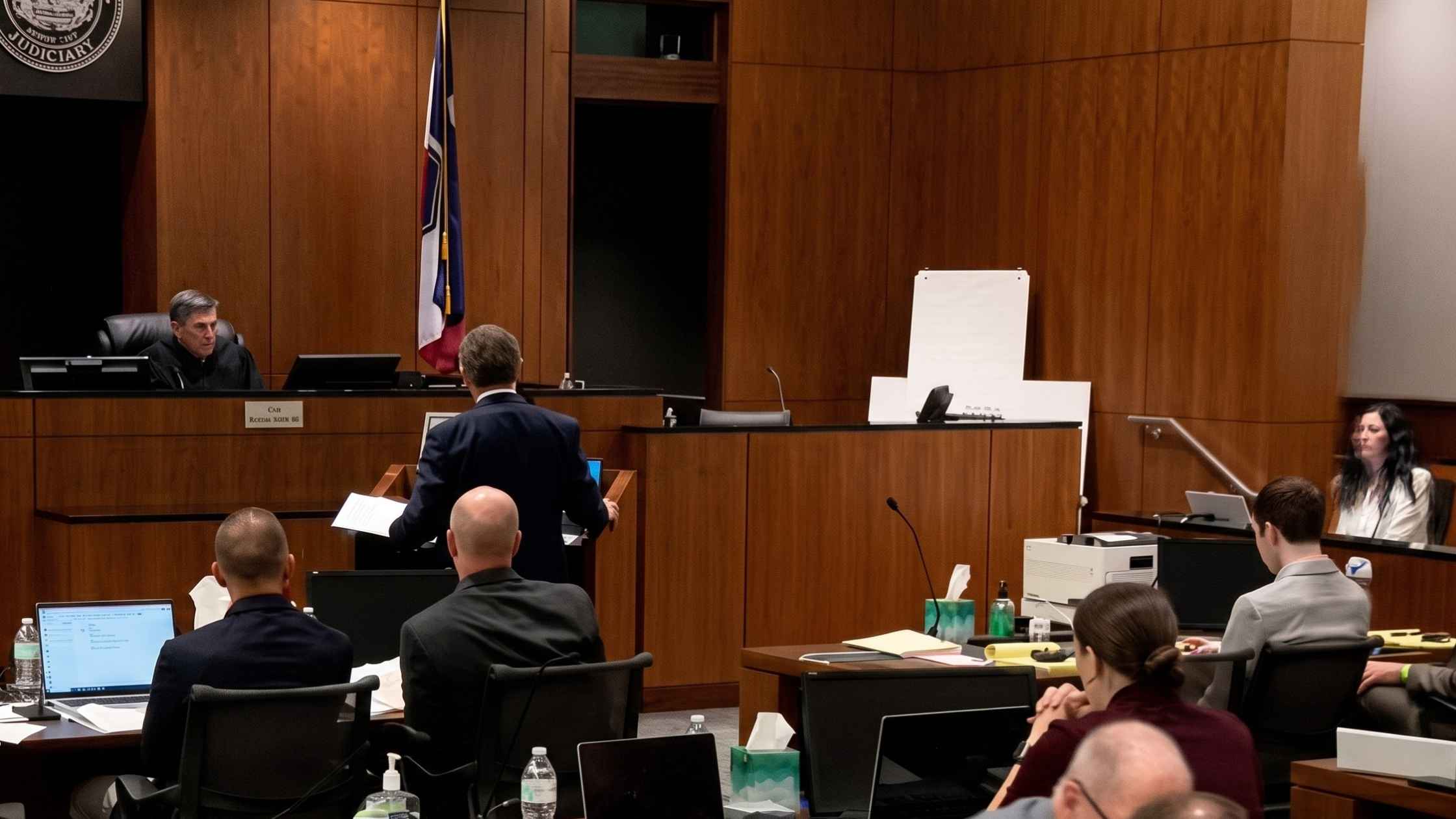
Good afternoon. Mr. Robinson, good afternoon. And also for the record, the court recognizes the presence of victim representative, Ms. Erica Kirk. Good afternoon. First, with respect to courtroom protocol to maintain security and decorum, any individual who exits the courtroom during the proceedings will not be permitted to reenter until the recess. All counsel are expected to take reasonable measures to safeguard confidential communication. Such measures may include the use of screen protections on electronic devices and care to avoid inadvertent capture of privileged or private discussions by recording equipment or by those present in the courtroom. And as you note, the microphones on your tables are turned off.
(06:34)
So, please come to the lectern for making when you're addressing the court. Second, the court will address the camera and still photographer, camera operator and still photographer. And if you both could come forward please to the lectern. All right. Could you both state your names?
John Wilson (07:04):
John Wilson, KSL Television.
Tess Crowley (07:06):
Tess Crowley, Deseret News.
Judge Tony Graf (07:08):
Good afternoon. Could you state your roles for today's hearing?
John Wilson (07:13):
Video recording and streaming of the proceedings.
Tess Crowley (07:16):
I'm the pool still photographer.
Judge Tony Graf (07:18):
All right. And have you both reviewed the court's standing decorum order?
John Wilson (07:23):
Yes.
Judge Tony Graf (07:24):
Do you understand the requirements set forth in that order as they apply to your activities today?
John Wilson (07:28):
Yes.
Judge Tony Graf (07:29):
Do you require additional time to review the order or to adjust equipment to ensure compliance?
Tess Crowley (07:35):
No.
Judge Tony Graf (07:36):
Do you anticipate any difficulties complying with the order?
John Wilson (07:39):
No.
Tess Crowley (07:40):
No.
Judge Tony Graf (07:40):
Thank you both for your cooperation. As we begin this afternoon, the court wishes to acknowledge the importance of safety, dignity and wellbeing of all those who are present or who may be present during these proceedings, including the parties, counsel, witnesses, court staff, and members of the public. The court is also mindful of its solemn obligation to protect and uphold the constitutional rights of both Mr. Robinson and Ms. Kirk. In furtherance of those important interests, all persons attending these proceedings are reminded that portable electronic devices are not permitted in the courtroom or on the fourth floor. Cell phones are not permitted in the courtroom unless expressly authorized.
(08:25)
Any unauthorized possession or use of a cell phone in the courtroom may be addressed by the court. For those individuals who are authorized to have a cell phone, please place your device on silent at this time so that these proceedings may continue without interruption. The court also expects that every person in attendance will be treated with the dignity and respect to which they are entitled to. Consistent with the court's standing decorum order, all spectators shall remain quiet, civil and orderly at all times. Spectators shall not engage in conduct that is distracting, disruptive, provocative, disrespectful, uncivil, or threatening in any manner.
(09:06)
Spectators shall not make audible comments of any kind, shall not shake or nod their heads and shall not make gestures or other visible reactions during their hearing. Spectators shall also not wear or display pins, buttons, signs, clothing, photographs, or other items expressing support for or in opposition to any person connected with this case or expressing any position concerning the status of this case as a capital offense. The court appreciates the cooperation of all present in maintaining a courtroom environment that is safe, respectful, orderly and faithful to the rights and dignity of every person involved.
(09:51)
Finally, I wish to note that this preliminary hearing is scheduled to conclude this Friday at 5:00 PM. I raise this as simply a reminder for the parties, particularly given that we have now reached the midpoint of this week. I recognize and respect the constitutional rights of all parties. When this preliminary hearing was set, the court allocated a substantial amount of time for both sides to address the matters they consider necessary and appropriate for purposes of this proceeding. The standard at a preliminary hearing is probable cause.
(10:25)
And with that in mind, I ask counsel to remain mindful of the time that remains and manage your time appropriately so each of you is able to fulfill your duties to your respective clients within the timeframe that has been provided. And with that, I wish to inquire of a brief overview on what is anticipated from each party in order the court has a roadmap on how we are proceeding for the remainder of this preliminary hearing. First turning to the state and if you wouldn't mind coming forward, Mr. Grunander.
Chad Grunander (10:59):
Thank you, Your Honor. We anticipate presenting evidence through Agent Brian Davis this afternoon. Sergeant Jennifer Falmina is also present in the courthouse and prepared to testify if we get to her today as well. Following her testimony, which we believe will carry into tomorrow, if we do get to her today, that will close the presentation of the evidence on the part of the state.
Judge Tony Graf (11:22):
Thank you, Mr. Grunander. For defense.
Michael Burke (11:32):
Good afternoon, Your Honor. Good afternoon. Michael Burke for Mr. Robinson. Judge, we have two remaining witnesses. Ms. Oliver from the ATF and Ms. Carner also from the ATF.
Judge Tony Graf (11:49):
All right. And to both parties, thank you. I appreciate that. Do both parties anticipate any issues concluding their case? Obviously there's variables, cross-examination and kind of the fog of war that happens in court proceedings, but any party anticipate issues concluding at or before Friday at 5:00 PM?
Chad Grunander (12:11):
Not from the state, Judge.
Richard Novak (12:12):
I just want to highlight one issue for the court because it may be that the court wants to do some time management. The state is going to proffer a video 11:02, a video recorded 11:02. We have provided the state, I want to say about a day and a half ago with proposed redactions because we believe that portions of it are not admissible even in a preliminary hearing. And the way we did that is we provided a transcript and then a redacted version of the transcript of the entire video recorded interview.
(12:53)
It may be that the court wants to look at the proposed redactions, not while court is in session, but during some other period of time, because the transcript of the video, which we prepared and we provided to the state so the state could raise any concerns about the accuracy of the transcript, that's not an issue. The admissibility of portions of the video or the issue is about 20 pages, maybe 22 pages. So, to use court time for the court to look at the proposed redactions may be an inefficient use of the time. I'm not saying when the court should do it. I'm just saying we may not want to do it between nine and noon and one and five tomorrow or Friday. But it's going to come up today.
(13:42)
And so, the question will be when does the court want to engage in the process of reviewing the 22-page transcript that has proposed redactions? That's all.
Judge Tony Graf (13:53):
I appreciate the heads-up. Mr. Grunander, do you wish to be heard?
Chad Grunander (13:56):
Yes, Judge. Your Honor, the state has received the proposed redactions and we are prepared to address them when that time comes. However, we do intend on presenting testimony through Mr. Davis, through Agent Davis. And when we get to that point, when it's ripe for discussion, we can address the matter with the court. That would be our preference.
Judge Tony Graf (14:19):
All right. Well, I'll address it as it comes. And to the defense with the remaining time, do you feel confident that it is sufficient to accomplish your duty?
Richard Novak (14:31):
We do, Your Honor.
Judge Tony Graf (14:32):
Thank you. All right. Does either party require the benefit of the record before we begin to the state?
Ryan McBride (14:52):
Ryan McBride for the state, Your Honor. Just to address an issue that's come up and we expect to come up as we enter the second half of this preliminary hearing regarding the admission of exhibits. Under rule 104(a), the court must decide preliminary questions about whether the witness is qualified or a privilege exists or evidence is admissible. In so deciding, the court is not bound by the rules of evidence except those on privilege. And I'm bringing this up again because it's likely to come up and it is going to affect the procedures we use as we go forward. The court holds two roles really at this stage.
(15:31)
One is a gatekeeper role on admissibility and the second is the fact finder role as the magistrate. And I know you've referred to those two roles earlier in this proceeding. And rule 104(a) means the court can consider evidence even though its admissibility has not yet been determined in its gatekeeper role. And then after it has been admitted, it can determine the admissible qualities of that evidence or that exhibit. And that is especially relevant at a preliminary hearing where foundational evidence is reliable hearsay under 1102.
(16:09)
Even at trial, State v. Griffin, which is a 2016 UT 33 Utah Supreme Court case, the court has held the rules of evidence do not apply to evidence used to establish foundation for admission of other evidence. It's a quote from paragraph 33. So, the point is foundational rulings on admissibility can consider evidence that is not in and of itself admissible. That's proper. The second point is the courts of appeals recognize a presumption that the court considers when acting in its fact finding role only the admissible evidence and disregards any inadmissible evidence. Most commonly, that comes up in a bench trial type case where prior bad acts evidence is admitted and it can have dual inferences.
(16:57)
State v. Adams was one of those cases. That's 2011 UT App 163. And what it means is we know that a fact finder is not tainted by the judge's role as a gatekeeper, even though the judge is a gatekeeper considers potentially inadmissible evidence. It also means that the court doesn't have to distinguish which hat it's wearing as we go through the proceeding. In this circumstance, this hearing is taking place outside the presence of the jury. The state has laid and intends to lay and continue to lay foundation in open court. Such foundation sometimes will include discussion of the actual exhibits rather than just proffers as well as foundation for the exhibits.
(17:42)
Now I don't think that there's any issue between us and the defense in understanding that kind of statement of the law. I think the issue that has come up is under rule 104(b), determinations of admissibility take place outside the presence of the jury. The defense appears to be assuming the jury to be basically the potential jury pool and trying to avoid the potential taint to a jury pool that discussion of evidence, which may or may not be admissible may cause. I think that's a fair point. I just want to put the court on notice of our view and how we have and intend to proceed as we move forward. Under 104(b), that determination takes place outside of the presence of the jury. Under the rules, there's a presumption that these hearings and this hearing is open to the public, including admissibility hearings. Because of that, we intend to move forward and move the admission of evidence and argue the admission of evidence as in open court. Should the court close the hearing, of course that would change. But that's because that's the presumption in the law and that conforms with 104(b), that's our intention unless court or counsel moves to close the hearing. So, in summary, the court can and often should consider evidence and review the exhibits before admission. Two, the court is not tainted by doing so and can distinguish between admissible evidence and improper evidence.
(19:19)
And there's no need for the court to identify which hat it's wearing. And three, absent closure, we'll move forward with our evidence in open court.
Judge Tony Graf (19:27):
All right. Well, I'll hear from defense if you want to be heard on that issue. I see you. Okay.
Richard Novak (19:34):
Briefly. Briefly, Your Honor. I'm sorry, I have two microphones. I'm just trying to be technologically savvy. I think the 104 issue, I agree completely with Mr. McBride on what he's saying. Because of the Supreme Court's ruling in Archuleta concerning the availability to the public of exhibits from a preliminary hearing, which of course is a fact specific inquiry by this court, we will continue to raise concerns about our client's right to a fair trial when we think it's appropriate and the court will make the rulings it makes. That's all I want to say.
Judge Tony Graf (20:16):
All right. All right. To both parties, the standing request remains when you are moving a piece of evidence into the record, I ask three steps to admit it to be published in the courtroom and then it to be published on that screen. And I'm going to have the screen adjusted slightly because if it's published, I want it to be meaningfully able to be viewed. And I noticed somebody sent me a screenshot that that angle creates an interesting angle that kind of distorts it. So, in the interest of, if we're going to be transparent, it should be viewable transparent. So, we'll adjust that screen briefly, but please address those three issues.
(21:02)
And I understand one side or the other might say, "Well, we agree or we don't agree, period." But please, I'm trying to make sure that the record before us is a clean and clear record. So, if you would do that, the court would appreciate that. All right. Anything further?
Richard Novak (21:18):
No, Your Honor.
Judge Tony Graf (21:21):
All right. The court acknowledges that the exclusionary rule is in effect at this time. Any witness who is subject to exclusion should be excused from the courtroom. I will leave it to the parties to monitor the courtroom to ensure that compliance is adhered to. With that, turning to the state, you may call your next witness.
Speaker 2 (21:38):
Your Honor, you want this to move that way?
Judge Tony Graf (21:41):
Yes. I mean, I want the press to be able to see it too, but there is a bit of a distortion when it's at that particular angle. So, while the parties are getting moving forward, go ahead and adjust it. And let's put a sample image of something that has nothing to do with this case on the screen.
Lauren Hunt (22:03):
Judge, that's another issue. I don't know that it is projecting yet. And I don't know if we need to take a break to make sure that [inaudible 00:22:11]
Judge Tony Graf (22:13):
Is it not projecting on the monitors?
Chad Grunander (22:17):
We're seeing it now.
Judge Tony Graf (22:17):
Okay. Technology is challenging us again. Well, what's our thought staff on projecting? Is this something that's not going to be cured by turning off and turning on, I'm assuming?
Speaker 1 (22:39):
[inaudible 00:22:34] I just need some other tables besides three so we can try some.
Judge Tony Graf (22:40):
All right. If all of you, counsel table, again, I'm trying to do this to get this out of the way so we can move forward cleanly. If you wouldn't mind turning off your monitor and then turning it back on and if I could borrow somebody to do that to the witness monitor as well so we all get them in sync. Thank you, sir. I appreciate that. And for the lectern as well, let's just see if we can get that up because that could cause a delay. I just want to knock this out first.
Speaker 2 (23:10):
Judge?
Judge Tony Graf (23:11):
Yes.
Speaker 2 (23:11):
If you would prefer, I mean, it's up to you [inaudible 00:23:13]. However, it works. Thank you.
Judge Tony Graf (23:21):
Where would that TV go?
Speaker 2 (23:22):
The lower kind of along that back wall if you want. We've done that in trials before.
Judge Tony Graf (23:28):
If that doesn't address any security issues, let's do that. I just want to make it easy that way that TV can be more flat and it's not a distorted view and then the media can look at that TV. Again, transparency needs to be viewable, not just there in concept. All right. Yeah, let's go ahead and do that. How are the monitors looking? Nothing? All right.
Speaker 1 (23:52):
I need them to actually plug in their HDMI.
Judge Tony Graf (23:58):
I see. Could I have someone with your laptop plug in so we can test so we can check if it's receiving the data or the information from your laptop to allow us to project? That may be the issue.
Richard Novak (24:12):
Mr. Ellis has plugged in.
Judge Tony Graf (24:14):
All right. Let's take a look here. I appreciate the parties' patience, especially after I just said we're at the halfway point.
Richard Novak (24:31):
We're getting a thumbs up.
Judge Tony Graf (24:33):
All right. So, it's displaying for defense. For prosecution?
Chad Grunander (24:38):
We're working on it right now, Judge.
Lauren Hunt (24:39):
Yes.
Chad Grunander (24:42):
Yes.
Judge Tony Graf (24:43):
All right. And on the screen monitor here, it looks like something came up.
Chad Grunander (24:50):
It's working.
Judge Tony Graf (24:51):
All right. All right. We'll just hope that the monitor for the witness works as well. All right, so we're ready to go?
Speaker 2 (24:58):
You can [inaudible 00:25:02]
Judge Tony Graf (25:04):
Just bring it in and go ahead and we'll get started. And how much time is needed for that?
Speaker 2 (25:09):
[inaudible 00:25:10]
Judge Tony Graf (25:12):
Well, let's go ahead and proceed. And then when we take a break, then we can do that. But for now, the media, if you can see that TV, if you have any problems, please let me know. And we're going to bring in that second TV. We just want to get the train on the track here. All right. Ms. Hunt?
Lauren Hunt (25:29):
The state calls Agent Brian Davis.
Judge Tony Graf (25:34):
Agent Davis, if you would like to come forward and be sworn in.
Speaker 3 (25:38):
You do solemnly swear that the testimony you shall give in the case now pending before the court will be the truth, the whole truth, and nothing but the truth so help you God?
Brian Davis (25:44):
Yes.
Judge Tony Graf (25:46):
All right. Agent, if you wouldn't mind having a seat to your left is a water bottle. And if you're seated, you'll have to adjust that microphone, pull it down and then pull it toward you to ensure that it is picking up your voice and we'll have a good record. All right. Ms. Hunt, your witness.
Lauren Hunt (26:08):
If you could please state your name and spell your last for the record.
Brian Davis (26:11):
Yeah, it's Brian Davis. D-A-V-I-S.
Lauren Hunt (26:15):
What is your occupation?
Brian Davis (26:17):
I'm an agent with the Utah State Bureau of Investigation.
Lauren Hunt (26:23):
How long have you been with... Is it fair to call that SBI?
Brian Davis (26:27):
Correct. Yes.
Lauren Hunt (26:28):
How long have you been with the SBI?
Brian Davis (26:30):
A total 18 years.
Lauren Hunt (26:33):
I want to briefly go over your experience as a law enforcement officer generally. Actually, are you a law enforcement officer in that capacity?
Brian Davis (26:41):
Yes, correct.
Lauren Hunt (26:42):
How long have you been a law enforcement officer? A
Brian Davis (26:45):
Total of 27 years.
Lauren Hunt (26:48):
You mentioned you were with SBI for 18, is that right?
Brian Davis (26:50):
Correct. Yep.
Lauren Hunt (26:51):
What other agencies were you with prior to SBI?
Brian Davis (26:54):
So, Department of Public Safety, I've been a state trooper for eight years, 18 years with SBI and one year with Utah Transit Authority Police.
Lauren Hunt (27:04):
We've heard talk from other officers about POST. What is POST?
Brian Davis (27:09):
It's peace officer standards and training.
Lauren Hunt (27:12):
Did you complete that?
Brian Davis (27:13):
I did.
Lauren Hunt (27:14):
What year did you complete that?
Brian Davis (27:15):
1999.
Lauren Hunt (27:21):
Is that a type of certification that you hold?
Brian Davis (27:25):
Yeah, it's a statewide certification that any peace officer in the City of Utah, local, state, county, I'll go through to become a certified peace police officer.
Lauren Hunt (27:35):
Has that certification lapsed or been any gaps in that time since you received it in 1999?
Brian Davis (27:40):
Nope. It's been constant since then.
Lauren Hunt (27:44):
I want to talk about a bit about your training and experience within law enforcement. What roles have you had at SBI?
Brian Davis (27:54):
I began as a alcohol enforcement team. We did covert overt operations. I was assigned to an ATF, the PSN Task Force, focusing on violent felons with guns and drugs. I was on a FBI task force, Safe Streets. It was a gang violent crime task force. I was on the US Marshals Fugitive Apprehension Team Task Force. I've been on several different OICI protocol teams, officer involved critical incident teams around the state of Utah and within SBI. I've been on dozens of those scenes. And within major crimes of SBI, we've worked a variety of cases.
(28:38)
I work anything from violent crime, homicides, sex crimes, drug crimes, firearm crimes, white collar crime, fraud. I was also on a task force with a FBI, a public corruptions task force as well.
Lauren Hunt (28:51):
Was that all on the job training or did you receive specific training or conferences, things like that?
Brian Davis (28:57):
Yeah, throughout the years, various trainings, conferences in all those capacities over the years.
Lauren Hunt (29:06):
You mentioned you've been a part of homicide investigations?
Brian Davis (29:09):
Yes.
Lauren Hunt (29:10):
Can you estimate how many?
Brian Davis (29:14):
My best guess would be 60 plus where I've had some involvement. I also currently work on a cold case unit within SBI. So, we consult with agencies around the state of Utah and I've probably consulted on over 50 of those as well in various capacities and roles.
Lauren Hunt (29:33):
Have you received training specific to homicide investigations?
Brian Davis (29:36):
Yes, I have.
Lauren Hunt (29:38):
What types of things have you been trained on in that regard?
Brian Davis (29:43):
Just several different times, week-long course training conferences on homicide from case studies to how to manage a case. Also, I've been on several trainings with crime scene investigation. I'm a FARO certified. It's a 3D FARO scan of crime scenes.
Lauren Hunt (30:06):
What's a FARO scan?
Brian Davis (30:07):
It's a 3D laser imaging that's used pretty commonly on crime scenes. It just accurately documents crime scenes. I've been certified as a forensic interview and the forensic interview technique with more child victims. So, just various trainings like that.
Lauren Hunt (30:32):
You mentioned currently you're a part of the cold case team within SBI?
Brian Davis (30:36):
Correct.
Lauren Hunt (30:38):
Have you been assigned as part of the investigation into the homicide of Charlie Kirk?
Brian Davis (30:44):
Yes.
Lauren Hunt (30:46):
And what is your role? Do you have a specific role in that investigation?
Brian Davis (30:51):
Yes. I was assigned to be a case agent along with Agent Dave Hull.
Lauren Hunt (30:57):
What does it mean to be a case agent?
Brian Davis (31:00):
Essentially, you manage the case, responsible for it...
Brian Davis (31:00):
Essentially, you manage the case responsible for it. Ultimately, you direct the cases as you go along, you make assignments as needed. Ultimately, everything comes back to you in the form of reports, evidence, and such. And then ultimately, you screen that case if applicable to the appropriate county attorney or DA.
Lauren Hunt (31:29):
You mentioned that you are a co-case agent, or were, with Agent Hull. Is it typical to have two case agents on a case?
Brian Davis (31:38):
It can be especially on a large case, yes.
Lauren Hunt (31:43):
Has this particular case been large?
Brian Davis (31:45):
Yes, it has.
Lauren Hunt (31:51):
Have other police agencies been involved in the investigation of this case?
Brian Davis (31:56):
Yes.
Lauren Hunt (31:57):
Who has been designated as the primary investigative agency?
Brian Davis (32:00):
The State Bureau of Investigation is the primary investigating agency.
Lauren Hunt (32:06):
I know there are probably several or dozens, but what other agencies have you been working with?
Brian Davis (32:13):
FBI, ATF as well, several local state agencies, UVU Police, Orem Police, Utah County Sheriff, Washington County Sheriff, St. George PD, most of all the agencies within Utah County and even others outside of the county. So we've worked a lot of agencies with this case. It was a pretty large scale investigation.
Lauren Hunt (32:40):
You mentioned ATF. What does that stand for?
Brian Davis (32:42):
Alcohol, Tobacco, Firearms.
Lauren Hunt (32:47):
All right. I know a lot about what we've... So as a case agent, have you been in court during this preliminary hearing?
Brian Davis (32:55):
Yes.
Lauren Hunt (32:56):
You've heard prior testimony?
Brian Davis (32:57):
Yes.
Lauren Hunt (32:59):
We've talked a lot about the events of September 10th of 2025. I want to direct your attention to September 11th, 2025. Do you remember that day?
Brian Davis (33:09):
I do.
Lauren Hunt (33:13):
What happened on that day in relation to your investigation?
Brian Davis (33:17):
I spent the day at the command post with various assignments. That evening, it was about 8:30 PM, I believe, of the 11th, I received a phone call from Sergeant Elsholz requesting that I travel to St. George.
Lauren Hunt (33:33):
Who is Sergeant Elsholz? What agency is Sergeant El-Schulz with?
Brian Davis (33:38):
With SBI.
Lauren Hunt (33:41):
And he requested that you travel to St. George?
Brian Davis (33:43):
Correct.
Lauren Hunt (33:43):
What was the reason stated for that?
Brian Davis (33:46):
We received information that an individual was turning himself in or was going to turn himself in to police in regard to his involvement with the incident, the shooting on UVU campus.
Lauren Hunt (33:59):
I'm sorry, what time did you get that information, that call?
Brian Davis (34:06):
About 8:30 PM.
Lauren Hunt (34:07):
Did you travel down to St. George?
Brian Davis (34:09):
I did.
Lauren Hunt (34:10):
On what day?
Brian Davis (34:12):
Of September 11th.
Lauren Hunt (34:16):
Did anyone else go with you?
Brian Davis (34:18):
Yes. So we traveled to the Salt Lake City Airport, to a hangar there, and we were flown down on a fixed-wing aircraft. It was Sergeant Elsholz. It was Agent Folger with FBI, Agent Anderson with FBI, Ryan McBride and myself and the two pilots.
Lauren Hunt (34:36):
And who is Ryan McBride?
Brian Davis (34:38):
With the Utah County Attorney's Office.
Lauren Hunt (34:42):
What time did you arrive in St. George?
Brian Davis (34:45):
We landed probably about 11:30 PM at the St. George Airport.
Lauren Hunt (34:52):
Again, this would be the evening of September 11th, 2025?
Brian Davis (34:55):
That's correct.
Lauren Hunt (34:57):
Where did you go once you landed in St. George?
Brian Davis (35:00):
There we were transported via ground to the Washington County Sheriff's Department.
Lauren Hunt (35:08):
Did you coordinate at that time with any other law enforcement agencies down in Southern Utah?
Brian Davis (35:14):
We did.
Lauren Hunt (35:15):
You did?
Brian Davis (35:15):
We did, yeah.
Lauren Hunt (35:16):
What other agencies?
Brian Davis (35:17):
Well, with FBI, as we were traveling, and then along with mainly the Washington County Sheriff's Department. We also have agents with an SBI assigned to the Southern Utah area. So working with them as well, just making plans and coordinating resources and manpower and personnel.
Lauren Hunt (35:33):
And you stated you went to the Washington County Sheriff's Office?
Brian Davis (35:37):
Yes.
Lauren Hunt (35:38):
What time did you arrive there?
Brian Davis (35:40):
Probably somewhere close to midnight, maybe just a little bit before midnight of the 11th.
Lauren Hunt (35:45):
What happened next?
Brian Davis (35:47):
So we met several other investigators, agents, and detectives there along with some other prosecutors. There were some federal prosecutors as well that were present. And from there, we began kind of making plans, determining how to handle the situation there.
Lauren Hunt (36:04):
You mentioned the reason you went down there was you had been told that an individual wanted to turn themselves in.
Brian Davis (36:13):
That's correct.
Lauren Hunt (36:13):
Did you observe that individual?
Brian Davis (36:15):
I did.
Lauren Hunt (36:17):
And where was that person at the time?
Brian Davis (36:19):
So when he arrived, we went into the room that we were in. It was one of their office, the cubicles there. On the wall, there was a television monitor where I viewed an individual on that screen that was sitting in one of the soft interview rooms. That room was equipped with audio-video recording device, and so I observed him on that screen at that time.
Lauren Hunt (36:41):
Were you aware or did you become aware what time that individual arrived at Washington County Sheriff's Office?
Brian Davis (36:51):
I was told he arrived there about 9:00 PM that evening.
Lauren Hunt (36:56):
And was he with anybody else?
Brian Davis (37:00):
Yeah, he'd come there with his parents and a family friend.
Lauren Hunt (37:04):
Did you speak with this individual that we've been talking about?
Brian Davis (37:08):
Yes, I did.
Lauren Hunt (37:11):
Did you get his name?
Brian Davis (37:13):
Yes. We obtained his name and date of birth.
Lauren Hunt (37:15):
What was his name?
Brian Davis (37:16):
Tyler Robinson.
Lauren Hunt (37:19):
Did he tell you that himself?
Brian Davis (37:21):
He did.
Lauren Hunt (37:24):
You mentioned other individuals came there with him. And then you also said that you had kind of coordinated with the team of law enforcement officers that were there. Were those other individuals spoken with by law enforcement?
Brian Davis (37:41):
They were.
Lauren Hunt (37:41):
Let's go through them. Or I guess how did that happen? Who was spoken to first of the other individuals?
Brian Davis (37:56):
So Tyler's mother was interviewed by SBI Agent Holgreen and FBI Agent Cox. And then kind of simultaneously, his father was being interviewed by SBI Agent Terry and FBI Agent Smith. Also, at that time, the family friend, Mike Mitchell, was interviewed by other agents as well.
Lauren Hunt (38:23):
And you said that these interviews were being conducted simultaneously?
Brian Davis (38:29):
Yes.
Lauren Hunt (38:32):
Were you part of the interview with either of Tyler's parents?
Brian Davis (38:40):
Yes. Yes, myself and Agent Folger. Did I misspeak earlier? Myself and Agent Folger interviewed the mother.
Lauren Hunt (38:46):
All right. Let's make sure the record's clear on that. So Agent Folger, what agency is he with?
Brian Davis (38:52):
With FBI.
Lauren Hunt (38:53):
And yourself interviewed Tyler's mother?
Brian Davis (38:55):
Yes, that's correct.
Lauren Hunt (38:57):
I just want to make sure the record's clear. Who interviewed Tyler's father?
Brian Davis (39:00):
Yeah, I think I might have misspoke. It was Agent Holgreen, Agent Cox that met with his father.
Lauren Hunt (39:05):
And then who spoke with family friend Mike Mitchell?
Brian Davis (39:09):
Agent Terry, Agent Smith.
Lauren Hunt (39:16):
Down in St. George, Washington County Sheriff's Office, was Mr. Robinson detained at that time?
Brian Davis (39:22):
Yes, he was.
Lauren Hunt (39:25):
Was he formally arrested at that time?
Brian Davis (39:28):
Yeah. After all the interviews were completed and we talked to everybody, that he was formally arrested at that time.
Lauren Hunt (39:36):
I'm going to come back to that in a second. Well, excuse me. Where did the arrest take place?
Brian Davis (39:45):
At the Washington County Sheriff's Office.
Lauren Hunt (39:56):
What date did that happen on?
Brian Davis (39:59):
It would've been September 12th. It was about 4:00 AM, I believe, of September 12th.
Lauren Hunt (40:13):
All right. I want to show just on your screen, not for public yet, what's been marked for identification as State's Exhibit 15. Let me know when you're able to see that.
Brian Davis (40:34):
Okay. It's there.
Lauren Hunt (40:38):
Before I ask you about that, did you have an opportunity to... You stated that you observed Mr. Robinson at Washington County Sheriff's Office. Is that right?
Brian Davis (40:47):
Yes, that's correct.
Richard Novak (40:49):
Your Honor, could I have a moment with Ms. Hunt? May I have a moment with Ms. Hunt?
Judge Tony Graf (40:55):
You may. You're just going to do the redacted version. Thank you.
Richard Novak (41:01):
That may happen a couple more times as we go through exhibits because of agreements and disagreements that we have.
Judge Tony Graf (41:08):
Thank you for the heads-up.
Lauren Hunt (41:11):
At Washington County Sheriff's Office where you initially observed Mr. Robinson, you stated that he was in a room. Is that room equipped with video recording?
Brian Davis (41:22):
Yes, it is.
Lauren Hunt (41:23):
Is that standard practice for a facility like that to have video recording in such a room?
Brian Davis (41:29):
Yes. Very common.
Lauren Hunt (41:30):
Have you reviewed that video?
Brian Davis (41:31):
I have.
Lauren Hunt (41:33):
And in your review of that video, does it fairly and accurately depict Mr. Robinson at that time?
Brian Davis (41:39):
It does.
Lauren Hunt (41:42):
You see on your screen what's been marked as State's Exhibit 15. Do you recognize that?
Brian Davis (41:47):
I do.
Lauren Hunt (41:48):
What is that?
Brian Davis (41:49):
That's the interview in which Mr. Robinson was seated and waiting.
Lauren Hunt (41:59):
State moves to admit Exhibit 15.
Judge Tony Graf (42:04):
Ms. Hunt, and the other two steps, what's your request?
Lauren Hunt (42:09):
Oh, we would ask to admit it into evidence. We have defense counsel and I have agreed upon, I guess, redaction of the video, and I would ask to publish it both to the courtroom and to the media.
Judge Tony Graf (42:32):
Mr. Novak?
Richard Novak (42:34):
It's silent, correct?
Lauren Hunt (42:35):
Yes.
Richard Novak (42:37):
Yes, Your Honor. Ms. Hunt is correct. The state had originally proposed a longer image with audio, and we've agreed to a shorter image without audio. And so...
Lauren Hunt (42:59):
That's correct. Yeah.
Richard Novak (43:00):
So we're fine with all three steps as to this exhibit.
Judge Tony Graf (43:05):
All right. Does the state wish to review this to make sure that what's queued up comports with what you believe? If not, we can move forward. I just want to allow all parties the opportunity to double-check.
Lauren Hunt (43:19):
Let me just confer with my paralegal. It has no audio, so we would like to admit and publish it at this time.
Judge Tony Graf (43:54):
All right. State's Exhibit 15 is admitted pursuant to discussion and may be published in the courtroom and may be recorded or transmitted electronically.
Richard Novak (44:10):
Your Honor, of course, this is subject to all of the objections which have been previously reserved in writing and reiterated over the last couple of days. I assume that we don't need to start over with that today.
Judge Tony Graf (44:23):
Thank you. I appreciate that. I note the standing objection by defense as previously made, and that objection is overruled, and this exhibit is admitted.
Richard Novak (44:34):
In this case, it wouldn't be the 1102 issues. It would be the electronic media coverage of the proceeding.
Judge Tony Graf (44:42):
Thank you for that clarification, Mr. Novak. I appreciate that. All right. With that, to the media, can you view that screen okay? All right. All right. State's Exhibit 15 may be played.
Lauren Hunt (44:59):
Agent Davis, who are we seeing here?
Brian Davis (45:03):
That's Tyler Robinson.
Lauren Hunt (45:06):
Although we are watching it on video, what is he wearing at this time?
Brian Davis (45:10):
He's wearing a dark-colored baseball cap with a... I believe it's like maybe the Hurley symbol on it, like a white symbol in front. It's a burgundy short sleeve shirt with no graphics. It's blue jeans, and gray and white tennis shoes. I believe they're Converse style tennis shoes.
Lauren Hunt (45:30):
Thank you. Was Mr. Robinson, you stated that he was arrested in the early hours of September 12th, is that right?
Brian Davis (45:38):
Yes, that's correct.
Lauren Hunt (45:39):
Did he remain in Washington County Sheriff's Office or was he taken somewhere else?
Brian Davis (45:43):
No, he was transported from there to the Utah County Jail.
Lauren Hunt (45:49):
Prior to being transported to the Utah County Jail, was any, I guess, personal property taken from him, clothing, anything like that?
Brian Davis (45:58):
So prior to our arriving to the St. George, to the Washington County Sheriff's Office, his cell phone was seized and taken from his person, but that was the only thing that was taken from him at that time.
Lauren Hunt (46:12):
After he was transported to Utah County Jail, were any personal items taken from him?
Brian Davis (46:21):
Yes, they were.
Lauren Hunt (46:22):
And what were those?
Brian Davis (46:24):
After a search warrant was granted, his clothing was recovered, along with buccal swabs to collect his DNA, and major case prints, which is fingerprints, palm prints, pretty much the entire hand. Those are all collected from him.
Lauren Hunt (46:43):
Sorry, you may have already stated, what time... When did he arrive in Utah County?
Brian Davis (46:49):
We arrived at the Utah County Jail about 7:00 AM on the 12th, September 12th. And he was formally booked in at about 8:00 AM of that morning. And then I was the booking officer.
Lauren Hunt (47:02):
What does it mean to be the booking officer?
Brian Davis (47:05):
I filled out the necessary paperwork essentially with the jail, which gives the individual's personal identification of the charges, the probable cause statement, and then it's signed and submitted to the system.
Lauren Hunt (47:23):
All right. I want to talk a bit about search warrants, some of the search warrants that were executed in this case. As part of the investigation, were search warrants obtained specifically for areas in Southern Utah?
Brian Davis (47:36):
Yes, they were.
Lauren Hunt (47:37):
And obviously do not give me exact addresses, but generally for what locations?
Brian Davis (47:41):
It was the residence of Tyler Robinson and the residence of his parents.
Lauren Hunt (47:46):
Were those warrants executed?
Brian Davis (47:48):
They were.
Lauren Hunt (47:48):
By whom?
Brian Davis (47:50):
The residents of Tyler Robinson was a team led by Sergeant Faumuina with SBI along with the Utah State Crime Lab. And the residence of his parents was a team led by the FBI, their evidence response team.
Lauren Hunt (48:08):
Are you aware of what date or dates, if applicable, those warrants were executed?
Brian Davis (48:14):
Yeah, September 12th. I believe Tyler's residence, they started the search warrant about 8:00 in the morning. And then his parents' residence, they started about 4:00 PM of September 12th.
Lauren Hunt (48:27):
So to be clear, you've stated he was involved in executing those warrants. Were you physically present for the execution of either of those warrants?
Brian Davis (48:35):
No, I was not.
Lauren Hunt (48:37):
Are you aware of whether Mr. Robinson lived with anyone else at that residence at the time?
Brian Davis (48:45):
Yes.
Lauren Hunt (48:46):
Do you know who that was?
Brian Davis (48:47):
Lance Twiggs.
Lauren Hunt (48:54):
And we won't get too into it right now. We'll cover this with Sergeant Faumuina, but did you receive information from officers involved in those execution of those warrants about what, if anything, had been found?
Brian Davis (49:04):
Yes, I did.
Lauren Hunt (49:09):
All right. Turning to another area. As part of this investigation, you have previously mentioned that a family friend came in initially with the Robinsons. Who was that family friend?
Brian Davis (49:23):
His name was Mike Mitchell.
Lauren Hunt (49:24):
And who is he in relation to the Robinsons?
Brian Davis (49:27):
So he's a family friend, a good family friend.
Lauren Hunt (49:31):
And what was his involvement here?
Brian Davis (49:34):
So he helped facilitate working with Tyler and his parents with the Sheriff's Department for Tyler to turn himself in.
Lauren Hunt (49:45):
And I believe you mentioned previously that law enforcement conducted an interview with Mr. Mitchell?
Brian Davis (49:50):
They did.
Lauren Hunt (49:51):
Remind us when that interview occurred.
Brian Davis (49:54):
So that was the early morning hours of September 12th at the Washington County Sheriff's Department.
Lauren Hunt (50:02):
And I know you've already stated, but remind me who was present for that interview?
Brian Davis (50:06):
That one was Agent Terry and Agent Smith.
Lauren Hunt (50:09):
What agencies are they with?
Brian Davis (50:12):
Terry is with SBI and Smith is with FBI.
Lauren Hunt (50:18):
Are you aware if a second interaction or statement was collected from Mr. Mitchell?
Brian Davis (50:24):
Yes, it was.
Lauren Hunt (50:25):
When did that happen?
Brian Davis (50:26):
It was March 31st of this year.
Lauren Hunt (50:29):
Who was present at that time?
Brian Davis (50:30):
It was Ryan McBride, Chad Grunander, Kimberlie Derfler, and Agent Chris Terry with SBI.
Lauren Hunt (50:41):
You mentioned Ryan McBride, Chad Grunander, and Kimberlie Derfler. What office do they work for?
Brian Davis (50:46):
The Utah County Attorney's Office.
Lauren Hunt (50:49):
And you mentioned Agent Chris Terry?
Brian Davis (50:52):
Yes.
Lauren Hunt (50:52):
So you were not present for this collection of this statement?
Brian Davis (50:55):
No, I was not.
Lauren Hunt (50:56):
Have you communicated with Agent Chris Terry about how this happened?
Brian Davis (51:00):
Yes, I have.
Lauren Hunt (51:02):
How did this happen?
Brian Davis (51:03):
So all those individuals met with Mike Mitchell at... It was the St. George... Well, it was at the St. George Courthouse there. They met and discussed briefly, just kind of talked generally about the situation. From there, Mr. Mitchell was given a handwritten 1102 paper statement, and he left the room. Went into a separate office by himself. Was there for about an hour where he hand wrote a statement, filled the statement out. When that was complete, he came back into the room where the others were waiting and provided that 1102 statement to them.
Lauren Hunt (51:42):
We've heard quite a bit about 1102 statements. Sounds like there's an official form that is used. What's present on that form, if you know?
Brian Davis (51:52):
There's an admission or warning given on those forms that states that the information you're giving is true and accurate to the best of your knowledge, that any false statement that is given or may be given would be punishable by a Class A misdemeanor.
Lauren Hunt (52:08):
Aside from that being written on the form, are you aware if this admonition was discussed with Mr. Mitchell?
Brian Davis (52:13):
It was.
Lauren Hunt (52:15):
Do you know by whom?
Brian Davis (52:16):
Yeah. Ryan McBride provided that admonition to him.
Lauren Hunt (52:19):
And you stated that Mr. Mitchell then went into a separate room for about an hour and wrote his statement down?
Brian Davis (52:24):
Correct.
Lauren Hunt (52:26):
Did anyone, including prosecutors or law enforcement, direct him what to say?
Richard Novak (52:30):
Foundation. Objection. Personal knowledge.
Judge Tony Graf (52:34):
Would you like to respond, Ms. Hunt?
Lauren Hunt (52:37):
I can lay a little more foundation.
Judge Tony Graf (52:39):
All right. So I'll sustain the objection for now. Ms. Hunt is moving forward with laying more foundation.
Lauren Hunt (52:45):
You discussed with Agent Chris Terry about how this statement was obtained?
Judge Tony Graf (52:49):
Yes.
Lauren Hunt (52:50):
Did he mention anything to you about anyone directing Mr. Mitchell about what to say or what to include in the form?
Brian Davis (52:56):
No. I spoke to him personally and reviewed his report also.
Lauren Hunt (53:02):
I'm going to show you what's been marked for identification as State's Exhibit 14.1. Let me know when you see that on your screen.
Brian Davis (53:17):
Okay. I see it.
Lauren Hunt (53:19):
What is that?
Brian Davis (53:21):
This is the written 1102 statement that was provided by Mr. Mike Mitchell.
Richard Novak (53:27):
Your Honor, may I have a minute with Ms. Hunt for the same purpose?
Judge Tony Graf (53:29):
You may. All right.
Lauren Hunt (53:29):
And how do you know that?
Brian Davis (53:42):
I've reviewed it. I reviewed it in its original. As soon as it came to us, I've seen it prior.
Lauren Hunt (53:46):
Kimberlie, if I can have you slowly scroll down. Sorry, Judge, if I can just have a moment.
Judge Tony Graf (54:29):
You may.
Lauren Hunt (55:10):
I apologize, Your Honor. I misspoke. It's not 14.1. It's just Exhibit 14.
Judge Tony Graf (55:18):
Okay.
Lauren Hunt (55:18):
So if we can place that again on the screen for the witness only.
Richard Novak (55:24):
Same exhibit?
Lauren Hunt (55:25):
Yes. Sorry, we had been scrolling through that. Do you recognize that?
Brian Davis (55:31):
I do.
Lauren Hunt (55:33):
Does it depict... Is it fair and accurate from what you remember?
Brian Davis (55:40):
Yeah. With the exception of the redactions, yes, it's fair and accurate.
Lauren Hunt (55:44):
Judge, I'll make a record. Defense counsel and I have stipulated on the redactions that are present. I would move for its admission State's Exhibit 14 into evidence, but we do not wish to publish it either to the courtroom gallery or the cameras.
Judge Tony Graf (56:05):
All right. Could I have a copy of it? What I have is the unredacted version. So I want to review it before I make that decision.
Lauren Hunt (56:15):
If I may approach.
Judge Tony Graf (56:38):
You may. Thank you.
(56:40)
All right. I've had a chance to review State's Exhibit 14, and noting the standing objections by defense concerning 1102, the court accepts into evidence State's Exhibit 14, and pursuant to the parties, it's not published.
Lauren Hunt (58:28):
Thank you, Judge. All right. I want to move on to another topic. You've stated that you've been present for the duration as the case agent of the preliminary hearing. Is that right?
Brian Davis (58:40):
Yes.
Lauren Hunt (58:41):
We heard testimony yesterday about, turning to the scene at UVU on September 10th, that a bullet was found on a roof. Do you remember that testimony?
Brian Davis (58:57):
I do.
Lauren Hunt (58:57):
Do you have knowledge about that bullet, what that is about?
Brian Davis (59:01):
Yes, I do.
Lauren Hunt (59:06):
What roof was that bullet found on?
Brian Davis (59:09):
I believe it was the... Well, it was found on the computer science building on the roof, on the far east side of the roof of the building itself.
Lauren Hunt (59:18):
How do you know that it was found there?
Brian Davis (59:22):
I reviewed the agent's report that found that, documented it, and collected it.
Lauren Hunt (59:28):
What agent was that?
Brian Davis (59:30):
It was Agent Ben Snyder with SBI.
Lauren Hunt (59:34):
Are you aware of where the computer science building is on campus?
Brian Davis (59:38):
Yes. Yes.
Lauren Hunt (59:39):
Can you explain generally where that is located?
Brian Davis (59:42):
Yeah. From where the Losee building is, it's a building directly kind of south and east of there, from the Losee.
Lauren Hunt (59:50):
Southeast from the Losee building. Where is it in connection to the auditorium section that we've been talking about where Mr. Kirk was stationed?
Brian Davis (59:59):
It's east of there. East and a little bit south. Yeah, mostly east.
Lauren Hunt (01:00:07):
From that roof of the computer science building, to your knowledge, would there have been a line of sight to Mr. Kirk's tent?
Brian Davis (01:00:14):
No, not according to the agent, Agent Ben Snyder. There was not a line of sight from there to where the tent was, where Mr. Kirk was.
Lauren Hunt (01:00:24):
Did you learn from Agent Snyder what caliber that bullet was?
Brian Davis (01:00:28):
Yes, I did.
Lauren Hunt (01:00:29):
And what was that?
Brian Davis (01:00:31):
It was a 223 caliber.
Lauren Hunt (01:00:34):
What is a live round?
Brian Davis (01:00:36):
It's a round that had not been fired. So still had the projectile, and it was a fully functional ammunition with the bullet.
Lauren Hunt (01:00:46):
Did you learn if this 223 bullet found on top of the computer science building was a live round?
Brian Davis (01:00:52):
Yes.
Lauren Hunt (01:00:53):
And how do you know that?
Brian Davis (01:00:55):
It was still intact. The primer had not been... It was not dented up and fired. It still had the bullet projectile on the end and still sealed.
Lauren Hunt (01:01:07):
Did you observe this bullet personally, or is this information you're getting from Agent Snyder?
Brian Davis (01:01:11):
From Agent Ben Snyder.
Lauren Hunt (01:01:18):
All right. Turning to a different topic. Judge, I'm aware that there are going to be some objections about this that we'll have to address, but I just want to lay a little bit of foundation first before we get there. You've mentioned him already. Are you familiar with an individual named Lance Twiggs?
Brian Davis (01:01:36):
Yes, I am.
Lauren Hunt (01:01:39):
And who is he in regards to this investigation?
Brian Davis (01:01:43):
He's the roommate of Tyler Robinson.
Lauren Hunt (01:01:48):
Was he interviewed as part of this investigation?
Brian Davis (01:01:50):
He was.
Lauren Hunt (01:01:51):
How many times?
Brian Davis (01:01:53):
Two times.
Lauren Hunt (01:01:54):
When was the first time?
Brian Davis (01:01:55):
The first time was the early morning hours of September 12th, and that occurred at St. George Police Department.
Lauren Hunt (01:02:03):
So we've heard of-
Brian Davis (01:02:00):
And that occurred at St. George Police Department.
Lauren Hunt (01:02:03):
So we've heard of several people coming in and being spoken with at Washington County Sheriff's Office.
Brian Davis (01:02:11):
Correct.
Lauren Hunt (01:02:12):
Mr. Twiggs was spoken with at St. George PD?
Brian Davis (01:02:17):
Correct.
Lauren Hunt (01:02:19):
Do you know who was present for that interview?
Brian Davis (01:02:21):
It was FBI agents Larson and Agent Ling.
Lauren Hunt (01:02:26):
Are you aware of Mr. Twiggs' buccal swab was taken at that time?
Brian Davis (01:02:29):
I don't recall happening there. I believe it happened later. I'd have to... But it did occur. That was obtained from him.
Lauren Hunt (01:02:39):
Okay. But you're not sure if it happened on the 12th?
Brian Davis (01:02:44):
I don't recall if it was there later at his residence.
Lauren Hunt (01:02:47):
But ultimately a buccal swab was obtained from Mr. Twiggs?
Brian Davis (01:02:51):
Yes, it was.
Lauren Hunt (01:02:53):
Do you know if his phone was taken from him?
Brian Davis (01:02:56):
It was.
Lauren Hunt (01:02:58):
When did that happen?
Brian Davis (01:03:00):
So It was during that interview with FBI at St. George Police Department. They conducted an interview of him and then he provided his phone. He did it voluntarily also, provided it to those agents.
Lauren Hunt (01:03:14):
And that would've been on September 12th, 2025?
Brian Davis (01:03:17):
Correct.
Lauren Hunt (01:03:18):
You mentioned a second interview of Mr. Twiggs?
Brian Davis (01:03:22):
There was a second interview, yes.
Lauren Hunt (01:03:23):
When did that take place?
Brian Davis (01:03:25):
April 20th of this year.
Lauren Hunt (01:03:27):
Where was that?
Brian Davis (01:03:29):
Happened at the Utah County Attorney's Office.
Lauren Hunt (01:03:32):
Who was present at that second interview?
Brian Davis (01:03:35):
It was Mr. Twiggs with his attorney, Jill Cottrell. It was Lauren Hunt, Sam Peed with the US Attorney's Office, Ryan McBride, Sergeant Elsholz. Well, now it's Lieutenant Elsholz, and myself.
Lauren Hunt (01:03:52):
We've talked about two interviews of Mr. Twiggs, one on the morning of September 12th, 2025, second on April 20th, 2026. Are you aware if both of those interviews were recorded?
Brian Davis (01:04:04):
They were.
Lauren Hunt (01:04:08):
Have you reviewed those recordings?
Brian Davis (01:04:13):
I have.
Lauren Hunt (01:04:13):
Before Mr. Twiggs' interview on April 20th, 2026... Well, first let me ask you this. Are you aware of what use immunity means?
Brian Davis (01:04:22):
Yes.
Lauren Hunt (01:04:22):
What does it mean?
Brian Davis (01:04:24):
It's a letter that... Use of immunity is essentially giving the individual... During the limited time of their statement, they're given that immunity from statements that are made in regard to an incident, but it does not preclude them from prosecution from evidence that would be known or found then or later outside of that interview. It just gives them that limited immunity during the time of the interview.
Lauren Hunt (01:04:55):
Okay, so for any statements made during the interview, they're given immunity for that, but they're not generally prohibited from being potentially prosecuted outside of that interview. Is that fair?
Brian Davis (01:05:05):
That's my understanding, yes.
Lauren Hunt (01:05:09):
Was Mr. Twiggs given use immunity?
Brian Davis (01:05:12):
Yes, he was.
Lauren Hunt (01:05:13):
By what offices?
Brian Davis (01:05:15):
The Utah County Attorney's Office as well as the United States Attorney's Office.
Lauren Hunt (01:05:20):
You mentioned that both of Mr. Twiggs' interviews were recorded. Have you reviewed those recordings?
Brian Davis (01:05:27):
Yes, I have.
Lauren Hunt (01:05:28):
Do they fairly and accurately depict those interviews?
Brian Davis (01:05:31):
Yes, they do.
Lauren Hunt (01:05:38):
We've talked about 1102 statements, we've talked about a form and you talked about that there's an admonition on there that warns that if false statements are given pursuant to 1102, then that person may be subject to a Class A misdemeanor. Is that fair?
Brian Davis (01:05:53):
Yes, that's correct.
Lauren Hunt (01:05:54):
Was a similar admonition given to Mr. Twiggs during his second or before his second interview on April 20th, 2026?
Brian Davis (01:06:05):
Yes, it was.
Lauren Hunt (01:06:07):
By whom?
Brian Davis (01:06:08):
By Ryan McBride with the Utah County Attorney's Office.
Lauren Hunt (01:06:12):
And again, you were present for that interview?
Brian Davis (01:06:13):
I was.
Lauren Hunt (01:06:15):
Did Mr. Twiggs say that he understood that admonition?
Brian Davis (01:06:17):
He did, yep. Yes.
Lauren Hunt (01:06:20):
Was he told that the April 20th, 2026 interview was being taken in lieu of him having to come and testify at the preliminary hearing?
Brian Davis (01:06:31):
Yes, it was. Yes, he was.
Lauren Hunt (01:06:34):
All right, Judge. I am aware that defense counsel has objections to this recorded 1102. I think now is probably a good time to address them. But I do have, I guess... I understand that they are suggesting redactions to the video. I have some procedural objections first, and if Your Honor sustains those, I think it may make the substance of the statements or the objections or the redactions that defense is proposing moot. So I'm wondering if Your Honor will entertain my responses procedurally first before we get into the substance of what defense is objecting to. Does that make sense?
Judge Tony Graf (01:07:26):
Yes, if you want to move it, because right now nothing's before me.
Lauren Hunt (01:07:31):
Yes. Well, what I want to move... So defense proposed about a day and a half ago, they created a transcript, Mr. Novak has proffered this earlier to Your Honor, on April... And I'll give you a little more proffer. On April 28th, 2026, the Utah County Attorney's Office provided this recorded 1102 statement of Mr. Twiggs to defense counsel. They have acknowledged the receipt and mentioned the recorded statement at previous hearings. In fact, they even filed a brief that Your Honor has decided about whether 1102 can be applicable to Mr. Twiggs at this hearing, which Your Honor has ruled upon. Monday at about 4:00 PM, defense counsel sent us a transcript that was prepared by defense, the defense team, and it had significant redactions that they were suggesting. It was about a 21-page transcript and their suggested redactions are approximately 11 pages of it. In total, redactions appear on 16 of the 21 pages.
(01:08:48)
My procedural objections to this are that this is essentially by surprise. We were already a day into the preliminary hearing. Defense counsel had been aware since at least April 28th, 2026 when the recorded 1102 of Mr. Twiggs was provided to them that that is how we intended to proceed. And like I said, they had already briefed the 1102 issue as it relates to Mr. Twiggs. At that time, they did not raise any objections to the substance of it or propose any redactions that they wished. And yeah, frankly, it's by surprise and it's at this point disrupting the hearing.
(01:09:32)
I did mention that defense prepared a transcript of this recorded interview. How the state intended to present it and how we have given it in discovery to defense is it's a video, audio and visual. Making redactions to that is not as simple as a transcript where you can just block out sections of the text. So it's far more complicated than that to edit or redact portions of the video at this time. So we would object procedurally basically on the timeliness of it, that they had an opportunity to make these objections if they had them at the time when the 1102 issue in regards to Lance Twiggs was briefed and decided by Your Honor. They did not do that or raise the issue at this time. And so we would object just procedurally on those grounds.
(01:10:40)
Additionally, the remedy requested, which I'm assuming is that we make redactions to the video or present it as a transcript rather than a video, is disproportionate. Even assuming if there are isolated statements that the court would not ultimately consider, again, as Mr. McBride pointed out and as Your Honor has stated throughout this hearing, this is a preliminary hearing to the court. It's not to the jury. The court is fully capable of disregarding any statement it determines exceeds the proper scope. As Mr. McBride cited this morning, several cases give Your Honor that authority and presumption that judges are able to basically make the difference between what's admissible evidence and disregard what may not be at a preliminary hearing or even at a bench trial. State v. Adams is one of those cases. If Your Honor wants the citation again, I'm happy to give it. State v. Featherson is another one. That one is 781P2D424. State v. Hannigan is another one, 2014 UT App 165, and State v. Rosecrans, 2024 UT App 128.
(01:11:57)
And those cases all stand for the notion that essentially judges, and this is to quote from Rosecrans, "Judges are not subject to many of the same concerns about prejudices and improper influences as jurors." So again, procedurally, the remedy, asking us to now in the middle of a week long preliminary hearing of which everyone was aware, edit or alter or redact portions of this video recording 1102, that remedy is disproportionate. If there are any potentially objectionable statements within that, Your Honor has the ability to disregard those. So we would prefer not to get into the substance and argue each statement line by line, and we would prefer to just move for its admission and have the court use its discretion as a judge to take what's proper versus improper, disregard anything the court might find improper. If we would like to move into substantive objections, then we're happy to, but if the court can rule on those procedural objections first, it may make any substantive objections moot.
Judge Tony Graf (01:13:16):
All right. So you're moving into evidence State's Exhibit 16?
Lauren Hunt (01:13:21):
Yes.
Judge Tony Graf (01:13:22):
And as it relates to publication, what is your request?
Lauren Hunt (01:13:26):
So Judge, we believe, and I believe this has been discussed before on the record, that the state is in agreement that the media should not have the ability to handle or replicate certain exhibits. Because it's video, Mr. Twiggs is shown certain exhibits. So we would agree that this should not be captured by cameras and projected by the media outside of the courtroom. But we would like at least the audio and maybe even the video within the courtroom itself to be captured, is the state's position.
Judge Tony Graf (01:14:06):
All right, I want to make sure I understand. So your request is that the video not be projected and captured by the video camera, but the video and audio is played in the courtroom and the audio is able to be transmitted, just not the video via the camera. Is that my understanding?
Lauren Hunt (01:14:26):
Correct. That's the state's position.
Judge Tony Graf (01:14:28):
All right. And in regards to this exhibit as State's Exhibit 16, is there any portion of that recorded statement that occurred before the 1102 warning was given to Mr. Twiggs?
Lauren Hunt (01:14:57):
Not that we are presenting today.
Judge Tony Graf (01:15:02):
Okay. All right, turning to the defense. Mr. Novak.
Richard Novak (01:15:04):
Thank you. So I'm going to address first, Your Honor, what Ms. Hunt describes as the procedural issues with our proposed redactions. Many, many weeks ago, the state lodged their anticipated exhibits with the court. And then the court said, "I'm not going to review them. In fact, I'm returning them." I'm sorry. The court said that the court is returning the exhibits to the state. So there is no moment to make objections to an exhibit which the court is not inclined to entertain until the moment, as the court has said many times, until the exhibit is presented. And so what we have done is we have given the state ... It's only a 20 page transcript. Excuse me. It's only a 20 page transcript.
(01:16:20)
We have given the state a transcript we prepared out of time so that the state could make sure that the transcript is accurate. The state has never said that the transcript is inaccurate, so I'm going to assume for purposes of the moment that the state doesn't have any dispute that the transcript is an accurate transcription of Mr. Twiggs' recorded 1102 interview. There's no surprise here. There's been all of Monday evening, all of Tuesday, this morning. In fact, the state informed me yesterday morning that they don't agree to the redactions. So there's no surprise here. And we're actually doing exactly what the court signaled should be done, which is at the time an exhibit is proffered, objections shall be made.
(01:17:21)
This wouldn't be as much of a problem if Ms. Hunt had just said to Your Honor following Archuleta and in light of the electronic coverage of this proceeding and in light of Mr. Robinson's right to a fair trial, the court will consider those portions of the exhibit which are admissible and the court will not consider those portions which it determines are not admissible, but it will not be broadcast either audio or video. So that becomes a problem because the categories of objections that we have to this video recording I'm going to talk about a little bit so that the court understands why Ms. Hunt's suggestion that the entirety of an exhibit which may not be admissible under the rules of evidence at a preliminary hearing be played in open court and that the audio be captured by electronic media and broadcast. Because of our client's right to a fair trial, that's a problem.
(01:18:35)
And I don't want to sound flippant, but this is actually the Ryan McBride 1102. The vast majority of this video is Mr. McBride testifying and Mr. Twiggs agreeing. If we were in a courtroom, it would be a leading examination virtually from start to finish. I don't want to say that every single statement by Mr. Twiggs is just an affirmation of what Mr. McBride says, but the vast majority of it is. There are also portions of this 1102 where Mr. McBride is basically testifying as to what other exhibits that this court will see say. So there are two other exhibits that this court will be asked to receive into evidence today, which are text messages and a group chat. I'm just going to distinguish between the two.
(01:19:39)
So this 1102 statement is basically Mr. McBride saying, "And then the chat says this and then the chat says that and then the chat says this." He's basically testifying as to what the exhibits say. So in some ways the 1102, those portions of the 1102 violate the best evidence rule because I have no doubt that those two things that I just talked about are going to be presented to the court by the state. There are also portions of this 1102 which are not relevant and really implicate Mr. Twiggs' privacy rights. And I'm not Mr. Twiggs' counsel. As Ms. Hunt said, he has counsel. I don't know if he's... Well, I don't want to speculate.
(01:20:37)
But it's not relevant. There are portions of it which are not relevant and there are portions of it which I think, especially to be broadcast, implicate other privacy interests. So I'm not trying to create complications and I'm definitely not trying to take the state by surprise because I went to great length to provide the state with a transcript, with a proposed redacted transcript. And in fact, today we prepared to make it easier on the state and actually on Your Honor. Instead of having redactions with big black sections, we highlighted them instead. So if the court wants to look at our proposed redactions, the court can do that without having to compare two documents.
(01:21:24)
The other thing I want to say is that if the court did order ultimately that portions of it would be broadcast in any way, in the courtroom, outside the courtroom, we're not trying to change the state's exhibit from a video with audio to a transcript. The transcript is really being used as a tool to address the inadmissible portions of the video, because there's no way to communicate to the court efficiently which portions of a video we think are not admissible. It's much easier to do it on paper. So the transcript is just a tool. We have the ability right here in this courthouse to cut the video into the pieces that the court deems admissible. Mr. Ellis tells me it'll probably take a couple hours at the most. So maybe that's also not a concern. There's no delay associated with this in light of the fact that it's Wednesday and this court is going to conclude this hearing by Friday afternoon.
(01:22:33)
So I've gone beyond the procedural issues I've addressed, that we think portions of it are not admissible, there's no surprise, we've followed exactly what the court has signaled, which is I don't want to hear about exhibits until we're in the middle of the hearing and I don't want to hear objections about it until we're in the middle of the hearing. The litigation over whether section 1102 is constitutional under Mr. Robinson's federal due process rights and the other rights that were addressed, that litigation does not mean that we should have brought to the court proposed redactions to an exhibit in a hearing which hasn't started yet, in a hearing in which the state hadn't until 20 minutes ago even proffered an exhibit.
(01:23:19)
So I understand that the state wants to avoid the substance by trying to short circuit this with a procedural argument, and Ms. Hunt is a very excellent advocate for her client. But the reason why the state is going to the procedural issue is because the exhibit contains significant content that is not admissible even in a preliminary hearing. So I'm going to stop now, but I do want to go back and say that if the court concluded that only Your Honor was going to review this exhibit and the Archuleta rule would be extended to this exhibit, including that it's not going to be broadcast, then I think that we have a different path toward the efficient resolution of this issue.
Judge Tony Graf (01:24:13):
All right.
Richard Novak (01:24:13):
Does that make sense, Your Honor?
Judge Tony Graf (01:24:15):
I believe I understand what you're saying. So let me respond to you before I go to Ms. Hunt. So going to your first point in regards to this court's position and not looking at the exhibits, that doesn't preclude any party from filing a motion in limine, which is anticipated before anything is moved into evidence. Typically motions in limine are used by either side on anticipated exhibits or that may come into court and that allows pre-litigation. So I want to clarify that the court's statement, I'm not looking at the exhibits, is far different than what the parties choose to do and file in regards to a motion in limine. I really want to go to what you've talked about, what specific objections are you making? I want to make sure that the request is clear so I can rule specifically on that. What exactly ... I think I understand some of them, but I wish for you to articulate what are your objections to State's Exhibit 16?
Richard Novak (01:25:15):
Significant. We could do it line by line or page by page. I know we have had hearings in this matter where the court has wanted to look at transcripts line by line, word by word. We're prepared to do that. But I'm going to give the court categories-
Judge Tony Graf (01:25:31):
Thank you.
Richard Novak (01:25:32):
... without referring to specific portions. There are many portions of it which are not the statement of Mr. Twiggs. They're Mr. McBride testifying on video as to what other exhibits say. And Mr. Twiggs is saying, "Yeah, that's what it says. Yeah, that's what it says. Yeah, that's what it says."
Judge Tony Graf (01:25:56):
I apologize. I don't mean to interrupt you.
Richard Novak (01:25:58):
No, it's fine.
Judge Tony Graf (01:25:58):
I just want to categorize it and put it in a box. So what objection under the rules of evidence that specifically? What are you boxing that as?
Richard Novak (01:26:09):
Well, first of all, it's counsel testifying. Second of all, it's hearsay. It's Mr. McBride's out of court statements as to what an exhibit says. There's a best evidence rule, which I'm sure the court is familiar with, which is that the best evidence of what an exhibit says is the exhibit. So we may have a little bit of a cart before the horse here, because there are two exhibits that I'm very confident are coming. There are portions which are not relevant. There are portions which I believe are inadmissible when the court balances under 403, the probative value versus the prejudicial value, especially in light of the manner in which this hearing is being broadcast.
(01:27:10)
So we have improper testimony by counsel. We have the best evidence rule, which I think also includes hearsay, we have relevance issues, and we have 403 issues. But what I'm saying is that those are all things that this court can manage, as Ms. Hunt and Mr. Bryant have taught us today, in terms of the court's preliminary assessments, the court's role as a magistrate, and the Archuleta rules that allow this court to decide certain exhibits will not be viewed or heard by the public because it interferes with Mr. Robinson's right to a fair trial.
Judge Tony Graf (01:27:55):
Okay. Thank you.
Richard Novak (01:27:57):
I heard exactly what the court said about the in limine situation, but I do want to just say this and I hope this is taken in the right spirit. If this court had said to us, "I'm returning the exhibits, but if any party has any objections to any exhibits, I want to hear about that before the hearing," we certainly would have done so. And I think that it's probably for counsel a suggestion about how future hearings where there are many or complex exhibits, because there will be such hearings, should be handled, which is we can do in limines before the hearing begins, so that the court knows these exhibits, there are no disputes, these exhibits, there are disputes, these are the disputes, and we don't have to waste courtroom time bringing the court up to speed on what those concerns are. It can all be briefed ahead of time. And we're happy to do that.
Judge Tony Graf (01:28:58):
Thank you. Well, going to the last point, let me be clear on the record that I don't intend to interfere with the duties of either party. It's not my job to say, "Well, here's what you should do. Here's what you shouldn't do." I'm independent. I'm not team prosecution, team defense. So I will not dictate how you run your case. Obviously if it goes against certain rules, constitutional rights, statutes, case law, I will weigh in. But I never want to put my finger on and say, "Well, Mr. Novak, here's what I think you should do." Or to the state, Mr. McBride, "Here's what I think you should do." That goes outside my role and I will not deviate from my role, which is not to interfere with the business of counsel.
(01:29:47)
And I'm fortunate as a district court judge that I have very experienced attorneys who I have watched and have done an excellent job, and you're experienced, as I stated on, I believe in the pro hac vice, highly experienced attorneys on defense, highly experienced attorneys on prosecution. So I do not want to get into the business of saying, "Here's what you should do." I hear what you're saying, but I want to be clear from this point on in case there's any ambiguity, the court does not need to go into the business of dictating what you feel is in the best interest of your client, to the state what is in the best interest of your client. I staying clear of that, but I appreciate the point you're making and I hope that clarifies any ambiguity that may exist.
Richard Novak (01:30:35):
There was no ambiguity. I don't think that what I was conceptualizing puts the court's finger on anybody's scales. I think it's really about case management. And now I think we're moving pretty far away from the admissibility of this 1102 statement and we could have a conversation later if the court wants to, it's up to the court, about case management issues. But as I said before, if I say anything else, I'm going to be repeating myself. So I'm just going to stop.
Judge Tony Graf (01:31:05):
All right. Thank you, Mr. Novak. Appreciate your thoughts. Ms. Hunt?
Lauren Hunt (01:31:16):
Yes, thank you, Judge. And as I tried to parse out, obviously we have procedural objections which may, depending on how the court rules, make the substantive objections moot or unnecessary. But to Mr. Novak's point about this not being by surprise, yes, to be fair, he did send me a transcript with proposed redactions Monday, I believe at about 4:00 PM. It was not accompanied by any objections that he actually had. So we had to compare the transcripts and, to our best guess, come up with what the substantive objections may be. I am ready to respond to what I believe they may be and obviously he's now given categories, but I think we're now at the point where the court needs to exercise its ability and obligation under rule 104A to decide a preliminary question about whether evidence admissible.
(01:32:17)
But before we do that, because to argue the substantive objections, I want to actually get into the substance of it. So I think we need to consider whether this is going to be a closed hearing, and then probably, I don't know, I'm assuming the media attorneys will want to weigh into that because I do want to quote specific sections to be able to advocate for my position, state's position on this. I think we will need to get into the meat of what is actually stated here. So I think the court needs to decide if this is going to be an open or a closed hearing and hear from the media or any other parties that need to weigh in on that.
Judge Tony Graf (01:32:55):
All right. Anything further from the parties as it relates to that?
Judge Tony Graf (01:33:00):
... that.
Richard Novak (01:33:05):
Only that Ms. Hunt invited the media to comment on what the court is going to do. And as Your Honor knows from conducting jury trials and other types of proceedings, sidebars are not for the public. They're not for the public in real time, and they're not for the public subsequently. It is very standard that sidebar proceedings where information is only to be exchanged between counsel for the parties and the court are conducted at sidebar so that witnesses, jurors, members of the public don't hear about those things. And so we are assuming that if the court wants to do this in what we would call sidebar or in a closed hearing, that the transcript of that is going to remain at least temporarily sealed until these proceedings conclude or the court conducts some closer analysis on a topic-by-topic basis. So that's what sidebars are about. Whether it's done in a closed hearing or in an open hearing through whisper, the public, potential witnesses, jurors, potential jurors don't get to hear what the court decides needs to be addressed in a manner which protects the party's rights.
Judge Tony Graf (01:34:33):
All right.
Michael Judd (01:34:40):
Your Honor, if I may. Michael Judd on behalf of the media. A request to close a court proceeding isn't a sidebar, and calling it a sidebar doesn't make it one. The court knows the rules at this point. Any attempt to close a hearing requires that the court engage in some sort of hearing about that closure that is open to the public. It can't be done in whisper. That can't be done with the cameras off. There are occasions where a court may find it necessary to put some portion of some hearing behind closed doors, but the conversation about whether or not that happens of course has to take place in public. I don't want to belabor any of the points that are made. I think the court recognizes the interests at issue here and what the media's position would likely be on these.
(01:35:29)
I'd like to find common ground. It appears to be a significant piece of common ground here is that everybody seems to believe that the video interview that is at issue here is very important. And that of course makes people want to invoke protections, invoke closures. From the media's perspective, from the public's perspective, of course, that pushes the other direction. There may be moments of this preliminary hearing, there may be exhibits that do not present significant pillars of support for the decision that the court will ultimately be called on to make as a gatekeeper and as a magistrate. It seems to me... I haven't seen this video. The public hasn't seen this video. It seems to me that this appears likely to be one of those pillars on which the state intends to base its case, and on which the court's ultimate decision will likely rest. That counsel's in favor of access, in favor of publication, in favor of allowing the public to see the work that the court is doing and why it's doing it.
(01:36:33)
I recognize Archuleta has been invoked. We respect and understand Archuleta. Respectfully, Archuleta, at least part of its reasoning, is based on something very different than putting something on a screen. In Archuleta, there was a request to say, "Hey, is there a murder weapon? Are there crime scene photos? Can we come handle those? Can we look at them? Can we turn them over in our hands?" And part of the reasoning in Archuleta was we're worried about that will impact the quality of the evidence and the obligation everybody has to keep that evidence reliable and safe. Putting something on the screen doesn't present any of those sorts of risks, because this is so important. So this interview appears to be such a critical piece of the case being presented here in this courtroom today. The media's position is that it should be shown on the screen and that the public should be allowed to see it as well.
(01:37:18)
To the extent there's any sort of compromise at all, the one that is presented by the state, which would allow the public to monitor and oversee and understand and comprehend and assist with the work being done by the court, then something like the state has provided, which is we would put it... We allow the audio to play. If there is some sort of... It sounds to me like what the state is saying is there's some sort of witness privacy issue that would be served by turning that video off. Maximalist advocates on behalf of the media would always want that video to be on, but I recognize that that may be a reasonable compromise. But the idea of shutting the courtroom down to argue about closure or keeping this recording from the people in the courtroom who are allowed here, the victim representatives, the media representatives, the public itself, is simply a non-starter.
(01:38:01)
I believe under the rules that govern this proceeding, we ask the court to keep this as open as possible, and if there is any sort of narrowing of the public's right of access here, that it be done only in the narrowest way possible and that it be based only upon recognized interests. And finally, I would say, Your Honor, to the extent that I hear any sort of real counter-interest at all, it continues to be a fair trial interest. We take that important. We recognize that, its importance. We take it seriously. The court has also, over and over again, recognized what the right approach to that is, is to say there are mechanisms in place under [inaudible 01:38:38] to say we do an expanded voir dire, we do a jury questionnaire. We can handle those counter-interests. And on behalf of the media and the public, I'd ask that the court handle this dispute that way.
Judge Tony Graf (01:38:48):
Thank you. Any further comment by any of the parties?
Lauren Hunt (01:38:54):
Not from the state.
Judge Tony Graf (01:38:55):
All right. Mr. Novak.
Richard Novak (01:38:58):
Only that I want to make an additional assertion about why the court should handle this exhibit pursuant to Archuleta, but I want to make that argument a sidebar, because the whole point is to protect my client's right to a fair trial. And by making part of this argument in open court, it's a self-defeating exercise. So when the court resolves whether it will hear from us at sidebar, we're prepared to do that.
Judge Tony Graf (01:39:32):
All right. The issue is sidebar is public, because the transcript's open. So it's just because the parties request sidebar and the court invokes the white noise, that doesn't make it private. It simply obscures the noise in the courtroom, because that goes in the transcript, unless it's a closed hearing. So-
Richard Novak (01:39:54):
Then we would like to have a very brief closed hearing to lodge another objection about the publication of this, of any portion of this exhibit. Well, of certain portions of this exhibit beyond Your Honor's eyes. That's what I'm saying.
Judge Tony Graf (01:40:13):
All right. Thank you. All right. Right now, what we're going to go ahead and do, and what I want to do, is I want to look at the redactions that you're proposing and take a look at that. And it's also a perfect time to take a break, because we need to bring in the monitor potentially for future exhibits. So that's going to give us our 15 minutes. I want to review that so I can be brought up to speed, because the transcript, from what I understand, is just a transcript with suggestions of what defense wants to redact. Is that correct?
Richard Novak (01:40:48):
That's correct, Your Honor. And so what I would suggest... well, if this works for the court, is we will email to the court staff something we've already given the state, which is the proposed redacted version of the transcript. I understand that the state wants a video to be presented as evidence. We can get there if the court concludes there should be redactions. It's not redacted through blackout. It's highlighted. So the highlights-
Judge Tony Graf (01:41:16):
[inaudible 01:41:17] appreciate that.
Richard Novak (01:41:17):
... are the proposed defense redactions. And Mr. Ellis can make sure that your court staff receive that, and it can either be emailed to you or printed out, whatever works.
Judge Tony Graf (01:41:28):
Any objections, Ms. Hunt, for the court reviewing the proposed redactions in order to bring the court up to speed at whatever argument the court may entertain?
Lauren Hunt (01:41:37):
No, Judge, but I want to clarify for the record and for myself. Is the court ruling on my procedural objections? And I want to reserve the right to make my substantive arguments using what's actually in the exhibit. So being able to quote directly from it, knowing that if it's not a closed hearing, those portions of what I'm saying are going to be on the record and broadcast.
Judge Tony Graf (01:42:03):
So the court is not making a ruling right now. We're just going to take a break, and then we're going to come back on the record. But on the break, I'm trying to maximize the time, and that's why I'm asking, is there any objection to me reviewing what it sounds like defense has sent you, which is just the transcript highlighting what they're anticipating redacting? I just want to bring myself up to speed, so on the next step, when I make my ruling, the court is ready to go, and maximizing the time, because we also want to put up a monitor. So there's like three things we can accomplish in the space of 15.
Lauren Hunt (01:42:32):
Fair enough. The state has no objection to that.
Judge Tony Graf (01:42:34):
All right. Mr. Novak, if you wouldn't mind sending what you sent to the state to the court for review, and we will take a 15-minute break. It is now... Well, let's go a little bit longer. Just I want to make sure everything is in place. Let's come back at 3:00, and we'll proceed from there. Court is in a brief recess.
Speaker 4 (01:42:52):
All rise.
Speaker 5 (02:04:00):
(silence)
Judge Tony Graf (02:41:04):
[inaudible 02:41:02]. The court is back in session. Noting the presence of counsel and all parties. I appreciate your patience. Sometimes it takes time to save time. And so, that was the intent of this court in addressing what is before this court as it relates to State's Exhibit 16.
(02:41:25)
Counsel, in this time, I've taken time to look at the video and you also reviewing what Mr. Novak submitted, the redactions requested and reviewing all parts of it in great detail.
(02:41:43)
All right. I want to address the objections before me, starting with Mr. Novak made a hearsay objection as it relates to Mr. McBride. The court agrees. It is hearsay. At the same time, I'm only going to consider Mr. McBride's statements to provide context for the things that Lance Twiggs says and for their effects on Lance Twiggs. As such, the hearsay objection as it relates to the statements of Mr. McBride in State's Exhibit 16 is overruled.
(02:42:23)
Turning to relevance as it relates to State's Exhibit 16. And I agree in part and disagree in part as it relates to this objection. So there are portions of the transcript or ... I say transcript, but what I really mean is State's Exhibit 16. And I appreciate the transcript. I found that to be helpful. It's a lot faster than trying to scroll. And so, I appreciate that being provided. It was helpful to the court. To be fair, I found it to be a true and accurate representation of the actual recording.
(02:43:01)
So did I listen to every word and compare it? No, but from what I reviewed, I did not find any inconsistencies. Just to put it on the record so there's no misunderstanding. But there are portions of the transcript, State's Exhibit 16, which relevance is still not clear to me. However, as the magistrate, I am able to distinguish between what is relevant to a probable cause determination and what is not. What I take into consideration when I make my ultimate decision about probable cause, I will not take into consideration what is not relevant.
(02:43:44)
So that is a constant balancing and evaluation I'm making throughout this hearing. After this hearing, my intent is to review everything again to be thorough. This is not a case where I'm going to be shooting from the hip and making that determination because this is an important determination. So I will take the necessary time as is required and as necessary to ensure that the constitutional rights of all parties are upheld.
(02:44:15)
So as I'm making determinations, where I land is pages 19 and 20 of the transcript as it relates to State's Exhibit 16 may contain irrelevant information, but I will reserve whether I consider those portions until I've heard the rest of the State's evidence. Therefore, as it relates to relevance, that ruling is reserved.
(02:44:46)
Now turning to the other objection, which is Rule 403, prejudice. As I am acting as a magistrate, I do not have the same concerns that my decision will be influenced by undue prejudice as that of a jury. Therefore, for purposes of admissibility, the defendant's objection is overruled. Even so, there are portions of this transcript, and again State's Exhibit 16, that may not be admissible at trial and whose relevance I have not yet determined.
(02:45:18)
In the abundance of caution and to protect the jury pool, the potential jury pool, from hearing potentially inadmissible evidence, I'm ordering that the audio cannot be published in the courtroom or on camera from page 19, timestamp 32:55 until timestamp 35:48. In other words, the State may publish the audio for all portions of the interview other than that one portion. When I say audio, I mean audio and video. So both.
(02:45:51)
I recognize there's approximately only one minute after 35:48. The State can fast forward to that point for ... It's an approximate 1 minute and 12 seconds, or may take the time to redact the video as they seem fit.
(02:46:08)
So where I'm landing today is up until ... From the beginning until that page 19, 32:55, that portion I am ruling is admissible and may be published. Again, if the State wishes that last minute and 12 seconds to be played, they can either take the time tonight to redact what the court is not going to allow to be published.
(02:46:48)
I wish to differentiate. I'm considering it all. But for publication purposes, that portion is not going to be permitted to be played in the courtroom.
Speaker 6 (02:46:59):
Your Honor, would you state those times again that you are ordering not to be public? I've got 32:55 to 35:48.
Judge Tony Graf (02:47:03):
Right.
Speaker 6 (02:47:03):
Okay.
Judge Tony Graf (02:47:07):
Those are the two timestamps for that. I hope that's helpful as both parties are trying to review on the transcript and State's Exhibit 16.
Speaker 6 (02:47:16):
That's from 32:55 to 35:48.
Judge Tony Graf (02:47:21):
Right.
Speaker 6 (02:47:22):
Okay, thank you.
Judge Tony Graf (02:47:23):
It's not publishable in the courtroom or to be broadcast. Finally, I want to recognize both parties wanted the benefit of the record to be more specific in their arguments concerning their objections. So if those arguments pertain to timestamp 32:55 through timestamp 35:48, I'm willing to allow you to do that in a closed hearing. Please be mindful of the time and keep your argument succinct. With that in mind, do the parties have any arguments they feel I have not considered in my ruling that require a closed hearing?
Richard Novak (02:48:12):
Yes, Your Honor. And so, I'm just going to tell the court what I think the general nature of that is without getting into the details-
Judge Tony Graf (02:48:19):
Sure.
Richard Novak (02:48:19):
... because I do think a closed hearing is appropriate. There are ... Okay. Setting aside the 1102 issue and objections, there are statements in this video by Mr. Twiggs attributed to Mr. Robinson.
Judge Tony Graf (02:48:41):
Okay.
Richard Novak (02:48:41):
Mr. Robinson said it. There are two other exhibits which, again, I've said before, I'm confident the State will offer, which Mr. Twiggs says in this video those are statements by Mr. Robinson, okay?
Judge Tony Graf (02:48:57):
Mm-hmm.
Richard Novak (02:48:58):
I will acknowledge that separate and apart from 1102, the statements of a party opponent are admissible if relevant. In fact, they're not even hearsay. They're excluded from the hearsay rule. But the question is whether statements of Mr. Robinson of the nature that I'm referring to can be published, not considered by the court but published, without violating Mr. Robinson's 14th Amendment due process rights. It is our view, as we have said in our earlier papers, that the answer is no.
(02:49:39)
Publication, especially in the way this proceeding is being published, would violate Mr. Robinson's due process rights under the 14th Amendment. We previously cited ... And the reason why I'm saying this again is not to reiterate something just because if you say it twice, it means something different, but because my colleagues have suggested that maybe my argument earlier was not clear enough. And so, I want to make sure it is clear so that the court makes a decision based on the arguments of counsel.
(02:50:18)
The United States Supreme Court said in Estes, E-S-T-E-S, versus Texas, 381 U.S. 532 the following. In Rideau versus Louisiana, and that's R-I-D-E-A-U, "This court constructed a rule that the televising of a defendant in the act of confessing to a crime was inherently invalid under the due process clause of the 14th Amendment, even without a showing of prejudice or a demonstration of the nexus between the televised confession and the trial." I am not calling the statements of Mr. Robinson confessions, but that is what the State will call them. And so, there are portions of this exhibit and the other exhibits that I've referred to which implicate Mr. Robinson's right not to have what the State calls a confession televised.
(02:51:26)
This court has authorized the televising of this proceeding. There are reporters in this courtroom who will go outside and speak on what we used to call television. That opinion was from the '60s. Now we have other forms of technology, but I'm just going to use what the Supreme Court says because it's the Supreme Court.
(02:51:48)
So we are very concerned that the publication beyond this court's eyes of what the State will call confessions at trial violates Mr. Robinson's due process rights right here and now today. I know that we said that before in the litigation, but now we're exhibit-specific.
(02:52:13)
If I haven't been clear about the argument, I want to make sure I'm clear about it because the court's decision to allow this video to be televised and the other two exhibits to be shown to the camera in the back of the courtroom is exactly what the Supreme Court says violates the 14th Amendment.
Judge Tony Graf (02:52:37):
I appreciate that clarity. Perhaps ... And, again, if you want to go into closed hearing, we can do so, or if you want to refer to the pages. So I want to know exactly what you're referring to, whether it's in that 32:55 through 35:48 which is being excluded or is it in the court-
Richard Novak (02:52:57):
It is not. It is earlier and it's also the two other anticipated exhibits. So we may as well deal with all of it at the same time. It's probably easier to do it in a closed proceeding because nobody has to be obtuse. I don't have to be obtuse in order to protect my client's rights.
Judge Tony Graf (02:53:13):
No, I appreciate that. It actually prompts ... In order for me to get to that, I do want to ask the State, are you intending to introduce the text messages as an exhibit in this proceeding, the preliminary hearing?
Lauren Hunt (02:53:27):
Yes, judge. We will be attempting and moving for the admission of the text thread, the Discord thread, and the note that is referenced in Mr. Twiggs's 1102.
Judge Tony Graf (02:53:45):
All right. Let me take one step at a time just for clarity. Again, Mr. Novak, I really do appreciate you being so precise. It's helping me parse it out so we can address it, because it's important, and I recognize that you're advocating for your client. And so, I want to give it its due time. The text messages, from my understanding ... And either side weigh in. My understanding that those were released to the public months ago in their entirety.
Lauren Hunt (02:54:15):
Judge, if I may. They were not released in their entirety. Portions of them were placed into the charging document, the information that supported in part the charges that the State has filed. We did not put the entirety of them in. Now we wish to publish more of them than were included in the charging document.
Judge Tony Graf (02:54:35):
I see. For some reason, I thought it was as part of an exhibit for a motion. But, Mr. Novak, I'm not sure if that's ringing any bells. I want to make sure-
Richard Novak (02:54:48):
I'm aware of the issue that the court is commenting on. I think the State needs to account for its decision to publish text messages that directly implicate the Supreme Court law that we're talking about. I don't want to pretend that I can anticipate what the court's concerns are, but that doesn't cure republication on television of what the State will call a confession in this proceeding.
(02:55:23)
So in other words, this is not like, oh, the cat's out of the bag or the barn door's open. This is another opportunity to violate Mr. Robinson's constitutional rights. I'm not at all suggesting that somebody is intending to do that, certainly not the court. I'm confident that the State's counsel would never intend to do that. But that would be the consequence of further televising what the State refers to as ... Previously referred to as confessions and certainly would refer to here in this proceeding as confessions. We are acknowledging that they are statements of a party. We have not filed anything in this case that publicizes the text messages, the Discord chat, the note which Miss Hunt is mentioning. And now that Miss Hunt has said that, yes, we want this note to be presented into evidence, and the court knows what this note is because the court's now watched the video, that's another piece of the same problem.
(02:56:34)
So this is all simplified by the court being extra cautious about Mr. Robinson's constitutional rights, considering these exhibits to the extent the court deems that they're admissible and portions of them are relevant and not further televising them in this proceeding in a manner which we think is inconsistent with what the Supreme Court said in Estes v. Texas.
Judge Tony Graf (02:57:04):
All right. I appreciate that, Mr. Novak. Miss Hunt, would you like to respond? Because I understand what Mr. Novak's saying, and there may be a 403 issue as well as it relates to this. I'm not going to pretend to read your mind because I can't do that. All right, Miss Hunt.
Lauren Hunt (02:57:28):
Just to clarify for the record and the court, the State's position is that we would like the audio played. The audio may be captured by the cameras in the State's position, but we never intended to visually put them on the monitor such that cameras can capture them and pause or get the actual exhibits, substances of the exhibits. I believe that was the media's position, if I remember correctly, is that they want everything audio and visually displayed. But the state's position is just we just want the audio played.
Judge Tony Graf (02:58:05):
Right. But what's-
Speaker 6 (02:58:05):
[inaudible 02:58:07].
Judge Tony Graf (02:58:17):
So I'm just focused on 16 right now.
Lauren Hunt (02:58:20):
Okay, yes, and that's the State's position with regards to Exhibit 16.
Judge Tony Graf (02:58:25):
So help me understand, what's the difference if the audio's played or the video's played on what the court is identifying is ... Well, first of all, 16 is admitted. So that threshold has been met. But we're dealing with the publication in regards to what is publicized, because this is going to Mr. Novak's argument about publicizing that is different than the court simply reviewing it in its own privacy. I don't want to misstate your argument, but I believe that was one of the distinctions you made.
Richard Novak (02:59:00):
The distinction that Miss Hunt is drawing is I think what people call a distinction without a difference. It doesn't matter whether it's audio or video, and it doesn't matter whether it's on a television or on the internet or on the radio, it's going to be broadcast. And so, it doesn't really matter whether it's audio or video.
(02:59:17)
It's actually not Mr. Robinson's video. It's Mr. Twiggs's video. When the court mentioned 403, yes, I think the court did accurately read my mind, which is fine with me, but it's unfair prejudice of a constitutional dimension, and 403 is a rule of evidence.
Judge Tony Graf (02:59:38):
All right. So, Miss Hunt, as it relates to that publication, help me understand whether it's audio or video, what's the difference there? Help me understand that.
Lauren Hunt (02:59:52):
I disagree that it's a distinction without a difference. As we've discussed prior in this hearing, UCJA Rule 4-202.02, Sub 2, Sub J states that exhibits are presumed to be public court records and it does give the court discretion to regulate access when necessary to protect the integrity of the exhibit or ensure a fair trial. So I do want to recognize that. But that discretion should be exercised narrowly, as we've talked about before with publication regarding this case. What the state is proposing, we believe, is a narrowly tailored accommodation. We don't want to display the full exhibits. Obviously within State's Exhibit 16, the video of Lance Twiggs, he has shown and then it can be seen, exhibits that the state will then in the future move to admit, 16.1, 16.2, the text threads, the Discord threads. So we're thinking that if it's displayed visually, what the cameras will be able to do is pause that, duplicate them, replicate them, essentially have access to those exhibits.
(03:01:07)
What we're trying to do, and maybe they can do the same thing with the ... I'm sure Mr. Novak will say they'll do the same thing with audio. But hearing the tone, the context, all of that, that's why the State chose to do ... We could have done a written 1102 statement from Mr. Twiggs. As is allowed by 1102, we chose to do a recording because that's how the State is choosing to present this evidence.
(03:01:36)
We believe that the appearance of ... Or the tone, the context, hearing Mr. Twiggs actually talk and talk through these exhibits, talk through his experience is a meaningful way of presenting our evidence. And so, that's the difference we're seeing.
Judge Tony Graf (03:01:57):
I see.
Lauren Hunt (03:01:58):
Obviously it's up to the court's discretion on how publication is to be made here. We've made our arguments generally about that issue and we'll submit it to the court. Our prime issue is that the exhibits be admitted into the record, that the court consider them as part of the preliminary hearing standard and bind over, but we'll submit it to the court on publication. But that's the State's position.
Judge Tony Graf (03:02:25):
All right. Mr. Novak.
Richard Novak (03:02:28):
I learned a long time ago that-
Speaker 7 (03:02:29):
[inaudible 03:02:30].
Richard Novak (03:02:29):
... when the opposing party says, "Your Honor, we're submitting on it," there's a suggestion that maybe the court is going to make a ruling which doesn't require more evidence, more argument from me. But I am going to say that it is fair for Miss Hunt to say, "Your Honor, we wanted the court to see the witness and hear the witness so that the court could make reliability determinations," because, as Your Honor has said, that's really up to you.
(03:02:57)
That's a different issue from the constitutional consequences of electronically publishing what the state will call a confession. Now I've changed the word from television to electronically publishing because I'm trying to be in the 21st century, and the Supreme Court used that word in 1963.
Judge Tony Graf (03:03:23):
Sure.
Richard Novak (03:03:35):
Citation to state standards for what is or is not a public document are not the issue. There's a constitutional issue here, and I think that the court has already heard from me at least three times about what we think the court should do here. It's a preliminary hearing. It's not a jury trial. There may be a jury trial in the future, at which we have to voir dire on yet another issue, which is whether potential jurors were exposed to media replaying of what the State called a confession. That's exactly what was structural error. There was no prejudice question in Rideau versus Louisiana, and that's why in Estes v. Texas, the Supreme Court said, "We have a rule. You can't televise what a prosecutor calls a confession before trial." Thank you.
Judge Tony Graf (03:04:36):
All right. Thank you. I appreciate both parties advocating and arguing it. It's helpful for the court.
(03:04:45)
All right. So in taking in consideration the argument, which, again, I appreciate the parties articulating, the further edits that the court is going to require to be redacted starting on page eight ... And I apologize, I don't have a timestamp. Starting on page eight and ... I'm sorry.
Judge Tony Graf (03:06:02):
And sorry, I'm just trying to... Sorry, it started on page seven, right after... It's that at eight. Well, let's start. Starting on page six. Well, let me go back here. Starting on page 6, after 6 minutes and 56 seconds. Going to 20 minutes and 27 seconds for reasons such as 403, under Rule 403. And again, this is simply for publication. This is not taking out what the Court will consider. The Court is considering the entirety of State's Exhibit 16, but the Court is trying to take a narrow approach in recognizing and balancing transparency with constitutional rights. And doing so in such a manner that it is meaningful and doesn't diminish the Court's duty as a magistrate under the probable cause determination. All right.
Richard Novak (03:08:41):
Can you state those times again, Your Honor?
Judge Tony Graf (03:08:42):
6:56 until the line before 20:27. Or 20:27, so until 20:27. And then what the Court indicated previously from 32:55 until 35:48.
Lauren Hunt (03:09:27):
And I apologize, Judge. Just to clarify, these timestamps that you just gave, the 32:55 to 35:48 and 6:56 to 20:27, those are just not being published, but they have been admitted for Your Honor's consideration?
Judge Tony Graf (03:09:45):
Right. So kind of going through my three step process, Exhibit 16, it's an entirety... Not the transcript because the exhibit is not the transcript. The exhibit is the video. That has been admitted in its entirety for the Court's determination as it relates to this case.
(03:10:05)
So, what I'm talking about here is this is only what will be published in the courtroom and captured by the video, is the differentiation. So what's being redacted, for the lack of a better word, or cut out, is what's going to be published in the courtroom, not what the Court's going to consider. The court's considering it in its entirety. The Court's not going to redact anything in here. It's going to make its own determinations regards to relevance. And everything that Mr. Novak noted, I'm taking that in consideration and making those determinations, which the court will do again, because this is not something you do watch once and then make your decision. This requires analysis, and the Court is committed to doing that. But hopefully, that gives you an idea of where as it relates to publication.
Lauren Hunt (03:11:11):
Yes. Thank you.
Judge Tony Graf (03:11:12):
All right. To the media.
Michael Judd (03:11:19):
Your Honor, I know how much time the court's already dedicated to considering this and I appreciate the additional time being afforded to the media. There's just one additional thing that... Two additional things that I wanted to mention to the court. I do want to reiterate the point that I made before, about the fact that if this is, in fact, a key consideration that the court is entering into when trying to make the determination that it is going to make at the conclusion of this hearing, Utah case law, including the Archuleta case, that the Defense has referred to over and over again, stresses that the same considerations that urge for access to a preliminary hearing itself, allowing the proceedings to be televised, allowing people to be in the courtroom, also advocate for access to documents on which the court bases its ruling.
(03:12:05)
Disclosing documents used, this is from Archuletaon page 238 to 239. "Disclosing documents used by courts in reaching a decision in a preliminary hearing will discourage decisions based on the improper means and will promote conscientious performance by all officials involved in the criminal justice system. Therefore, providing a presumptive right of access to documents filed in connection with preliminary hearings can play a significant positive role in the functioning of that process. Do want to reiterate the belief that providing access to the documents on which the court bases its decision in this proceeding is critical."
(03:12:40)
The second thing that I do want to mention, because the Court referred to it before, is the fact that without going into the content of the interview itself, I believe, I understand from the arguments being made today that many of these references are to text messages. Again, the public doesn't have access to that, but I do believe that the documents filed in this case, including the information that was filed days after this, contain many, if not all of the text messages that are now at issue that are going to be kept from the public in this proceeding.
(03:13:19)
I know the Court in previous occasions has said if this information is in the public already, I shouldn't be in the business of trying to now keep that from the public for two reasons. One, it's already out there. Second, it suggests to the public that something else lurks in there. Something else is being kept from them that isn't. And so not only does it run counter to the idea of transparency generally, but it seems to suggest that there is something embedded in there that the public doesn't already have access to when the court denies access to materials in a proceeding like this that are already public.
(03:13:53)
And so, again, recognizing how much time the Court has already invested in this, I believe it's wise, and I believe it would help avoid potentially making a mistake that the Court later on then thought, "Oh, I wish someone had brought that to my attention," to check whether or not any of the materials that are now under consideration to be withheld from the public are actually already in the public's domain because they are part of the information and probable cause statements that were filed at the outset of this case. That's all I had, Your Honor.
Judge Tony Graf (03:14:21):
Thank you. And all rights. Counsel, if you would like to state your name.
Jeffrey Neiman (03:14:29):
Your Honor, Jeffrey Neiman on behalf of the Kirk family. I've been very hesitant to speak up at these proceedings. We understand it's the State, the Defense and the judge, you're all doing your job, but I feel as if we need to. I want to be clear as to what the Kirk's family's position is on all of this.
(03:14:45)
The Kirk family believes strongly that if the evidence is being admitted in this preliminary hearing, it should be made public for the world to see. No redactions. This court has tools at its disposal to make sure the defendant receives a fair trial. You'll use them if you find that you need to. That's it, Your Honor.
(03:15:08)
To not be transparent here, to not be open, to not let the world see what happened will create doubt and distrust in the judicial system, and that's not what anybody wants. That's not what any of us believe should happen here. And we'd ask the Court to consider the position of the family in making its ultimate decision.
Judge Tony Graf (03:15:27):
Thank you. Anything further before I issue my final ruling to clarify what's been stated, just so it's clear to all parties? Mr. Novak? Your mic's muted.
Richard Novak (03:15:45):
Yes. We just want to say that we totally respect Ms. Kirk's position in this situation, as well stated by her counsel. Media counsel's suggestion that because the State, in our view, improperly disclosed what the State is going to call a confession in charging documents does not mean that this court can just let it go. This has been the most transparent criminal proceeding I've ever been involved in, and I am sure it will continue to be transparent.
(03:16:36)
But there are some things which the Supreme Court has said, the public has to wait for the jury trial in order to hear evidence, because the number one preeminent question is how do we protect Mr. Robinson's right to a fair trial? And with all due respect to the Kirk family and with all due respect to the media, and with all due respect to the public, the number one concern in this proceeding is Mr. Robinson's right to a fair trial, which means a jury which has not been exposed before it's in this courtroom, under this court's supervision, with this court's guidance to pretrial information of this nature.
Judge Tony Graf (03:17:31):
All right. I do have a follow-up question for you, Mr. Novak, and returning to the Estes case. It's an important point. I want to make sure I fully understand it before I issue my final ruling. My understanding is Estes cited to a dissenting opinion in Radeau.
Richard Novak (03:17:48):
Rideau, yes.
Judge Tony Graf (03:17:49):
Rideau. My French is bad.
Richard Novak (03:17:51):
Mine too.
Judge Tony Graf (03:17:54):
... that constructed a rule that publicizing a confession runs afoul at the 14th Amendment. But that didn't appear to be the holding. The opinion talked about coerced confessions being put out to the public. Could you cite to Estes that supports-
Richard Novak (03:18:10):
The portion that the court is looking at is exactly what I would read to the court. It says, "We constructed a rule." Now, I understand there's a parentheses there where it refers to a dissenting opinion in Rideau because I think that was a case where there were multiple opinions. And we all understand how complicated it is to figure out what comes out of a Supreme Court opinion when there are multiple concurring and dissenting opinions.
(03:18:35)
But what the Court says in Estes is that, "Televising..." I'm going to paraphrase a little bit, "Televising what the prosecution calls a confession, defacto violates a defendant's 14th Amendment right to due process," without a prejudice analysis, without even looking at what happened in the trial vis-a-vis that earlier televised analysis. So yes, we could go down a, what lawyers like to do, we could go down the rabbit hole of, "What were all the different opinions in Rideau and why is Estes citing to a dissenting justice?" But what Estes said is, "We constructed a rule." It's not a reference to a dissenting opinion. And I think when the Supreme Court says, "We have a rule," we should just take it at face value that that's the rule. I understand what's in parentheses there is a little confusing, but what the Supreme Court is saying in Estes is, "We have a rule." And if I may have one moment. The Estes opinion was written by Justice Clark. There was a concurrence by Chief Justice Warren, Mr. Justice Douglas, Mr. Justice Goldberg, and then there were dissents by Justices Stewart, Black, Brennan and White. So, we could spend some time deconstructing that, but it's a five-four opinion of the United States Supreme Court saying what rule they adopted in Rideau versus Louisiana. It's a five-to-four opinion.
(03:20:46)
And I would have to sit down with the cases, just like Your Honor probably is wishing he's had time to do right now, the court had time to do it right now, but it's a five-four opinion of the United States Supreme Court saying what the holding in Rideau is.
Judge Tony Graf (03:20:58):
Thank you. All right. I appreciate that guidance, Mr. Novak. So, take into consideration all the factors, the previous edits starting at, I believe I said starting at 6 minutes and 56 seconds, going to 20 minutes and 27 seconds. Does that comport what I previously said?
Richard Novak (03:21:30):
Yes.
Judge Tony Graf (03:21:31):
All right. And then the other edit is from 32:55 until 35:48. Does that comport with what I previously said?
Richard Novak (03:22:03):
Yes.
Judge Tony Graf (03:22:03):
All right. And then from 35:48 to the remainder 37 can be included. So there is that gap, but that can be included. And part of the reason in responding to the media, and it's an important point, and to the representative, the victim representative, Erika Kirk, is I recognize the importance of transparency. I also recognize the importance of balancing constitutional rights, and it is a fine line.
(03:22:38)
One of the reasons why for these edits includes under my analysis under 403, going to the last part, "Needlessly presenting cumulative evidence." And based off the representation of the State, that the text messages may be introduced, the court is ruling that this may be revisited in case that doesn't happen. But to throw back the curtain, much of this is the text messages, to be clear.
(03:23:11)
And again, all of this is going to be considered by the court. I'm balancing all these competing rules, the constitutional rights, as well as transparency. And sometimes it is an imperfect balancing act, but I'm trying to act in the interest of justice in making this balancing act, and for transparency to actually be transparent. And so, that is the ruling of the court as it relates to State's Exhibit 16. Turning to the State, do you wish to make the edits, as identified by the court, and play it tomorrow to publish it? Or do you wish to go a different route?
Lauren Hunt (03:23:56):
I think just to make sure that we are completely in line with the Court's ruling, I think we would like to take the evening to make sure the edits are all correct and start out tomorrow by playing it.
Judge Tony Graf (03:24:06):
And if you wouldn't mind, when you have that final copy, if you could send it to Defense to review to as to form, just to make sure it comports with the timestamps that the Court has identified.
(03:24:17)
And I know this has been a long conversation, but I just want to make sure everyone understands, "Okay, this is what the Court said," and we're all on the same page that what is being presented reflects that. So, not doubting the State, simply allowing everyone to review it before it is introduced into court.
Lauren Hunt (03:24:38):
Absolutely. We will do that.
Judge Tony Graf (03:24:39):
All right. On this issue, anything further?
Richard Novak (03:24:45):
As to this exhibit, no.
Judge Tony Graf (03:24:47):
All right. Well, Ms. Hunt, let us move forward. Being that you indicated that you're going to prepare this for tomorrow, how would we like to proceed for the remainder of our time together?
Speaker 8 (03:25:03):
If we can have just a moment?
Judge Tony Graf (03:25:04):
Of course.
(03:25:04)
And I know the State's engaged, but if someone could send a copy of that to the court after it's been reviewed by counsel so the court can review it to double check that it comports with what I said, to make sure that it reflects what I was intending to reflect. That way, we can save time as well. Thank you.
Lauren Hunt (03:26:17):
Judge, it's the State's position that we close for today, come back once those edits have been made. And we can start tomorrow with that and proceed from there.
Judge Tony Graf (03:26:28):
All right. Any opposition from Defense?
Richard Novak (03:26:37):
No, Your Honor. I do want to point out that there is one additional exhibit which we think the State will offer through Mr. Davis... I'm sorry, Agent Davis.
Speaker 9 (03:26:49):
[inaudible 03:26:52].
Richard Novak (03:26:52):
Agent Davis. As to which we proposed redactions. It's five screenshots of Mr. Twiggs' phone. It's not a 25-page transcript. I'm not suggesting that we should argue about that now, but I'm just making the court aware of that. It's a much simpler exercise. It's not nearly as complicated. I think that's the only one where we proposed other redactions.
(03:27:29)
But the publication question still remains as to all of the asserted statements by Mr. Robinson. So it's according to Mr. Twiggs, according to the text messages, according to the Discord, and the note. All of that is part of the SD's issue. I just want the Court to be aware of that.
(03:27:54)
And I understand it's hard because the court doesn't have all those exhibits in front of it, but I just want the Court to understand. I think that all of the argument that we've had with respect to the transcript lays the foundation for the legal issues, but it's going to come up with respect to those exhibits as well.
(03:28:10)
And the comments that the court made about 403, I understand it with respect to relevance and admissibility, but I'm not sure how 403 applies to the televising of statements that the prosecution will call confessions. So maybe that's something-
Judge Tony Graf (03:28:28):
It was a different problem that I was addressing.
Richard Novak (03:28:31):
Good. Okay.
Judge Tony Graf (03:28:31):
The duplicative part or cumulative part as it relates to the text messages, and that's why I reserved that if it doesn't come in, then it can be revisited to the redactions that's made public.
Richard Novak (03:28:44):
For evidentiary purposes, as opposed to for publication purposes?
Judge Tony Graf (03:28:47):
Right.
Richard Novak (03:28:47):
Understood.
Judge Tony Graf (03:28:48):
Right.
Richard Novak (03:28:49):
But if the Court wants to recess, we have no problem with that.
Judge Tony Graf (03:28:51):
And so just going to your point, and again, trying to maximize our efficiency, given your arguments, which you articulated well, would you mind perhaps preparing a memorandum or a short brief that can help us move forward? Because I want to look at, in detail, what you're citing to. It's difficult on the fly to jump into Estes and go to a portion.
(03:29:18)
And I want to give your argument full consideration. And it's a suggestion if you can. I know you're extremely busy, but it may be helpful if you choose to. If you choose not to, I will certainly allow the time for it to argument. I just want to make sure I'm fully up to speed, as opposed to trying to shoot from the hip there.
Richard Novak (03:29:35):
When the Court says, "I'd like to know which exhibits and what the legal issues are ahead of time so that at 9:00 the Court has already had an opportunity to understand what's coming," we're happy to do that. And I'll try to get something to the Court by 8:00 AM.
Judge Tony Graf (03:29:50):
I appreciate that.
Richard Novak (03:29:51):
No problem.
Judge Tony Graf (03:29:51):
Thank you, Mr. Novak. And if you wouldn't mind obviously sending a copy to the State as well.
Richard Novak (03:29:57):
Of course, of course.
Judge Tony Graf (03:29:57):
So it's not ex parte. All right.
Richard Novak (03:29:59):
So, is the Court referring to a formal filing?
Judge Tony Graf (03:30:01):
No. Just if you want-
Richard Novak (03:30:02):
A bench memo?
Judge Tony Graf (03:30:03):
A bench memo, and that all sides can take a look at, just to prepare. Again, in light of efficiency and try to maximize our time, and give as much weight and time to addressing these issues fully, as opposed to trying to hit them at the moment and doing a deep dive when it's a little bit more difficult.
Richard Novak (03:30:27):
Happy to do so.
Judge Tony Graf (03:30:27):
If you'd like to, I would entertain that to the State. If you want to confer and talk to see where you are and want to do the same, certainly you are entitled to do so as well.
Lauren Hunt (03:30:38):
I think we plan on doing that. Thank you, Judge.
Judge Tony Graf (03:30:43):
All right. All right. Is there anything else for this afternoon?
Lauren Hunt (03:30:49):
Not from the State.
Judge Tony Graf (03:30:49):
All right. To Defense?
Richard Novak (03:30:50):
No, thank you very much for your time, Your Honor.
Judge Tony Graf (03:30:52):
All right. Court will be in recess until 9:00 tomorrow morning.
Speaker 10 (03:30:58):
All rise.