Donald Trump (00:08):
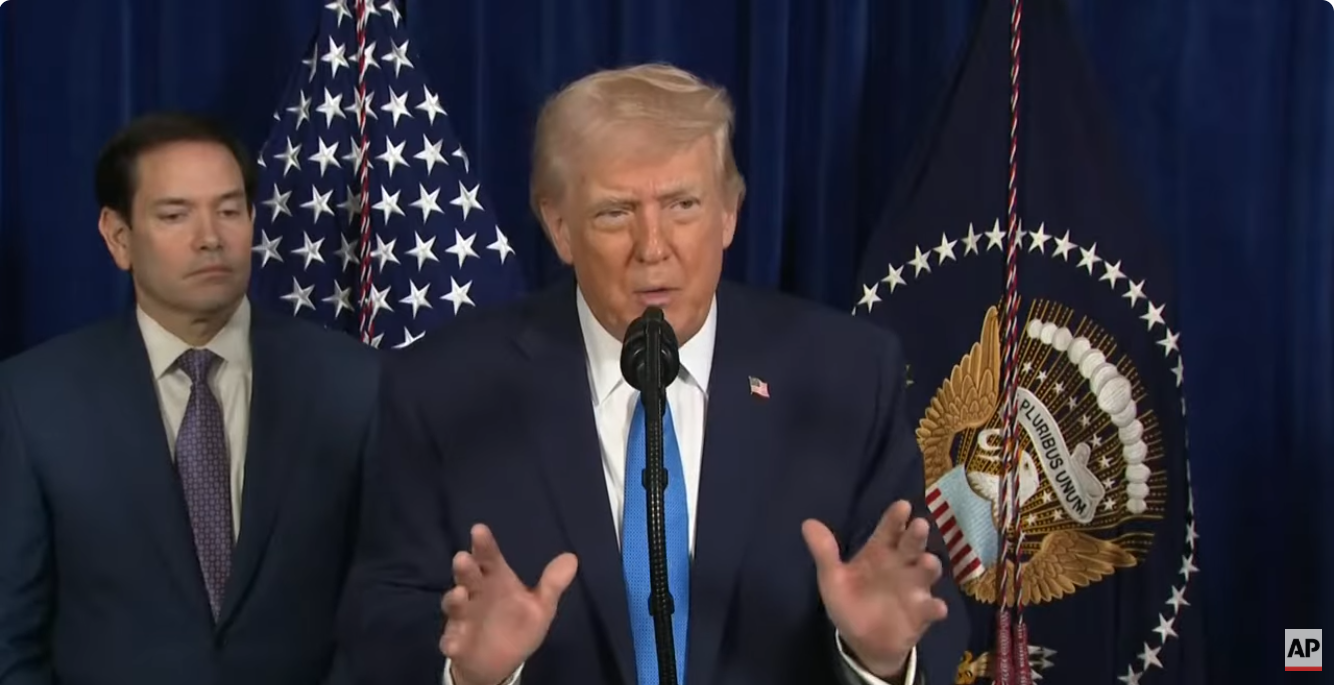
Okay. Thank you very much. This is big stuff. We appreciate you being here. Late last night and early today, at my direction, the United States Armed Forces conducted an extraordinary military operation in the capital of Venezuela. Overwhelming American military power, air, land and sea was used to launch a spectacular assault, and it was an assault like people have not seen since World War II. It was a force against a heavily fortified military fortress in the heart of Caracas to bring outlaw dictator, Nicolas Maduro, to justice.
(01:03)
This was one of the most stunning, effective, and powerful displays of American military might and competence in American history. And if you think about it, we've done some other good ones like the attack on Soleimani, the attack on al-Baghdadi, and the obliteration and decimation of the Iran nuclear sites just recently in an operation known as Midnight Hammer, all perfectly executed and done.
(01:48)
No nation in the world could achieve what America achieved yesterday or frankly in just a short period of time. All Venezuelan military capacities were rendered powerless as the men and women of our military working with US law enforcement successfully captured Maduro in the dead of night. It was dark. The lights of Caracas were largely turned off due to a certain expertise that we have. It was dark, and it was deadly. But captured along with his wife, Cilia Flores, both of whom now face American justice, Maduro and Flores have been indicted in the Southern District of New York. It's Jay Clayton for their campaign of deadly narco terrorism against the United States and its citizens.
(02:56)
I want to thank the men and women of our military who achieved such an extraordinary success overnight with breathtaking speed, power, precision, and competence. You rarely see anything like it. You've seen some raids in this country that didn't go so well. They were an embarrassment. If you look back to Afghanistan or if you look back to the Jimmy Carter days, they were different days where a respected country again, maybe, like never before. These highly trade warriors operating in collaboration with US law enforcement caught them in a very ready position. They were waiting for us. They knew we had many ships out in the sea. We were just sort of waiting.
(03:43)
They knew we were coming. So they were in what's called a ready position, but they were completely overwhelmed and very quickly incapacitated. If you would have seen what I saw last night, you would have been very impressed. I'm not sure that you'll ever get to see it, but it was an incredible thing to see.
(04:04)
Not a single American service member was killed, and not a single piece of American equipment was lost. We had many helicopters, many planes, many people involved in that fight. But think of that not one piece of military equipment was lost. Not one service member was more importantly killed. The United States military is the strongest and most fierce of military on the planet by far.
(04:33)
With capabilities and skills, our enemies can scarcely begin to imagine. We have the best equipment anywhere in the world. There's no equipment like what we have. And you see that even if you just look at the boats, we've knocked out 97% of the drugs coming in by sea, 90%. Each boat kills, on average, 25,000 people. We knocked out 97%. And those drugs mostly come from a place called Venezuela. We're going to run the country until such time as we can do a safe, proper, and judicious transition.
(05:14)
So we don't want to be involved with having somebody else get in, and we have the same situation that we had for the last long period of years. So we are going to run the country until such time as we can do a safe, proper, and judicious transition. And it has to be judicious because that's what we're all about. We want peace, liberty, and justice for the great people of Venezuela. And that includes many from Venezuela that are now living in the United States and want to go back to their country. It's their homeland. We can't take a chance that somebody else takes over Venezuela that doesn't have the good of the Venezuelan people in mind, decades of that. We're not going to let that happen.
(06:10)
We're there now, and what people don't understand, but they understand, as I say this, we're there now. But we're going to stay until such time as the proper transition can take place. So we're going to stay until such time as we're going to run it, essentially, until such time as a proper transition can take place. As everyone knows, the oil business in Venezuela has been a bust, a total bust for a long period of time. They were pumping almost nothing by comparison to what they could have been pumping and what could have taken place.
(06:51)
We're going to have our very large United States oil companies, the biggest anywhere in the world, go in, spend billions of dollars, fix the badly broken infrastructure, the oil infrastructure, and start making money for the country. And we are ready to stage a second and much larger attack if we need to do so.
(07:18)
So we were prepared to do a second wave if we needed to do so. We actually assumed that a second wave would be necessary. But now, it's probably not. The first wave, if you'd like to call it that, the first attack was so successful, we probably don't have to do a second. But we're prepared to do a second wave, a much bigger wave, actually.
(07:44)
This was pinpoint, but we have a much bigger wave that probably won't have to do. This partnership of Venezuela with the United States of America, a country that everybody wants to be involved with because of what we were able to do and accomplish will make the people of Venezuela rich, independent, and safe. And it will also make the many, many people from Venezuela that are living in the United States extremely happy. They suffered. They suffered. So much was taken from them. They're not going to suffer anymore.
(08:21)
The illegitimate dictator, Maduro, was the kingpin of a vast criminal network responsible for trafficking colossal amounts of deadly and illicit drugs into the United States. As alleged in the indictment, he personally oversaw the vicious cartel known as Cartel De Los Soles, which flooded our nation with lethal poison responsible for the deaths of countless Americans and many, many Americans, hundreds of thousands over the years of Americans died because of him.
(08:56)
Maduro and his wife will soon face the full might of American justice and stand trial on American soil. Right now, they're on a ship. They'll be heading to ultimately New York. And then a decision will be made, I assume, between New York and Miami or Florida. But we have people where the overwhelming evidence of their crimes will be presented in a court of law.
(09:28)
And I've seen it. I've seen what we have. It's both horrible and breathtaking that something like this could have been allowed to take place. For many years after his term as president of Venezuela, expired Maduro remained in power and waged a ceaseless campaign of violence, terror, and subversion against the United States of America, threatening not only our people, but the stability of the entire region.
(09:59)
And you all saw it. In addition to trafficking gigantic amounts of illegal drugs that inflicted untold suffering and human destruction all over the country, all over, in particular, the United States. Maduro sent savage and murderous gangs, including the bloodthirsty prison gang, Tren de Aragua, to terrorize American communities nationwide. And he did indeed. They were in Colorado. They took over apartment complexes. They cut the fingers off people if they call police. They were brutal, but they're not so brutal now.
(10:36)
And I just have to congratulate our military, Pete and everybody and our National Guard because the job that they've done, whether it's in Washington, DC, where we have a totally safe city where it was one of the most unsafe cities anywhere in the world, frankly. And now, we have no crime in Washington, DC. We haven't had a killing. We had the terrorist attack a few weeks ago, a little bit of a different kind of a threat, but we haven't had a killing in a long period of time, six, seven months. We used to have, on average, two a week in Washington, our capital. We don't have that anymore.
(11:19)
The restaurants are opening. Everyone's happy. They're going. They're walking their daughters. They're walking their children, their wives. They walk to restaurants. Restaurants are opening all over Washington, DC. So I want to thank the National Guard. I want to thank our military. And I want to thank law enforcement. Been amazing. And they should do it with more cities. We're doing it, as you know. And we're doing it in Memphis, Tennessee right now. And crime is down. We've just sort of started a few weeks ago, but crime is down now 77%.
(11:52)
And the governor of Louisiana called, great person, and he wanted us to help him, as you know, in a certain very nice part of Louisiana. And we have done that. It was a rough section, and we have crime down. I understand it's down to almost nothing already after two and a half weeks.
(12:16)
New Orleans, it's down to almost nothing. And we've only been there for two and a half weeks. Can't imagine why governors wouldn't want us to help. We also helped, as you know, in Chicago. Then crime went down a little bit there. We did a very small help because we had no working ability with the governor. The governor was a disaster, and the mayor was a disaster, but it knocked down crime.
(12:41)
But we're pulling out of there when they need us. We'll know. You'll know. You'll be writing about it. And likewise, Los Angeles, where we saved Los Angeles early on, where the head of the police department made a statement that if the federal government didn't come in, we would have lost Los Angeles. That's long after the fires. That's when they had the riots in Los Angeles. We did a great job. Got no credit for it whatsoever, but that's okay. It doesn't matter. We don't need the credit. But we'll be pulling out when they need us. They'll call, or we'll go back if we have to. We'll go back. But we did a great job in various cities.
(13:19)
But the thing, the place that we're very proud of is Washington, DC because it's our nation's capital. We took it from being a crime-ridden mess to being one of the safest cities in the country. But the gangs that they sent raped, tortured, and murdered American women and children. They were in all of the cities. I mentioned Tren de Aragua. And they were sent by Maduro to terrorize our people. And now, Maduro will never, again, be able to threaten an American citizen or anybody from Venezuela. There will no longer be threats.
(13:56)
For years, I've highlighted the stories of those innocent American whose lives were so heartlessly robbed by this Venezuelan terrorist organization. Really one of the worst. One of the worst. They say the worst. Americans like 12-year-old Jocelyn Nungaray from Houston, beautiful Jocelyn Nungaray, what happened to her?
(14:22)
As you know, they kidnapped, assaulted, and murdered by Tren de Aragua animals. They murdered Jocelyn and left her dead under the bridge. There was a bridge, a bridge that will never be the same to so many people after seeing what happened.
(14:42)
As I've said many times, the Maduro regime emptied out their prisons, sent their worst and most violent monsters into the United States to steal American lives. And they came from mental institutions and insane asylums. They came from prisons and
Donald Trump (15:00):
… jails. The reason I say both, they sound similar actually. Prisons a little bit more, a little bit more hostile, a little bit tougher. A mental institution isn't as tough as an insane asylum, but we got them both. They sent from their mental institutions, they sent from their jails prisons. They were drug dealers. They were drug kingpins. They sent everybody bad into the United States. But no longer. We have now a border where nobody gets through. In addition, Venezuela unilaterally seized and sold American oil, American assets and American platforms costing us billions and billions of dollars. They did this a while ago, but we never had a president that did anything about it. They took all of our property. It was our property. We built it. We never had a president that decided to do anything about it. Instead, they fought wars that were 10,000 miles away.
(16:03)
We built Venezuela oil industry with American talent, drive and skill. And the socialist regime stole it from us during those previous administrations, and they stole it through force. This constituted one of the largest thefts of American property in the history of our country. Considered the largest theft of property in the history of our country. Massive oil infrastructure was taken like we were babies, and we didn't do anything about it. I would've done something about it. America will never allow foreign powers to rob our people or drive us back into and out of our own hemisphere. That's what they did. Furthermore, under the now deposed dictator Maduro, Venezuela was increasingly hosting foreign adversaries in our region and acquiring menacing offensive weapons that could threaten US interest and lives. They used those weapons last night. They used those weapons last night, potentially in league with the cartels operating along our border.
(17:07)
All of these actions were in gross violation of the core principles of American foreign policy dating back more than two centuries, and not anymore. All the way back, it dated to the Monroe Doctrines. The Monroe Doctrine is a big deal, but we've superseded it by a lot. By a real lot. They now call it the Donroe document. I don't know. It's Monroe Doctrine. We forgot about it. It was very important, but we forgot about it. We don't forget about it anymore. Under our new National Security Strategy, American dominance in the Western Hemisphere will never be questioned again. Won't happen.
(17:56)
So just in concluding, for decades other administrations have neglected or even contributed to these growing security threats in the Western Hemisphere. Under the Trump administration, we are reasserting American power in a very powerful way in our home region, and our home region is very different than it was just a short while ago. We did this in my first term. We had great dominance in my first term, and we have far greater dominance right now. Everyone's coming back to us. The future will be determined by the ability to protect commerce and territory and resources that are core to national security. These are core to our national security. Just like tariffs are, they made our country rich and they've made our national security strong, stronger than ever before.
(18:55)
But these are the iron laws that have always determined global power, and we're going to keep it that way. We will secure our borders. We'll stop the terrorists. We will crash the cartels and we will defend our citizens against all threats, foreign and domestic. Other presidents may have lacked the courage or whatever to defend America, but I will never allow terrorists and criminals to operate with impunity against the United States. This extremely successful operation should serve as warning to anyone who would threaten American sovereignty or endanger American lives. Very importantly, the embargo on all Venezuelan oil remains in full effect. The American Armada remains poised in position, and the United States retains all military options until United States demands have been fully met and fully satisfied.
(19:55)
All political and military figures in Venezuela should understand what happened to Maduro can happen to them, and it will happen to them if they aren't just fair, even to their people. The dictator and terrorist Maduro is finally gone. In Venezuela, people are free. They're free again. It's been a long time for them, but they're free. America is a safer nation this morning. It's a prouder nation this morning because it didn't allow this horrible person and this country that was doing very bad things to us. It didn't allow it to happen, and the Western Hemisphere is right now a much safer place to be.
(20:42)
So I want to thank everybody for being here. I want to thank General Raizin Caine. He's fantastic man. I've worked with a lot of generals. I worked with some I didn't like. I worked with some I didn't respect. I worked with some that just weren't good, but this guy is fantastic. I watched last night one of the most precise attacks on sovereignty. I mean, it was an attack for justice. I'm very proud of him and I'm very proud of our Secretary of War, Pete Hegseth, who I'm going to ask to say a few words. Thank you very much.
Speaker X (21:17):
Mr. President [inaudible 00:21:19].
Speaker X (21:19):
Mr. President, can you explain how the US will run Venezuela?
Pete Hegseth (21:22):
Well, thank you, Mr. President. Finally, a commander-in-chief the world respects and the American people deserve. As the President said, words can barely capture the bravery and the power and the precision of this historic operation. A massive joint military and law enforcement raid flawlessly executed by the greatest Americans our country has to offer. American warriors are second to none, the best in the world and the best of our country. What I, what all of us witnessed last night was sheer guts and grit, gallantry, and glory of the American warrior. I'm simply humbled by such men. I tip my hat to our chairman, Dan Raizin Caine and all those Americans who stood watch last night. Our warriors are the elite of America, and again, President Trump has your back.
(22:17)
No other country on planet Earth, and it's not even close, could pull this kind of operation off, and no other president has ever shown this kind of leadership, courage, and resolve. The most powerful combination the world has ever seen. As the President said, our adversaries remain on notice. America can project our will anywhere, anytime. The coordination, the stealth, the lethality, the precision, the very long arm of American justice, all on full display in the middle of the night.
(22:53)
Nicholas Maduro had his chance, just like Iran had their chance, until they didn't and until he didn't. He effed around and he found out. President Trump is deadly serious about stopping the flow of gangs and violence to our country, deadly serious about stopping the flow of drugs and poison to our people, deadly serious about getting back the oil that was stolen from us, and deadly serious about reestablishing American deterrent and dominance in the Western Hemisphere. This is about the safety, security, freedom, and prosperity of the American people. This is America first. This is peace through strength, and the United States War Department is proud to help deliver it. Welcome to 2026, and under President Trump, America is back. I'd like to welcome now our chairman, Chairman Raizin Caine to give a few more details about the operation. Mr. Chairman.
Gen. Caine (24:01):
Thank you. Thank you, Mr. Secretary. Thank you, Mr. President. Good morning. Last night on the order of the President of the United States and in support of a request from the Department of Justice, as the President said, the United States military conducted an apprehension mission in Caracas, Venezuela to bring to justice two indicted persons, Nicolas and Cilia Maduro. This operation known as Operation Absolute Resolve was discreet, precise, and conducted during the darkest hours of January 2nd, and was the culmination of months of planning and rehearsal, an operation that frankly, only the United States military could undertake. What I'd like to do this morning is talk to you through some of the preparation and the details without compromising any of our tactics, techniques, and procedures. There is always a chance that we'll be tasked to do this type of mission again.
(24:58)
Our interagency work began months ago and built on decades of experience of integrating complex air, ground, space, and maritime operations. While the past two decades have honed the skills of our special operations forces, this particular mission required every component of our joint force, with soldiers, sailors, airmen, Marines, and guardians working in unison with our intelligence agency partners and law enforcement teammates in an unprecedented operation. We leveraged our unmatched intelligence capabilities and our years of experience in hunting terrorists, and we could not have done this mission without the incredible work by various intelligence agencies, including the CIA, NSA, and NGA. We watched, we waited, we prepared, we remained patient and professional. This mission was meticulously planned, drawing lessons from decades of many missions over these last many years.
(26:06)
This was an audacious operation that only the United States could do. It required the utmost of precision and integration within our joint force. And the word integration does not explain the sheer complexity of such a mission. An extraction so precise, it involved more than 150 aircraft launching across the Western Hemisphere in close coordination, all coming together in time and place to layer effects for a single purpose, to get an interdiction force into downtown Caracas, while maintaining the element of tactical surprise. Failure of one component of this well-oiled machine would have endangered the entire mission, and failure is never an option for America's joint force. Those in the air over Caracas last night were willing to give their lives for those on the ground and in the helicopters.
(27:10)
Let me talk a little bit about the preparation. After months of work by our intelligence teammates to find Maduro and understand how he moved, where he lived, where he traveled, what he ate, what he wore, what were his pets, in early December, our force was set pending a series of aligned events. Key was choosing the right day to minimize the potential for civilian harm and maximize the element of surprise and minimize the harm to the indicted personnel so, as the President said, they could be brought to justice. As the President said earlier today, weather in Venezuela is always a factor this time of the year. Over the weeks through Christmas and New Years, the men and women of the United States military sat ready, patiently waiting for the right triggers to be met and the President to order us into action. Last night, the weather broke just enough, clearing a path that only the most skilled aviators in the world could maneuver through, ocean, mountain, low cloud ceilings, but when tasked with a mission, this organization does not quit. At 10:46 P.M. Eastern time last night, the President ordered the United States military to move forward with this mission. He said to us, and we appreciated it Mr. President, "Good luck and God speed," and those words were transmitted to the entire joint force. Over the course of the night, aircraft began launching from 20 different bases on land and sea across the Western Hemisphere. In total, more than 1150 aircraft, bombers, fighters, intelligence, reconnaissance, surveillance, rotary wing were in the air last night. Thousands and thousands of hours of experience were airborne. Our youngest crew member was 20 and our oldest crew member was 49, and there's simply no match for American military might.
(29:18)
As the night began, the helicopters took off with the extraction force, which included law enforcement officers and began their flight into Venezuela at 100 feet above the water. As they approached Venezuelan shores, the United States began layering different effects provided by Space Com, Cyber Com, and other members of the interagency to create a pathway. Overhead, those forces were protected from aircraft, were protected by aircraft from the United States Marines, the United States Navy, the United States Air Force, and the Air National Guard. The force included F-22s, F-35s, F-18s, EA-18s, E-2s, B1
Gen. Caine (30:00):
… bombers and other support aircraft as well as numerous remotely piloted drones. As the force began to approach Karacas, the joint air component began dismantling and disabling the air defense systems in Venezuela, employing weapons to ensure the safe passage of the helicopters into the target area. The goal of our air component is, was, and always will be to protect the helicopters and the ground force, and get them to the target and get them home.
(30:35)
As the force crossed the last point of high terrain where they'd been hiding in the clutter, we assessed that we had maintained totally the element of surprise. As the helicopter force ingressed towards the objective at low level, we arrived at Maduro's compound at 1:01 AM Eastern Standard Time or 2:01 AM Karacas local time, and the apprehension force descended into Maduro's compound and moved with speed, precision and discipline towards their objective and isolated the area to ensure the safety and security of the ground force while apprehending the indicted persons.
(31:18)
On arrival into the target area, the helicopters came under fire, and they replied with that fire with overwhelming force and self-defense. One of our aircraft was hit but remained flyable, and as the president said earlier today, all of our aircraft came home and that aircraft remained flyable during the rest of the mission.
(31:37)
As the operation unfolded at the compound, our air and ground intelligence teams provided real-time updates to the ground force, ensuring those forces could safely navigate the complex environment without unnecessary risk. The force remained protected by overhead tactical aviation. Maduro and his wife, both indicted, gave up, and were taken into custody by the Department of Justice assisted by our incredible US military with professionalism and precision with no loss of US life.
(32:12)
After securing the indicted persons, the force began to prep for departure. Helicopters were called in to exfiltrate the extraction force while fighter aircraft and remotely piloted aircraft provided overhead coverage and suppressive fire. There were multiple self- defense engagements as the force began to withdraw out of Venezuela. The force successfully exfiltrated and returned to their afloat launch bases and the force was over the water at 3:29 AM Eastern Standard Time with indicted persons on board, and both Maduro and his wife were embarked aboard the USS Iwo Jima.
(32:56)
In closing, what we've witnessed today is a powerful demonstration of America's joint force. We think, we develop, we train, we rehearse, we debrief, we rehearse again and again, not to get it right, but to ensure that we cannot get it wrong. Our jobs are to integrate combat power so when the order comes, we can deliver overwhelming force at the time and the place of our choosing against any foe anywhere in the world.
(33:34)
I am immensely proud today of our joint force and filled with gratitude to represent them here today. There is simply no mission too difficult for these incredible professionals and the families that stand by them and support them.
(33:51)
As we stand here this morning, our forces remain in the region at a high state of readiness, prepared to project power, defend themselves, and our interests in the region. This operation is a testament to the dedication and unwavering commitment to justice and our resolve to hold accountable those who threaten peace and stability. In closing, I want to express my heartfelt gratitude to the brave men and women who executed this mission. Their courage and tireless commitment to our nation are what makes us strong. Thank you, Mr. Secretary, and thank you, Mr. President.
Donald Trump (34:32):
Thank you very much. Please, you may.
Marco (34:36):
Well, I don't have much to add to what you've heard now other than the following points. Nicholas Maduro was indicted in 2020 in the United States. He is not the legitimate president of Venezuela. That's not just us saying it. The first Trump administration, the Biden administration, the second Trump administration, none of those three recognize him. He's not recognized by the European Union in multiple countries around the world. He is a fugitive of American justice with a $50 million reward, which I guess we save $50 million.
Donald Trump (35:03):
We should make sure.
Marco (35:04):
Yeah, exactly.
Donald Trump (35:06):
Don't let anybody claim it. Nobody deserves it, but us.
Marco (35:10):
But I want to be clear about one thing. Nicholas Maduro had multiple opportunities to avoid this. He was provided multiple very, very, very generous offers and chose instead to act like a wild man, chose instead to play around. And the result is what we saw tonight. The other message here is the following. You have a guy, like many people around the world, they like to play games. You have a guy who decides he's going to invite Iran into his country, is going to do the confiscation of American oil companies, is going to flood our country with gang members, is going to take Americans prisoner and try to hold him for hostage and trade him like he was able to do with the Biden administration. Basically likes to play games all this time and thinks nothing's going to happen. And I hope what people now understand is that we have a president.
(35:53)
The 47th president of the United States is not a game player. When he tells you that he's going to do something, when he's tells you he's going to address a problem, he means it. He actions it. I can tell you, I've watched this process now for 14, 15 years, been around it. Everybody talks. "I'm going to do this. I'm going to do that when I get there, we're going to do this. We're going to take…" This is a president of action.
(36:11)
I don't understand yet how they haven't figured this out. And now if you don't know, now you know, because this is the way it's going to play out. And I think people need to understand that this is not a president that just talks and does letters and press conferences. If he says he's serious about something, he means it. And this is something that was a direct threat to the national interest of the United States and the president addressed it.
(36:31)
He's a president of peace, by the way. I told you what I just said earlier. This guy had multiple opportunities to find his way somewhere else and figure out another. He could have been living somewhere else right now very happy, but instead he wanted to play big boy. And so now, he's got other sets of problems on his hands. But I think that the message here should be for the world. But the president doesn't go out looking for people to pick fights with. He generally wants to get along with everybody. We'll talk and meet with anybody, but don't play games. Don't play games with this president's in office because it's not going to turn out well.
(37:03)
And so I guess that lesson was learned last night, and we hope it'll be instructive moving forward.
Speaker 1 (37:12):
Is that a message for Cuba?
Speaker 2 (37:13):
Mr. President, you said that the US is going to run Venezuela. So who's in power right now?
Donald Trump (37:24):
Well, we're going to be running it with a group, and we're going to make sure it's run properly. We're going to rebuild the oil infrastructure, which will cost billions of dollars. It'll be paid for by the oil companies directly. They will be reimbursed for what they're doing, but it's going to be paid. And we're going to get the oil flowing the way it should be. As you know, it was just a minor flow. It was actually a minor flow for what they have.
(37:47)
But we're going to run it properly and we're going to make sure the people of Venezuela are taken care of. We're going to make sure the people that were forced out of Venezuela by this thug are also taken care of.
Speaker 3 (38:01):
Mr. President, does the US running the country mean that US troops will be on the ground? How will that work?
Donald Trump (38:07):
Well, they always say boots on the ground. Oh, so we're not afraid of boots on the ground that we have to have. We had boots on the ground last night at a very high level, actually. We're not afraid of it. We don't mind saying it, but we're going to make sure that that country is run properly. We're not doing this in vain. This is a very dangerous attack. This is an attack that could have gone very, very badly. Could have gotten very badly. We could have lost a lot of people last night. We could have lost a lot of dignity. We could have lost a lot of equipment. The equipment is less important, but we could have lost a lot, and we're going to make sure that this is proper. We're there now. We're ready to go again if we have to. We're going to run the country right. It's going to be run very judiciously, very fairly.
(38:54)
It's going to make a lot of money. We're going to give money to the people. We're going to reimburse people that were taking advantage of. We're going to take care of everybody. It's very important. We couldn't let them get away with it. We built that whole industry there, and they just took it over like we were nothing. And we had a president that decided not to do anything about it. So we did something about it. We're late, but we did something about it. Yeah, please.
Speaker 1 (39:22):
Can you explain the exact mechanism by which you're going to run the country? Are you going to designate a US official to coordinate?
Donald Trump (39:29):
Yes, it's all being done right now. We're designating people. We're talking to people.
Speaker 1 (39:32):
Who specifically?
Donald Trump (39:32):
We're designating various people, and we're going to let you know who those people are.
Speaker 4 (39:35):
What's the group you mentioned that would run Venezuela?
Donald Trump (39:39):
Well, it's largely going to be for a period of time, the people that are standing right behind me. We're going to be running it. We're going to be bringing it back. I talk about a dead country. A year and a half ago, we were a dead country. Now we're the hottest country anywhere in the world. We're a country doing better than any country, anywhere in the world. And it required leadership.
(40:02)
Venezuela has a lot of bad people in there, a lot of bad people that shouldn't be leading. We're not going to take a chance that one of those people take over for Maduro and others. We have fantastic people, including people in the military. So we're going to have a group of people running it until such time as it can be.
Speaker 4 (40:21):
So you're saying-
Donald Trump (40:21):
Put back on track. Make a lot of money for the people and give people a great way of life and also reimbursement for people in our country that were forced out of Venezuela.
Speaker 5 (40:34):
You said earlier today that you weren't going to back Machado to come back and be the opposition later in your Fox and Friends interview. And then you also mentioned the vice president of Venezuela. Are you going to work with vice president of Venezuela or how do you foresee the relationship going?
Donald Trump (40:46):
Well, I understand she was just sworn in, but she was, as you know, picked by Maduro. So Marco's working on that directly. He just had a conversation with her, and she's essentially willing to do what we think is necessary to make Venezuela great again. Very simple.
Speaker 6 (41:04):
Mr. President, so Columbian president Gustavo Petro, a couple of weeks ago, he said he's got to watch his ass. And today he said he's not concerned about anything happening to him in the aftermath of this operation. So just what your message is about that?
Donald Trump (41:17):
Well, he has cocaine mills. He has factories where he makes cocaine. And yeah, I think I stick by my first statement. He's making cocaine and they're sending it into the United States, so he does have to watch his ass.
Speaker 7 (41:29):
Mr. President, did you notify any members of Congress in advance?
Donald Trump (41:34):
And Marco, do you want to talk about that because you were involved in it?
Marco (41:37):
Sure. We call members of Congress immediately after. This was not the kind of mission that you can do congressional notification on. It was a trigger-based mission in which conditions had to be met night after night. We watched and monitor that for a number of days. So it's just simply not the kind of mission you can call people and say, "Hey, we may do this at some point in the next 15 days."
(41:54)
But it's largely a law enforcement function. Remember at the end of day, at its core, this was an arrest of two indicted fugitives of American justice, and the Department of War supported the Department of Justice in that job. Now there are broader policy implications here, but it's just not the kind of mission that you can pre-notify because it endangers the mission.
Donald Trump (42:13):
If I can add one thing to that. Congress has a tendency to leak. This would not be good. If they leaked, General, I think it would have been maybe a very different result. But I have to say, they knew we were coming at some point. A lot of ships out there, they sort of knew we were coming. But Congress will leak, and we don't want leakers.
Speaker 8 (42:37):
You were one of the only people to watch this all play out live. What was Maduro doing when the US forces entered what I assume would be his home? And also, was there any point where the US was considering if Maduro pushed back or resisted killing Maduro?
Donald Trump (42:51):
It could have happened. It could have happened. He was trying to get into a safe place. You know what a safe place is, all steal, and he wasn't able to make it to the door because our guys were so fast. They went through the opposition so fast and there was a lot of opposition. People were wondering, do we get him by surprise? Sort of surprised, but they were waiting for something. It was a lot of opposition. There was a lot of gunfire. You saw some of it today, but he was trying to get to a safe place, which wasn't safe because we would have had the door blown up in about 47, I think 47 seconds, they say on average, regardless of how thick the seal was. It was a very thick door. It was a very heavy door, but he was unable to get to that door.
(43:35)
He made it to the door. He was unable to close it.
Speaker 9 (43:41):
Where is Maduro going to be in the time being right now? Do you know his exact whereabouts?
Donald Trump (43:44):
Well, eventually, ultimately in the near future, he's going to be brought to New York.
Speaker 9 (43:49):
And where is he going to be held in New York, do you know?
Donald Trump (43:51):
Well, that's going to be up to the officials that do these things.
Speaker 3 (43:53):
Mr. President, Mr. President, the US has something of a mixed track record of ousting dictators without necessarily a plan for what comes afterwards.
Donald Trump (44:03):
Not with me, we didn't.
Speaker 3 (44:03):
Did that weigh on your decision-making?
Donald Trump (44:04):
Well, that's why we have different presidents, but with me, that's not true. With me, we've had a perfect track record of winning. We win a lot and we win. If you look at Soleimani, you look at Al Baghdadi, you look at the Midnight Hammer. Midnight Hammer was incredible. Right now, you wouldn't have peace in the Middle East. We have essentially peace in the Middle East because of that. If we weren't successful with Midnight Hammer, you wouldn't have peace in the Middle East. So with me, you've had a lot of victory. You've had only victories, you've had no losses. Yeah.
Speaker 10 (44:36):
Mr. President, how long do you expect the US to run Venezuela, and how soon do you want the Venezuelan people to hold elections?
Donald Trump (44:44):
So I'd like to do it quickly, but it takes a period of time. We're rebuilding. We have to rebuild their whole infrastructure. The infrastructure is rotted. It's actually very dangerous. It's a blow up territory. Oil is very dangerous. It's a very dangerous thing to take out of the ground.
Donald Trump (45:00):
… can kill a lot of people. It has killed a lot of people doing just that. The infrastructure is old. It's rotted. Much of it is stuff that we put there 25 years ago. And we're going to be replacing it, and we're going to take a lot of money out so that we can take care of the country.
Marco (45:17):
Are you saying that Secretary Rubio and-
Speaker 11 (45:21):
Mr. President, China, Russia, and Iran have interests in Venezuela. How does this operation affect your relationships with them-
Marco (45:28):
Well, in terms of China-
Speaker 11 (45:29):
… when it comes to the oil and drugs?
Donald Trump (45:29):
… and Russia, well, Russia when we get things straightened out, but in terms of other countries that want oil, we're in the oil business, we're going to sell it to them. We're not going to say we're not going to. In other words, we'll be selling oil probably in much larger doses because they couldn't produce very much because their infrastructure was so bad. So we'll be selling large amounts of oil to other countries, many of whom are using it now, but I would say many more will come.
Marco (46:02):
Are you saying… Mr. President-
Speaker 12 (46:02):
Mr. President, what is your message to the people of Venezuela?
Marco (46:03):
… are you saying that-
Donald Trump (46:03):
Wait.
Marco (46:03):
Mr. President-
Donald Trump (46:03):
One second please.
Marco (46:03):
… are you saying that-
Donald Trump (46:03):
Go ahead, behind you, please.
Speaker 12 (46:04):
Mr. President, thank you. What is your message to the people of Venezuela today? Of course, the civilian population specifically, they have a lot of questions. What is your message to the people of Venezuela?
Donald Trump (46:13):
That you're going to have peace, justice. You're going to have some of the riches that you should have had for a long period of time. It was stolen from you, but you're going to have peace and you're going to have safety. You're going to have justice. You're going to have a country. You're going to have a real country. You're going to have, potentially, a great country. If you go back 20 years, maybe even a little longer ago, that was a great country. And they destroyed it.
(46:35)
Remember I said that, if we lose this election, the United States will be Venezuela on steroids. That's what would have happened had we lost the election, the 2024 election. We suffered so badly when you look at the border from 2020. What they did, what Joe Biden, the administration, did to our country should never be forgotten. But if we had to go through another year of that, we wouldn't have… We would be exactly where Venezuela was in terms… I used to say, if they win, we're going to be Venezuela on steroids. And that's what would have happened.
Marco (47:09):
Mr. President, thank you. Are you saying that Secretary Hegseth and Rubio are going to be running Venezuela? And will you be sending in US military trips to provide-
Donald Trump (47:17):
They're going to be a team that's working with the people of Venezuela to make sure that we have Venezuela because, for us to just leave, who's going to take over? I mean, there is nobody to take over. You have a vice president who's been appointed by Maduro. And, right now, she's the vice president. And she's, I guess, the president. She was sworn as president just a little while ago. She had a long conversation with Marco, and she said, "We'll do whatever you need." I think she was quite gracious, but she really doesn't have a choice.
(47:48)
We're going to have this done right. We're not going to just do this with Maduro and then leave like everybody else leave and say, "Let it go to hell." If we just left, it has zero chance of ever coming back. We'll run it properly. We'll run it professionally. We'll have the greatest oil companies in the world going and invest billions and billions of dollars and take out money, use that money in Venezuela. And the biggest beneficiary are going to be the people of Venezuela and, also, I can't stress this strongly enough, the people that got thrown out of Venezuela that are now in the United States and, frankly, some want to stay and some probably want to go back. Yeah.
Speaker 13 (48:26):
Mr. President?
Speaker 14 (48:27):
What's being done to protect Americans in the country? And were any of the detained Americans rescue after?
Donald Trump (48:31):
Well, right now, they're very protected because nobody's going to mess with us. They're very protected. And we let them know that you better not touch one of them.
Speaker 15 (48:39):
Mr. President, why is-
Speaker 14 (48:40):
And are you concerned that bad elements of the Maduro regime will remain in place?
Donald Trump (48:45):
Well, we know who they are. We're on them. And they're acting much differently now than they would have acted two days ago.
Speaker 16 (48:52):
And what can you say about-
Donald Trump (48:53):
Okay. Wait. Behind you please?
Speaker 15 (48:54):
Mr. President, why is running a country in South America "America First"?
Donald Trump (48:58):
Well, I think it is because we want to surround ourself with good neighbors. We want to surround ourself with stability. We want to surround ourself with energy. We have tremendous energy in that country. It's very important that we protect it. We need that for ourselves. We need that for the world, and we want to make sure we can protect it.
Speaker 16 (49:15):
Mr. President, on oil-
Donald Trump (49:17):
Yes, sir, please go ahead.
Speaker 17 (49:18):
Yeah. Is there a message here for Cuba and Diaz-Canel?
Donald Trump (49:21):
Well, Cuba is an interesting case. Cuba is not doing very well right now. That system has not been a very good one for Cuba. The people there have suffered for many, many years. And I think Cuba is going to be something we'll end up talking about, because Cuba is a failing nation right now, a very badly failing nation. And we want to help the people. It's very similar in the sense that we want to help the people in Cuba, but we want to also help the people that were forced out of Cuba and living in this country.
(49:49)
Do you want to say something about that, Marco, please?
Marco (49:51):
Well, I mean, I just gave you a statement a few minutes ago about, when the president speaks, you should take him seriously. So, suffice it to say, Cuba is a disaster. It's run by incompetent Sino men and, in some cases, not Sino but incompetent nonetheless. It has no economy. It's in total collapse. And, by the way, they were… All the guards that help protect Maduro, this is well known, their whole spy agency, all that were full of Cubans. I mean, they basically… It's amazing. This poor island took over Venezuela in some cases. One of the biggest problems the Venezuelans have is they have to declare independence from Cuba that tried to basically colonize it from a security standpoint. So, yeah, look, if I lived in Havana and I was in the government, I'd be concerned at least a little bit.
Speaker 15 (50:33):
Are you cutting off the oil flow to Cuba from Venezuela?
Marco (50:36):
Well, the president already announced a week ago that anything that's sanctioned, it's sanctioned oil, it's not going to be allowed to get there, so that's an-
Speaker 17 (50:49):
Mr. President?
Speaker 18 (50:49):
President Trump?
Donald Trump (50:50):
The answer is yes.
Speaker 19 (50:50):
Mr. President?
Speaker 20 (50:50):
Mr. President?
Donald Trump (50:50):
Yes?
Speaker 19 (50:50):
Is the US aware of the location of opposition leader Machado? And have you been in contact with her?
Donald Trump (50:55):
No, we haven't really. No, we haven't.
Speaker 21 (51:02):
Mr. President, on Monday-
Donald Trump (51:03):
Oh, I think it would be very tough for her to be the leader. She doesn't have the support within or the respect within the country. She's a very nice woman, but she doesn't have the respect within the country.
Speaker 22 (51:12):
Mr. President, is it possible that the US ends up administrating Venezuela for years in this situation?
Donald Trump (51:16):
Well, it won't cost us anything because the money coming out of the ground is very substantial. So it's not going to cost us anything.
Speaker 22 (51:23):
So the US isn't going to dedicate any money to-
Donald Trump (51:24):
We will. Well, we want safety there. We want to be surrounded by countries that aren't housing all of our enemies all over the world. That's what was happening, and you don't want to have that. But we're going to be rebuilding. And we're not spending money. The oil companies are going to go in. They're going to spend money. We're going to take back the oil that, frankly, we should have taken back a long time ago. A lot of money is coming out of the ground. We're going to get reimbursed for all of that. We're going to get reimbursed for everything that we spend, so it's going to be a very important… it's going to be a very important… This is a very big evening that took place last night.
(52:02)
We have to be surrounded by safe, secure countries. And we also have to have energy. Very important, we have to have energy that's real energy, not where they're getting 4% and 5% of the energy out of the ground. If you take a look, it was such a disaster. So what's going to happen with Venezuela, I think, over the next period of a year is going to be a great thing. And the people of Venezuela will be the biggest beneficiaries.
Speaker 21 (52:32):
Mr. President, on Monday-
Speaker 22 (52:33):
What did you last… Mr. President, thank you. What did you last speak to Maduro about when you spoke? And is the US-
Donald Trump (52:37):
Well, I don't want to get into the conversations. But I did have conversations with him, and I said, "You got to surrender." And I actually thought he was pretty close to doing so, but now he wished he did. Yeah.
Speaker 23 (52:51):
Mr. President, can you explain… You said that Maduro is responsible for drug trafficking. You recently pardoned the former president of Honduras who was convicted on many drug trafficking. Can you explain how these two situations are different?
Donald Trump (53:02):
Well, the-
Speaker 23 (53:03):
And would you ever pardon Maduro?
Donald Trump (53:04):
Yeah, I endorsed, as you know, the winning president, the man who won in Honduras. I endorsed the man who won in Chile. I endorsed the man who won in Argentina. And we are doing very well with that whole group. The man that I pardoned was, if you could equate it to us, he was treated like the Biden administration treated a man named Trump. That didn't work out too well for them. This was a man who was persecuted very unfairly. He was the head of the country. He was persecuted very unfairly. And there are a number of them. And we felt that it was a very unfair situation that happened to him. He's also a party member of the man who won, so, obviously, the people liked what I did. And one of the reasons that was done is because of the fact that the party in power felt very strongly that that man was treated very badly.
(53:54)
I studied it very quickly and then I studied it in great detail. I went to a lot of the people standing behind me, and they felt that that man was persecuted and treated very badly. That's why I gave him a pardon.
Speaker 24 (54:06):
Mr. President, you referenced boots on the ground earlier. Can you just sort of button this up? Do you envision the US military having a presence in Venezuela as the US runs that country?
Donald Trump (54:16):
Well, no, we're going to have presence in Venezuela as it pertains to oil because we have to have… We're sending our expertise in, so you may need something, not very much. But, no, we're going to be taking out a tremendous amount of wealth out of the ground, and that wealth is going to the people of Venezuela and people from outside of Venezuela that used to be in Venezuela. And it goes also to the United States of America in the form of reimbursement for the damages caused us by that country. So I want to thank you all very much. Thank you.
(54:46)
Do you have one? Yes, please. You were so nice before. I'm going to give you the final question. Go ahead.
Speaker 16 (54:51):
Thank you, Mr. President.
Donald Trump (54:52):
Unless it's a bad question-
Speaker 16 (54:53):
It's about Putin.
Donald Trump (54:54):
… in which case I'll go… Wait, what? It's about who?
Speaker 16 (54:55):
It's about Putin. If you want to-
Donald Trump (54:56):
About Putin? Well, it's always nice to talk about Putin.
Speaker 16 (55:00):
You had a phone call with him on Monday. Did he talk at all about Maduro? Did y'all talk about this?
Donald Trump (55:04):
No, we didn't.
Speaker 16 (55:04):
And then-
Donald Trump (55:05):
We never spoke about Maduro.
Speaker 16 (55:07):
Are you mad at him right now? I mean there's this intelligence-
Donald Trump (55:09):
I'm not thrilled with Putin. I'm not thrilled with Putin. He's killing too many people.
Speaker 16 (55:15):
There was that intelligence-
Donald Trump (55:16):
I thought that would be. So I settled eight and one-quarter war. You know what the one-quarter was? Thailand. In Cambodia, I did it again. They broke out. And I did it in about five hours and I settled it. I'm giving myself one quarter, so I'm up to now eight and one quarter. In other words, I settled the war, but then they broke out. They had a pretty bad breakout. Over the last four days, I got them to go back to peace. So I only give one quarter.
(55:45)
I thought the easiest one would be… One of the easier ones would be Russia, Ukraine. It's not. And they both have done some pretty bad things. And, look, that's Biden's war. That's not my war, but I want to stop the lives… Did you see? Well, last month, 30,000. This last… It was 27, 27,000 the month before. 30,000, mostly soldiers, were killed this last month. 30,000. I want to stop that. I got NATO to pay 5% instead of the 2% that they weren't paying. They weren't paying two. Now they pay five. And we send them a lot of munitions. We send them a lot of things, missiles and various other things, a lot. And they pay.
(56:32)
The United States is not losing money. We're probably making money on that. It's the last thing I care about. I just want to stop all those people. We're losing 25, 30,000 human beings. They come from two places that are very far away. But, if I can stop, because it's something I've been pretty good at doing, deals, I guess. It's all a deal. Life is a big deal. But if I can stop that war and stop 30,000 young people… In addition to the fact that people are being killed in Kyiv, people are being killed in other cities throughout, a much smaller number, but they're being killed, viciously killed. So I'm not happy about it. I thought that would be something that would get solved.
(57:12)
We have Mr. Witkoff here. I think that we're making progress. But that's a war that should have never happened. If I were president, it would have never happened. Putin says it. Everybody says it. If I were president, that would have never happened. But I inherited that war. That was Joe Biden, Zelenskyy, and Putin. I came into the situation. And it's a mess.
(57:34)
And I will say this. I watched an operation last night that was so precise, that was so brilliant. I mean, it was incredible. If we had our people like this general and our people involved, that war would not have gone on very long, that I can tell you. That war, to use an old term, that war has become a bloodbath, and we wanted to get it stopped.
(57:59)
Thank you very much, everyone.
Speaker 25 (58:08):
Mr. President, are you concerned a rogue general can take over the country?
Speaker 26 (58:09):
Mr. President, can you talk about your conversation with the vice president?