




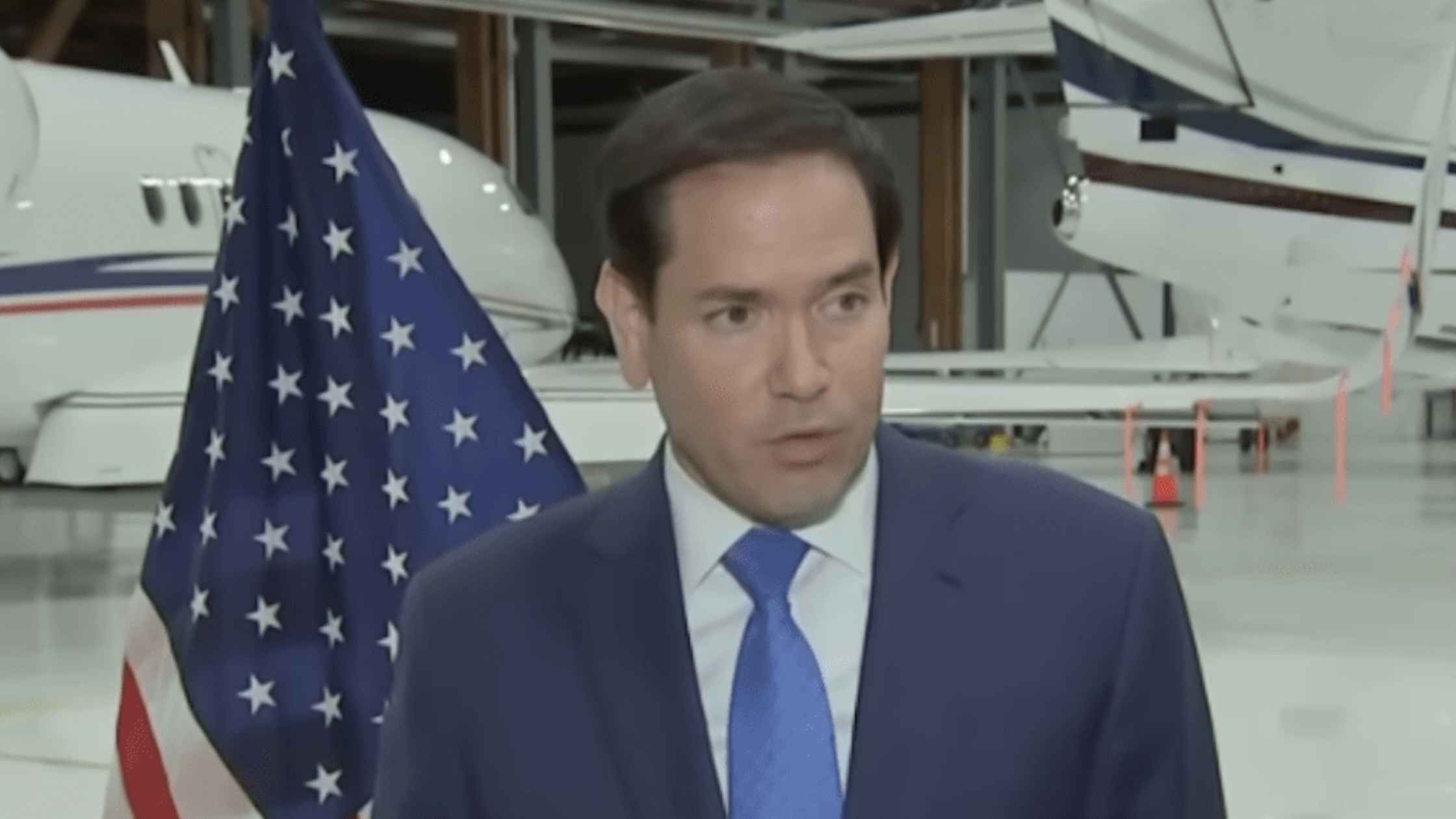


Secretary Marco Rubio (00:02):
Taking my time. Where do I stand? Here?
Speaker 5 (00:03):
Yes.
Secretary Marco Rubio (00:04):
All right. Let's go.
Speaker 1 (00:06):
Mr. Secretary-
Secretary Marco Rubio (00:06):
What the hell is that? Are you a court reporter?
Speaker 5 (00:08):
[inaudible 00:00:09]
Secretary Marco Rubio (00:09):
Is he a court reporter? What's wrong with him? Sorry. What's up?
Speaker 1 (00:12):
Mr. Secretary, is it your assessment that Russia does not really want the case?
Secretary Marco Rubio (00:16):
Well, we can only go by what we see. I mean, I think they've stated clearly what they want is they want the risk of Donetsk and obviously the Ukrainians aren't going to agree to that. So what we see now is they continue long-range strikes into Ukraine, obviously to degrade their electrical grid and try to demoralize the country or what have you. And they've made some gains in Donetsk and they're losing 7,000 soldiers a week, 7,000 dead soldiers a week from Russia's side. So as of now, I mean, that's the assessment we have to make. They've made a demand that Ukraine can't agree to and so we're sort of where we are at this point.
Speaker 2 (00:54):
You didn't have any deliverables to bring from Washington on the Ukraine issue, is that correct? Or did you-
Secretary Marco Rubio (01:00):
Well, I mean the president has done the sanctions, which is what they asked him to do. So that happened very recently. But as far as deliverables, we continue to do what we've been doing, plus we know the new sanctions.
Journalists (01:11):
Mr. secretary, I was told by the European representative on foreign policy, Kaja Kallas that it was discussed, the Venezuela military operations were discussed [inaudible 00:01:24]
Secretary Marco Rubio (01:24):
Not with me. No one raised it. I mean no one in the meeting raised it.
Journalists (01:27):
It was raised in the meeting.
Secretary Marco Rubio (01:29):
Not with me. They didn't raise it with me. They may have raised it among themselves and they all came now from CELAC or whatever they were at. But it didn't come up once in any of the gatherings that we had either last night or today.
Speaker 6 (01:41):
Sorry. Can you-
Journalists (01:42):
Let me ask you about that. She told me that they discussed the legality and that there were two reasons why an operation would be legal self-defense, and a UN resolution that neither of those applied in this case, that they are all struggling with the drug issue and that they should discuss whether international law needs to be updated. So let me ask you about that.
Secretary Marco Rubio (02:06):
I don't think that the European Union gets to determine what international law is. They certainly don't get to determine is how the United States defends its national security. The United States is under attack from organized criminal narco-terrorists in our hemisphere and the president is responding in the defense of our country. I do find it interesting that all these countries want us to send and supply, for example, nuclear-capable Tomahawk missiles to defend Europe. But when the United States positions aircraft carriers in our hemisphere where we live, somehow that's a problem.
(02:36)
So I would say that the United States and this president has made very clear his job is to protect the United States from threats against the United States and that is what he's doing in this operation.
Journalists (02:45):
Canada's foreign minister says that they have been assured that the US is using its own intelligence and that the Canadian intelligence is not being used. We've been told, or there are reports, rather that the UK is not sharing targeting terms.
Secretary Marco Rubio (03:01):
Yeah, a couple points. The United States, there's reasons why we have those assets in the region and that is to collect intelligence and we're actioning on that. Obviously, I won't go any deeper when it comes to intelligence matters. I did see a CNN report yesterday. I'm not going to go into great detail and to say it's a false story. It's a fake story. And what's happening now is people with a business card that has a government email on it become sources because they don't know… They're not even in the know. So they either have an agenda or they want to make themselves important.
(03:25)
And it's been a plague of story after story that's either inaccurate or misleading. And that falls in the category of both. That story does. But again, going back, look, this is a counter-drug operation. The president has ordered it in defense of our country. It continues. It's ongoing. It can stop tomorrow if they stop sending drug boats. The Maduro regime is a narco-terrorist regime indicted in the Southern District of the United States for narco-terrorism. But more importantly, they're also a trans-shipment organization that allows these groups to operate from their national territory. They allow drugs to be shipped. They openly cooperate with the shipping of these drugs towards the United States and Europe, by the way. So maybe they should be thanking us.
(04:03)
But the bottom line here is that the President is going to defend the national interest and the national security of the United States, which is under threat by these terrorist organizations.
Speaker 7 (04:12):
Secretary, you met with your Saudi counterpart today. Can you talk about what is being discussed in preparation for MBS visit to the White House next week? And will the Saudis get a security deal that is better than the deal that Qatar previously got?
Secretary Marco Rubio (04:30):
Well, we're still working through all that. I mean, obviously all that will be announced just prior to or during the visit, but we'll have some good agreements to sign with them. A lot of progress has been made since the president's visit there, so we're working through that. I feel good about where it's at. There's still a few things that need to be tightened up and finalized, and we're going to have a good meeting next week.
Speaker 8 (04:47):
[inaudible 00:04:47] Mr. Secretary, I'd like to go to another region.
Secretary Marco Rubio (04:50):
Which one?
Speaker 8 (04:51):
Thanks for that. Sudan.
Secretary Marco Rubio (04:52):
Oh, yeah. It's terrible.
Speaker 8 (04:53):
Exactly. And I saw the Communiqué that the G7 put out today, I mean, what is your take? Is there anything that can be done right now?
Secretary Marco Rubio (05:02):
Unlike the Caribbean, which anybody who told you that was discussed is not being honest with you? Not a single person brought it up and any of those. And we had three meetings with the whole group of four. That was discussed and we're very concerned. As you know, we've been sponsoring this Quad initiative along with Egypt, Saudi Arabia and the United Arab Emirates. I think the fundamental problem we have is that the RSF agrees to things and then never follows through with it. So now what you have is a calamity on your hands.
(05:28)
And so I had meetings on this yesterday. We've discussed it multiple times with multiple countries today and I think something needs to be done to cut off the weapons and the support that the RSF is getting as they continue with their advances. I think it's telling. The humanitarian groups are telling us that some of the levels of malnutrition and suffering that they're seeing from some of these people who have been able to flee is unprecedented.
(05:51)
They've recorded things they've never recorded before. And I think even more troubling is that they didn't have the number of refugees they expected to receive because they assume many of them are either dead or so sick and malnourished. They can't move anymore. So what's happening there is horrifying. We have worked, I think, all the way back to July and August on this Quad because there are countries involved in helping these elements on the ground fighting. And we share many of the same concerns that others do about how that could turn into a nest for jihadist and terrorist activity. But the solution to it is not to fight a war where civilians literally are being targeted for rape, sexual violence and murder, and that's what's happening.
Journalists (06:32):
But the UAE [inaudible 00:06:33]
Speaker 3 (06:32):
What's your assessment on the UAE's role in this conflict?
Journalists (06:32):
… is still supplying them with drones, Chinese drones.
Secretary Marco Rubio (06:34):
So we're working hard. We know who the parties are that are involved, these things. That's why they're part of the Quad along with other countries involved. And so I can just tell you, at the highest levels of our government, that case is being made and that pressure is being applied to the relevant parties. I don't want to get into calling anybody out in a press conference today because what we want is a good outcome here. This needs to stop. I mean, they're clearly receiving assistance from outside that's allowing them. And clearly that assistance isn't just coming from some country that's paying for it. It's also coming from countries that are allowing their territory to be used to ship it and transport it so that in order for this to be solved, that needs to be addressed.
(07:07)
I don't know if you saw the RSF a few days ago agreed to humanitarian ceasefire, but they don't intend to comply with it. And when you raise the issue of these atrocities, they always hide behind the argument that this is rogue elements. Well, it's not rogue elements. They're doing it systematically. And it's something that we have taken very seriously and are doing everything we can to bring the relevant countries to the table to stop it. It needs to end.
Speaker 3 (07:28):
[inaudible 00:07:28] Would you support the bipartisan Senate push to label the RSF either a foreign terrorist organization or SGGG?
Secretary Marco Rubio (07:37):
Yeah. I mean, if it would be helpful in bringing this to an end, we would. I haven't seen that proposal. I know some senators discussed it with me months ago, but in the end, we just want… This needs to stop. And I think unfortunately what's happening here is the RSF has concluded that they're winning and they want to keep going. And by going, they're not just fighting a war, which war alone is bad enough. They're committing acts of sexual violence and atrocities, just horrifying atrocities against women, children, innocent civilians of the most horrific kind.
(08:07)
It needs to end immediately. We're going to do everything we can to bring it to an end and we've encouraged partner nations to join us in this fight. We're not going to let the Quad process that we've set up be a shield that people hide behind and say, "Well, we're involved with the Quad. We're trying to solve it." We need actionable results, and they need to happen very quickly, otherwise, what's already a travesty is going to get far worse.
Speaker 4 (08:26):
Can I ask you more specifically about your assessment of the scale of the atrocities? I mean, we heard these reports recently of 460 patients in a hospital, civilians being killed by the RSF.
Secretary Marco Rubio (08:37):
Those are the ones that can get out.
Speaker 4 (08:38):
Yeah. Do you have an assessment of the scale overall of what's being committed in [inaudible 00:08:44]
Secretary Marco Rubio (08:44):
Well, I don't know about numbers. I can tell you that the one thing that I think was most shocking to us is that they anticipated receiving thousands of refugees and they didn't. So obviously these aren't people that are happy living there after a year of siege against the city. There's a reason why they didn't come out. And we fear that the reason
Secretary Marco Rubio (09:00):
… that's why it didn't come out is because they're dead, or because they're so sick and so famished that they can't move. So I think it's even worse, not that refugee flows and crisis is a positive thing, but when the refugees don't come and you know they would otherwise, you have these suspicions that they're either dead or unable or about to die. And that is just what really is weighing on us right now.
Journalists (09:20):
So to get back to Ukraine, several allies here announced energy support, fundings and other ways of support to help Ukraine stabilize energy grids. Was there any specific US commitment?
Secretary Marco Rubio (09:32):
Well, we've had those conversations with the Ukrainians about what they need, and I know that's ongoing. And clearly, helping them survive the winter is important, just from on a humanitarian ground.
(09:41)
The challenge is that Ukraine's energy grid has been diminished each year. So each year they start at a lower baseline than the year before. Now, I think in Kyiv, for example, upwards of 50 to 60% of the day is spent without electrical power. And they've done a tremendous job of sort of rerouting their grid and trying to work around it. But that also means there are hours of the day where you can't… there's no water, there's no electricity. You have to schedule business and life activities around that.
(10:05)
And that's clearly part of Russia's strategy is to try to collapse morale within the Ukraine and the will to fight. So that's why we've been in discussions with them about defensive weapons to be able to protect their grid. And I know we've been in ongoing technical conversations about the specific equipment they need. But ultimately, if that equipment is ultimately destroyed a week later after it's installed, that remains a problem. And that's been the history of the last two or three years.
Journalists (10:30):
Can I go back to try take another stab at the Venezuela intel thing? And I'll try to keep this from being a hypothetical. Do you think that you, the United States, needs anyone else's help on intel to continue to do what you're doing?
Secretary Marco Rubio (10:45):
Well, I'll say this to you, again, when I talked about intel matters, I just don't comment on them broadly. Suffice it to say that there's a reason why we have assets in the region. Those assets do, among other things, collect intelligence. We're very confident in the intelligence we have, and nothing has happened. Nothing has happened in this entire process that has impeded our ability to identify drug boats and strike them.
Journalists (11:10):
Without getting into details on the… you mentioned the story-
Secretary Marco Rubio (11:13):
Without getting into details, you'd like details. Okay, go ahead.
Journalists (11:15):
You mentioned the story the other day is fake news.
Secretary Marco Rubio (11:17):
It's a fake news story.
Journalists (11:19):
Has there been no change then in UK sharing of intelligence?
Secretary Marco Rubio (11:22):
We have very strong partnerships with the UK and other countries. Again, nothing has changed or happened that has impeded in any way our ability to do what we're doing, nor are we asking anyone to help us with what we're doing in any realm, and that includes military.
Journalists (11:38):
Has the UK expressed concern over US strikes in the Caribbean?
Secretary Marco Rubio (11:40):
Is what now?
Journalists (11:40):
Has the UK expressed concern to the US over strikes in the Caribbean?
Secretary Marco Rubio (11:41):
I've not discussed that with them. They've not discussed it with me. Maybe they've expressed it to the media, but they haven't with me directly. I think other ones aware of what's happening, but I don't think anyone's… no one's raised it with me directly. Certainly didn't raise it today. It didn't come up one time.
Journalists (11:53):
Mr. Secretary is the Coast Guard doing effective work in the Pacific?
Secretary Marco Rubio (11:57):
Sure.
Journalists (11:57):
On [inaudible 00:11:58].
Secretary Marco Rubio (11:58):
I mean, interdictions continue. The problem is interdictions alone are not effective. You have to de-incentivize this industry that these terrorists are using to flood our country with heroin, with cocaine, with fentanyl, and by the way, destabilize the Caribbean in the process. Interdictions have limited to no deterrent effect. These drug organizations, they've already baked in the fact they may lose 5% of their drug shipments. It doesn't stop them from coming, continuing to do it. What you have seen is an impact on drug boats. You have seen much less of them. You're starting to see it. In both the Pacific and in the Caribbean basin, especially in the Caribbean.
Journalists (12:36):
Any response to Venezuela's government saying that it's doing a massive military mobilization in response to what they call a threat from the United States?
Secretary Marco Rubio (12:43):
Yeah, they don't have a government. There's an illegitimate regime that's basically a narco-trafficking organization that's empowered itself. By the way, many of the countries represented here at the G7 don't recognize the Maduro regime as a legitimate government. So I don't generally respond to what they're saying.
(12:58)
Suffice it to say that the problem we have is that the senior leader of that regime, of that illegitimate regime, is also indicted in the United States, in the Southern District of New York, on drug charges. And unfortunately, the Biden administration… You know both of his nephews were convicted of drug trafficking in the United States, and they were sitting in jail serving their federal sentences when the Biden administration pardoned them and released them. Along with Maduro's bagman, Alex Saab, who was also in US custody awaiting trial, released them as well, on a promise that he would hold free and fair elections. So the Biden administration got snookered. And they've snookered other people. They've snookered the Vatican. The Maduro regime has fooled other entities. There were Norwegians who have tried to get involved and broker deals with them. But look, this is a counter-drug operation, and if they stopped sending drug boats, there won't be any problem.
Journalists (13:51):
Manuel Noriega was also an indicted drug trafficker whom the United States considered an illegitimate leader, and we went in and arrested him. Is that something that you're talking about?
Secretary Marco Rubio (13:59):
Yeah. I was in high school when that happened. So I wasn't involved in that operation. I'm telling you about… I can only comment on what we're facing now, and that is what the president has authorized, is an operation to stop these terrorist organizations from flooding our country with drugs. And that's what we're in the process of carrying out. That's what he's authorized. That's what the military is doing. That's why our assets are there.
Journalists (14:19):
Mr. Secretary, on the Middle East-
(14:21)
Don't you need to… Secretary, don't you need to do it on the land also? There's suggestion that most of the fentanyl at least is coming over land.
Secretary Marco Rubio (14:27):
Sure. And we have excellent cooperation with the Mexicans, and the Mexicans are doing more today than they've ever done to stop it. Also, as part of the president's agreement with President Xi of China, they've agreed to schedule… I think the FBI director, if not today, was going to have or did have a press conference announcing that… But as part of the arrangement and the agreement that was made in South Korea two weeks ago, the Chinese have agreed to schedule 13 key precursors. So for the first time, if they can cut back on that being shipped to Mexico, that will certainly have an impact on the manufacturing of fentanyl inside of Mexico.
(14:59)
And Mexican authorities are doing more today than they ever have, and we're working closer with Mexican authorities than we ever have that I can recall, perhaps ever for certain, in stopping this flow. So we have a strong cooperation with Mexico, with El Salvador, with Ecuador, with Guatemala, with multiple countries in the hemisphere that are helping us on land stop these flows from getting here. That's the difference between them and the drug boats. With the drug boats, we have no cooperation. On the contrary, the Venezuelan regime has long facilitated the use of Venezuelan territory as a trans- shipment point for drugs.
Journalists (15:31):
Secretary, you met with your Indian counterpart here as well. India has declared that the explosion in Delhi on Monday was a terrorist incident. How concerned are you about rising tensions between India and Pakistan, given the antecedent of the tension and the fighting?
Secretary Marco Rubio (15:47):
Yeah, I mean, we're aware.
Journalists (15:48):
[inaudible 00:15:48].
Secretary Marco Rubio (15:48):
Yeah, we're aware of the potential that that holds. But I think the Indians need to be commended, they've been very measured and cautious and very professional in how they're carrying out this investigation. That investigation continues. It clearly was a terrorist attack, and it was a car loaded with highly explosive materials that detonated and killed a lot of people. But I think they're doing a very good job of carrying out an investigation. And I think when they have facts, they'll release those facts.
(16:16)
But clearly, I mean, we're aware of the potential that it has. And so we spoke about that a little bit today, the potential that it has to become something broader. But I think we're going to wait to see what their investigation reveals. We've offered to help, but I think they're very capable on these investigations, they don't need our help and they're doing a good job. And I thought they were very measured and professional in how they've approached it, as they usually are.
Journalists (16:36):
You mentioned China and fentanyl. This working group that the Treasury Secretary has talked about setting up, measuring China's progress on cracking down on fentanyl flows, is there a timeline for when that will be established do you know?
Secretary Marco Rubio (16:48):
I don't know. You'll have to ask the… Since it's part of the trade agreement, it'll largely involve Treasury and probably elements of law enforcement as well. But the FBI director traveled to China a few days ago, had very positive meetings. And from everything we've seen and heard so far, it appears that the Chinese have a real interest in scheduling these substances. These precursor chemicals have legitimate uses, but when you combine them all together, they create fentanyl, which is not legitimate. And so everything we've seen from them is that they're serious about doing it. And in return, the president cut in half its fentanyl tariffs. So we expect both sides to comply with their end of the bargain. And so far, everything we've seen indicates that they intend to.
Journalists (17:26):
On the Middle East, can you talk about-
(17:27)
[inaudible 00:17:28] international stabilization force? Is there any further progress on the force?
Secretary Marco Rubio (17:31):
We have a new draft, I think, that's being worked on now. We feel optimistic that it's going to happen. It needs to be done the right way. And obviously there's a lot of different countries, you have to balance their interests here and how that's structured, beyond just the security force. So I think we're making good progress on the language of the resolution, and hopefully we'll have action on it very soon. We don't want to lose momentum on this.
Journalists (17:50):
What should its role be? Do you foresee it potentially a fighting force, that it may have to be involved in raids against Hamas remnants or militants [inaudible 00:18:00]?
Secretary Marco Rubio (17:59):
Well,
Secretary Marco Rubio (18:00):
… it shouldn't be a fighting force, I mean it shouldn't have to be, because the agreement that was signed and that all parties agreed to calls for the demilitarization of Hamas. But I think the question is who's going to be standing on that line and beyond it to provide security? Because you're going to need security. If you want to really flood Gaza, particularly in that red area that's not in Israeli control, if you really want to see a huge uptick, not just in humanitarian assistance, but redevelopment, you're going to need to have security, and that can't be Hamas.
(18:26)
So, there'll have to be a force that provides just basic everyday security. That's as much as anything else with the stabilization force's role is to stabilize. As far as demilitarization is concerned, that's a commitment Hamas made. That's a commitment all of our partners on this deal made. And we expect those countries, and they are, will, at the appropriate time, including now, bring about pressure on Hamas to live up to that commitment.
Speaker 4 (18:49):
Do you think the stabilization force should go beyond the yellow line if there is an agreement on the disarmament of Hamas?
Secretary Marco Rubio (18:56):
Well, the way to think about it's eventually there won't be a yellow line, eventually there'll be Gaza and none of it will be controlled by Hamas. Right now that yellow line is what differentiates between the parts of Gaza under Hamas control and the ones that are not in Hamas control. Eventually, none of it should be under Hamas control. There should be a civilian Palestinian organization that runs Gaza. And that's the goal, is to stand that organization up, give it capacity, allow it to grow in both capability and credibility. And ultimately, it will govern Gaza. The Israelis don't want to govern Gaza. We don't want to govern Gaza. No country in the Middle East wants to govern Gaza. But it'll take some time to build up that capability, and in the interim, someone has to provide security.
Speaker 4 (19:34):
It just sounds like you're saying the ISF wouldn't go in until there is a full withdrawal that the Israelis from that line?
Secretary Marco Rubio (19:39):
Well, that's what's being worked on in the resolution, and those are the questions that key partner countries are asking before they participate, and so that's part of the ongoing conversations that are happening. But clearly, there'll have to be some delineation of all of that before countries sign up, and that's part of what's going on… I don't want to comment on it in detail simply because it's still being worked on and negotiated as part of the drafting.
Speaker 9 (19:59):
There's been a spate of violence in the West Bank. Critics say that West Bank settlers have carried out this violence with impunity. I'm just wondering what your reaction is to that, if you could see that in any way, potentially undermining or endangering some of these agreements in Gaza?
Secretary Marco Rubio (20:14):
I hope not. I saw comments today from the president of Israel and even from the head of the IDF in that region condemning what happened. I think they also attacked Israeli forces as part of this. I don't have all the details on exactly what happened, but this has happened in the past. But yes, look, certainly there's some concern about events in the West Bank spilling over and creating an effect that could undermine what we're doing in Gaza. We don't expect it to. We'll do everything we can to make sure it doesn't happen.
(20:43)
I think you're just talking about the violence part, but I thought today the comments were very strong by the president of Israel and also by the IDF commander in the area. His own troops were attacked, as well as police officers. So, I thought the Israelis today responded. And they actually sent forces to respond to the attacks today as well, which is why their forces came under attack by some of these elements.
Speaker 10 (21:07):
Mr. Secretary, a word-
Secretary Marco Rubio (21:08):
Hold on one second. Go ahead.
Speaker 11 (21:09):
Thank you. Sorry. On Syria, the US is allowing Syria to resume embassy operations in the United States. Is the US looking to resume embassy operations in Syria? Are you working towards-
Secretary Marco Rubio (21:21):
Well, it's a little safer in Washington than it is in Damascus right now, so I think that's part of it. Look, we want to give these guys every chance to succeed. They told us what they want to do is create a national Syrian government in which every element of Syrian society is represented and feel safe. They don't want Syria to ever again be a base of operations for Iran, for ISIS, or for any of these groups. They want it to be a country, not a launching pad for attacks against their neighbors. And so, we want to give them every chance to succeed in that regard.
(21:47)
The alternative is that if it doesn't work, if this doesn't happen and it collapses, then the alternative is going to be that Syria will fall into civil war and it'll become a playground for virtually every dangerous element in the Middle East and including a return of Iran and it'll even strengthen Hezbollah. We don't want to see that happen. So, this is the best option on the table to prevent that from happening, so we want to give these guys every chance to succeed. We hope that they do. No one can guarantee that it will. The tasks they're taking on is very difficult.
(22:19)
Some of the elements that helped the current government come to power and drive Assad out are foreign fighters. Some of them that helped them are people that have some pretty radical views, and they're not all entirely under the control of the government in Damascus. There are issues with the Kurds in the north. There are issues with Bedouin and Druze in the South. So, there's concerns that Israel has about its own security. All these things have to be balanced.
(22:42)
So, it's a tough task, but I ask everybody the alternative. The alternative, if this fails, let's say that this government project fails either because they make it fail or because they're just not successful, then what you're going to see is Syria fall into total civil war and it'll just become an ungoverned space and a playground for ISIS, for Hezbollah, for Iran, for al-Qaeda, for every dangerous element in the region. And we will have a whole new war on our hands.
Speaker 10 (23:08):
Mr. Secretary-
Secretary Marco Rubio (23:09):
Go ahead. I'm sorry.
Speaker 10 (23:10):
Thank you, Mr. Secretary. The communique mentions China's nuclear arsenal and concerns about that. Can you describe what conversations were had with other GC members and other representatives in the meetings? And what did you tell them about President Trump's pledge to resume nuclear testing?
Secretary Marco Rubio (23:31):
Well, I mean Trump's pledge to resume testing of our nuclear capabilities, that includes delivery systems, is on par with what other countries around the world are doing. We got to make sure these things work and that they're safe. In terms of the Chinese nuclear program, that wasn't discussed at any of our meetings. That's something that happened at the staff level, but these are long-standing concerns. I mean, the Chinese are undertaking the most rapid military buildup in human history, and part of that is their expansion of their nuclear capabilities. So, obviously, we're keeping an eye on that, and I think everybody's concerned about that.
Speaker 12 (24:03):
Secretary, to what extent did that come up to further sanction [inaudible 00:24:10]?
Secretary Marco Rubio (24:10):
Well, there's not a lot left to sanction from our part. I mean, we hit their major oil companies, which is that everybody's been asking for. Obviously, those have to be implemented, and it'll take some time to begin to feel it. But I mean, I don't know what more there is to do. I mean, we're running out of things to sanction in that regard.
Speaker 12 (24:26):
Shadow fleet?
Secretary Marco Rubio (24:27):
Well, shadow fleet is an enforcement mechanism, and obviously, sanctions have to be enforced. So, we don't put sanctions in and not enforce them. We're interested in enforcing them as well, but that's more of an enforcement matter. And shadow fleet has come up because I do think there are things that the Europeans can do on shadow fleets since a lot of these are happening in areas much closer to them.
Speaker 7 (24:49):
[inaudible 00:24:48] and you've talked about Mexico helping more than ever before. There's been a high-profile assassination in recent weeks of mayor of a town in the state of Michoacán in Mexico. How concerned are you about Mexico's public security situation? What more can the US do to help Mexico to take on the scourge of the cartels and the violence and the-
Secretary Marco Rubio (25:09):
Well, we're willing to provide them any help they want. Obviously, we're not going to take unilateral action or go in and send American forces into Mexico, but we can help them with equipment, with training, with intelligence sharing, with all kinds of things that we could do if they asked for it. They got to ask for it. But look, you asked about one mayor. There's been other mayors, there's been journalists, there's been politicians, there's been judges. These cartels there are very powerful. And one of the things that no one is discussing enough is the rise of these transnational terrorist organizations.
(25:37)
And just because they're not ideologically-driven does not mean they're not terrorists. You don't have to be ideological to be a terrorist, and they're terrorists because they possess, in many cases, more weapons, better training, better intelligence, and more capabilities than nation-states do. In the case of Ecuador, these terrorist organizations are threatening the Ecuadorian state. I mean planting IEDs and attacking the presidential convoy. In Mexico, there are areas of the country that are, frankly, run by and governed by these cartels. They're more powerful than local law enforcement or even the national forces are. So, these are a concern throughout the hemisphere.
(26:17)
In the case of Haiti, the Haitian problem is not with some ideological movement. The Haitian problem is with armed gangs that in many cases are stronger and more capable than the Haitian forces are to be able to stand up against them. So, this is something that is probably the most serious endemic problem in the region. These aren't just criminal organizations, they're terroristic organizations because they threaten the viability and the capabilities of nation-states. And in the case of Haiti, they're trying to make Haiti have no government at all. It's just a playground for them. That's what the Maduro regime has become in Venezuela, and they were in power. And obviously, in areas of Mexico as well. But the level of cooperation between the US and Mexico today is at an all-time high and it's growing
Secretary Marco Rubio (27:00):
And it's positive and it's driven by what they ask for, what they need, and by helping them improve their own capabilities, if they ask us for that help. And they have in some cases and others, they have those capabilities already. So, we have a very good relationship with them. We've made incredible strides in the first 10 months of this year, but it's a big problem that's been existing for a very long time, so we're taking on something that's been there for a long time. So, it's going to take a while to see measurable progress. In some cases, we already have. We're getting extraditions faster than we ever have, for example. Not always, but in many of these cases. So, we have no complaints on the level of cooperation we've had from Mexico and the work we're doing with them is historic right now on. But there's more to be done.
Speaker 13 (27:37):
On Haiti, did you get any commitments today at the G7 for the gang force?
Secretary Marco Rubio (27:41):
Well, I mean, the Canadians have stepped up already. Yeah. So, we have two challenges in Haiti. The first is we have to finish out the transition period to the gang suppression force. So, there's another three months early next year that has to be funded. We have agreed to fund the first half of the transition phase, which takes us to the end of this calendar year. And now the money needs to be raised from international partners to fund the second three or four months' transition. Then we need to raise money for the UN office, and the grand suppression force, and we have to get countries to volunteer to send forces. We can't just have the Kenyans doing it alone with 2,000 troops. So, there's a lot of work to be done. We work on it every single day. We have a whole crew that's working on that every single day and we're asking for three things.
(28:16)
Money for the remaining transition phase. We covered half of it. The rest of the world should be able to cover the other half. Second is money for the UN office and the gang suppression force. And third are the forces. Countries make a commitment to bring forces to bear so that they can rise to 5,000, as opposed to 2,000. And we're very grateful to what the Kenyans have done already, so we don't want to see them abandoned. And we welcome them and we encourage them to remain a part of the gang suppression force.
Speaker 13 (28:40):
Is someone ready take over for the Kenyans?
Secretary Marco Rubio (28:43):
No. Just other countries will join it, is what we hope. It won't just be the Kenyans by themselves.
Speaker 13 (28:47):
No, no, yeah, but delete it?
Secretary Marco Rubio (28:49):
Well, that's what we're working on right now. As you can tell, I mean, it's work to be done there in that regard. And we think there needs to be more hemispheric participation in that regard. It really is something that we'd like to see higher levels of participation from our hemisphere. Now, we welcome other countries as well, but we think it's important that countries in our hemisphere participate in this, since it is a hemispheric challenge.
Speaker 14 (29:12):
Are there negotiations going on right now in advance of the New START Treaty expiring in February?
Secretary Marco Rubio (29:15):
No. There's no active open… I mean there's conversations about potentially speaking to them about that, that they've expressed publicly some interest in it. So, we're viewing that. We bifurcate that from the whole Ukraine lens or context. But look, we have communications with the Russians at levels every day. Maybe not at my level, but whether it's our embassy operations issues or things like what you've just asked about, the New START. But I don't have any news on that today.
Speaker 15 (29:41):
How's your relationship with Lavrov right now?
Secretary Marco Rubio (29:43):
I haven't talked to him in a month, but it's fine.
Speaker 15 (29:46):
How did the last conversation go?
Secretary Marco Rubio (29:47):
Well, I mean, the last conversation I think in my view, the way I would characterize it is I think there was agreement on both sides that the next time our presidents meet, there has to be a concrete result. We have to know going in that we have a real chance to get something positive coming out. And we'd love to see that happen. I mean, we'd love to see this war end, but we can't just continue to have meetings for the sake of meetings. And I think both sides view it that way. At least that's what I took from our conversation. So, my conversations have always been professional and productive, but I mean obviously we want to see results.
Speaker 16 (30:17):
Do you have any evidence, sir, that the Russians or the Wagner Group, other proxies are involved in Sudan in continuing this war?
Secretary Marco Rubio (30:24):
Well, there's a lot of players involved in Sudan, but I think the primary challenge we face right now… And I'm not diminishing that what the other side has done or what other atrocities that have been committed in different groups that are playing. And that includes potentially the Iranians, at least money and weapons being flown into the other side. But I think our biggest problem right now, not to single them out, but we need to, is what the RSF has done in recent weeks, is they don't have manufacturing capabilities. Someone's giving them the money, and someone's giving them the weapon, and it's coming through some country. And we know who they are, and we're going to talk to them about it, and make them understand that it's going to reflect poorly on them. It's going to poorly on the world, if we can't stop this.
Speaker 17 (31:02):
Mr. Secretary, on the frozen Russian assets, will the US get involved in the European's plan to use the Russian frozen assets to support Ukraine?
Secretary Marco Rubio (31:09):
Well, Secretary Bessent is sort of dealing with that topic, so I wouldn't want to get ahead of him on that. I encourage you to ask Treasury about it. I'll let him speak for what our latest thinking.
Speaker 17 (31:19):
Was it discussed [inaudible 00:31:20]?
Secretary Marco Rubio (31:20):
I mean, I'm well aware of their efforts in Europe. Obviously, they have a couple countries that are not excited about it, but that's a European matter. As far as frozen assets in the United States and our approach to that, that's something the Secretary of Treasury is working on. And collectively, we're working on as a team, but I'll refer you to him. I don't want to be commenting on that and getting ahead of him on anything.
Speaker 17 (31:40):
Does the US support the European plan?
Secretary Marco Rubio (31:43):
Again, it's also something that he's looking at. Look, like anybody else, there are some unintended consequences to doing that, but I don't have any official statement on that right now.
Speaker 18 (31:55):
Very quickly on Russian incursions in Eastern Europe.
Secretary Marco Rubio (31:57):
What's that now?
Speaker 18 (31:58):
Russian incursions, increasing incursions in Eastern European countries. How concerned are you about those incursions and any-
Secretary Marco Rubio (32:05):
Yeah. We're not in favor of them. I mean, we don't like them, but we have a strong commitment to NATO and to defend our partners if they ever come under attack. We think any of those provocations are coming from Russia. We think that they're counterproductive and obviously create a high level of tension that could spark something broader, which would be bad news for them and bad news for everybody really.
Speaker 18 (32:24):
One quick question on Hungary, Mr. Secretary. You guys have issued waiver, [inaudible 00:32:29] waiver for Hungary. They completely report about terms limits. Is it about one year or indefinite?
Secretary Marco Rubio (32:35):
No. No. So, it depends. There's a nuclear plant issue that's already under construction and they need to complete. And because it involves a Russian company that did the design and build, we want them to be able to complete because we want them to be energy independent. In the case of the pipelines on oil and gas, it's a one-year extension because it would be deeply traumatic to their economy to cut them off immediately. It's a very small piece of what Russia sells. It's almost all of what they buy, and it would be deeply destabilizing in Hungary for them to lose access to those energy resources. All right. Let's get out of here.Before they-