

MUSIC (00:15):
(music)
MUSIC (00:15):
(Instrumental music).
Speaker 1 (19:12):
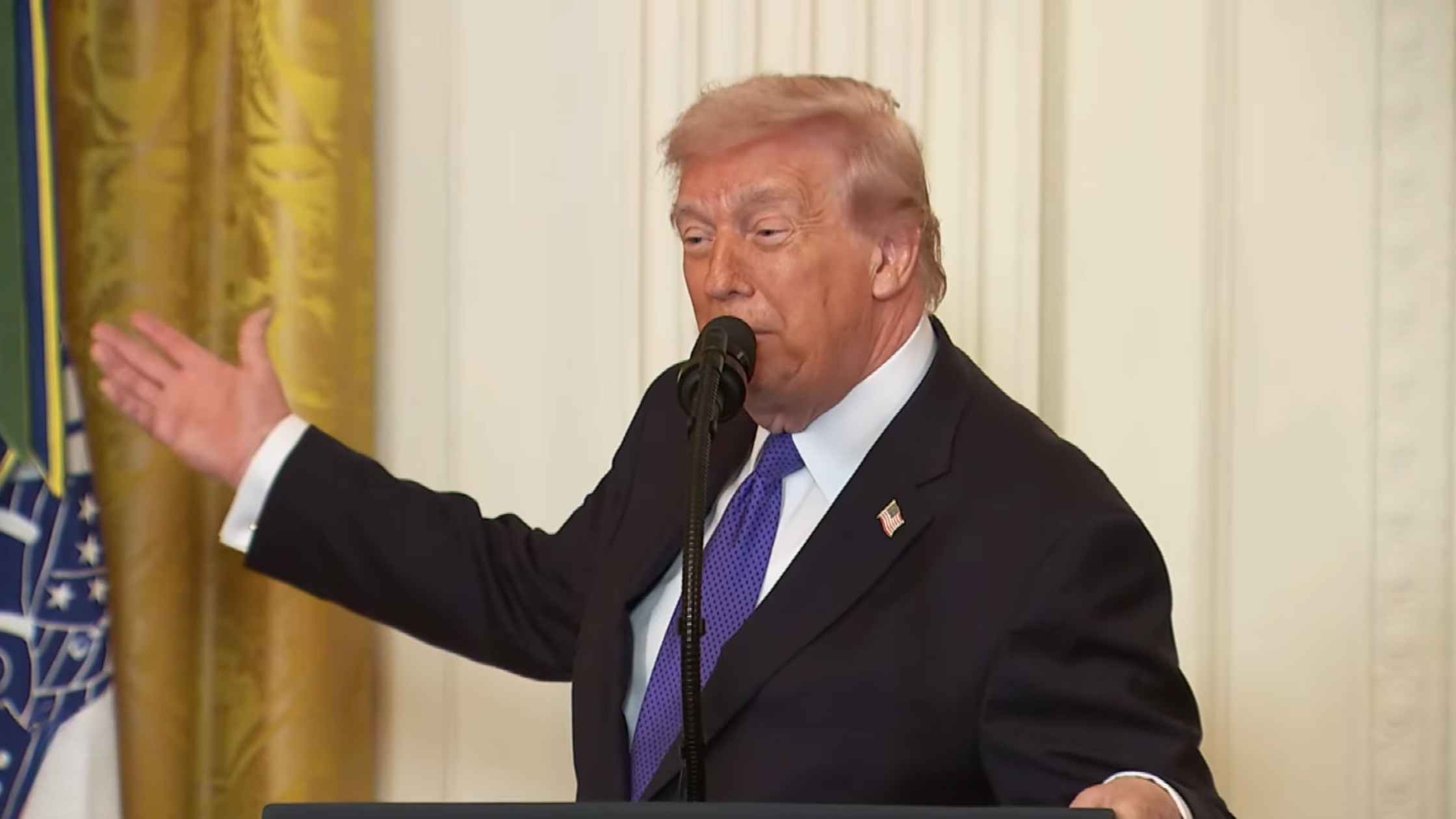
Ladies and gentlemen, the President of the United States, Donald J. Trump.
Chaplain Green (19:40):
Ladies and gentlemen, please bow with me as I ask God's blessings upon this ceremony.
(19:56)
Almighty God, your steady hand has guided this republic for nearly 250 years. From its birth in the wilderness to this very hour, we come to you now with grateful hearts. We assemble here today to honor men who, when the test came, were steadfast and unmovable.
(20:22)
We thank you for the unyielding conviction of Master Sergeant Roderick Edmonds, who looked evil in the eyes and did not flinch. And we thank you for the battlefield grit of Command Sergeant Major Terry Richardson, courage that saved lives in Vietnam and courage that stands before us today. And Lord, we thank you for Staff Sergeant Michael Ollis, who in a final selfless act made his own body a shield for a friend.
(20:59)
Bless the family and friends of these great men of honor, oh Lord. And forbid that we leave this place as mere admirers of their heroic deeds. Plant in our hearts a measure of their courage that we might prove worthy of the freedom for which they and generations before them defended.
(21:23)
Lord, now let the light of liberty continue to shine on our great nation. We pray in the strong name of the one who guides us this will defend. Amen.
AUDIENCE (21:36):
Amen.
President Trump (21:45):
Thank you very much, Chaplain Green. Wonderful job. Appreciate it. And thank everybody for being here and please feel free to sit. So before we begin this important ceremony, and there's no ceremony that can be much more important than this, let me provide a brief update on Operation Epic Fury. Today, the United States military continues to carry out large scale combat operations in Iran to eliminate the grave threats posed to America by this terrible terrorist regime. Following our obliteration of Iran's nuclear program in Operation Midnight Hammer a short while ago, we warned Iran not to make any attempt to rebuild at a different location because they were unable to use the ones that we so powerfully blew up, but they ignored those warnings and refused to cease their pursuit of nuclear weapons. In addition, the regime's conventional ballistic missile program was growing rapidly and dramatically, and this posed a very clear colossal threat to America and our forces stationed overseas.
(23:08)
The regime already had missiles capable of hitting Europe and our bases, both local and overseas, and would soon have had missiles capable of reaching our beautiful America. The purpose of this fast-growing missile program was to shield their nuclear weapon development and make it extraordinarily difficult for anyone to stop them from making these highly forbidden, by us, nuclear weapons. We were the ones that were complaining. We were the ones that wanted it stopped, but everybody was behind us. They just didn't have the courage to say so. An Iranian regime armed with long range missiles and nuclear weapons would be an intolerable threat to the Middle East, but also to the American people. Our country itself would be under threat and it was very nearly under threat.
(24:03)
I was very proud to have knocked out the Iran nuclear deal by President Barack Hussein Obama. That was a horrible, horrible, dangerous document. They would have had nuclear weapons three years ago and they would have used them, but I'll not let that happen.
(24:22)
For almost 47 years, this regime has been attacking the United States and killing Americans. Every time you see someone with missing arms and legs or a face that's been absolutely shattered violently, it was almost certainly caused by an Iran roadside bomb. They were put there by General Soleimani, who was the father of the roadside bomb. Very proudly, he thought, but I terminated him in my first term. This was our last best chance to strike what we're doing right now and eliminate the intolerable threats posed by this sick and sinister regime. And they are indeed sick and sinister.
(25:12)
Our objectives are clear. First, we're destroying Iran's missile capabilities, and you see that happening on an hourly basis and their capacity to produce brand new ones and pretty good ones they make. Second, we're annihilating their Navy. We've knocked out already 10 ships. They're at the bottom of the sea. Third, we're ensuring that the world's number one sponsor of terror can never obtain a nuclear weapon. Never going to have a nuclear weapon. I said that from the beginning. They're never going to have a nuclear weapon. They were on the road to getting one legitimately through a deal that was signed foolishly by our country.
(25:56)
And finally, we're ensuring that the Iranian regime cannot continue to arm, fund, and direct terrorist armies outside of their borders. And we thought we had a deal, but then they backed out and they came back and we thought we had a deal and they backed out. I said, "You can't deal with these people. You got to do it the right way."
(26:17)
Today we grieve for the four heroic American service members who have been killed in action and send our love and support to their families. In their memory, we continue this mission with ferocious unyielding resolve to crush the threat this terrorist regime poses to the American people and a threat indeed it is. We have the strongest and most powerful by far military in the world, and we will easily prevail. We're already substantially ahead of our time projections, but whatever the time is, it's okay.
(26:57)
Whatever it takes, we will always... And we have, right from the beginning, we projected four to five weeks, but we have capability to go far longer than that. We'll do it. Whatever somebody said today, they said, "Oh, well, if the President wants to do it really quickly after that, he'll get bored." I don't get bored. There's nothing boring about this. Do you agree with that, Pete? I don't think there's anything, Mr. General, I think there's nothing boring about it.
(27:26)
Somebody actually said from the media, "I think you'll get bored after about a week or two." No, we don't get bored. I never get bored. If I got bored, I wouldn't be standing here right now, I guarantee you that, to go through what I had to go through. We also projected four weeks to terminate the military leadership. And as you know, that was done in about an hour, so we're ahead of schedule there by a lot.
(27:52)
But please join me in thanking every American service member who bravely is standing in harm's way. They really are incredible. And I just want to thank you. We have a lot of them right here. Thank you very much. Thank you.
(28:17)
Thank you, everybody. We have a lot of great service members here with us too in this beautiful building. Isn't it beautiful? We're adding onto the building a little bit. We're improving the building. See that nice drape? When that comes down right now, you see a very, very deep hole, but in about a year and a half from now, you're going to see a very, very beautiful building. And there's your entrance to it right there. In fact, it looks so nice I think I'll save money on the doors because it can't get more beautiful than that. I picked those drapes in my first term. I always like gold, but I think we can save a lot of money. I just saved curtains.
(28:59)
And it will be, it'll be spectacular. It'd be the most beautiful ballroom. I believe it's because I built many a ballroom. I believe it's going to be the most beautiful ballroom anywhere in the world. And when you hear all that hammering out there, you know why the first lady is not thrilled exactly. She said, "Will the pile drivers ever stop?" They go from six in the morning till 11:30 in the evening. Can you imagine? Here. You know what? To me, that's a beautiful sound. She doesn't like it, I love it. You know what? To me, other than here, because we're donating it, not a penny to the taxpayer. It'll be under budget, ahead of schedule. It'll be 400 million or less. Most people say 400 million or more. No, it'll be less. But when I hear that sound, that beautiful sound behind me, it means money, so I like it, but my wife isn't thrilled. She said, "This is getting crazy." I said, "Don't worry about it. We'll be all finished up in a few months."
(29:57)
But now for the reason that we're gathered this morning to recognize the unsurpassed courage of three really incredible American heroes, one living, and two no longer with us. So together, we recognize the exceptional valor of Master Sergeant Roderick Edmonds. And maybe I could ask your families to stand because they're beautiful families. I got to meet them, and please. So Staff Sergeant Michael Ollis and Command Sergeant Major Terry Richardson, as they receive our nation's highest military award, the Congressional Medal of Honor. And we're pleased to be joined by Secretary of War, Pete Hegsath. He's busy. He's busy, very busy guy. In fact, I said, "If you want, Pete, you can avoid it. General Raizin Caine also." And they said, "We don't avoid this one. This is one you wouldn't avoid for anything, right?" So we appreciate that you're here.
(31:15)
Secretary of Veterans Affairs who's doing an incredible job, Veterans Affairs, Doug Collins, Doug, thank you. You are stand up, Doug. You're doing such a good job. 92% approval rating. Chairman of the Joint Chiefs of Staff, General Dan Caine, who's known as Raizin Caine. I liked him when I heard that name, Raisin Kane. I said, "If it's true, you're my guy." And it's true. It turned out it's very true. He's a great guy and a great General.
(31:48)
Secretary of the Army, Dan Driscoll and Army Chief of Staff Randy George, thank you. Thank you both, Dan. As well as Senators Tom Cotton, Bill Hagerty. You guys were great
President Trump (32:00):
... played on television this weekend. I'll tell you what, you can't have a better representative than both of you. Thank you very much. And Representatives Tim Burchett, Jack Bergman, and Nicole Malliotakis, so we have a few others sitting here, but I'm not going to go through it because we have far more important people to honor today. Oh, we have Tom Homan. I've got to at least mention Tom Homan. I would be a standup, Tom. What a job. Zero, zero people coming in. We had millions and millions of people pouring into our country. Now that... I mean, I'm not even sure I can believe this number is zero. But it is given out by Democrats, Democrats from the last... And they're rated for the last nine months, we had zero people come illegally through our border, right, Tom? So I want to thank you very much.
(32:51)
And I also want to salute six former Medal of Honor recipients, William Swenson, Jim McCloughan, Walter Marm, Thomas Payne, Sammy Davis. That's an interesting guy, Sammy. Where is Sammy Davis? We have a big story here, Sammy. You've heard that all your life, I'll bet, huh? And Edward Byers. Stand up, please. You all look good. You all look good. We remember the ceremonies, all great. It's a great honor. There's no greater... I tried for myself, I've tried numerous times to get one by myself. I keep getting shut down. They say, "You can't do it, sir." Bad protocol. Very bad. I would say the worst. I'm only kidding. I have to say I'm only kidding. Otherwise, the press will come out with... Which they actually did once, "Donald Trump wants the Congressional Medal of Honor, but he's been shut down." Now, you are brave, amazing people, and I want to thank you all.
(34:00)
In 1941, Roddie Edmonds of Knoxville, Tennessee enlisted in the US Army, and soon rose to one of the youngest master sergeants in the military. In 1944, he sailed to Europe to fight in World War II, and he was so enthusiastic and young and full of vim and vigor. Roddie soon found himself on the front lines of the Battle of the Bulls, that was a big one, massively outnumbered by enemy forces. His 1,200 soldier unit fought valiantly until they were completely overrun. The force was massive on the other side, many times the number. After a four-day death march, one that was covered very well by the history books, through bitter cold, they were put into a German POW camp. Roddie was the top ranking infantryman in the camp, he was number one, meaning he was responsible for the lives of his fellow service members.
(35:07)
On July 26th, 1945, a Nazi SS officer issued an order over the camp loudspeaker, loud and strong, he said that only American Jews were to show up to roll call following this morning. He added, "All who disobey this order will be shot immediately. There were more than 200 Jewish American soldiers in the camp, and Roddie knew their separation from the group would mean certain death. So that night, he summoned his team and devised a plan. The next morning, all 1,200 American men fell in line together, shoulder to shoulder. Enraged, the Nazi commandant rushed forward, drew his Luger pistol, and pressed the barrel between Sergeant Edmond's eyes.
(36:03)
He barked at Roddie. "They cannot all be Jews," he screamed loud and again and again. And staring straight back into the raging face of evil, Sergeant Edmonds replied fearlessly, "We are all Jews here." The Nazi officer lowered his weapon and the soldiers erupted in cheers. With total disregard for his own life, Roddie had saved over 200 of his fellow service members. Their camp was liberated two months later. We're honored to be joined today by Roddie's son, Chris. Please stand up as... Thank you, Chris. Today, your father gets the honor he so courageously earned. Really amazing, right? It's an amazing story. Congratulations to the family of Master Sergeant Roddie Edmonds.
(37:12)
The next two we recognize today served in the 1st Battalion, 28th Infantry Regiment of the 1st Infantry Division, better known as Big Red One. Do you know about that, Pete? Command Sergeant Major Terry Richardson, we are honored to have you with us. On September 12th, 1968, 102 brave men of Terry's Alpha Company were asked with securing Hill 222 deep behind the enemy's line in Vietnam. They didn't know it at the time, had no idea, but the area was totally infested with nearly 300 enemy bunkers and many, many enemy soldiers, far outnumbering them by at least four, five, even six-to-one.
(38:06)
As Terry led Lima Platoon up Hill 222, the enemy launched an ambitious and violent attack, unleashing a withering fire of machine guns and rocket-propelled grenades. It just didn't stop. It just kept coming. Pinned down in hell on Earth, Terry summoned unimaginable courage. Three times he exposed himself to enemy fire to rescue severely wounded comrades, and three times he dragged them back to the group. Terry soon realized that the 82 remaining men had one chance of survival, that was air support. Acting without regard of his own life, he grabbed a radio and charged up Hill 222 alone. He needed to be there, it was the only place you'd get reception. He withstood a storm of enemy bullets, eventually reaching the top, where he spent the next eight hours calling in tactical strikes, completely exposed.
(39:09)
An hour in, an enemy sniper shot, rang out, and the bullet tore through his right leg violently. He was in bad shape, but Terry disregarded that and pushed through. And after seven more hours of calling in American fire from above, the enemy retreated. Later that day, his team found him with both eardrums totally ruptured and a mangled right leg and foot, but still barely living, but living nevertheless. Due to Terry's actions above and beyond the call of duty, 82 men in Alpha Company survived this battle, including two in this room, Norm Meyer and Dave Himmer.
(39:56)
Where are you? Do you want to stand up, Norm and Dave? Where's Norm and Dave? Very good. And that story is 100% correct, isn't it? How much have you paid him over the years? Have you said, "Take everything we have, we wouldn't be here"? That's great. That's a great story. Terry, today, you enter the ranks of the bravest warriors ever to stride the face of the Earth. Please, stand up, please. Thank you. That's great, Terry. That's a great, brave man. I met him back there, I said, "He's central casting." Look at him. He looks great. He looks great. You feel like fighting? I think we could take him today. What do you think, Pete? We'll make a little deal with him, as you are a brave man.
(41:34)
Finally, we honor one more American soldier, a fallen warrior of world of wars and really a really terror, Staff Sergeant Michael Ollis. Born in 1988 on Staten Island, Michael grew up seeing the World Trade Center across the bay. I know Staten Island so well. The people in Staten Island are amazing. After 9/ 11, Michael enlisted in the Army, and by 24 years old, he was in, he was locked in, he loved it, he wanted it so badly. He was a squad leader serving in Afghanistan with the 2nd Battalion, 22nd Infantry Regiment, 1st Brigade Combat Team of the legendary 10th Mountain Division.
(42:24)
On August 28th, 2013, terrorists detonated a 400-pound car bomb on the east wall of the forward-operating base, Ghanzi, ripping open a 60-foot wide breach into a compound that housed NATO coalition forces, a lot of them. 10 Taliban fighters wearing suicide vests swarmed through. From across the compound, Michael saw the pillar of white smoke rising and ran to join the fight, rushing without his gear, wearing almost no gear, no Kevlar helmet, no body armor, just one magazine in his rifle. Along the way, he encountered a Polish soldier, and together they advanced under heavy fire, very, very heavy fire. At one point, shrapnel ripped through the Polish soldier's legs, rendering him unable to walk, very, very severely hurt.
(43:25)
In that chaos of gunfire explosions and charred human remains, a terrorist insurgent appeared rounding a corner with his suicide vest, fully armed. And you could see it, it was going to happen, he charged the wounded Polish soldier. Without hesitation, Michael raised his gun and forced himself between the insurgent and the man he just met, shielding him with his own body. He knew it was going to happen. He shielded him with his own body. Bravery's amazing. You never really know who's brave, who's not, until they're really tested. We think some people are brave, Pete, and they're not. We think others aren't and they are. You never know. But he was tested. That's called the ultimate test. And in perhaps his final heartbeat, Michael fired his weapon, and the terrorist detonated his vest simultaneously.
(44:20)
Staff Sergeant Ollis was killed just weeks before his 25th birthday, and nobody was any more brave than that. In his final act on Earth, Michael absorbed the blast, sparing the life of that Polish warrior, who we are grateful to have in the room with us today, 2nd Lieutenant Karol Cierpica. Karol Cierpica, where are you, Karol? Hey. Would you like to come up? Please. Please. I'd love to have you come up. Thank you, Karol. Thank you very much.
Chaplain Green (45:11):
[inaudible 00:45:12]
President Trump (45:13):
Thank you very much.
Chaplain Green (45:14):
Thank you.
President Trump (45:14):
Thank you.
Chaplain Green (45:23):
Mr. President, Ministers of War, my Minister Polish of National of Defense, distinguished West, everyone gathered here today, dear my Basha, Michael and Jacob, especially dear Linda and Robert, and the entire Ollis family. What do you have that you did not receive? This is how I would like to begin these few words to speak to you all here in this special place and on occasion of this incredibly important ceremony, one that is significant for many, but truly, especially exceptional for me.
(46:13)
It's a particular privilege and a greater honor. Above all, however, it is my commitment. It is part of my new mission, which began 13 years ago. A soldier is not something you are from time to time. It is who you are forever. It is just like you are not a mother, a father, a sister and brother only for a moment. These are not roles given to us for a while. They are a great gift, but also a great lifelong commitment.
(46:52)
Yes, today, my commitment and my greatest gift is to cultivate the memory of true heroic act of courage that I witnessed performed by your beloved son, Michael. Please forgive me if my words have not fully captured what I truly feel today. However, sometimes, words are simply not enough. I'm deeply moved, happy, and grateful to God for my service, for my parents, for my family, for my bill of homeland, Poland, for my second family from State Island, and for my second homeland, America. God bless you all. Michael, thank you for your service, and I will see you in our heavenly homeland. Thank you for your service. Thank you so much.
President Trump (48:18):
... and Karol is joined by his wife and their two wonderful sons, Jacob and Michael. Michael is named after the American hero who saved his father's life. Stand up, Michael. All right. That's great. We're also pleased to be joined by several members of the Polish government, including representatives of the president, who, I think, is a fantastic man, by the way. I must be honest with you, I endorsed him and he won. He came from behind. He won and he was the biggest story in Europe. He's going to be a great president, he already is. But as well as Poland's minister of defense to honor the blood and sacrifice that has helped seal the Polish-American bond. We have a great bond and we have a great relationship with your country. And I just want to thank you to Michael's parents, Bob and Linda, your son's selflessness in the face of real evil reminds us of the courage that keeps our country free.
(49:31)
And I just said the genetics in that family are very strong, right? I said that before. All three families, I said, "Good. I see some of the young ones today." I said, "You have good genes." They were asking me, "What does that mean?" I said, "Don't worry about it. You'll figure it out." But you have the best genes you can have actually. Thank you for giving America your beloved son. And now, I would like to ask the military aide to come forward and read the citations, and then, we will do the honors. Thank you all very much. This is a tremendous honor for me to be here. Thank you, please, military aide.
Military Aide (50:17):
Chris Edmonds, accepting on behalf of his father, Master Sergeant Roderick W. Edmonds. The President of the United States of America, authorized by Act of Congress, March 3, 1863, has posthumously awarded in the name of Congress the Medal of Honor to Master Sergeant Roderick W. Edmonds, United States Army. Master Sergeant Roderick W. Edmonds distinguished himself by acts of gallantry above and beyond the call of duty from January 27, 1945 to March 30, 1945, as a prisoner of war in Germany. Upon arrival at Stalag 9A in Ziegenhain, Germany on the evening of January 26, 1945, the Germans announced that only Jewish-American prisoners would fall out for roll call the following morning at the threat of execution. Master Sergeant Edmonds directed his senior leaders to have all 1,200 American prisoners present themselves for roll call. The Nazi commandant became incredulous after realizing that so many Americans were standing in formation.
(51:28)
The commandant removed his pistol, pressed it hard against Master Sergeant Edmonds' forehead between his eyes and demanded that he order all Jewish-American prisoners to step forward or he would be shot. Master Sergeant Edmonds fearlessly held his ground refusing to concede. The commandant lowered his weapon without further attempts to segregate the Jewish-American prisoners. Several weeks later in March 1945, the Germans ordered all prisoners to assemble outside the barracks for evacuation. Master Sergeant Edmonds ordered all American prisoners to form in front of the barracks, and when the enemy transports arrived, they would break ranks and rush back to the barracks. Master Sergeant Edmonds gallantly led these prisoners in a relentless pursuit of opposition and resistance, forcing the Germans to abandon the camp, leaving the 1,200 American prisoners behind. Master Sergeant Edmonds' conspicuous gallantry above and beyond the call of duty are in keeping with the highest traditions of military service and reflect great credit upon himself, his unit in the United States Army. Command Sergeant Major Terry P. Richardson. The President of the United States of America, authorized by Act of Congress March 3, 1863, has awarded in the name of Congress the Medal of Honor to Staff Sergeant Terry P. Richardson, United States Army. Staff Sergeant Terry P. Richardson distinguished himself by acts of gallantry above and beyond the call of duty on September 14, 1968 in the vicinity of Loc Ninh, Republic of Vietnam. On this date, his company was tasked with the mission of securing Hill 222 in hostile and enemy territory near the Cambodian border. Staff Sergeant Richardson directed one of his squads to be the point element leading the way. Shortly after the assault began, three of the squad members became severely wounded and pinned down between three enemy machine gun bunkers. Staff Sergeant Richardson advanced forward under a heavy enemy fire and recovered his wounded soldiers between heavy machine gunfire.
(54:17)
By the time he was able to make it back to join his unit, his entire company had been completely surrounded by the enemy. Staff Sergeant Richardson recognized that the only way to keep his company from being overrun was with accurate tactical air strikes. Staff Sergeant Richardson advanced to the top of Hill 222 under heavy enemy fire for better sight lines to direct the tactical air strikes. He began to direct the tactical airstrikes and shortly thereafter became wounded by an enemy sniper. Staff Sergeant Richardson's continued directing the tactical airstrikes for seven more hours before the enemy broke contact. Six soldiers from his platoon found him still alive. Staff Sergeant Richardson declined medical evaluation for his gunshot wound and requested that he be allowed to stay to lead his soldiers. Altogether, his actions directly resulted in 85 lives being spared on that fateful day. Staff Sergeant Richardson's conspicuous gallantry and extraordinary heroism at the risk of his life above and beyond the call of duty are in keeping with the highest traditions of military service and reflect great credit upon himself, his unit in the United States Army.
(55:23)
Robert and Linda Ollis accepting on behalf of their son, Staff Sergeant Michael H. Ollis. The President of the United States of America, authorized by Act of Congress March 3, 1863, has posthumously awarded the name of Congress the Medal of Honor to Staff Sergeant Michael H. Ollis, United States Army. Staff Sergeant Michael H. Ollis distinguished himself by acts of gallantry above and beyond the call of duty on 28 August 2013 in Afghanistan. On this date, a complex enemy attack involving multiple vehicle-borne improvised explosive devices, suicide vests, indirect fire, and small-arms fire was launched against Forward Operating Base Ghazni. Staff Sergeant Ollis ordered his fellow soldiers to move to bunkers to shield themselves from enemy fire. After accounting for his soldiers, he moved toward the enemy force that had penetrated the perimeter of the forward operating base. Staff Sergeant Ollis located a coalition forces officer, and together they moved toward the point of attack, armed with only their rifles.
(57:40)
Upon reaching the attack point, they linked up with other friendly forces and began a coordinated effort to repulse the enemy. While under continuous fire, Staff Sergeant Ollis moved from position to position, engaging the enemy with accurate and effective fire. While fighting along the perimeter, an insurgent came around the corner. Staff Sergeant Ollis fired on the insurgent and incapacitated him, but as he approached the downed insurgent, the insurgent suicide vest detonated and mortally wounded him. Staff Sergeant Ollis' exceptional courage and complete disregard for personal safety were in keeping with the highest traditions of military service and reflect great credit upon him, his unit in the United States Army.
Chaplain Green (58:28):
Ladies and gentlemen, please bow with me as we give the benediction. Eternal God, our unfailing light in every darkness, the rock on which we stand. As we depart this place of honor, may the courage of these heroes be our example. Righteousness our choice, and hope in you our guiding light. We, especially, ask for your protection over our military service members who are protecting the interests of our nation at this very moment. And Heavenly Father, grant us the will to do justly, to love mercy, and to walk humbly before you. In your holy name, we pray, this will defend. Amen.