
Speaker 1 (00:06):
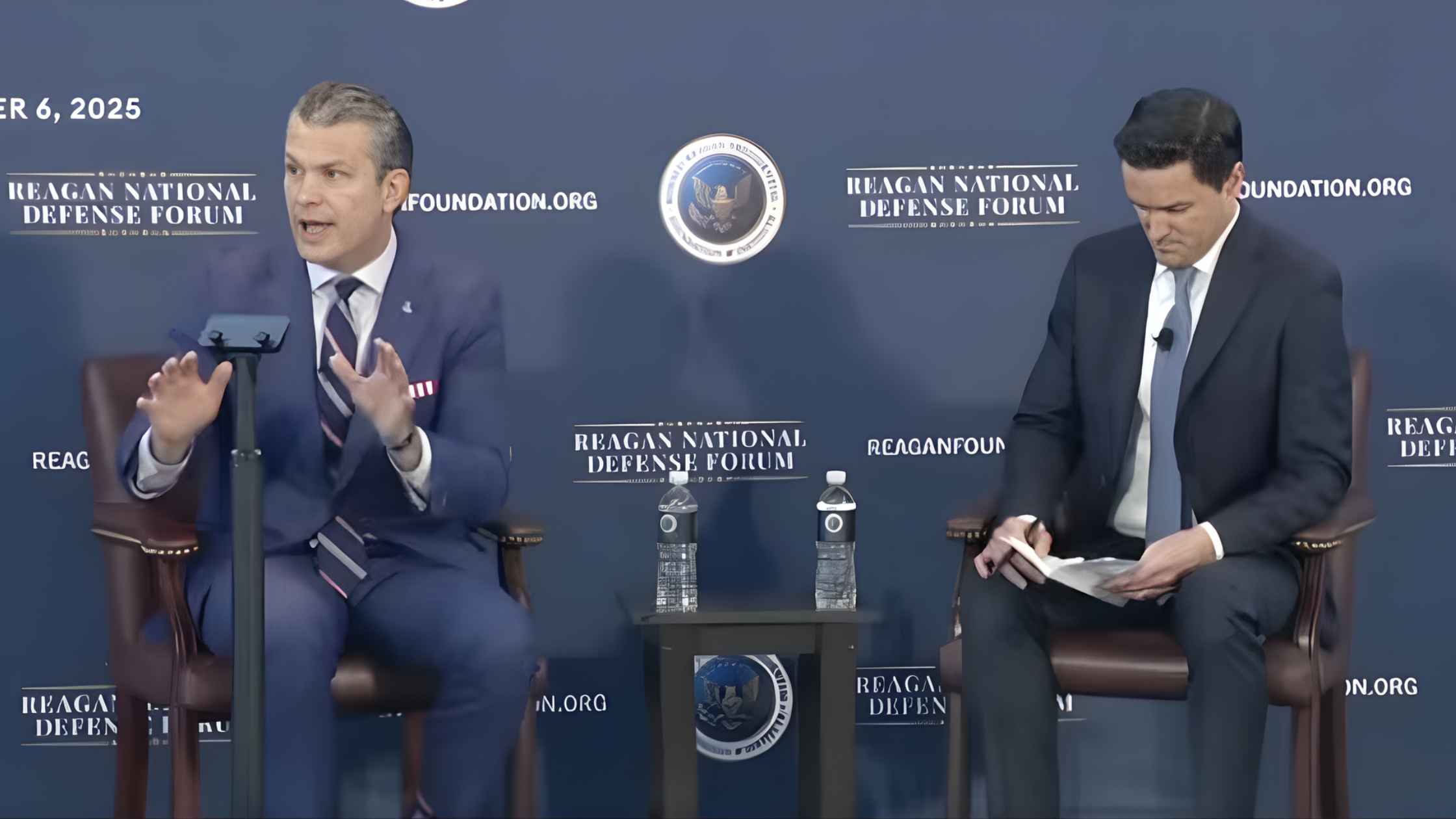
Please welcome to the stage Mr. Lucas Tomlinson of Fox News.
Lucas Tomlinson (00:19):
Thank you for your remarks, Mr. Secretary, and for joining us here at the Reagan National Defense Forum. You're reminded not only your remarks, but all morning about the Reagan doctrine, that's peace through strength. Let's remind everybody here what fueled that strength, and that was defense spending that was roughly two times more than what the U.S. is spending today. My question to you, Mr. Secretary, should the U.S. be spending more? There are many people in this audience responsible for building, operating, and funding combat systems.
Pete Hegseth (00:55):
Well, the president has said and continues to say he's committed to rebuilding the military and that requires spending and substantial spending. People have asked me what keeps me up and other than the operational aspects of the job, the men and women out there doing the workforce, which of course is top of mind always, it's actually been the budget, it's actually been resources. It's actually been ensuring that our team does all the spade work necessary with the services to make sure we're properly representing what we need to deter and fight and win our nation's wars. That's just this week, and I was with some of you, was there in the oval having these very discussions about FY26 and FY27. And all I can say today is the president is committed to ensuring that our services, our great companies, our industries have what is needed to what we say and we call rebuilding the arsenal of freedom.
(01:47)
We need a revived defense industrial base. We need those capabilities. We need them yesterday. And so resource-wise, I think this room will be encouraged by what we'll see soon, but I don't want to get too ahead of it.
Lucas Tomlinson (02:00):
Is at the high mark of President Reagan, we were spending 6% of our GDP on defense. At the low mark of Jimmy Carter's presidency, we're spending 4.5% of GDP and today it's about 3%. Do you think that number will go up?
Pete Hegseth (02:16):
I think that number is going up. I don't want to get in front of the president and his desire to properly shape what the budget should look like. But just reading the tea leaves, just watching it, he understands the threat better than anybody I've ever seen articulate and understand the threat and that includes investment. He just needs to make sure… By the way, if you haven't met our deputy secretary, Steve Feinberg, he's the absolute best in the business. He understands how to drive budgets, how to drive change. And he and I, along with the chairman, Dan Caine in the front here, are absolutely shoulder to shoulder in the belief of representing the president exactly what we need to make sure we're at the proper level. And I believe it'll be going up.
Lucas Tomlinson (03:01):
Can you take us back to the September 2nd strike off the coast of Venezuela? The very first one when combat operations began in the Caribbean. And walk us through the timeline and your role in it from mission planning, the operation and the follow-on strikes?
Pete Hegseth (03:19):
Absolutely. So it took us a couple of weeks, almost a month to develop, and I can't get into sources and methods and all of those things for obvious reasons, but you have to develop the intel picture and get an understanding of what you're looking at. And a lot of our assets, as I talked about in the speech, you've been pointing 10,000 miles around at the other side of the world for a very long time. So once we got to the point where a strike was eminent, I had taken the decision, responsibility up to my level. Not many military decisions should be made by the secretary of war. I believe in deferring those decisions to local commanders as much as possible, but because of the strategic implications of the first few strikes, I wanted to hold that decision at my level. And the briefing that I received before that strike was extensive, exhaustive, I would say, as each one is since.
(04:07)
On the military side, on the civilian side, lawyers, intel analysts, red teaming, every aspect, what do we know? What do we know about their affiliation? A lot of things I can't share in this room to give us the kind of confidence that we know where this is coming from, who's driving it, who's on it, what their intentions are, all the details you need to strike a designated terrorist organization, which is an important thing to remember at the top of all this. The president has designated these as terror organizations, poisoning and threatening American people, making them a target just like Al-Qaeda. So in that room in that moment, I can't even remember exactly how long it would have been, 20, 30 minutes of a preview of exactly what's going on. And my job was to say, "Execute or don't execute." So I was satisfied with the strike criteria, yes, saw the strike itself, which all of you have seen.
(04:58)
There was probably 30 or 40 minutes is what I've been told of dust and it was on fire for a long time after that. I stayed for probably five minutes or so after, but ultimately at that point it was a tactical operation. And so I moved on to other things. I shouldn't be fighting tactics as the secretary of war, so I moved on to other things. Later on, a couple of hours later, I was told, "Hey, there had to be a re-attack because there were a couple folks that could still be in the fight, access to radios. There was a link-up point of another potential boat. Drugs were still there. They were actively interacting with them. Had to take that…" I said, "Roger, sounds good." From what I understood then and what I understand now, I fully support that strike.
(05:41)
I would have made the same call myself. Those that were involved in 20 years of conflict, Iraq and Afghanistan or elsewhere know that reattacks and re-strikes of combatants on the battlefield happen often. In this particular case, it was well within the authorities of Admiral Bradley, who's an incredible American and American hero. And the 22 or 23 strike since have followed the similar protocol of ensuring we meet the criteria. The decision's not at my level anymore. And then we take the strike.
Lucas Tomlinson (06:11):
After Admiral Bradley's meetings on Capitol Hill with the chairman of the Joint Chiefs, President Trump said he would have no problem if the full video of the strike is released. When can we see that video? When will you release it?
Pete Hegseth (06:24):
We're reviewing it right now to make sure sources, methods. I mean, it's an ongoing operation, TTPs. We've got operators out there doing this right now. So whatever we were to decide to release, we'd have to be very responsible about it. We're reviewing that right now.
Lucas Tomlinson (06:36):
Did you at any time say that everybody on board should be killed?
Pete Hegseth (06:42):
Is anybody here from the Washington Post? I don't know where you get your sources, but they suck. Of course not. Anybody that's been in the situation room or they've been in the war room there, secretary's office, no, we don't walk in and say, "Kill them." It's just patently ridiculous. It's meant to create a cartoon of me and the decisions that we make and how we make them. It's ridiculous. The chairman and Admiral Bradley and everybody shot it down immediately because anybody that knows, knows that's not how things go. There's a very defined process. Specific criteria, go/no-go, yes, no, lawyers, intel analysts, everything. And then after that, you simply say, "Cleared hot or not."
Lucas Tomlinson (07:22):
And did you have a plan to deal with survivors?
Pete Hegseth (07:25):
There was protocol for dealing with survivors, but in that… And frankly, there was a, I don't know, 10 strikes later, there was a semi-submersible that I think folks here, meaning a submarine. You don't go fishing on a submarine, full of drugs. And in that particular case, the first strike didn't take it out. A couple of guys jumped off and swam, from what I understand, a ways away. When we struck the submarine a second time, it sunk. And then you had two people that you had to go get. And we had the ability to go get them. We gave them back to their host countries. That's a story that's already been out in the public.
(07:57)
So we didn't change our protocol. It was just a different circumstance. So what people think is cavalier or cowboy about it is the exact opposite. These are the most professional Americans going through specific processes about what they can and cannot do. Understanding all the authorities, all the laws of war, all the capabilities and applying it to deter our adversaries. And by the way, there aren't many people getting in boats right now running drugs, which is the whole point. We want to stop the poisoning of the American people. The catch and release program or the pat them on the head and release them so they can go back to the fight, didn't work in Iraq and Afghanistan and it's not going to work in the Caribbean. So we're putting them at the bottom of the Caribbean, which forces them to change the way they operate and hopefully makes the American people safer in the problem. Not hopefully. It will make the American people safer in the process.
Lucas Tomlinson (08:43):
So, Mr. Secretary, you will be releasing that full video.
Pete Hegseth (08:46):
We are reviewing it right now.
Lucas Tomlinson (08:48):
Is that a yes or no?
Pete Hegseth (08:51):
The most important thing to me are the ongoing operations in the Caribbean with our folks that use bespoke capabilities, techniques, procedures in the process. I'm way more interested in protecting that than anything else. So we're viewing the process and we'll see.
Lucas Tomlinson (09:07):
Let's move over to China who now has the world's largest navy. For every eight warships they're building each year, United States is only building 1.8. They're building and modernizing their nuclear forces, building a nuclear triad. They're helping Russia build artillery, 300,000 rounds a month. The U.S. can only muster 40,000 rounds manufacturer a month. How concerned are you about these numbers? Chinese shipbuilding is 230% greater than the United States' capability. How worried are you about that?
Pete Hegseth (09:44):
We're obviously well aware of their historic military buildup. It's right in front of us, which the most important thing we can do is look inward and increase our urgency of ensuring we rebuild our defense industrial base and the national freedom. I mean, that's why we're crisscrossing the country. That's why we did an entire acquisitions requirements of foreign military sales overhaul, not a reform, not a tinkering. Ask the folks that understand it, our folks that are doing it. This is a complete game change in how we deliver systems to the battlefield. We have to, we don't have time. Ultimately, we need to be able to field the best as quickly as possible. So we see it, we're aware, but we're also prudent in how we approach it, which is the way the president has approached it and we'll do the same.
Lucas Tomlinson (10:27):
Speaking of time, we're running short, but I know the IG report cleared you with Signal. If you had to do it again, would you have used it before combat operations?
Pete Hegseth (10:38):
I don't live with any regrets. It's not a healthy way to live. And I know exactly where my compass is on these troops, which is why you've seen, and same with the president. The revival of the spirit inside our military. I've encouraged some reporters here to spend some time with actual formations of units, Marine, soldiers out there, combat arms folks. The revival of the spirit, the desire to join and to reenlist is at historic levels because they believe in the core of what the president's trying to do. They know he has their back. They know I have their back. Silly news stories pedaled for months and months and months and months and months because you got to fill, I know something about filling cable news segments. You got to do it. It's not something I worry about or they worry about.
Lucas Tomlinson (11:24):
When you were a young platoon leader in Iraq, would you have wanted any of your soldiers communicating your mission for [inaudible 00:11:32]
Pete Hegseth (11:32):
Lucas, I had used an AT&T payphone to call home for a buck 99 a minute. Some contractor was ripping us off. So I would have liked anyway to actually communicate back home.
Lucas Tomlinson (11:43):
AI, a quick question on AI. Would you rather to see your soldiers, Marines on the front lines armed with more AI capability or have them replaced with autonomous systems?
Pete Hegseth (11:56):
I think it's going to be both. I mean, you watch the modern battlefield. It has to be both. A couple companies we visited yesterday and others I've seen, and what AI is doing to 10, 100, 1,000 X, the speed of sensing. Everything we do on the modern battlefield is critical. But autonomy is, we see it in Ukraine, we see it outward, we're learning from that, the army's learning from that is a huge part of the way of the future, so it's definitely going to be both.
Lucas Tomlinson (12:24):
Well, this number is flashing zero. One last question, a small one. Who's going to win next week?
Pete Hegseth (12:29):
Knows how to get another one in.
Lucas Tomlinson (12:30):
Army or navy, who are you going to be rooting for?
Speaker 4 (12:32):
Go navy.
Pete Hegseth (12:32):
You know.
Lucas Tomlinson (12:38):
Heard that.
Pete Hegseth (12:39):
He's a Naval Academy grad, I know that. I'm not supposed to answer that question. If I was a good politician, I wouldn't answer that question. But I will say that the Marine Corps of all the services is the service that never wavered. When there was a lot of political prerogatives, a lot of nonsense in the space, the Marine Corps stood strong. So for this one, maybe not next one, for this one, I'm with navy. How about that?
Lucas Tomlinson (13:02):
Thanks a lot. Thank you.
Pete Hegseth (13:02):
Thank you. Oh, I got to go that way.
Lucas Tomlinson (13:02):
Okay.
Pete Hegseth (13:02):
Appreciate you, brother.
Lucas Tomlinson (13:02):
Good luck.
Pete Hegseth (13:02):
Thank you. You good?