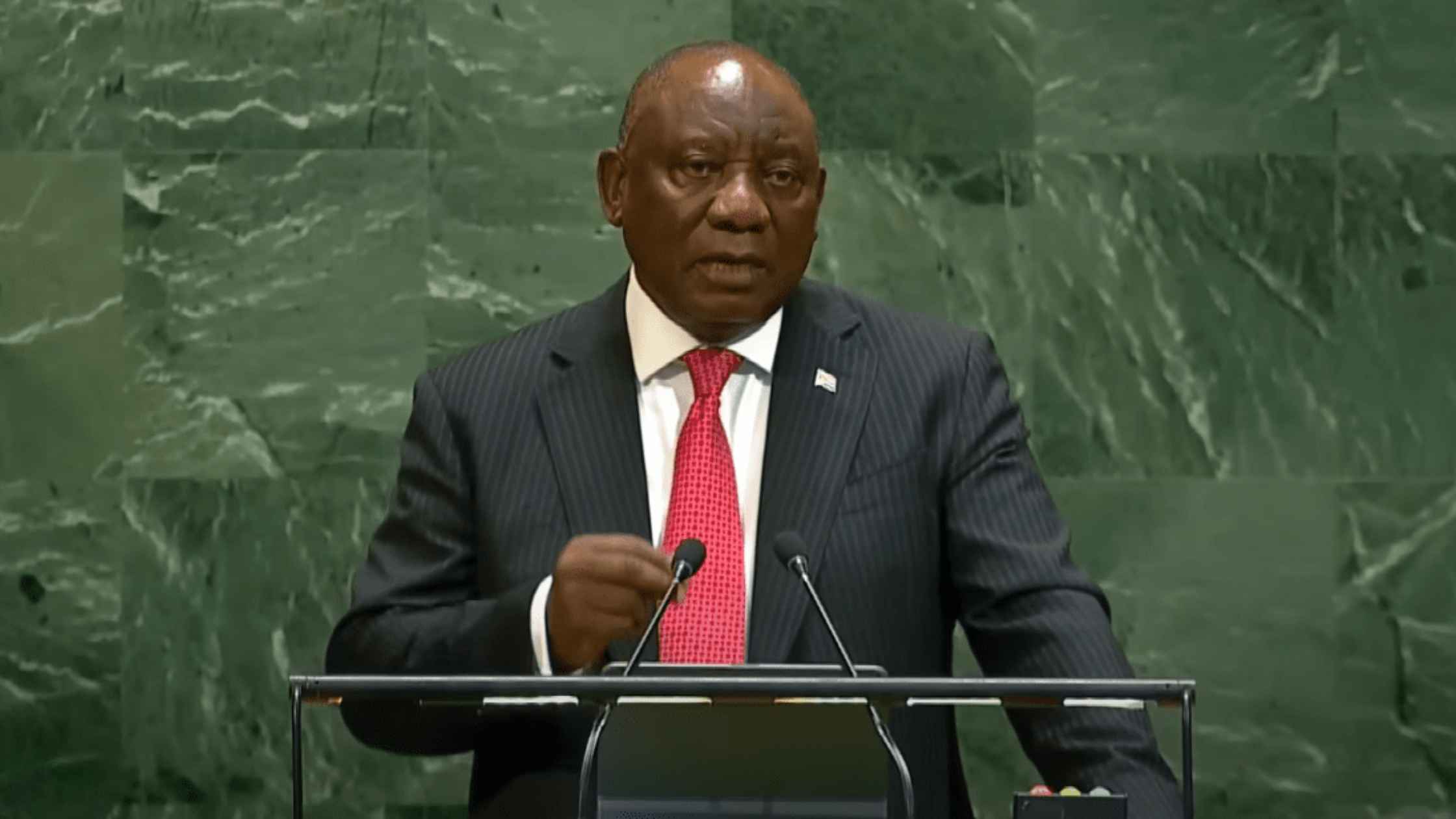
President Ramaphosa (00:00):
Thank you, president of the 80th session of the UN General Assembly, United Nations Secretary-General, excellencies, heads of state and government, and ladies and gentlemen. Eight years ago, the United Nations was established to save succeeding generations of humanity from the scourge of war, and to build a peaceful, prosperous, and just world arising from the devastation brought about by global conflict. Through the UN Charter, the nations of the world pledged to uphold peace, development, and human rights, which would be underpinned by international law. Now, more than ever, we are called upon to uphold the values and advance the purpose of the United Nations. We are also called upon to advance cooperation and solidarity between nations. We are called upon to promote multilateralism and safeguard the institutions that enable it. South Africa's engagement in the international sphere echoes our domestic imperatives of eradicating poverty, reducing unemployment, and addressing the root causes of inequality. Our foreign policy is guided not only by the needs of our people, but also those of the continent of Africa and the Global South.
(01:57)
Inspired by our own history, South Africa strives to maintain world peace, and also the settlement of all international disputes, through negotiation and dialogue, and not through war. We therefore welcome the strong partnership between the African Union and the United Nations, in promoting peace, security, and stability on the African continent. This year, South Africa is honored to preside over the G20. This is the first time that the G20 Leader Summit will be held on the African continent, the cradle of humanity. South Africa's G20 presidency is guided by the theme equality, solidarity, and sustainability. To give full meaning to our theme of equality, solidarity, and sustainability, we have invited the G20 countries to join us in prioritizing the following areas. Firstly, in discussion to strengthen disaster resilience and response by addressing the increasing frequency and impact of climate-induced natural disasters.
(03:38)
Secondly, to ensure that we have debt sustainability for low-income countries by crafting innovative ways to support countries to have low levels of debt to maintain economic stability. Thirdly, to discuss how to mobilize finance for a just energy transition by encouraging investments in renewable energy and sustainable technologies, without foregoing what we would call baseload energy sources. Fourthly, by harnessing critical minerals for inclusive growth and sustainable development through the value-addition processes that is beneficiation of these minerals at the source where the minerals are extracted to foster the development of communities where these minerals are found. These priorities reflect South Africa's commitment to addressing global challenges and promoting inclusive growth and sustainable development.
(05:09)
Our country's G20 presidency is a significant opportunity for South Africa to advocate for Africa's development agenda, and to amplify African voices in global economic governance for a continent that is irreversibly on the rise. As member states of the United Nations, we have all adopted the sustainable development goals. However, many of these goals remain elusive. There are many reasons that hold many countries back from fulfilling and implementing these development goals. Some of these reasons, a lack of sufficient financial resources that can finance the advance that these countries need to make to fulfill those goals. Many countries with developing economies, especially in Africa and the Global South, do not have adequate capital to finance their development goals. They are indebted, and are paying much more on debt servicing than they do on health and education. In fact, these countries pay much more than countries in the north for their debt. Yet, through global solidarity, by having fairer lending rules, especially for several of Global South countries, we can achieve our shared commitment.
(06:57)
Through the G20 process, we are working towards building consensus on how this problem can be tackled, including the reform of international financial institutions, particularly multilateral development banks, to better tackle global challenges that many countries face. The multilateral trading system needs to be reformed, as we reconfirm that the World Trade Organization remains the only multilateral body that is capable of managing differences and coordinating positions in global trade. Trade is one of the most important instruments to mobilize domestic resources for development. It is concerning that geopolitical shocks and unprecedented trade policy volatility are destabilizing the global economy and jeopardizing a critical source of development finance. In fact, trade is now being used as a weapon against a number of countries in the world. We must redouble our efforts to strengthen the link between trade and development. Unilateral trade practices and economic cohesion have a detrimental impact on many nations, this includes the economic embargo against Cuba, which has caused untold damage to the country's economy over the years. This unfair embargo must be lifted, and we want it lifted sooner rather than later.
(09:03)
In the midst of global trade uncertainty, the African continent is providing a pragmatic example of constructive collaboration and cooperation, by using the African Continental Free Trade Area as an engine for sustainable growth and development. This will, with commitment, become the central pillar of economic cooperation and integration for our continent. As part of the effort to build more inclusive economies, South Africa's G20 presidency has launched an extraordinary committee of independent experts on global wealth inequality. This committee, chaired by Professor Joseph Stiglitz, a Nobel laureate, will deliver the first-ever report on global inequality to G20 leaders when they meet in November, in Johannesburg, in South Africa. Climate change is an existential threat. We are failing future generations by our inability to reduce global warming. Climate change is reversing economic growth and development gains in many countries, especially in the Global South.
(10:38)
Although Africa carries the least responsibility for climate change, many countries on the continent of Africa experience much of its harshest effects. Extreme weather events, like floods and droughts, are driving food insecurity, displacing populations, causing damage to infrastructure, and leading to the unnecessary loss of livelihoods. Member states must honor their undertakings and commitments, in line with the guiding principle of common, but differentiated responsibilities and respective capabilities. The Secretary General recently reported that global military expenditure has reached historic highs, just as the world is falling behind on its core development promises. We are building weapons when we should be building social infrastructure that advance the lives of our people. We are fighting wars that cause death and destruction, when we should be fighting poverty and developing the livelihoods of vulnerable people. We must act decisively to silence all the guns everywhere, to realize the goal of sustainable development and global peace. And I do believe that this is an objective that is possible to reach. As we commemorate the 80th anniversary of the UN, the relevance of this institution, and various multilateral processes for the maintenance of international peace and security, is being willfully undermined.
(12:46)
There is an increasing reliance on unilateral military action in contravention of international law. The United Nations Security Council has proven to be ineffective in its current form and composition, in carrying out its charter mandate to maintain international peace and security. South Africa remains deeply concerned by the erosion of the credibility of the Security Council, and its failures to ensure accountability and uphold international law. As the security and humanitarian situations in the Democratic Republic of the Congo, Sudan, Gaza, and elsewhere, deteriorate, it is a matter of great concern that there are countries that continue to violate international law, and also defy the United Nations resolutions and rulings also from bodies like the International Court of Justice. The establishment of the Hague Group and the Madrid Group aim to reaffirm the primacy of international law, promoting accountability, and ensuring support for a just peace. We cannot, and should not, accept that members of this organization continue willfully to violate, without consequence, the charter that we have all agreed to uphold.
(14:30)
Therefore, as nations that have pledged to uphold the UN Charter, we have the ultimate responsibility to ensure and protect the rights of the Palestinian people to self-determination. Consistent with the case that South Africa brought before the International Court of Justice, there is growing global consensus. There is growing global consensus that Israel is committing genocide in Gaza. Just last week, the United Nations Independent International Commission of Inquiry found that Israel is responsible for the commission of genocide in Gaza. As Palestinians continue to face genocide and famine, we have a duty to act. South Africa has acted in the interest of saving lives, by insisting that the International Court of Justice should make a ruling, that indeed, genocide is being committed in Gaza and that it should stop. And we stand here to say it must stop.
(16:03)
We welcome the historic high-level meeting held yesterday on the two-state solution, yesterday, in this very chamber. This reflects the determination of the global majority, a global majority that now stands at 142 and more countries, that Palestinians deserve a peaceful state alongside a peaceful Israel. Many nations in the world are calling for that, and that is the voice that we believe that Israel should heed, and those powerful nations that can make a two-state solution viable and possible, and implementable, should act in that regard. The long-overdue announcement by increasing number of countries to recognize the State of Palestine is testament to this determination. We have a responsibility, as the member states of the United Nations, to reaffirm the right also of self-determination of the people of Western Sahara.
(17:30)
The very first resolution of the United Nations General Assembly, in January of 1946, called for the elimination of atomic weapons. The resolution was passed shortly after the catastrophic use of atomic bombs on Hiroshima and Nagasaki that killed thousands of people. Decades later, we have not made significant progress in the fulfillment of the commitment to nuclear disarmament. In 2026, next year, South Africa will be presiding over the first review conference of the Treaty on the Prohibition of Nuclear Weapons. This treaty reaffirms that there is no greater assurance of nonproliferation than the complete prohibition of nuclear weapons. I was glad to hear that a number of leaders stood here to speak against nuclear weapons and the use thereof. This year, we celebrate the 30th anniversary of the Beijing Declaration and Platform for Action as a roadmap for the achievement of gender equality, the empowerment of the women and girls of the world. South Africa reaffirms its unwavering commitment to the empowerment of women, and their full, equal, and meaningful participation in all spheres of life. Yes, we would support also the election of a female Secretary General of the United Nations.
(19:32)
The Beijing Conference Milestone reminds us of our shared responsibility to advance human rights, dignity, and justice for all. We are all equal, men and women, and there is no reason that we continue to hold the women of the world backwards. The right to development must be central to the policies and operational activities of the United Nations, and its specialized agencies, programs, as well as funds. It must be at the core of the policies and strategies of the international financial and multilateral trading systems. As we celebrate 80 years of the United Nations, we must seize the opportunity to build a better United Nations for the next 80 years. What is needed now is a stronger and more capable United Nations, a United Nations that is based on the renewed commitment to its founding principles. We must invigorate the negotiations on the Security Council reform of the intergovernmental negotiations in the General Assembly, including by initiating text-based negotiations.
(21:04)
The Security Council must be accountable. It must also be representative. It must be democratic and effective in executing its mandate. We can no longer accept that a large portion of the world's population is not represented in the United Nations Security Council. My own continent, Africa, home to 1.4 billion people, as well as South America, are not represented in the United Nations Security Council. This is unjust. This is unacceptable, and it must end. We want representation in the Security Council. We look forward to working with the Secretary General on the UN80 Initiative, to ensure that our organization works more effectively and efficiently. Mandates given by member states must be implemented, and the necessary structural changes and program realignment must be implemented across the UN system. In the face of the decrease in funding to the United Nations to fulfill its mandate, the UN80 Initiative is important to maintain the integrity of the multilateral system and to uphold international law.
(22:43)
Lastly, I'm reminded that our collective membership of the United Nations is our shared humanity in action. The United Nations at 80, compels us to reflect on our collective achievements, and to chart a way forward, building an organization that is able to address our common challenges. We must rise to the occasion, and do our utmost together to ensure the political, economic, and social freedom of all humanity. We must reaffirm that freedom is indivisible, and that the denial of the rights of one person diminishes the freedom of all of us. We must reaffirm the equal dignity and worth of every person, and must therefore leave no one behind, and no country behind. I thank you.