


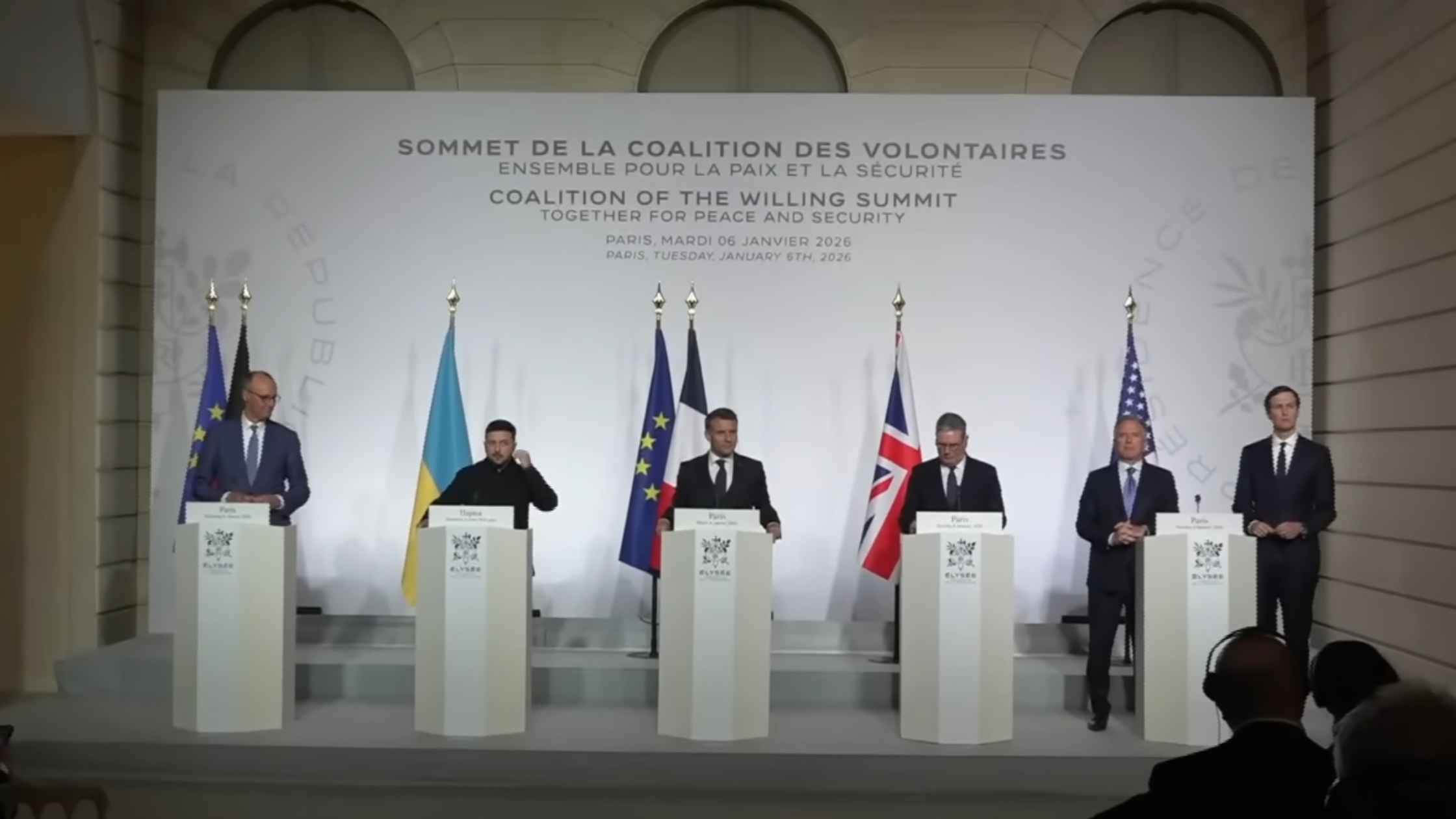
Speaker 1 (01:19):
Declaration of intent between the French Republic, the United Kingdom of Great Britain and Northern Ireland, and Ukraine relating to the deployment of multinational forces in support of the defense reconstruction and strategic sustainability of Ukraine. Signatory for the United Kingdom of Great Britain and Northern Ireland, Sir Keir Starmer, Prime Minister of the United Kingdom of Great Britain and Northern Ireland. Signatory for the French Republic, Mr. Emmanuel Macron, President of the French Republic. Signatory for Ukraine, Mr. Volodymyr Zelenskyy, President of Ukraine.
Emmanuel Macron (03:13):
So, President, dear Volodymyr, Chancellor, dear Friedrich, Prime Minister, dear Keir, Special Envoys, dear Steve and Jared, thank you for being here with us today. Ministers, ladies and gentlemen, protocol is observed.
(03:22)
Today we have just had here in Paris a new meeting of the heads of state and government of 35 countries that make up the coalition of the willing, with President Zelenskyy and in the presence of an American delegation under Mr. Witkoff and Mr. Kushner.
(03:55)
This is the 15th meeting of the coalition of the willing that we've had since the 17th February last year. We have with us the 28 heads of state and government, the Secretary General of NATO, and the President of The European Commission, and the president of The European Council.
(04:18)
But today we've made considerable progress, as reflected in The Paris Declaration providing strong guarantees for lasting peace. This declaration of the coalition of the willing for the first time recognizes operational convergence between the 35 countries making up the coalition of the willing, Ukraine and the United States of America. We're talking about strong security guarantees. This declaration sets out each of the components of the security guarantee. We report from our heads of general staff and also from the side of the American coordination, and here we have taken due note of the fact that there is a coordination body that will fully coordinate all of the competent armed forces and provide coordination between the coalition of the willing, United States of America and Ukraine in operational terms that will support the general staff of the coalition here in Paris.
(05:31)
Within this coalition on the basis of all the work done in recent months we have consolidated our approaches, firstly with setting up ceasefire monitoring mechanisms to be placed under American leadership, with contributions from several states that said they were willing and able to do so. Then longterm support, firstly to Ukrainian armed forces that are and will remain in the front line of defense and deterrence against aggression. So we will have on a volunteer basis 800,000 men with training capabilities and all the necessary resources to ensure that this army can deter any new aggression.
(06:22)
Then we will continue to lay the ground for the creation of a multinational force in the air, on the seas, and on land to provide reassurance after the ceasefire and a long way behind the contact line that was agreed between all the general staff from in France to Germany and Poland. I would also like to salute the work done and offered by Turkey. In maritime [inaudible 00:06:53], they are willing to take on responsibilities.
(06:55)
And fourthly, we have decided to translate into legal terms, these commitments to support Ukraine in the event of a new attack by Russia through solidarity and intervention mechanisms. And also we are continuing to converse around the questions of economic support [inaudible 00:07:15], that's the second thing we talked about. But at the same time, we have consolidated the architecture, the planning, the means and the rules for the security guarantee for Ukraine the day after peace is signed, both for Ukraine and the [inaudible 00:07:33] of Europe.
(07:33)
Part of our discussion was then focusing on Ukraine's future prosperity, with the American plan that was presented and the European contributions with the desire to speed up our work alongside Ukraine so that in the next few weeks, this prosperity plan can be finalized, will be a major component of the peace agreement. All of this constitute essential pillars of what will support the negotiations that are underway and we want therefore that to be completed as soon as possible. But these security guarantees are the key to ensuring that never a peace agreement can mean Ukrainian surrender, and never a peace agreement can mean a new threat for Ukraine.
(08:22)
And I think what's very important to underscore is all the countries represented here, but also all the countries in the coalition of the willing and those who attending this meeting following the excellent coordination that we had last year in Berlin, all those actors share the same desire for peace in Ukraine and Europe, but we insisted that this be a fair, lasting and strong peace. And we are all clear in our minds that the peace agreements signed by Russia in the last 15 years have all been broken, in Moldova, Georgia and Ukraine. Therefore, based on that experience we want to have peace and guarantees of peace on the basis of Europe's experience of the last 15 years. This is why the Paris Declaration includes these guarantees and notes the convergence between coalition of the willing, Ukraine and the United States of America.
(09:24)
In addition to [inaudible 00:09:29] in the short term, we will continue to provide our support to Ukraine to cope with all the challenges it is facing at the moment, in terms of protecting its air space, protecting civilians who are continually targeted, even as we speak, by the Russians, and we will also continue our work on sanctions to limit and to reduce Russia's war efforts.
(09:56)
And I just want to [inaudible 00:09:59] thanking my colleagues in Europe and the United States for the progress that has been possible thanks to today's meeting. I'll now hand over to President Zelenskyy.
Volodymyr Zelenskyy (10:30):
Thank you again Emmanuel for your invitation. I would like to thank Chancellor, Prime Minister, as well as the American representatives and all the journalists present.
(10:31)
First of all, I would like to thank you for this meeting, which is the most representative of 27 leaders of the European Union, NATO, Australia, New Zealand, Turkey. And as a matter of fact, it is a very proud representation and we're able to sign a document. This is very concrete. There is a declaration, a joint declaration, and there is also this declaration of intent signed by all three countries. And this illustrates the willingness of the coalition and the European countries to work for peace. And we want to be ready so that when diplomacy reaches peace, we can place the forces of the coalition of the willing. The details will be set out in other documents. We are working on which countries are willing to contribute and guarantee security in the air, at sea, and on land. We are assessing which forces are necessary, who shall coordinate all of that. And we also want to work on monitoring and clearly say how this force or that force will be financed, as well as the Ukrainian army.
(10:36)
I believe that all Ukrainian forces will be based on the Ukrainian army with other elements. The military from France, the United Kingdom and others have worked on now the necessary military equipment. We already have enough details and we know which countries will get involved and what each of them will contribute separately. And allow me to thank every leader who is willing to contribute to this peaceful solution. We also address, we had very concrete discussions with the American delegation regarding the monitoring of peace. It's very important to us. What is crucial in this peace deal is anything that can prevent a new Russian aggression. We also made progress-
Volodymyr Zelenskyy (13:00):
We also make progress with the American representatives who worked on documents and in Harris and we will have other meetings with Mr. Witkofen and Mr. Kashner. We are working on some bilateral agreements and bilateral documents as well as trilateral documents. And then are hoping to sign these soon in different formats. And god willing, we will succeed. We are very grateful for the support of the United States of America and so that we can provide the necessary support so that Russia cannot aggress Ukraine once again.
(13:45)
And we very much agree upon the fact that the guarantees must be based on some legal grounds to be confirmed by the American congress. Of course, some issues remain open regarding these documents including the 20 point document. And what we really need to work upon is the issue of temptry. We have a number of ideas that could be helpful and if some issues remain blocked between our teams and the leaders, can also get involved. And there will be other discussions and I would like to thank you, Emmanuel, for us giving this opportunity, allowing our teams to continue working here for two days. And I'd like to thank the American representatives for contributing to it.
(14:35)
When it comes to security, the architecture already exists and our partners can pressure Russia to put an end to this war. Ukraine never prevented peace. Russia started this aggression. And it is very clear to who should do what, what is necessary to be done to put an end to this war. So I would like to thank all of those who contribute to peace. We all understand that we need to stop the aggression to allow peace.
(15:43)
The deep strikes, the sanctions or diplomacy, all of this is working. Today we also talked about our air defense. It is essential. Some leaders of the Coalition of the Willing mentioned it. First, it is daily issue. It is true that Ukraine needs missiles every day because notwithstanding diplomacy, the Russian strikes continue.
(15:43)
Russia is not concentrating on diplomacy. They are striking our villages, our cities, our infrastructure. And we discussed this issue with President Trump in Mar-a-Lago. And I would like to thank him deeply for his understanding and support in Paris. Dissension over air defense has been discussed again. And the stronger our defense, the stronger will be our diplomacy. So thank you to all of you for your support. Thank you.
Speaker 2 (16:15):
Thank you, Emmanuel. And it's important that we're starting the year like this. European and American allies side by side with President Zelenskyy standing for peace. And we are closer to that goal than ever. But of course, the hardest yards are still ahead. So we're here today to keep driving that effort forward.
(16:40)
And we've had a very constructive meeting, which is built on the excellent progress made in negotiations over recent days and weeks. The purpose of the Coalition of the Willing is to help deliver a peace that can last and to work with the US to guarantee Ukraine security for the long term. This work is now more advanced than ever. Today's joint declaration set that out in clear terms. On top of that and alongside President Zelenskyy and President Macron, we went even further today. We signed a declaration of intent on the deployment of forces to Ukraine in the event of a peace deal.
(17:26)
This is a vital part of our iron cast commitment to stand with Ukraine for the long term. It paves the way for the legal framework under which British, French, and partner forces could operate on Ukrainian soil, securing Ukraine's skies and seas and regenerating Ukraine's armed forces for the future.
(17:50)
We discussed these issues in detail today. And so I can say that following a ceasefire, the UK and France will establish military hubs across Ukraine and build protected facilities for weapons and military equipment to support Ukraine's defensive needs. And with our coalition partners, we've also agreed significant further steps. First, that we will participate in US-led monitoring and verification of any ceasefire.
(18:25)
Second, we will support the longtime provision of armaments for Ukraine's defense. And third, we will work towards binding commitments to support Ukraine in the case of a future armed attack by Russia. This is all about building the practical foundations on which peace would rest. But we can only get to a peace deal if Putin is ready to make compromises. And so we have to be frank.
(18:58)
For all Russia's words, Putin is not showing that he's ready for peace. Over the last few weeks, we've seen the opposite. Further horrific strikes on Ukraine, killing and wounding civilians and cutting off power for millions of people in the dead of winter. His forces hit a hospital in Kyiv just yesterday, and he's tried to distract from peace efforts with unfounded claims of attacks on his residence.
(19:28)
Now, this only hardens our resolve. We will continue to step out our support for Ukraine's defense in 2026 to ensure it gets the equipment and backing it needs to continue to fight. And we will keep the pressure up on Russia, including further measures on oil traders and shadow fleet operators funding Putin's war chest. We will continue these efforts until they come to the table in good faith and until we realize the goal that we all share of a just and lasting peace. Thank you, Emanuel.
Speaker 3 (20:05):
[foreign language 00:20:09].
Chancellor Merz (20:11):
Chancellor Frederic, over to you. Thank you, Emmanuel. Ladies and gentlemen, this new year is beginning exactly the way the old one ended. That's to say with intensive peace diplomacy for Ukraine. And today's meeting of the Coalition of the Willing was a further step on this path towards peace. And so I would like to start by thanking Emmanuel Macron for his hospitality here in Paris.
(20:46)
And also like to thank both Emmanuel and Kyiv for preparing this meeting today along with Volodymyr Zelenskyy. Because, ladies and gentlemen, today in the triangle of Europeans, Ukraine and United States, we have built on the progress till we achieve last year in Berlin. This is a shared success and I'd also like to thank Steven Witkoff and Kushner, representative of the United of States and thank them and president Trump for their support in all this effort.
(21:16)
We have the same strategic goal. First and foremost we want to make sure that the weapons in Ukraine after four years of war be finally silenced. The country is on the verge of humanitarian energy crisis. And therefore we are stepping up in any case our enormous efforts so as to reach a swift conclusion.
(21:52)
Secondly, we want there to be a cease fire, unlike the Munst agreement 2015. One based on strong security guarantees. And thirdly, as Europeans and Ukrainians we want to ensure that we can shape the ceasefire together. Today we focused on the contribution that Europe and it's partners after a ceasefire could make for Ukraine. As Coalition of the Willing, we will be shouldering our responsibilities. We want to help to make sure that in the future there are strong armed forces in Ukraine that constitute a credible for Russia through arming, training and funding.
(22:39)
We also will take part in the monitoring of a ceasefire and we will also make a contribution to strengthen on land and sea and in the air. With our partners in Washington, we agree for that certain conditions have to be met. Firstly, there needs to be strongly binding security guarantees including from the USA and American backstop to provide security European commitments.
(23:08)
I'm very thankful that the United States has already said they'd be willing to do so. Secondly, the ceasefire has to be organized in such a way with Russia that the Coalition of the Willing can play an active role. We are actually working towards that. And thirdly, of course, all partners in the coalition have to go through the domestic processes to decide what contribution they will make.
(23:35)
Germany will continue to support politically, financially and militarily. That could mean for example that after a ceasefire for the Ukraine in a neighboring NATO area we would have a presence. As for the type and scope of a German contribution, obviously that has to be decided by the German government in parliament once these conditions have been specified and clarified.
(23:56)
For me and for the German government, I would say that for the moment nothing is excluded. As of now, the thwarting of the war German is Kyiv's strongest supporter. And after a ceasefire, Germany will accept responsibility for the security of Ukraine and for the continent as a whole. We also discussed how after a ceasefire we could promote the reconstruction of Ukraine. We are working on a package for that among European partners in close coordination with the USAD. President of the commission today explained today how the commission could contribute to that.
(24:46)
And this reconstruction is insociable from the question of security guarantees. Economic strength will be an indispensable guarantee for ensuring in the future Ukraine can present a credible deterrent to Russia. So [inaudible 00:25:03] this also means an expectations of Ukraine as we discussed in Brussels. Ukraine must make sure that its young men can find decent jobs in their own country rather than traveling to Germany, Poland or France. This is something that we have already discussed in Brussels together and I think that this is an expectation that Ukraine can meet and will meet.
(25:33)
So ladies and gentlemen, no one can say today whether the arms will be silenced in Ukraine in six weeks or in six months but we are working tirelessly towards that. Peace will obviously have to make compromises. We will probably not be able to achieve the ideal of a perfectly designed peace. Not as much as we would like but we have to learn not from-
Chancellor Merz (26:00):
But we have to learn not from books, but from the existing geopolitical circumstances going forward the next three months. We will go about this with perseverance, realism, and a clear view of what is best for Europe. That's to say a stable ceasefire, strong security guarantees, and peace in Europe, linking Ukrainians and Europeans so that we form together. So once again, thank you for this excellent meeting today. It really was worth coming together in such great numbers. Never happened before in the coalition of the willing. We've never had so many people in one room as we have today in Paris, and that just shows clearly to Russia that they have to stop the war. There's no point in continuing it. And as coalition of the willing, we are willing to work with Ukraine and the US to find a way through to permanent or stable peace in Europe. So all the best for Ukraine. Thank you very much.
Speaker 4 (27:03):
[foreign language 00:27:04].
Steve Witkoff (27:08):
Hello. So my name is Steve Witkoff. Hello, everybody. President Macron, I want to thank you for your hospitality. You're an incredible man, and thank God for you. And President Zelenskyy, I want to thank you for your commitment to the peace here. Your team, you have an outstanding team, and it's our privilege to work on this endeavor. I want to be clear that Jared and I have been working with Ambassador Kushner for close to 10 hours today, and we'll be meeting with the Ukrainian delegation this evening, continuing that work. Because President Trump's mandate is that he wants a peace in Ukraine, and we are determined on his behalf to do everything possible to attain that peace. A lot of progress began first in Geneva. We made tremendous progress there. We moved on to Berlin. Lots of progress happened there. And as President Zelenskyy identified, we had a very compelling meeting in Mar-a-Lago. And we look forward to more progress as a result of everything that's occurred today.
(28:21)
We think we're largely finished with security protocols, which are important, so that the people of Ukraine know that when this ends, it ends forever, but we also think critically that we are very, very close to finishing up as robust a prosperity agreement as any country has ever seen coming out of conflicts like this. It will aspirationally mean large, large possibilities for the Ukrainian people, for people coming home from war who will find wonderful jobs out there. We're working with BlackRock, Larry Fink, in this endeavor, and we think it's going to be very, very important for the people of Ukraine. And we believe that a robust economy correlates and works directly with these security protocols. It makes Ukraine a strong independent nation, and we think that's really important in terms of the long-term future.
(29:23)
Jared and I are prepared to do anything necessary to work with our European colleagues. Prime Minister Starmer, you've been incredible, as has Chancellor Merz, and all of the European nations who we met today, who we spoke with. It's all been an important meeting today, and we think we've made a lot of progress. We heard President Zelenskyy and some of the other people here talking about land options. That will be the most critical issue, and we're going to be continuing on with those discussions, and hopefully we'll be able to meet or come up with certain compromises with regard to that.
(30:05)
But I do want to say this: We are here to mediate and help in the peace process, and we're prepared to do anything necessary to get to that place. President Trump strongly, fervently believes that this killing has to stop, that the carnage has to stop, and we're determined, all of us up here, to be a part of that.
Jared Kushner (30:28):
Nothing to add. That was perfectly said.
Steve Witkoff (30:30):
Okay. Thank you.
Speaker 4 (30:35):
Questions. We'll take questions now. One question by delegation. Go ahead.
Claire Gatinois (30:43):
Good evening. Claire Gatinois from Le Monde. Good evening presidents, prime ministers, heads of state government, and special advisors. President Macron, this is fifteenth time that you said that the coalition of the willing has come together to produce security guarantees for Ukraine, hoping for the support of the United States. Trump has not firmly committed to American support. After what happened in Venezuela and the threats to Greenland's sovereignty, can Europeans still trust our American ally? Don't you think we should think of security guarantees without the United States? And regarding Greenland, in light of what was said this morning, should we consider deploying European troops to protect that territory, and to protect this? Is it because you want to protect links with the United States you haven't condemned the intervention in Venezuela?
Emmanuel Macron (31:52):
Thank you that multiple question, and I wish you a happy New Year. On the question of Venezuela, which I think is not really connected with today's matters, diplomacy has its own routes and ways. French diplomacy has already expressed itself. We have to see that as a coherent message. I think I've been very clear about that. Regarding today's matters, President Trump's special envoys today and the commitments by President Trump himself, in particular what he said at the meeting in Mar-a-Lago at the end of last year with President Zelenskyy, that was about an American commitment to take responsibility. This meeting I think is a milestone in the process that we defend it in line with the American interests. It's what France has been defending for several years, is a more independent Europe with more strategic autonomy. That's to say Europe taking responsibility, greater responsibility for its security, taking into account [inaudible 00:33:04], but taking on a greater share.
(33:07)
In his first mandate, and in this one too, President Trump has said that Europeans must bear a greater share of the burden. That's what he's asking us to do, and it makes sense. So all the work of these recent months through the coalition of the willing is to get the Europeans together, but there's also Canada, New Zealand, Japan, United States. And the Canadian Prime Minister in particular was with us today, which is very strong signal, and is fully committed to these security guarantees. So the coalition of the willing is the beating heart of the support to Ukraine, offering security guarantees. So what we're saying is the day after the ceasefire, this is how we will provide these different commandments of support to Ukraine, in particular through a new [inaudible 00:33:59] that will deter Russia.
(34:03)
So in this context, the support and participation of the United States, very important for a lot of countries, many NATO member countries, because American capabilities. Sometimes they are the only ones who have the ability to provide certain guarantees. All that is of key importance. Recent weeks have illustrated a change, as Chancellor Merz has said in our meeting in Berlin. That was already a milestone, with a new step forward in [inaudible 00:34:44]. That's to say the American authorities in charge of military matters in Europe, they were all involved. So there are these different levels of security guarantees where the United States of America have clarified their participation, in particular with respect to monitoring, that's to say surveillance of the front line, and the American observation capabilities are absolutely vital. And that's been confirmed.
(34:54)
So my point is that in recent months, we have put together a coherent and meaningful construct. The Americans want us to do more, and we can. We now have a coalition of the willing providing guarantees, but we also have American participation through its [inaudible 00:35:39] the backstop. And in that context, the statements by President Trump in Mar-a-Lago, along with President Zelenskyy at the end of last year, and confirmed by the relevant generals in the chain of command, and as confirmed by Kushner and Witkoff, that confirms guarantee, but on the part of the Americans. So I have no reason to doubt the sincerity of that commitment, given their statement today and all the work that is being done with United States in order to design the scheme. And as a UN charter signatory and members of NATO, they are allies to us here in Europe, and it's as such that they are here today. And they have worked alongside us in recent weeks. Thank you.
Speaker 5 (36:46):
Hello to everyone. [inaudible 00:36:47], Ukrainian channel 1+1. I have a few questions, first one for Ukrainian president. Could you say that the security guarantees are ready to be put in place? And what about the legal framework? What would be the institutional basis? Would that be an invitation for an international force? And also, question to European leaders. Could you explain specifically what would be a contribution from each of your country? Can we name a number of troops and mandate they will have? And to the American side, if I may, what does it mean-
Speaker 6 (37:26):
There is a technical issue. The interpreters can't hear.
Speaker 5 (37:27):
… being a backstop in the security guarantees? And when are you going to present them to President Trump and to the Russian side? Is there any specific date for meeting? Thank you.
President Zelenskyy (37:48):
Thank you for the question. Firstly, I think that the members of the coalition of the willing have to work hand in hand with the United States, and these guarantees have to be legally binding. For the Americans, this means that this has to be supported by the American Congress, and we very much hope that will happen. All the documents are ready for signature, and we hope that will now go through. As for this declaration, the Paris security declaration, it paves the way for this process that will be legally binding. Because for most of the coalition members, it is necessary to have the support of parliament. We count on them for that.
Jared Kushner (38:57):
So with regards to the security guarantees,
Speaker 7 (39:00):
There was extensive conversations about that with President Zelenskyy and President Trump at Mar-a-Lago in December. And I think that they really resolved most, if not all, the issues that are outstanding on that. These have been really designed over the last really month in consultation with the Ukrainians, with the Europeans. I will say I think today was a very, very big milestone, and I thank President Macron for assembling this and for all the work that everyone here has done behind the scenes to bring this together. This does not mean that we will make peace, but peace would not be possible without the progress that was made here today. Meaning that if Ukraine is going to make a final deal, they have to know that after a deal they are secure, they have obviously a robust deterrence and there's real backstops to make sure that this will not happen again.
(39:52)
One of the reasons why President Trump is comfortable with where the security guarantees are headed towards is because based on his assessments and his conversations with President Putin is that if we can make the right deal, it would mean a deal where both sides look to deescalate, that there's a real monitoring mechanism, real ability if there ever is a violation to have deconfliction and hopefully deescalation. And obviously you create a robust deterrence, peace through strength, where it's unlikely that somebody will ever go and start this again. So this is a really important building block towards an eventual peace deal. And I think that it's a big, big milestone that was reached today between the Europeans with the Coalition of the willing. And I really want to just thank the DOD and the whole amazing team in the US.
(40:42)
Obviously you saw last week the incredible capability of the US military and that's just a small piece of what they're capable of doing. And so they've been really thinking about this and they believe that a real peace here is possible and there are ways to stand behind it.
Speaker 8 (41:03):
James Mates, ITV News from London. Mr. Starmer, Prime Minister, today's commitments by the United States are already being called a game changer. And I know there's a reluctance to talk about Greenland today, but what value do these commitments have on the very day that at the highest levels of government in Washington, they are talking about seizing the sovereign territory of a fellow NATO member? Mr. Witkoff or Mr. Kushner, if I may ask you, the commitments made today, does President Trump commit to coming to the aid of any European forces deployed in Ukraine were they to come into conflict with Russian forces? Will President Trump have their back? And President Zelenskyy, if I may ask you, is this enough? You said before today you were 90% of the way towards a peace agreement. How close are you now?
Speaker 2 (41:59):
Well, let me start. On the question of Greenland, I've been very clear as to what my position and the position of the UK government is, both in statements I made myself yesterday and in the statement that was put out earlier today. I've been equally clear that the relationship between the UK and the US is one of our closest relationships, particularly on issues on defense security and agents. And we work with the US 24/7 on those issues.
(42:28)
So far as today is concerned, the coalition of the willing was set up just under a year ago now with the aim to bring about a just and lasting peace and we knew that that would require security guarantees. We worked on military plans, which were prepared over the early months of the year to a point of several months ago, we were able to set them out with clarity. Today, we've made real progress on the political commitment, declarations and commitments that have been made today. The biggest meeting of the coalition of the willing in terms of the number of leaders here and the first meeting of the coalition where we've been sat together with our American colleagues around the same table hammering out these issues, so this is the political declaration that goes with it, and we've made some real progress on those security guarantees.
(43:22)
They're set out in the documents we've issued, but they include on issues such as working with the US on ceasefire monitoring, on binding commitments to support Ukraine and on the operations headquarters here in Paris. And as Jared said a moment ago, and I thank Steve and Jared for all the work they've done in recent weeks, particularly on the security guarantees and for being here today at our meeting, but peace is only possible because of the progress that we're making in these meetings of the coalition of the willing and that we've made here today, and I'm really pleased that nearly a year after we begun this work with the coalition of the willing that we've got this far now with security guarantees.
(44:09)
Of course, nobody is saying that is job done. Of course, there's more work always to be done, but we've made some real progress today and that is a good thing for Ukraine. It's a good thing for Europe. It's a good thing for the United Kingdom because, of course, this is about our security, our defense, our freedoms, and the impact that it's already had over four long years on Ukraine, on Europe, and back in the United Kingdom.
Steve Witkoff (44:41):
The president, strongly, strongly stands behind security protocols. Those security protocols are meant to, A, deter any attacks, any further attacks in Ukraine, and B, if there are any attacks, they're meant to defend and they will do both. They are as strong as anyone has ever seen. Everyone on this stage up here has acknowledged that, as has almost all of the countries that sat at the table with us today. The president does not back down from his commitments. He is strong for the country of Ukraine and for a peace deal, and we will be there for the Ukrainians in helping them to get to that final peace, and we're confident we will get there. Do you want to say something, Jared?
Speaker 9 (45:28):
Thank you very much for your permission. So first of all, we have declaration and I think this is a huge step forward because one year ago we couldn't even think about it and now we have this step. Yes, of course not enough, not still enough. We will have document which will be supported, I hope, I'm sure, between us, will be supported by European parliaments and that will be enough. Then we have really very good dialogue with American side, thanks again Steve and Jared. So we really have good steps forward. Yes, 90%, but we are each day a little bit closer. It's still not enough to have a peace because enough when the war will finish, will end in Ukraine, we still have losses, so it's still not enough. Thank you very much.
Speaker 10 (46:27):
Okay. Good.
Speaker 11 (46:28):
Good evening [inaudible 00:46:31] You talked about a major milestones. One of them is perhaps that Germany is willing to make a military contribution to the coalition. Do you think that's enough to put forces in neighboring NATO, could you say a bit more about that? There are expectations that you said that Germany's biggest supporter, so do you think we should up our military contribution?
Chancellor Merz (47:07):
Thank you, Ms. Vegel for that question. Yes, we discussed that at length [inaudible 00:47:13] the government that, of course we're willing to participate in the security guarantees. Exactly how? At the moment, that's an open issue because the whole package as a security guarantee has not yet been fully addressed. We have some very specifics proposals available. If Germany is going to be in, that will mean there has to be decision by the German Government followed by confirmation from the parliament.
(47:49)
So I will make proposals to the government and the parliament to perhaps once we have a ceasefire and when in the coalition of the willing we have a consensus view on how we should proceed, we're moving in that direction, but I said in discussions today that it can be the right thing to do both things. As to say to place troops in Ukraine, but that means the strengthening Ukrainians troops first and foremost, but also in a neighboring state perhaps place further troops that would be available for intervention should there be a fresh Russian aggression.
(48:36)
I'm saying if. It's all on the conditional because the total package has not been negotiated. But the basic premise for all this is a ceasefire agreement with Russia and and that then has to be secured with the appropriate military support to Ukraine and I want to stress once again it's not just militarily supporting Ukraine, talking about military support for peace and freedom in Europe, and that is why we are also committing to that. It's not just about the territorial integrity of Ukraine. It's about the lasting maintenance of the political freedom and peace that we have in Europe. We've always protected that and deterrence has been the case for the last 70 years and and I imagine that will be the case of decades going forward as well. Thank you.
Speaker 12 (49:33):
That's the end of the press conference. Thank you all very much and good night.
Speaker 13 (49:37):
And happy new year, once again, to you all.