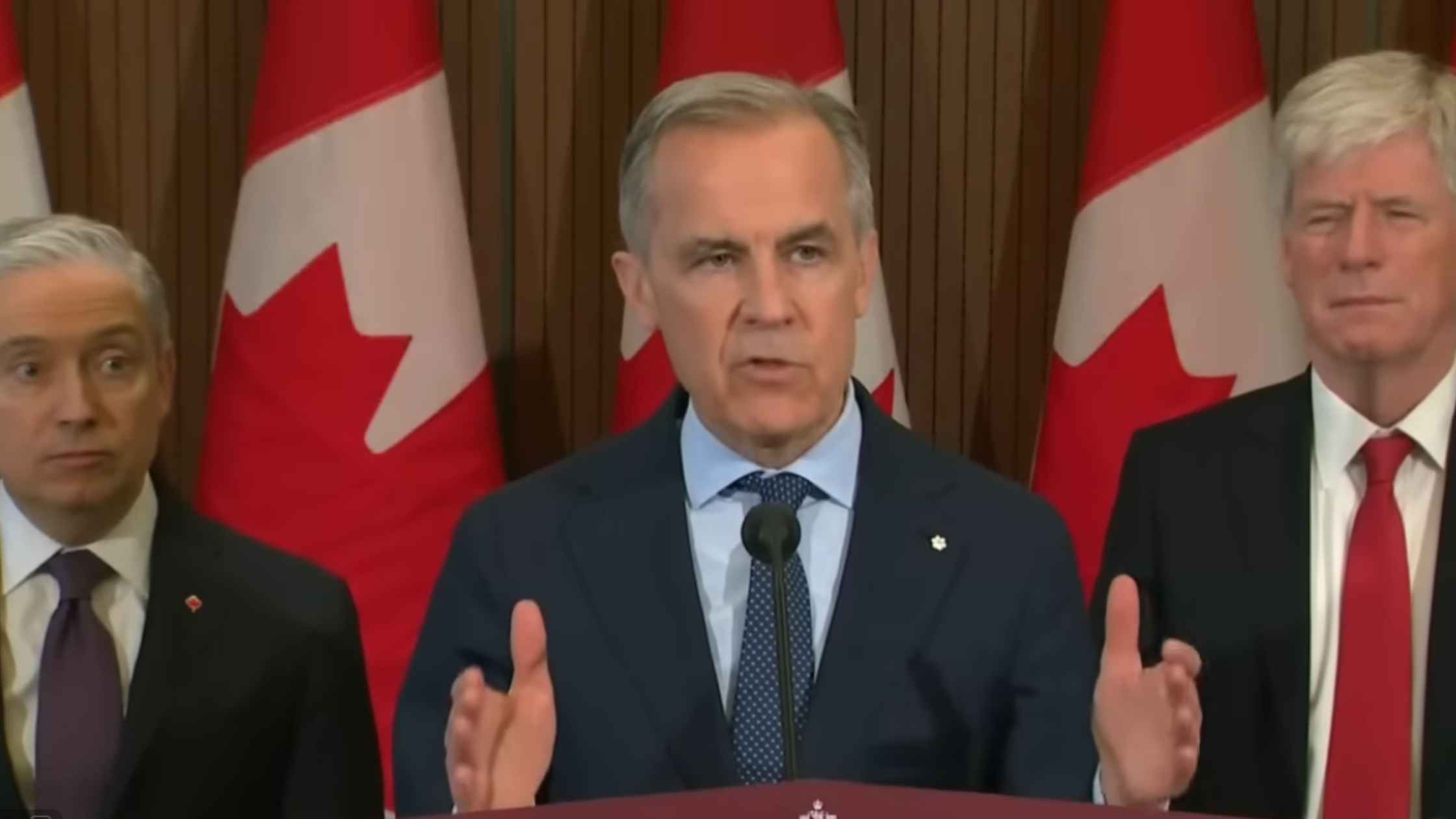
Prime Minister Mark Carney (00:00):
[foreign language 00:00:00]
Speaker 2 (00:14):
In English? [foreign language 00:00:16]
Prime Minister Mark Carney (00:18):
The question in terms of economic priorities, I'd say... I'd highlight three. In fairness to Mr. Noel, it wasn't specifically on economic priorities but was the preamble. First, affordability. There's this initiative here that goes directly to affordability concerns.
(00:40)
Secondly, working to accelerate our housing program. In our community build program, there's a build before the House on Build Canada Homes, the structure for Build Canada Homes, which will help accelerate at scale of these projects. And thirdly, the large projects.
(00:59)
But I'd add one more. [foreign language 00:01:01] In Canada, this initiative, [foreign language 00:01:14].
(01:14)
Okay. To put it in English, we're putting in place a series of measures. Some will have short-term payoffs. Many will have payoffs in a few years. The bigger projects, the bigger initiatives, we have to change fundamentally our economy to be stronger, more independent, more prosperous.
(01:40)
But we want to make sure that those benefit all Canadians and in the spring update, which the minister will in due course announce the timing for and the initiatives, of course, in that, you'll see more emphasis on taking where we're going with the economy and making sure that it benefits all Canadians.
Speaker 3 (01:58):
[foreign language 00:02:00]
Prime Minister Mark Carney (01:58):
[foreign language 00:02:14]
Speaker 2 (02:42):
[foreign language 00:02:42] Next question.
Kate McKenna (02:42):
Good morning, Prime Minister.
Prime Minister Mark Carney (02:42):
Good morning.
Kate McKenna (02:44):
Kate McKenna from CBC. I just wanted to push you a little bit on that question from my colleague. Some of the things you mentioned, housing, gas tax, major projects, these are all things that have received either rhetorical or legislative support from the conservative. So what specifically can you advance that you weren't previously able to advance with the minority government?
Prime Minister Mark Carney (03:05):
Look, we've had a variety of issues over the course of the parliament where things have taken longer than they necessarily would, where debates have been more performative than actual, around debates around substance.
(03:19)
I don't want to read into the record, although other deputies in parliament did read into the record, their love of cats and dogs and the... But these are examples. These are real examples in committee. You get the pleasure of covering committees.
(03:34)
And I ask you, and I say this as someone who's testified to committees in front of the Canadian Parliament, in front of the UK Parliament for decades. There's a difference between real testimony, real substance, getting to issues, debating aspects of law, advancing. That's the job of parliamentarians and showboating. We're going to have less of that. We're going to have more substance. I think all parliamentarians in the end will appreciate that, even if it's a change for some of them.
(04:07)
That's [foreign language 00:04:08]
Speaker 3 (04:07):
[foreign language 00:04:08]
Prime Minister Mark Carney (04:07):
We... Okay. [foreign language 00:04:59]
Speaker 3 (04:58):
[foreign language 00:04:59]
Prime Minister Mark Carney (04:58):
[foreign language 00:04:59]
Speaker 2 (04:59):
Over?
Prime Minister Mark Carney (05:00):
Wait.
Kate McKenna (05:01):
Some of your bills have been criticized by senators' opposition for including little, they call them poison pills. What checks and balances are going to exist for you now that you have a majority government? Some examples might be the lawful access in former C2.
Prime Minister Mark Carney (05:19):
Lawful access, that would be lawful access that's supported by virtually every law enforcement agency in the country. This is an exceptionally important issue. We all know how we communicate increasingly in different channels of communication. And the fact is...
(05:38)
And I'll give you the example, I just spent a number of hours with Peel Police in their serious crime unit and on their action unit that's working against home invasions, extortions, auto thefts. The biggest thing they want is lawful access.
Kate McKenna (05:58):
But what-
Prime Minister Mark Carney (05:58):
So this is a serious point, if I may, Kate, which is that this is not a poisoned pill. These are important issues, and that is a framing. That is a framing of an issue that is tying the hands of police forces behind their backs, unnecessarily in this time.
(06:14)
Now, we will go through processes for any bill, certainly any bill related to the criminal justice system, with debate in parliament, with serious committee discussions, not about cats and dogs, but about lawful access, the implementation of it and others. And we welcome that, but then we will take our responsibilities as all deputies will, as parliamentarians and vote.
Speaker 2 (06:41):
Next question. [foreign language 00:06:42].
Abigail Bimman (06:42):
Abigail Bimman, CTV news. On the gas tax, did you get this idea from the conservatives-
Prime Minister Mark Carney (06:47):
No.
Abigail Bimman (06:47):
... and will you continue to lean on the opposition for ideas now that you have a majority?
Prime Minister Mark Carney (06:52):
Well, let me... No, is the short answer to your first question. But to your second question, second part of your question, we're open to ideas from anyone. Certainly, any deputies, ideas that could come from the Senate, above all ideas from Canadians, from stakeholders and others. That is what governing in a collaborative way means and governing for Canadians.
(07:21)
So if there's good ideas for Canadians, we will look at them and implement them. One difference, if I may, and this is not aspersion on anyone but is: when you're a government, to govern is to choose. And if you're choosing a fiscal measure, such as the gas tax, you're balancing it against other priorities that the government has. How well we can continue to fund childcare, dental care, healthcare with the provinces? How we continue to support the vulnerable? What's the best way to do it?
(07:56)
And so what you see today with what we're going to put in front of the House, the minister will put in front of the House is a balance which takes an additional revenue that we expect to get, returns it to Canadians for a temporary period of time, will the economy adjusts and one would hope will events improve, if I can put it that way, in the Middle East. Yeah.
Speaker 2 (08:28):
[foreign language 00:08:29]
Abigail Bimman (08:30):
If you were Mr. Poilievre, would you quit today?
Prime Minister Mark Carney (08:36):
I don't... That's an unfair question. I can't look into the heart of Mr. Poilievre. I respect him as a parliamentarian as I do the other leaders of the other parties and I'll continue to work with him and all parliamentarians, as will my colleagues, to advance the interests of Canadians. Thank you.
Speaker 2 (09:01):
Next question. [foreign language 00:09:02]
Tonda MacCharles (09:03):
Morning. Tonda McCharles, Toronto Star. Poilievre called you badly educated in economics and-
Prime Minister Mark Carney (09:09):
Did-
Tonda MacCharles (09:10):
... he... He did.
Prime Minister Mark Carney (09:11):
Wow.
François-Philippe Champagne (09:11):
Really?
Prime Minister Mark Carney (09:12):
Given...
François-Philippe Champagne (09:12):
[foreign language 00:09:13]
Tonda MacCharles (09:13):
So I'd like to hear a little bit about-
Prime Minister Mark Carney (09:16):
Can I take back my previous answer? No. That's a joke.
Tonda MacCharles (09:22):
You can respond to it if you wish. My question though is to get your view of how you assess the risk of recession in Canada and the impact on government revenues and people's pocketbooks, given what you just referred to, turmoil in the Middle East that's causing energy and supply chain crunches?
Prime Minister Mark Carney (09:40):
Yeah. So Ms. McCharles, this is an important and fundamental question, something that we think about constantly and we design our economic response... Myself with the minister and the rest of the cabinet, we design our economic response with that in mind.
(09:59)
There is an enormous shock in the global economy that is undergoing right now because of the conflict. And we have to assess what's the best approach given our core plan and what can we do in the short term.
(10:17)
And so we're balancing support for Canadians with the measure today, with responsible fiscal management and reinforcing, reinforcing the plan to build Canada strong on housing, on community infrastructure, energy infrastructure, new ports, et cetera.
(10:37)
That is: restoring investor confidence both here in Canada and globally. We're one of the most attractive... rated one of the most attractive places now for foreign investment. I think we're going to see more of that that's going to help create jobs for Canadians and keep this economy growing. I would note that literally in, what, the last hour-
François-Philippe Champagne (10:55):
Minutes.
Prime Minister Mark Carney (10:55):
... or so, the IMF has just released its forecast for the global economy. Canada is rated by the IMF as the second-fastest growing economy in the G7. You will have seen in the last two months of GDP data, a return to growth of the economy after a short periods of return to growth there, a forecast to be the second strongest in the G7.
(11:19)
Clear plan that's addressing short term issues in terms of affordability, which are real, but also staying the course, reinforcing that investment that this economy needs. And I just, maybe finish and hand back, which is that we have to grow this economy to create the jobs for Canadians. And it's absolutely clear, it's been reinforced again by the events in the Middle East, we have to make our economy stronger and more independent.
(11:44)
And if there's a unifying theme in our economic strategy, it's strength and independence. And so we'll continue to do that. And that becomes self-reinforcing. And I can tell you, based on my... You can put an adjective in front of my economic education, economic experience, that is the type of strategy that really pays dividends. It compounds to the benefit of Canadians over time, and that's why we're sticking with it.
Tonda MacCharles (12:12):
It sounds like you're not anticipating a recession but-
Prime Minister Mark Carney (12:17):
No, we expect-
Tonda MacCharles (12:17):
... that manual [inaudible 00:12:18]-
Prime Minister Mark Carney (12:18):
To be clear... I'll be absolutely clear on that. The economy is growing again, creating jobs. We want it to grow faster and build. We've got to make these big investments. That's why it's so crucial. That's why we are grateful for the support of the voters in Terrebonne, in Scarborough Southwest, and in University--Rosedale.
(12:37)
But the expectation, even in the wake of one of the big economic shocks, is that Canada will be the second-strongest economy, fastest growing economy in the G7 this year and next. And that is the view of the IMF just released hours ago.
Tonda MacCharles (12:55):
Thank you. You talked about accepting this majority mandate with humility and determination. So I would like to know, you addressed the question about... Not calling an election, but I would like to know, are you a one and done majority mandate prime minister?
Prime Minister Mark Carney (13:10):
[foreign language 00:13:12]
Tonda MacCharles (13:13):
In English.
Prime Minister Mark Carney (13:15):
Honestly, I... Yeah, sorry. No idea. I mean, look, we get... Canadians have placed their trust in this government. We have a responsibility to live up to that, work every day to implement our policies, the right plan for the country to grow the country. And that's what we're going to do. Not thinking ahead beyond that and nor Canadians want us...
(13:43)
We're here to do a job. We're doing a job. We didn't go out and celebrate last night. We were working last night on finishing touches on this, other aspects of the spring economic statement, which you'll see in due course. First thing we're doing is focused on affordability for Canadians. We're going to keep building. I'm meeting...
(14:03)
Thank you, by the way, for the question about President Stubb. That's an important meeting. It's an important meeting because for our security, it's an important meeting for relations within Europe. It's an important meeting for Ukraine. And yes, we will play a little hockey this afternoon, so it's important for us because we got to hang out with the Ottawa Charge for half an hour. Thank you.
Speaker 2 (14:23):
We're coming up on time, so we'll do last question. [foreign language 00:14:25]
Laura Osman (14:26):
Good morning, Prime minister.
Prime Minister Mark Carney (14:27):
Upon the... [foreign language 00:14:31]
Laura Osman (14:31):
Laura Osmond with The Logic. On the excise fuel tax, how much do you expect this to cost? And why have you decided to go with such a broad measure, which has been criticized when the conservatives raised it as unnecessarily expensive and difficult to reverse? Why have you decided to go with this rather than more targeted measures for people who need it most?
Prime Minister Mark Carney (14:51):
Well, this is targeted within the overall gamut of things we can do around fuel charges. So it's targeted in a couple ways. One, it's, as I said, but just to repeat for those joining late, if you will, it's until Labor Day, from Monday until Labor Day. So it's a finite period of time, basically a little more than four months. It's an obvious time when Canadians are traveling a bit more.
(15:17)
And by the way, I'll just add that the fuel tax for aircraft fuel is also included in this. So for domestic flights, it's relevant for that. So that's the first point, it's targeted.
(15:29)
The provinces also have excise taxes on fuel. So ours is 10 cents on gasoline. The provincial average is about 13 cents. It's obviously a decision for provinces, whether or not they want to do something targeted.
(15:45)
And when you look at, again, to have a balanced approach, and we don't know exactly where obviously energy prices are going to be, but the cost of this measure, Minister, is about 2.4 billion-
François-Philippe Champagne (16:00):
Mm-hmm. Indeed.
Prime Minister Mark Carney (16:00):
... dollars? So this is a big decision in terms of fiscal expense. And so we balance that given the situation. Where the Canadian economy is, where commodity prices are, it's a little more than we expect the uplift from the growth and the economy, but it's basically a recycling of higher money that we expect to get. And we're not assured of that, but higher money we expect to get in and back to Canadians.
(16:30)
So in that regard, in our view, and this is why we spent time on it and very deliberate about it, we didn't just say, "Get rid of all taxes on gasoline and let's spend $9 billion as if we're not in government," which is actually what you do say when you're not in government. But when you're in government, you have to choose, you have to balance, and this is the balance we've struck.
Laura Osman (16:53):
I also wanted to ask you for an update on the Alberta MOU negotiations. A lot has changed since that initial MOU was initially signed, especially with respect to what's going on in Iran. Has there been a change in calculus at all about whether the Pathways project makes sense for all parties?
Prime Minister Mark Carney (17:11):
I would say that [foreign language 00:17:15].
(17:18)
It reinforced what's happened, many respects has reinforced the motivations on all aspects of the agreement. It's reinforced the importance of energy security here in Canada, but also in our potential partners, including very much in Asia.
(17:34)
So there's even more interest in what the Alberta agreement could unlock. It's also reinforced interest in the overall energy transition of which the Pathways project to your specific question can play a part. So we're making good progress.
(17:52)
They're very constructive negotiation. These are serious, detailed discussions, negotiations, but really discussions because we're not just advancing specific projects, but we're setting up the framework for major, major investment in Alberta and across the country for decades to come. Thank you.
Speaker 2 (18:13):
[foreign language 00:18:14] Last question. Selene.
Prime Minister Mark Carney (18:13):
Madam.
Selene (18:13):
[foreign language 00:18:16]
Prime Minister Mark Carney (18:13):
[foreign language 00:18:30]
Speaker 2 (18:13):
[foreign language 00:18:59]
Prime Minister Mark Carney (18:13):
[foreign language 00:19:00]
Selene (18:13):
[foreign language 00:19:11]
Prime Minister Mark Carney (18:13):
No. [foreign language 00:19:22]
Speaker 2 (19:56):
[foreign language 00:19:56] This is the end of the press conference. Thank you.
Prime Minister Mark Carney (19:57):
Okay.
François-Philippe Champagne (19:57):
Mr. [inaudible 00:19:58].
Prime Minister Mark Carney (19:57):
Okay. Well, then. Okay. We go this way? Okay? Yep?
Speaker 12 (20:01):
Yep.