


Speaker 1 (03:39):
[French 00:00:10].
(03:39)
In 2025, work began here on one of the world's biggest and most powerful icebreaker in the world, the Polarmax.
(03:47)
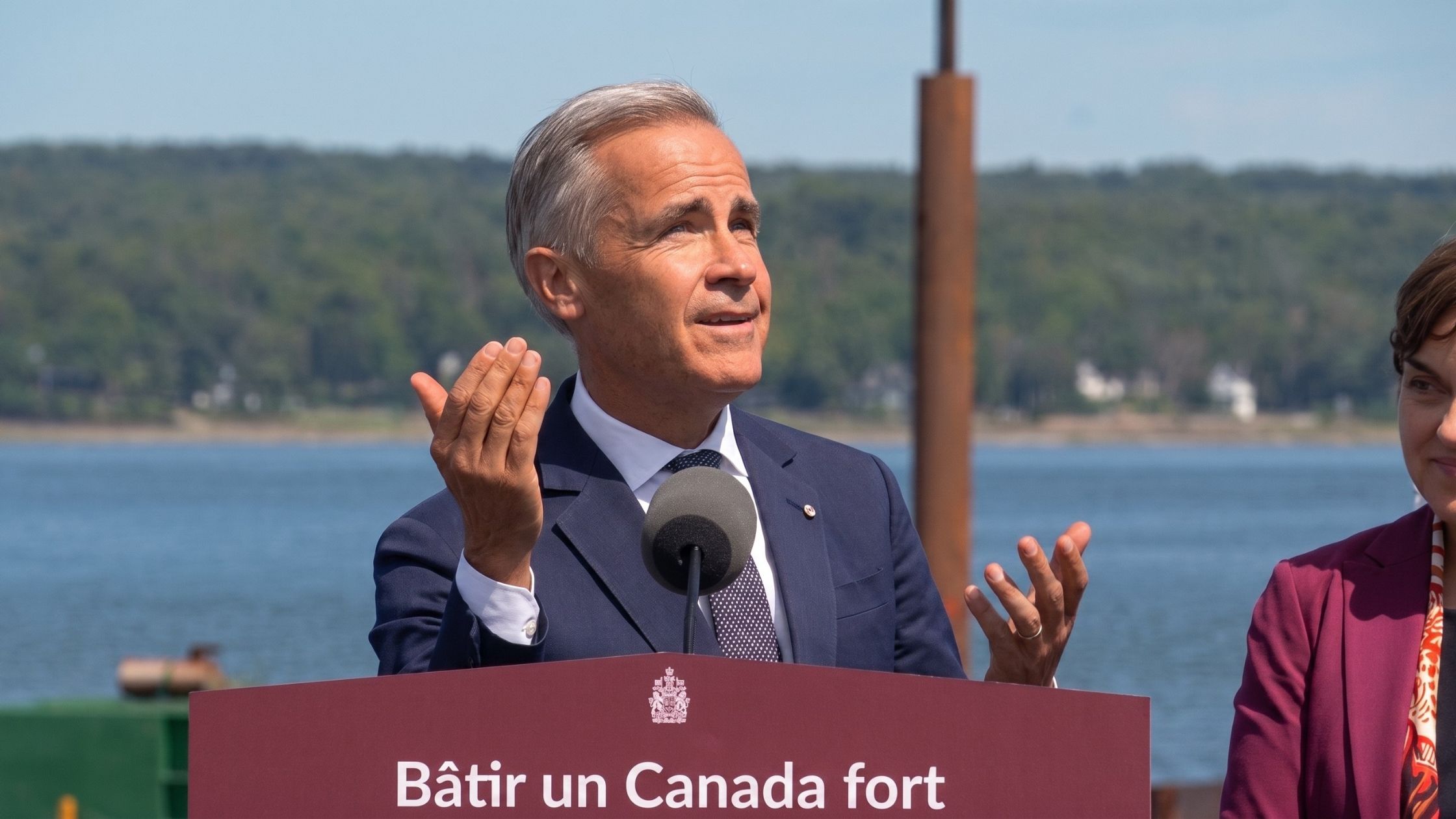
[French 00:03:48]. What we're announcing today will mark the beginning of a new chapter for Davie Shipyard, but also a new chapter in the long tradition of shipbuilding in Canada. And once again, the workers here in Levis and in Quebec are answering the call for Canada because the ships we build here will defend our sovereignty and because we defend our sovereignty by building these ships here.
(04:39)
[French 00:04:41].
Mark Carney (06:34):
[French 00:04:54]. The goal of our trade negotiations with the United States has always been to get the best deal for Canadians, never a deal at any price or in any timeframe. The best deal. [French 00:06:54]. While we made progress, we did make some progress in recent weeks. In the end, that momentum reversed and we could not accept what the US had offered, nor could we give what they asked. And by standing up for our values and focusing on what we can control, we will build [French 00:07:14].
(07:17)
Now, that's not to say there won't be challenges in the road ahead, but we're ready to meet them because we have all we need right here. The workers, the engineers, the ambition and the right plan, the right plan for a stronger Quebec and a stronger Canada. Building at home and diversifying our trade abroad, that's not plan B. It's been our plan A from the start. [French 00:07:54]. Now, diversifying trade is also fundamental to building a stronger, a more independent, and a more resilient country. Over the last year, the last year alone, Canada has signed more than 20 trade and security deals across five continents. We completed our most recent trade deal with the United Arab Emirates in a record 47 days. Canada is now the best connected economy in the world. Canadian businesses now enjoy tariff-free access to one and a half billion consumers. Over the next six months, we will double that number through new trade deals with ASEAN and India. This fall, we will begin intense discussions with the European Union, the world's second-largest economy, to build a much stronger and deeper economic and security partnership.
(09:52)
Now, we can build such unparalleled access because we're trusted, because we're reliable, and because we have what the world wants. But our connections depend on accessible, secure sea roots that carry our world-class products. The St. Lawrence, one of the world's great trade arteries. 1959, determined to build our own future by connecting the St. Lawrence to the Great Lakes. Canada opened the St. Lawrence Seaway. Seven locks, 300 kilometers built in just five years. [French 00:10:34].
(10:31)
Today, we're announcing the largest shipbuilding initiative in Quebec's history. The government of Canada will invest more than $11 billion to build six new program icebreakers for the Canadian Coast Guard in partnership with Chantier Davie. We'll move fast. The first steel, Canadian steel, the first steel will be cut next fall. The first ship will be delivered five years later, and the first full fleet, and the full fleet will be in service five years after that. The new icebreakers will replace the Coast Guard's aging heavy and medium icebreakers. The work in Atlantic Canada, the St. Lawrence, and throughout the death of winter and in our arctic throughout the summer. [French 00:14:07].
(15:28)
Today's announcement continues the shipbuilding tradition in Levis that stretches back two centuries. Two centuries. Since 1825, Davie has built hundreds of vessels, including 35 warships for Canada and our allies during the Second World War. Today we're building on that proud legacy, investing in Canadian shipbuilding on a scale not seen in generations. [French 00:15:58].
(17:24)
Let's be clear. The work of this immense contract doesn't stop at that shipyard gate. More than 1,500 suppliers from across Canada will support the work here at Davie. That means steel workers at Algoma Steel in Sault Ste. Marie, fabricators at Brennan Steel in Brampton, Ontario, steel specialists at Stigterstaal in Hamilton, all working together, producing, preparing, and supplying the high-grade marine steel that forms the backbone of these ships. It also means designers and manufacturers at Hawboldt Industries, Hawboldt Industries in Chester, Nova Scotia, supplying the advanced marine equipment that these vessels carry. [French 00:18:10]. Today's announcement is an example of our defense industrial strategy in action. When Canada builds our own ships, the benefits are felt across the country by design. And you know the sovereignty of a country that has the world's largest and longest coastline depends on our strength at sea. The Coast Guard is central to that strength. And when Canadians see that distinctive red hull coming over the horizon, they know that our waters are being watched over. They know help is at hand. They know that the way ahead will be clear. [French 00:20:27].
Mark Carney (21:13):
[French 00:21:01].
(21:13)
So, to finish, last week we launched together the largest clean energy investment in North American history. Today, we are launching the largest shipbuilding contract in Quebec's history. No matter the headwinds, the work of building Canada strong goes on interrupted. No matter the circumstances, Canadians will take charge of building our future.
(21:49)
[French 00:21:52].
Speaker 2 (21:49):
[French 00:22:41].
Speaker 3 (21:49):
[French 00:36:00].
Speaker 5 (21:49):
[French 00:42:01].
Speaker 4 (42:40):
[French 00:42:40]. Good afternoon, everybody. Prime Minister Carney. Madam the Premier Minister Fréchette. Minister McGuinty. [French 00:43:08] Minister Lightbound. Minister Drainville. [French 00:43:19] Blaney. [French 00:43:23] Marchand. [French 00:43:26] Pierre Picard. Representatives of the governments of Canada and of Quebec. Distinguished guests, colleagues and friends. Thank you for joining us here today, particularly at such short notice.
(43:42)
[French 00:43:46].
(43:42)
14 years ago when Alex and I acquired Davie, this yard was effectively closed. Today, the Government of Canada is entrusting it with the construction of six new program icebreakers for the Canadian Coast Guard. It would be tempting to call this a full circle moment. The circle brings you back to where you started and we have moved forward. And today gives us both the opportunity and the responsibility to go further. When we acquired Davie, the yard was often presented as a symbol of an industry in decline, but Quebec's shipbuilding tradition had not disappeared just because the order book had gone. It remained in knowledge and skill and pride of the people across Quebec and especially in this region, the people of Lévis, of Lauzon. And if it hadn't have been here, I can tell you we wouldn't have been able to do this.
(45:04)
Over the years that followed, we assembled the projects, partnerships, and transactions that rebuilt Davie. I spent much of that time understanding why operating a shipyard in Canada and in the West more broadly had become such a difficult proposition, and we developed ways around those obstacles, built strategies to mitigate the risks, and secured capital to make the strategy work. But strategy and capital do not build ships. The people who returned to help us restart the yard and those that joined subsequently learned from them and also brought skills and experience of their own and they carried the work forward. And together we completed the Cecon Pride, a DP-3 subsea construction vessel, an incredible ship, and Canada's largest single export in 2014. I'd hazard it was the last time we actually sold a very large ship abroad. We built two highly advanced ferries for Quebec, the first LNG-powered passenger carrying vessels in North America, writing the rules with Lloyd's, the classification society. We delivered the combat support ship Asterix in three years, not just a ship, but as a service. And nearly a decade later, Asterix continues to maintain Canada's crucial re-provisioning at sea capability. We sourced and converted three sister ships that became Canadian Coast Guard's medium icebreaker fleet. And we completed our first deep refits of [inaudible 00:46:33] frigate HMCS St. John's. Most of it during COVID and the yard did not shut down.
(46:43)
The second ship, HMCS Toronto, it's just over here. She's just out to the dry dock and preparing to come back to service. And Fredericton ...
Speaker 6 (46:52):
Montreal.
(46:52)
Montreal.
Speaker 4 (46:55):
Oh, sorry.
Speaker 6 (46:56):
Montreal.
Speaker 4 (46:57):
Montreal, so many of them, is just over here. Not perfect. For the third Halifax-class docking work period. In 2019, Davie qualified to proceed through the process of becoming the third strategic partner under the National Shipbuilding Strategy. Working through COVID again, we completed that demanding qualification and negotiation process, signing Davie's umbrella agreement in 2023. That agreement gave us an extraordinary program of heavy icebreakers to build. And we were very, very grateful for that opportunity, but we also understood the scale of the challenge. Talk about the dog that caught the milk flow.
(47:44)
With the support of Government of Quebec, we acquired Helsinki Shipyard, the world's most experienced builder of icebreakers, and began leveraging its know-how to help advance Canada shipbuilding industry and the portfolio of work that we have to carry out. And that expertise is already, as you've heard and know, being applied through the Polar Max, a program that's structured to accelerate the delivery of a much-needed capability for that heavy icebreaker.
(48:14)
And we're also modernizing Davie, as you know. And that's not just about the hard assets, the physical tools of shipbuilding. This touches all our systems, processes, every aspects of the way we work. And Lyndsey will talk to you a little bit more about that shortly. And we're also recruiting at scale, bringing another generation into the yard to learn new skills and contribute experience of their own. Now, this strategy is deliberate, and it's the work of thousands of employees and suppliers, partners, supporters, that have converted a strategy and capital into ships and an initial promise into national capability.
(48:56)
The responsibility Canada is placing upon us today is extraordinary, and we are profoundly grateful for that confidence. Prime Minister Carney, thank you and your government for your ambition, your leadership in advancing the national shipbuilding strategy, not always easy, and this program, which is a long-term commitment to Canada's Arctic sovereignty, economic resilience, and industrial strength. Thank you, sir.
(49:30)
Premier Fréchette, at critical moments in Davie's journey, Quebec believed in us and supported our ambition. Thank you. Minister Drainville, Bernard, as minister responsible for the maritime strategy and the economy, and as the member for Lévis, you believed in our ambition when I first met you four years ago to build a globally competitive shipbuilding champion with its deepest roots here in Quebec. Without that support, today would not have happened. Thank you.
(50:06)
It's kind of warm. These ships, program icebreakers, are essential to Canada's future. They will maintain access to our waterways, strengthen Canada's presence in the high north, and support the vital work of the women and men of the Canadian Coast Guard. But today's announcement is more than just about six ships. It's a proof point in Canada's continuing effort to rebuild its shipbuilding industry. This is strategic industrial policy writ large. It is hard. And we've been at it for 15 years. Not just Davie, and that's the NSS.
(50:59)
There are other critical industries, but shipbuilding is our passion. And it matters because a country that cannot build and sustain the ships, as everybody has said here, ultimately weakens its ability to protect its sovereignty, support its economy, and act independently in its own waters and potentially further afield. The success of industrial policy is often framed through the lens of jobs, job numbers, and it matters, but it's just too simple a scoring mechanism and it understates what's actually going on. Industrial capability is created by putting skills in people's heads, tools in their hands, and a sustained flow of the right kind of work in front of them. Not make work, but in our case, the right ships in the right order.
(51:51)
Sustained throughput produces proficiency. Proficiency produces capability. Capability sustained over time produces capacity. Combine that with the right product expertise and a coherent export policy. And Canada has the opportunity to compete beyond its own shores. Now, none of this is easy, but I think we can do it. The capability exists here, but it is dispersed. Quebec and Ontario together provide deep pools of industrial skill, engineering expertise, suppliers, and adjacent industries. And they are connected by a natural industrial artery, the St. Lawrence. Now, Canada has not yet converted the full strength of the industrial base into internationally-competitive cost and schedule performance. We can be candid about that, but this sixth program provides something essential, the continuity. It gives us the opportunity to standardize, to learn, to improve, one ship to the next, under a fixed price contract. And we've asked for the opportunity to continue to prove that Davie can do everything that we said. And this contract is that continuity. And we take the responsibility of it seriously because it comes with responsibility.
(53:16)
That is the bargain. It's pretty straightforward. Sufficient freedom to organize for delivery matched by clear accountability for cost and schedule and performance. It's up to every one of us, especially everybody in the Davie team to remember that. We're at the test, guys, and we're going to perform. That job, our job, is to turn that continuity into steadily improving productivity and lasting Canadian capacity. That capacity will allow us to go abroad and sell ships internationally. That's why this contract can become a bridge for rebuilding an industry to that competition. And it's critical we do that.
(54:05)
The program icebreakers give us the opportunity to demonstrate how we believe that can be done. And our approach is not standard and it's demanding. And it needs to be because the task is hard. It depends on the disciplined application of critical path. But that's what you get with Davie.
(54:29)
I wanted to say on behalf of everybody whose work has brought us to this point, our direct workforce, blue collar, white collar, our partners, thousands of people in our supply chain. I say this, thank you. Prime Minister Carney, Premier Fréchette, Minister McGuinty. Minister Lightbound, Minister Drainville. Thank you. And thank your teams for making this possible. Deputy Minister Reza, Commissioner Brosseau, Deputy Commissioner White, and your respective teams, thank you for the work, rigor, and commitment that have brought us here.
(55:20)
We've spoken about and worked over years to develop alternative approaches to rebuilding Canada's shipbuilding industry. This contract gives us the opportunity and the responsibility to prove that it can be done differently at scale. And I'd like to now introduce Lyndsey Kettel, president of Davie, who is leading the team to deliver on this at scale. Thank you.
Lyndsey Kettel (55:47):
[French 00:56:06].
Speaker 7 (56:06):
[French 00:59:28]. Thank you very much. [French 00:59:33]. Please identify yourself as well as your outlet as well as who the question is for. [French 00:59:42]. First question.
Speaker 8 (56:21):
[French 00:59:45].
Mark Carney (01:02:43):
[French 01:00:05]. If I can repeat in English. It's not a surprise for us that the US would take some form of reprisal to our response to their unjustified tariff, which was on top of other unjustified tariffs. That's not a surprise. But what message does that send to the workers?
Mark Carney (01:03:01):
But what message does that send to the workers in Michigan and Ohio and Kentucky and Alabama, who rely on Canadian demand? We're their largest customer for automobiles, more than the European Union, Japan, Korea, many others combined. And United Kingdom. We can throw them in as well. This is the most successful automotive partnership in history. It's existed for all my life, for 60 years, and the president is doing what we not just suspected, but we had confirmed through the terms that they were offering. Instead of a quick change to the terms in the automobile industry, they were putting on the table terms that gradually would have that impact, and we wouldn't accept that. So it's very revealing that this is where they go.
(01:03:55)
Now, our focus, as the focus is today, and I would just encourage policymakers around the world to take a lesson of what we see today, the importance of l'audace, ambition, cooperation, putting workers, families first, investing in technology. We will put all of those lessons to work, as we have been for our auto industry, for the industries that supply our auto industry.
(01:04:31)
Look, the final point, and I'll hand back for your follow-up. There is a mutually beneficial deal possible here, but it has to be one that respects Canada's sovereignty, that respects our independence, that uses our complimentary strengths to build something better, not tear apart for short-term gain. That's the offer.
Audience (01:04:54):
Hear, hear.
Speaker 12 (01:04:54):
[French 01:04:57]-
Mark Carney (01:04:54):
[French 01:05:03]-
Speaker 11 (01:04:54):
[French 01:05:04] Mr. Carney?
Mark Carney (01:04:54):
Oui.
Speaker 11 (01:04:54):
[French 01:05:10]
Mark Carney (01:04:54):
Okay [French 01:05:27]
Speaker 13 (01:04:54):
[French 01:07:10]
Speaker 12 (01:08:08):
Merci. [French 01:08:07] Next question.
Speaker 10 (01:08:08):
[French 01:08:10] Bonjour.
Mark Carney (01:08:21):
Bonjour.
Speaker 10 (01:08:26):
[French 01:08:22] It's a funny fact. [French 01:08:28]
Mark Carney (01:09:06):
Okay [French 01:09:07] funny fact. It's a right.
Audience (01:10:53):
Yeah.
Speaker 12 (01:10:53):
[French 01:10:53]
Speaker 9 (01:10:53):
[French 01:10:53]
Mark Carney (01:10:53):
Okay. Okay. [French 01:11:15]
Speaker 13 (01:10:53):
[French 01:11:59]
Speaker 12 (01:10:53):
[French 01:12:39] Next question.
Speaker 14 (01:10:53):
[French 01:12:41]
Mark Carney (01:12:57):
[French 01:12:57] No, not objective. [French 01:13:01] Michigan, Ohio, Kentucky, and Alabama [French 01:13:59]
Speaker 12 (01:13:58):
[French 01:13:59] follow up-
Speaker 15 (01:13:58):
[French 01:13:59]
Mark Carney (01:13:58):
Français. Hello. [French 01:14:25]
Speaker 13 (01:13:58):
Merci. [French 01:16:03]
Speaker 12 (01:17:13):
[foreign language 01:17:12] Last question.
Eric Andrew-Gee (01:17:15):
Yes, sir. Eric Andrew-Gee, The Globe and Mail. This is for Prime Minister Carney. U.S. Transportation Secretary Sean Duffy told Fox News on Sunday that Canada will come back to the negotiating table because the tariffs are so devastating and that we depend on the U.S. for our security. How do you respond to that?
Mark Carney (01:17:36):
Look, when the Americans go to the negotiation table first with the right attitude towards our industries and a true partnership, of course we'll come to the negotiating table. Let's be clear, there is an existing arrangement between our countries and Mexico that works. It can be improved, there's ways to improve it, and we will work to improve it in ways that are to the benefit of Canadians, but also to the benefit of Americans and the people of Mexico. But an attitude at the negotiation table that Canada is a subsidiary of the United States, the Canadian industry is going to be disadvantaged relative to American industry, that we're going to set up terms so that over time Canadian industry is going to face constant headwinds, that's not something we're going to accept. And that's before you get to constraints on our ability to do what the rest of the world wants, which is to sign trade deals with Canada. And that's before the very fundamental issues on culture. Thank you.
Speaker 12 (01:18:45):
Follow up? No.
Mark Carney (01:18:46):
Are you going to switch your ... Yeah, go ahead.
Justin Ling (01:18:48):
I'm taking over.
Mark Carney (01:18:49):
Yeah.
Justin Ling (01:18:49):
Some cooperation here. Justin Ling, the Toronto Star. Prime Minister Carney, the Davie Shipyard is the linchpin of the ICE Pact between Canada, Finland, and the United States. It will be the savior-faire of this shipyard that will help the U.S. recapitalize its own Coast Guard with icebreakers. Does the most recent round of tariffs put that into question, especially considering that the tariffs are on steel and aluminum necessary to make these icebreakers?
Mark Carney (01:19:16):
Well, first off, thank God that Davie ... And it's not thank God, it's through good work of Minister Lightbound, Minister Drainville, and the leadership here at Davie, that the steel for these ships is Canadian. It'll come from Algoma. It'll come from Rendan. It comes from [inaudible 01:19:39]. So that's a core advantage. And it's a reminder to us of the strategic advantage of producing what we need. Nothing about what's happened over the last week affects this program. In fact, what it does is reinforce it.
(01:19:53)
And I thank you for your question because it's a reminder of one of the many, many, many things that the United States needs from Canada, this expertise. The United States has a handful, and I'm being generous, of icebreakers. We have 20. Yeah, one. Yeah, I was being generous. Okay, I didn't want ... Yeah. I rounded up. They have a habit of doing that there. And we have 20. We're building the best-in-class across all classes with the expertise here.
(01:20:30)
And I'll just finish with this if I can reinforce the very astute observations of Mr. Davies, this process, both delivering this contract as enormous as it is, and how it reinforces the competitive advantages of Davie in engineering, in production, in supply chain management, and how it's going to set it up for even more contracts internationally, this is first class, best-in-class. This is the launchpad. As important as today's announcement is, it's what's to come is even more important. And there's a world in which America is part of that. That's a sensible world. It's a world after the fever breaks. And Canada will be a partner in that, but on terms that work for Canadians and work for these workers here. Thank you.
Speaker 12 (01:21:27):
Thank you, everyone. This marks an end for our press conference. [French 01:21:30]
Mark Carney (01:21:27):
[inaudible 01:21:35]
Speaker 13 (01:21:27):
[foreign language 01:21:40]