
Speaker 1 (00:00):
… at NASA's Johnson Space Center in Houston to share more details about the mission. They are Lakiesha Hawkins, acting deputy associate administrator for NASA's Exploration Systems Development Mission Directorate. Charlie Blackwell-Thompson, Artemis launch director. Judd Frieling, Artemis II ascent flight director. Jeff Radigan, lead flight director for the mission. Rick Henfling, Artemis II entry flight director. And Dan Flores, NASA test director.
(00:38)
We'll have some remarks this morning from each of our participants here, and then we'll take questions from reporters both here in the room and on the phone. And reporters who are on the phone, you can get into the question queue by pressing star one.
(00:53)
And with that, we'll start with Lakiesha.
Lakiesha Hawkins (00:57):
Good morning and thank you for joining us. I'm glad we opened with that video. It gets your heart pumping and it reminds us of the historic nature of the mission that we are about to embark upon. We're here today to talk about Artemis II and we together have a front-row seat to history. We're returning to the moon after over 50 years during the Apollo program, the Apollo era, and we are going back to the moon.
(01:29)
Now, this is a series of tests, Artemis is. Artemis I was a 25-day mission. It was a great success where we demonstrated the capabilities of the SLS rocket, the Orion spacecraft, and all of the supporting operational and ground systems. We were able to test out those capabilities in a real deep space environment. And so, now here we are moving on to Artemis II. Artemis II is a 10- day test flight. We will be launching four crew, our friends, Commander Reid Wiseman and Pilot Victor Glover and Mission Specialist Christina Koch, and Canadian Space Agency and Mission Specialist Jeremy Hansen. And them, along with our ground teams, we are going to be working together to execute this mission.
(02:27)
But let me emphasize that this is a test flight and so the activities that we do together, we are going to learn from them. And so, while Artemis I was a great success, there are new systems and new capabilities that we will be demonstrating on Artemis II, including the life support systems, the display capabilities, software and et cetera. We'll be taking lessons learned that we learned from Artemis I, and incorporating that into Artemis II. And then, building upon what we learned from the last mission. This is a stepped approach and all that we learned from Artemis II, we will build upon that to prepare us for our first crewed landing on the surface of the moon for Artemis III.
(03:16)
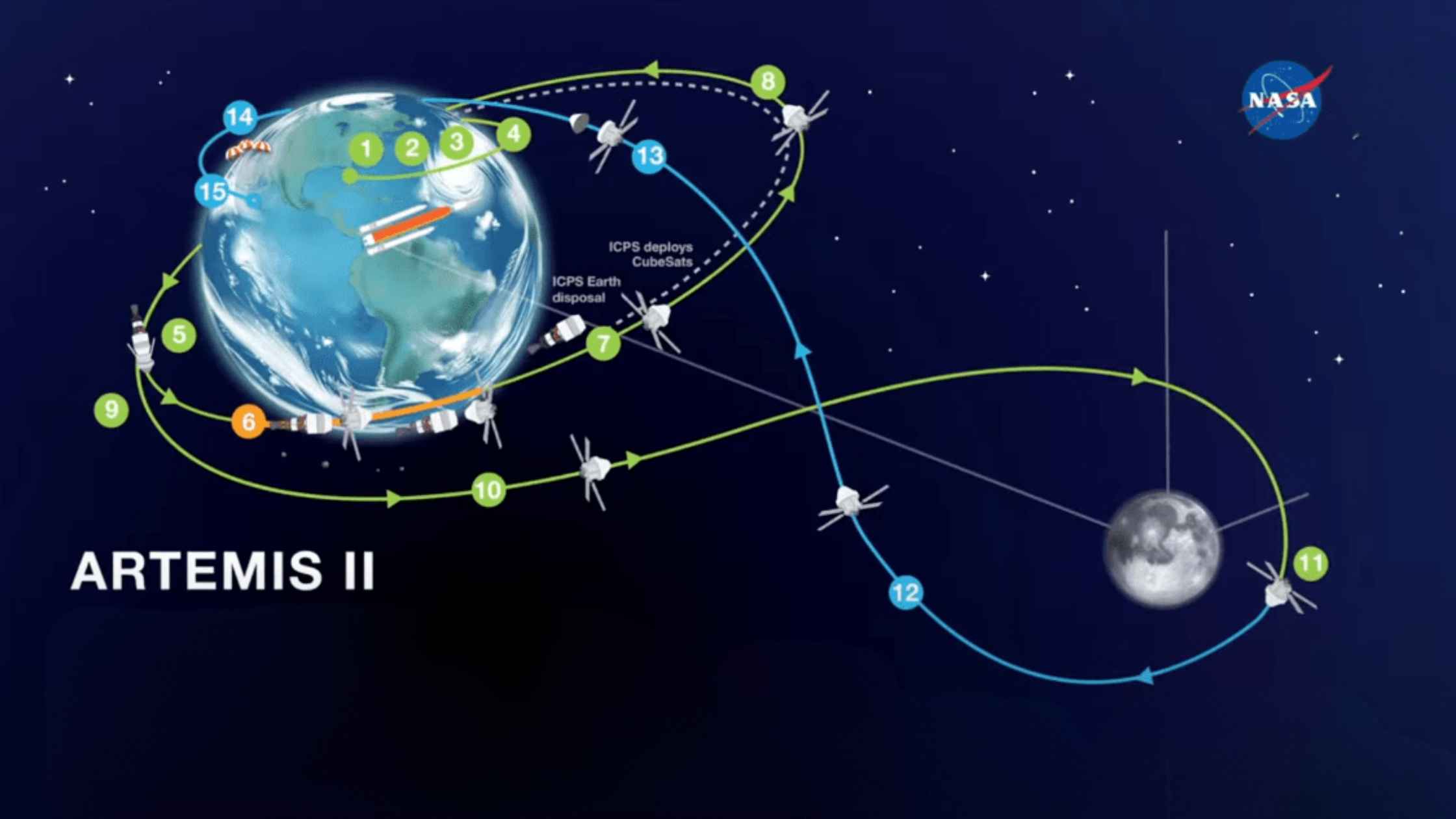
Now, there are some things that we're doing for Artemis II. We can talk a little bit about what that mission will look like. This is going to be a free return trajectory and what that means is as a mitigation, we are going to essentially set the course when we do the translunar injection burn on day two to use physics, the earth and moon gravity to make sure that we can return the crew without having to make major course corrections, propulsion burns. This is something that we've experienced before. If you recall in your history, we did that on Apollo eight and Apollo 13. And so, when you look at this map, we go from launch and then the boosters, of course, which provide about 75% of the thrust that we need in order to be able to get the spacecraft aloft. Once we do that, and of course the RS-25 engines burn, then we're going to jettison the boosters, as well as the launch abort systems. Once we get through main engine cutoff, then we're going to do an apogee-raise burn, an apogee-raise maneuver, and perigee-raise burn. And then, we're going to demonstrate a rendezvous proximity operations demonstration and I think my colleagues are going to talk a little bit about that. That's going to be critical to ensure that we can control two bodies in close proximity to one another as we prepare to do something similar on Artemis III when we get ready to move the crew from the SLS Orion into our landing system in preparation for landing.
(05:05)
And then, after we dispose of the upper stage the ICPS, we're going to do some checkouts of some of our life support systems in HEO, or high-Earth orbit, into trans-lunar injection. We then make our path out to the moon, around the moon and then return back home. Once we get to the entry interface, once we hit the atmosphere, then all that's left to do is splash down and to safely recover our crew. Our job is not only to launch this crew, but to make sure that we return our friends home safely.
(05:49)
So, there's a couple other things I want to talk about. I'd like to talk about the mission management team. The mission management team will be activated about two days before the launch. Now, the mission management team is responsible for the overall risk management and critical decisions at key points during the mission. And that team is going to be made up of senior leaders and technical experts who understand the risk that we have been mitigating and thinking through and some accepting as we lead up to the mission and then be able to support that and lead that during the mission. But the real time making a lot of that will be handled by my launch and flight and return recovery colleague sitting next to me and they'll be talking a little bit more about their jobs during this mission. We'll start at Kennedy Space Center and then we will transition here to Johnson Space Center acts after the proximity operations demonstration on lunch day one. And then, from then on, will meet daily or they'll meet daily until the crew is safely returned.
(07:04)
And so, one more question that I often get asked is when will we actually launch? The agency has made a commitment to launch no later than April of '26, and we intend to keep that commitment. We're also though working to accelerate, as much as we can, in terms of the preparations and the operations preparation to potentially as early as February, but we want to emphasize that safety is our type priority. And so, as we work through these operational preparations, as we finish stacking the rocket, we're continuing to assess to make sure that we do things in a safe way. And once we get through some of those key integration points, once we get ready through some of those test prep activities, we'll be able to fully assess where we are. Now, the process that we go through and in order to be able to set that is we understand where our progress is in terms of stacking of the rocket and our ops, planning and preparation, our training, planning and preparation. And then, we take a look at the potential launch periods that are available to us. The launch periods, which is the days, and essentially that falls about monthly days available to us, as well as the windows within those days that are suitable for us to be able to launch. And we take a look at our technical readiness, we take a look at potential constraints, technical constraints. And we also, of course, take into consideration or the mechanics, the physics of the earth relative to the moon. The trajectory that we have prepared and set out for ourselves and any range constraints, any Earth and space weather. All of these we put together to make an assessment of what is available to us to be able to execute on this mission. And as we get closer, we're narrowing that down and we'll be ready to talk about that very soon.
(09:10)
And so, I'll just conclude by saying that we're making preparations and when we are ready to safely launch, we are going to accelerate as much as we can to do so. We'll be able to execute this mission and it is our plan and our desire to be able to bring our crew safely home. With that, I'll turn it over… Uh-oh, I think I lost the mic. With that, I'll turn it over to Charlie Blackwell-Thompson.
Charlie Blackwell-Thompson (09:37):
Thank you, Lakiesha, and thanks for everyone who's joining us today, either here in the room or online. I'm going to talk about our preparations at the Kennedy Space Center for this SLS rocket and the Orion spacecraft as we prepare for Artemis II. And as Lakiesha said, this is a very exciting time for us.
(09:58)
Orion is in its final preparations in what we call our offline processing. It is currently in the Launch Abort System Facility are the LASF, as we call it back at Kennedy. And it is finishing up it's processing there. We expect that to complete in about a week or so, and then it'll be headed over to the Vehicle Assembly Building or the VAB. The SLS rocket is pretty much stacked and ready to go. Its test campaign is behind it. We are finishing up some of our closeouts and some of our other work, but most of our work there on SLS is behind us, which is a wonderful milestone.
(10:40)
Later this week we plan to stack the Orion stage adapter. It does have some payloads onboard it that'll be going along for the ride with us, some CubeSats, so we're looking forward to that as well. Once Orion is complete over in the LASF, we'll bring it over to the VAB, it will get mated to the SLS rocket and we'll begin our test campaign. And as part of that, some of the tests are the same that we did during the Artemis I timeframe. There's an end-to-end comm test. There's an interface verification test, but we also have some new ones. And those new tests consist of the countdown demonstration test, which is about our crewed flight.
(11:25)
If any of you remember or were following back in the shuttle days, we had a similar test that was called TCDT, terminal countdown demonstration test. That's where we suit up the crew, they come out, we go through our checklist and our countdown. They'll enter the ship. We'll get them strapped in. We'll do comm checks. We'll do the configuration of the crew module and we'll count down to inside of terminal count before we have a plan stop. As part of that, we'll also do an egress demonstration and that will be what we call a CDDT part one.
(12:06)
Once that testing is complete, we have some other servicing ops that we'll take care of in the Vehicle Assembly Building. We will go ahead and do our flight termination system test and we'll start closing out the vehicle compartments as part of our final closeouts of SLS. And when all of that is done, we'll get ready to roll out from the VAB to the pad.
(12:37)
And you can see some imagery here from rollout from Artemis I. It is truly a beautiful site when that vehicle begins to make its way across the threshold of the VAB and along that four-mile journey to the pad, once we get to the launch pad, we will make the connections between the mobile launcher and the pad. We have a little bit of testing that we will do out there as well. We have some comm testing that we'll do the RF environment. We have booster servicing to take care of. We have emergency egress system to do the final configuration of. We'll take care of that right after getting to the pad. We'll have the crew come out for what we call part two of CDDT, and that is where we'll walk down that emergency egress system and go over the events of egress in the event that we have to perform one of those on launch day.
(13:37)
After that, we're off to wet dress. Wet dress rehearsal will be a full tanking of the vehicle, core stage and upper stage. We will get into a terminal count. And again, we will count down inside a terminal count to about the 29 second point. And then, we will terminate that test. We'll go review the data and a few days later we'll get into launch countdown. Our countdown is two days long, very similar to what we had for Artemis I. We do have a couple of changes though because we have a crew this time around. So, after tanking, we have a new built-in hold that we will use just prior to sending the crew to the pad. We will send them out, get them strapped in. Again, comm checks, and get the crew module configured. And we'll count down to our final planned hole point, which is a T-minus 10 minutes.
(14:32)
Very similar to what we did during Artemis I, We'll do our final readiness checks, make sure all of the work is complete, that we are tracking no constraints. And at that time we will give the go to pick up the count at T-minus 10 minutes, which again, is our last planned hold point, and we'll count down through terminal count. The launch abort system are the last will become available to us at five minutes, 25 seconds and then we'll count down through our terminal count. Again, we'll be terminating the propellant to the vehicle, pressurizing flight tanks, transitioning from ground power over to onboard power, and then transitioning the software from the ground over to the flight. And we'll get down into that inside of 31 seconds and we'll count down, we'll get the GLSs go for course stage engine, start right around 10 seconds, just like Artemis I, we'll begin that stagger start of the engines and then we'll have booster ignition and liftoff.
(15:36)
And at that point in time, our launch control team will hand over control of the vehicle to the flight control team and just like that, I'm going to do it here today as I hand off to Judd Frieling, our ascent flight director.
Judd Frieling (15:50):
Thanks, Charlie. So, of course, we at the Mission Control Center will be falling along the pre-launch with Charlie through the RF link of the Kennedy Uplink Ground Station. And we can probably still start the video. I got an animation to show you what it's going to look like when we lift off. So, that 8.8 million pounds of thrust is going to start to propel the crew upwards towards our mission objective. There you can see, we'll clear the tower probably about 10 seconds after liftoff, and then we'll start a roll maneuver that will get the crews heads down position and then pitch down so that we can start developing some horizontal velocity. And you can see from this shot gives you a good wide angle from what that trajectory is going to look like. So, about a minute in or we get to our supersonic, so Mach one a little shortly after we get to our max Q.
(16:48)
There, at about 150,000 feet, the solid rocket boosters separate from the stack. We continue on upwards. Then, about a little over three minutes, the SM panels jettison, revealing the solar arrays. And then, about six seconds later, the last jettisons, that's the launch abort system. So, we get to MECO, so main engine cutoff, and the core stage separates from the upper-stage and the Orion space [inaudible 00:17:29]. There you see a good shot from inside the core stage. By that time at MECO, we're at a 1,500 by 1,200 nautical mile orbit, with just the upper stage in Orion. We will do a few maneuvers, including extending the nozzle on RL-10 engine. As well as you can see the solar arrays deploying at that point. That's about 20 minutes into the mission.
(17:54)
We'll continue on past that and as we're doing those activities, Christina and Jeremy, they're setting up the toilet and the water dispenser, as well as the last shot you saw there was doing the upper stage perigee raise maneuver. That'll get us to 100 by 1,200 nautical mile orbit, after which we'll be in a safe orbit. This chart shows you we're now on the right side of that chart a little bit. After that perigee raise maneuver, Christina and Jeremy will be getting out of their orange survival suits.
(18:32)
And then, we'll be doing several activities up until the apogee raise maneuver. And so, the apogee raise maneuvers also performed by the upper stage. That'll get us to a zero by 38,000 nautical mile orbit. That'll set us up for our Prox-Ops demonstration. At that time, after ARB, Victor and Reid will be getting out of their orange survival suits and Christina and Jeremy will be setting up the camera for the Prox-Ops demonstration, so they have a good view out the docking hatch.
(19:10)
At that time, we will then separate the ICPS from the Orion spacecraft and that's when I hand over to our lead flight director, Jeff Radigan, for him to do the Prox-Ops demonstration. So, Jeff.
Jeff Radigan (19:24):
All right. Thanks, Judd. So, let's see, at this point in the mission, the crew in the Orion spacecraft are in a high-Earth orbit. They're in a 24-hour orbit. It'll take them again 24 hours to come back around and get ready for TLI. And so, we're going to spend that 24 hours checking out the Orion spacecraft, ensuring that everything is ready to go before we actually take the crew to the moon. And the first thing we're going to do there, as was mentioned, is this Prox-Ops demo, where we're going to take Orion and we're going to have Reid and Victor fly it and approach the ICPS. We're going to do that in a way that checks out the handling qualities of the Orion spacecraft. Let's see if we could cue the video, please. We've got a nice animation that'll show you exactly what we're going to do there.
(20:06)
So, we'll separate from the ICPS and the Orion spacecraft will then flip around and go nose-on to ICPS, which is where our camera is for docking. And the crew will use that camera to then do a series of maneuvers to ensure that all of our ground models, all of the preparations that we've done prior to flight actually match what is going on with the spacecraft. And so, they'll do a series of turns, series of approaches and departures in order to ensure that the manual control of the vehicle is what we were expecting it to be.
(20:39)
Of course, on Artemis I, we did test the automated control of the vehicle and that was very successful. This is an opportunity for us to test the crewed control and a way for us to check that out in preparation for future Artemis missions.
(20:53)
After the crew does their checkouts there, then they'll set for the departure burn our USS-2, our separation
Jeff Radigan (21:00):
… separation burn from ICPS. And of course, we'll send it on its way having done its job. And then the Orion will continue on to do a perigee raise burn that will allow us to raise our perigee off the Earth and to set up for TLI. As we check out our ECLA systems and ensure that everything is working there, the crew then has a good night's sleep that is interrupted by that perigee raise burn. It's actually right in the middle of the night. Unfortunately, physics cannot be defied. We have to put the burns where they're necessary for the trajectory. So, the crew will get a short nap, they'll get up, they'll do the burn, and then they'll go back to sleep again in preparation for TLI on the next day.
(21:41)
Orion will come back down from the high Earth orbit to approximately 100 nautical miles off the surface of the Earth and perform TLI, sending the crew on the way to the moon. That's going to be a very exciting day. I have to admit I'm very much looking forward to the day where we send a crew back to the moon for the first time in a long time. On the way to the moon, the crew will complete a series of checkouts of the Orion spacecraft. We again want to ensure that all of our systems are working successfully and then we have a number of test objectives, as was mentioned. It's a test flight, so we're going to going to put the vehicle through its paces and check all the systems, ensuring that everything is ready to go.
(22:19)
And then all of those checkouts will be interrupted by a lunar flyby. And it'll be very enjoyable for us to watch the crew and enjoyable for them to watch as they fly past the moon. It's going to look a little different than previous flybys. And here we've got the video going of what it's going to look like to the crew. They're going at least 5,000 nautical miles past the moon, which is much higher than previous missions have gone. And so, the moon's going to look a little bit smaller. The comparison I can give you is if you held a basketball out from your hand, that's about the sight distance that the moon will appear to the crew in the window. So, it's going to look a little bit smaller, since they're not going as low, but they are going further past the moon than anyone's gone before and so I'm sure they'll be pretty excited about that.
(23:07)
They'll complete their observations. And as you saw on the video, half the moon is lit, half of it is in darkness. And so, the crew, as they go, they'll see that transition. And I think the video we have is representative of early in the year. And so, they'll complete their observations and then become on their way back home. We do have a series of correction burns. Lakeisha mentioned we're on a free return trajectory, but we will be slightly correcting that, as our nav dispersions cause us to do those correction burns on the way home. So, we'll have a few of those. And as we approach the Earth, then I'll hand it over to Rick, who's our entry flight director.
Speaker 2 (23:44):
Thanks, Jeff. And thanks to all who were able to join us this morning in person and online. So, I am in charge of the entry team, so we will come on console about the time that the flight crew wakes up on landing day. We will have a short conference with Reed, and Victor, and Christina, and Jeremy. We'll provide them updates on the weather at the landing site and any other updates on spacecraft performance from the overnight period. The crew's going to spend their morning tearing down the toilet. They're going to de-configure the water dispenser. They're going to put away the food warmer. Basically, all the things that they set up on flight day one, they're going to put away and stow for entry. Once the crew gets the cabin configured, we're going to perform that last final trajectory correction maneuver that Jeff talked about. This is going to put us on track for a bullseye landing in the Eastern Pacific off the coast of San Diego.
(24:35)
Once that trajectory correction maneuver is complete, the flight crew are going to put their orange survival suits back on. They're going to do a leak check to ensure that they're leak tight for entry. And that process is going to take about two hours to do for all four crew to get suited. In the meantime, while the flight crews are donning their suits, the ground team is going to be doing some final spacecraft configurations, like configuring the backup flight software to perform an entry in the event of a failure of the primary flight computers. Once we get to about an hour from entry interface, that's when the pace of activity is really going to pick up. The first major activity is we're going to hand down from the deep space communications network to the Tracking and Data Relay Satellite system network. This is the first time we'll be back on TDRS, since just before the translunar injection burn.
(25:27)
So, the comm system will get reconfigured about 38 minutes prior to entry interface, at which point we'll perform a comm check. And then we will start configuring the service module for disposal. We're going to position the solar arrays in a position that's favorable for separation. We're going to perform a test firing of the crew module thrusters to ensure they're warmed up for entry and then we're going to get into the proper attitude for service module separation. Separation will occur about 20 minutes before entry interface. And the next step will be then to maneuver the crew module into the entry interface attitude. This is to get the heat shield facing forward to take the brunt of the heat that's going to be generated on entry. Just before entry interface, we're going to perform a firing of those crew module thrusters. We're going to do a burn called the raise burn.
(26:19)
This is going to sweeten up our entry flight path angle to ensure again that we get that bullseye landing off the coast of San Diego. So, at 400,000 feet and about 1,775 nautical miles from our splashdown location, we'll hit entry interface. And that's when the heat of the atmosphere is going to start interacting with our heat shield and we're going to create that plasma trail you see. This is a video from Artemis I looking out the crew module windows towards the plasma trail. The spacecraft is going to perform some bank maneuvers. It's going to roll right, and left, and you can see that here in the video. To fine tune the landing spot, our entry guidance flight software will take care of that for us. And that's all going to put us on target for that targeted splashdown, waiting for the recovery forces.
(27:08)
Once we get to about 325 miles per hour and about 24,000 feet altitude, we're going to start deploying some of our parachutes, all right? We'll have two drogue parachutes that deploy. And then they'll bring us down to about a speed of around 115 miles per hour, at which point our three orange main parachutes will deploy. And that's going to bring the flight crew down to the safe splashdown velocity of 15 miles per hour. And that will be in a location right near where the recovery forces are waiting to extract the flight crew from the spacecraft. Once the spacecraft has landed in the ocean, we'll perform a couple of other reconfigurations, and then we're going to power down the spacecraft so that I can hand over to Dan Florez, who is going to be a part of the recovery team to extract the flight crew.
Daniel Florez (27:57):
All right. Thanks, Rick. So, again, Dan Florez. I am here representing the Landing and Recovery team. I'll walk you guys through the process of how we get to the capsule to recover both the crew and Orion back to the recovery ship. I'm going to say this is my favorite part of the mission, because like Lakeisha said, we have our friends flying around the moon. This is when we get to bring our friends back home to their families. Within 24 hours of splashdown, we're going to be positioned on the recovery ship in the Pacific Ocean, just off the coast of San Diego, which is our nominal landing site. The recovery ship is going to approach the landing zone and a team of Navy divers on small boats, they're going to deploy from the well deck of that ship into the open water.
(28:41)
Just prior to splashdown, our team here at Johnson Space Center, they're going to map out all the various elements that Rick mentioned, the drogue parachutes, forward bay cover, all the mortars that jettison from Orion. They're going to analyze where they're going to land relative to the splashdown zone. We're going to map that out and deliver that to our small boats and helicopters to ensure that they're safely away from that zone. The Navy divers, they're going to be the first ones to approach Orion. And once they initiate the approach, they're going to conduct assessments of the air and the water, surrounding the capsule to make sure it's safe to approach and help the crew exit the Orion.
(29:18)
After ensuring the area is safe, they'll open Orion's hatch and they're going to help the astronauts from their seats into a large inflatable, called the front porch, which you can see on the screen there. Once all four astronauts are on the front porch, they'll carefully drift several yards away from Orion and they're going to be awaiting pickup from the Navy helicopters that will be deployed from the recovery vessel. Two helicopters, they're going to rotate, picking up all four crew members before they return to the recovery ship within a couple of minutes of each other. Once the crew has exited the helicopters, they'll transition over to the ship's medical bay and they're going to undergo routine post-flight checkups. And we expect to recover the crew to Medical Bay within two hours of splashdown.
(30:03)
With the crew safely out of the capsule and intended to their recovery, our team's going to start on the recovering of the Orion capsule back to the recovery ship. And we're going to use procedures similar to the ones that we use for Artemis I. The Navy divers are going to secure a system of lines to the capsule, using connection points and a pony collar that you can see around the capsule in that image. And that's going to help tow Orion inside the ship. When Orion's close to the ship, we're going to attach an additional series of lines to help stabilize the capsule as it transitions into the well decks. Sailors, our Navy sailors are going to help manage the lines and handle the lines. They're going to pull on the lines with the assistance of NASA technicians that are going to operating key ground support equipment to help stabilize the capsule as it comes in.
(30:53)
Once Orion is safely inside, we're going to start making our return back to Naval Base San Diego. And depending on our distance to shore, the Artemis II crew will either fly back to San Diego on helicopters or they'll just stay on the ship and ride back on the ship back to San Diego. Once we arrive back on shore, the astronauts are going to depart back to Houston, while the NASA recovery team is going to complete our post splashdown processing activities of Orion before it's transported back to the Kennedy Space Center in Florida. Some of these post operations include initial assessments of the capsule and removal of any scientific payloads that need to return back to their NASA center of origin.
(31:34)
Before I wrap up my opening remarks, I just want to take a moment and really thank our partners from the military who support our Artemis recovery efforts and have supported NASA since early days of human spaceflight. Our joint NASA Navy and Air Force team, they've been training for several years together to ensure a seamless recovery of Orion and the Artemis II crew. We had a successful recovery of the uncrewed Orion during Artemis I. And we feel very confident that through our testing and our training alongside the Navy and other collaborators, we'll make Artemis II just as successful. So, thank you and happy to take any questions.
Speaker 3 (32:12):
All right. Thank you, all. We'll go ahead and take some questions both here in the room and on the phone. For those joining by phone, just a reminder, you can press star one to raise your hand and start two to put it down. And as you ask your questions, please limit yourselves to one to start, and we'll go ahead and get started over here.
Speaker 4 (32:36):
Thank you very much. Tariq Malikwith space.com. I think for Lakeisha or for Charlie, just about that opening of the window for Artemis II as early February. I'm very curious, what is that earliest state that you could be looking at in February? And what is the number of days per month that you're looking at to have that time period in which to fly? Thanks.
Lakiesha Hawkins (33:02):
Okay. Charlie, why don't I start and then you can help me fill in the gaps. So, right now, that window could open as early as the 5th of February, depending on how we progress. Of course, there will be more work in order to be able to nail that down. In terms of launch periods, generally those windows go anywhere. Our periods range anywhere from four to about eight days in each month. And so, as we get closer, we'll be able to more clearly communicate what those periods could be. Anything you want to add, Charlie?
Speaker 5 (33:45):
No, I think you covered it.
Lakiesha Hawkins (33:46):
Okay, thank you.
Speaker 6 (33:47):
I think this is for Jeff. Approximately, how much time around closest approach to the moon is that period that the crew's going to be doing that? I mean, about how much time is that? Thanks.
Jeff Radigan (34:04):
Yeah. And really, I would say we think of it as a full day of science as the crew approaches. And they spend, I'll say about two hours in that real close approach timeline, where you can't really tell the difference. And the moon's not changing size out the window, is maybe the way I'd phrase it, because obviously you're still either approaching or leaving the moon. And your closest approach is only at a single point in time. But it's a couple hours where you can't really tell the difference. On the other hand, we're spending most of that day doing science as we approach the moon and then as we leave it as well. And so, really, we're dedicating a full day of this mission to observing the moon and doing the lunar science that we can on Artemis II.
Speaker 7 (34:54):
Hey. Bill Hart with CBS. I think this is for Jeff. Can you go over with us what…? I know you're on a free return trajectory, obviously. But if you have a major problem with the TLI burn, like either the command module engine doesn't fire, it under-speeds, what sort of abort options are there once you get to that point in the mission? And how do you get back if you don't get a full duration burn, that sort of thing? Thanks.
Jeff Radigan (35:19):
So, I'm going to split your question into a couple answers, because I'm going to avoid using the word abort on what we call a TLI recovery. And so, I do want to differentiate there, because we're going to do the TLI on the OMS that Orion has. And so, we'll start with that engine. And where we'd have an issue and do a partial burn in that case, we have the option of using the plus X thrusters that we have on Orion in order to recover that TLI burn and still go to the moon. And really, that's our first and primary goal is to get back on our free return trajectory, get to the moon, and do the full completed mission. And so, we have the ability to recover in a partial TLI burn case.
(35:59)
We also have the ability to do an abort burn. And there's varieties of aborts, but we can use those same plus X thrusters to bring the crew home. Now, it's going to take a few days. It's not like low Earth orbit where you come home immediately. It's going to take a little while to come home. But we have the opportunity to continue to take the crew past the moon or if we don't think that's prudent, we can take a more securitized pathway and bring them home, but we would still use that second set of thrusters to do it.
Speaker 8 (36:33):
Eric Berger, Ars Technica. Question about the first day you spend in orbit around the moon, where you're checking out Orion. If there's a problem with some spacecraft system, thermal or whatever, that you might be able to fix or address, is there a loiter period? Could you make a second orbit and then go to the moon? Or how long do you have to check the spacecraft out before you have to make a decision either to come back to Earth or go out to the moon?
Speaker 3 (37:01):
Go ahead.
Jeff Radigan (37:01):
Let's see, I'll take that one as well. And so, for many of our launch days, it's really a propellant question, how much propellant we have in order to ensure that we can get Orion to the moon, if we are unable to do that on the first opportunity of TLI and we stay another rev in the high Earth orbit. Obviously, the moon's changing position, and so we have a new set of targets that we need to ensure that we've got enough propellant in order to fly past. And so, most days we have that opportunity to do a second rev in the high Earth orbit, and try and fix whatever issue caused us to miss that first TLI opportunity.
(37:40)
And of course, that's our preference. We want to solve whatever problem we run into and then we want to take the crew to the moon. And so, we have the opportunity to do that, again assuming that the propellant is there and in most cases it is. It is launch day dependent, but that is something we're preparing to do and something that… in the eventuality that we're unable to do TLI on the first rev, we'll do it on the second rev.
Speaker 3 (38:03):
Okay. We'll take one more here and then we'll go to take a few from the phone. Go ahead, Micah.
Micah Maidenberg (38:09):
Thank you. Micah Maidenberg, Wall Street Journal. For Administrator Hawkins… Sorry. Okay. Try this again. Just given the time that has elapsed since Artemis I, competition that NASA's facing with China at the moon and new NASA leaderships drive to move faster, I wonder if you could talk about what kind of pressure or urgency you and your teams are facing to make Artemis II happen and avoid further delays outside of the window that we've been talking about this morning. Thanks.
Lakiesha Hawkins (38:52):
All right. Well, that's a really good question. So, to be clear, the message has been clear to us that this administration has us to acknowledge that we are indeed in a, what people have commonly called a second space race. There is a desire for us to return to the surface of the moon and to be the first to return to the surface of the moon. With that being said, NASA's objective though is to do so safely. And so, we are certain, and we have done assessments, and we have worked together as a team to ensure that the progress that we are making is moving in an accelerated fashion, but that we are doing everything that we can to also ensure that this mission is successful and that we return the crew back home safely. And so, I don't want us to lose sight of one for the other. It's a great question.
Speaker 3 (39:56):
Okay. We have a few on the phone. We'll take a couple of those and then we'll come back into the room. First up, we have Marcia Dunn with the Associated Press.
Speaker 9 (40:07):
Oh, hi. Good morning. I know you're going 5,000 miles beyond the moon, but what's the closest point to the moon that you're going to come? How far away will you be at the closest approach? And also, I'm thinking you are all now students of Apollo, which is considered still NASA's pinnacle half a century later. Do you think Artemis can set a similarly high bar or are these comparisons unfair? And what, if any, takeaway lessons from Apollo are you actually applying for Artemis II and beyond? Thanks so much.
Lakiesha Hawkins (40:43):
So, I think that was multiple questions. Why don't we talk about the distance?
Jeff Radigan (40:46):
I'll take the first one. I think it's the easiest. So, the actual distance from the moon is actually launch date specific, because we're flying past the moon. Once we have a specific launch date, we'll be happy to give you the number for each of the launch dates, but it is somewhere between 5,000 and 9,000 nautical miles past the moon. Let's see. That was the easy one.
Lakiesha Hawkins (41:06):
That was the easy one. I think the second part of your question, I think there were multiple parts, but I'm going to hit what I can remember and we'll do the best we can here. I think you were harkening back to Apollo and part of your question was, is this the same or are we doing something different from Apollo? And so, similar to Apollo, yes, we are returning to the moon. And yes, we are moving in accelerated fashion to get to the surface of the moon. But different from Apollo, though, we are going back to the moon to establish a sustained presence on the moon. We want to demonstrate long-term capability on the surface of the moon. We are going to continue to add capabilities on the surface of the moon. We are going with commercial and
Lakiesha Hawkins (42:00):
… international like-minded partners, and we are demonstrating those capabilities so that we can go on to the next destination. We've got our eyes set further, deeper into space onto Mars and being able to show that we can establish a presence on Mars and further destinations. And so we honor the Apollo missions and what was done and even the flag that was left behind. And we are planning to go to the moon again for a sustained presence.
Speaker 10 (42:36):
Okay, we'll take another from the phone bridge, this one from Jackie Wattles with CNN.
Jackie Wattles (42:44):
Hi, folks. Thanks so much for doing this. Quick question about a wet dress rehearsal. Can you guys give any indication on where you are on the timeline for a wet dress? And how far in advance of launch does that wet dress need to be completed before you start facing schedule pressures?
Charlie Blackwell-Thompson (43:02):
So you want me to take that one?
Lakiesha Hawkins (43:03):
I think you should take that one, Charlie.
Charlie Blackwell-Thompson (43:06):
All right. So our wet dress rehearsal is planned as part of our pad flow. There's a limited amount of activities that we purposely take to the pad. All of our testing is done, the majority of it is actually done in the VAB. If it can be accomplished in the vehicle assembly building, we want to do that before rollout. So when we roll to the pad, it is to do wet dress or launch or both. And in this case it is to accomplish both in the single pad flow.
(43:35)
So our pad flow is a little over two weeks long. It sits at about 18 days of work. We do carry a few contingency days with us as part of our plan, and our wet dress happens toward the end of that flow. So the plan for wet dress is very similar to what we did for Artemis I. Of course, this time a little bit different because we have Orion that is up on top. And while it is not cryogenically fueled in any way, that is the rocket down below, we do go through all of the Orion activities and terminal count with the configuration, the commands and responses and the LCCs.
(44:15)
And so that is really our best risk reduction test that we do as part of our Artemis II campaign. And today that test will be finished up a few days ahead of launch. And so it's about two to three days before we would start into our two-day launch campaign.
Speaker 10 (44:34):
Okay. We'll take two more here in the room. Okay, next.
Ivan Semeniuk (44:41):
Thank you very much. Ivan Semeniuk With The Globe and Mail in Canada. I have to ask, I mean, people have talked about the similarity with Apollo 8. One way this mission is different is you have an international partner on board, in the form of Jeremy Hansen. I'm curious how that plays out in of the color and character of the mission so far and in the planning, how the international side of it is exhibited? And if there's time for a technical question, what happens on the return if there are choppy seas or bad weather? I'm just curious about what contingencies are. Maybe Daniel can answer that one about how you plan for that. Thanks.
Daniel Florez (45:26):
You want to take that one?
Jeff Radigan (45:26):
Yeah. So I'll take the first part of your question and then hand it over to Dan. Jeremy is just a pleasure to work with, right? He's a fantastic astronaut. Every once in a while you get the little bit of the Canadian accent and we get to joke about that a little bit. But in working with an international partner, of course we have a number of things where they bring a little bit different perspective, which I think is helpful. There's a lot of times where he'll ask, "Hey, why are we doing this? Why are we doing this?" And I have to provide them an answer. And of course, every once in a while I start thinking to myself, "Well, why are we doing this? Why can't we do it a little bit differently? Why can't we do it a little bit better?"
(46:07)
And having that outside perspective is very, very helpful. And we appreciate his inquisitive nature. He's one of the most curious people I've ever met in my time here. Always wants to know exactly what's going on and demands a level of rigor. Not that we aren't rigorous here anyway, but he just adds that little bit on the top that I think is truly helpful for our flight here. And the way he gets along with the rest of the crew is I think demonstrative of that is the one. He's generally the one pushing to, "Hey, why can't we do this? Why can't we make this a little bit better?" And those are all great questions and things that we truly enjoy about working with him.
Daniel Florez (46:48):
Yeah. With respect to the choppy seas for landing, well ahead of landing our mission management team and our flight team, flight control team and the recovery team, they're going to be looking at the weather forecast for the landing zone well ahead of time. If we have unfavorable conditions that violate the limits of the vehicle or for recovery operations, decision is going to be made to either move the landing location based on the entry trajectory.
(47:15)
So we have various weather alternate options and Rick could go into details and all of those. But if for some reason after we land, the weather is unfavorable, the Navy really just needs the small boats with the divers to get to the crew. We also have multiple contingencies that we work with the Air Force to ensure that we get personnel on time to the crew to rescue them.
Speaker 10 (47:38):
Okay. We'll go back to here in the room.
Michael Burton (47:40):
Hello everyone, I'm Michael Burton, University of Nebraska-Lincoln. Lakiesha, you talked a little bit about this and I wondered if a few of you could comment. This is such an exciting time. It's so similar to perhaps when early colonists came to America, we're talking about sending people to Mars. This is one step in that direction. So can you talk a little bit about what it means to you personally and being part of this great time in spaceflight history?
Lakiesha Hawkins (48:09):
I feel like we have a front seat to a history-making experience. It's funny to me that you talk about colonists, explorers, et cetera. Right? Because growing up, that was always so interesting to me. I mean, one of my favorite book series was the Laura Ingalls Wilder series, The Little House series where they were explorers themselves and they were trying to figure out how to live off of the land.
(48:42)
And very similarly, we are working with a team of pioneers. And ultimately when we get to the surface of the moon, there will be very similar exploration going on. And the crew there on the surface of the moon will be trying to figure out how to live off the land, how to live off and utilize the regolith to build structure and to pull water from water ice and to be able to distill that down to fuel that's needed and et cetera. We are very much on the cusp, on the verge of exploration in a very similar way, and this is a very exciting time to be a part of it.
Paul Hunter (49:28):
Yes. Paul Hunter, Broadcasting Corporation. Just a follow-up of a kind on the Jeremy question. He's the first non-American to get out there. And I wonder what, setting aside the curiosity that Jeremy brings, what was the thinking that went into that decision to broaden these types of missions beyond strictly Americans? And what do you think it means for the space program going forward to take it to include other countries and astronauts from other countries?
Lakiesha Hawkins (49:59):
Well, the team is looking at me, so I think that this must be my question, right? Oh, goodness. So I think I mentioned before that we are going with like-minded countries, with friends. And I believe that this is a demonstration, part of the demonstration of America's leadership. Very different from the Apollo missions before, we realize that there is benefit from a strategic standpoint, from a resources standpoint to be able to partner with others.
(50:35)
And other countries as evidenced by the many, many countries that have signed on to the Artemis Accords, many countries still see NASA and America's leadership as very important for the future of space exploration. And partnering with Canada, partnering with Jeremy going with our NASA team is a first step in demonstrating that.
Speaker 10 (51:03):
Okay, we'll go here.
Will Robinson-Smith (51:05):
Yes, Will Robinson-Smith with Spaceflight Now. Thank you so much for taking the time to do this with us. Question for Charlie Blackwell-Thompson, regarding activities at the pad, you mentioned that the crew will be doing a walk down with the emergency egress system. Will they be riding the baskets down to the terminus point or just kind of checking them out at the top of the mobile launcher? And then just during the wet dress rehearsal, if there's another hydrogen leak, would that be a potential showstopper that could result in the rocket going back to the VAB? Or is the plan to power through that based off the learnings from Artemis I? Thanks.
Charlie Blackwell-Thompson (51:42):
So the test at the pad with the crew is a walk down of the system configured. It does include a basket release, but at this time as part of the baseline, it does not include the crew riding the basket. It is really close to the launch. And so we certainly do not plan to have the Artemis II crew ride the basket. In regard to wet dress rehearsal and what we would do in the event that we had an issue, we learned an awful lot during Artemis one and we learned the relationship between the flow rates, the pressures and how those manifest or could manifest into leaks.
(52:27)
We had made some modifications to the ground side of the plate, the LH2 plate, that we think we'll see some improvement there. And then also, if you recall during Artemis I, we had a leak with the replenish valve that is on the mobile launcher, and that was during launch countdown attempt number three. So what I would say is that during Artemis I, we learned a whole lot about how to manage our way through the loading operations. That was very successful on the third launch attempt. It was a really quiet tanking until we picked up that leak on the replenish valve.
(53:05)
Since that time, we've actually modified that valve. You recall, we sent a red crew out to the pad, they torqued it. We didn't have any additional issues, but we've actually made a change to that valve to kind of keep some additional compression on it. So we don't expect to have that problem again. We fully tested it in a cryo environment in a cycle set that was very reflective of what we would do for launch. We believe that that issue has been put to bed. We intend to load the vehicle very similarly to how we did it for launch countdown attempt number three.
(53:37)
And so we believe that we'll have success there as well. And then I mentioned on the backside of the ground plate, we did make some additional mods. The interface between the flight and ground plates are exactly the same. So that's the reason that we believe the loading procedures that we utilize for our tanking tests, which was successful, as well as launch countdown attempt number three, which was successful. We believe that those will serve us well.
(54:03)
In the event that we had something that needed to be repaired, it would really depend on what that repair was. You may recall that we ended up changing a seal out at the pad and we were able to remain at the pad and get that work done. So really would depend on what the problem was.
Eric Berger (54:21):
Eric Berger, Ars Technica. A couple more for me. If you do launch on the fifth, is that a night launch, I think? Do you have a time or a window for that day? And then if there's a government shutdown at the end of the month, does the launch slip day for day essentially?
Lakiesha Hawkins (54:38):
Charlie, why don't you take the first part and then I'll follow up with you.
Charlie Blackwell-Thompson (54:42):
Yep. I certainly can take the first part. So most of our launch attempts in that February window are in the evening.
Lakiesha Hawkins (54:51):
Yes. And to the second part of your question, in the past we have typically been able to prepare for and work with leadership to be able to request and gain exceptions to be able to continue very safety-critical activities in the event of a shutdown. And we anticipate in this particular case that this is obviously very safety-critical and we anticipate being able to request and being able to continue to move forward on Artemis II in the event of a shutdown.
Speaker 10 (55:35):
Okay. Micah, go ahead and then we'll go back to the phone bridge.
Micah Maidenberg (55:40):
Hi, Micah Matenberg, Wall Street Journal for Director Blackwell-Thompson. I'm curious, did the anomaly with the SRB during that test over the summer prompt any new checks or analysis regarding the boosters that are going to used for… or the SRBs that are going to be used for Artemis II particularly with regards to crew safety? Thanks.
Charlie Blackwell-Thompson (56:01):
So I'll take a shot at this and then I'll look to Lakiesha for a little bit of help here. But that was on the new design of the boosters, which the issue that they had. And I do not believe that there's an applicability for the current booster design, which is based on our shuttle heritage.
Lakiesha Hawkins (56:19):
Yeah, that's correct, Charlie. That actually was a different configuration of booster. And so while that was an excellent demonstration of the evolution of potential future booster designs, it has been made clear and we have confirmed that there is a difference between the two booster configurations and not applicable to or impactful to Artemis II.
Speaker 10 (56:49):
Okay. We'll go back to the phone and we have Jeff Faust with SpaceNews.
Jeff Foust (56:57):
Good morning. Question for Jeff Radigan. When you're doing that ProxOps demonstration in the vicinity of ICPS, how close are you able to get to the upper stage or can get to the upper stage before safety becomes an issue? And how long would you have to actually perform those tests before you have to move on to the next phase of the mission? Thanks.
Jeff Radigan (57:19):
So appreciate the question. At that time, let's start with the fact that ICPS is going to be passivated and so its main propulsion system will have all of the propellant vented from it and it'll be relying just on its reaction control system. And so that actually allows it to be at a low energy state and therefore allows us to bring Orion as close as 10 meters and fly in formation with the ICPS and be confident that if we were to have an issue with ICPS, the crew would have plenty of time to react and then do a breakout burn to take Orion away from ICPS.
(57:54)
When I say plenty of time, I mean on the order of roughly 10 minutes to observe that something was wrong, it gives us a chance to talk about it with the crew and then perform a breakout burn. So due to the fact that we've configured the vehicle ahead of time to be able to approach Orion, we can bring what is fairly close in space flight, 10 meters, and still be confident that there's not going to be a safety issue if we have an issue on ICPS.
(58:21)
As far as how long the demonstration is going to take, it's roughly about an hour and a half. I think of it as really 2 45 minute sessions. We've got a first session where the crew is actually piloting off the nose of ICPS and then ICPS will do a turn about halfway through and then we'll perform our flight test on the side of ICPS before doing our breakaway burn. So about 90 minutes.
Speaker 10 (58:48):
Okay. Next we have Loren Grush with Bloomberg.
Loren Grush (58:54):
Hey everyone, thanks so much. I wanted to follow up on the ProxOps demo as well. I'm just curious how well you use that demo to inform Orion's future docking for Artemis III. Is there additional testing beyond this demonstration to ensure a smooth docking? And will this ensure that Orion can dock with any type of lander? Just would love more details there. Thanks so much.
Jeff Radigan (59:19):
See, so I'll take a shot at that one. What we're really learning on Artemis II is how closely our ground simulations and our ground models match the spacecraft as it flies in space. This is why we need a fixed target in space to actually pilot Orion around such that the inputs that we've modeled on the ground, and that we have full confidence in, has gone through a full verification program. And of course, this is not our first time docking vehicles in space, we actually do that pretty regularly. But we want to test this specific vehicle in Orion in order to ensure that everything matches.
(59:57)
And so as far as confidence going forward, I actually have great confidence in the vehicle today, even before doing the ProxOps demo that we would be able to dock with future vehicles. It's something that it's an operation that we're quite confident in doing and have done with many other vehicles before and gotten the verification right on the first try. But it also makes a lot of sense since we have this opportunity to go test it, we absolutely should go test it in flight. And so that's really what we're doing with the ProxOps demo, is testing our verification in space.
(01:00:29)
And so I'm looking forward to seeing how it correlates. I expect it'll correlate quite closely. But of course that's why we do the test is so we can learn something that we couldn't learn on the ground.
Speaker 10 (01:00:42):
Next up on the phone is Marcia Smith with SpacePolicyOnline.
Marcia Smith (01:00:48):
Thanks so much. I had two questions. One is on the ICPS and the service module, will they be commanded to reenter? You mentioned that you're going to be passivating the ICPS. Will the reaction control thrusters be enough to the orbit it and will the service module automatically reenter? What happens to those? But more broadly I had a question. Lakiesha, you were talking about the importance of this historically, and I'm wondering what the plan is for NASA, and maybe Rachel could add something to this, what is the plan for public engagement during those 10 days?
(01:01:22)
How are you going to bring the public along? What are you going to have the astronauts doing inside the spacecraft and being back to earth? What kind of cameras have you got on the exterior of Orion, that kind of thing? How do you bring the public along?
Judd Frieling (01:01:35):
So I'll take a shot at the first one. So the ICPS itself, so recall the ARB, apogee raise burn, puts us in a zero by 38,000 nautical mile orbit. I mean that zero means if we did nothing else, it's going to impact the Earth. After the ProxOps demo, Jeff and his team will perform the perigee raise maneuver for the Orion spacecraft, but the ICPS will continue down to that zero perigee and still has reaction control jets to basically target the correct part in the ocean for disposal.
(01:02:11)
As far as the service module, that's really on Rick's shift, but I can answer that one too. After they separate the CM from the SM, the SM disposes in the Pacific behind… or I mean behind the CM. And then the public. I think that's probably yours, Lakiesha?
Lakiesha Hawkins (01:02:35):
Yeah. So I'll talk a little bit. You refer to the historic nature of this mission. It is fully our intention to turn us into somewhat of Artemis generation, just as the Apollo generation had the mission and the astronauts and the work that was going on on the names of every American and people around
Lakiesha Hawkins (01:03:00):
… the world. And so to that end, there is an expectation, and I'll get my friends to talk a little bit about the comm capabilities in order to be able to understand directly what's going on with the crew and the mission. But there is an expectation that daily we will be able to have press briefings, we will be able to talk about the progress of the crew, how they're progressing, how they're doing, so that we can bring the public along with us and that we can all have some ownership in this mission. Jeff and Judd, if you could talk a little bit specifically about the comm capabilities so that we can know what's going on every day?
Jeff Radigan (01:03:38):
So, as we fly further from Earth, of course, Judd mentioned we'll be on the various different communication systems. When we're on the TDRS system, the Tracking and Data Relay Satellite system, we have a much higher bandwidth, and so I expect the high definition videos that you guys are expecting from us that you see all the time on Space Station, and we'll be able to have that capability.
(01:04:01)
As we go further from Earth, and we have to go onto the deep space network, we have a much lower bandwidth. And so, we are prioritizing getting video of the crew, getting video of the cameras. If you saw from Artemis I, we, of course, had a video set up as we got close to the Moon and had that downlinking, but it is a much lower data rate, and so our ability to transfer high-def video is significantly reduced or not even possible on certain days of the mission.
(01:04:29)
And so, we're going to keep the video on as much as we can, but I do want to calibrate your expectations. It's a lower bandwidth, it's going to look a little grainy, and that is just due to the distance and due to the communication assets that we have available. It turns out the Moon is a pretty long way from Earth when we start talking communication signals and bandwidth. And so, we just need to set our expectations there. The good news is we're recording a significant amount of video during the mission, and afterwards, of course, that'll be released.
Lakiesha Hawkins (01:04:59):
That'll be amazing.
Speaker 11 (01:05:01):
And I'll just add, we do plan 24/7 coverage of the mission, starting with tanking all the way through crew recovery. We've been working very closely with Jeff's team, Charlie's team, and the team that Dan supports, to make sure we can show you the crew and keep your apprised of their activities. And we're working hard to develop engagement opportunities to bring the public along with us.
(01:05:27)
We recently launched an effort where anyone around the world can submit their name to fly on a little microchip that will be inside Orion. We've invited the public previously to submit ideas for the little plush animal or doll that will ride with the crew and indicate when they're in space, and we'll have more to come. Okay. Next, from the phone we will have Anthony Leone.
Speaker 12 (01:06:02):
Hello. Thank you for taking our questions today. With the Artemis I mission when Orion came back, there were issues with the heat shield and it actually postponed the Artemis II launch. So, how was the heat shield with this mission, what you learned from Artemis-I, how did you incorporate that into Artemis II and how confident are you that the heat shield will be okay for Artemis II?
(01:06:30)
And my second question, how does it feel to be part of history? You are sending humans back to the Moon and someone else said, "We are the Artemis generation." How does it feel to be part of this historic event? Thank you.
Lakiesha Hawkins (01:06:47):
Rick, why don't you start with that question?
Speaker 2 (01:06:49):
All right. Great. Thanks for the question. So, for those who are less familiar, on Artemis I, we performed a skip entry trajectory, which means that we had an initial dip into the atmosphere to bleed off some of our energy and then we lofted our trajectory a little bit and then entered a second time to burn off the remainder of our energy.
(01:07:09)
As part of some of the routine post-flight inspections, it was noted that some of the char from the heat shield had mechanically liberated on entry. And we took this problem very seriously. There were teams across the country both involving NASA, other governmental agencies and private industry, to really work to determine the cause of this problem, because this has ultimately had the chance of becoming a crew safety problem.
(01:07:39)
And what those teams found, both the primary team as well as an independent review team that was set up, was that gas generation as the ablative heat shield decomposed during entry, that gas generation … The expectation is those gases dissipate through a porous heat shield. And as the gases are generated and the heat shield material turns to char, it becomes more porous. And the ideal solution is as that porosity increases, the gases that are generated get dissipated and move away from the spacecraft.
(01:08:20)
What we saw on Artemis I was the trajectory that we flew, this skip entry, created a environment where the gases that were generated as the heat shield decomposed, the generation rate exceeded the rate of the gas dissipation. And when the generation rate exceeds the rate of dissipation, we get a pressure buildup. And that pressure buildup inside the heat shield is what ultimately resulted in that mechanical separation or liberation that we saw in entry on Artemis I.
(01:08:52)
So, what did we do about it? Well, and this was understood and replicated in multiple tests, we had test facilities across the country engaged in solving this problem. And if you look back, there's a great quote from Wernher von Braun about, "A test being worth 1,000 expert opinions." Well, we had a number of tests and they all helped back up this understanding of what was going on in the char.
(01:09:17)
And so, the Artemis II trajectory that we're going to fly is going to be one that is not going to replicate that temperature environment, which was conducive to that increased gas generation rate. And so, the confidence that we have on Artemis II is built upon numerous tests throughout the course of multiple years and it helped inform how we were going to fly this mission. And I have the utmost in confidence in the engineering expertise that went into the testing and the flight rationale, that we are going to be able to bring the Artemis II flight crew home safely at the end of the mission.
Lakiesha Hawkins (01:09:56):
Rick, I appreciate that summary. I want to emphasize as well, right? Is we brought in expertise from all over in order to be able to come to those conclusions. Not only did we bring in the NASA expertise, but we also brought along expertise from industry as well as DOD and DOE.
(01:10:17)
You mentioned there was an independent review team that came in, a group of experts that came in and assessed and affirmed that they too agreed with the conclusions that were drawn, the testing that was done, they had an opportunity to walk that down and fully understand that as well and agree. And this conversation was taken all the way through agency leadership. And so, the leadership at the time, as well as the current leadership, understands and fully affirms the way that we are going as well as the trajectory that we have chosen to be able to mitigate Artemis II, we are all on board with. And so, from a risk perspective, we feel very confident that we are going to be able to bring our crew back safely for Artemis II.
Speaker 2 (01:11:10):
And then the second question was related to place in history. I know at least amongst the flight directors here, none of us were born during Apollo, and so this is our opportunity to inspire a generation of kids to get involved in future space exploration. And maybe one of those kids who was inspired by what we do on Artemis II becomes that person who sets the first footprints on the surface of Mars. And so, it's an honor to be a part of the flight director team leading the flight control team to execute this mission.
Speaker 11 (01:11:46):
Okay. We'll take another from the phone from Christopher Mick of Hudson Star Observer.
Speaker 13 (01:11:53):
Good morning. Thank you. I wanted to ask specifically about the CubeSats that are going to be on the ride-along, if there's any more information that could be provided on the deployment sequence and if any of the science they'll be generating will be applicable to future Artemis datasets?
Lakiesha Hawkins (01:12:11):
So, why don't I start and maybe you guys can jump in and provide a little bit of context for whatever I missed?
(01:12:18)
So yes, so we are going to be bringing a few payloads along with us, as you call them, CubeSats. And this is another opportunity for us to partner specifically with other countries. So far, what we've got confirmed is three CubeSats that are fully integrated. One is from Germany and we call that TACHELES, and that is an assessment of radiation effects on electronics.
(01:12:51)
The second one is with Saudi Arabia, and that is a series of instruments that is going to be checking out space weather. And then the third is from South Korea and that one is called K-Rad, and that one is going to be checking out the biological effects of radiation. And once deployed, those instruments will be able to go off and independently assess all of their test and science objectives.
(01:13:20)
Anything you guys want to add to that?
Jeff Radigan (01:13:22):
Let's see, Lakiesha, I'll just mention that as far as deployment that occurs after the Prox Ops demo and after Orion has done a separation burn from ICPS, one of the last things ICPS does is activate the launcher and put the CubeSats out prior to it finalizing its disposal trajectory.
Speaker 11 (01:13:42):
Okay. We'll take a few more here in the room and then we'll wrap up.
Speaker 14 (01:13:47):
Hi. Philip Sloss again. I think this is for Judd. Could you talk a little bit about the launch abort modes and maybe some of the calls that we might hear from the CAPCOM and the crew during the launch? Thanks.
Judd Frieling (01:13:57):
Yeah, sure. So, we have continuous launch abort capability throughout the window. We also have a single-engine capability, so those are two a little bit closely related, but different concepts.
(01:14:10)
So, right off the pad we have a single-engine capability that takes us all the way to the Pacific Ocean if we get a single RS-25 engine failed off the pad. And that mode that we would abort in if we had an additional failure, so something that was emergent during that time, is the LAS abort mode, abort mode one. So, we have that abort mode all the way up until the last jettison, which is about a little over three minutes.
(01:14:43)
The single-engine out capability, also, let's see, at about 23 seconds or so, we gain a higher energy alternate mission. So, if we had a single engine out after that 23 seconds, we could make a mission to a low-Earth orbit. We would lose the lunar mission, but we'd still make a mission and be able to check out all of the life support systems in a low-Earth orbit.
(01:15:10)
Our next major milestone would be another three-engine press call, so that's about five minutes, five-15-ish or so, whereby if we lost a RS-25 engine after that time, we could make full nominal mission. During the time between last jettison and we'll call it about seven minutes and 30 seconds, we have what's called a mode two or a untargeted abort splashdown capability, whereas we would land in the Atlantic Ocean. At about that seven-and-a-half minute mark, we pick up what's called AOA capability, abort once-around capability, whereby if we had an abort during the seven-and-a-half minutes to the nominal MECO at around eight-ish minutes, then we could make the Pacific Ocean stretch capability off the coast of Baja.
Speaker 11 (01:16:07):
Bill.
Speaker 7 (01:16:07):
Bill [inaudible 01:16:08] again, for Rick. You talked about the environmental change for entry, but how is that done? I mean, I've heard it still described as a skip entry, just not the same sort of skip entry, but I've also heard people say it's not a skip entry technically anymore. So, can you straighten up exactly how the thing comes in to make you comfortable with heat shield?
Speaker 2 (01:16:27):
Sure. Sure, thanks for the question. We characterize it as a lofted entry for Artemis II. So, what was done to redesign the trajectory for Artemis II, we moved our target line closer to San Diego.
(01:16:40)
So, in my opening remarks, I had talked about how entry interface is going to start at 400,000 feet altitude and 1,775 nautical miles away from our landing site. By redesigning that target line, we shortened our entry range, which changes the temperature profile that the heat shield acreage material is going to see. And so by changing that temperature profile, that's what gives us that confidence that the heat shield, we're not going to see those mechanical liberations on Artemis II like we saw in Artemis I. Yeah, we don't go as high on that skip. It'll just be a little bit of a loft.
Speaker 11 (01:17:18):
Okay.
Speaker 15 (01:17:18):
It's Paul Hunter again from CBC News. At the end of the day, what is the ultimate singular measure of success for Artemis II?
Lakiesha Hawkins (01:17:33):
You want me to start?
Jeff Radigan (01:17:33):
I'll take that one.
Lakiesha Hawkins (01:17:33):
I think you should.
Jeff Radigan (01:17:36):
I think, when we look at what a successful Artemis II mission is, taking our crew back to the Moon and bringing them home safely and paving the way for the next Artemis mission is really what we define to be a fully successful mission.
(01:17:50)
And are there other things that we're going to do during Artemis II? Absolutely. We're going to go test the life support system in a high Earth orbit. We're going to test the handling qualities of Orion. We're going to go perform a test flight. A test flight doesn't have one singular objective, it's got many of them. But in order for at least me personally to call this mission fully successful, we need to go fly by the Moon and bring the crew home safely and welcome them back with open arms.
Speaker 11 (01:18:16):
Okay, I think that's a great way to end. We're going to go ahead and wrap up today. Thank you for joining us. You can tune in shortly at 11:00 AM Central Time this morning to hear more about the science and technology aboard Artemis II. And you can follow our progress at nasa.gov.