Chris Nanos (00:00):
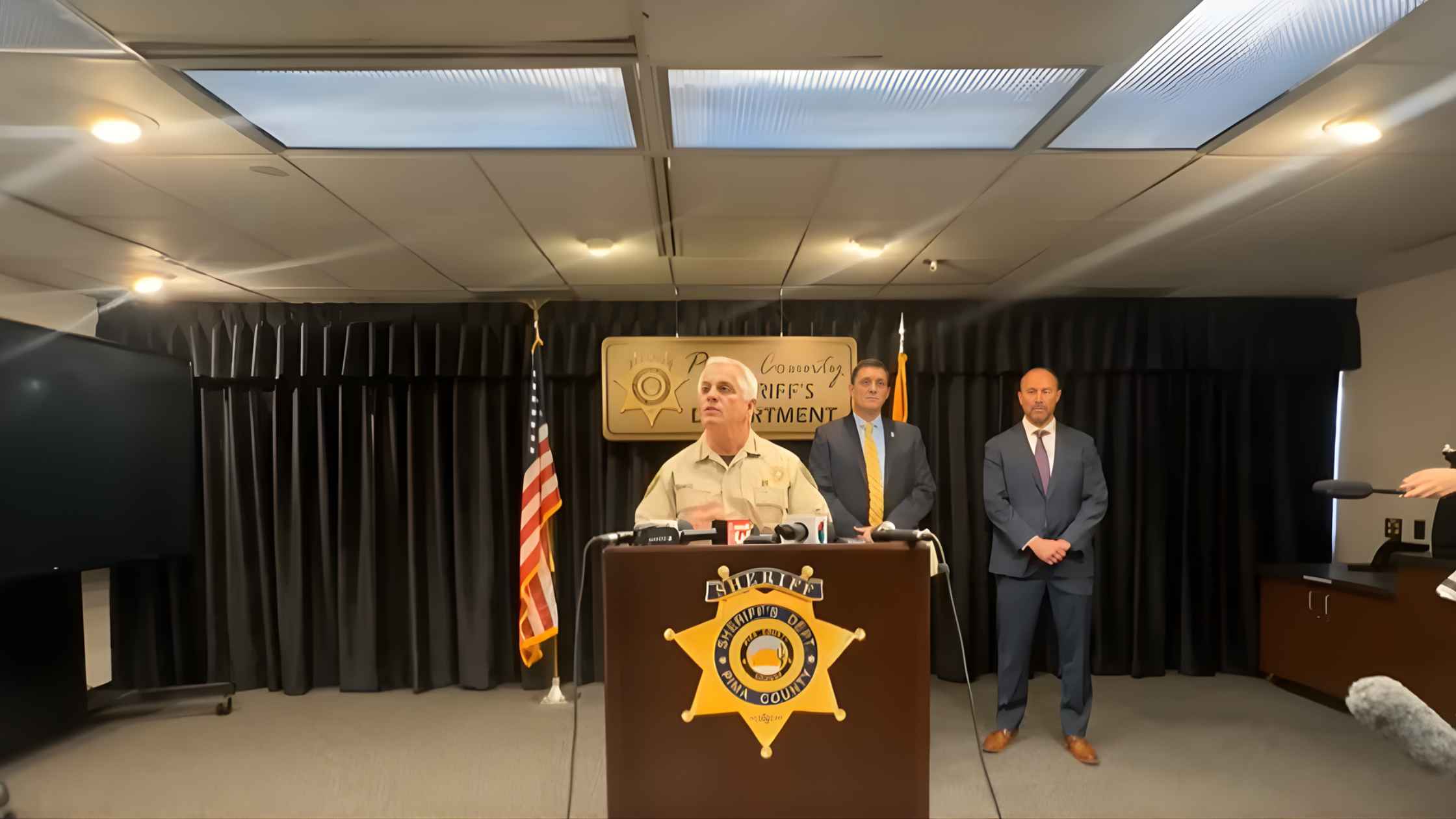
It was pretty clear cut, but I'd like to give you, I think you have a media release with some of those details, but I'll share it with you anyway again. It involves an individual who was involved in human trafficking from an earlier incident. They recognized his vehicle, went, made a traffic stop. When they made that traffic stop, the lone occupant, the driver, fled on foot. The agent, the border patrol agent chased after him on foot. Shortly thereafter, shots were fired from the suspect and the agent returned fire. The suspect was hit and is currently in one of our local hospitals here being treated for his injuries. His condition, I believe, is listed as serious but stable. The agent was not injured in any way, to our knowledge. This is a really ongoing investigation. There's a lot more work to do here, particularly in terms of gathering information from any witnesses and collecting and gathering physical evidence that may be out there in the field, as well as any type of video evidence that we might be able to obtain as well.
(01:12)
So with that, I'm going to introduce a couple of people here. First of all, John Edwards is with the FBI office. He's the here in Tucson and ASAC. And then his boss is Heith Janke. He is the SAC out of Phoenix. He's the FBI head of the Phoenix or the state office here in Arizona. And I can't stress this enough. This is something we do all the time. Pima County, we take great pride in the fact that we were the first agency in the state to coordinate with all of its law enforcement agencies, there's 11 of those agencies in this valley of Tucson, to coordinate our efforts when it comes to critical incidents such as this.
(02:00)
We created what is known as PCROIT. It's our Pima County Regional Officer Incident Team. And it combines effort from all regional partners in the valley. Whenever an incident like this occurs, the agency involved in that incident, particularly say today's incident, where there's a shooting, that agency steps aside and allows all the other agencies to come in and investigate for that for the obvious reason, right? It's transparency. We know that, but it also gives that agency some relief and deconflicting any kind of concerns that may come up from that. It's all about public trust. We get that here in Pima County. And this is something we've been doing for a number of years.
(02:43)
Assisting our federal partners is no different than any other law enforcement agency. We've been tied to our federal partners in similar incidents like this going back for decades. I've been around for almost 50 years here and I remember my time in homicide and this was just routine for us. If you're involved in a critical incident, no matter what agency you're with, you call the Sheriff's Department, we'll step up and help you with that investigative effort and work alongside our partners daily. That's the benefit of working and living here in Pima County is every law enforcement agency, every law enforcement agency head gets along in a great way. We help each other out. I think if you talk to some of your local media here with you, they'll tell you the same.
(03:36)
This is rather unique for us in terms of being the first critical incident team that uses all agencies in the valley to work together. So with that, I'm going to let Mr. Janke come up, give a few remarks, and then from there, we'll take your questions.
Heith Janke (03:54):
Thank you, Sheriff. Good afternoon. I'm Heith Janke, the special agent in charge of the FBI's Phoenix Division. The FBI, through our Tucson office, is leading the federal investigation on the assault of a federal officer, which occurred at approximately 7:30 this morning. We are working this jointly with the Pima County Sheriff's Department and the Custom and Border Protections Office of Professional Responsibility. Our FBI Violent Crime and Gang Task Force, which includes both the Sheriff's Department and CBP OPR, have been out processing the scene and continuing the investigation. We have and will continue to conduct witness, victim, and subject interviews, review and analyze surveillance footage, and recover and analyze evidence.
(04:42)
In order to be transparent with the community, preliminary information as we know it at this time is. While reacting to an active alien smuggling matter, CBP agents came into contact with the subject. During the attempt to apprehend him, the subject used a firearm to shoot at a manned CBP helicopter. The subject continued to flee on foot while being pursued by CBP agents who returned fire. The subject was shot. Aid was rendered by the CBP agents. The subject was transported to the hospital, underwent surgery, and is currently in recovery at this time. The subject, Patrick Gary Schlegel, age 34, and a resident of Arizona is currently in federal custody.
(05:30)
Schlegel has a significant criminal history to include an active federal arrest warrant issued in 2025 by the US Marshal Service for escape related to a previous federal alien smuggling conviction. Schlegel is expected to be charged via a criminal complaint in the District of Arizona with three charges: assault on a federal officer, alien smuggling, and felon in possession of a firearm. We would ask for the community's patience in allowing the investigative and prosecutive process to continue. Let me be clear. Any assault on law enforcement officers will not be tolerated. The FBI will continue to vigorously investigate those who harm or threaten to do harm to those who wear the badge. Thank you.
Chris Nanos (06:28):
So we'll take some questions. Yes, ma'am.
Speaker 3 (06:32):
Can you talk about the federal officer, the agents? Were they injured as well?
Chris Nanos (06:36):
They were not injured, to my knowledge.
Speaker 3 (06:37):
No injury to the federal agents. Okay. You mentioned shots were fired. How many were fired and was it a single agent that fired them?
Chris Nanos (06:46):
I believe it was one agent, the agents who actually made the traffic stop, but we're still looking into all that. We don't have all of our witness interviews done, and I don't have the round counts or number of shots fired, just multiple shots.
Speaker 4 (06:59):
Can you all describe this previous escape you mentioned a minute ago and the circumstances of what he'd been arrested for and how he escaped at that time?
Heith Janke (07:07):
All I can comment at this time, it was for a previous conviction and an ailing smuggling case, and he escaped after that. The US Marshals put out that arrest warrant in 2025.
Speaker 5 (07:18):
Can you talk a little bit about what the differences between the investigation Pima County is doing versus the one that the FBI is doing? Are you separately pursuing evidence or are you working together?
Chris Nanos (07:28):
So we're working together. That's first and foremost. But typically in these incidents where you have a critical incident, officer involved shooting, our incident teams come out and we handle, if in this case, the Border Patrol agent is the shooter, we'll look at the shooting. Any criminal charges related or peripheral to that, that's where the FBI or Border Patrol or the federal government will look at those matters. If there's state charges to be had, we have charges here for could be attempted murder or prohibited possession. Those things can also be presented to our county attorney's office as well in addition. So it's not just one or the other. We can take our charges, and we will, to the county attorney's office and say, "Here's the case," and let them decide what they want to charge with and what level of prosecution is to handle there.
Speaker 5 (08:22):
So is it fair to say that both Pima County and FBI have equal sort of first grab at the other?
Chris Nanos (08:29):
Well, I'll say this right now. He is being held under a federal warrant by United States Marshal's Office. He is in federal custody. We will take our case forward to the county attorney's office, and at that point in time, the county attorney's office will decide what criminal charges she wants to pursue.
Speaker 5 (08:48):
For the person being pursued or for the shooter?
Chris Nanos (08:51):
It could be both. We don't know that. That's what our investigation will reveal. If there was something wrong that the shooter did, that would be there too. We're just gathering all the facts and evidence, present it to the county attorney's office and answer any concerns they may have with that investigation. In this case, we believe our agent in USBP, that agent acted lawfully. That's our belief based on what we know today right at this moment. The investigation is still ongoing. There may be other things that show up. But right now, I'll support Mr. Janke's statements.
(09:31)
Pima County, we're not tolerating any abuse of a law enforcement officer, any assaultive behavior, any type of abuse, but that goes to our citizens as well. The citizen of Pima County know very well where I stand when it comes to violence. We're not tolerating violence to anyone in Pima County. And so we'll look at it all. We'll gather all those facts and we'll be back again in a few days with more information to you so you can assure our communities that the system works. It's worked before and it continues to work.
Speaker 4 (10:03):
Can we clarify how the pursuit began? Were they after this particular person or was it a vehicle behaving suspiciously and the pursuit began for that reason? And was there someone being smuggled in the vehicle?
Chris Nanos (10:16):
So what I understand, and again, the accuracy will be better explained as we get deeper into the investigation, but what I understand occurred is earlier in the morning, before seven o'clock, this vehicle was seen by agents, they had found it with other occupants. When they went to stop the vehicle, everybody fled, the vehicle fled. It's not till later in the morning this agent sees the vehicle again in the area of Arivaca Road and makes a second traffic stop. When doing so, that vehicle pulls over, the driver flees on foot, Border Patrol agent also flees on foot, and the chase is on.
Speaker 4 (11:00):
Was this a specialized border patrol unit or just regulars?
Chris Nanos (11:03):
I have no knowledge of that.
Speaker 5 (11:06):
Is there body camera footage available from the border patrol agent?
Chris Nanos (11:09):
We're looking at all of that right now. I don't know that. I know there's video where it came from. I don't know. I believe they had air assets, but we're, again, that investigation will look at it.
Speaker 6 (11:22):
On the scene, I know obviously everyone was on the scene investigating. We did see pictures of a blue pickup truck there with crime scene tape around it. Can you confirm if that is the vehicle?
Chris Nanos (11:36):
I don't know that. Captain Cornitas was there. Do you know if that vehicle was blue or... I just don't know that. I'm sorry.
Speaker 4 (11:47):
It's an older model of Dodge truck [inaudible 00:11:51] that's what it is.
Speaker 6 (11:52):
Thank you. And you did mention it's just one suspect currently under federal custody.
Chris Nanos (11:56):
Correct.
Speaker 6 (11:57):
There was nobody else in the vehicle perhaps at the moment of the incident?
Chris Nanos (12:00):
No, no. Not at the time of the shooting, no.
Speaker 5 (12:05):
So the person fled on foot, the suspect fled on foot, the border patrol agent pursued and the shooting happened away from this vehicle that had been stopped during the traffic stop?
Chris Nanos (12:14):
Correct. I'm not sure. I believe it's just south of the location of where the stop was made, but I don't know how far he got into the desert area. Again, if you look at Arivaca, that's a very rural community. And so yeah, it's a pretty tough desert terrain, but I couldn't tell you any more than that.
Speaker 7 (12:36):
In previous instance, the FBI has actually run herd on investigations involving Border Patrol without the sheriff's department. Is there a shift here that's happening where you're actually really having the sheriff's department really involved in this particular shooting? Can you talk a little bit about whether this is a change or why this case is also really involving the sheriff's department?
Heith Janke (12:58):
No, I think here in Arizona, we work investigations together. So the FBI, we're brought in for that transparency of being that neutral federal agency to come in and work that assault on a federal officer. So we are here to gather every single fact and be able to know exactly how things transpired, but we do that cooperatively amongst the law enforcement agencies, including the sheriff's department, including CBP. That is common throughout when we work investigations. So there's no change here.
Chris Nanos (13:28):
Yeah. Let me add to that. Well, it makes us sound like we're really terrible here in Tucson. We get contacted by the FBI, DEA, ATF, whoever may be involved in these matters on a constant basis when these things occur. There's some discussion, a decision as to who's handling it and what the reasons might be. It could be from staffing is available or not available. It could be whatever it is. In this case, to me, I think the decision to turn it to the sheriff's department was more than appropriate. One, because we always do that. We have some expertise from our past regional incidents we've covered, and we have probably more manpower than the FBI here locally does, and we're able to help and respond to those things. But more importantly to me, I think on everybody's mind is what we've seen going across the country.
(14:29)
Why would you not do what you normally do? If it's worked in the past, why would you not do that? And this is, to me, when we were asked, it was a no-brainer for me. Absolutely. We'll get out there, we'll investigate. The investigation will show one way or the other what actually happened there, and then the community can decide whether or not this was appropriate or not. So far what I'm seeing, I believe it's appropriate, but we'll continue with the investigation. We'll take that investigative report to the county attorney's office and they can see for themselves. In the meantime, criminal charges, the FBI will bring forward, they'll affect the arrest on the ... They have affected the rest on the outstanding warrant, and they will continue that prosecution with the US Attorney's Office.
Speaker 5 (15:16):
Sheriff, when an investigation is completed, what kind of format can the public expect? Would it be a long form investigation that people can access online? Would it be press releases?
Chris Nanos (15:27):
Well, our investigations don't go online for obvious reasons. Look, it's like any other criminal investigation. We conduct criminal investigations every day. Could be a fraud case, could be a robbery, could be an officer homicide. The investigation does... When it's complete, that is packaged up, taken to a prosecutorial office in this case, county attorney's office, and they make decisions as to charges. That process is all there. It's really just about following the law. It's not anything new for us. It's not something that, "Oh my goodness, we've never done this before." And so does the community have access to it? Everybody has access to it according to public records laws, right? You know that while it's investigated, we can't release that type of information out. But once the case is resolved, then public records requests come in and we meet those.
Speaker 5 (16:18):
Critical incident investigations in the past though that have involved law enforcement local to within the critical incident team here have included at the end, a sort of video breakdown, whether body camera footage and a sort of written breakdown of what happened. Is that going to be happening in this case?
Chris Nanos (16:37):
Yes. The same process we do with all of our officer involved shootings. We will put together the case. We will talk during the investigative process, not just to the end, but during it, we'll be talking with our partners from the FBI, letting them know what else we've learned, showing them things, get with them, debrief them, and we discuss what is or shouldn't be put out to the public media or whatever, because some things are sensitive for the... And you have to understand that I'm not the prosecutor, but the prosecutor may have a reason, a prosecutorial reason to say, "I want this evidence kept aside because it may help me in this strategy or with that strategy." Those are for the prosecutor to decide. We simply sit back and say, "Here's the shooting." We produce what we know of the shooting to the media, and then we hope you will present that to the community, what it is that we've seen with the cases discover-
Speaker 3 (17:40):
Can you say if the subject is a US citizen as well as-
Chris Nanos (17:40):
He is. He lives in the town of Sahuarita. Sahuarita is a... I think it's outside the Green Valley area. It's an unincorporated area of Pima County and it's, what is that? Maybe 20 miles south of where we're at here.
Speaker 3 (17:59):
And can you say how many times he was hit, he was struck by the firearm?
Chris Nanos (18:03):
I cannot say that right now.
Speaker 3 (18:06):
Thank you.
Speaker 8 (18:09):
Good afternoon. [foreign language 00:18:09] Today members of the community are calling for an emergency protest because of this shooting where they just hear a Border Patrol agent is involved in another shooting. This is because obviously what is happening in nationwide, these two shootings that we see in the past, do this kind of ambient or this situation is becoming harder for us law enforcement, either for the sheriff's department, the FBI knowing that the fact that the community just hear border patrol agent shooting, immediately they think that you already do something wrong?
Chris Nanos (18:46):
I clearly understand the sensitivity of these types of events in today's world and climate. I too get upset just like our citizens when you see something that you think is just really, "Wow, that couldn't happen. That's my profession and we don't do that." I understand all that thinking. All I can tell you is from the Pima County Sheriff's Department and this community, we take all of these matters very seriously. We've been, I think long before I've been here, this county has always had, I believe, the best service available from its law enforcement partners. That continues today. I am very blessed to have the team I have work for me. They make me look like a hero every single day and I do so little. But I will tell you, this case, like any case we deal with, will be done by what we call the rule of law. We have processes, we have procedures, we follow those processes and we take all the information and move it forward for somebody to make a decision as to what happened here and what should happen further.
Speaker 8 (20:00):
Sorry, to follow up, what will be the message for the community?
Chris Nanos (20:02):
The message for the community is we think we built a great relationship with our community here in Pima County. And it's not just here, it's in our traffic units, in our school resource officers, in our men and women out on the street. We've built a very strong tie to our community that says, "We hope you can trust us to do the right thing because that's what we teach here." You do the right thing every single time, every time. That doesn't mean we won't make mistakes. I make them all the time, but those are mistakes of the head, never the heart. And that's what our team is about. We do the right thing.
Speaker 8 (20:42):
Thank you.
Speaker 5 (20:44):
Quick question for the FBI, and might not be around your jurisdiction, but Customs and Border Protection for a time was posting an edited version of body camera footage taken from critical incidents or use of force incidents during a Biden Era initiative to increase accountability and transparency, things like that. That hasn't been happening at least in recent months. Do you know what the status is of what that'll look like in terms of what sort of information from the FBI side or the federal government side is going to be released to the public?
Heith Janke (21:19):
Yeah. So where we're at now, like I said during my statement, we've submitted where we believe three charges for a ... criminal complaint to the US Attorney's Office. And now once those charges, if that complaint is granted, the prosecutive stage will take off. So that will go through the courts and through the US Attorney's Office and the public can follow along at that time to see how this transpires. As far as the beginning of your question and CBP and all that, that would be out of my lane to answer and you would have to go to that agency.
Speaker 5 (21:51):
Sure. So is it fair to say at this point that FBI will be handling the assault portion and Pima County's handling the use of force portion of the investigation?
Heith Janke (22:02):
So that's all part of the overall investigation, right? We have to follow the facts and see what the entire scenario and incident involved, which includes all of those things. So that will be part of the overall investigation. What we're confident in and of the public is the facts that we've already gathered today, that we are seeking that federal criminal complaint for the actions taken by Mr. Schlegel against those CBP agents.
Speaker 5 (22:29):
And at this time, the assault in the complaint would be the shooting up at the helicopter and the exchanging gunfire with the agent on the ground?
Heith Janke (22:39):
I think at this time we want to leave it just how we have those facts. This is still an ongoing and active investigation and we are doing this very early on because we want to be transparent with the community for those exact things that you commented about of we want to put out as much as possible, but we also need to respect the prosecutive process. This individual is presumed innocent until proven guilty, so we need to keep that in mind as we're putting out additional facts. So we'll leave what we put out on those limited facts today, knowing that the investigation will continue and we will know everything at the end.
Speaker 5 (23:15):
Could you just spell your name for the case?
Heith Janke (23:17):
Yeah. So H-E-I-T-H, last name is Janke, J-A-N-K-E.
Speaker 5 (23:21):
Thank you.
Chris Nanos (23:25):
I'm going to go outside this more to my local media, but you asked something about body-worn cameras and that. And recently, my office made a request to my board of supervisors who handles the finance part of what we do here in the sheriff's department. And I really want to let the community know that body-worn cameras, technology is where law enforcement not only is headed, but needs to go that way. We can't, just because we are fearful of the potential misuses of cameras or constitutional rights being abused, we can't let that make our decisions based solely on that. We have solved a number of homicides in record time. Last Christmas, 24 hours after a homicide, a brutal homicide, we found the suspect because of technology. Just recently, this Christmas, again, within 72 hours, a brutal crime, no clue who did it, again, because of the technology there.
(24:35)
To this community, technology is advancing so fast, so quickly. If we don't stay up with it, we're doing a disservice to our community in the way we don't investigate things. Every tool out there that's available to us, we should have to complete a very thorough investigation as quickly as we can. And so I'm sorry for getting political with you there, but I heard your question. I couldn't help myself. Anything else?
Speaker 3 (25:10):
Just to clarify the location, it sounds like the agent recognized the vehicle on West Arivaca Road, and at some point the person fled in that area, but this is all north of the town of Arivaca, am I right?
Chris Nanos (25:23):
No, actually, so the town of Arivaca is, you go down I-19 and you head west on Arivaca Highway. This is about milepost 15, a little further west, that road wind. So you could be right technically it'd be north, but it's actually east of the town of Arivaca is my understanding. Am I accurate there, Luis?
Speaker 9 (25:49):
[inaudible 00:25:52]
Chris Nanos (25:52):
Okay. I believe that's the case.
Speaker 4 (25:54):
At the risk of a dumb question, I just want to be sure. The helicopter was airborne or had landed when shots were fired?
Chris Nanos (26:02):
I really don't know that I believe it was airborne though, but I ...
Heith Janke (26:09):
Yes, it was airborne.
Chris Nanos (26:14):
We still have investigators on the scene doing all of these things that you're asking about, and that's one of the reasons we're kind of hesitant to say things until they actually come back to us. I'm hoping later this evening, maybe tomorrow morning, we'll get more briefing from the actual scene investigators.
Speaker 5 (26:32):
Are you able to say the miles in between that initial traffic stop, the fleeing, and then the gunfire shots fired on there?
Chris Nanos (26:40):
We hope we'll be able to tighten all of that down and be able to... We use Leica and different things, our own drones to process that crime scene, and so they have such technology, again, that can come in here and you could find a pencil on the floor. Yeah, all of that thing's handled by our crime scene technicians.
Speaker 4 (27:03):
Can you all be more specific about the type of weapon Schlegel was using?
Chris Nanos (27:07):
I don't have that. I really don't. I believe I heard it was a 45.
Speaker 4 (27:12):
Okay, I just long gun, handgun.
Chris Nanos (27:14):
A handgun.
Speaker 6 (27:16):
Was the border checkpoint on Arivaca Road shut down today?
Chris Nanos (27:19):
I don't know that.
Speaker 7 (27:21):
You don't know what is was then?
Chris Nanos (27:22):
I'm sorry?
Speaker 7 (27:23):
It wasn't shut down?
Chris Nanos (27:24):
It wasn't shut down when we went there, but I don't know what time they open or not. Yeah, that's a better question for Border Patrol.
Speaker 7 (27:30):
It was closed for a bit.
Chris Nanos (27:30):
I'm sorry?
Speaker 7 (27:30):
They had it closed for bit.
Chris Nanos (27:34):
Okay. Yeah. Yeah. I think you're better off asking them the hours they were operational.
Speaker 5 (27:41):
And just to clarify, since this has been a question we've seen in other parts of the country after shootings involving federal officers, do you as the local entity feel that you have full access to body cameras, other evidence, on the ground evidence, sort of, I guess unimpeded?
Chris Nanos (28:00):
Yeah. Yeah. Trust me, if you asked us to come and assist you and you were going to impede our assistance, we'd just pack it up and go away. But you're asking us to assist you. That means you're going to... We've never had that problem. So yeah, I don't see it. I've not heard that. Yeah. No.
Speaker 5 (28:27):
Thank you.
Heith Janke (28:28):
Thank you.
Chris Nanos (28:28):
Thank you.
Speaker 5 (28:28):
Could you state your name one more time, sir?
Jon Edwards (28:28):
Jon Edwards.
Speaker 5 (28:28):
Jon Edwards. And that's J-O-H-N?
Jon Edwards (28:28):
J-O-N.
Speaker 5 (28:28):
J-O-N. Got it. Thanks. And your title here at Tucson office.
Jon Edwards (28:28):
Tucson [inaudible 00:28:39]
Chris Nanos (28:28):
Hey, how are you doing?
Speaker 3 (28:28):
Good. How are you doing?
Chris Nanos (28:28):
Good. Really. [inaudible 00:28:43] good.
Speaker 8 (28:28):
You working. How are you?
Chris Nanos (28:45):
Just working.
Speaker 8 (28:48):
Yeah. You remember me? I interview you when you were a candidate. I went to your house [inaudible 00:28:55]
Chris Nanos (28:51):
Oh, yeah, outside-