

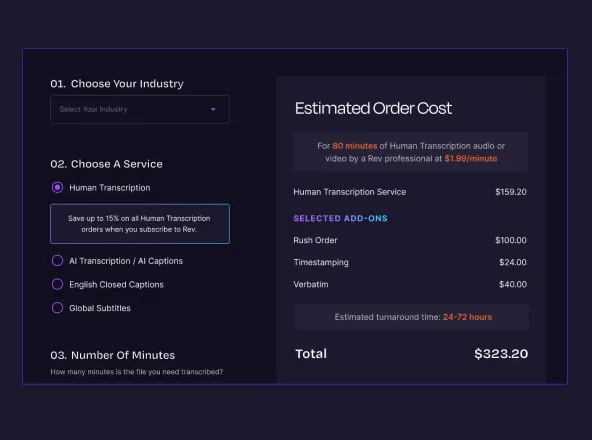
Medical Legal Transcription Tips to Transform Your Practice
Medical legal transcription plays a critical role in medical cases like malpractice claims. Here’s how legal teams can improve transcriptions for medical cases.

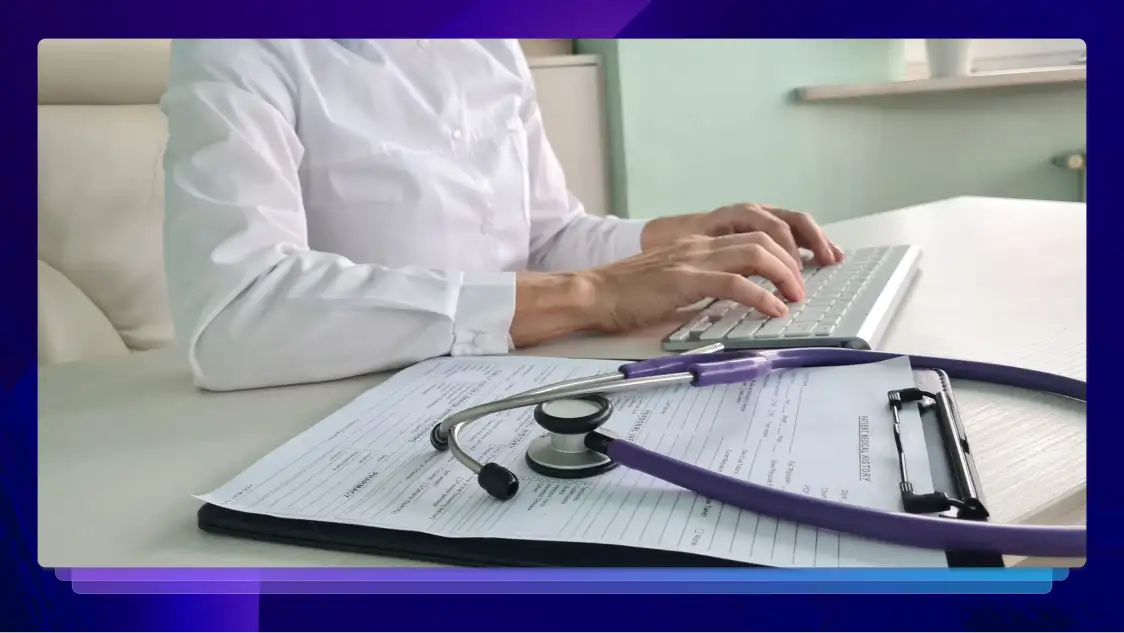
Medical cases involve high stakes and heightened emotions. In these cases, which include medical malpractice, accidental injuries, or even death, patients are often seeking answers, families are hoping for justice, and healthcare professionals are under intense scrutiny. When medical transcriptions are brought into the courtroom, they’re more than just documents— they’re evidence that shapes a case’s outcome.
Given the weight of these documents, accuracy is critical. Medical legal transcription services ensure that complex medical terminology and sensitive case details are captured with precision, accuracy, and compliance.
In this article, we’ll go over everything you need to know about medical legal transcription and share tips for getting reliable transcripts.
What Is Medical Legal Transcription?
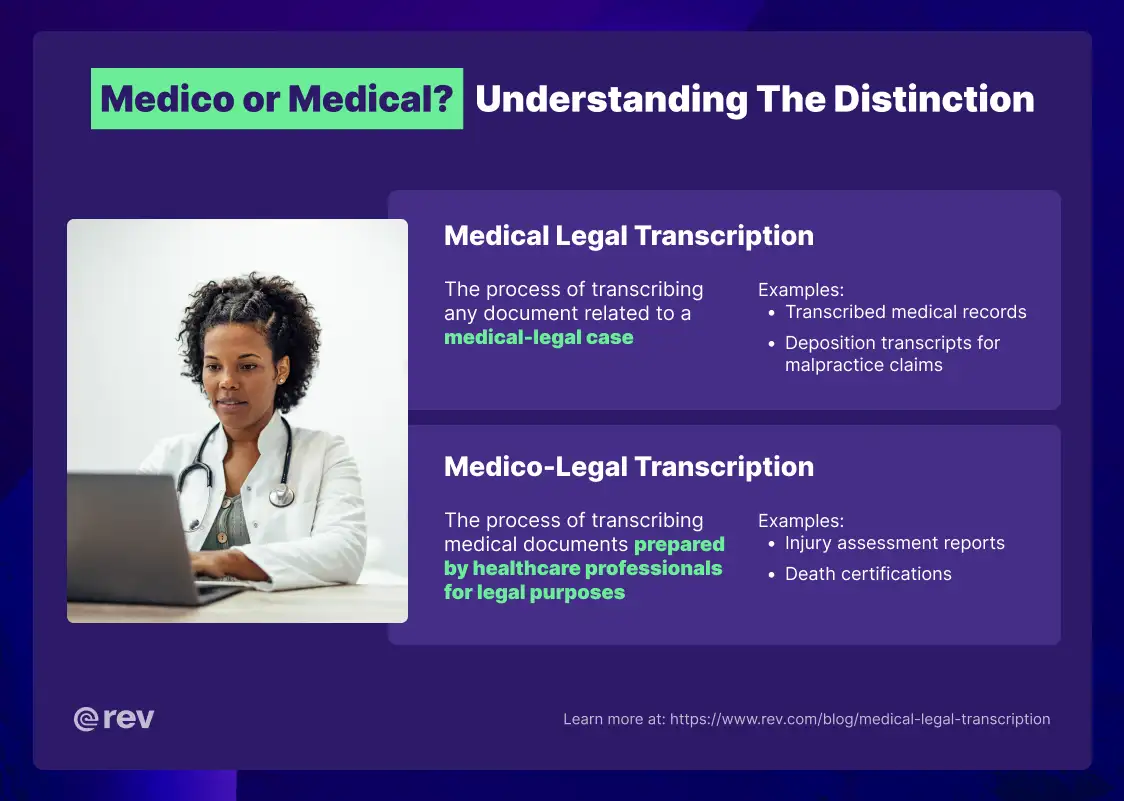
Medical legal transcription is the process of transcribing any document related to a medical legal case. This includes transcribing medical records and depositions for cases such as malpractice claims or insurance disputes.
Essentially, medical legal transcription is a broad term that encompasses any medical document used in a legal context. It’s not to be confused with medical transcription. Medical transcription is when healthcare professionals turn voice notes into written text.
What About Medico-Legal Transcription?
Medico-legal transcription is the process of transcribing medical documents that were prepared by healthcare professionals for legal purposes.
Medico-legal documents are forensic-focused, often prepared by medical examiners and forensic pathologists. These documents also play a critical role in medico-legal cases, which are cases of injury or illness where law enforcement gets involved or conducts an investigation. This is a specific subset of medical legal cases, hence the more specific terminology.
Examples of medico-legal documents include autopsy reports, injury assessment reports, and death certifications.
Types of Medical Legal Transcription
It’s estimated that 80-90% of medical malpractice claims are settled before reaching trial. However, when a case does reach a jury trial, healthcare providers such as physicians win 70-80% of cases that present weak evidence.
The outcome of medical legal cases hinges on the medical evidence that legal teams choose to present—from medical records and timelines to autopsy reports and medical evaluations.
The most common types of medical documents that need to be transcribed for legal cases include:
- Medical records: This is a comprehensive history of an individual’s health. Documents used for medical records include anything that outlines a patient’s personal information, medical history, diagnoses, treatments, and notes from healthcare providers.
- Medical chronologies: This is a documented timeline of an individual’s experience that led to a medical event. Medical chronologies typically begin when the individual first seeks care, and go on to outline each doctor visit, treatment, and instance of care.
- Insurance claims: Claims provide additional context for a medical incident, such as key dates, policies, damages, and correspondence.
- Autopsy reports: Prepared by forensic pathologists or medical examiners, these documents provide a full analysis of a body’s state at the time of death. Autopsy reports also include a death certificate and act as key evidence during criminal cases.
- Independent medical evaluations (IME): These are often requested by the opposing party in a medical claim case and act as an objective, third-party examination of an individual.
- Depositions: In a medical context, this involves transcribing depositions or expert interviews with doctors, nurses, or other healthcare professionals involved in the case.
Why Accurate Transcription Matters For Your Practice
Accurate transcriptions are critical for all legal cases, but medical cases, in particular, are especially important. Not only do transcriptions serve as legal evidence, but they also preserve the integrity of medical documents.
Nick Heimlich, attorney and founder of Nick Heimlich Law, emphasizes the importance of confidentiality when working with medical documents.
“The distribution of medical documents to people not related to the legal team may result in a breach of HIPAA regulations and weaken the case,” says Heimlich. “The documents should be provided by clients only via encrypted channels.”
Below are the top reasons why accurate medical transcription matters for legal teams.
Compliance
One of the top reasons why accurate transcriptions matter is that they handle sensitive data. Medical documents must be HIPAA-compliant in order to protect the patient’s privacy, and this includes transcriptions of those documents.
Transcription errors could result in privacy violations or non-compliance, potentially exposing legal teams or healthcare organizations to fines and penalties.
To ensure your documents are secure and compliant, use a trusted transcription service that follows healthcare regulations. For example, Rev’s transcription platform was built with security at its core, offering industry-leading security measures such as SSO and MFA, along with file protection and encryption.
Legal Evidence
When you’re working on a medical case — whether it’s a malpractice claim or insurance dispute — the details matter. Medical documents such as autopsies, medical records, and depositions often serve as primary evidence. This means that the strength of a case depends on these documents being accurate.
Any inaccuracies can lead to challenges to admissibility, undermine the credibility of expert witnesses, cause a case to be dismissed, or even result in an unjust outcome because the evidence was wrong.
Understanding medical terminology is also important for the sake of accuracy. Healthcare is a complex industry, so it’s critical to use a transcription service that understands both legal terminology and medical jargon.
Risk Mitigation
In malpractice or personal injury cases, even minor transcription errors—for example, misstating a dosage, diagnosis, or timeline—can shift responsibility and create unjust liability for parties involved.
Healthcare providers, insurers, and attorneys alike rely on precise wording to defend their position and avoid costly disputes.
Accurate records also protect patients by ensuring their medical history is not misinterpreted in legal proceedings. By focusing on accuracy when hiring a medico-legal transcription service, you’re protecting your practice from lawsuits, civil disputes, and much more.
Medico-Legal Speech-to-Text Challenges
The biggest challenge with speech-to-text for medico-legal documents is interpreting the complex terminology. There are countless medical terms that are notoriously complicated: cardiovalvulitis, epistaxis, and choledocholithiasis, to name a few. If a speech-to-text tool isn’t familiar with them, it can be difficult to decipher what was really said.
Misinterpreting or missing a word can drastically alter the context or meaning of a transcript. For example, the terms “ileum” and “ilium” sound the same but have completely different meanings. Ileum is a section of the small intestine, while ilium is part of the hip bone. Not two terms you want to mix up in court!
Because of this, it’s important to use a service with a high accuracy rating. The higher the accuracy, the less chance there is for errors. Additionally, consider tools that also offer human transcription or editing services. Specialized human transcriptionists often have more experience with industry jargon and can ensure that the terms used in the transcript are correct and align with the context.
Security and compliance are also important challenges to address. When you’re handling documents with Protected Health Information (PHI), it’s critical to use a platform that’s HIPAA-compliant and follows the strictest security standards. Using platforms that aren’t healthcare compliant can put your client, team, and case at risk.
While speech-to-text can speed up the transcription process, the complexity of medical and legal language, and the legal consequences of even the smallest errors mean that human review and editing are critical.
Tips For Better Transcripts + Documents
With the significant role transcripts play in medical legal cases, it’s always a smart idea to continue improving the transcription process. If you want your legal team to produce better medical legal transcripts, follow these tips.
Use Tools Built for Healthcare
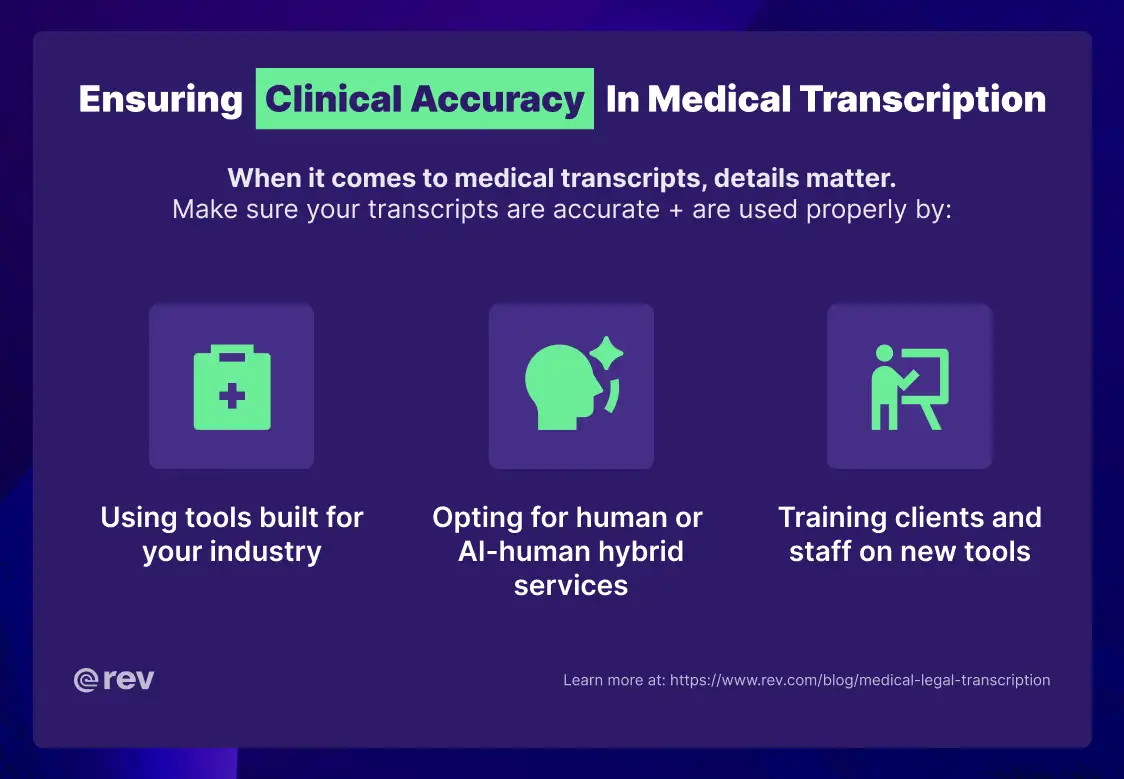
When creating medical legal transcriptions, it’s important to use tools that are built for complex industries such as healthcare and legal. When speech-to-text tools are trained in these industries, they have built-in vocabularies that allow them to more accurately identify specific terms from audio and text files. If you’re working with transcription tools, look for a platform that offers an editable glossary.
Rev, for example, leverages the extensive amount of audio and text data it has accumulated from the medical and legal industries over the years. It also allows for custom vocabularies that let you upload a list of terms to help the tool easily identify or interpret these words within the conversations it’s transcribing.
Human Transcription
For even more accurate transcripts for medical cases, consider using human transcriptionists or including human reviews in your process. Human transcription offers a higher level of accuracy and can give you the option of receiving a verbatim transcript, a type of transcription that provides an exact representation of what was said and how the speaker said it. This is crucial for getting a deeper context for medical legal cases.
Training Clients and Staff
When working with clients or expert witnesses—including doctors and other healthcare professionals—it’s also a good idea to train them on how to speak when being interviewed or transcribed, just as you would prepare them for trial.
Explain the need for clear communication, limiting the use of unnecessary jargon, and being specific when talking about facts related to the case. The clearer they can be while being interviewed, the easier it will be to decipher the transcript, leaving little room for errors.
The Future of Medico-Legal Transcription
As transcription technology develops, legal and medical teams can use it for even more advanced case analysis and other needs.
Below are a few areas where medical legal transcriptions are evolving:
- Image recognition: Speech-to-text tools will soon be able to interpret and identify medical images such as medical charts, scans, x-rays, and other medical imagery. However, accuracy isn’t guaranteed—the average error rate for image recognition is 3.4%.
- Sentiment analysis: As AI tools continue to evolve, they’ll get better at interpreting sentiment. Sentiment analysis is the process of analyzing digital text to understand the emotional tone—whether positive, negative, or neutral. This can provide legal teams with even more context for their cases, whether they’re listening to a deposition or a physician’s voice notes.
- Multi-file analysis: Transcriptions will go beyond simply translating audio to text. With tools that offer multi-file analysis like Rev, you can easily analyze all your audio, video, and text evidence in one place for more comprehensive insights.
Getting Medical Legal Transcriptions Right
Accurate, precise medical transcriptions are critical for medical legal cases. By understanding the need for compliance and security, prioritizing accuracy, and using healthcare-experienced transcription services, legal teams can reduce risk and ensure their medical legal documents not only hold up under legal scrutiny, but contribute to an effective case strategy.