Law Enforcement Technology Shaping The Future of Cases
AI, drones, and digital evidence tools are helping transform evidence into insights. Learn more about the latest law enforcement technology with our guide.


Law enforcement, like many industries, is undergoing a technological revolution. From automatic body camera transcription and drones to AI-assisted analysis and gunshot detection systems, police technology is reshaping how agencies prevent crime, investigate incidents, and prepare airtight cases.
If your department is drowning in mountains of digital evidence, it's worth exploring how these tools can help streamline case analysis and turn media into searchable insights—fast. Below, we break down tools to consider, pros and cons of each, how to integrate law enforcement technology the right way, and how Rev shines as your newest investigation assistant.
What Is Law Enforcement Technology?
Law enforcement technology is a term that describes the set of tools, software, and equipment that help law enforcement agencies prevent, investigate, and prosecute crime. The goal with this technology is not to take over police officers' jobs, but instead to help them work more efficiently and fairly.
Think beyond computers; this type of tech includes everything from body cameras and AI crime prediction software to biometric scanners and drone surveillance systems. At its best, the latest technology is a force multiplier—improving response times, surfacing leads, enhancing public safety, and tightening case preparation.
Let’s dive into the actual tech below:
1. Body-Worn Cameras (BWCs)
Body-worn cameras capture what officers are doing in real time, including public interactions, traffic stops, arrests, and more. These devices capture high-definition video and audio during police encounters, providing an objective record that can be invaluable during investigations, court proceedings, and training.
The benefits of body cameras extend beyond evidence collection—they also promote accountability, reduce complaints against officers, and can actually protect both police and civilians by providing clear documentation of events. It’s an essential tool, especially when public trust wavers.
However, departments face challenges like the cost of data storage, privacy concerns, and the time it takes to review and analyze footage. The sheer volume of video often requires sophisticated digital evidence management systems (DMS) and transcription services to convert footage into searchable, court-ready documents.
Despite this, the overall sentiment on integrating cameras into daily police activities is positive. But in order to make the most out of this tech, law enforcement leaders need to define rules and regulations for their staff, including redaction workflows, camera activation, and data storage.
2. Artificial Intelligence and Analytic Software
There’s virtually no industry that hasn’t been impacted by AI in recent years, and law enforcement is no exception. AI and analytical software can help police with pattern detection, video search, license plate recognition, and drafting narratives from both structured and unstructured data.
Integrating this type of tech into modern policing can help with faster lead generation, highlight crime patterns, accelerate video review, and reduce the overall administrative load. With legal AI and transcription services like Rev, you can upload all your case files at once, analyze them in an instant, and ask AI questions about your case to get source-cited responses.
But that’s not to say there aren’t risks with this new technology. Just like humans, AI can be prone to bias and mistakes, so strict review, regular audits, and security measures should be put into place alongside any new software.
Expert tip: When narrowing down your AI tools, make sure to look for human-in-the-loop review services, high levels of accuracy, and robust security measures to help safeguard your department from any issues.
3. Drones and Robotics
There is more to drones than capturing an aerial view of a landscape or concert—especially when it comes to criminal investigations. Drones and other types of robotics can provide remote views for search-and-rescue efforts, aid in overwatch, help with accident reconstruction, and even provide important information to EOD and SWAT operations.
These devices help improve officer safety, provide otherwise unknowable information, provide an objective overview of events, and cost less than similar manned operations. But issues such as public privacy, flight rules, weather, ongoing maintenance, and department training are all things that need to be considered before usage begins.
To take advantage of these benefits without compromising public trust, make sure to address community concerns ahead of time, define geo-fences before flying, and train operators well. This ensures future teams are always transparent, without sacrificing advances in technology.
4. Police Communication Technology
Communication is vital to nearly every aspect of law enforcement, from effective communication with the public to internal data sharing to solve cases across state or city lines. Digital radios, FirstNet cell service, computer-aided dispatch, and secure messaging platforms allow for quick responses, streamlined communication to units en route, and improved officer and public safety.
While there are a variety of benefits to these communication platforms, it’s important to take precautions before implementing them department-wide. Issues such as coverage dead zones, device overload, and security concerns can harm your department. To ensure you’re integrating communication tech the right way, set up a full tech migration plan, train your staff, and plan around coverage gaps in your area.
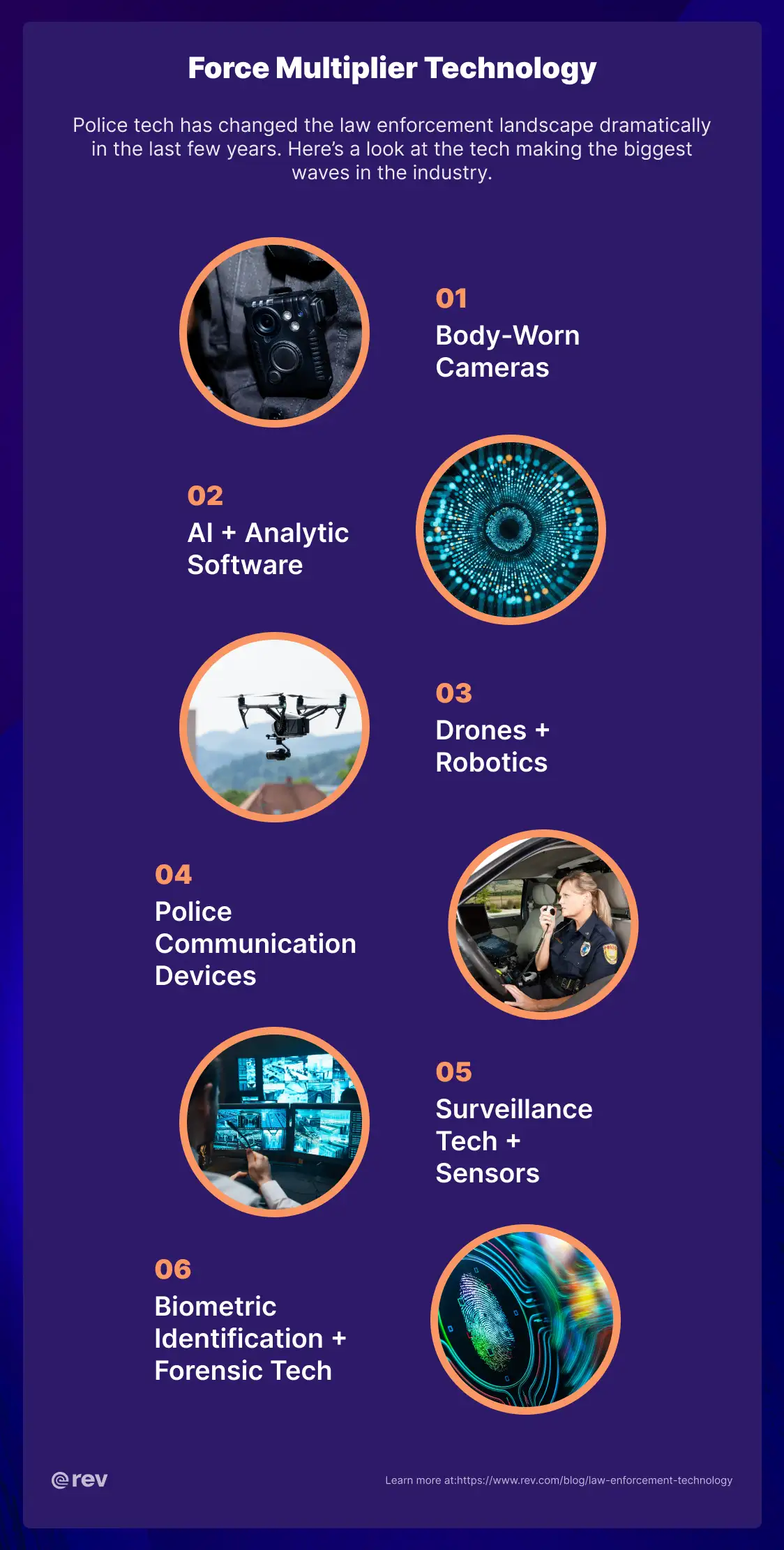
5. Surveillance Tech and Sensors
Consider this type of tech an extension of your eyes and ears. City cameras, automated license plate readers, and gunshot detection technology all fall within this category and help share crime data in real time.
For example, if your department uses ShotSpotter technology, you could be alerted as soon as a firearm is discharged in your monitored area. Getting an alert before the 911 call even comes in (if it comes in at all—studies have shown 80% of shootings are never called in) can mean the difference between recovered evidence and a compromised crime scene. That alone may be worth the high cost of these data collection devices, especially for departments that are already stretched thin.
To ensure proper use of this technology, clear access policies need to be set. Regular audits and clear communication are also vital to this technology benefiting the public.
6. Biometric Identification and Forensic Technology
Biometric identification systems have revolutionized how law enforcement identifies suspects, victims, and witnesses. Unique things like fingerprints, facial features, DNA, and iris patterns are all taken into account when investigating both civil and criminal cases.
From Automated Fingerprint Identification Systems (AFIS) that can search through millions of records in seconds, to facial recognition technology that can identify individuals in crowds, there are a lot of ways forensic technology can track people digitally.
In addition, DNA analysis has become increasingly sophisticated, with new techniques that allow investigators to extract genetic profiles from older evidence. Rapid DNA analysis systems can now provide results in hours rather than weeks, enabling faster case resolution and more timely arrests. Some departments are also exploring newer biometric technologies like gait analysis and voice recognition to expand their capabilities.
These forensic technologies significantly improve case closure rates and help ensure accurate identifications, but they also raise important privacy and civil liberties concerns. Departments looking to implement this tech should focus on creating protocols for data collection, storage, and sharing. They should also conduct ongoing training for staff to maintain the chain of custody and ensure admissibility in court.
How Police Tech Has Changed Over The Decades
It’s easy to see that law enforcement technology has gone through one of the most dramatic transformations in policing history. Just a few decades ago, police work relied on paper, analog radio, and basic computers. Officers often had to return to the station to access criminal databases or file reports, creating significant delays in investigations and response times.
The digital revolution of the 2000s introduced computerized record management systems, early GPS tracking, and the first generation of in-car computers. This period saw the emergence of crime mapping software, basic data analysis tools, and call phones, which transformed how departments understood crime patterns, allocated resources, and communicated.
Now, cloud computing, artificial intelligence, social media intelligence, and IoT sensors have created an interconnected ecosystem of law enforcement tools. According to recent criminal justice statistics, over 80% of large police departments require their officers to wear body camera, showing just how widespread this implementation has become. And with all this data collected, it’s clear that the future of policing will require sophisticated systems to manage and analyze their data at scale.
Drawbacks of Law Enforcement Tech
Even the best police technology brings trade-offs. The rapid pace of technology often outpaces training programs, leaving officers struggling to properly use new tech while maintaining their focus on core policing duties.
Key drawbacks include:
- Adoption challenges: Officers need comprehensive training on new systems, and any resistance to change can slow adoption rates.
- Bias and accuracy: AI and other automated systems can perpetuate biases that already exist or produce inaccurate results if not properly trained and monitored.
- Cost: Technology isn’t cheap, especially at first. Add to that the ongoing expenses for licenses, hardware updates, and technical support, and the high cost may be a hindrance to some departments.
- Data security: Storing sensitive information digitally creates cybersecurity risks and potential for data breaches.
- Integration issues: Different systems often don't communicate effectively, creating information silos and workflow disruptions.
- Privacy: Extensive surveillance systems and biometric identification raise concerns about privacy and constitutional rights for civilians.
Ethical Considerations of Police Technology
We’d be remiss not to mention the complex ethical questions that departments must address to maintain public trust and ensure compliance. Privacy concerns top the list, as surveillance systems and identification technology could potentially infringe on citizens' privacy rights and Fourth Amendment protections.
Algorithmic bias presents another critical ethical concern, particularly in AI systems used for predictive policing or risk assessment. These systems can perpetuate historical biases, potentially leading to discriminatory actions that disproportionately impact certain communities. Departments must implement regular bias audits, diverse training datasets, and human oversight to ensure fair and equitable use of this technology.
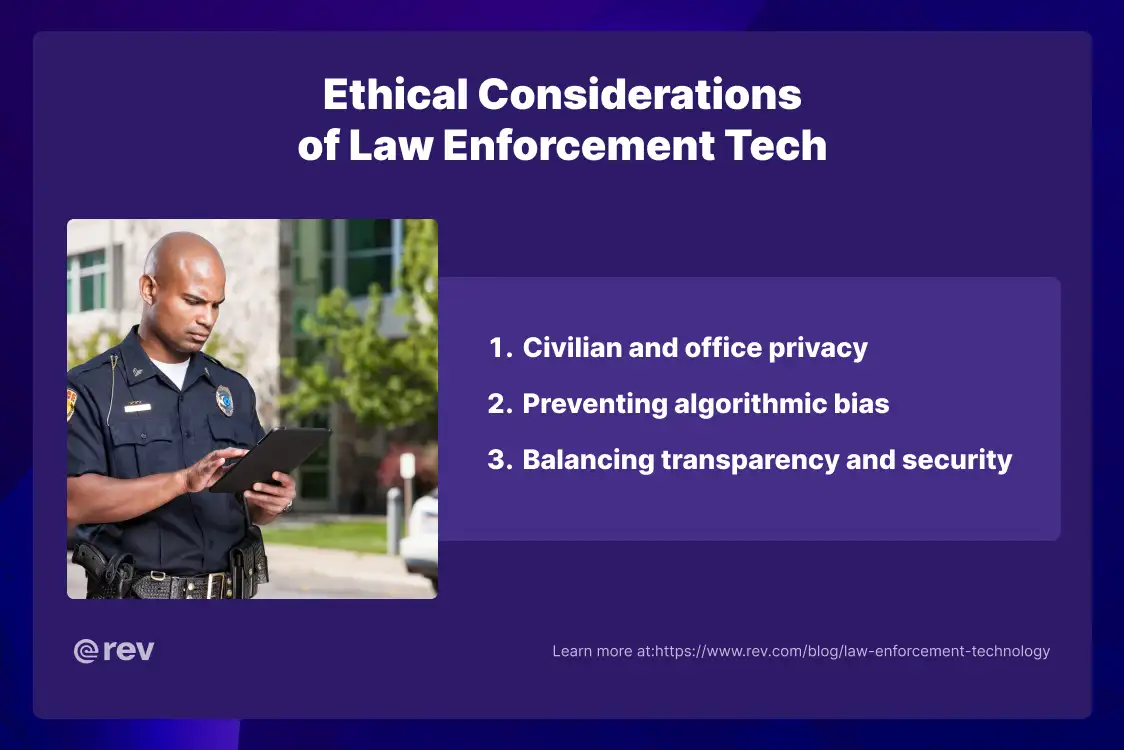
Transparency and accountability become increasingly complex as technology advances. While citizens have the right to understand how they're being monitored, departments must balance transparency with operational security.
Establishing clear policies for technology use, creating community oversight guidelines, and being transparent with the public can help maintain the delicate balance between effective law enforcement and constitutional protections. Hiring training officers for both the technical and ethical aspects of these tools will be essential for responsible implementation.
Do Police Use AI To Solve Crimes?
Yes, police use AI to help solve crimes, and they are doing so at an increasing rate.
AI applications range from pattern recognition and data analysis to suspect identification and case prioritization. These systems can process vast amounts of data at once, identifying connections and patterns that would take a human weeks (or even months) to discover. However, AI is often serving as an investigative tool rather than a replacement for human judgment, as officers are ultimately responsible for interpreting results and making enforcement decisions.
Trends and Predictions in Law Enforcement
Similar to decades past, the future of law enforcement promises even more changes as technology advances and costs are cut, meaning implementation will eventually reach even the smallest departments in the country.
Integration will be a key trend, as more connected systems will allow for seamless data sharing across platforms and jurisdictions. We can also expect to see continued growth in real-time analytics, automated report generation, and decision support systems that help officers make faster, more informed choices.
Virtual reality training, augmented reality field support, and advanced biometric identification will likely become standard tools, while quantum computing may eventually revolutionize data processing and encryption capabilities for law enforcement technology and various applications.
Streamline Investigation With Rev’s Documentation Services
Modern law enforcement generates unprecedented amounts of digital evidence, and managing this evidence effectively requires more than just storage—it demands accurate, searchable documentation that can withstand legal scrutiny and support successful prosecutions.
As litigation paralegal Joselyn Sosa from Casey Gerry explains: "We rely heavily on police reports, 911 call logs, arrest records, body cam footage, accident reconstruction reports, as well as photos, witness statements, and information collected by law enforcement. These vital documents help us to corroborate testimony, determine liability, establish violations under the law, retain important pieces of evidence and information that would otherwise be lost, and so much more."
Rev's professional transcription and documentation services help law enforcement agencies transform their digital evidence into accurate, court-ready transcripts that can be easily searched, referenced, and analyzed. By partnering with Rev, departments can focus their resources on what matters while ensuring their critical evidence is properly documented and accessible whenever they need it.