
How To Run A Focus Group From Recruitment To Analysis
Learn how to run a focus group step by step, from setting goals and recruiting participants to moderating, recording, and analyzing results.


If you survey eight people on whether they’d use a new service, you’d only get a percentage. But if you put the same eight people around a table, you’d hear why two of them love it, why three are lukewarm, and the one objection nobody on your team has thought of before. The percentage tells you where people land. The conversation tells you how they got there.
A focus group is a moderated discussion designed to show how people think, feel, and talk about a topic in their own words. Focus groups can give you unique insight into how your target audience thinks, and can often uncover friction points you never would’ve discovered from more traditional surveys.
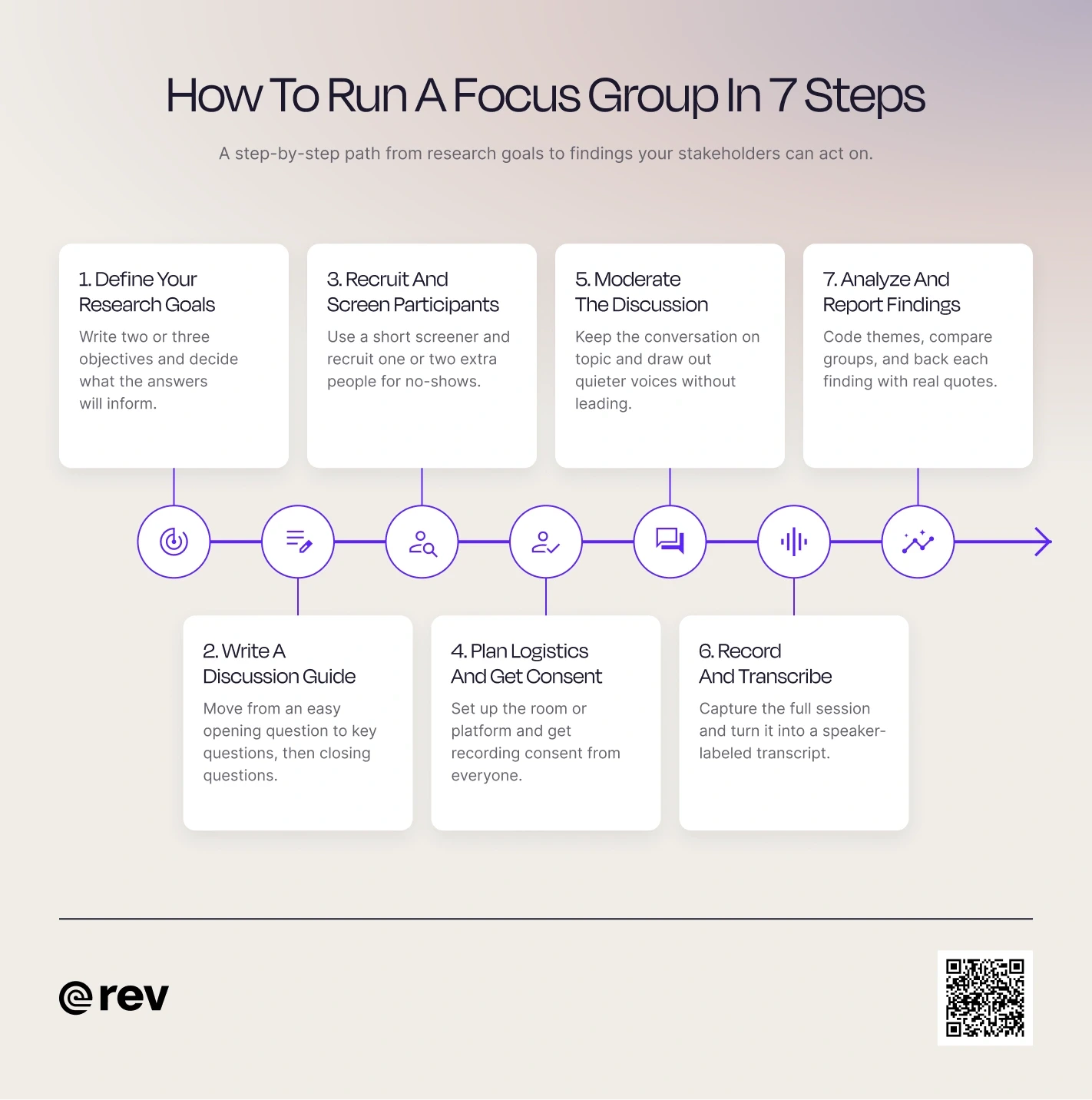
Learning how to run a focus group well comes down to seven steps, from setting goals and recruiting the right people to recording the session and turning the conversation into findings. Here’s how to handle each one.
1. Define Your Research Goals
Start by making a decision on what the research should inform. A product team choosing between two messages, a nonprofit testing a new program, and a trial team testing a case theory all need different questions, participants, and analysis. Write down two or three objectives and what you’ll do with the answers.
Then confirm that a focus group is the right method for your needs. Qualitative research focus groups are good at surfacing shared language, reactions, and disagreement, but they aren’t the best fit for sensitive topics or detailed individual histories. If you need depth from each person, compare focus groups vs. in-depth interviews before you commit.
2. Write a Discussion Guide
Your discussion guide is the script the moderator works from. It lists every question in order, with rough timing and optional probes. Most guides move from broad questions to more specific ones, to help keep the conversation on track without losing the opportunity for new information to surface.
Plan for three kinds of questions: an easy opening question that gets everyone talking, a handful of key questions that take up most of the session, and closing questions that let participants add anything you missed. Keep the guide short enough to leave time for follow-ups.
What Questions Should You Ask in a Focus Group?
You should ask open-ended questions tied directly to your research goals, such as “Tell me about the last time you…” or “What stood out to you about…” Avoid yes-or-no questions, questions that hint at the answer you want, and “why” questions, which can come across as accusatory. “What made you choose that?” gets the same information with less defensiveness.
3. Recruit and Screen Participants
Recruitment determines what you’ll learn. Write a short screener that confirms each person matches the profile you need, such as recent buyers, program participants, or jury-eligible adults in a trial venue. Screen out people who know each other, work in the field you’re studying, or have a direct conflict of interest to the topic or subject at hand.
Offer an incentive that respects participants’ time, around $20 to $35 in cash or gift cards for community groups, with the understanding that professionals and specialists will typically expect more. Recruit a participant or two beyond your target, since not everyone who confirms will show up.
How Many People Should Be in a Focus Group?
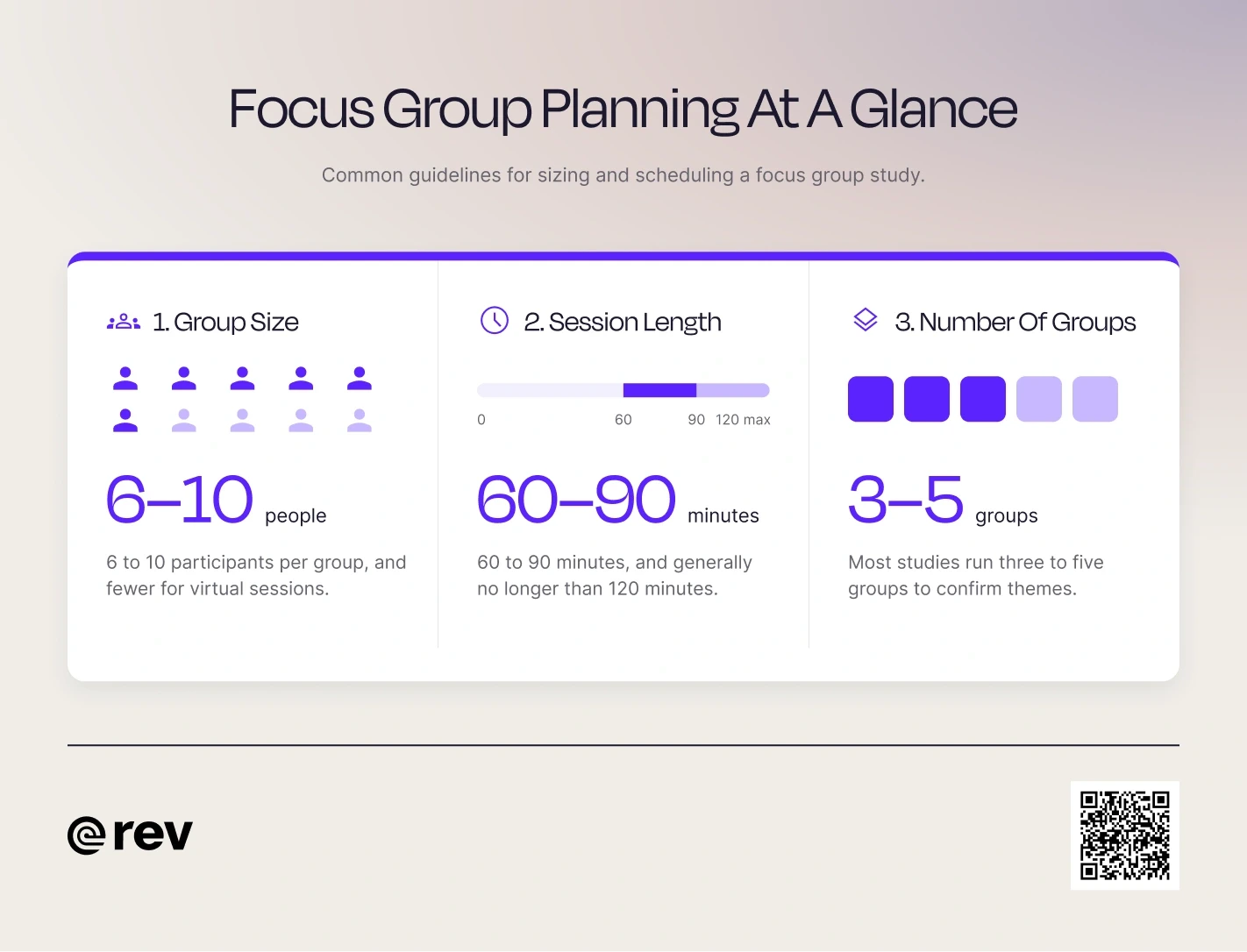
Most focus groups should include 8 to 10 participants. Fewer than six can leave the discussion thin, and more than ten makes it hard for everyone to contribute. However, if you’re running a virtual session, aim for 6 to 8 participants to help keep things running smoothly. Plan for more than one group, too, to help confirm your findings are consistent.
4. Plan Logistics and Get Recording Consent
In-person groups need a quiet room, a table where everyone can see each other, name cards, and microphones. Online groups need a stable video platform, a tech check before the session starts, a recording and transcription platform, and a backup plan for dropped connections. Our guide to online focus group interviews covers the virtual setup in more detail.
It’s important to get consent before you record. Explain how the recording will be used, who will see it, and how long you’ll keep it, then collect signed consent forms. Recording laws vary by state, and some, including California under Penal Code section 632, require consent from every party to record a confidential conversation. The simplest approach is explicit consent from everyone in the room.
How Long Should a Focus Group Last?
A focus group should usually last 60 to 90 minutes. That’s long enough to work through a full discussion guide and short enough to keep energy up. Complex topics can justify a longer session, but aim for under 120 minutes total to keep participants from losing interest.
5. Moderate the Discussion
Knowing how to lead a focus group is mostly about restraint. The moderator keeps the conversation on topic, draws out quieter participants, and redirects anyone who dominates, all without signaling which answers they want to hear. Make sure to set focus group ground rules at the start: one person speaks at a time, there are no right or wrong answers, phones go away, and disagreement is welcome.
“Give the instructions beforehand like you would want the jury to be instructed in the actual trial,” explains Tina Baxter, nurse practitioner and legal nurse consultant. “Allow the focus group to deliberate and come to their own conclusions and listen carefully to their questions and feedback.”
Bring in a second person as a note-taker (yes, in addition to your recording and transcription tool). While the moderator manages the room and the transcript tool records every spoken word, the note-taker should note any nonverbal reactions, as well as moments worth revisiting. To balance participation, use direct prompts like “We haven’t heard from everyone yet. Does anyone see it differently?”
6. Record and Transcribe the Session
Notes capture what seemed important in the moment. A recording captures everything. Record audio at a minimum, and video if body language matters to your research. Online platforms can record natively, and Rev’s AI notetaker can join Zoom, Microsoft Teams, Google Meet, or WebEx sessions to capture the conversation.
Then, transcribe it. Group discussions are hard audio, with crosstalk, interruptions, and similar voices, so speaker labels and timestamps matter. Rev produces speaker-labeled AI transcripts in minutes, and any file can be upgraded to human-verified transcription with 99%+ accuracy when every word needs to be exact.
Our guide to transcribing a focus group discussion walks through formatting and cleanup.
7. Analyze the Data and Report Findings
Focus group analysis turns hours of conversation into a short list of themes your stakeholders can act on. Read every transcript, code responses by topic, mark where participants agreed or pushed back, then compare themes across groups.
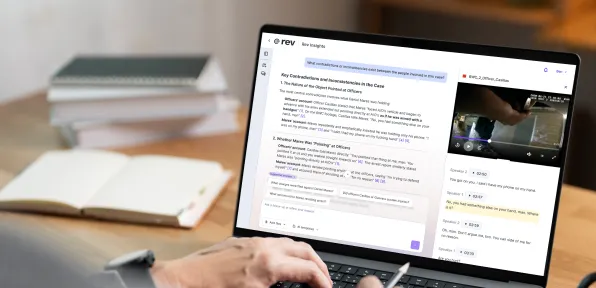
Report each finding with evidence behind it: the overarching theme, how widely it came up, and two or three representative quotes. With Rev, you can search every session at once for a product name, objection, or phrase, ask questions across the transcripts with answers that link to the exact moment, and clip short highlights for the readout.
For a deeper process, see our guide to analyzing focus group data.
What Not To Do In A Focus Group
Most focus group mistakes are avoidable. Don’t start without clear objectives, recruit friends or colleagues, or let one strong personality set the tone for the room. Don’t ask leading questions or react to answers in ways that show approval or disappointment. And don’t treat a single session as proof, since a theme that shows up in one group may not show up in the next.
Don’t skip the recording, either. Relying on notes alone means your report reflects what the note-taker caught rather than what participants said. These focus group best practices hold whether you’re testing ad concepts, evaluating a program, or preparing for trial.
How Rev Helps Research Teams Turn Focus Groups Into Findings
The hardest part of how to run a focus group often comes after the room empties. A study with four 90-minute sessions leaves six hours of recordings, and the findings are only as strong as the review behind them. Rev turns those recordings into speaker-labeled transcripts, then lets you search and ask questions across every session at once, with each answer linked to the timestamp it came from.
Pull exact quotes, clip key moments for stakeholders, and keep recordings, transcripts, and notes in one place. Legal teams use the same workflow for mock trials and jury focus groups, comparing how different panels reacted to the same case theory.
Run Focus Groups That Lead To Clear Decisions
A well-run focus group shows you the words people use, the concerns they share, and the reasons behind their choices. Once you know how to run a focus group, the rest is discipline: plan carefully, moderate with restraint, and give the analysis the same attention as the session itself.
Rev helps with accurate transcripts and findings you can trace back to the moment they were said. Plus, our free plan lets you try it on your next session risk-free.