
Different Learning Styles: Boost Student Participation
Rev breaks down different learning styles and how teachers can adapt their strategies to serve all their students.

It’s no secret that people learn in different ways. While some are best at absorbing and comprehending the written word, others prefer listening to lectures or other audio-forward instructions. Different learning styles work for different people, and the more we understand the way we absorb and comprehend information, the better we’ll be at learning and teaching.
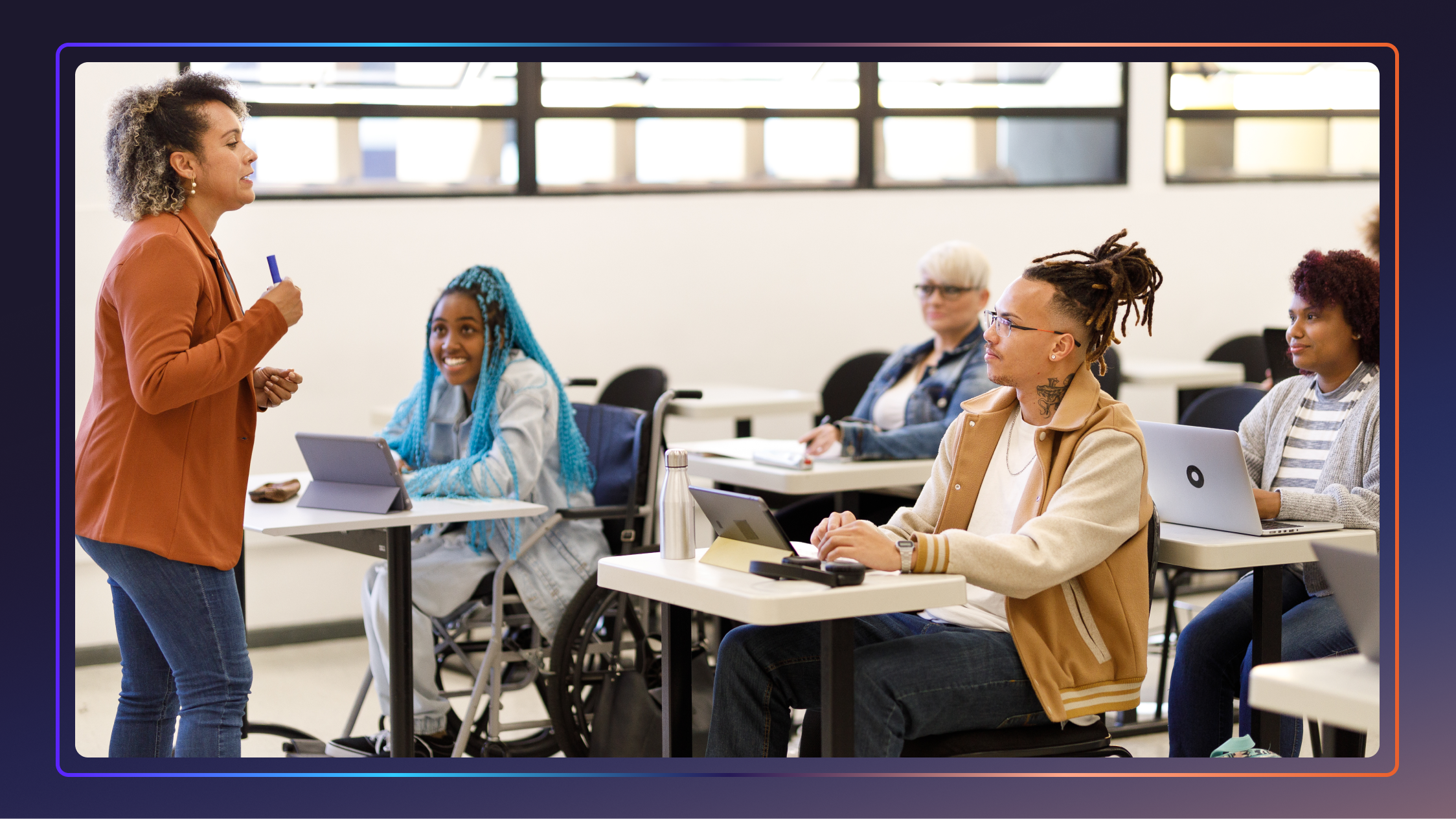
Teaching modalities can be applied differently for different learners, and teachers often must apply multiple teaching methods in the same classroom.
By knowing the learning style that works best for you or your students, you can optimize study techniques and the overall learning experience.
What Are Learning Styles?
Learning styles are the different types of methods people use to absorb, comprehend, and retain information. Though it’s worth noting that learning styles are a hotly debated topic.
Traditional learning styles fit into the “VARK” model. VARK stands for Visual learning, Auditory learning, Reading/writing, and Kinesthetic learning. While VARK was introduced in 1992 and has been the standard, new styles, or “non-traditional” learning methods have emerged and more will emerge as times and technologies change.
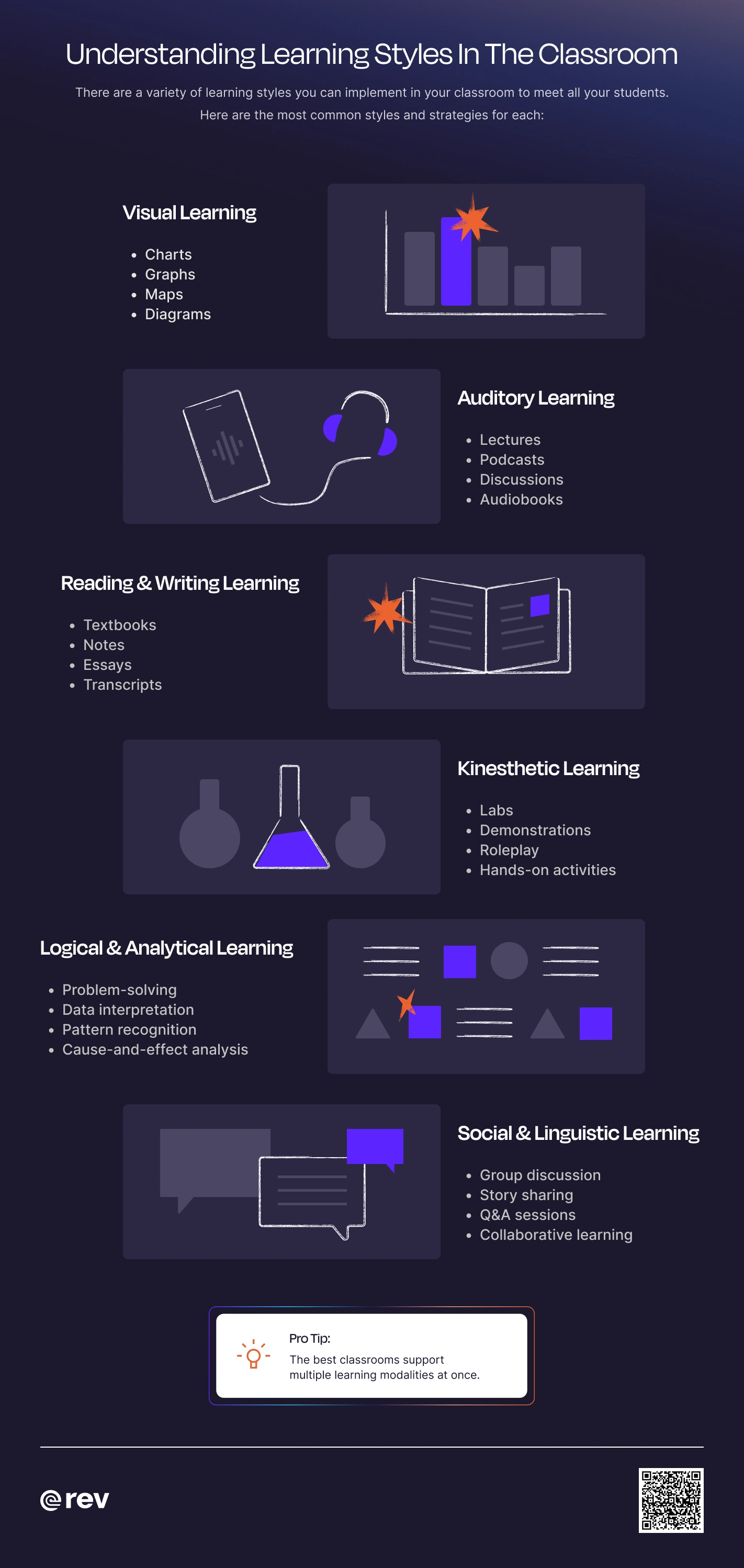
Here is a breakdown of some of the most prominent learning styles, and the strategies that work best for each type of learner.
1. Visual Learning
Visual learners are students who best comprehend and retain material presented in a visual format. Think charts, graphs, and maps. However, these visuals don’t always include photos and videos.
Visuals simply refer to things that show the relationships between multiple pieces of information. A graph, for instance, shows how the chosen info relates on at least two axes. A map shows where locations are in context with other locations. Teachers who work with visual learners tend to heavily use the chalkboard, whiteboard, or smartboard in the classroom to present infographics, flowcharts, Venn diagrams, and anything else that can present information as it compares or relates to other information.
Around 65% of people are visual learners, so chances are there are quite a few visual learners in any given group or classroom.
2. Auditory Learning
Auditory learners work best with information that’s presented out loud. Live situations like one-on-one instruction, group discussions, and lectures are traditionally great environments for auditory learners, but more modern technologies like podcasts and audiobooks have expanded their world of learning.
Auditory learners also respond to their own “audio,” so encouraging these students to verbally work through new concepts or actively engage in group discussion can be helpful. Reading passages aloud, either alone or to a group, can have an impact. Some teachers will incorporate music, rhyme, or mnemonic devices to reach their auditory learners. Attaching sound to the information absorption process is important for auditory learners.
3. Reading And Writing Learning
The tried-and-true study method of reading information and then writing it down either verbatim or in your own words is a hallmark of a reading/writing learner. Textbooks, essays, reports, instruction manuals, lecture notes, web copy, and even transcriptions are the best ways to reach these learners.
Including a written component or version of a lesson is vital when teaching reading/writing learners. Transcription can be valuable in that it turns audio or video into a format that these learners can respond to. It can also provide closed captions during live or recorded video so that they can read along in real-time.
Teachers who work with reading/writing learners often encourage journaling in their classrooms. Assigning essays so students can demonstrate their comprehension of the material is also common. While students of all learning types take notes in some form, teachers can suggest that reading/writing learners also add highlighting and annotating as part of their note-taking process. The more ways students can read and then write about what they read, the better they’ll learn.
4. Kinesthetic Learning
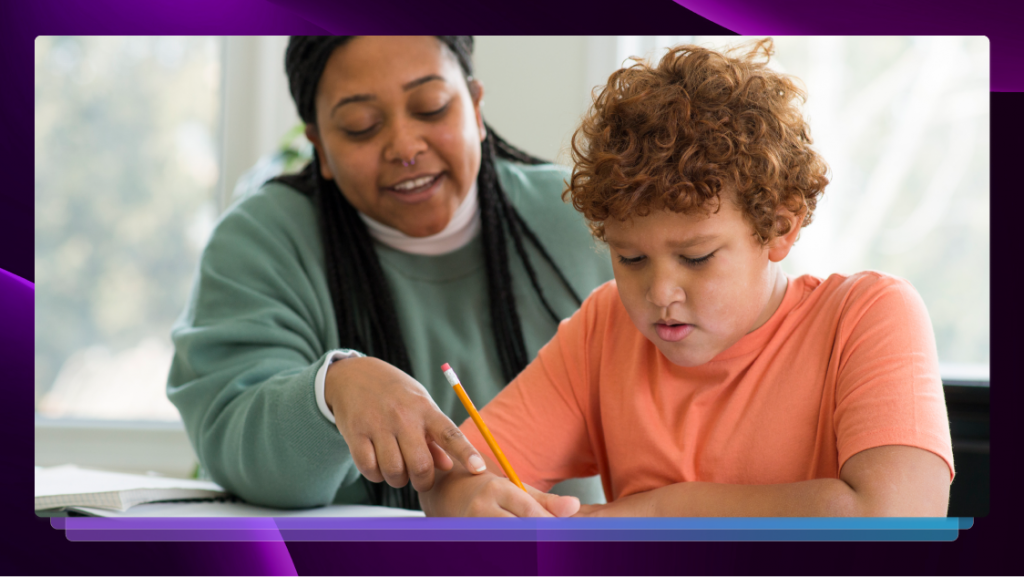
Kinesthetic learning involves physical movement. The types of learners who respond to kinesthetic learning comprehend information best when it’s in the form of hands-on demonstration, roleplaying, fieldwork, laboratory experiments, and many other types of physical activity.
Being able to apply what they have learned in a real-life setting is crucial for kinesthetic learners. Repeating or mimicking the actions of others has been proven to help kinesthetic learners thrive. Working with tools, solving puzzles with physical pieces (think Rubik’s Cube or marble mazes), and going on field trips are great examples of kinesthetic learning.
For kinesthetic learners, it’s all about participation. If they are doing, they are learning.
5. Logical Or Analytical Learning
Where the first four entries on this list fall into the more traditional learning styles categories, different learning styles are often recognized. Logical or analytical learning is classified as “non-traditional” but is no less valid as an educational tool.
Logical or analytical learners look for patterns, connections, cause-and-effect relationships, and patterns in information. A staple of analytical learning is the ability to study vast reams of data and use analysis and problem-solving skills to reach conclusions.
To have the greatest impact on logical or analytical learners, teachers should create a learning environment that allows them to apply problem-solving skills to interpret data.
6. Social/Linguistic Learning
Social and linguistic learners favor group work. They work best when the learning process involves socializing. Roleplay, story sharing, Q-and-A sessions, and other peer interactions are the best way to foster understanding of a subject for social and linguistic learners.
Social and linguistic learners thrive when participating in collaborative projects. This can simply mean group work in the classroom, but it isn’t limited to it.
Taking part in workshops and seminars that encourage participation. Mentorship programs or peer-led learning groups have been proven to reach these learners. Stepping outside of the physical classroom a bit, social learners have seen success working in online forums or discussion groups.
Identifying Learning Types In Your Students
It’s not always easy to identify different learning styles, especially since many students can have multiple learning preferences. Chances are, teachers won’t have a classroom that is limited to a single style.
“A single academic concept must appear in multiple formats,” said Joel Butterly, CEO of InGenius Prep. For instance, “A visual infographic that illustrates a structural logic model, an isolated audio file that explains a historical context, and a well-structured text document that contains the empirical content.”
There are, however, some strategies that teachers can use to identify a student’s learning style:
- Observation. This is the most obvious and direct method of determining learning styles. Watch how a student interacts with others and how they react to different ways of presenting information.
- Experimentation. Experimenting with your teaching methods, while time-consuming, can directly show you what a student or students respond to. Mix visual, auditory, kinesthetic, reading/writing, and even some more non-traditional methods, and note which students respond positively to specific types of lessons.
- Learning modality quiz. Offering students a learning modality quiz can help both teachers and students better understand what works best for individual and group learning.
Are Learning Styles Scientifically Proven?
Though teachers have been proven to use learning styles in the classroom, there is some debate about the “science” behind them, and some have gone so far as to label learning styles a myth. Simply put, it’s hard to qualify how effective a learning style might be, because even within the styles, learners learn differently.
“We found that (VARK) was hard to validate statistically, including with several modifications we
tried and several statistical strategies such as multidimensional scaling. We just couldn't get a good fit with the data,” stated Dr. Marilla Svinicki, Professor and Area Chair, Department of Educational Psychology at the University of Texas at Austin.
Though the science isn’t always in support of learning styles, studies show that an estimated 89% of teachers believe in matching instruction to a student’s preferred learning style. When the rubber hits the road, teachers overwhelmingly believe in learning styles of some type.
Teaching Strategies For Diverse Classrooms
As most teachers know well, no one learns in one single way. An auditory learner might also benefit from group or social learning, since listening and responding are crucial to both. In a similar vein, a kinesthetic learner would do well in a lab setting with a demonstration and/or group work.
A teacher’s ultimate goal is to provide all students with equal opportunities to learn, whether the students fit into a specific learning style, multiple learning styles, or break the mold altogether. This is the basis for the Universal Design for Learning (UDL). UDL is built to help educators address the diversity in learning, engagement, representation, action, and expression. Essentially, UDL provides the foundation for teachers to be flexible in their teaching.
By offering a wide array of materials, information, and formats (and by giving students choices in assignments), teachers can accommodate multiple learning styles at once. For instance, if research materials or study guides are in video or audio format, make transcripts available to cover both auditory and reading/writing learners. Or hold a group discussion after the video to accommodate social learners.
Whether subscribing to UDL or specific learning styles, teachers today benefit from emerging technologies that can make it easier to adapt to multiple different learning styles at once.
“Online and multimedia learning resources can make lessons easier for students to understand,” said Lidija Elezovic, School Counselor and Professor of Psychology at Education World Wide.
“Visual learners love diagrams and charts, but they can process the information most thoroughly when the image is coupled with clear multimedia explanations. Auditory learners benefit from discussion and listening to explanations that have been recorded, while text-based learners are aided by transcripts, written materials, and hands-on activities.”
Using Transcripts To Support Different Learning Styles
In today’s digital world, video and audio lessons are an everyday part of the classroom. Whether you’re showing a documentary to study or working with remote students via teleconferencing, students will likely have to interact with these formats in some way.
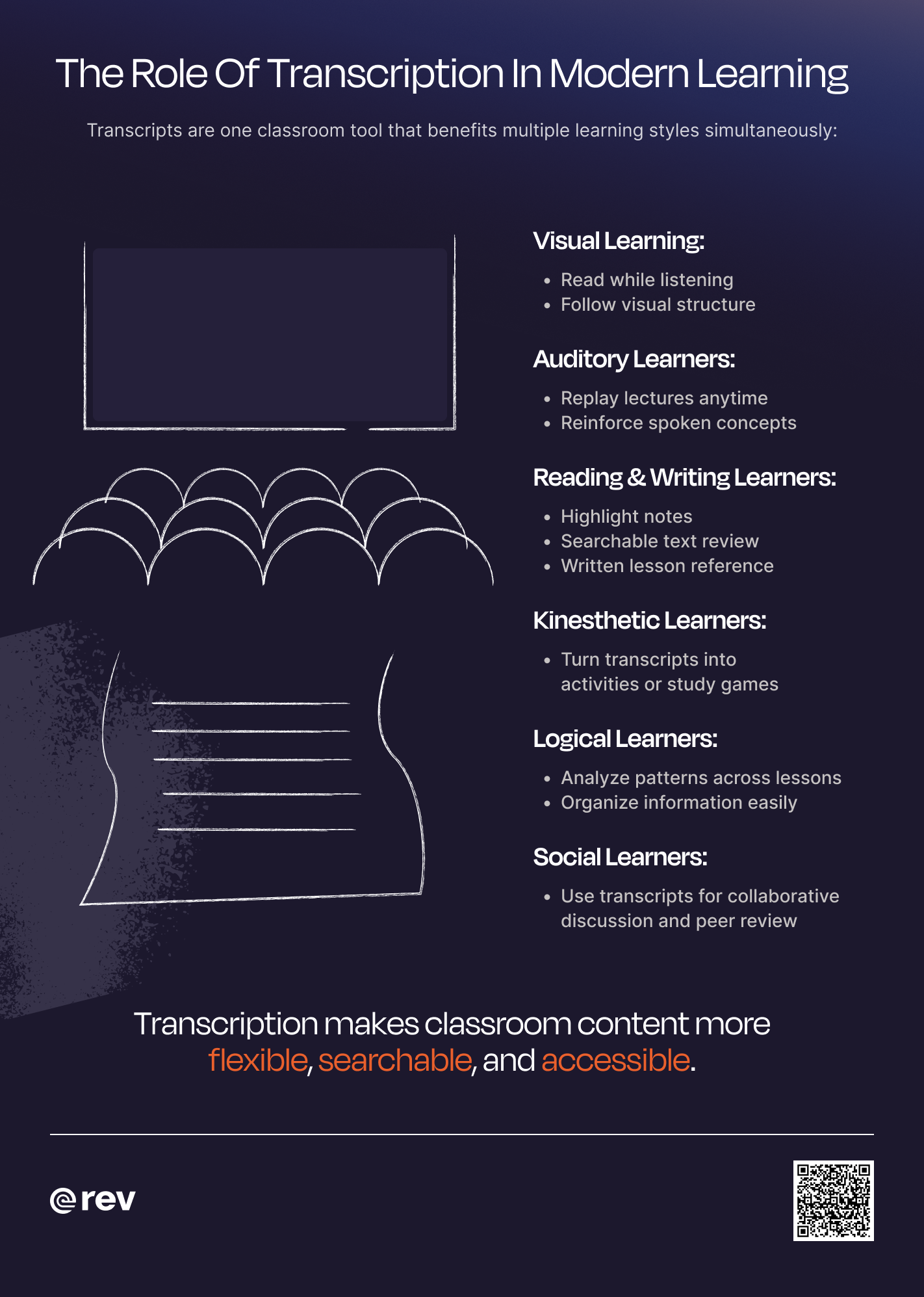
Transcription can ensure that you have all types of learning styles covered in your classroom. Here’s how transcription can benefit learners of all types:
- Post-lecture review: Students can typically capture only about 30-40% of lesson points during lectures. Recording and transcribing your lectures can ensure that students have the opportunity to review all information presented.
- Increased lecture engagement: Transcripts help students engage in lectures by eliminating the need for live note-taking. Using transcription in academic research offers the chance to catch every detail the first time around.
- Diversified channels: Transcripts add a multisensory aspect to lessons. By automatically transcribing lessons, you provide the opportunity for multiple learning methods to be effective. Auditory learners might have been covered by your lecture, but now reading and writing learners can better use the information.
- Increased inclusion and comprehension: Automatic captions can help students better understand video information or live teleconferencing lessons.
- Easily adapted to learning style: Transcriptions are adaptable, so that any student can make them work for their specific learning style. For instance, kinesthetic learners could adapt the transcript into a learning game.
How Learning Styles + Teaching Strategies Change Over Time
The VARK list of learning styles has been around for nearly 40 years, and educators have more or less accepted it as the foundation of learning styles, while acknowledging that there’s no single method of learning for any individual.
While VARK has been accepted, it’s far from definitive. Other learning styles, like logical or social learning, have taken root in the decades since, and as we continue to learn about the brain and how students operate, more different learning methods will emerge. Teaching strategies have always had to adapt to students' needs, and will continue to do so as classrooms and technologies change.
The Future Is Personalization
Since there’s no one-size-fits-all style of learning, teachers have to continually adapt to the needs of their students. Technology has made this easier than ever, as there are now so many ways to present lessons.
The evolution of technology in the classroom—from interactive whiteboards to the rise of online learning—has made it possible to personalize education for students. If a student doesn’t respond well to video review, it takes one click of a button to produce a transcription. Or if a student doesn’t operate well in a lab setting, filming an experiment for later review can make learning accessible to them.
It’s a big ask for teachers to personalise every lesson for every student, but it’s also easier than ever to do it. Here are a few pieces of tech to consider incorporating into the classroom.
- Remote learning tools: Zoom, Teams, and Google Meet have become standard options for snow days and the like, but can also be used to provide socially-adverse students with options for learning.
- Interactive whiteboards: Modern alternatives to classic chalkboards can include interactive smartboards, touchscreens, and magnetic whiteboards. Each lets teachers use multiple types of media to reach a wider variety of students.
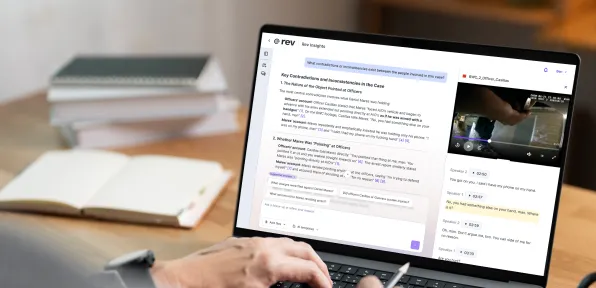
- Automated transcription: A transcription service like Rev turns any audio or video file into searchable, scannable text that is much easier to navigate than the original format.
- Automated Speech Recognition: Automatic subtitles and closed captions provide a lot of flexibility and accessibility as well, allowing disabled students and others who cannot access visuals to participate.
- A projector and document camera: Teachers can display any document on the screen without the need to recreate it in text.
- Google Drive: Shared documents that everyone can use and share in real-time have truly changed teaching and learning.
Rev For The Modern Classroom
Accurate, thorough, and fast transcription can change the way teachers teach and students learn. Rev can automatically transcribe lessons, lectures, and other learning materials so that every student can get the most out of your efforts in the way that best suits their learning style.
And because our ASR leads the industry in accuracy, you don’t have to worry about its output. Rev can be a major boon to your classroom almost immediately.