
Cross-Examination: Questions That Control The Courtroom
In this guide, we explore the most effective cross-examination question types and share advanced techniques to help you command the courtroom with confidence.

Cross-examination is where cases are won and lost. It's the moment when you take control of the narrative, expose inconsistencies, and reshape how the jury sees the evidence.
But here's the thing: effective cross-examination isn't about flashy courtroom theatrics. It's about preparation, precision, and asking the right questions at the right time.
Whether you're impeaching a witness with their prior testimony or methodically building your case one question at a time, the questions you ask—and how you ask them—can make all the difference. In this guide, we'll break down the fundamentals of cross-examination, explore different question types, and share techniques that'll help you command the courtroom with confidence.
What Is Cross-Examination?
Cross-examination is the opportunity to question a witness called by the opposing party. Unlike direct examination, where attorneys guide their own witnesses through testimony using open-ended questions, cross-examination lets you challenge the other side's narrative and test the credibility of their witnesses.
The main difference between direct vs cross examination lies in control. During direct examination, witnesses tell their story in their own words. During cross-examination, you control the testimony through carefully structured questions that typically call for yes or no answers.
Cross-examination serves multiple purposes: it can undermine a witness's credibility, highlight favorable facts the witness may have overlooked, demonstrate bias or inconsistency, and ultimately support your theory of the case. When it’s done well, it's one of the most powerful tools in trial.
What Are The 3 C's of Cross-Examination?
The 3 C's of cross-examination are control, clarity, and conciseness—fundamental principles that separate an effective cross from rambling interrogations that lose the jury's attention.
- Control means you dictate what the witness says and when they say it. You're not having a conversation; you're making statements that the witness must confirm.
- Clarity ensures every question has a single, unmistakable point. If the jury doesn't understand what you're getting at, your cross-examination fails regardless of the witness's answer.
- Conciseness is all about short and focused questions—typically one fact per question. The longer your question, the more room a witness has to wiggle away from the answer you want.
These principles work together to create cross-examinations that juries can follow and remember. When you maintain control through leading questions, communicate with crystal clarity, and stay concise, you transform testimony into building blocks for your case.
How To Prepare For Cross-Examination
Effective cross-examination starts long before you step into the courtroom. Your preparation should begin the moment you receive discovery materials, and grow as the trial approaches.
Start by thoroughly reviewing all prior testimony and statements from the witness—depositions, witness interviews, police reports, and any recorded conversations. Look for inconsistencies between different accounts, contradictions with physical evidence or other witnesses, and statements that support your theory.
Create a detailed outline of what the witness said previously, organized by topic rather than chronologically. This makes it easier to spot patterns and contradictions that you can exploit with various cross-examination techniques (more on that later).
Next, develop your cross-examination goals. What do you need this witness to admit? What points do you want to score? Not every witness needs to be harshly questioned—sometimes you simply need to extract a few favorable facts and sit down.
Finally, prepare your impeachment materials. If you plan to confront a witness with prior inconsistent statements, have those transcripts, recordings, or documents immediately accessible.
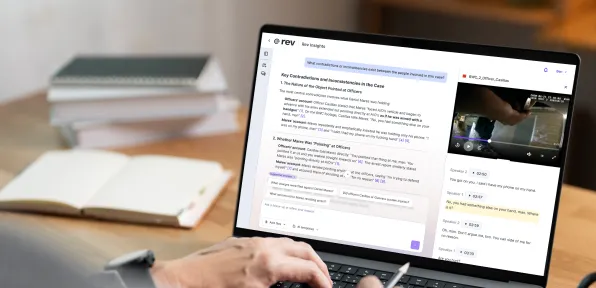
Technology like Rev's searchable transcripts can be invaluable here—you can instantly pull up timestamped quotes from depositions or recorded statements, compare testimony across multiple files, and find the exact moment when a witness said something different.
For example, Craig Greening of Greening Law Group was able to use Rev to do just that. "I was able to prepare within seconds during the middle of the trial,” said Greening. “When he started lying on the witness stand, I already had the timestamps to the videos so I could go right to him."
The faster you can locate and present impeachment material, the more powerful the moment becomes.
Types of Cross-Examination Questions
Different situations call for different types of questions. While the core principle remains the same—maintain control through leading questions—understanding these categories helps you structure your cross more effectively.
Below are the main types of cross-questioning you can implement in your cases, along with sample cross-examination questions for each type.
Leading Questions
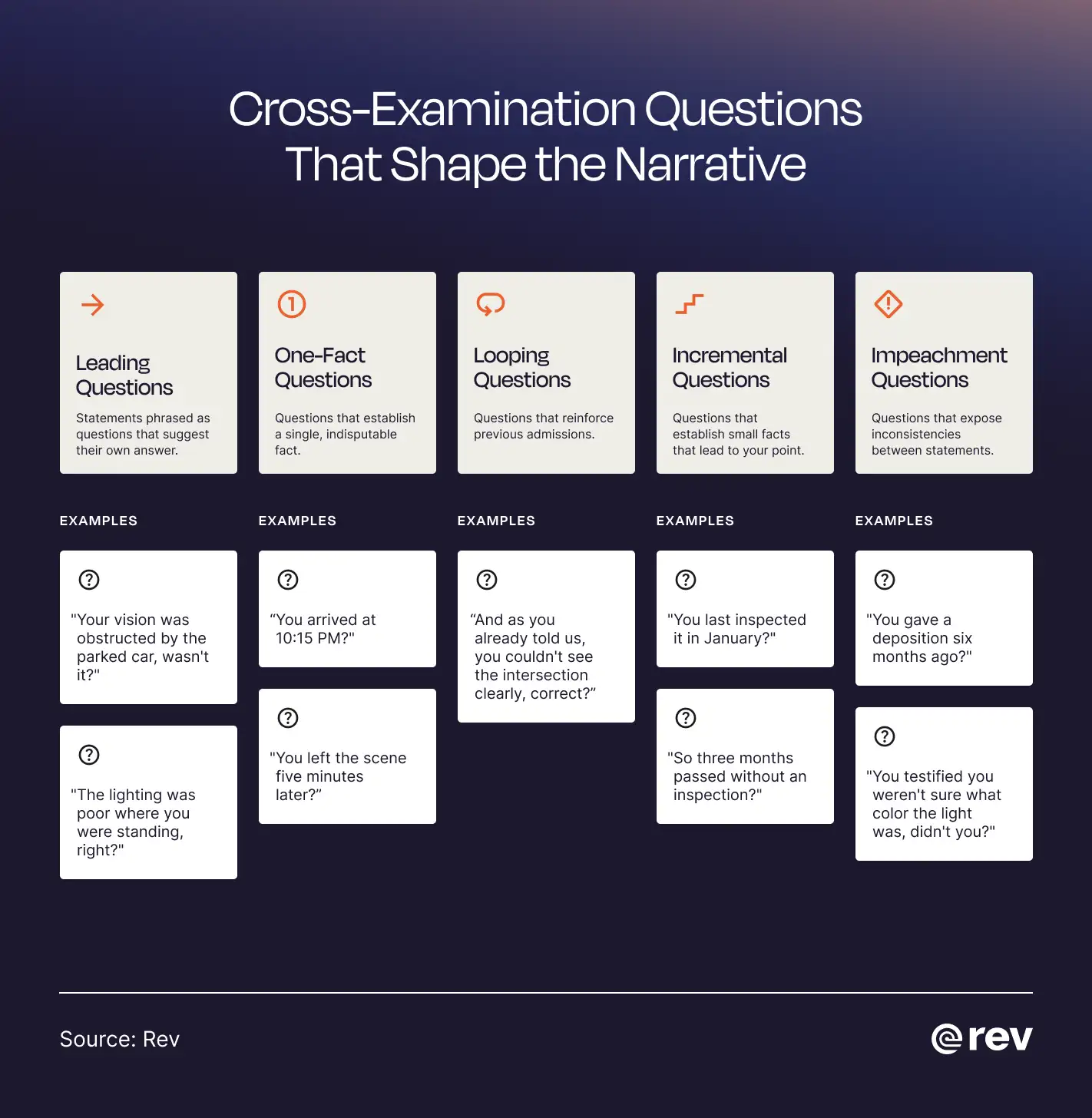
Leading questions form the backbone of cross-examination. These are statements phrased as questions that suggest their own answer, allowing you to maintain complete control over the testimony.
Here’s a classic example: "You were 50 feet away from the accident, weren't you?" versus the non-leading version: "How far away were you?" The leading question tells the witness what answer you expect and gives them little room to elaborate. When properly constructed, leading questions allow you to get the information you want in front of the jury, without having to say it yourself.
Sample leading cross-examination questions include:
- "You admit you were drinking that night, correct?"
- "Your vision was obstructed by the parked car, wasn't it?"
- "You never mentioned seeing a weapon in your initial police statement, did you?"
- "The lighting was poor where you were standing, right?"
- "You discussed your testimony with the plaintiff's attorney before today, didn't you?"
One-Fact Questions
One-fact questions are questions that establish a single, indisputable fact. String enough of these together, and you've built a case without the witness realizing it.
Instead of asking "What did you see when you arrived at the scene?"—which hands control to the witness—you might ask one-fact questions like:
- "You arrived at 10:15 PM?"
- "The streetlight was out?"
- "You couldn't see the license plate from where you stood?"
- "You left the scene five minutes later?"
- "You never spoke to the driver?"
Notice how each question locks down one fact. The witness can only say yes or no. This allows you to control the pace, the sequence, and the narrative.
Looping Questions
Looping questions bring the witness back to admissions they've already made, reinforcing key points for the jury. This technique prevents witnesses from backtracking on helpful testimony and emphasizes important admissions.
For example, after establishing that the witness didn't have a clear view, you might later ask: "And as you already told us, you couldn't actually see the intersection clearly, correct?" This loops back to lock in the prior admission and reminds the jury of what they've already heard.
Incremental Questions
Incremental questions build toward a conclusion step by logical step. Rather than asking for a big admission upfront (which the witness might resist), you establish a series of small facts that inevitably lead to your point.
Here's how it works:
- "You were responsible for inspecting the equipment?"
- "The inspection should happen monthly?"
- "You last inspected it in January?"
- "This incident occurred in April?"
- "So three months passed without an inspection?"
Each individual question feels reasonable. But together, they paint a picture of negligence that is hard to ignore.
Impeachment Questions
Impeachment questions expose inconsistencies between current testimony and prior statements. These are your "gotcha" moments, but they only work if you've done the right witness preparation.
The classic impeachment sequence follows this pattern:
- Lock the witness into their current testimony: "You're certain you saw the light turn red?"
- Confirm the prior statement: "You gave a deposition in this case six months ago?"
- Establish that they told the truth then: "You were under oath, just like today?"
- Confront them with the inconsistency using a leading question: "At that deposition, you testified you weren't sure what color the light was, didn't you?"
This is where having instant access to searchable transcripts becomes crucial. The faster you can pull up the exact quote and timestamp, the more devastating your impeachment becomes.
Advanced Cross-Examination Techniques
Once you've mastered the basics, these advanced techniques can elevate your cross-examination from competent to commanding.
Know When To Sit Down
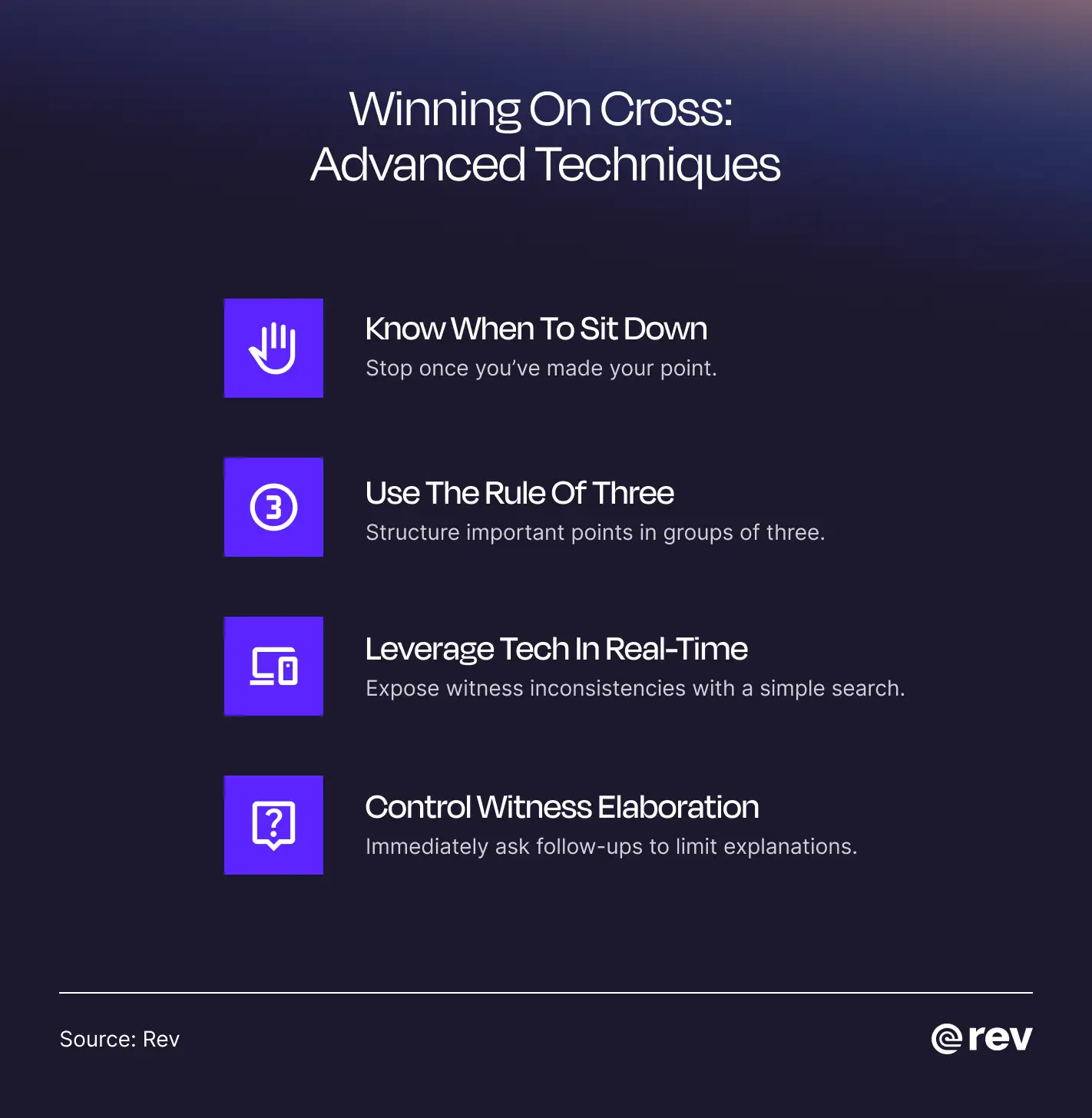
One of the hardest skills to develop is recognizing when you've accomplished your goals and resisting the temptation to ask "one more question." Many lawyers damage their own cross-examination by pushing too hard or too long. If you've made your points, extracted your admissions, or successfully impeached the witness, stop. Every additional question is a chance for the witness to explain, backtrack, or try to save themselves.
Use The Rule of Three
People naturally remember things in groups of three. Structure your most important points around this principle. For instance, establish three reasons the witness's identification is unreliable, or three ways the defendant violated industry standards. This makes your cross-examination more memorable for the jury and gives you a natural framework for your closing argument.
Strapped for time? Rev’s AI chat can do this for you. “I said [to Rev], put it in an order where I can cross-examine this witness, and it created a cross-examination template for me," said Greening.
Leverage Technology In Real-Time
Modern trials demand modern tools. With platforms like Rev, you can search through hundreds of pages of deposition transcripts in seconds, pull up prior statements on the fly, and find contradictions you might have missed during your initial prep.
“Technology has drastically changed the way in which our office prepares for cross-examinations,” explains John Malm, Owner of John J. Malm & Associates Personal Injury Lawyer. “Instead of going through information and prior depositions manually, we can now use AI and other assistive technology to search through information for us and pull out the information we are looking for and specifically need during cross-examination.”
When an unexpected answer comes up, you can instantly search your trial exhibits for supporting or contradicting evidence without fumbling through paper files. This kind of agility separates attorneys who control the courtroom from those who merely react to it.
Control Witness Elaboration
When a witness tries to explain an answer you want left simple, you have options. Immediately ask your next question to cut off their explanation. Remind them to answer yes or no. Or politely interrupt: "I'm sorry, counsel asked for a simple yes or no. Can you answer the question?" Done respectfully but firmly, this demonstrates control without looking like you're badgering the witness.
“A good cross is just a series of controlled steps where the witness can either agree, disagree, or admit they don’t recall,” says Angel Reyes, Managing Partner of Angel Reyes & Associates. “When the questions are tight, and the witness is boxed in, the jury gets a clear picture without the witness hijacking the moment.”
What Questions Can't Be Asked In Cross-Examination?
Questions that can’t be asked in cross-examination include argumentative, compound, and speculative questions. These types of questions are banned to protect both witnesses and the integrity of proceedings. In addition, understanding these boundaries keeps you from committing reversible error—or worse, alienating the jury.
Argumentative questions that harass or belittle the witness often cross the line. Questions like "Are you really asking us to believe that?" or "Is that your ridiculous explanation?" will draw objections and make you look like a bully. Frame your skepticism through factual questions, not editorial commentary.
You can't ask compound questions that bundle multiple facts together, like "You were driving fast and not paying attention, weren't you?" The witness can't properly answer this—they might agree with one part and dispute the other. Break it into separate questions: "You were driving 50 in a 35 mph zone?" Then: "You were looking at your phone?" Each fact deserves its own question.
Questions calling for speculation about what someone else knew, thought, or intended are typically banned unless the witness has firsthand knowledge. "What was the defendant thinking when she turned left?" is objectionable. "Did the defendant look before turning?" is about a fact.
Finally, understand that recross-examination in court is limited in scope. After the opposing counsel conducts a redirect to try to reframe what their witness said, you may get a chance to recross—but only on topics raised during the redirect. You can't simply start fresh with a whole new line of questioning.
Master Your Cross, Master Your Case
Cross-examination is both an art and a science. The science lies in meticulous preparation, understanding court questions and evidence rules, and structuring your inquiries for maximum impact. The art comes from reading witnesses, adapting on the fly, and knowing when to press forward versus when to stop.
But here's what separates good trial lawyers from great ones: trial preparation backed by the right tools. When you can instantly search through depositions, compare prior statements, and pull up timestamped quotes to impeach witnesses, you enter the courtroom with a decisive advantage.
Rev helps attorneys transform how they prepare for and conduct cross-examination. Our platform turns hours of testimony into searchable, citable, and instantly accessible evidence. Whether you're building your cross-examination outline weeks before trial or responding to unexpected testimony in real-time, having every word at your fingertips changes what's possible in the courtroom.
Ready to elevate your cross-examination game? See how Rev's AI-powered transcription and analysis tools can give you the edge you need when it matters most.